

Soul: Immortality; Rebirth and Liberation.
Official Syllabus: Paper II, Section B, Unit 4
Liberation (mokṣa, mukti) is the highest goal of life in almost every Indian philosophy — freedom from suffering, from ignorance and karma, and from the endless cycle of birth and death. It is known by many names: mokṣa, mukti, apavarga, kaivalya, nirvāṇa. All the schools except the Cārvāka accept it, but they differ sharply on what liberation is (an unconscious stillness, an isolation of pure consciousness, the extinction of craving, infinite knowledge and bliss, identity with Brahman, or loving communion with God), on whether it can be attained in this life, and on how it is reached. This article sets out the meaning of liberation and the conception of each school — with special attention to Nyāya’s apavarga, Advaita’s jīvanmukti, and the Advaita–Viśiṣṭādvaita debate on whether liberation needs a real agent. The paths to liberation and its relation to immortality and rebirth follow in Article 8.
In simple words
A man dreams that he is chained in a prison. In the dream he tries everything — he pleads, he bribes the guards, he digs a tunnel. Then he wakes up: there was never a prison. Advaita says liberation is like that waking — not an escape to somewhere new, but realising what you always were. A theist answers with another picture: a lost child found by its mother — liberation is coming home to God, not discovering that there was no child. The whole debate on liberation lies between these two pictures.
Context & Problem
Meaning and Names
- Literal meaning: “liberation” is to get rid of, to be free — a state in which one is rid of all suffering.
- Names:
- Mokṣa / mukti — release (Vedānta and the general Hindu term).
- Apavarga — final release, absolute freedom from pain (Nyāya–Vaiśeṣika).
- Kaivalya — “aloneness”, isolation of the self (Sāṃkhya–Yoga, Jainism).
- Nirvāṇa — “blowing out”, extinction of craving (Buddhism; also used by Jainas).
- Niḥśreyasa — the supreme good.
- The highest goal: liberation is the last and highest of the four goals of life (puruṣārthas) — dharma (righteousness), artha (wealth), kāma (pleasure), mokṣa (liberation).
- Universal except Cārvāka: for the materialist, “death itself is liberation” (maraṇam eva apavargaḥ); all other schools treat liberation as the fundamental concept of Indian philosophy.
What the Schools Share
- Pessimism at the start, optimism at the end: life in saṃsāra is suffering, but suffering can be ended.
- Bondage is caused by ignorance and karma: we are bound because we misunderstand ourselves and act from desire.
- Liberation is freedom from rebirth: it ends the cycle of birth and death.
- Knowledge is central: even the schools of devotion and action give a key place to right knowledge.
- Discipline is needed: ethical and spiritual practice (yoga, vows, meditation) prepares the way.
Where They Differ
- Nature: is liberation negative (mere absence of pain and bondage) or positive (presence of bliss, knowledge, love)?
- Consciousness: does the liberated self remain conscious?
- Individuality: does the self remain distinct (from God and other selves) or merge?
- Time and place: can one be liberated in this life (jīvanmukti) or only after death (videhamukti)? Is liberation a place (Vaikuṇṭha, the top of the universe) or a state?
- Means: knowledge, action, devotion, meditation, moral conduct — and is God’s grace needed?
Core Doctrine
Jainism — Kaivalya: The Soul’s Own Infinite Nature
- Bondage: the soul’s natural infinite knowledge, perception, bliss and power are veiled by karmic matter, which flows in (āsrava) and binds (bandha) because of the passions (anger, pride, deceit, greed).
- Release:
- Stopping the inflow of new karma (saṃvara) — by vows, self-control, carefulness.
- Wearing off the karma already bound (nirjarā) — by austerity (tapas).
- Final release (mokṣa) when all karma is shed.
- Means: the three jewels — right faith, right knowledge, right conduct — together, not singly; right conduct includes the five great vows (non-violence, truth, non-stealing, celibacy, non-possession).
- State of the liberated soul: positive and conscious — it regains infinite knowledge, infinite perception, infinite bliss and infinite power (ananta-catuṣṭaya). Freed of karmic weight, it rises to the top of the universe (siddha-śilā) and remains there eternally, individually, in its own nature.
- Liberation in life: the kevalin (omniscient one) or arhat — like the Tīrthaṅkaras — is liberated while still embodied; the body continues until the remaining (non-destructive) karma is exhausted.
- No God: liberation is won by one’s own effort; the liberated souls themselves are worshipped as ideals.
Buddhism — Nirvāṇa: The Blowing Out of Craving
- Meaning: nirvāṇa = “blowing out” — the extinguishing of the three fires of greed, hatred and delusion. It is the end of suffering (the Third Noble Truth) and of rebirth.
- Cause of bondage: ignorance and craving, working through the twelve links of dependent origination (Article 6).
- Means: the Noble Eightfold Path — right view, right resolve, right speech, right action, right livelihood, right effort, right mindfulness, right concentration — summed up as morality, concentration and wisdom.
- Two kinds:
- Nirvāṇa with remainder (sopadhiśeṣa) — attained in this life by the arhat; the aggregates continue but no craving remains.
- Nirvāṇa without remainder (nirupadhiśeṣa / parinirvāṇa) — at the death of the arhat; the aggregates cease and there is no further birth.
- Is nirvāṇa annihilation? The Buddha refused to say whether the enlightened one exists after death — the question is “not fitting“. Nirvāṇa is described both negatively (cessation, extinction) and positively — “the deathless“, “supreme peace“, “the highest bliss“. It is the end of craving and the illusion of self, not the annihilation of a self (there being none to annihilate).
- Mahāyāna: the bodhisattva postpones his own final nirvāṇa out of compassion until all beings are freed; Nāgārjuna holds that nirvāṇa and saṃsāra are not different — nirvāṇa is seeing saṃsāra rightly, as empty (śūnya).
- By one’s own light: no one can confer nirvāṇa on another — “be a lamp unto yourselves“.
In simple words
When an oil lamp goes out, where does the flame go — north, south, east or west? The question does not fit: the flame simply ceased because its fuel was used up. The Buddha used this very example. Nirvāṇa is the “going out” of the fires of greed, hatred and delusion once their fuel — craving — is gone. Asking where the enlightened one “goes” after death is like asking where the flame went.
Nyāya–Vaiśeṣika — Apavarga: Absolute Freedom from Pain
- Definition: liberation is “absolute freedom from pain” — not mere relief for a while, but the complete and permanent cessation of all suffering (duḥkha-atyanta-vimokṣa).
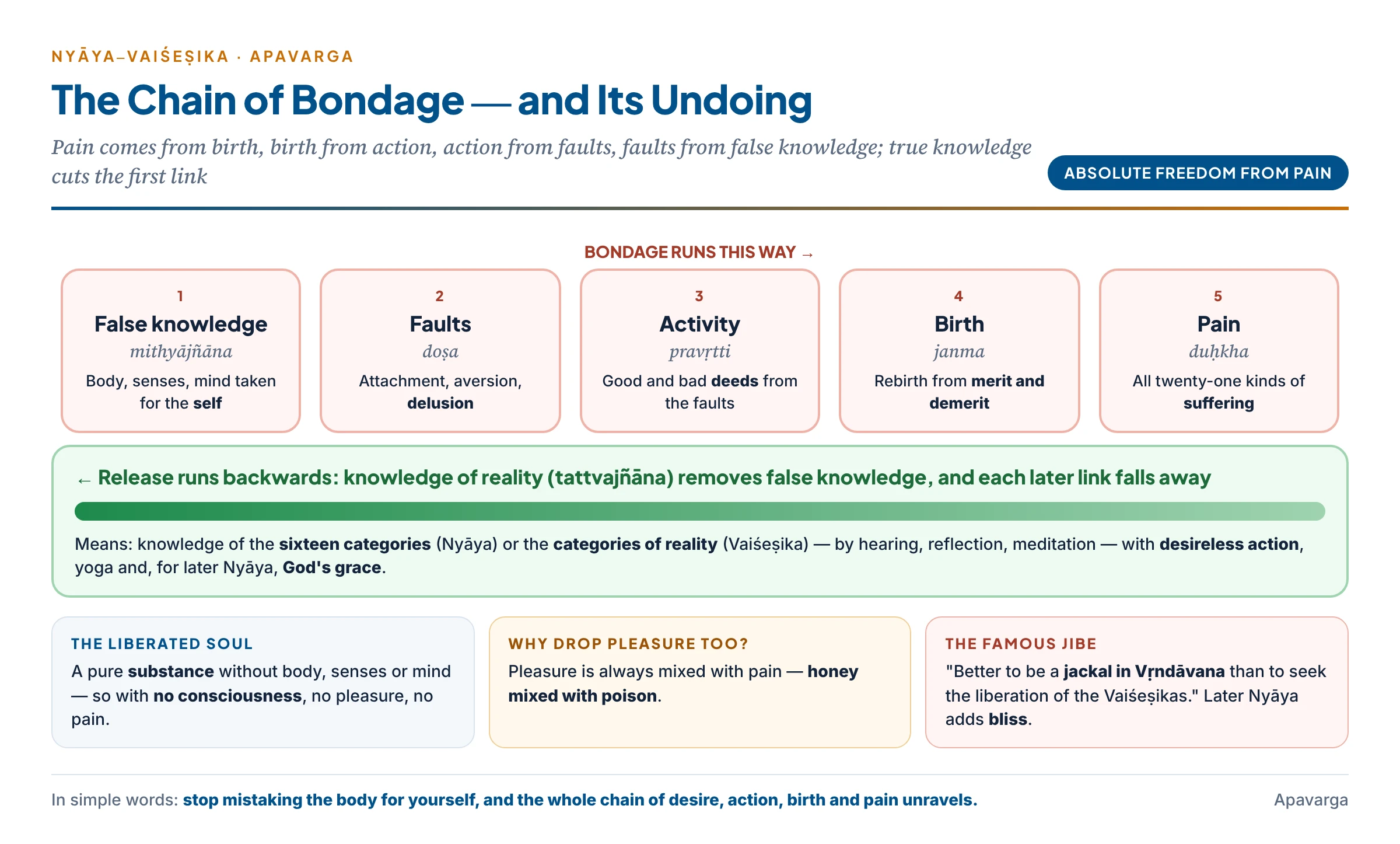
- The chain of bondage: the Nyāya Sūtra traces suffering through five links:
- False knowledge (mithyājñāna) — taking the body, senses and mind for the self.
- Faults (doṣa) — attachment, aversion and delusion.
- Activity (pravṛtti) — good and bad actions prompted by these faults.
- Birth (janma) — rebirth produced by the merit and demerit of these actions.
- Pain (duḥkha).
- Release works backwards: true knowledge destroys false knowledge; then the faults vanish, then activity, then birth, and finally pain.
- Means: knowledge of reality (tattvajñāna) — for Nyāya, of the sixteen categories beginning with the means of knowledge; for Vaiśeṣika, of the categories of reality (substance, quality, action, universal, particularity, inherence and non-existence) — gained by hearing, reflection and meditation, together with desireless action and yoga. Later Nyāya gives God’s grace a role.
- The state of liberation: since consciousness is only an accidental quality of the soul, arising when soul, mind, senses and objects meet, the liberated soul — free of body, senses and mind — has no consciousness, no pleasure, no pain. It exists as a pure substance, like a stone. All twenty-one kinds of pain are gone — body, the six senses, their six objects, the six cognitions, pleasure (which is always mixed with pain) and pain itself.
- Why exclude pleasure? Pleasure is always tinged with pain — like honey mixed with poison; to be rid of pain entirely, one must be rid of pleasure too.
- Mostly after death: final apavarga comes when the body falls.
- Criticisms:
- A state without consciousness is indistinguishable from a stone — who would strive for it? A famous quip: “It is better to be born a jackal in the lovely forest of Vṛndāvana than to seek the liberation of the Vaiśeṣikas.“
- It is a purely negative ideal — release from pain without any positive value.
- Reply: later Naiyāyikas (such as Bhāsarvajña) held that liberation includes eternal bliss; and the “stone-like” state is the soul’s true, untroubled nature, not a deprivation.
Sāṃkhya — Kaivalya: The Isolation of Pure Consciousness
- Bondage: the puruṣa (pure consciousness) wrongly identifies itself with prakṛti — with the body, senses, mind and ego, which are products of matter. This non-discrimination (aviveka) is the root of suffering.
- Release: discriminative knowledge (viveka-khyāti) — the clear realisation “I am not this; this is not mine; this is not I“.
- The dancer: prakṛti is like a dancer who performs before an audience and stops once she has been seen; when puruṣa has fully “seen” prakṛti, she ceases to act for it.
- A paradox: in truth “no one is bound, no one is released, no one transmigrates” — only prakṛti, in her various forms, is bound, transmigrates and is released. The puruṣa only seems bound, as a crystal seems red beside a red flower.
- State: isolation (kaivalya) of puruṣa in its own nature — pure consciousness, but without bliss (bliss belongs to prakṛti’s sattva) and without activity.
- Jīvanmukti accepted: after knowledge arises, the body continues for a time by the momentum of past impressions, “as a potter’s wheel goes on turning after the potter has stopped”; final release (videhamukti) comes at death.
Yoga — Kaivalya through the Stilling of the Mind
- Yoga accepts Sāṃkhya’s metaphysics; it adds a practical discipline: “Yoga is the stilling of the fluctuations of the mind” (citta-vṛtti-nirodha).
- Means: the eight limbs — restraints, observances, posture, breath-control, withdrawal of senses, concentration, meditation and absorption (samādhi); and devotion to Īśvara (Īśvara-praṇidhāna) as an alternative and an aid.
- Two levels of samādhi: with support (samprajñāta, absorption with an object) and without support (asamprajñāta, all mental activity stilled), in which the seeds of karma are burnt.
- Goal: kaivalya — the puruṣa rests in its own nature, free from the afflictions and karma.
Mīmāṃsā — From Heaven to Release
- Early Mīmāṃsā: the goal was heaven (svarga), won by performing Vedic rituals.
- Later Mīmāṃsā (Prabhākara and Kumārila) accepts liberation as the cessation of rebirth — the soul’s freedom from the body.
- Means: avoid desire-prompted (kāmya) and forbidden (niṣiddha) actions, so as to bind no new karma; perform obligatory (nitya) and occasional (naimittika) duties without desire, so that past karma is exhausted; knowledge of the self helps (Kumārila).
- State: the soul in its own nature, free from pleasure and pain — for Prabhākara without consciousness, much like the Nyāya view.
Advaita Vedānta — Mokṣa as the Realisation of Brahman
What liberation is
- Bondage is due to ignorance (avidyā): the self (ātman), which is Brahman, wrongly identifies itself with body and mind (superimposition, adhyāsa).
- Liberation is the realisation that “I am Brahman” (ahaṃ brahmāsmi) — the self’s identity with the infinite, which is existence, consciousness and bliss (saccidānanda).
- Not produced: liberation is eternal; anything produced by action (a pot, heaven) perishes, so mokṣa cannot be the effect of action. It is not becoming something new but knowing what one always was.
“The attainment of the already attained”
- Advaita describes liberation as “the attainment of what is already attained” (prāptasya prāptiḥ) and “the removal of what was never really there” (parihṛtasya parihāraḥ).
- The necklace: a woman searches everywhere for the necklace she is wearing; when a friend points to her neck, she “gains” what she never lost.
- The tenth man: ten men cross a river; each counts the others and finds only nine, forgetting himself; they mourn the drowned “tenth” until a passer-by says, “You are the tenth” (daśamas tvam asi).
- The rope and the snake: mistaking a rope for a snake brings fear; seeing the rope removes the snake — nothing is destroyed, ignorance alone is removed.
The role of knowledge
- Knowledge alone liberates: since bondage is ignorance, only knowledge can end it — as only light removes darkness. Action cannot, because action and ignorance belong to the same order (agent, act, result); Śaṅkara rejects the combination of knowledge and action (jñāna-karma-samuccaya) as the cause of liberation.
- Action prepares: selfless action and worship purify the mind (citta-śuddhi) and make it fit for knowledge.
- The fourfold qualification (sādhana-catuṣṭaya):
- Discrimination between the eternal and the non-eternal (viveka).
- Detachment from enjoyment here and hereafter (vairāgya).
- The six virtues — calm, self-control, withdrawal, endurance, faith, concentration (ṣaṭ-sampatti).
- Intense longing for liberation (mumukṣutva).
- Three steps: hearing the Upaniṣadic teaching (śravaṇa), reflection to remove doubts (manana), and deep contemplation (nididhyāsana), centred on the great sayings — “That thou art“, “I am Brahman“.
What knowledge does the liberated person acquire?
- Not knowledge of an object — Brahman cannot be an object — but the removal of ignorance about the subject. The final insight (a mental mode in the form of the undivided Brahman) destroys ignorance and then itself subsides, like the clearing-nut powder that settles muddy water and sinks with the mud, or fire that burns the fuel and then goes out.
- It is direct and immediate (aparokṣa), not inferential; it burns all accumulated karma (sañcita) and prevents new karma; only the karma that has already begun (prārabdha) runs its course.
Jīvanmukti and videhamukti
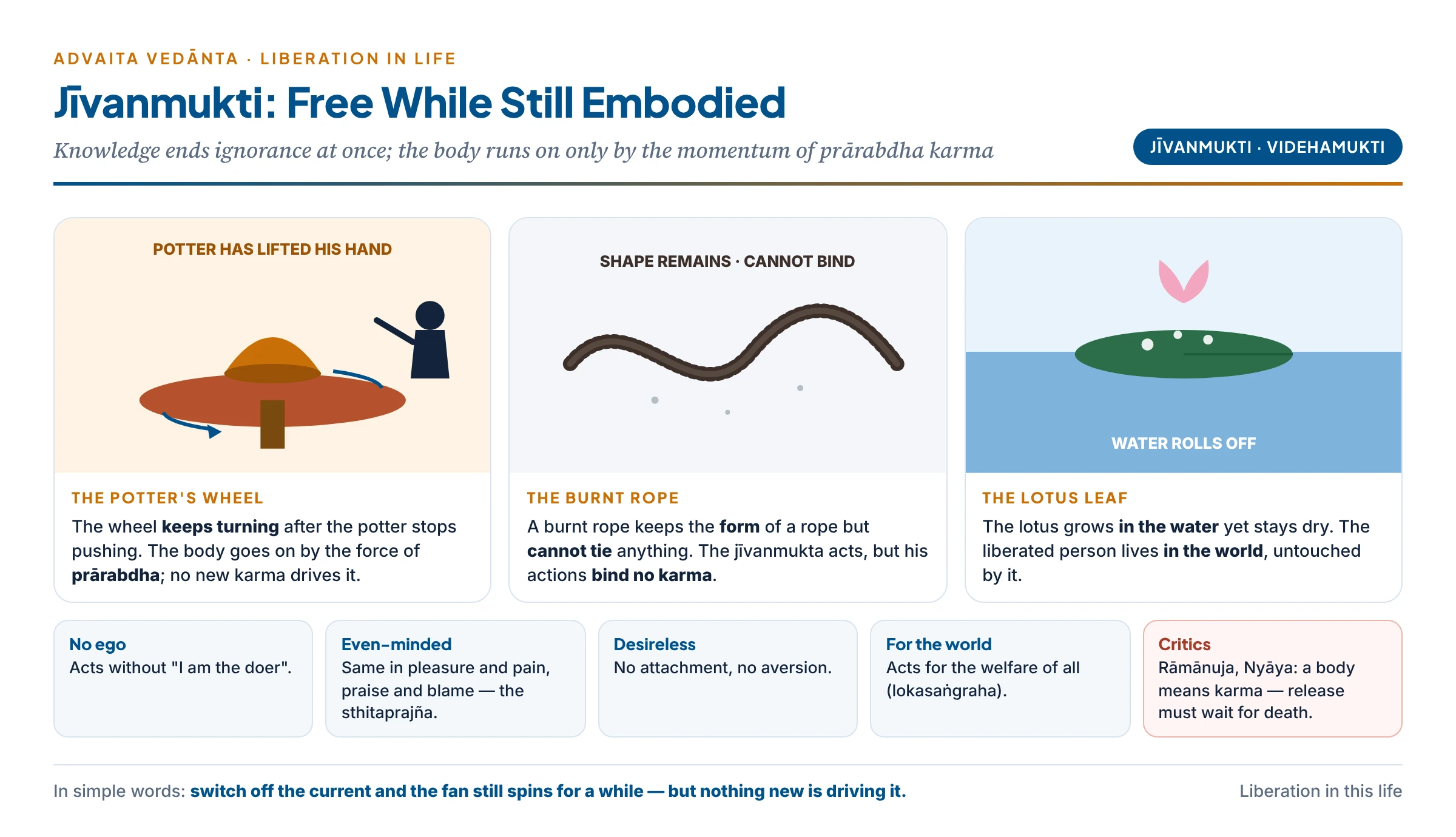
- Jīvanmukti — liberation while living: since bondage is only ignorance, it ends the moment knowledge dawns; the body continues only because the prārabdha karma that produced it has not been exhausted — “the potter’s wheel turns on after the potter has left it“; the burnt rope keeps its shape but can bind nothing.
- Videhamukti — liberation at the fall of the body, when prārabdha is exhausted: the jīvanmukta is not reborn.
- Gradual liberation (kramamukti): worshippers of the personal God go after death to the world of Brahmā and are liberated there at the end of the cosmic cycle.
Characteristics of the liberated person (jīvanmukta)
- No egoity: acts without the sense “I am the doer“.
- Free from desire, attachment and aversion; equal-minded in pleasure and pain, honour and dishonour — the Gītā’s “person of steady wisdom” (sthitaprajña).
- Like a lotus leaf on water — in the world but untouched by it.
- Acts for the welfare of the world (lokasaṅgraha) — teaching, serving, setting an example — without binding himself.
- Inner peace and bliss; sees the one Self in all beings.
Objections to jīvanmukti
- If ignorance is wholly destroyed, why does the world and the body still appear to the liberated person? Advaita answers that a trace of ignorance remains — critics take this as an admission that the destruction was incomplete.
- Rāmānuja: embodiment is itself the fruit of karma; so liberation with a body is a contradiction — liberation must wait for death.
- Nyāya and Mīmāṃsā deny it: release requires freedom from the body.
- Reply: jīvanmukti is intelligible if liberation is a change in knowing rather than a change in being. Where liberation is a state to be produced, it must wait for death; where it is a truth to be recognised, it can be had now. It also answers the charge that Indian thought is world-fleeing: the liberated person stays in the world and acts in it.
In simple words
When a fan is switched off, the blades keep turning for a while on their own momentum, then stop. No new electricity is flowing. Advaita says the jīvanmukta is like that fan: the current of ignorance has been switched off by knowledge; the body and its habits keep turning on the momentum of past karma (prārabdha) until they stop at death — but nothing new is driving them.
Viśiṣṭādvaita (Rāmānuja) — Mokṣa as Communion and Service
- Bondage: the soul, a real mode (body) of Brahman, is bound by karma and ignorance, which contract its knowledge (dharmabhūtajñāna).
- Liberation: after death, the freed soul travels by the path of light to Vaikuṇṭha, the Lord’s abode. There:
- It retains its individuality — it never becomes Brahman.
- Its knowledge expands fully; it becomes like Brahman in purity, knowledge and bliss (brahma-sāmya).
- But it does not share Brahman’s unique powers of creating, sustaining and controlling the world.
- It enjoys eternal loving service (kaiṅkarya) of the Lord.
- No jīvanmukti: the body is a product of karma; liberation comes only after death.
- Means: devotion (bhakti) — a constant, loving remembrance of God “like the unbroken flow of oil” (dhruvā smṛti), prepared by selfless action (karma-yoga) and knowledge (jñāna-yoga); and self-surrender (prapatti), open to all. God’s grace is decisive.
- Seven aids to devotion: discrimination in food, freedom from desire, practice, works, virtue, cheerfulness (freedom from despair) and freedom from excessive elation.
Dvaita (Madhva) — Graded Bliss in God’s Presence
- Five eternal differences: God–soul, God–matter, soul–soul, soul–matter, matter–matter. The soul is eternally distinct and dependent on God (Viṣṇu).
- Liberation: direct knowledge of Viṣṇu (aparokṣa-jñāna), arising from devotion and granted by grace, frees the soul to enjoy its own innate bliss in God’s presence.
- Four forms of liberation:
- Sālokya — living in God’s world.
- Sāmīpya — living near God.
- Sārūpya — having a form like God’s.
- Sāyujya — entering into God (but without losing distinctness) and sharing his bliss.
- Gradation even in liberation (tāratamya): souls enjoy bliss according to their intrinsic capacity — like vessels of different sizes, each full, but not equal.
In simple words
Pour water into a cup, a jug and a bucket until each is full. All three are completely full — none lacks anything — yet the bucket holds far more than the cup. Madhva pictures liberation like this: every liberated soul is perfectly satisfied, but souls differ in their capacity for bliss, so their bliss is graded.
- Three classes of souls: those fit for liberation, those eternally transmigrating, and those destined for darkness — a doctrine critics find hard to square with God’s goodness.
Other Vedāntic Schools
- Nimbārka (Dvaitādvaita): liberation is a state of difference-in-identity with God, attained by surrender and grace.
- Vallabha (Śuddhādvaita): the path of grace (puṣṭi-mārga) — loving devotion to Kṛṣṇa, which is higher even than liberation.
- Caitanya (Acintya-bhedābheda): pure love of God (prema) is the supreme goal; liberation in the sense of merging is not even desired.
Liberation Without a Real Agent? — Advaita vs Viśiṣṭādvaita
The question
- Liberation seems to need someone who is liberated. Advaita says the individual soul (jīva) is not ultimately real — it is Brahman appearing through ignorance. Can there be a liberation with no real agent to strive for it and enjoy it?
Rāmānuja’s objections to Advaita
- No one to be liberated: if the “I” disappears in liberation, then nobody is liberated — seeking such liberation is like cutting off one’s own head; no one would strive for it.
- The self is the “I”: the self is essentially the knower who says “I”; to deny the “I” is to deny the self.
- Real bondage needs real release: if bondage is unreal, so is the striving, the teacher, the scripture — the whole path becomes illusory.
- Who has ignorance? Not Brahman (pure knowledge) and not the jīva (itself a product of ignorance) — so the theory of bondage collapses.
Advaita’s replies
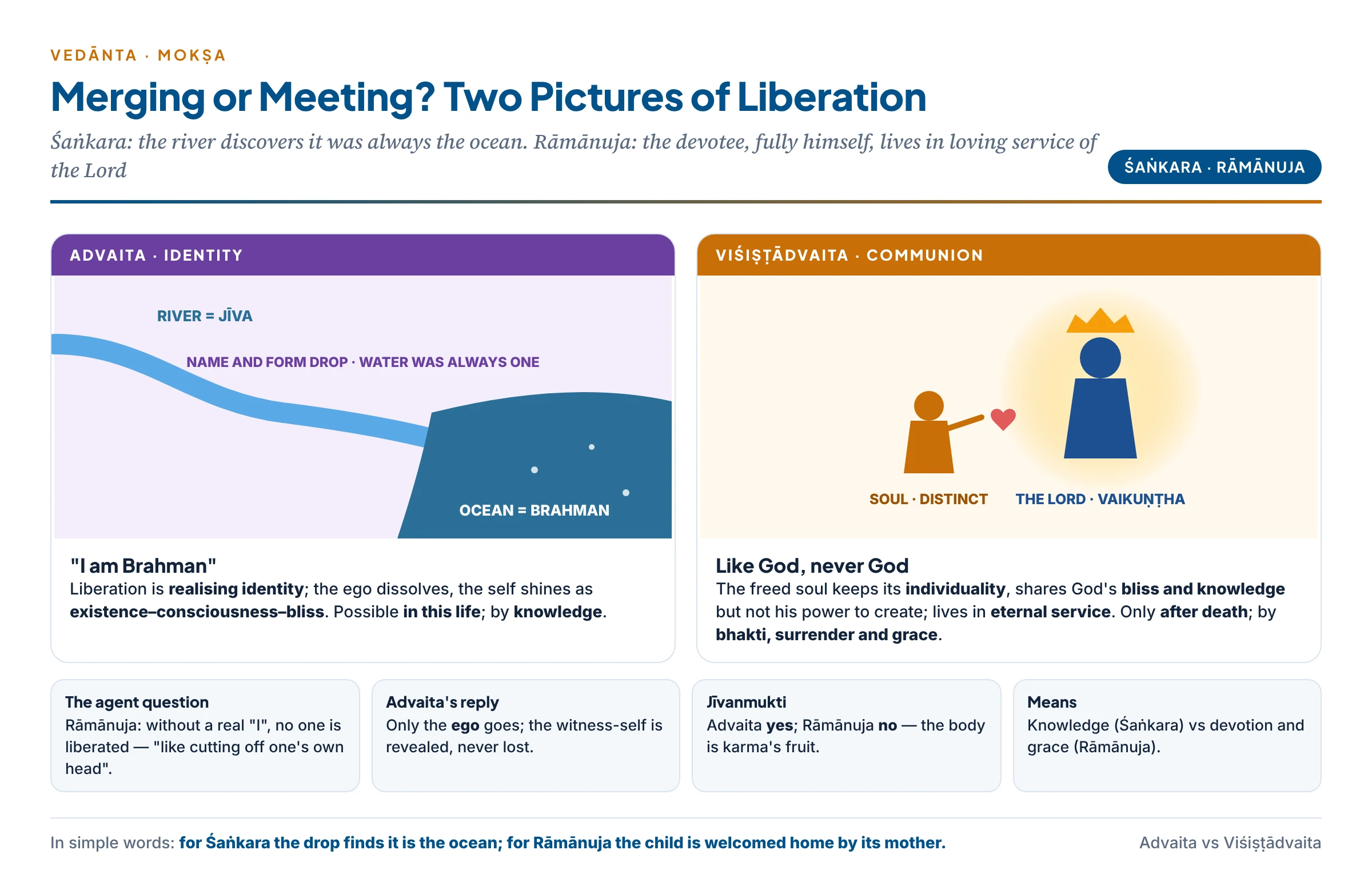
- The “I” that disappears is the ego (ahaṃkāra), a product of ignorance — not the self. The self, pure consciousness, is never lost; it is revealed.
- At the level of everyday experience (vyāvahārika), the jīva is real enough to strive, study and meditate — as a dreamer can be woken by a dream-lion.
- Liberation is the end of false agency: the self was never really the doer; realising this is liberation.
- Ignorance is indescribable (anirvacanīya) — neither real nor unreal; asking “whose” it is already assumes duality.
Verdict: the dispute turns on what the self is — the witness-consciousness beyond all “I”-thoughts (Advaita) or the personal knower and lover of God (Viśiṣṭādvaita). Advaita offers liberation of the self from individuality; Viśiṣṭādvaita offers liberation of the individual for communion.
Advaita and Viśiṣṭādvaita on Liberation Compared
| Point | Advaita (Śaṅkara) | Viśiṣṭādvaita (Rāmānuja) |
|---|---|---|
| Nature of the soul | Jīva = Brahman appearing through ignorance | Jīva = real, eternal mode of Brahman |
| Cause of bondage | Ignorance (avidyā), superimposition | Karma and ignorance contracting knowledge |
| What liberation is | Realising identity with Brahman | Attaining likeness to Brahman in bliss; eternal service |
| Individuality | Dissolves — “the river enters the ocean” | Retained — the soul remains distinct |
| Agent of liberation | No ultimate agent; the self is revealed | Real agent — the individual soul |
| Means | Knowledge (jñāna), prepared by action and devotion | Devotion (bhakti) and surrender (prapatti), prepared by action and knowledge |
| Role of God | Īśvara at the level of appearance; grace helps preparation | God’s grace is decisive |
| Jīvanmukti | Yes | No — only after death |
| Place | Not a place — a state of realisation | Vaikuṇṭha, reached by the path of light |
| Positive content | Existence–consciousness–bliss | Bliss, knowledge, loving service |
Common confusion
Is Advaita’s liberation the “extinction” of the self? No — it is the extinction of the ego and of the false sense of separateness, not of the self. Advaita insists the self is existence, consciousness and bliss, and that in liberation it shines fully. What Rāmānuja objects to is not extinction of the self but the loss of the individual “I” — the knower and lover of God that he takes the self to be.
Ways to Liberation in the Systems of Vedānta
| School | Main means | Supporting means | Role of grace |
|---|---|---|---|
| Advaita (Śaṅkara) | Knowledge of identity with Brahman | Selfless action and worship (purify the mind); the fourfold qualification; hearing–reflection–contemplation | Helps preparation; knowledge itself liberates |
| Viśiṣṭādvaita (Rāmānuja) | Bhakti (loving meditation) and prapatti (surrender) | Karma-yoga and jñāna-yoga; seven aids | Decisive |
| Dvaita (Madhva) | Bhakti leading to direct knowledge of Viṣṇu | Study, detachment, worship | Essential — liberation is God’s gift |
| Dvaitādvaita (Nimbārka) | Surrender to Kṛṣṇa and Rādhā | Devotion, knowledge | Essential |
| Śuddhādvaita (Vallabha) | Path of grace — loving devotion | Service of Kṛṣṇa | Supreme |
| Acintya-bhedābheda (Caitanya) | Prema — pure love of God; chanting the divine name | Devotional practices | Supreme |
Critical Evaluation
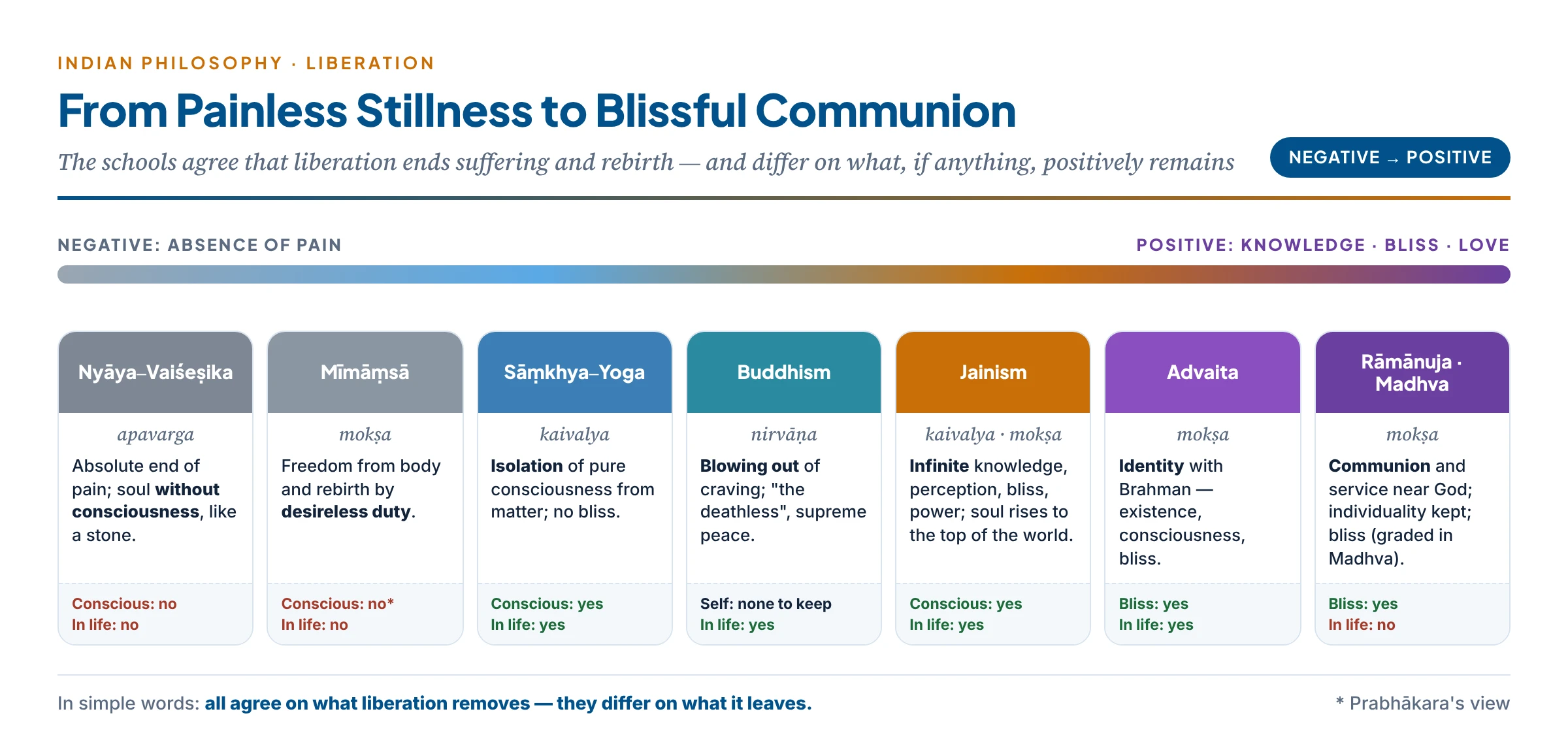
A Spectrum of Liberation
| School | Nature of liberation | Conscious? | Bliss? | Individuality | In this life? | Main means |
|---|---|---|---|---|---|---|
| Nyāya–Vaiśeṣika | Absolute absence of pain | No | No (later Nyāya: yes) | Retained (soul-substance) | No | Knowledge of categories |
| Mīmāṃsā | Freedom from the body, no rebirth | No (Prabhākara) | No | Retained | No | Desireless duty |
| Sāṃkhya–Yoga | Isolation of puruṣa | Yes (pure) | No | Retained (many puruṣas) | Yes | Discrimination; yoga |
| Jainism | Soul’s own infinite nature | Yes | Yes | Retained | Yes (kevalin) | Three jewels |
| Buddhism | Extinction of craving | — (the question is set aside) | Supreme peace | No self to retain | Yes (arhat) | Eightfold Path |
| Advaita | Identity with Brahman | Yes (pure consciousness) | Yes | Dissolved | Yes | Knowledge |
| Viśiṣṭādvaita | Likeness to God, eternal service | Yes | Yes | Retained | No | Bhakti, prapatti, grace |
| Dvaita | Graded bliss in God’s presence | Yes | Yes (graded) | Retained | No | Bhakti, grace |
Assessment
- Negative conceptions (Nyāya, Mīmāṃsā, early Sāṃkhya) are logically tidy — the end of pain — but unattractive: an unconscious state is hard to distinguish from non-existence.
- Positive conceptions (Jaina, Advaita, theistic Vedānta) give liberation value — knowledge, bliss, love — but need richer metaphysics.
- Jīvanmukti (Advaita, Sāṃkhya, Jaina, Buddhist arhat) makes liberation testable in life and turns the liberated into moral exemplars; denying it (Nyāya, Rāmānuja) makes liberation purely posthumous.
- The agent question shows that each school’s idea of liberation follows from its idea of the self.
Critics and Defenders
Criticism — The critics
- On Nyāya: an unconscious, stone-like release — “better a jackal in Vṛndāvana”.
- On Advaita (Rāmānuja): liberation with no real agent is self-defeating; jīvanmukti contradicts the karmic origin of the body.
- On Dvaita: graded bliss and souls destined never to be freed seem unjust.
- On Buddhism: if there is no self, who attains nirvāṇa?
- Modern critics: liberation as escape from the world can encourage social indifference.
Defence — The defenders
- Advaita: the ego disappears, not the self; liberation is knowing, so it can be had now — the jīvanmukta stays in the world for its good.
- Rāmānuja: liberation keeps what we value most — the person and his love of God.
- Jainism: liberation is the soul’s own infinite knowledge and bliss, won by one’s own effort.
- Buddhism: nirvāṇa is “the deathless“, supreme peace — the end of craving, not of anything worth keeping.
- Later Nyāya: release includes eternal bliss; the untroubled self is not a stone but freed.
Cross-Tradition Comparison
| Indian idea | Western parallel | Difference |
|---|---|---|
| Advaita’s realisation of the Self | Plotinus: the soul’s return to the One; Spinoza: the mind’s eternity in knowing God | Advaita: identity was always there |
| Theistic Vedānta’s communion with God | Christian beatific vision; Dante’s Paradise | Indian theists add many lives before release |
| Buddhist nirvāṇa | Stoic apatheia (freedom from passions); Schopenhauer‘s denial of the will to live | Nirvāṇa ends rebirth, not just disturbance |
| Jīvanmukta | The Stoic sage; Christian saints | Indian ideal is free in this life from all karma |
| Sāṃkhya’s isolation | Plato‘s purified soul freed from the body | Puruṣa is pure consciousness, not reason |
Indian Connect — Indian Connect — liberation as the Indian “summum bonum”
- Kant’s highest good is virtue crowned with happiness, which needs immortality and God (Article 3).
- India’s highest good is liberation — which goes beyond virtue (dharma) and happiness (kāma): the jīvanmukta is beyond merit and demerit.
- Both make the highest good the goal of practical life; but where Kant’s is an endless progress, mokṣa is a completion — possible, for many schools, here and now.
Synthesis (Siddhānta)
- Liberation — mokṣa, mukti, apavarga, kaivalya, nirvāṇa — is the highest goal of every Indian school except Cārvāka: freedom from suffering, karma and rebirth, caused by ignorance and desire.
- The schools range from negative conceptions (Nyāya’s painless, unconscious stillness; Mīmāṃsā; Sāṃkhya’s isolation without bliss) to positive ones (Jaina infinite knowledge and bliss; Advaita’s saccidānanda; theistic communion and service). Buddhism sets aside the question of existence after nirvāṇa and calls it the deathless.
- Jīvanmukti is accepted by Advaita, Sāṃkhya–Yoga, Jainism and Buddhism, denied by Nyāya, Mīmāṃsā, Viśiṣṭādvaita and Dvaita; its intelligibility depends on liberation being a change in knowing.
- Advaita makes knowledge the sole means — “the attainment of the already attained”; Viśiṣṭādvaita demands a real agent and makes devotion, surrender and grace decisive.
- Contemporary relevance:
- The jīvanmukta ideal — acting without ego for the good of all — inspired Vivekananda’s and Gandhi’s service-centred spirituality.
- Mindfulness and meditation traditions, now worldwide, draw on Buddhist and Yogic paths to inner freedom.
- The idea of freedom from craving speaks to a consumer culture of endless wants.
- Balanced view: the many conceptions of liberation are not mere rivals; they express different answers to what the self is — and together they make liberation the defining ideal of Indian philosophy.
“The knower of Brahman becomes Brahman.” — Muṇḍaka Upaniṣad
Previous Year Questions
- 2025Discuss the nature of embodied liberation (Jīvanmukti) with reference to Advaita Vedanta.
- 2024Discuss the concept of liberation (Apavarga) according to Nyaya-Vaiśeşika.
- 2022Is it possible to have an idea of Liberation without the conception of a real agent? In this context, discuss the difference between Advaita and Visistadvaita systems of thought.
- 2021Elucidate the concept of liberation according to Advaita Vedanta. Explain the role of knowledge in the attainment of liberation.
- 2015What is liberation? Briefly discuss the ways to attain it as outlined in the system of Vedanta.
- 2014Compare and contrast the concept of liberation according to ‘Advaita’ and ‘Visishtadvaita’.
- 2010If ignorance is the cause of suffering, knowledge should remove suffering. What is the notion of knowledge which a liberated person acquires? Discuss.
- 2005What do you understand by liberation? Is it possible for one to be liberated in this very life? If it is, what are the characteristics of a liberated person? Discuss.
- 2002Advaita Vedanta theory of jivanmukti. Critical notes.
- 2000Elaborate the nature of Liberation according to Advaita Vedanta.