

Problem of Evil.
Official Syllabus: Paper II, Section B, Unit 3
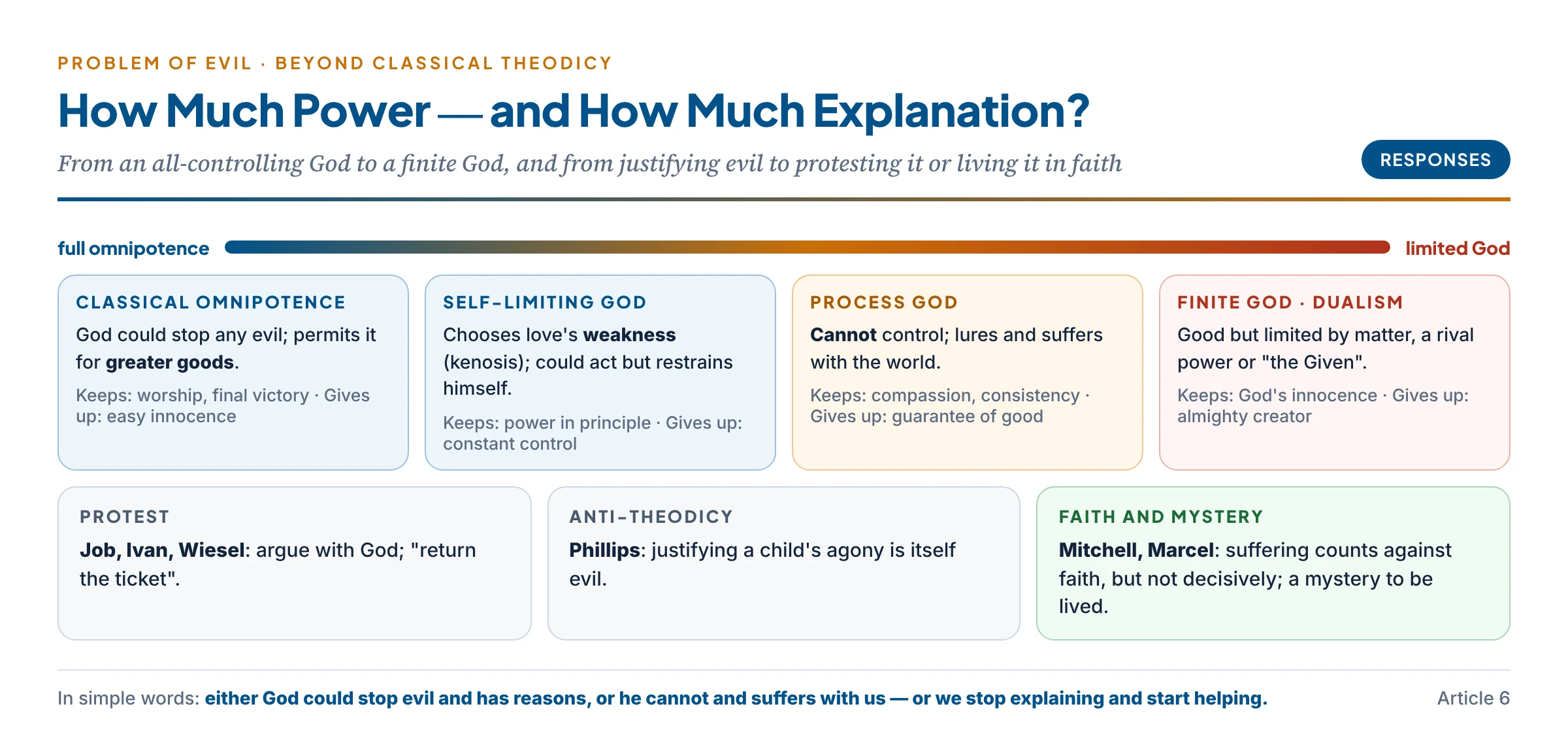
Every classical theodicy keeps God all-powerful and then explains why he permits evil. A second group of thinkers takes the opposite road: perhaps God cannot prevent all evil. Process theology (Whitehead, Hartshorne, Griffin) holds that God’s power is persuasive, not coercive; the finite-God tradition (Plato, Mill, James, Brightman) sees God as good but limited; thinkers after Auschwitz speak of a God who suffers with creation. A third group refuses to explain evil at all — protest and anti-theodicy — or rests in faith and mystery. This article sets out these views and asks the old question directly: must God be thought imperfect and powerless in the face of evil?
In simple words
Think of two doctors. One is said to be able to cure every disease instantly — then every patient who dies raises the question “why didn’t she?” The other is a skilled doctor who cannot cure everything, but who does all she can, stays at the bedside and feels each loss. Nobody blames the second doctor for deaths she could not prevent; we admire her. Process theology says God is like the second doctor. Its critics ask whether such a doctor is still God.
Context & Problem
Why Limit God?
- The traditional theodicies strain — Augustine’s Fall, Hick’s soul-making and Leibniz’s best world all leave excessive, innocent and animal suffering unexplained (Articles 3–5).
- Mackie’s “adequate solutions” — Mackie admitted that the problem disappears if God is not omnipotent; he simply thought this abandoned real theism (Article 2).
- The non-traditional answer: accept that God is good but limited — by matter, by a rival power, by the freedom of the world, or by the very nature of reality.
- The traditional reply: a “limited God” is a contradiction in terms — the most perfect being cannot lack power; such a God could not guarantee the final victory of good and would not deserve worship.
Core Doctrine
The Finite-God Tradition
- Plato — the divine craftsman (Demiurge) of the Timaeus shapes the world out of pre-existing, disorderly matter, persuading Necessity as far as it can be persuaded. Evil comes from the recalcitrance of matter, not from God.
- Zoroastrianism and Manichaeism — the good God (Ahura Mazda, the Light) is locked in a cosmic battle with an evil power (Angra Mainyu, the Darkness). Human beings are called to fight on the side of the good.
- J. S. Mill (Three Essays on Religion, 1874) — nature, he wrote, does daily what we hang or imprison people for doing to one another: it impales, crushes, starves, poisons. So if there is a God, he is good but not almighty. Such a creed “allows it to be believed that all the mass of evil which exists was undesigned by, and exists not by the appointment of, but in spite of” God; the virtuous human becomes “a fellow-labourer with the Highest, a fellow-combatant in the great strife“.
- William James — in a “pluralistic universe” God is finite, one power among others; the world’s improvement is possible, not guaranteed (meliorism) and depends partly on us.
- E. S. Brightman — God is personal and good but contains within his own nature a non-rational element (“the Given”) that he must gradually master; evil arises from this Given.
Process Theodicy — Main Tenets
Process theology applies the metaphysics of A. N. Whitehead (1861–1947) to religion; Charles Hartshorne called classical omnipotence a “theological mistake“, and David Ray Griffin (God, Power and Evil, 1976) wrote the first systematic process theodicy.
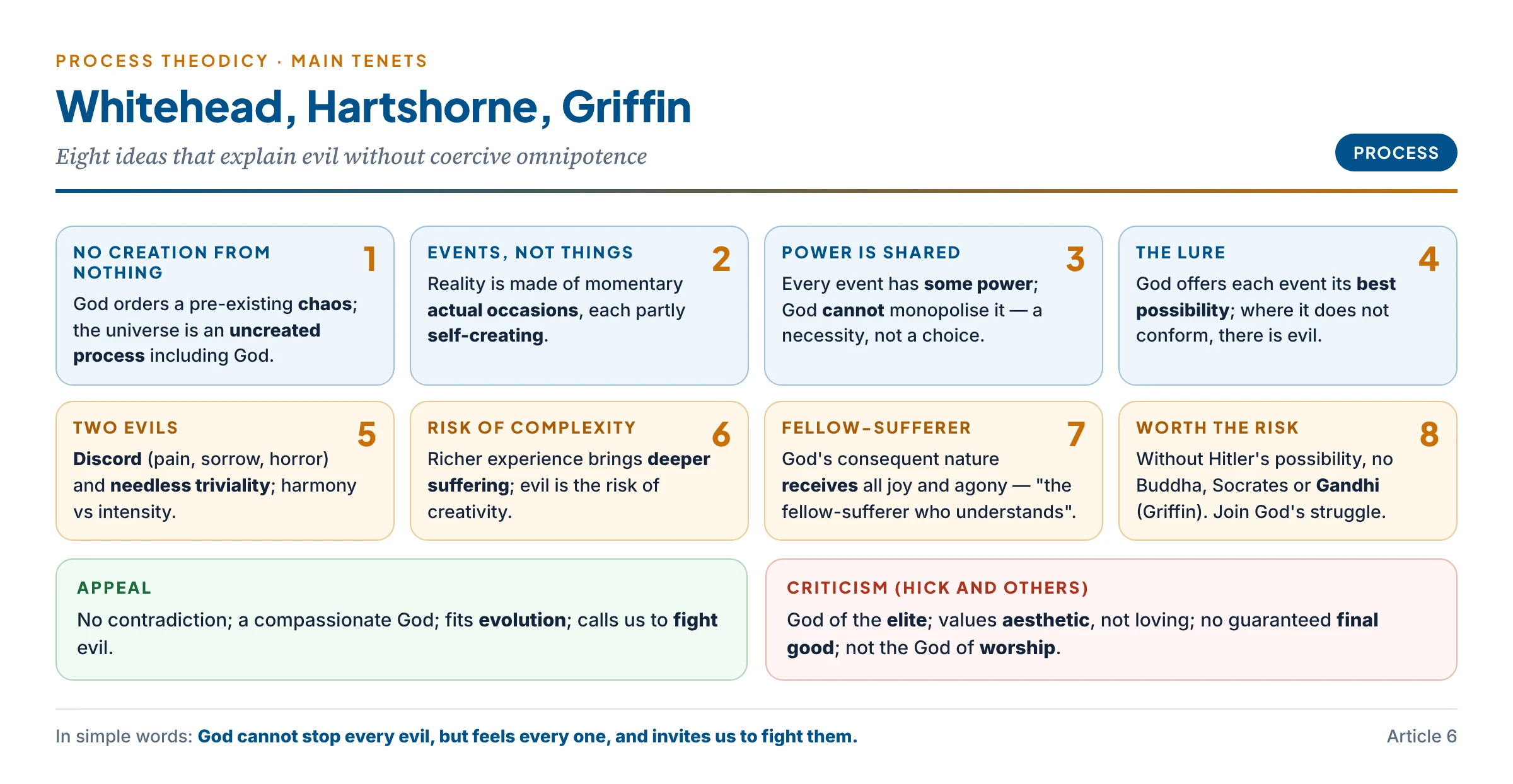
- 1. No creation out of nothing — God did not create the universe out of nothing. The universe is an uncreated process that includes God; God orders a pre-existing chaos into a cosmos. Its basic principles are eternal necessities, not God’s decisions — beyond even God’s will.
- 2. Reality is made of events — the ultimate units of reality are not lasting substances but momentary “actual occasions” (events of experience), each partly determined by the past and partly self-creating. Every occasion takes in (prehends) the data of the previous moment and makes its own selection.
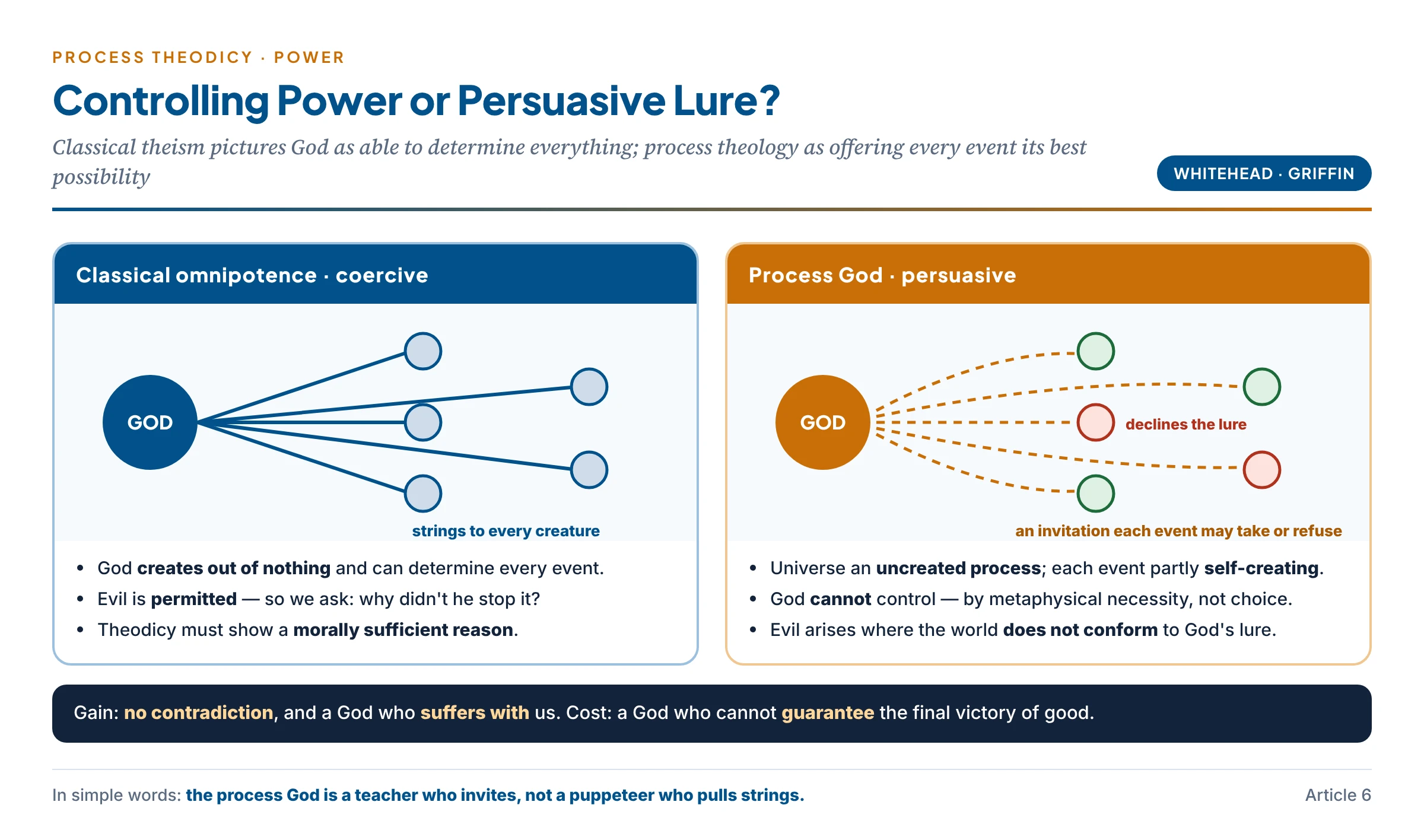
- 3. Power is necessarily shared — since every actual occasion has some creativity, it necessarily has some power. God cannot hold a monopoly of power. As Griffin puts it, God does not refrain from controlling creatures merely because persuasion is better, but “because it is necessarily the case that God cannot completely control the creatures“. This is a metaphysical limit, not a voluntary self-limitation.
- 4. God works by persuasion (the “lure”) — God offers each occasion the best possibility open to it (its “initial aim”); the occasion is free to conform or not. “So far as the conformation is incomplete, there is evil in the world” (Whitehead).
- 5. Two kinds of evil: the values of experience are harmony and intensity.
- Discord — failure of harmony: physical pain, mental evil such as sorrow, horror, dislike.
- Needless triviality — failure to reach the intensity possible.
Greater complexity makes possible greater richness of experience — and new depths of suffering. Humans can enjoy what lower beings cannot, but also suffer anguish that can drive them to suicide. So evil is an inherent risk of the creative process.
- 6. A God who is affected — God has two poles: a primordial nature (envisaging all possibilities) and a consequent nature that receives the experience of the world. Every earthly joy and every agony passes into God’s own experience. Whitehead: God is “the great companion — the fellow-sufferer who understands“.
- 7. God is still responsible — and justified — God could have left the primal chaos alone; he lured it toward ever greater complexity, knowing this risked great evil as well as great good. Griffin’s justification: the goods made possible are worth the risk. “Should God, for the sake of avoiding the possibility of persons such as Hitler, and horrors such as Auschwitz, have precluded the possibility of Jesus, Gautama, Socrates, Confucius… Mahatma Gandhi… and millions of other marvelous human beings?” Only someone who answers “yes” could indict the process God.
- 8. The moral call — since evil exists in spite of God, believers are summoned to join God’s side in the never-ending struggle against evil — the appeal of Mill’s “fellow-labourer” and of the Zoroastrian battle.
In simple words
A good teacher cannot make students learn; she can only offer the best lesson and invite each student to take it up. Some will, some will not — and the failures are not her doing, though she grieves over them. Whitehead’s God is like that teacher, offering every moment of the world its best possibility. Evil is what happens when the world does not take up God’s lure.
Common confusion
Is process theology the same as the free-will defence? No. In the free-will defence, an omnipotent God chooses to limit himself and could intervene if he wished; so we can still ask why he does not. In process theology God cannot control the world — not by choice but by metaphysical necessity, because every event has its own creative power. That is why process theists say God need not be excused for failing to prevent evil — he never had that power.
Criticisms of Process Theodicy
- Not the God of worship — a God who cannot unilaterally abolish cancer or stop an earthquake is not the almighty creator and saviour of classical religion; can such a being be trusted with our final good, answer prayer, or work miracles?
- A “limited God” is a contradiction — the most perfect being cannot be limited; a God within the universe is one being among others, not the ground of all being.
- No guarantee of final good — Griffin refuses to rely on a future heaven to justify past evil; but then the tragedy of history is ultimate — there is no assurance that “all shall be well” (Mother Julian).
- Elitism (Hick’s chief objection) — Griffin justifies the risk by pointing to the great achievers of history. But for every such person, countless others have lived in hunger, disease, oppression and early death, with no chance to develop. The process God seems to be the God of the elite — of saints and geniuses rather than of the anonymous millions — an outlook reminiscent of laissez-faire economics: the weak may go to the wall, but the system is good because it produces the strong.
- Aesthetic, not ethical — its ultimate values are harmony and intensity, not love for each creature; it weighs totals, not persons.
- God still responsible — God chose to lure the world into complexity knowing the suffering it would bring; the problem of evil returns in a smaller form.
Defences:
- It dissolves the logical problem: no omnipotence, no contradiction.
- It replaces the impassive spectator God with a God who shares every suffering.
- It fits evolution and modern science: a creative, open, unfinished universe.
- It motivates action: evil is to be fought, not explained away.
After Auschwitz: The Suffering and Self-limiting God
- Hans Jonas (The Concept of God after Auschwitz, 1987): in creating, God renounced his omnipotence and gave himself over to the world; at Auschwitz God was silent “not because he chose not to, but because he could not intervene“. A God who is good and intelligible after Auschwitz cannot also be all-powerful.
- Harold Kushner (When Bad Things Happen to Good People, 1981), written after his son’s death: God does not send suffering and cannot always prevent it; he gives strength and courage to bear it.
- The crucified God — Jürgen Moltmann (The Crucified God, 1972) and Dietrich Bonhoeffer, writing from a Nazi prison in 1944 that “only the suffering God can help“, hold that God is not above suffering but in it — revealed on the cross.
- Elie Wiesel, in Night, describes a boy hanged in a camp; a prisoner asks “Where is God now?” and a voice within answers: “Here He is — He is hanging here on this gallows.” The words can be read as God’s death — or as God suffering with the victim.
- Kenosis (self-emptying) — many Christian thinkers keep omnipotence in principle but say God chooses to act through love’s weakness rather than force, as in the Incarnation.
Protest Theodicy and Anti-Theodicy
- Job — the righteous man who loses everything refuses his friends’ theodicy (“you must have sinned”) and protests to God. God answers not with reasons but with the vastness of creation — “Where were you when I laid the foundations of the earth?” — and declares that Job, the protester, has spoken rightly, not his theodicy-making friends.
- Ivan Karamazov (Dostoevsky, 1880) — after recounting the torture of children, Ivan refuses any future harmony built on their tears: “It’s not God that I don’t accept, Alyosha, only I most respectfully return Him the ticket.“
- Camus — in The Plague, Dr Rieux refuses “to love a scheme of things in which children are put to torture” and chooses simply to fight the plague.
- Protest theodicy (Elie Wiesel‘s The Trial of God; John Roth) — faith that argues with God, holding him to account in the name of his own justice, without letting go of him.
- Anti-theodicy (D. Z. Phillips, Kenneth Surin) — the very attempt to justify suffering by its benefits is morally corrupt: to say a child’s cancer was planned for some good is “the deepest evil“. Theodicy treats victims as means and turns horror into a calculation. Kant (1791) had already judged all philosophical theodicies failures and praised Job’s honesty.
- Horrendous evils and the goodness of God (Marilyn McCord Adams) — instead of totals, ask whether God can make each victim’s life a great good for that person; she argues that only intimate union with God — a good that “engulfs” even horrors — could defeat such evils within the victim’s own life.
Is God a Moral Agent at All?
- Brian Davies argues that the problem of evil usually assumes God is a morally good agent, bound by duties like a parent, doctor or nurse.
- But God, as maker and sustainer of everything, has no context of obligations, no law above him, and no job to produce a set amount of goodness; the cardinal virtues (courage, temperance, prudence) cannot be ascribed to him.
- God’s goodness is the source of all created goodness — not the moral goodness of a well-behaved person.
- If so, the problem of evil, as a charge of moral failure, becomes a pseudo-problem.
- Objection: a God who is not good in any sense we understand cannot be loved, trusted or worshipped; if God’s “goodness” may include permitting anything, the word loses its meaning (Mill: “I will call no being good who is not what I mean when I apply that epithet to my fellow-creatures”).
Faith and Mystery
- The conclusion of many: even after all these arguments the problem remains; every justification has one weakness or another; evil cannot be fully explained by reason, and is resolved — if at all — only in the realm of faith.
- Finite logic, infinite God — some argue that the problem arises because we apply finite human logic to the infinite God; God belongs to a “logic of the infinite” that remains indeterminate to finite intellect.
- Falsification and faith — Antony Flew objected that believers let nothing count against “God loves us”: a child dies of inoperable cancer of the throat while his earthly father is frantic, but “his heavenly father reveals no obvious sign of concern” — and the believer just qualifies the claim. Basil Mitchell replied that the believer does admit that pain counts against God’s love — his faith is put on trial — but does not let it count decisively, as a partisan keeps trusting a mysterious stranger who seems sometimes to help the enemy. John Hick added that the truth will be verified at the end (eschatological verification).
- Problem and mystery — Gabriel Marcel distinguished a problem (something outside me that I can solve) from a mystery (something I am involved in and must live through). Evil, for the believer, is less a puzzle to be solved than a mystery to be lived with trust and compassion.
- Objection: appealing to mystery can become a way of avoiding the question; faith that cannot say what would count against it risks becoming empty.
In simple words
In Mitchell’s parable, a resistance fighter meets a stranger who says, “I am on your side — trust me.” Later the fighter sometimes sees the stranger helping the resistance, and sometimes in the uniform of the enemy. His friends say, “Your stranger is a traitor.” He admits the evidence counts against his trust — it hurts him — but having met the stranger, he keeps trusting. That is how many believers hold faith in God’s love in spite of evil: not blind to the evidence, but not ruled by it either.
Critical Evaluation
Can God Be Thought of as Imperfect and Powerless?
The two opposite views:
View 1 — God is perfect and omnipotent; evil is permitted for good reasons
- For: preserves the God of worship and salvation; a God who can guarantee that good will triumph; supported by the free-will defence, soul-making and the best-world arguments; the logical problem has been answered (Article 2).
- Against: excessive, innocent and animal suffering; foreknowledge and control; “a God who could and did not” seems less good; theodicies risk justifying horrors.
View 2 — God is good but limited (finite or process God)
- For: no contradiction; God is with the sufferers, not responsible for their pain; fits science; calls us to fight evil.
- Against: not the God of classical faith; no guarantee of final good; God still responsible for the risks he took; elitism (Hick); a “limited God” is a contradiction for classical theism.
Does evil “tell upon” omnipotence and omniscience?
- It tells against a crude concept: omnipotence as the power to do anything at any time, and omniscience as a foreknowledge that fixes the future. Such a God would indeed be responsible for every evil.
- It does not tell against refined concepts: omnipotence as power to do what is logically possible, exercised through love rather than force; omniscience as timeless knowledge that does not cause what it knows (Article 2).
A considered position:
- Keep perfection, rethink power — God’s power is best understood as the power of love, which creates free beings and respects their freedom (self-limitation, kenosis) rather than as the power of a puppeteer.
- Combine the partial answers — free will explains moral evil; a lawful world and soul-making explain much natural evil; the eschatological hope (a final good for each person) and God’s sharing in suffering answer the rest as far as reason can.
- Admit the remainder — some evil remains unexplained; here the theist moves from explanation to trust, and from theory to practical compassion — the protest of Job and the work of Dr Rieux both belong to an honest religious response.
- So: God need not be thought powerless or imperfect; but the believer must give up a tyrant’s picture of omnipotence and a calculator’s picture of goodness.
Critics and Defenders
Criticism — Against limiting God or retreating to mystery
- Classical theists: a “limited God” is a contradiction and cannot guarantee the triumph of good.
- Hick: the process God is the God of the elite; its values are aesthetic, not loving.
- Mill (against Davies): a “goodness” unlike any we know is not goodness.
- Flew: a faith that lets nothing count against it says nothing.
- Critics of mystery: “mystery” can be an escape from honest thinking.
Defence — For limiting God, protest and faith
- Process thinkers: no omnipotence, so no contradiction; God the fellow-sufferer.
- Jonas and Kushner: after Auschwitz, only a God who suffers is credible.
- Job and Ivan: honest protest is more faithful than false justification.
- Phillips: refusing to justify horrors is a moral achievement.
- Mitchell and Marcel: faith can admit that suffering counts against it and still trust; evil is a mystery to be lived.
Cross-Tradition Comparison
| Response | Western form | Indian parallel |
|---|---|---|
| God limited by another principle | Plato’s matter; Zoroastrian dualism; Brightman’s Given | Sāṃkhya‘s independent Prakṛti; Nyāya’s God limited by karma and eternal atoms |
| God who suffers with creation | Whitehead’s fellow-sufferer; Moltmann; Bonhoeffer | The avatāra who shares human suffering; Rāma‘s exile and grief |
| Protest and argument with God | Job; Ivan Karamazov; Wiesel | Bhakti poets’ complaint (nindā-stuti) — praise through reproach |
| Mystery beyond reason | Kant on Job; Marcel | Līlā — creation as play beyond human reasons; Advaita’s anirvacanīya |
| Evil to be fought, not explained | Mill’s fellow-labourer; Camus’s Rieux | The Gītā‘s call to act for dharma (lokasaṅgraha); Buddha’s practical path |
Indian Connect — Indian Connect — līlā and the limits of explanation
- The Brahmasūtra says the Lord creates “as a sport (līlā), as in the world” — not from need. Later Vedāntins use līlā to say that God’s ultimate reasons are beyond human calculation, while karma explains the distribution of suffering (Article 7).
- The Buddha famously refused to answer speculative questions and compared the speculator to a man shot by a poisoned arrow who will not let it be removed until he knows who shot it: the urgent task is to remove suffering, not to explain its cosmic origin — close in spirit to Camus’s Rieux.
Synthesis (Siddhānta)
- Process theodicy (Whitehead, Hartshorne, Griffin) answers the problem by denying coercive omnipotence: the universe is an uncreated process of self-creating events; God lures but cannot control; evil (discord and triviality) is the risk of creative complexity; God is the fellow-sufferer and calls us to fight evil. Its critics find it elitist, aesthetic, without guaranteed final good, and too far from the God of worship.
- The finite-God tradition (Plato, Zoroaster, Mill, James, Brightman) and post-Holocaust thinkers (Jonas, Kushner, Moltmann) likewise trade omnipotence for innocence and compassion.
- Protest theodicy (Job, Ivan, Wiesel) and anti-theodicy (Phillips) refuse to justify horror; Adams asks God to defeat horrors within each life; Davies argues God is not a moral agent at all; many believers rest in faith and mystery.
- Can God be imperfect and powerless? Evil defeats a tyrant’s omnipotence and a calculator’s goodness, not a God whose power is the power of love, whose knowledge is timeless, and whose goodness is shown in sharing and finally redeeming suffering. Some remainder is left to faith — and to action against evil.
- Contemporary relevance: in hospitals, disaster zones and after atrocities, the responses that help most are often the process and protest ones — a God who suffers with and a faith that fights evil — rather than abstract justifications; the most respected theological voices today join intellectual honesty about evil with practical solidarity with its victims.
“God is the great companion — the fellow-sufferer who understands.” — A. N. Whitehead
Previous Year Questions
- 2025Explain the main tenets of the Process Theodicy as an explanation of the problem of evil.
- 2015Do you think that evil is a bitter pill which no theist can easily swallow? Discuss.
- 2014Is evil reconcilable with the benevolent God?
- 2008How can a theist resolve the problem of evil? Does evil not tell upon omnipotence and omniscience of God? Can God be thought of as imperfect and powerless in this regard? Discuss critically for and against the two possible opposite views and justify your own position.