

Caste Discrimination: Gandhi and Ambedkar.
Official Syllabus: Paper II, Section A, Unit 10
B.R. Ambedkar (1891–1956) was not only the leader of India’s untouchables and the chairman of the Constitution’s Drafting Committee; he was the most rigorous theorist of caste India has produced. Trained in economics, sociology and history at Columbia and the London School of Economics, he analysed caste from the inside of its suffering and the outside of social science. This article explains his diagnosis: why Hindu reformers had failed, his rejection of both the racial and the Marxist explanations, his early paper Castes in India (1916) with its theory of endogamy superimposed on exogamy, imitation and the “closed door”, his historical works Who Were the Shudras? (1946) and The Untouchables (1948, the “broken men” theory), his idea of “revolution and counter-revolution”, and the concepts of graded inequality and the “division of labourers” — the ground for his programme of Annihilation of Caste (Article 6).
In simple words
A doctor who treats a fever without finding its cause may bring the temperature down, but the illness returns. Ambedkar thought earlier reformers had treated the symptoms of Hindu society — child marriage, widow remarriage — without asking what produces them. His answer was surprising: the marriage rules that keep castes closed produce sati, enforced widowhood and child marriage, and caste itself is kept alive by those rules. Find the cause, and you know what to destroy.
Context & Problem
Ambedkar’s Starting Point
- Experience: born into the Mahar caste (an untouchable caste of Maharashtra) at Mhow in 1891, he faced humiliation from childhood — made to sit apart in school, denied water — yet became, through scholarships, one of the most highly educated Indians of his time (M.A. and Ph.D. from Columbia; D.Sc. from London; barrister).
- Teachers: at Columbia he studied with John Dewey (philosophy of democracy and education) and the anthropologist Alexander Goldenweiser, in whose seminar he read Castes in India.
- Why reformers failed: nineteenth-century Hindu reformers concentrated on the family — child marriage, widow remarriage, women’s education — but did not attack caste, because caste is the ideological foundation of Hindu society. Reforming the family while leaving caste intact was like repairing the rooms of a house with a rotten foundation.
Ambedkar against Two Popular Explanations
1. Against the racial theory
- The theory that caste reflects the conquest of dark natives by fair Aryans is false: “the caste system does not demarcate racial division”; it is a social division of people of the same race. A Brahmin of Punjab is closer in physical type to a Chamar of Punjab than to a Brahmin of Madras.
- In Who Were the Shudras? he rejected the Aryan-invasion account of caste as unsupported, and attacked the use of race to justify hierarchy.
2. Against the Marxist (economic) interpretation of Indian history
- History is not always progressive: Indian history was retrogressive — the change from the varṇa system to the rigid caste system was a decline, and Brahmanism, not British colonialism, was responsible for it.
- Ideas shape history: the Marxist claim that material forces alone make history does not fit India; Brahmanical ideology — religious ideas — shaped the course of Indian history.
- Caste, not only class: in India the primary division is caste; socialists who ignore caste will find it blocking every revolution — “turn in any direction you like, caste is the monster that crosses your path” (Article 6).
Core Doctrine
Castes in India: Their Mechanism, Genesis and Development (1916)
Read at Columbia University in May 1916, when Ambedkar was twenty-five.
1. Earlier definitions examined
- Ambedkar examined the definitions of caste given by Senart (the idea of pollution), Nesfield (no eating with other castes), Risley (endogamy, common name, hereditary occupation) and S.V. Ketkar (membership by birth, prohibition of marriage outside).
- His finding: most “features” — pollution, food rules, occupation — are effects, not the essence. Only one feature is peculiar to caste: endogamy.
- Definition: caste in India means “an artificial chopping off of the population into fixed and definite units, each one prevented from fusing into another through the custom of endogamy“.
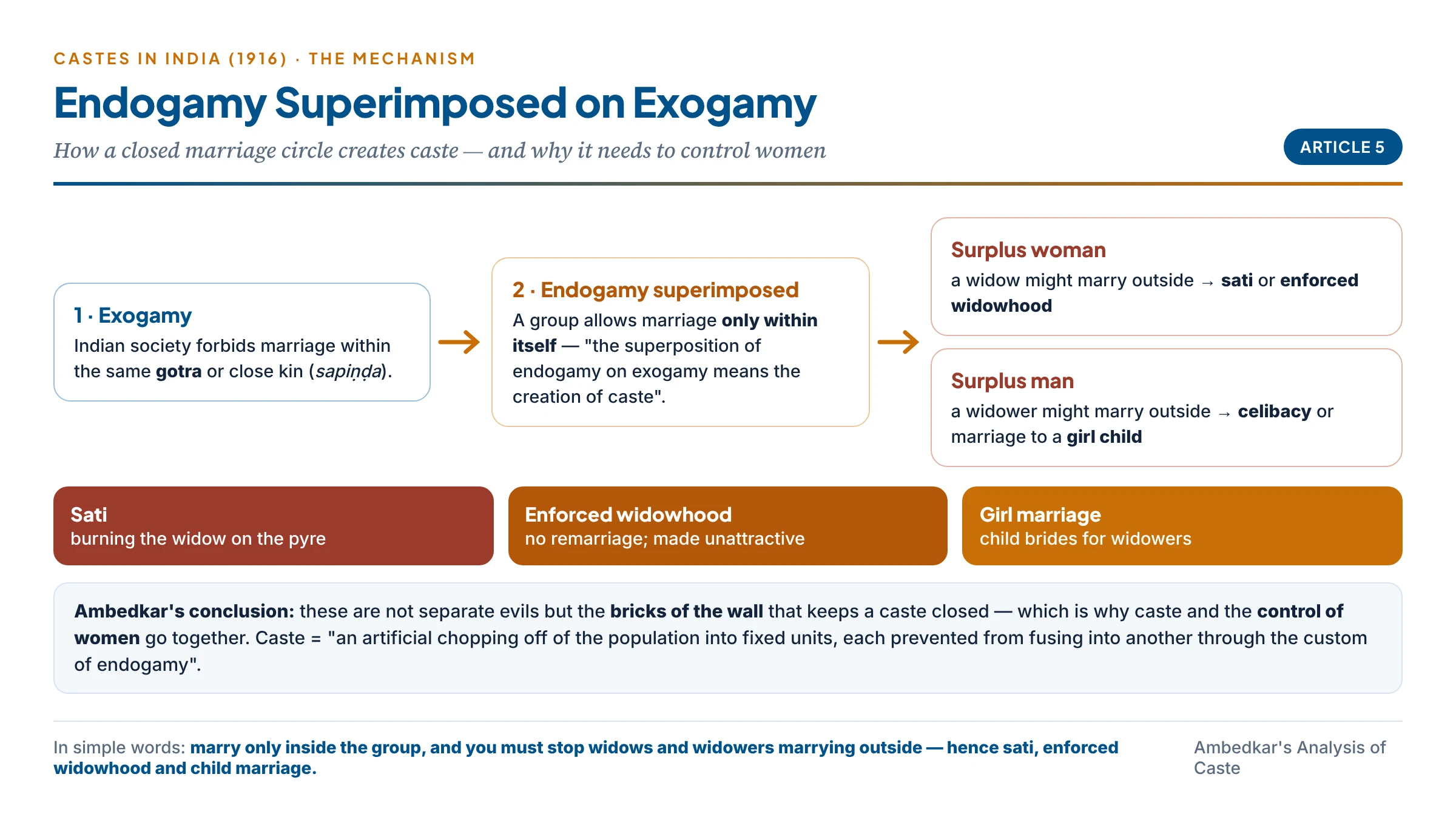
2. The mechanism — endogamy superimposed on exogamy
- Indian society was exogamous: marriage within the same clan (gotra) or close kin (sapiṇḍa) was forbidden — and still is.
- Caste is created when endogamy (marriage only within a group) is superimposed on this exogamy: “the superposition of endogamy on exogamy means the creation of caste”.
- The problem endogamy creates: a closed group must keep a balance between marriageable men and women; any surplus — a widow or a widower — threatens the boundary, because the surplus person might marry outside.
3. The “surplus woman” and the “surplus man”
- Surplus woman (the widow):
- Burn her on her husband’s funeral pyre — sati.
- Or impose enforced widowhood — she may never remarry, and is made unattractive (shaved head, white clothes, no ornaments).
- Surplus man (the widower):
- He cannot be burnt or forced into widowhood — men held the power — so he may be made a celibate (hard to enforce).
- Or married to a girl below marriageable age — hence child marriage.
- Conclusion: sati, enforced widowhood and girl marriage are not separate social evils but the means of maintaining endogamy — and therefore of maintaining caste. This explains why caste is bound up with the control of women.
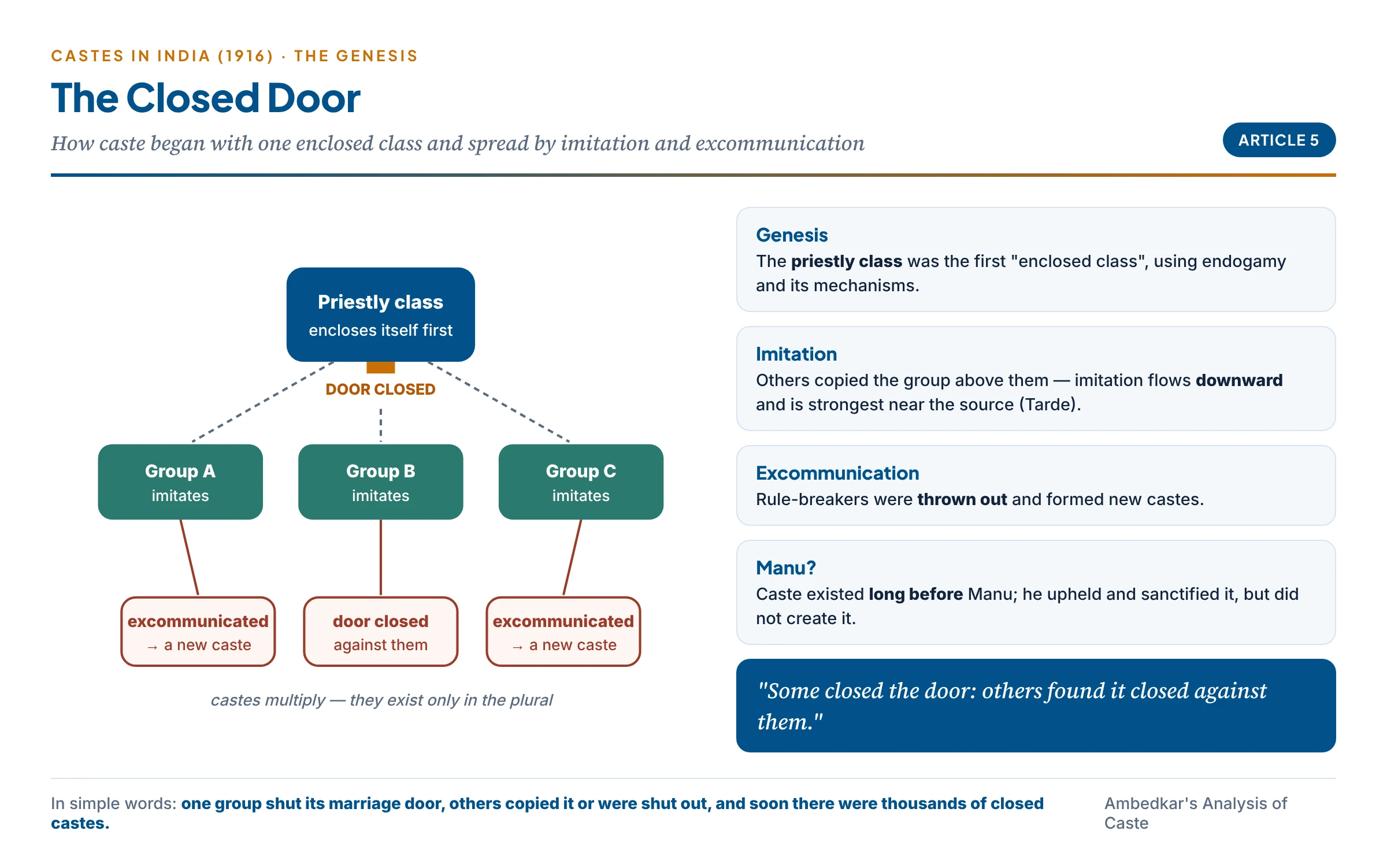
4. Genesis — the Brahmins as the first “enclosed class”
- Caste is an enclosed class. The priestly class (Brahmins) were the first to enclose themselves by practising endogamy, using sati, enforced widowhood and girl marriage.
- Spread by imitation: other groups imitated the Brahmins — following the French sociologist Gabriel Tarde‘s “laws of imitation”: imitation flows from the higher to the lower, and is strongest among those nearest the source.
- Spread by excommunication: those who broke the rules were thrown out and formed new castes.
- “Some closed the door: others found it closed against them.” — the Brahmins and those who imitated them closed themselves; the rest found the door closed against them and became castes perforce.
5. Development — castes exist only in the plural
- “Caste in the singular number is an unreality. Castes exist only in the plural number.” There cannot be one caste; a caste exists only in relation to others above and below it — caste is a system.
6. Manu did not create caste
- Ambedkar insisted that Manu did not give the law of caste, and could not have done so: caste existed long before Manu. Manu was its upholder — he philosophised about it and gave it sacred sanction — but no single law-giver can create such a system.
In simple words
Imagine a club that decides its members may marry only other members. Soon a problem arises: whenever a member is widowed, there may be no partner left inside the club — and the widowed person might marry an outsider, breaking the club’s wall. So the club invents harsh rules: widows must never remarry, widowers must marry very young girls. Those rules are not accidents; they are the bricks of the wall. Ambedkar’s point is that caste is such a club, and sati, enforced widowhood and child marriage were its bricks.
Common confusion
Did Ambedkar blame Manu for creating the caste system? Not in that simple sense. In Castes in India he said plainly that caste existed long before Manu, and that Manu could not have created it. His charge against the Manusmṛti was that it codified, sanctified and hardened caste and the subordination of Śūdras and women — which is why he publicly burned it at Mahad in 1927 (Article 7). The root, for him, was the endogamous closure of groups and the religious sanction given to it.
The Historical Perspective
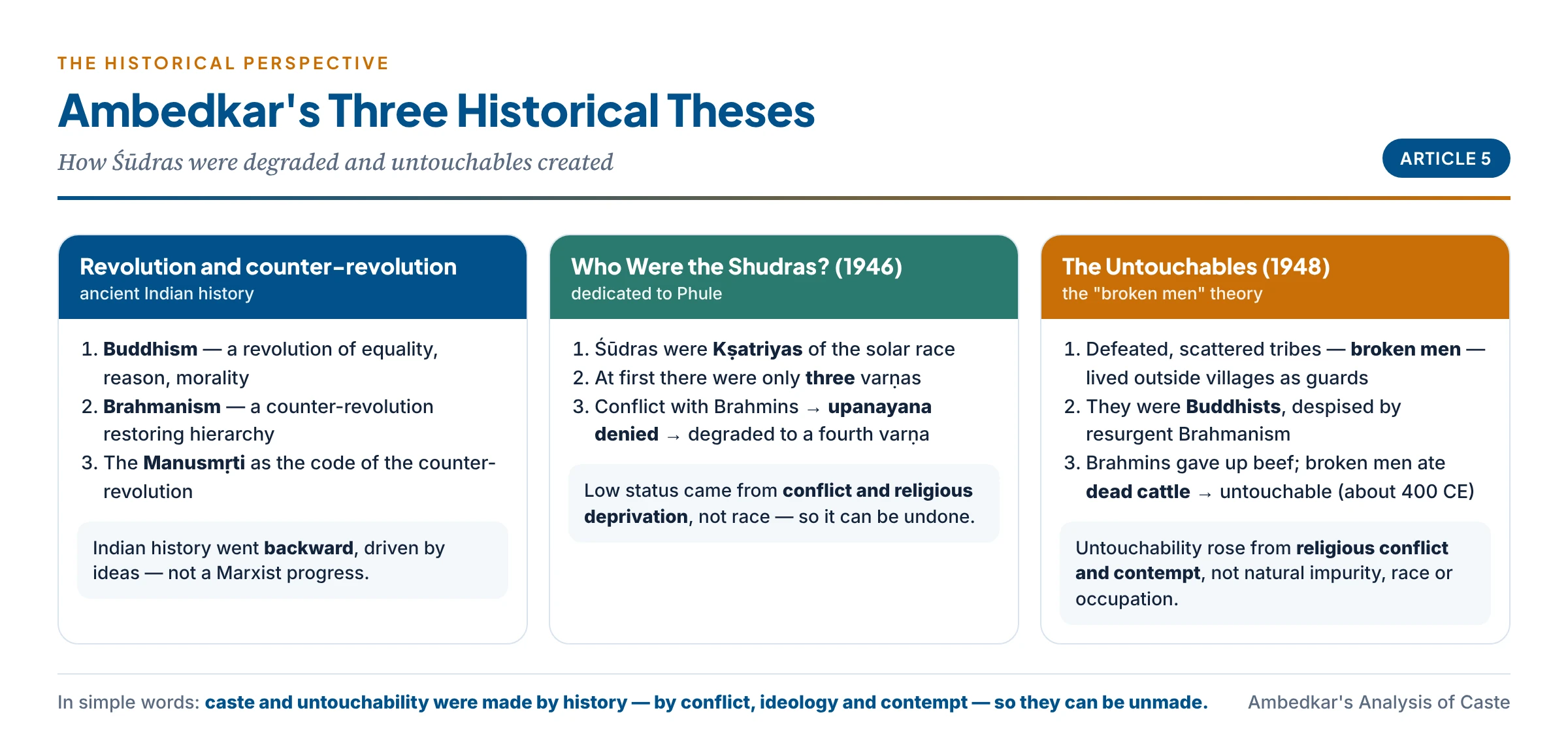
1. Who Were the Shudras? (1946) — dedicated to Jotirao Phule
- Thesis:
- The Śūdras were originally one of the Aryan communities belonging to the solar race — they were Kṣatriyas, not a conquered non-Aryan people.
- There was a time when Aryan society knew only three varṇas; the Śūdras were part of the Kṣatriya varṇa.
- A long conflict between Śūdra kings and the Brahmins (in which the Brahmins suffered humiliation) led the Brahmins to refuse the sacred-thread ceremony (upanayana) to the Śūdras.
- Deprived of upanayana, the Śūdras were degraded below the Vaiśyas into a fourth varṇa.
- Significance: the low status of the Śūdras is the result of social and political conflict and religious deprivation, not of race or nature — so it can be undone.
2. The Untouchables: Who Were They and Why They Became Untouchables? (1948)
- Rejects: the racial origin (untouchables are not a separate race) and the occupational origin (unclean work alone cannot explain untouchability).
- The “broken men” theory:
- In ancient tribal wars, defeated tribes were broken and scattered; these “broken men” sought protection from settled communities and lived outside the village, serving as its guards.
- They adopted Buddhism and kept it when Brahmanism revived; the Brahmins therefore regarded them with contempt and hatred.
- To win back ground from Buddhism, the Brahmins gave up beef-eating and made the cow sacred; the broken men, who continued to eat the flesh of dead cattle, came to be treated as untouchable.
- Untouchability, on this account, was born around 400 CE.
- Significance: untouchability is a product of religious conflict (Brahmanism vs Buddhism) and contempt, not of any natural impurity — which is why Ambedkar later returned to Buddhism (Article 7).
In simple words
Think of a family feud in a village that lasts for generations. Long after anyone remembers how it started, one family’s children are still not allowed into the other’s courtyard, and both sides call it “tradition”. Ambedkar’s historical works argue that the low status of the Śūdras and the untouchables began the same way — in old conflicts (over sacred rites, over Buddhism, over food habits) that hardened into “sacred” rules. If a rule has a history, it is not eternal — it can be ended.
3. Revolution and counter-revolution in ancient India
- Ambedkar read ancient Indian history as a struggle between Buddhism — a revolution of equality, reason and morality — and Brahmanism — a counter-revolution that restored hierarchy. The Manusmṛti was the code of the counter-revolution, re-establishing varṇa, the subordination of Śūdras and women, and the authority of Brahmins.
The Social Perspective — Graded Inequality and the Division of Labourers
1. Graded inequality
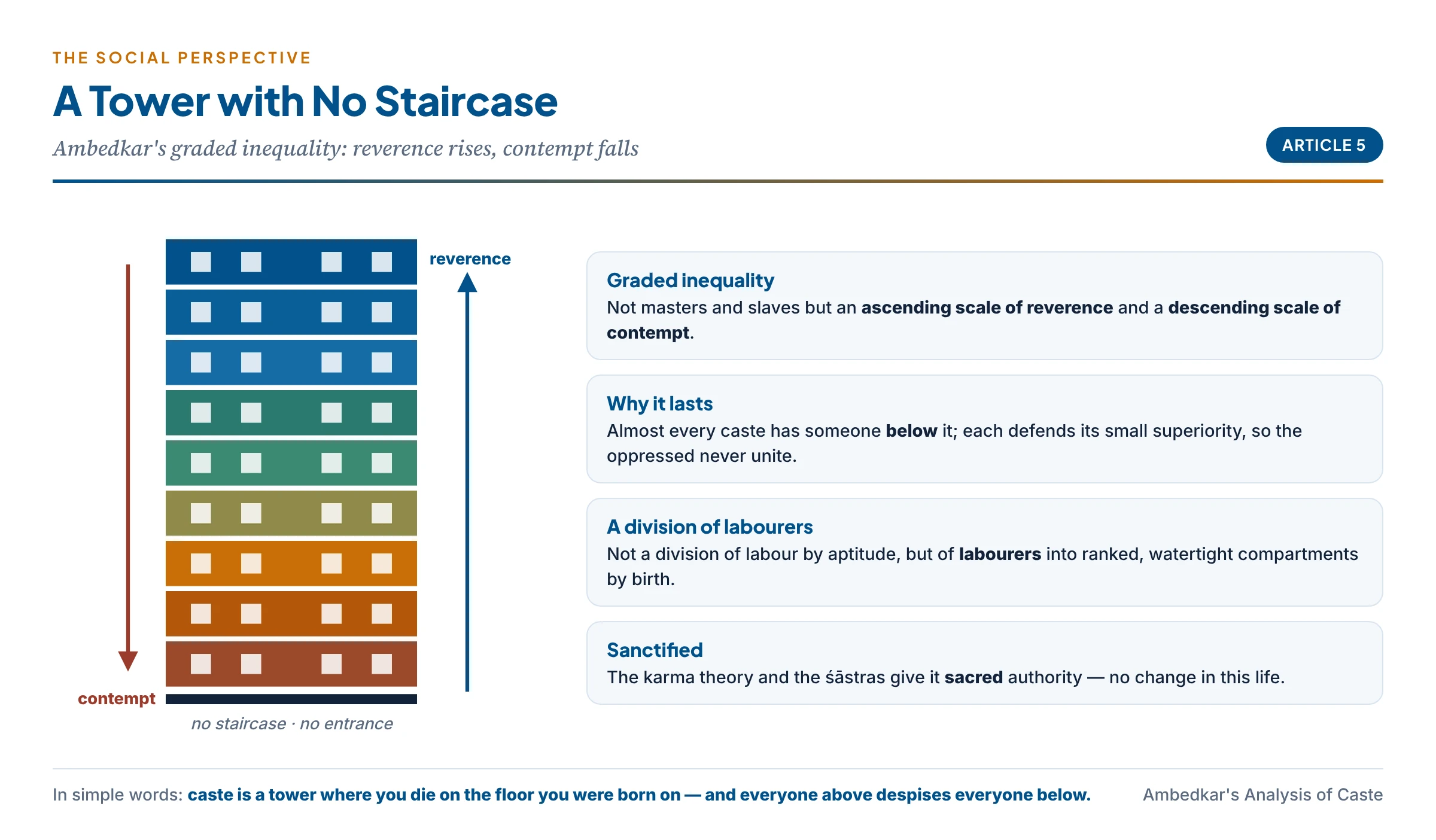
- Caste is not a simple two-class division of masters and slaves; it is graded inequality — “an ascending scale of reverence and a descending scale of contempt“.
- Why it is so stable: every caste except the lowest has someone below it to despise; each is too busy defending its small superiority to unite against the system. The lowest are divided among themselves too.
- Ambedkar compared Hindu society to a tower of many storeys with no staircase and no entrance — one must die on the storey on which one was born.
2. A division of labourers, not of labour
- “Caste system is not merely a division of labour. It is also a division of labourers.” Civilised society needs a division of labour, but in no civilised society is it accompanied by division of labourers into watertight compartments, ranked one above the other.
- Not based on aptitude: caste assigns work by the social status of the parents, not by natural ability; so it is neither good economics, good psychology nor a good social principle (Article 6).
- The karma theory freezes the arrangement: it gives no scope for change in this life to those doing “defiling” work.
3. Caste as a pathology
- Caste is a pathological system of Indian society; Indian society was fragmented, not cohesive; Muslim and Christian invasions made caste identities even more entrenched as defensive walls.
- It must be discarded the way the proletariat must discard capitalism — but by a notional (mental and religious) revolution, not merely an economic one.
4. Hinduism and the three values
- Ambedkar judged Hinduism by liberty, equality and fraternity and found it wanting:
- Against equality — graded inequality is its social law.
- Against liberty — it forbids choice of occupation, marriage and learning; it denied most people the right to study the Vedas, condemning them to ignorance.
- Against fraternity — it treats inter-caste marriage as sinful and keeps groups apart.
- Comparing the Manusmṛti’s ideal with Nietzsche‘s idea of the “superman”, he said such a religion is heaven for a few and hell for the masses.
- His 1936 speech to Mahar leaders put it in three lines: a religion that regards self-respect as a sin is not religion but a sickness; a religion that allows one to touch an animal but not a fellow human is not religion but madness; a religion that says the poor must stay poor and the ignorant ignorant is not religion but a punishment.
In simple words
In a two-storey house of masters and servants, all the servants share one grievance and can unite. In a fifty-storey tower with no staircase, the people on floor 30 look down on floor 29 and fear floor 31; nobody can unite with anybody. Ambedkar’s graded inequality explains why caste, though it oppresses the majority, has so rarely been overthrown from within.
Is Caste Discrimination the Result of a Superiority Complex or of Religious Ritual? — Ambedkar’s View
- Superiority complex: Ambedkar did see caste as an expression of the arrogance and self-interest of the privileged — the Brahmins enclosed themselves first; caste keeps their status, land and supply of labour.
- Religious ritual: but he insisted that this superiority could last only because it was made sacred — by the śāstras, by rules of purity and pollution, by karma.
- His answer: the two are one system. Ritual gives superiority its legitimacy; superiority gives ritual its purpose. Ordinary Hindus observe caste not because they are inhuman but because they are religious and believe the śāstras command it — so the deepest root is the religious notion, and the remedy is to destroy the sanctity of the śāstras (Article 6).
Ambedkar’s Critique of the Caste System — the Six Dimensions
| Dimension | Ambedkar’s charge |
|---|---|
| Sociological | Caste = endogamy superimposed on exogamy; women controlled to keep groups closed |
| Historical | Brahmanical counter-revolution degraded Śūdras and created untouchables; history in India went backward |
| Religious | The śāstras sanctify caste; Hinduism is a religion of rules, not principles |
| Economic | A division of labourers, not by aptitude; inefficient; keeps the lowest landless |
| Political | Hindus are a collection of castes, not a society or a nation; no democracy without fraternity |
| Moral | Graded inequality — reverence upward, contempt downward; denial of dignity |
Critical Evaluation
Strengths of Ambedkar’s Analysis
- Finds the mechanism: by locating caste in endogamy, he explains why caste survives economic change, urbanisation and conversion — and why its control over women is central.
- Links caste and gender: he was among the first to show that the subordination of women (sati, enforced widowhood, child marriage) is structurally tied to caste.
- Demystifies: by tracing caste to history, conflict and ideology, he shows it is man-made and therefore changeable — neither divine nor racial.
- Graded inequality explains the system’s stability better than simple oppression models.
- Historical contextualisation: he gives a comprehensive account of structural inequality, which grounds his remedies (Articles 6–7).
Criticisms
- Historical speculation: the Śūdras-as-Kṣatriyas and broken-men theses rest on selective readings of texts; many historians find the evidence thin.
- Sati as a general mechanism: sati was practised by a small section in some regions and periods; it cannot have been a general mechanism of endogamy everywhere.
- Hierarchy not fully explained: endogamy explains closure, but not why closed groups are ranked by purity — a point stressed by those who place the purity–pollution principle at the centre.
- Brahmin-centred causation: making the Brahmins the originators may overstate one group’s power; others stress land, kingship, local dominant castes and colonial categories.
- Economic factors (land, labour) receive less weight than ideology — the Marxist criticism.
Critics and Defenders
Criticism — Critics of Ambedkar’s analysis
- Historians: the Śūdra and broken-men theories are speculative.
- Purity theorists: endogamy explains closure, not ranking; the core is pure vs impure.
- Marxists: too much weight on ideas and religion, too little on land and class.
- Gandhians: varṇa and caste should be distinguished; varṇa is not the parent of untouchability.
Defence — Defenders of Ambedkar’s analysis
- Endogamy is still the clearest reproducer of caste — only about 5% of marriages are inter-caste.
- The caste–gender link is now central to feminist and sociological work.
- Graded inequality explains the system’s resilience and the divisions among the oppressed.
- His demystification makes caste historical, hence changeable — the basis of all later reform.
Cross-Tradition Comparison
| Theme | Ambedkar | Western thinker |
|---|---|---|
| Social closure | Caste as an “enclosed class” | Weber: status groups monopolise honour and marriage |
| Imitation | Lower castes imitate the Brahmins | Gabriel Tarde: laws of imitation |
| Ideas and history | Brahmanical ideology shaped history; history can regress | Against Marx‘s materialism; close to Weber‘s view that religious ideas shape economic life |
| Control of women | Sati, widowhood, child marriage maintain endogamy | Engels and feminist theory: control of women’s sexuality maintains property and lineage |
| Superman ethic | Manu’s ideal as heaven for the few | Nietzsche‘s “master morality” |
| Democracy as associated living | Fraternity, social endosmosis (Article 6) | Dewey‘s Democracy and Education |
Indian Connect — Indian Connect — from Phule to Ambedkar
- Phule read Indian history as Brahmanical domination of the Śūdras and Ati-Śūdras; Ambedkar dedicated Who Were the Shudras? to him and gave the thesis scholarly form.
- Ambedkar’s reading of Buddhism as revolution connects his history with his final remedy — conversion to a religion of prajñā, karuṇā and samatā (wisdom, compassion, equality) (Article 7).
Synthesis (Siddhānta)
- Ambedkar began by asking why reformers failed: they reformed the family but not caste, the foundation of Hindu society.
- He rejected the racial theory (castes are of the same stock) and the Marxist reading (Indian history went backward, driven by Brahmanical ideology).
- Castes in India (1916) found the essence of caste in endogamy superimposed on exogamy; sati, enforced widowhood and girl marriage are its mechanisms; the Brahmins were the first enclosed class, and others imitated or were excommunicated — “some closed the door, others found it closed against them”; castes exist only in the plural; Manu upheld but did not create caste.
- Historically, the Śūdras were degraded Kṣatriyas denied upanayana; the untouchables were broken men, Buddhist and beef-eating, despised by resurgent Brahmanism; the Manusmṛti was the code of a counter-revolution.
- Socially, caste is graded inequality and a division of labourers — a tower without a staircase, sanctified by religion. Superiority and ritual are one system, rooted in the religious notion — hence his call to annihilate caste (Article 6).
- Contemporary relevance: honour killings, caste-based matrimony and the policing of inter-caste love confirm his insight that controlling marriage and women is how caste survives.
“Some closed the door: others found it closed against them.” — B.R. Ambedkar, Castes in India
Previous Year Questions
- 2017Is caste discrimination a result of the superiority complex of a privileged class of the society or of religious rituals? Discuss with reference to the views propounded by Dr B. R. Ambedkar.
- 2016How did Ambedkar analyse the caste system from the historical and social perspectives? Explain.
- 2015Evaluate Ambedkar’s critique of caste system.