

Development and Social Progress.
Official Syllabus: Paper II, Section A, Unit 8
Social progress is the idea that human societies can move forward: towards more knowledge, justice, freedom, health and well-being, not just change from one state to another. The word assumes a direction and a standard: to call a change “progress” is to judge it better. Where does that standard come from? Is there one road of progress for all societies, as the thinkers of the Enlightenment believed, or many? Is progress driven by reason (Condorcet, Comte), by Spirit (Hegel), by material forces (Marx) or by evolution (Spencer)? Must it be material, moral, or both? And can it be measured apart from economic growth? This article explains the meaning of social progress and how it differs from change, evolution and development; the role of values; its characteristics, indicators and types; the rise of the idea from the Greeks to the Enlightenment; the great theories of Turgot and Condorcet, Hegel, Comte, Spencer and Marx; scientific temper; material and moral progress (Vivekananda, Gandhi); the link between alienation and progress; and the ways of measuring social progress beyond GDP.
In simple words
A child on a merry-go-round moves all the time but ends where she began: that is change. A child climbing a staircase moves towards the floor she wants to reach: that is progress. Progress is change with a direction and a purpose, and someone must decide which floor is worth reaching.
Context & Problem
- Older pictures of history were cyclical or declining:
- The Greek poet Hesiod described five ages of man (gold, silver, bronze, heroic, iron), each worse than the last.
- Plato described the decline of constitutions from the ideal state to tyranny.
- Indian thought speaks of four yugas (Satya, Tretā, Dvāpara, Kali), descending in virtue and repeating in vast cycles.
- Christianity gave history a direction (from creation to the Last Judgement), and the Renaissance and scientific revolution added confidence in human reason.
- Before scientific temper, people tended to keep a conservative outlook, trusting authority over observation. Bertrand Russell’s example: Aristotle held that women have fewer teeth than men; although he was twice married, it never occurred to him to verify this by examining his wives’ mouths.
- The modern idea of progress chiefly flourished in the wake of the Enlightenment (17th–18th centuries): Francis Bacon declared that “knowledge is power” and pictured science improving human life; Immanuel Kant saw human reason as a liberating force: “Enlightenment is man’s emergence from his self-incurred immaturity”, and its motto is “Sapere aude!” (“Dare to know!”).
- The problem: progress is both a description (societies do change in certain directions) and an evaluation (those changes are good). Whose values decide what is “better”?
Core Doctrine
The Meaning of Social Progress
- Social progress is the positive and collective advancement of societies towards improved conditions, justice and the overall well-being of individuals.
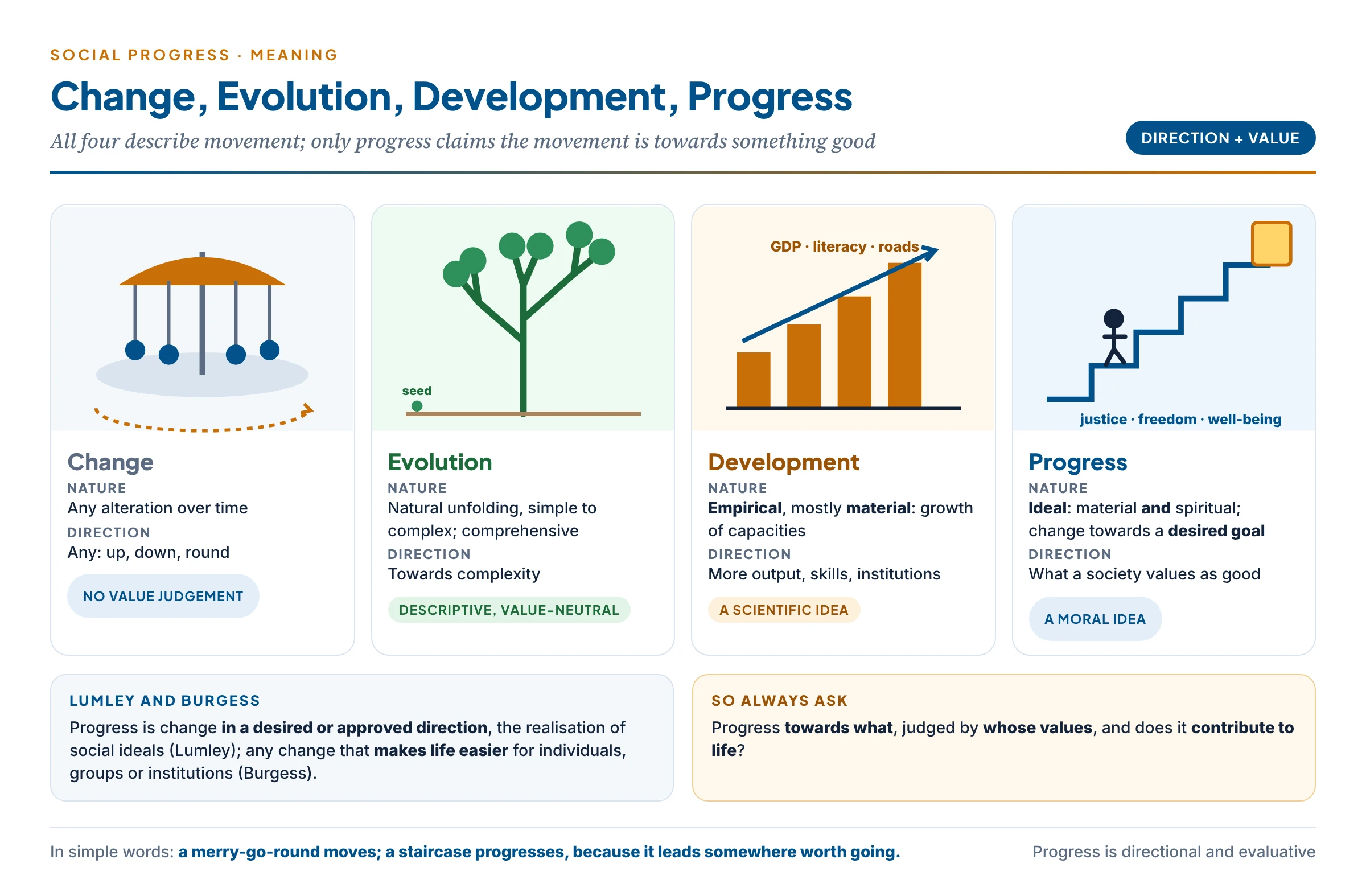
- Progress implies forward movement towards a specific goal. This distinguishes it from mere change, which may be in any direction, good, bad or neutral.
- Progress should be viewed in a directional context: it is movement towards something, not universal transformation.
- Unlike evolution, which is a more comprehensive and value-neutral process of growth and differentiation, progress means positive changes aligned with a particular aim.
- E. W. Burgess, the American sociologist, defined progress as any adaptation or change that makes life easier for individuals, groups or institutions.
- Any change called progress should contribute to life: life is the primary and indispensable value by which progress is judged.
- Philosophically, social progress raises questions of equality, human rights and the ethical responsibility of governments and institutions to bring about positive change.
- To move in a better direction, both quantitatively and qualitatively, in every walk of life: progress is an idealistic stage that every society wants to reach.
| Concept | Nature | Direction | Value judgement? | Example |
|---|---|---|---|---|
| Change | Any alteration over time | Any direction | No | Fashions change; a city grows or shrinks |
| Evolution | Gradual, natural unfolding from simple to complex | Towards greater complexity | No: it is a scientific description | Tribe → kingdom → modern state |
| Development | Growth of capacities and resources; empirical, largely material | Towards more output, skills, institutions | Partly: a scientific idea | Industrialisation, rising literacy |
| Progress | Change towards a desired goal; ideal, both material and spiritual | Towards what a society values as good | Yes: a moral idea | Abolition of slavery, equality of women |
Values and Progress
- F. E. Lumley, an American sociologist, wrote that progress is change, but change in a desired or approved direction, not in any direction: it is the realisation of social ideals.
- So progress is contingent on prevalent social values. In sociology a value means desirability or worth compared with other things: activities or attitudes that meet the needs of the group or fit its habitual way of life become valued and are built into its culture.
- Progress depends on achieving social values: society advances further in the desired direction.
- Whether a change counts as progress or regress is contextual: it depends on values, and values change. Contraception, divorce or industrial farming have been called progress by some and decline by others.
- Yet the concept is not wholly relative: within certain limits it remains constant. Almost every society counts less hunger, less disease, less violence and more knowledge as progress. The sociologist Morris Ginsberg therefore defined progress as development in a direction that satisfies rational criteria of value.
In simple words
Two villages both build a liquor shop. In one, people call it progress (“new business, new jobs”); in the other, women call it ruin (“our husbands drink away the wages”). The building is the same; the values decide whether it is progress. That is why every claim of progress must say progress towards what, and by whose standard.
What Counts as Social Progress? Indicators
Philosophers have pointed to concrete markers:
- Disappearance of slavery: Condorcet listed the abolition of slavery as a sign of progress.
- Rise of literacy in a society.
- Lessening of inequalities between groups (classes, castes, races, and the sexes).
- Reforms and the decline of poverty.
- Increase in GDP and in the quality of life, with better opportunities for success.
Indian Connect — Indian Connect
- Ambedkar’s measure: “I measure the progress of a community by the degree of progress which women have achieved” (All-India Depressed Classes Women’s Conference, Nagpur, 1942).
- Social reform as progress: the abolition of sati (1829), widow remarriage (1856), the struggle against untouchability (Article 17 abolishes it) and the Hindu Code Bills are India’s own landmarks of social progress.
The Characteristics of Social Progress
Each feature is shown with an everyday example:
- Justice and equality: eliminating discrimination and unequal access. Example: legal reforms giving equal rights to all genders.
- Human rights: upholding the inherent dignity of all. Example: advocacy for LGBTQ+ rights (in India, Navtej Singh Johar, 2018, decriminalised same-sex relations).
- Inclusivity and diversity: valuing cultural, ethnic, racial and gender diversity. Example: workplace diversity programmes.
- Democracy and participation: citizen participation, representation and protection of individual freedoms. Example: voter education initiatives.
- Rule of law: transparent, just and consistently applied law. Example: transparent legal systems that protect individual rights.
- Economic justice: reducing poverty and income inequality; fair economic systems. Example: fair trade policies.
- Education and knowledge: the transformative power of education. Example: free online education platforms that democratise knowledge.
- Environmental sustainability: human well-being depends on environmental health. Example: adoption of renewable energy.
- Health and well-being: public health and access to care. Example: campaigns against the stigma of mental illness.
- Civic engagement: citizens taking part in decisions for their communities. Example: community-led initiatives.
- Cultural and artistic expression: creativity and a vibrant culture. Example: public art projects that celebrate diversity.
- Technology and innovation: using technology to improve living standards and access to information. Example: digital literacy programmes.
- Peace and conflict resolution: dialogue, diplomacy and just, lasting settlements. Example: diplomatic efforts in conflict zones.
- Community development: local initiatives that create change from below. Example: community gardens and local empowerment programmes.
- Ethical leadership: leaders who put the common good, transparency and accountability first. Example: government transparency initiatives.
- Global cooperation: shared action on poverty, climate change and pandemics. Example: international climate collaborations.
- Adaptability and flexibility: adjusting to new challenges. Example: flexible work arrangements during crises.
- Generational responsibility: current actions consider future generations. Example: sustainable development policies.
- Cultural evolution: willingness to change norms that block justice and well-being. Example: social acceptance of diverse family structures.
- Continuous improvement: progress is never finished; it needs reflection and review. Example: regular review and updating of policies.
The Types of Social Progress
| Type | Meaning | Main features | Significance |
|---|---|---|---|
| Economic | Better economic conditions: GDP, employment, financial well-being | Productivity, wealth distribution, jobs, poverty reduction | Foundation of material well-being and a more equitable society |
| Educational | Wider access, better quality, relevant skills | Higher literacy, better schools, lifelong learning | Empowers individuals; social mobility |
| Healthcare | Better access to care, disease prevention, public health | Longer life, lower mortality, medical technology | Healthier, more resilient society |
| Social justice | Ending systemic inequality and discrimination | Fewer disparities, voice for the marginalised, fair laws | A society that values equality and inclusion |
| Political | Stronger democracy, governance and rights | Democratic institutions, rule of law, civic engagement | Accountable government; protected liberties |
| Cultural | Flourishing arts, diversity and heritage | Arts, preserved heritage, celebrated diversity | Vibrant society; shared identity |
| Environmental | Sustainable practices and protected ecosystems | Conservation, resource management, climate action | Harmony of society and nature, now and for the future |
| Technological | Advances in science and technology for social good | Innovation, research, adoption of technology | Drives growth, living standards and communication |
| Global | International cooperation on shared problems | Diplomacy, humanitarian work, global problem-solving | Shared responsibility of nations |
| Community | Improvement within particular communities | Grassroots effort, local empowerment | Local agency in shaping progress |
The Rise of the Idea of Progress
1. Ancient Greek and Roman thought
- Plato (Republic) pictured a just society led by philosopher-kings, with a harmonious division of labour in which each class does its own task. Progress means approaching this ideal order.
- Aristotle described the natural growth of society from household to village to the polis (city-state), the community in which humans can flourish. Unlike Plato, he questioned the wisdom of too much unity in the state and saw value in diversity.
2. Early modern political thinkers
- Thomas Hobbes (Leviathan, 1651): progress requires escape from the state of nature, a “war of all against all” in which life is “solitary, poor, nasty, brutish and short”, through a strong sovereign who keeps order.
- John Locke (Two Treatises of Government, 1689): natural rights to life, liberty and property; government’s legitimacy rests on the consent of the governed.
- Jean-Jacques Rousseau (The Social Contract, 1762): the general will, which represents the common good; whoever refuses to obey it will be “forced to be free“. (Rousseau was also the first great critic of progress; see the next article.)
- Karl Marx (The Communist Manifesto, 1848): progress comes through class struggle and revolutionary change in the economic structure.
3. The Enlightenment: Turgot and Condorcet
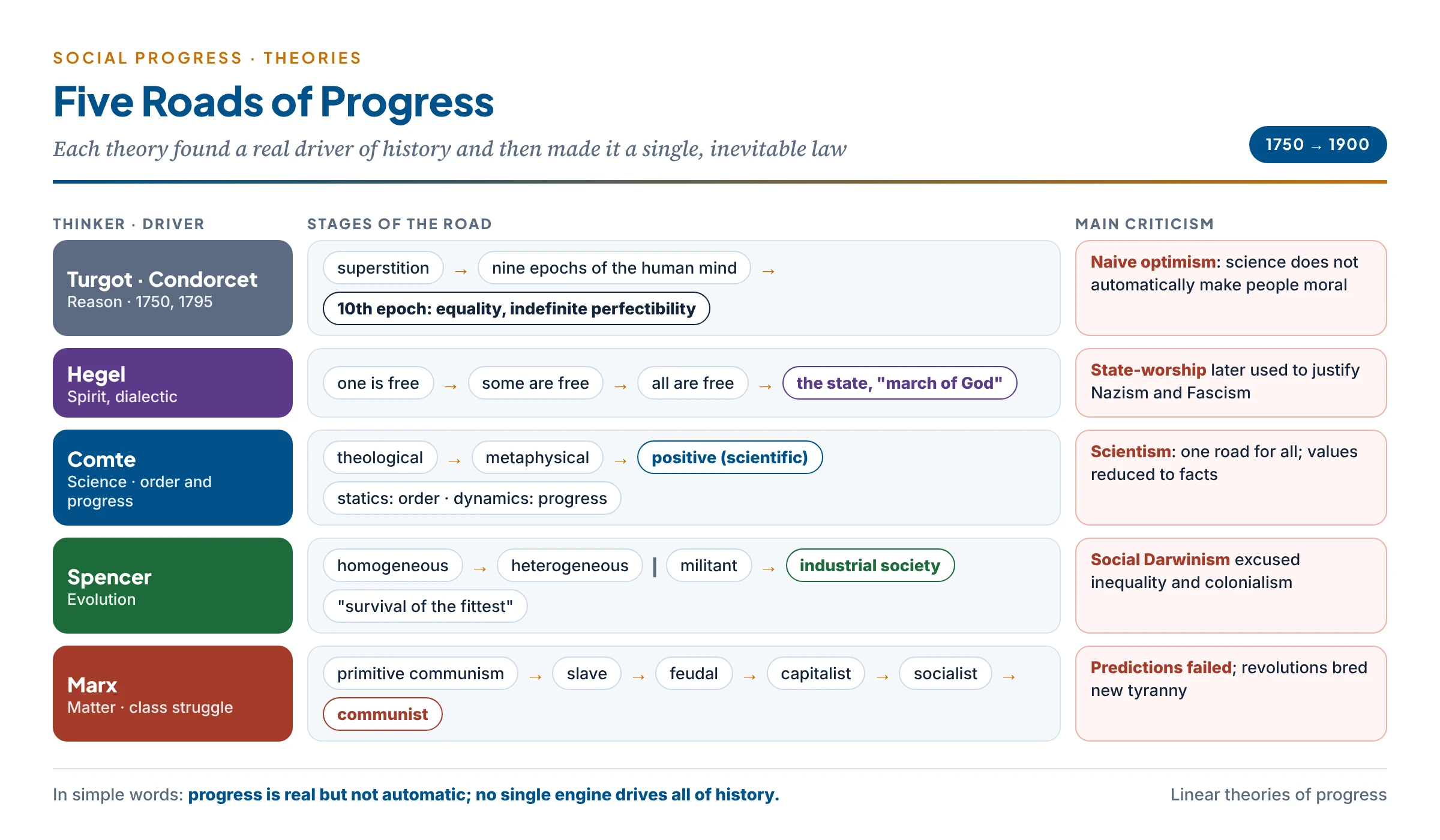
- Anne-Robert-Jacques Turgot, in a lecture at the Sorbonne (1750) on the successive advances of the human mind, described the continuous progress of humanity and three stages of thought (religious, speculative, scientific) that Comte later developed.
- Marquis de Condorcet wrote Sketch for a Historical Picture of the Progress of the Human Mind (published 1795) while hiding from arrest during the French Revolutionary Terror; he died in prison soon after.
- History is the unilinear march of human reason, casting off the shackles of superstition, tyranny and religious dogma, through nine epochs so far.
- Scientific knowledge inevitably produces moral and political emancipation.
- The tenth epoch (the future) would bring three things: the destruction of inequality between nations, the progress of equality within each nation, and the true perfection of humanity.
- Human perfectibility is indefinite: there is no limit to improvement.
- Signs of progress: the disappearance of slavery, the rise of literacy and the lessening of inequality between the sexes.
Common confusion
Were Turgot and Condorcet “20th-century social thinkers”? No. Some notes list them among twentieth-century thinkers. Both were 18th-century French Enlightenment philosophers: Turgot (1727–1781) gave his lecture on progress in 1750, and Condorcet (1743–1794) wrote his Sketch during the French Revolution. Their optimism about reason and progress preceded the nineteenth-century theories of Comte, Spencer and Marx, and was severely questioned by twentieth-century critics.
The Great Theories of Social Progress
1. Hegel: history as the progress of the consciousness of freedom
- History is a continuous march of consciousness, of Idea or Spirit (Geist). Idea is the essence of the universe, and all social institutions are manifestations of the changing forms of the Idea.
- History moves dialectically: a thesis produces its antithesis, and their conflict is resolved in a synthesis, which becomes a new thesis, and so on, towards perfection.
- “The history of the world is none other than the progress of the consciousness of freedom.” In the ancient Oriental world one was free (the despot); in the Greek and Roman world some were free; in the modern Germanic-Christian world all are known to be free.
- History culminates in the state, the perfect social institution, which Hegel called “the march of God in the world”.
- Criticism: Hegel’s over-emphasis on the nation-state was later used to justify Nazism and Fascism; Karl Popper attacked him as an enemy of the “open society”. History, critics add, is not a single rational story.
2. Marx: progress through dialectical and historical materialism
- Matter, not Idea, is the essence of the universe; social institutions are the manifestation of changing material conditions (Marx “turned Hegel on his head”).
- The dialectical process continues until perfect material conditions, a rational mode of production, come into existence.
- Stages of history (historical materialism): primitive communism → slave-owning society → feudal society → capitalist society → socialist society → communist society. Each stage is driven forward by the conflict between forces of production (technology, labour) and relations of production (ownership, class).
- Marx praised capitalism for its enormous productive power but criticised it severely for its dehumanising effect: under it the worker suffers alienation.
- The four forms of alienation (Economic and Philosophic Manuscripts, 1844):
- From the product of labour, which belongs to the capitalist and confronts the worker as an alien power.
- From the activity of labour, which becomes forced, not free, self-expression.
- From the worker’s species-being (Gattungswesen), the free, conscious, creative activity that makes us human.
- From other human beings, who appear as competitors and exploiters.
- Progress ends in communism, the “realm of freedom”, where alienation and class are abolished.
Common confusion
Are Marx’s four alienations “from product, nature, other persons and oneself”? Not quite. Some notes list “nature” and “oneself” as two of the four. In the 1844 Manuscripts Marx names alienation from the product of labour, from the activity (process) of labour, from species-being (our human essence as free, creative producers, which includes our relation to nature) and from other human beings. Alienation from nature and from oneself are aspects of the third form, not separate items.
3. Auguste Comte: order and progress
- Auguste Comte (1798–1857) is called the father of sociology; he coined the word.
- He divided sociology into:
- Social statics: the study of social order: the conditions that hold society together.
- Social dynamics: the study of social progress: the laws of social change.
- “Order and Progress” was his motto; it is written on the flag of Brazil (Ordem e Progresso).
- The law of three stages of intellectual development, based on the source of knowledge:
- Theological stage: events explained by supernatural causes (gods, spirits).
- Metaphysical stage: explained by abstract causes (essences, “nature”, forces).
- Positive stage: the discovery of laws governing facts through observation and science.
- Society, like every science, progresses through these stages; the positive, scientific society is the goal.
4. Herbert Spencer: progress as evolution
- Herbert Spencer (1820–1903) applied cosmic evolution to society. In Progress: Its Law and Cause (1857) he defined progress as the movement from simple, uniform (“homogeneous”) to complex, differentiated (“heterogeneous”) forms, in nature and in society alike.
- Societies move from militant societies (ruled by force, hierarchy, compulsory cooperation) to industrial societies (based on voluntary contract, trade and individual freedom).
- He coined the phrase “survival of the fittest” (1864) and applied it to society: this social Darwinism opposed state help to the poor.
- Criticism: it justified inequality, laissez-faire capitalism and colonialism as “natural”; it confused biological change with moral improvement.
5. J. S. Mill: progress through liberty and the “stationary state”
- Progress depends on individuality and liberty: free discussion and “experiments in living” let truth and better ways of life emerge.
- Mill also argued (1848) that a stationary state of capital and population “implies no stationary state of human improvement“: once basic needs are met, society should turn from accumulation to the “art of living“, an early idea of sustainable progress.
Scientific Temper
- Scientific temper is a way of thinking critically and rationally: accepting beliefs on the basis of evidence and reason, not authority or superstition. Jawaharlal Nehru used the phrase in The Discovery of India (1946), and Article 51A(h) makes it a fundamental duty of every citizen “to develop the scientific temper, humanism and the spirit of inquiry and reform”.
- Its steps:
- Observation of facts.
- Generalisation, by the inductive method (from many cases to a general rule) and the deductive method (from a general rule to particular cases).
- Explanation: giving the reason for general rules.
- Prediction and prescription: foreseeing what will happen and guiding action.
- Karl Popper: metaphysics cannot simply be set aside in scientific inquiry. Metaphysical ideas may supply hypotheses, which are then tested and possibly falsified to arrive at scientific knowledge. Example: alchemy led to modern chemistry; astrology to astronomy.
- Why it matters for progress: without scientific temper, societies preserve conservative outlooks and repeat errors (like Aristotle’s untested claim about teeth); with it, they can learn and correct themselves.
In simple words
A village believes an eclipse is a demon swallowing the sun and beats drums to scare it away. Scientific temper does not mock the villagers; it asks: what do we observe, what pattern repeats, what explains it, and can we predict the next one? When the next eclipse arrives exactly on the predicted day, fear gives way to understanding. That shift, repeated in every field, is how societies progress in knowledge.
Material and Moral Progress
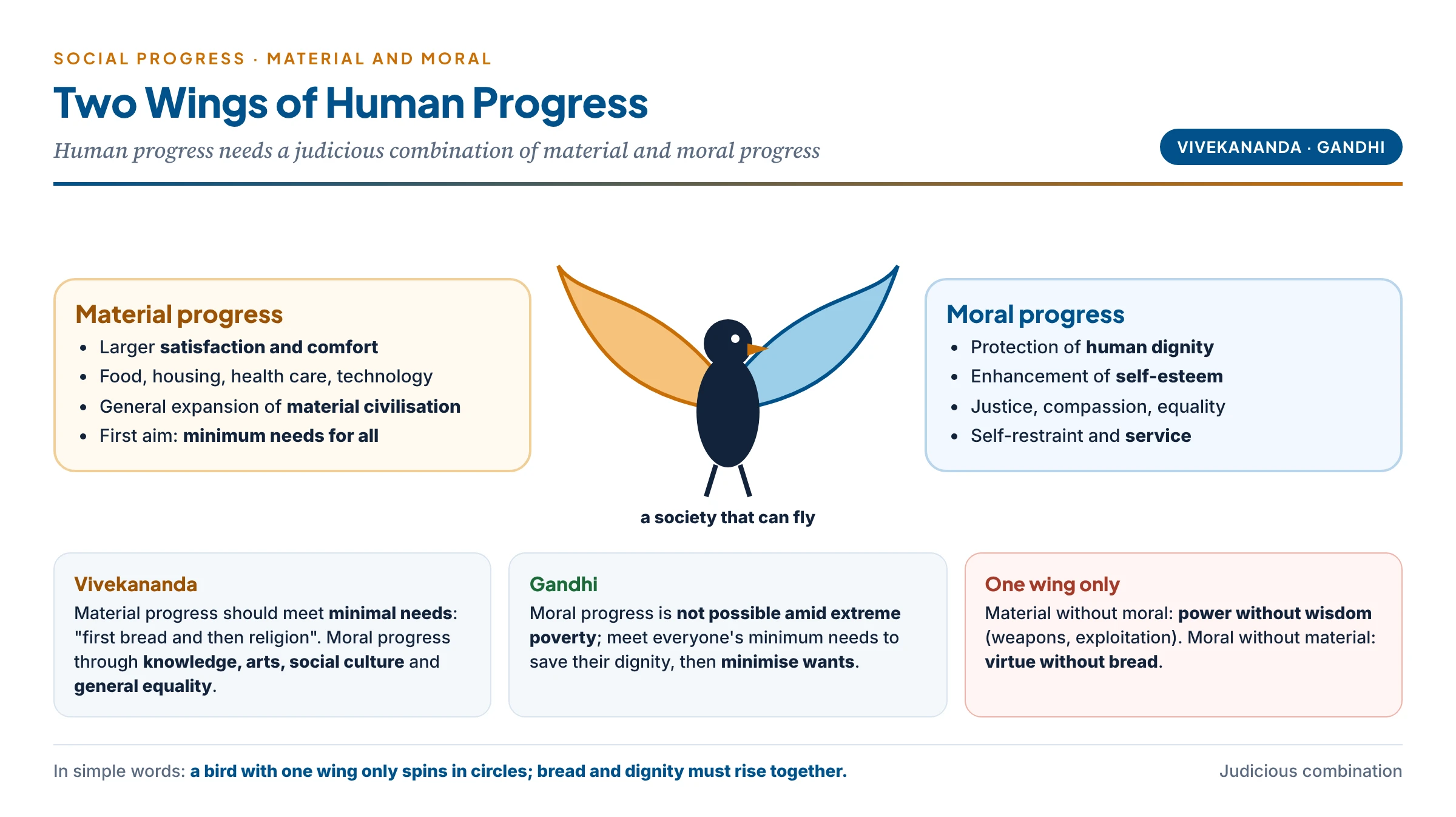
- Material progress: larger satisfaction and comfort, and a general expansion of material civilisation: food, housing, health, technology.
- Moral progress: the protection of human dignity and the enhancement of self-esteem; growth in justice, compassion and self-restraint.
- Human progress requires a judicious combination of both. Material progress without moral progress produces power without wisdom (weapons, exploitation, consumerism); moral progress without material progress leaves people hungry.
Swami Vivekananda:
- Material progress should focus on the fulfilment of minimal needs for all: “First bread and then religion”; “it is an insult to a starving people to offer them religion”.
- Moral progress comes through the expansion of knowledge, the advancement of arts and social culture, and the promotion of general equality; service of the poor is service of God (daridra-nārāyaṇa sevā).
- He wanted India to combine Western science and organisation with Indian spirituality.
Mahatma Gandhi:
- Moral progress is not possible amid conditions of extreme poverty; the minimum needs of everybody must be met to save their dignity.
- Beyond that, he commended the minimisation of wants to ensure the moral progress of human beings.
In simple words
A bird with one wing cannot fly; it only spins in circles. A society with only material progress gets richer and crueller; a society with only moral progress preaches to hungry people. Vivekananda and Gandhi both said: first give everyone bread, then help everyone grow beyond bread.
Can Eliminating Alienation Bring Social Progress?
The case for (Marx and humanist thinkers):
- Alienation is the core of unfreedom under capitalism: workers produce wealth that dominates them, do meaningless work, lose their creative human essence and see others as rivals.
- Ending it (through social ownership, democratic control of work and the end of classes) would let people realise their species-being: free, creative and cooperative. This, for Marx, is real progress: from the “realm of necessity” to the “realm of freedom”.
- Wider meanings of alienation: sociologists describe it as powerlessness, meaninglessness, normlessness, isolation and self-estrangement. Reducing these (by participation, meaningful work and community) clearly improves social life.
- Erich Fromm (The Sane Society, 1955) argued that consumer societies alienate people from themselves, producing “sick” societies; a humane, participatory society would be healthier.
- Gandhi’s bread labour, village self-rule and trusteeship also aim at work that is meaningful and controlled by the worker.
The limits:
- Alienation has many sources, not only capitalism: bureaucracy (Max Weber’s “iron cage”), technology and screens, caste, patriarchy and urban anonymity. State socialism in the Soviet Union produced its own alienation.
- Total elimination may be utopian: division of labour and large organisations are unavoidable in complex societies.
- Progress needs more than ending alienation: it also needs justice, rights, health, education and ecological balance; a society could reduce alienation while remaining poor or unfree in other ways.
- Means matter: attempts to abolish alienation by violent revolution and dictatorship produced new oppression.
Conclusion: reducing alienation (through meaningful work, participation, community and economic democracy) is a necessary part of social progress, but not sufficient: it must be joined to justice, freedom and material well-being.
Measuring Social Progress Beyond GDP
Can social progress be measured independently of economic development?
Yes, to a large extent:
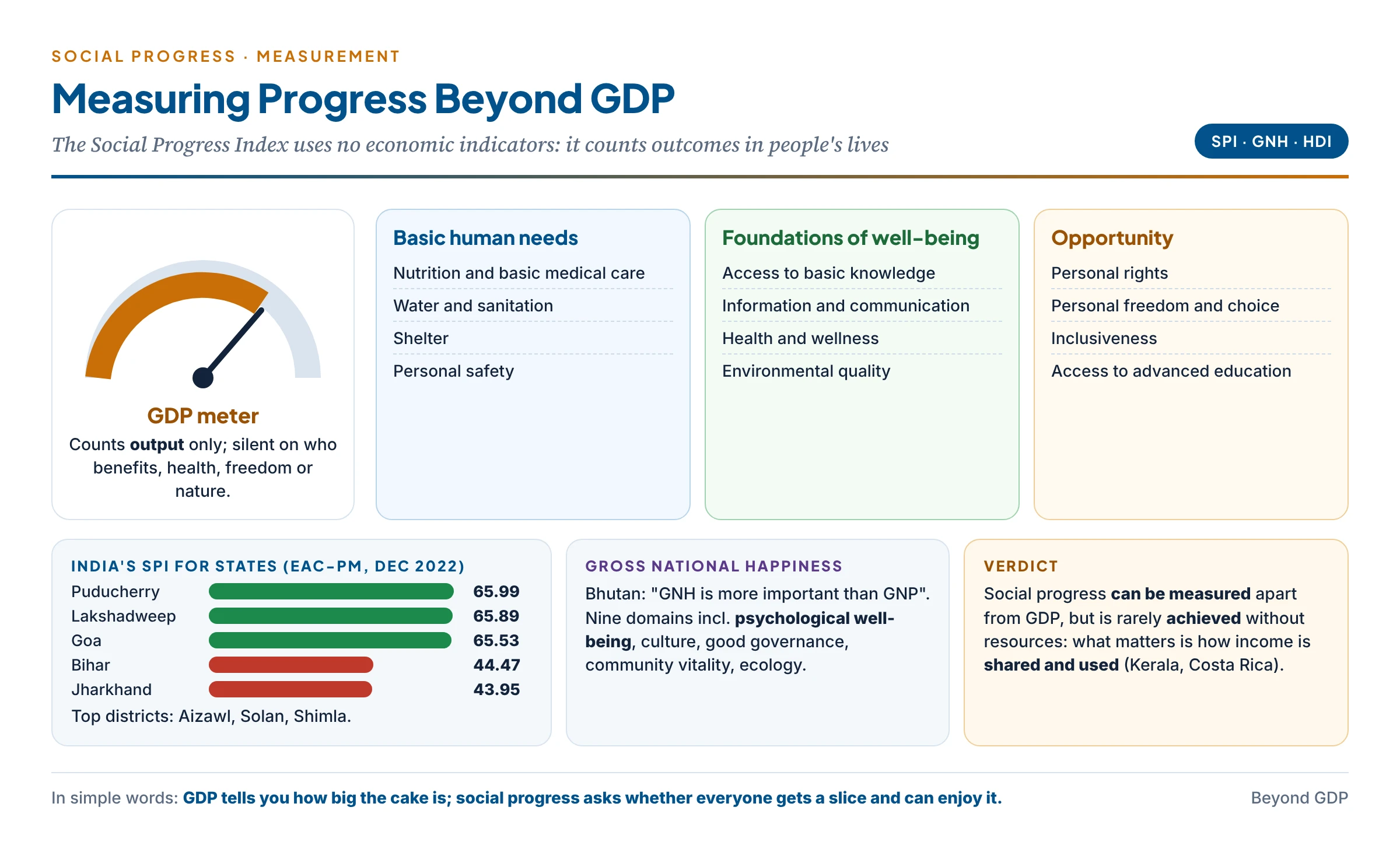
- The Social Progress Index (SPI), created by the Social Progress Imperative (launched in 2013, with the economist Michael Porter among its founders), deliberately uses no economic indicators. It measures outcomes in three dimensions and 12 components:
- Basic human needs: nutrition and basic medical care, water and sanitation, shelter, personal safety.
- Foundations of well-being: access to basic knowledge, access to information and communication, health and wellness, environmental quality.
- Opportunity: personal rights, personal freedom and choice, inclusiveness, access to advanced education.
- India’s Social Progress Index for states and districts (released by the Economic Advisory Council to the Prime Minister, December 2022) used 89 indicators for states and 49 for districts. Puducherry, Lakshadweep and Goa scored highest; Jharkhand and Bihar lowest; Aizawl, Solan and Shimla were the top districts.
- Gross National Happiness (GNH): Bhutan’s fourth King, Jigme Singye Wangchuck, declared in the 1970s that “Gross National Happiness is more important than Gross National Product”; Bhutan measures nine domains including psychological well-being, culture, good governance, community vitality and ecology.
- The World Happiness Report (from 2012) and the OECD Better Life Index (2011) measure life satisfaction, trust, social support and freedom.
- The Stiglitz–Sen–Fitoussi Commission (2009) recommended measuring well-being and sustainability separately from production.
- Evidence of divergence: some places achieve high social progress at modest income (Kerala, Costa Rica, Sri Lanka), while some rich countries do poorly on health, safety or inclusion.
But not completely:
- Economic resources pay for schools, hospitals and safety nets; across countries, social progress and income are strongly correlated.
- The HDI includes income, and many indicators depend on public spending.
- Choosing indicators and weights involves value judgements: what counts as progress differs between cultures.
Conclusion: social progress can and should be measured independently of GDP, because it concerns outcomes in people’s lives rather than the money spent. But it cannot be achieved wholly independently of economic development: income is a means, and its distribution and use decide whether it becomes progress.
The UN Declaration on Social Progress and Development (1969)
- Adopted by the UN General Assembly in 1969, it states that social progress and development shall be founded on respect for the dignity and value of the human person and shall promote human rights and social justice.
- Its aims: the continuous raising of the material and spiritual standards of living of all; the elimination of hunger, malnutrition, poverty, illiteracy and disease; the right to work; adequate housing and social security; equal rights for women; and the participation of all members of society in development.
- It was carried forward by the World Summit for Social Development (Copenhagen, 1995) and today by the SDGs.
Critical Evaluation
Criticisms and Challenges of Social Progress
- Inequality and marginalisation: social progress may not reach everyone; persistent disparities in access to resources, opportunity and representation show that “progress” often benefits the already advantaged.
- Cultural sensitivity: policies of progress can impose uniformity on diverse cultures; what one culture calls progress another may see as loss.
- Environmental sustainability: progress measured by consumption may destroy the ecological basis of future progress.
- Power structures and resistance: progress is shaped by who holds power; real changes (abolition of slavery, women’s suffrage, civil rights, Dalit rights) were won by resistance movements, not given by the powerful.
- Philosophical doubts: is history really moving forward at all? (Rousseau, Adorno and Horkheimer, Benjamin; see the next article.)
Counterarguments and Mitigation
- Inclusive policy frameworks that address the needs of diverse communities and accommodate cultural variation.
- Education and awareness on social issues, diversity and inclusion, which change attitudes over time.
- Community engagement and participatory approaches, so that communities share in decisions.
- Global collaboration between nations, international organisations and civil society on shared problems.
Critics and Defenders
Criticism — Critics of the idea of progress
- Rousseau: arts and sciences corrupted morals.
- Adorno and Horkheimer: enlightened reason turned into domination and the death camps.
- Benjamin: what we call progress is a storm piling wreckage upon wreckage.
- Cyclical thinkers (Vico, Spengler, the yuga theory): civilisations rise and fall; there is no endless ascent.
- Postmodernists and post-colonial critics: “progress” is a European story imposed on others.
Defence — Defenders of progress
- Condorcet and Kant: reason and enlightenment free humanity from superstition and tyranny.
- Hegel and Marx: history, through conflict, moves towards freedom.
- Comte and Mill: science and liberty make steady improvement possible.
- Evidence: life expectancy, literacy and the abolition of slavery and untouchability are real advances.
- Ambedkar and Sen: progress is measurable in the freedoms of the weakest, especially women and Dalits.
Cross-Tradition Comparison
| Point | Enlightenment Western view | Indian traditions |
|---|---|---|
| Shape of history | Linear, upward (Condorcet, Comte, Hegel, Marx) | Cyclical yugas; but also evolutionary spiritual ascent (Aurobindo) |
| Driver of progress | Reason, science, class struggle, evolution | Dharma, self-realisation, social reform, service |
| Content of progress | Material welfare, liberty, equality | Material and spiritual: artha within dharma, aimed at mokṣa |
| Measure | Knowledge, wealth, rights | The condition of the weakest; moral character |
| Representative thinkers | Condorcet, Hegel, Comte, Spencer, Marx | Vivekananda, Gandhi, Tagore, Aurobindo, Ambedkar |
Indian Connect — Indian Connect
- Sri Aurobindo gave a spiritual theory of progress: evolution of consciousness from matter to life to mind and on to supermind, with society moving from the “infrarational” through the “rational” to the “suprarational” age (The Human Cycle). Progress, for him, is the growth of consciousness, not only of goods.
- Vivekananda’s cycle of varṇas: power passes from priests to warriors to merchants, and the next age will belong to the labouring masses, a social progress towards equality.
Synthesis (Siddhānta)
- Social progress is change in a valued direction: towards justice, freedom, well-being and knowledge. It is therefore always a moral as well as a factual idea, and its standards come from values that must be argued for.
- The great theories (Condorcet’s reason, Hegel’s Spirit, Comte’s science, Spencer’s evolution, Marx’s material dialectic) each grasped a real driver of progress but turned it into a single, inevitable law, a confidence that the twentieth century shattered.
- A sound view treats progress as possible but not guaranteed: it requires scientific temper, a judicious combination of material and moral progress, the reduction of alienation, and measures (SPI, HDI, GNH) that look at lives, not only incomes.
- Have human beings progressed in all fields? Clearly in science, technology, health, literacy and legal equality; far less clearly in moral character, peace, and harmony with nature, where the twentieth century brought world wars, genocide and ecological crisis. Progress is uneven: humanity has gained power faster than wisdom.
“The history of the world is none other than the progress of the consciousness of freedom.” — Hegel
Previous Year Questions
- 2016Is it possible to measure social progress independent of economic development? Discuss.
- 2014By eliminating alienation can we bring social progress?
- 2005What do you understand by progress? Have human beings made progress in all fields of their activity? Discuss.