

Development and Social Progress.
Official Syllabus: Paper II, Section A, Unit 8
Mahatma Gandhi offered the most radical Indian answer to the question “what is development?” For him the West’s model of progress, with its machines, cities, endless wants and centralised power, was not development but a disease of civilisation. True development is moral and spiritual growth together with the satisfaction of everyone’s basic needs, achieved through self-restraint, village self-reliance, bread labour, trusteeship and non-violence, and judged by its effect on the last and the least. His critique, written in Hind Swaraj (1909), was long dismissed as romantic. In an age of climate change, inequality and burnout it is read again, and it inspired a line of heirs: J. C. Kumarappa’s economy of permanence, E. F. Schumacher’s “Small Is Beautiful”, and the post-development and ecofeminist critiques of Arturo Escobar and Vandana Shiva. This article explains Gandhi’s diagnosis of modern civilisation, his alternative (swadeshi, gram swarāj, sarvodaya, bread labour, trusteeship, nai talīm), the Gandhian concept of social development, the debate between ethics-first and economics-and-politics-first models, the Gandhian and Western models compared, and the criticisms and continuing relevance of this vision.
In simple words
A man’s appetite grows with every meal he is served: today two dishes, tomorrow four, next year ten, and still he is hungry. Gandhi said modern civilisation is that man: it multiplies wants and calls the multiplication “progress”. His remedy was not starvation but a sensible meal: enough for everyone’s needs, and the wisdom to stop there.
Context & Problem
- Hind Swaraj (“Indian Home Rule”) was written in Gujarati in 1909, in ten days, on board the ship Kildonan Castle returning from London to South Africa. It is a dialogue between a “Reader” (a young Indian nationalist) and an “Editor” (Gandhi).
- Its target: Indian extremists who wanted to drive the British out by violence but keep their modern civilisation: in Gandhi’s words, they wanted “English rule without the Englishman”, “the tiger’s nature, but not the tiger”.
- Influences:
- John Ruskin’s Unto This Last (1860), which Gandhi read in 1904 and paraphrased in Gujarati as “Sarvodaya” (1908).
- Leo Tolstoy: non-violence, simple living and bread labour.
- Henry David Thoreau: civil disobedience and simple life.
- Edward Carpenter’s Civilisation: Its Cause and Cure (1889), which called modern civilisation a disease.
- Indian sources: the Bhagavad Gītā (selfless action, yajña), Jainism (non-possession, non-violence) and the ideal of the self-governing village.
- His core claim: “India is being ground down, not under the English heel, but under that of modern civilisation.” Political freedom without freedom from modern civilisation would be no swarāj at all.
Core Doctrine
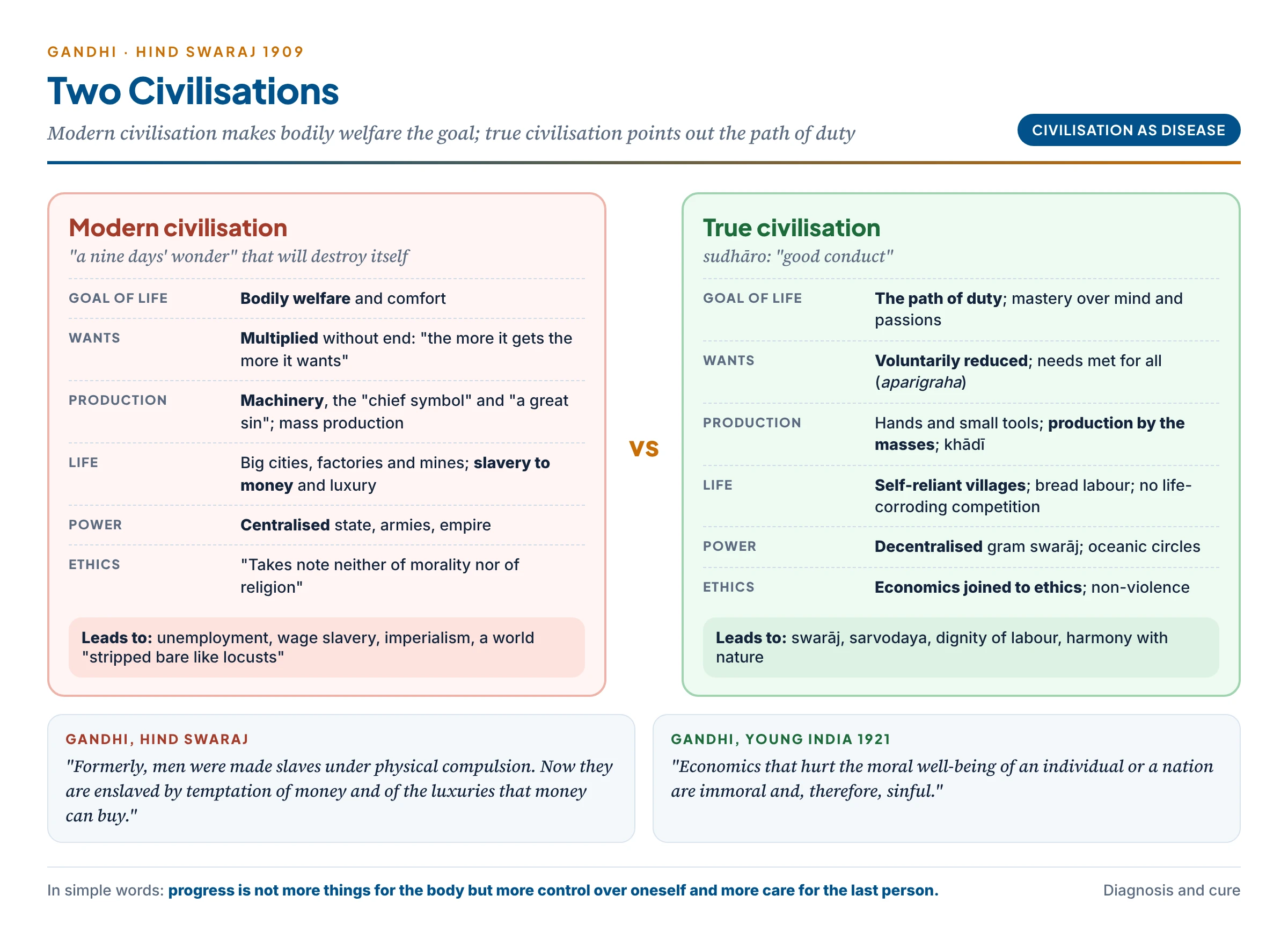
The Diagnosis: Modern Civilisation as a Disease
What modern civilisation is:
- Its true test is that people living in it make bodily welfare the object of life: better houses and clothes, machines in place of ploughs, trains and aeroplanes, guns that kill thousands from a hill, food every two hours.
- “This civilisation takes note neither of morality nor of religion.” It “seeks to increase bodily comforts, and it fails miserably even in doing so.”
- It enslaves in a new way: “Formerly, men were made slaves under physical compulsion. Now they are enslaved by temptation of money and of the luxuries that money can buy.”
- It is self-destroying: “This civilisation is such that one has only to be patient and it will be self-destroyed.” It is “a nine days’ wonder”, a passing glamour; “Civilisation is not an incurable disease”, but the English are “at present afflicted by it”.
The five charges against modern development:
- Unlimited multiplication of wants: modern economics defines progress as more desires and more commodities; the mind is “a restless bird; the more it gets the more it wants, and still remains unsatisfied.”
- Mechanisation destroys the dignity of labour: “Machinery is the chief symbol of modern civilisation; it represents a great sin.” Large-scale, labour-displacing machinery throws millions out of work, concentrates wealth in a few hands and turns workers into wage-slaves in dangerous factories and mines.
- Centralisation breeds violence: industrialism needs big cities, big markets and a big, coercive state to protect property and conquer markets; it is the root of imperialism. Gandhi warned: “God forbid that India should ever take to industrialism after the manner of the West. The economic imperialism of a single tiny island kingdom is today keeping the world in chains. If an entire nation of 300 million took to similar economic exploitation, it would strip the world bare like locusts” (Young India, 1928).
- Economics severed from ethics: “I must confess that I do not draw a sharp or any distinction between economics and ethics. Economics that hurt the moral well-being of an individual or a nation are immoral and, therefore, sinful.”
- Exploitation of nature and of the colonies: the industrial economy lives by draining the countryside, the colonies and the earth.
Railways, lawyers and doctors: in Hind Swaraj he also attacked the symbols of colonial modernity: railways (spread plague and famine, carried grain away for export, made holy places unholy), lawyers (profit from quarrels and helped sustain British rule) and doctors (cure the effects of self-indulgence so that people go on indulging).
What true civilisation is:
“Civilisation is that mode of conduct which points out to man the path of duty. Performance of duty and observance of morality are convertible terms.” — Gandhi, Hind Swaraj
- The Gujarati word for civilisation, sudhāro, means “good conduct”.
- Real happiness is “largely a mental condition”; a man “is not necessarily happy because he is rich”. India’s ancestors “set a limit to our indulgences”: they lived in small villages, used their hands and feet, and avoided “life-corroding competition”.
Machines: Gandhi’s Later Clarification
Gandhi is often called “against all machines”. His later statements are more careful:
- “What I object to is the craze for machinery, not machinery as such. The craze is for what they call labour-saving machinery. Men go on ‘saving labour’ till thousands are without work and thrown on the open streets to die of starvation” (Young India, 1924).
- He praised the Singer sewing machine as “one of the few useful things ever invented”, and welcomed machines that lighten the burden of millions of cottage workers rather than replace them.
- His test: does the machine serve people and keep them employed, or does it displace them and concentrate wealth?
- He objected equally to Indian capitalism on the Western pattern: “It would be folly to assume that an Indian Rockefeller would be better than the American Rockefeller.”
Common confusion
Was Gandhi against all machinery and all industry? No. He opposed labour-displacing machinery driven by the craze for profit and the centralisation it brings. He accepted tools and machines that help the many (the sewing machine, the spinning wheel itself is a machine), and in his later years conceded that some key industries might be needed, provided they were owned or controlled by the State for the public good, not run for private profit. His measure was always the effect on employment, dignity and decentralisation.
Need, Greed and the Voluntary Reduction of Wants
- The principle: genuine progress lies not in multiplying desires but in their deliberate and voluntary restriction. In Gandhi’s often-quoted words, civilisation “in the real sense of the term, consists not in the multiplication, but in the deliberate and voluntary reduction of wants“, which alone promotes real happiness and increases the capacity for service.
- Need vs greed: nature produces enough for everyone’s daily needs; if each took only what he needed, there would be no pauperism. Taking more than one needs is a kind of theft (asteya) from others.
- Aparigraha (non-possession): one of his ashram vows; possessions should be limited to real needs.
- Not asceticism for all: Gandhi insisted that minimum needs must be met first; moral progress is impossible amid extreme poverty: “To a people famishing and idle, the only acceptable form in which God can dare appear is work and promise of food as wages.”
Common confusion
Did Gandhi write “The earth provides enough to satisfy every man’s need, but not every man’s greed”? The sentence is not found in Gandhi’s own writings. It was reported by Pyarelal, his secretary, in Mahatma Gandhi: The Last Phase (1958). Gandhi’s own words say the same thing at greater length: “Nature produces enough for our wants from day to day, and if only everybody took enough for himself and nothing more, there would be no pauperism in this world.” The idea is authentically Gandhian; the polished one-line version is a later report.
The Gandhian Alternative
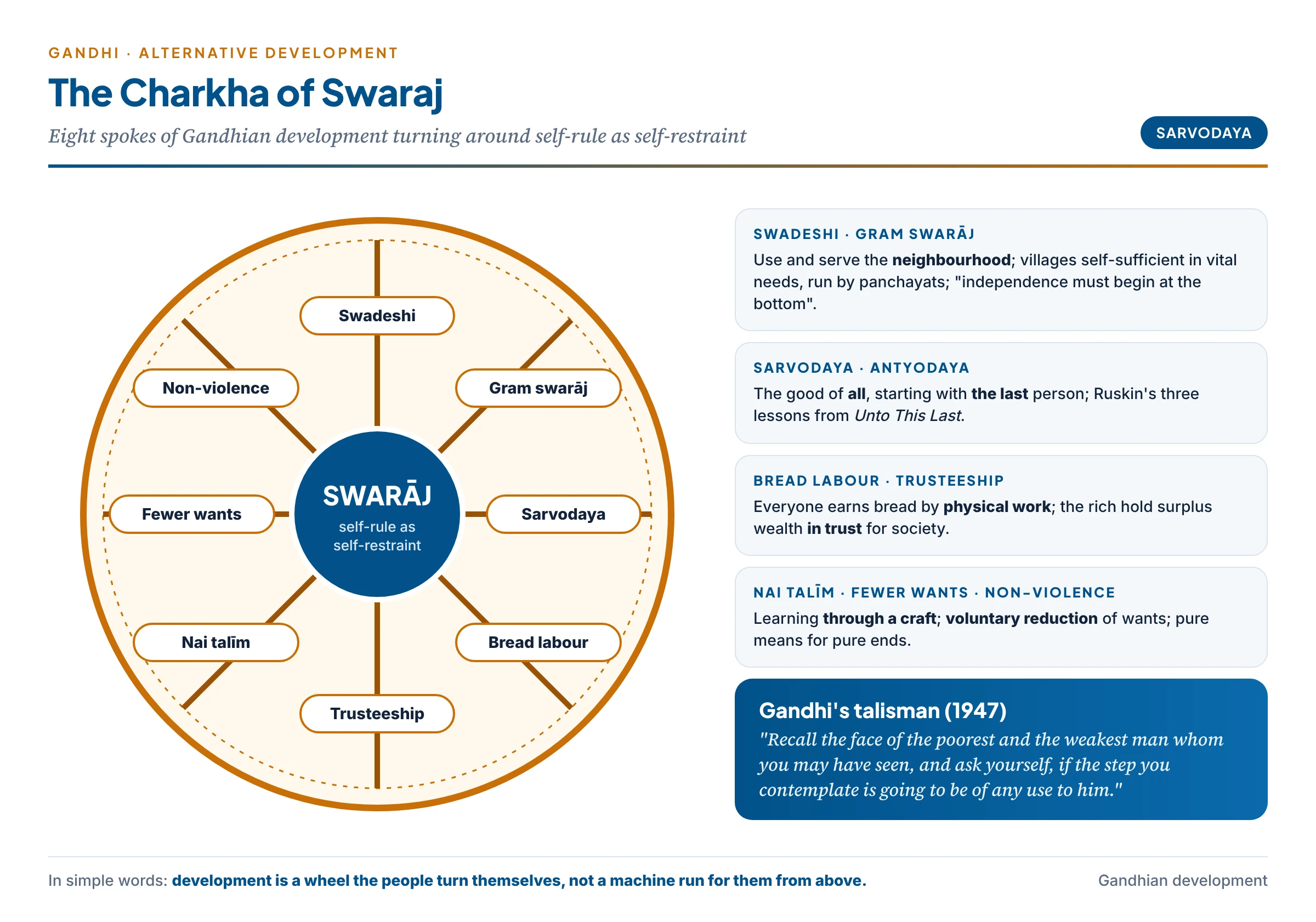
1. Swadeshi (self-reliance of the neighbourhood)
- “Swadeshi is that spirit in us which restricts us to the use and service of our immediate surroundings to the exclusion of the more remote” (1916).
- In economics: buy and use what is produced by neighbours and local artisans; khādī (hand-spun, hand-woven cloth) and the charkhā (spinning wheel) became its symbols. The charkha meant work for the idle millions, especially women, in the slack agricultural season.
2. Gram swarāj (village republics)
- Each village should be a self-sufficient republic for its vital needs (food, cloth, housing, schooling, sanitation), governed by an elected panchayat, and “capable of managing its affairs even to the extent of defending itself against the whole world”.
- “Independence must begin at the bottom.” Society is an “oceanic circle” with the individual at the centre, not a pyramid with power at the top.
- Interdependence beyond the village is allowed for things the village cannot produce.
3. Sarvodaya (the welfare of all) and antyodaya (uplift of the last)
- From Ruskin’s Unto This Last, Gandhi drew three lessons:
- The good of the individual is contained in the good of all.
- A lawyer’s work has the same value as a barber’s, as all have the same right to earn a livelihood from their work.
- A life of labour, the life of the tiller of the soil and the craftsman, is the life worth living.
- Sarvodaya rejects the utilitarian “greatest good of the greatest number”, which can sacrifice the minority; it seeks the good of all, beginning with the last person (antyodaya).
- Gandhi’s talisman (1947): “Recall the face of the poorest and the weakest man whom you may have seen, and ask yourself, if the step you contemplate is going to be of any use to him.”
4. Bread labour (śarīra-śrama)
- Every person must earn his or her bread by physical labour. Gandhi took the idea from Tolstoy (who took it from the Russian peasant writer T. M. Bondaref) and found it in the Gītā: one who eats without performing yajña (sacrifice) eats stolen food, and for Gandhi this sacrifice means bread labour.
- Purpose: to end the hierarchy that ranks mental labour high and manual labour low, a hierarchy rooted in the caste system; to give dignity to scavengers, farmers and weavers; and to make everyone share in producing what all consume.
In simple words
Imagine an ashram where the professor, the lawyer and the sweeper all spend the first hour of the day in the fields and the latrines before going to their desks. No one can look down on manual work that he does himself. That is bread labour: a daily lesson in equality, written with the hands.
5. Trusteeship
- The rich should regard their surplus wealth not as private property but as held in trust for the welfare of society, especially the poorest. Capital and labour should cooperate, not fight.
- Trusteeship provides a means of transforming the present capitalist order into an egalitarian one by persuasion, with legislation to regulate ownership if persuasion fails (the “Practical Trusteeship Formula”).
6. Nai talīm (basic education)
- Proposed in 1937 (the Wardha scheme): learning through a productive craft (spinning, weaving, carpentry, agriculture), in the mother tongue, uniting hand, head and heart, so that schooling makes children self-reliant and respects manual work.
7. Non-violence and the purity of means
- “The means may be likened to a seed, the end to a tree.” A non-violent, decentralised economy cannot be built through violent, centralised methods.
The Gandhian Concept of Social Development
For Gandhi, social development is the moral and material uplift of every member of society, beginning with the most oppressed, through non-violent self-effort. Its main features:
- Sarvodaya and antyodaya: the good of all, judged by the condition of the last person.
- Removal of untouchability: he called it “a blot” and “a crime against God and man”; founded the Harijan Sevak Sangh (1932); worked for temple entry and the dignity of scavenging work.
- Equality of women: women’s participation in the freedom struggle, opposition to child marriage, purdah and dowry; he called woman “the nobler sex”.
- Communal harmony: Hindu–Muslim unity was his first constructive goal; he gave his life for it.
- Economic equality: trusteeship, swadeshi, khādī and village industries to give work and dignity to all.
- Basic education (nai talīm) and adult education.
- Health and sanitation: village cleanliness, sanitation and nature cure; “Sanitation is more important than independence“, he said.
- Prohibition of liquor, which ruined poor families.
- Decentralised democracy: gram swarāj and panchayats.
- The Constructive Programme (1941): eighteen items including communal unity, removal of untouchability, prohibition, khādī, village industries, village sanitation, basic education, adult education, uplift of women, health education, provincial languages, a national language, economic equality, and the welfare of peasants, labourers, adivasis, lepers and students. Gandhi saw it as “the truthful and non-violent way of winning Poorna Swaraj”: freedom built from below by social reconstruction.
Its philosophical basis:
- Unity of all life (Advaita and the Gītā): service of others is service of the self and of God; daridra-nārāyaṇa, God in the poor.
- Swarāj as self-rule: social development begins with self-purification and self-restraint; outer reform without inner change will not last.
- Duties before rights: “The true source of rights is duty. If we all discharge our duties, rights will not be far to seek.”
Its legacy: Articles 40 (village panchayats), 43 (cottage industries), 46 (weaker sections), 47 (prohibition and nutrition) and 48 (cow protection) of the Directive Principles; Article 17 (abolition of untouchability); the 73rd Amendment (Panchayati Raj); Vinoba Bhave’s Bhoodan (1951), which collected over four million acres in land gifts; MGNREGA and the Khadi and Village Industries Commission.
Indian Connect — Indian Connect
- Vinoba Bhave carried sarvodaya forward through Bhoodan (land gift, from 1951) and Gramdan (village gift).
- Jayaprakash Narayan turned it into “Total Revolution” (1974).
- Chipko (1973) and the Narmada Bachao Andolan (from 1985) used Gandhian methods to resist destructive development; Anna Hazare’s Ralegan Siddhi (watershed development) and Mendha-Lekha (forest self-rule) are village experiments in gram swarāj.
Social Development Rooted in Ethics vs Progress Based on Economic and Political Ideals
Two broad ways of thinking about how a society improves:
| Point | Ethics-first social development (Gandhi, Vivekananda, Tagore, Aurobindo) | Progress through economic and political ideals (liberalism, Marxism, technocracy) |
|---|---|---|
| Starting point | Moral transformation of the individual: truth, non-violence, self-restraint, service | Institutions: markets, rights, the state, ownership, planning |
| Measure of success | Character, harmony, the condition of the last person | Income, growth, rights won, equality of resources |
| Means | Persuasion, constructive work, purity of means | Law, policy, revolution, technology |
| Role of the state | Minimal and decentralised; society reforms itself | Central: the state guarantees rights or plans the economy |
| Danger | Moralism, paternalism, slowness; “change of heart” may never come | Materialism, alienation; institutions without virtue become empty or corrupt |
Evaluation:
- The ethical view is strong where institutions fail without virtue: laws against dowry, untouchability or corruption do little if people’s attitudes do not change. Economic growth without ethics produces inequality, consumerism and ecological ruin.
- The economic-political view is strong where virtue is not enough: hungry people cannot be moralised into well-being, and the oppressed need rights and power, not only the goodwill of the powerful. Ambedkar insisted that social change needs law, constitutional safeguards and political power, not only appeals to the conscience of the caste Hindu.
- Synthesis: the two need each other. Gandhi himself used political means (satyagraha, Congress) and economic programmes (khādī); liberals and Marxists appeal to moral ideals (dignity, freedom, the end of exploitation). The Indian Constitution joins them: Fundamental Rights and Directive Principles (political-economic) together with Fundamental Duties and the moral ideals of the Preamble.
The Gandhian and Western Models Compared
| Western model | Gandhian model |
|---|---|
| Emphasis on industrialisation | Emphasis on the agrarian economy and village industries |
| Urbanisation | Village-centric model (gram swarāj) |
| Materialism and consumerism dominate; necessities keep expanding | Spiritualism dominates; necessities are limited, not expanded |
| Controlling and defeating nature | Living in harmony with nature |
| Direct (private or state) ownership of resources | Trusteeship model |
| Mass production by machines | Production by the masses, by hand and small tools |
| Centralised state and markets | Decentralised, self-governing villages |
| Progress measured by output and income | Progress measured by the condition of the last person and moral growth |
Gandhi’s Heirs
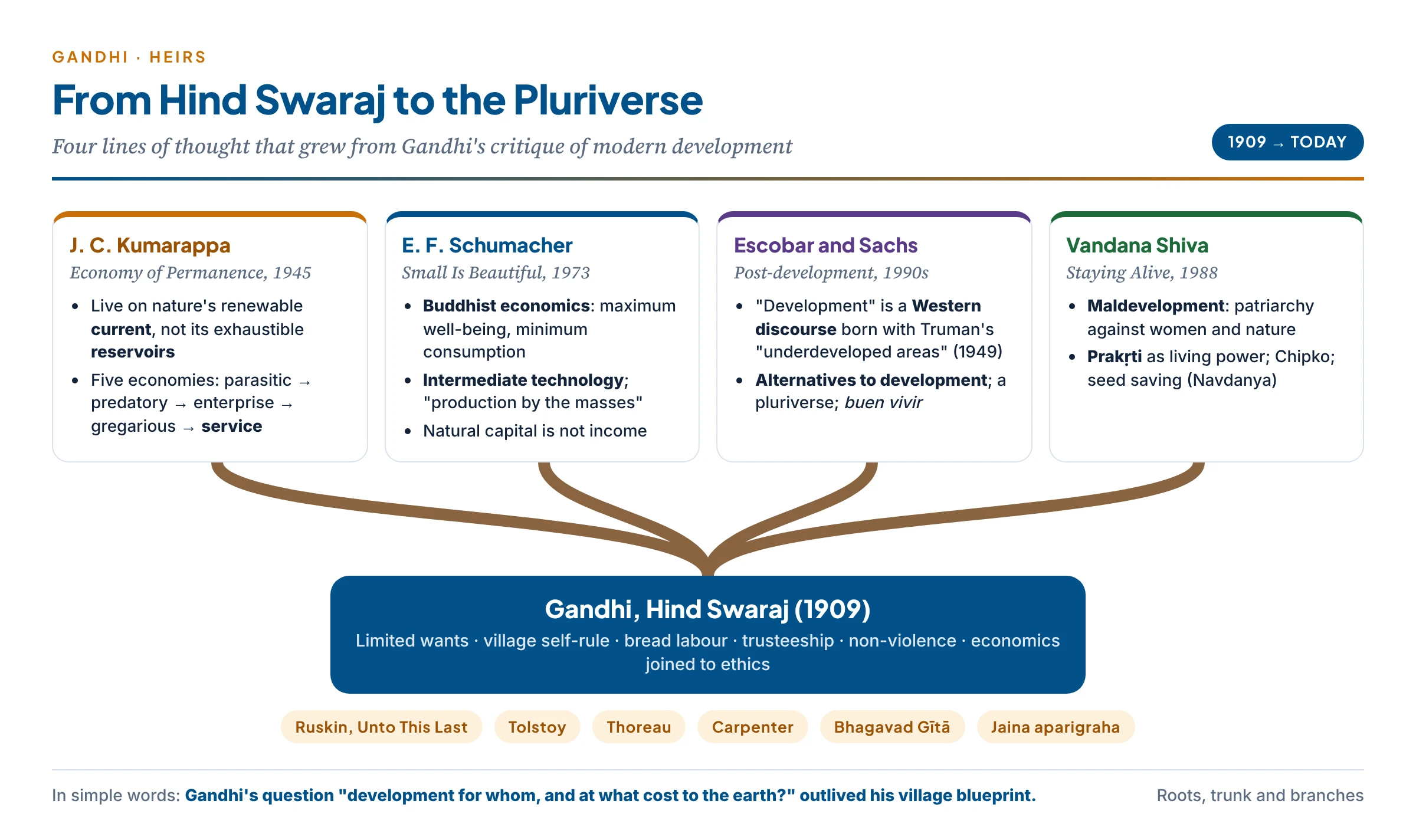
1. J. C. Kumarappa: the economy of permanence
- J. C. Kumarappa (1892–1960), Gandhi’s chief economist, wrote Economy of Permanence (1945).
- Two kinds of economy:
- An economy of transience draws on “reservoirs” of nature that can be exhausted (coal, oil, minerals); it is violent, centralised and cannot last.
- An economy of permanence draws on the renewable “current” of nature (sun, rain, soil, forests, human labour); it can continue indefinitely and is non-violent.
- Five stages of economic life, from the lowest to the highest: the parasitic and predatory economies (taking without giving), the economy of enterprise (working for one’s own gain), the gregarious economy (working together for the group, like bees), and the economy of service (working for others without seeking return, like a parent). Development should move up this ladder towards service.
In simple words
A family that lives on its monthly salary can go on for ever; a family that lives by selling the family gold is rich for a few years and then ruined. Kumarappa said industrial economies live on nature’s gold (coal, oil, minerals); an economy of permanence lives on nature’s salary (sun, rain, soil and human work).
2. E. F. Schumacher: “Small Is Beautiful” (1973)
- E. F. Schumacher, a German-British economist, subtitled his book A Study of Economics as if People Mattered.
- Buddhist economics (a chapter written after he advised the government of Burma in 1955): conventional economics measures the standard of living by the amount of consumption; Buddhist economics aims at “the maximum of well-being with the minimum of consumption”. Work is not a cost to be minimised but a chance to use one’s faculties, overcome ego-centredness by working with others, and produce what is needed.
- Intermediate technology: instead of giant, capital-intensive, energy-hungry factories, use small, cheap, decentralised and ecologically sound technologies that employ many people. He quoted Gandhi: the poor of the world cannot be helped by mass production, only by “production by the masses”.
- Natural capital: modern industry treats irreplaceable natural capital (fossil fuels, soil, the environment’s capacity to absorb pollution) as income to be spent.
3. Post-development: Arturo Escobar and Wolfgang Sachs
- Arturo Escobar, a Colombian anthropologist, argued in Encountering Development: The Making and Unmaking of the Third World (1995) that “development” is not an objective reality but a Western discourse (a way of speaking that creates what it describes) invented after the Second World War.
- Its birth: when US President Harry Truman, in his inaugural address of 1949, spoke of the “underdeveloped areas” of the world, two billion people were, in effect, labelled underdeveloped overnight.
- Its effects: the discourse pathologises traditional cultures as “backward”, hands power to Western experts, the World Bank and national technocrats, and homogenises diverse ways of life into one model of consumer society.
- Wolfgang Sachs, editor of The Development Dictionary (1992), wrote that the idea of development “stands like a ruin in the intellectual landscape”.
- The alternative: not “development alternatives” but “alternatives to development”: local, plural ways of living well, a “pluriverse”. Example: buen vivir (“living well” in harmony with community and nature), drawn from Andean indigenous traditions and written into the constitution of Ecuador (2008), which also gives rights to nature.
In simple words
Call a healthy, contented village “underdeveloped” and it soon begins to see itself as sick, waiting for outside doctors to cure it. Post-development thinkers say the word itself did this to most of the world in 1949: it turned difference into deficiency.
4. Vandana Shiva: ecofeminism and “maldevelopment”
- Vandana Shiva, Indian physicist and activist, in Staying Alive: Women, Ecology and Survival in India (1988), called Western development “maldevelopment”: a patriarchal project that subjugates women and nature together.
- Her argument:
- Modern reductionist science and the market treat nature as dead matter and women’s subsistence work as “unproductive” because it earns no money.
- This violates the feminine principle, Prakṛti or Śakti, the living, creative power of nature in Indian thought.
- Women’s knowledge of seeds, forests, water and food sustains life; the Chipko women defended forests as sources of life, not timber.
- The Green Revolution brought chemical monocultures that degraded soils and seed diversity; she founded Navdanya (1987) to save indigenous seeds.
- Criticism: the economist Bina Agarwal argued that women’s closeness to nature is not essential (built into being female) but material: it comes from the gendered division of labour (women collect fuel, fodder and water), so the remedy is change in property and power, not a romantic “feminine principle”.
Critical Evaluation
Criticisms of the Gandhian Model
- Utopian: a society of self-sufficient villages and limited wants is an ideal that real people, who desire comfort and mobility, will not choose.
- Against scientific advancement: it seems to reject modern science, medicine and technology; modern health care, defence, communications and digital trade cannot be run by village republics.
- “There will be no development”: without industry, a poor country cannot generate the surplus for schools, hospitals and pensions, or the jobs for a growing population.
- Agrarian bias: it gives too much importance to the agricultural sector and village crafts, which have low productivity.
- Romanticises the village: Nehru wrote to Gandhi (1945) that the village is normally “backward intellectually and culturally”. Ambedkar was harsher: “What is the village but a sink of localism, a den of ignorance, narrow-mindedness and communalism?” (Constituent Assembly, 1948). For Dalits, the self-governing village often meant caste tyranny.
- Trusteeship is naive: the rich rarely give up wealth voluntarily; without force of law it leaves property relations intact.
- Moral demands on the poor: asking the poor to limit their wants can sound like preaching contentment to the deprived.
Significance and Relevance
- No class division: trusteeship and bread labour aim at a society without class war.
- Environment-friendly: limited wants and local production keep human demand within nature’s limits: the core of today’s sustainability and degrowth debates.
- More employment: labour-intensive village industries provide work for millions, a lesson for a country facing jobless growth and automation.
- A spiritual boost: it restores meaning, community and self-restraint to economic life.
- Decentralisation: the 73rd Amendment and participatory planning carry Gandhi’s idea into the Constitution.
- Climate and consumerism: global warming, biodiversity loss, consumer burnout and extreme inequality have vindicated his warning that an economy of infinite consumption on a finite planet cannot last. Mission LiFE, circular economy and “slow” and local movements are his unconscious heirs.
- The normative core survives: even if his literal village model is impractical, his ideals of voluntary simplicity, human-scale technology, dignity of labour and moral responsibility remain an indispensable corrective.
Critics and Defenders
Criticism — Critics
- Nehru: modern science and heavy industry are needed to end poverty; the village is culturally backward.
- Ambedkar: the village is “a sink of localism”; Dalits need rights, the city and the state, not village self-rule.
- Marxists: trusteeship protects capitalists; a “change of heart” cannot replace class struggle.
- Economists: village self-sufficiency means low productivity and lasting poverty.
- Bina Agarwal (against ecofeminism): linking women to nature by essence romanticises their burdens.
Defence — Defenders and strengths
- Schumacher and Kumarappa: a permanent, human-scale economy is the only one that can last.
- Environmentalists: Gandhi foresaw that Western consumption cannot be universalised without stripping the earth bare.
- Sen and the capability school: Gandhi’s talisman and swaraj anticipate judging development by people’s real freedoms.
- Post-development thinkers: he exposed development as a Western civilisational project, not a neutral fact.
- Constitution-makers: panchayats, cottage industries and the abolition of untouchability carry his vision into law.
Cross-Tradition Comparison
| Point | Gandhi | Marx | Schumacher | Escobar and Shiva |
|---|---|---|---|---|
| Diagnosis | Moral disease of multiplying wants; machines and centralisation | Capitalist exploitation and alienation | Gigantism; consumption of natural capital | Western discourse and patriarchal maldevelopment |
| Attitude to industry | Opposes labour-displacing, centralised industry | Welcomes industry; wants social ownership | Prefers small, intermediate technology | Questions industrial modernity itself |
| Agent of change | Self-purifying individual and village | Working class through revolution | Communities and appropriate technology | Local, indigenous and women’s movements |
| Goal | Sarvodaya and swaraj | Communist society | “Economics as if people mattered” | A pluriverse of ways of living well |
| Means | Non-violence, persuasion, constructive work | Class struggle | Policy and design | Resistance and revival of local knowledge |
Indian Connect — Indian Connect
- Aparigraha (Jaina and Yoga ethics) and the Īśa Upaniṣad’s “tena tyaktena bhuñjīthāḥ, mā gṛdhaḥ kasyasvid dhanam” (“enjoy through renunciation; do not covet anyone’s wealth”) are the ancient roots of Gandhi’s voluntary limitation of wants. Gandhi said that if all the Upaniṣads were lost and only this first verse survived, Hinduism would live for ever.
- Arne Naess, the founder of deep ecology, and Martin Luther King Jr. both acknowledged Gandhi as a teacher, showing how his idea of development travelled far beyond India.
Synthesis (Siddhānta)
- Gandhi’s critique of modern development is a moral critique: a civilisation that makes bodily welfare its goal, multiplies wants and separates economics from ethics will produce exploitation, violence and ecological ruin. True civilisation is the path of duty.
- His alternative (swadeshi, gram swarāj, sarvodaya, bread labour, trusteeship, nai talīm) is a model of development measured by the last person and by moral growth.
- Taken literally, the model faces serious objections from Nehru, Ambedkar and economists: modern science, industry, cities and the state are needed to end poverty and caste oppression.
- Taken as a normative compass, it is more relevant than ever: Kumarappa, Schumacher, deep ecology, post-development and ecofeminism all develop his insight that development must be human-scale, ethical, decentralised and within nature’s limits.
“There is enough for everybody’s need, but not for everybody’s greed.” — attributed to Gandhi (reported by Pyarelal)
Previous Year Questions
- 2020State and examine the Gandhian concept of social development.
- 2017Evaluate the concept of social development as rooted in ethical principles against the concept of social progress being based on economic and political ideals.