

Crime and Punishment: Corruption, Mass Violence, Genocide, Capital Punishment.
Official Syllabus: Paper II, Section A, Unit 7
Capital punishment — the death penalty — is the deliberate, lawful killing of a person by the State as punishment for a crime, after a judicial process. It is the sharpest test of every theory of punishment, because it is the one penalty that cannot be undone. Is it ever morally justified? Retributivists like Kant said that a murderer must die; utilitarians like J.S. Mill defended it as a deterrent; Beccaria, the later Bentham, Camus, Gandhi and Ambedkar argued against it. Behind the debate lie deep questions: Is the right to life absolute, or can it be forfeited? Does death deter better than life imprisonment? Can a fallible State be trusted with an irreversible penalty? This article sets out the moral arguments for and against, the difference between the deontological and consequentialist cases, the evidence on deterrence, and a balanced evaluation. The Indian law and global practice follow in Article 7.
In simple words
A doctor who gives the wrong medicine can stop it, give an antidote, apologise and compensate. A tailor who cuts a cloth too short can patch it. But a surgeon who removes the wrong kidney cannot put it back. Most punishments are like medicine — they can be stopped or compensated if they turn out to be a mistake. The death penalty is the one surgery that can never be reversed. That single fact sits at the centre of the whole debate.
Context & Problem
Meaning and Scope
- Capital punishment — from Latin caput, “head” — is the death sentence awarded by a court under due process of law and carried out by the State.
- Methods used in the world today include hanging (India), lethal injection, shooting, beheading and gas.
- Crimes: most retaining countries reserve it for murder, terrorism and treason; some also impose it for drug trafficking, rape, or corruption.
- The world picture (end of 2025): 113 countries have abolished it for all crimes and 145 have abolished it in law or practice; executions were recorded in 17 countries in 2025, and 2,707 executions were recorded worldwide (excluding China’s thousands) — the highest figure since 1981, driven mainly by Iran and Saudi Arabia.
- Abolition is a condition of membership of the European Union and the Council of Europe.
Why It Is the Hardest Case
- It is irreversible — no correction after a mistake.
- It ends the person — no reform, no repentance, no restitution is possible afterwards.
- It is inflicted on a person already in the State’s power — disarmed and harmless at the moment of execution.
- It touches the most basic right — the right to life — which the State exists to protect.
Core Doctrine
The Case for Capital Punishment (Retentionist Arguments)
- Retributive justice — “life for life”:
- Kant: “If he has committed murder, he must die. There is no substitute that will satisfy justice.” Only death is equivalent to the deliberate taking of a life; anything less dishonours the victim’s worth.
- Hegel: punishment honours the murderer as a rational being who must answer for what he willed.
- The island example: even a dissolving society must first execute the last murderer, so that “blood-guilt” does not cling to the people (Article 2).
- Deterrence:
- Death is the punishment people fear most; its unique finality is said to give it unique preventive force, especially for calculated crimes — contract killing, terrorism, organised crime.
- J.S. Mill (1868 speech in Parliament): against those who wished to abolish it, Mill argued that death is the most impressive penalty, that its threat deters more than its actual cruelty, and that for the worst murders it is less cruel than a lifetime of hard labour.
- Incapacitation (prevention): an executed murderer can never kill again — in prison, after escape or on release.
- Denunciation (expressive): the death penalty expresses society’s deepest condemnation; abolishing it may be felt as devaluing the victim’s life.
- Justice for victims: debates often think only of the rights of the accused and forget the rights of victims and their families, for whom anything less can seem a betrayal.
- Forfeiture of the right to life:
- Locke: a murderer has declared war on mankind and forfeited his life; he “may be destroyed as a lion or a tiger”.
- Rousseau: “It is in order not to become the victim of a murderer that one consents to die if one becomes one.” Under the social contract, each accepts this condition for his own safety.
- Extreme cases: a new breed of terrorists who plan the mass killing of innocents, or cruel crimes such as gang rape followed by murder and honour killing — a deliberate dishonour of humanity — seem to call for the ultimate penalty. On this view it must be retained in the statute books, even if rarely used.
- Humane method required: even retentionists agree that, when awarded, death must be peaceful, not extremely painful (burning alive, stoning). Kant himself insisted the execution be free of any mistreatment that degrades humanity.
The Case Against Capital Punishment (Abolitionist Arguments)
- Irreversibility and fallibility — the strongest argument:
- Human justice makes mistakes: mistaken identity, false confessions, perjured witnesses, poor lawyers, forensic error.
- If an executed person is later shown to be innocent by new evidence, nothing can undo it — an irremediable absolute injustice.
- India: in the decade 2016–2025, 364 persons who should not even have been convicted spent time on death row; the Supreme Court did not confirm a single death sentence in 2023, 2024 or 2025, and acquitted several death-row prisoners (Article 7).
- Discrimination and arbitrariness:
- The death penalty falls overwhelmingly on the poor, the illiterate and the marginalised; the well-to-do defend themselves with the best lawyers and benefit from the “benefit of the doubt”.
- Whether a person lives or dies often depends on the quality of his lawyer and the composition of the bench — not on the crime alone.
- No proven deterrent effect:
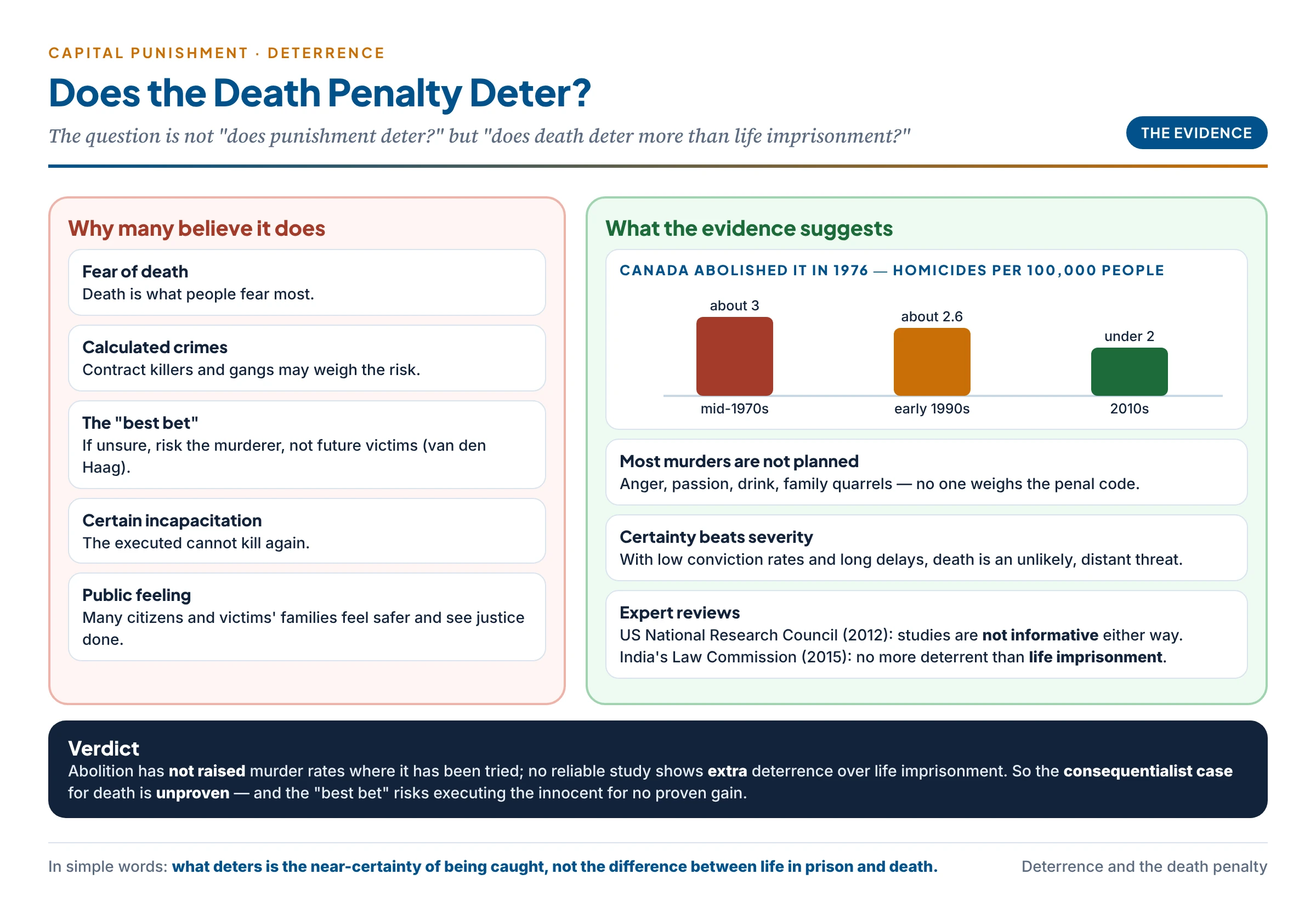
- Empirical studies show that the murder rate does not go up when the death penalty is abolished, nor does it go down when it is reintroduced.
- The US National Research Council (2012) concluded that research to date is not informative about whether capital punishment decreases, increases, or has no effect on homicide rates, and should not be used to make policy.
- What matters is whether death deters more than life imprisonment — and no reliable evidence shows that it does.
- The State cannot give life, so it has no right to take it: life is not the State’s gift; the State exists to protect life.
- Inalienable right to life (Beccaria): in the social contract each person gave up only the smallest portion of his liberty; no one gave the State the right to take his life — for no one has the right to kill himself.
- Forecloses reform: death ends every possibility of repentance, reform and restitution — the aims modern penology and Indian jurisprudence stress.
- The State teaches violence: a State that kills teaches the very lesson it wishes to unteach — that killing solves problems. Some studies even suggest a “brutalisation effect” after executions.
- Cruelty beyond the crime (Camus): the condemned suffers years of waiting, the anticipation of a known date — a torment few murderers inflict on their victims.
- Moral and religious traditions: ahiṃsā (Buddha, Mahāvīra, Gandhi); Gandhi — “an eye for an eye makes the whole world blind“; many modern religious authorities now oppose it.
- Global trend and human rights: two-thirds of the world has abolished it; the UN General Assembly has repeatedly called for a moratorium (130 votes in favour in December 2024).
Camus — “Reflections on the Guillotine”
- Albert Camus (1957), whose own father had been sickened by watching an execution, argued that the death penalty is not “life for life” at all:
- An execution is “the most premeditated of murders“, to which no criminal’s deed, however calculated, can be compared.
- For true equivalence, the penalty would have to punish a murderer who had warned his victim of the date of his horrible death and then kept him confined at his mercy for months. Such a monster is rarely met in private life.
- The real reason for retaining the penalty, Camus suggested, is vengeance dressed as justice.
Deontological vs Consequentialist Justifications
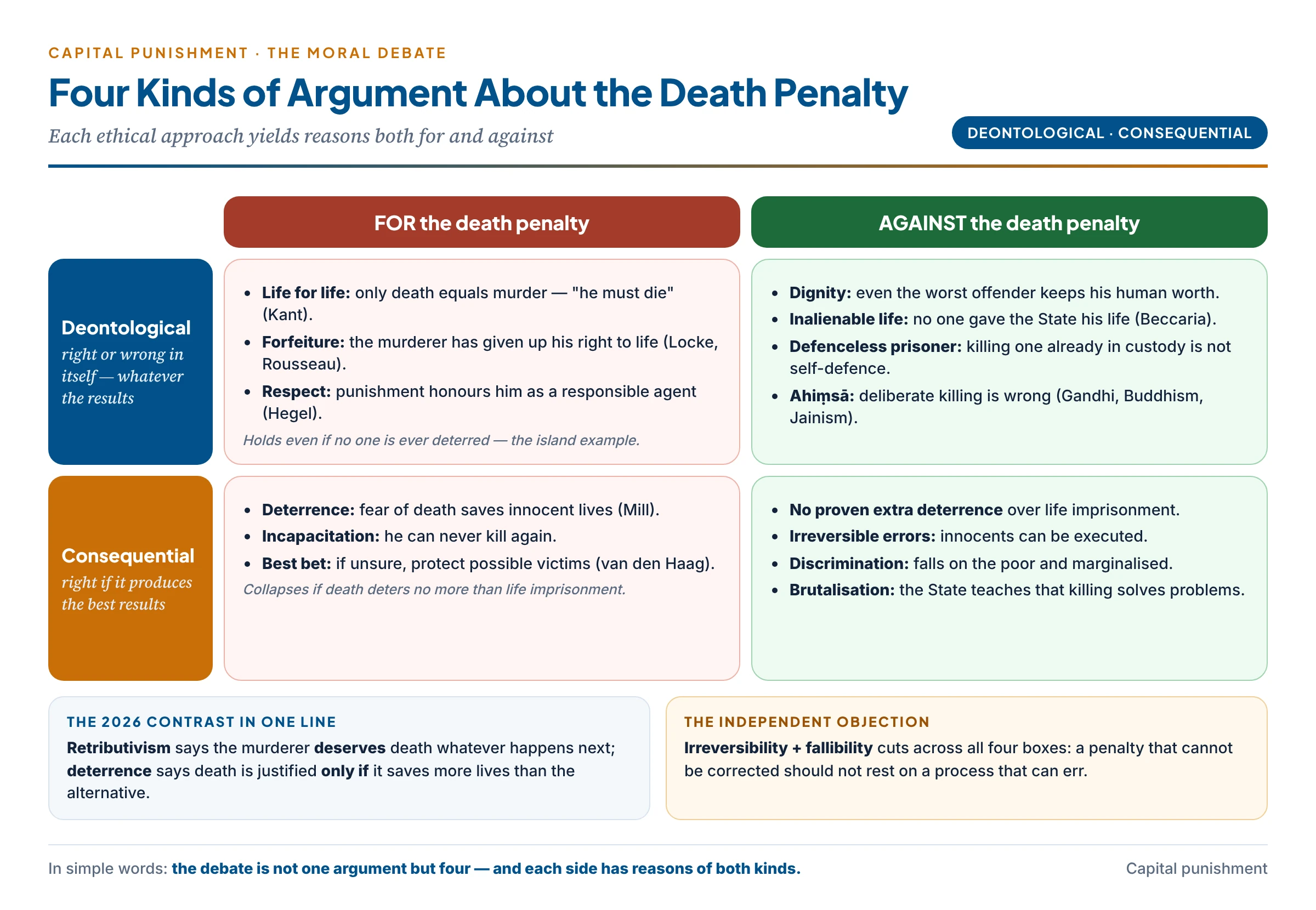
The 2026 paper asked us to explain that “retributivism presents a deontological justification for capital punishment, whereas deterrence presents a consequential justification for it“.
- Deontological (retributive) justification:
- Meaning: an act is right or wrong in itself, by its nature, regardless of consequences.
- Applied to death: the murderer deserves to die because of what he did. Death is the only punishment equal to murder (Kant’s jus talionis).
- Key feature: the justification would hold even if executions deterred no one — Kant’s island example shows it.
- It respects the criminal as a rational agent responsible for his act (Kant, Hegel).
- It also sets limits: only the guilty, only for the gravest crime, and without cruelty.
- Consequential (deterrent) justification:
- Meaning: an act is right if it produces the best results.
- Applied to death: capital punishment is justified if and only if it saves lives — by deterring future murderers or disabling the dangerous — more effectively than any alternative such as life imprisonment.
- Key feature: the justification depends on evidence. If death does not deter more than life imprisonment, the consequentialist case collapses.
- It looks to the future and to society as a whole; the executed person is, in part, a means to protect others.
- The contrast:
| Point | Deontological (retributive) | Consequential (deterrent) |
|---|---|---|
| Basis | Desert — what the murderer did | Results — lives saved in future |
| Direction | Backward | Forward |
| Depends on evidence? | No | Yes, entirely |
| If no deterrence | Still justified | Not justified |
| View of offender | An end — responsible agent | Partly a means — an example |
| Main weakness | Cannot answer irreversibility of error; lex talionis is unworkable for other crimes | Deterrence unproven; could justify executing the innocent or excess |
- Both families also produce arguments AGAINST: deontologists argue that human dignity and an inalienable right to life forbid the State to kill a defenceless prisoner; consequentialists argue that the death penalty has no extra deterrent effect and that its errors, costs and brutalising effects outweigh any benefit.
In simple words
Two people defend the same rule — “No phones during the test.” The first says, “Using a phone in an exam is cheating, and cheating is simply wrong” — that is a deontological reason; it holds even if no one ever gets caught. The second says, “The rule raises the average honesty of results and protects good students” — a consequentialist reason; if it stopped working, he would drop the rule. The death-penalty debate has the same two kinds of reasons — and that is why the two sides often talk past each other.
Is Capital Punishment an Effective Deterrent?
The 2024 paper asked on what grounds one would accept or reject capital punishment as an effective deterrent.
Grounds for accepting it:
- Common sense: people fear death more than anything; the ultimate penalty should have the ultimate effect.
- Calculated crimes: contract killers, organised gangs and some terrorists plan their crimes and may weigh the risk.
- The “best bet” argument (Ernest van den Haag): if we do not know whether it deters, it is better to risk executing guilty murderers than to risk the lives of innocent future victims.
- Incapacitation is certain: an executed person cannot kill again.
Grounds for rejecting it:
- Most murders are not calculated — they occur in anger, passion, intoxication, family quarrels or mental disturbance, where no one weighs the penal code.
- Terrorists and fanatics often seek death as martyrdom; execution may make them heroes.
- Certainty, not severity, deters (Beccaria): with low conviction rates and decades of delay, the death penalty is an unlikely and distant threat.
- Evidence: abolition has not raised murder rates — Canada, after abolishing it in 1976, saw its homicide rate fall over the following decades; US states without the death penalty have consistently had lower or similar murder rates than those with it; the NRC (2012) found no reliable evidence either way.
- Life imprisonment already gives most of whatever deterrent and preventive effect punishment can have.
- India’s Law Commission (262nd Report, 2015) found that the death penalty does not serve the penological goal of deterrence any more than life imprisonment.
- The “best bet” fails: if the extra deterrent effect is unknown and probably zero, the bet risks executing the innocent for no gain.
In simple words
Ask a hundred people who have shoplifted whether they thought about the jail term before doing it. Almost none did; most thought only, “Will I get caught?” A thief caught nine times out of ten is deterred by a small fine; a thief caught once in a hundred times ignores even a terrible penalty. The same logic applies to murder: the chance of being caught and convicted quickly shapes behaviour far more than the difference between life imprisonment and death.
Can the Right to Life Be Absolute?
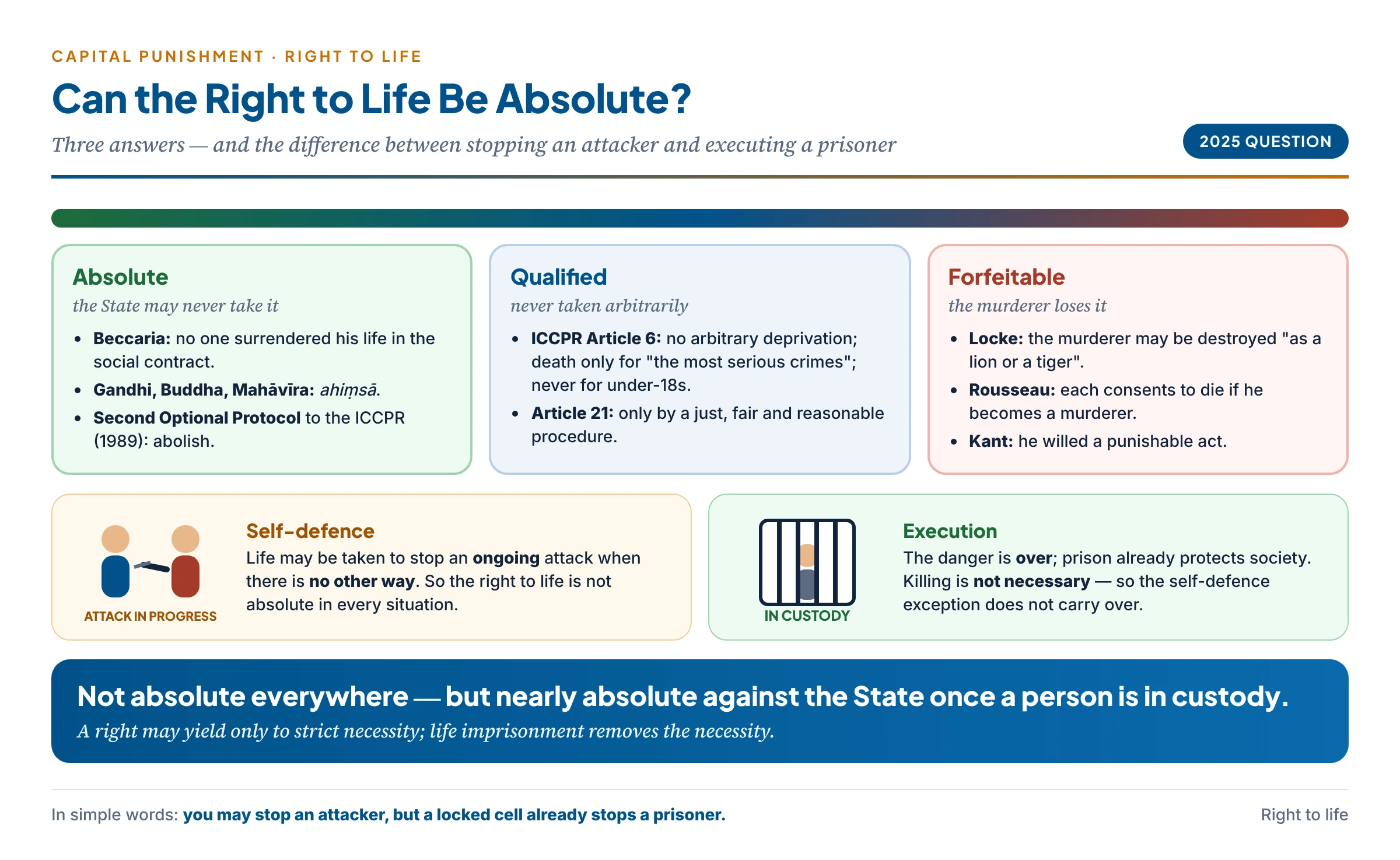
The 2025 paper asked whether one’s right to life can be absolute, with reference to capital punishment.
Three views:
- Absolute — never to be taken by the State:
- Beccaria: no one surrendered his life to the social contract.
- Gandhi and ahiṃsā: life is sacred; no one may deliberately take it.
- Modern human-rights abolitionism: the Second Optional Protocol to the ICCPR (1989) commits States to abolish the death penalty; Amnesty International opposes it “in all cases without exception”.
- Forfeitable — the murderer loses his right:
- Locke: by murder, a person forfeits his right to life.
- Rousseau: by the social contract, each consents in advance to die if he becomes a murderer.
- Kant: the murderer is not wronged by death; he receives what he willed in willing a punishable act.
- Qualified — protected against arbitrary deprivation:
- ICCPR, Article 6: “No one shall be arbitrarily deprived of his life”; in countries that have not abolished it, death may be imposed only for “the most serious crimes“, after a fair trial, never on those under 18 or pregnant women.
- Indian Constitution, Article 21: “No person shall be deprived of his life or personal liberty except according to procedure established by law” — a procedure that must be just, fair and reasonable (Maneka Gandhi, 1978). The right is fundamental but not absolute.
Arguments that the right to life is not absolute in practice:
- Almost all ethical and legal systems allow killing in self-defence, in defence of others, and in just war.
- If life can be taken to save life in these cases, the right is conditional, not absolute.
Arguments that, even so, the State should not execute:
- Self-defence differs from execution. Self-defence stops an ongoing attack; execution kills a person who is already disarmed and in custody, years later, when life imprisonment would protect society just as well.
- Necessity is missing. A right may yield only to necessity; where life imprisonment suffices, killing is not necessary.
- Non-arbitrariness cannot be guaranteed. If the right to life may be taken only non-arbitrarily, and the death penalty is in fact applied arbitrarily (by class, lawyer, bench), then it fails its own legal test.
- Dignity is not lost by crime. Even the worst offender keeps his human dignity; the State’s refusal to kill affirms that every life counts.
In simple words
A householder wakes to find an armed intruder attacking his child; he strikes the intruder down. Almost everyone agrees he acted rightly — the danger was here and now, and there was no other way. Now imagine the same intruder caught, disarmed and locked in a cell. Years later, would it still be “self-defence” to kill him? The danger is over; a locked door already protects the child. That difference — between stopping an attack and killing a prisoner — is why many who accept self-defence still reject the death penalty.
Balanced answer: the right to life is not absolute in the sense that it can never yield (self-defence, war). But it is close to absolute against the State when the person is already in custody: the State may take life only from strict necessity, and the death penalty — irreversible, arbitrary in practice and unnecessary given life imprisonment — rarely, if ever, meets that test. Hence the global trend towards abolition and India’s restriction of it to the “rarest of rare” cases.
Capital Punishment and the Theories of Punishment
The 2011 paper asked whether capital punishment can be justified with reference to the theories of punishment.
| Theory | Verdict on the death penalty | Reason |
|---|---|---|
| Retributive | For (Kant, Hegel) — but with doubts | Only death equals murder; yet proportion is of value, and the order of severity does not fix the scale (Article 2) |
| Deterrent | Divided | Mill for; Beccaria and the later Bentham against; evidence shows no extra deterrence over life imprisonment |
| Preventive | Weak case | Life imprisonment also incapacitates, without irreversibility |
| Reformative | Against | Death ends all possibility of reform |
| Restorative | Against | Nothing is repaired; the offender cannot make amends |
| Expressive | Divided | It voices maximum condemnation — but condemnation can be expressed without killing |
| Mixed (Hart) | Against, or only in extreme cases | Even if deserved, it fails the test of necessity and safe distribution |
- Conclusion: only strict retributivism clearly supports the death penalty; every forward-looking theory either rejects it or makes it depend on deterrent evidence that does not exist. Even the retributive case is weakened by fallibility — desert can be honoured only if guilt is certain, and no court can promise certainty.
Moral Justifications Offered — A Summary
The 2022 paper asked for the moral justifications of capital punishment. In brief:
- Retributive desert — life for life (Kant).
- Forfeiture — the murderer has forfeited his right (Locke, Rousseau).
- Deterrence — fear of death saves innocent lives (Mill).
- Incapacitation — the dangerous can never kill again.
- Denunciation — maximum condemnation of the gravest crimes.
- Justice to victims — vindication of the victim and family.
- Protection against terror — for mass killers and terrorists.
Each is a serious moral reason; the question is whether, together, they outweigh irreversibility, arbitrariness and the absence of proven deterrence.
Common confusion
Did Kant reject capital punishment because it makes the criminal a “spectacle”? Some notes say so, but it is the opposite of Kant’s view. Kant held that every murderer must die — “there is no substitute that will satisfy justice” — and called Beccaria’s abolitionism “sophistry” born of “overly compassionate feelings”. Kant mentions a “spectacle of a slaughterhouse” only in one special case: when so many accomplices share in a murder that executing them all would empty the State; then the sovereign may, as an act of clemency, substitute deportation. Kant is the classic defender, not a critic, of the death penalty.
Common confusion
Did Chāṇakya say “Justice must not only be done, but must also be seen to be done”? No. The famous line is from the English judge Lord Hewart (R v Sussex Justices, 1924), about the appearance of judicial impartiality. Kauṭilya’s own teaching on punishment is the rule of the just rod — neither too harsh nor too mild (Article 1). The principle behind the quotation is still relevant here: in a matter as grave as death, the fairness of the process must be visible to all.
Critical Evaluation
Weighing the Arguments
- The retentionist case is strongest in the rare, extreme case — a fully proved, premeditated mass murder or act of terrorism — where retributive desert and public condemnation press hardest.
- The abolitionist case is strongest on institutional grounds: the penalty is irreversible, courts are fallible, its use is arbitrary and discriminatory, and it gives no proven protection beyond life imprisonment.
- The decisive consideration: the irreversibility argument is independent of both retribution and deterrence. It does not deny that a murderer may deserve death; it denies that any human institution is reliable enough to apply an uncorrectable penalty. “A punishment that cannot be corrected should not be entrusted to a process that can err.“
Critics and Defenders
Criticism — Critics of the death penalty
- Beccaria: neither necessary nor useful; no one surrendered his life to the social contract.
- Bentham (later work): irremissible — an error can never be remedied.
- Camus: the most premeditated of murders; vengeance disguised as justice.
- Gandhi: an eye for an eye makes the whole world blind; even the murderer has a soul.
- Ambedkar: a country devoted to non-violence should abolish the death sentence altogether.
- Human-rights bodies and the UN: irreversible, discriminatory, with no conclusive deterrent value.
Defence — Defenders of the death penalty
- Kant: if he has committed murder he must die; no substitute satisfies justice.
- Hegel: punishment honours the criminal as a rational being.
- Locke and Rousseau: the murderer forfeits his life; each consents to die if he becomes a murderer.
- J.S. Mill: the most impressive and, for the worst crimes, least cruel deterrent.
- Van den Haag: when in doubt, the best bet is to protect potential victims.
- Retentionist States: needed against terrorism and the most heinous crimes.
Cross-Tradition Comparison
Indian and Western Views on the Death Penalty
| Thinker or tradition | Position | Reason |
|---|---|---|
| Manu, Kauṭilya | Retain (vadha-daṇḍa) | Order and protection require the ultimate rod |
| Aśoka | Retained, but softened | Granted a three-day respite to the condemned for appeal and spiritual preparation |
| Buddhism, Jainism | Against killing | Ahiṃsā; every life is precious; killing breeds killing |
| Gandhi | Against | Hate the sin, not the sinner; reform, not revenge |
| Ambedkar | Personally for abolition | India’s moral tradition of non-violence |
| Kant, Hegel | For | Retributive justice; dignity of the rational agent |
| Locke, Rousseau | For | Forfeiture; social contract |
| Beccaria, later Bentham | Against | Not necessary, not useful; irreversible |
| J.S. Mill | For | Deterrence; less cruel than life imprisonment |
| Camus | Against | Premeditated killing by the State; vengeance |
Indian Connect — Ambedkar in the Constituent Assembly
On 3 June 1949, Dr B.R. Ambedkar told the Constituent Assembly that rather than merely give death-row prisoners a right of appeal, he “would much rather support the abolition of the death sentence itself“. His reason was moral and Indian: “this country by and large believes in the principle of non-violence. It has been its ancient tradition“, and so “the proper thing for this country to do is to abolish the death sentence altogether“. He left the final decision to Parliament — which has not abolished it. Seven decades later, the Supreme Court’s “rarest of rare” doctrine and its refusal to confirm a single death sentence in 2023–2025 move India, in practice, closer to Ambedkar’s view.
Synthesis (Siddhānta)
- Capital punishment is the State’s deliberate, lawful taking of life. Its defenders rely on retributive desert (Kant), forfeiture (Locke, Rousseau), deterrence (Mill), incapacitation and denunciation; its critics on irreversibility, fallibility, discrimination, the absence of proven deterrence, the inalienability of life (Beccaria), non-violence (Gandhi, Ambedkar) and the cruelty of the penalty itself (Camus).
- Deontologically, retributivism justifies death whatever its effects — but deontology also supplies the strongest objection: the dignity of even the worst offender and the wrongness of killing a defenceless prisoner. Consequentially, deterrence would justify death only if it saved more lives than life imprisonment — and no reliable evidence shows that it does.
- The right to life is not absolute in every situation (self-defence, war), but against the State, in custody, it is nearly absolute: it may yield only to strict necessity, which life imprisonment removes.
- Balanced position: abolition is best defended on institutional rather than absolutist grounds — not because no murderer could ever deserve death, but because no fallible, unequal system should be trusted with a penalty that cannot be corrected. Where it is retained, it must be confined to the rarest of rare cases, with the strictest procedure, full consideration of mitigation, and real review and clemency — the Indian position examined in Article 7.
“It seems to me absurd that the laws, which are the expression of the public will, which detest and punish homicide, should themselves commit it, and that to deter citizens from murder they should order a public one.” — Beccaria
Previous Year Questions
- 2026“Retributivism presents a deontological justification for capital punishment, whereas deterrence presents a consequential justification for it.” Explain.
- 2025Can one’s right to life be absolute? Answer with reference to the idea of Capital Punishment.
- 2024On what grounds would you accept or reject the idea of capital punishment as an effective deterrent? Discuss.
- 2022What are the moral justifications of capital punishment? Discuss.
- 2011Can capital punishment be justified? Answer with reference to the theories of punishment.
- 2009Is capital punishment in your view ethically justified?