

Political Ideologies: Anarchism; Marxism and Socialism
Official Syllabus: Paper II, Section A, Unit 5
India produced its own answers to the questions of this unit. Mahatma Gandhi called his ideal an “enlightened anarchy”, a stateless society of self-ruling individuals, and built a non-violent socialism of Sarvodaya (the welfare of all) and trusteeship. Around and after him, Indian socialists tried to join Western socialism with Indian conditions and values: Acharya Narendra Deva combined Marxism with Gandhian ethics; Jawaharlal Nehru pursued democratic socialism through planning; Jayaprakash Narayan moved from Marxism to Sarvodaya and partyless democracy; Ram Manohar Lohia kept an equal distance from capitalism and communism; and M. N. Roy, once a leading communist, turned into Marxism’s sharpest Indian critic. This article explains Gandhi as a political anarchist, the features and contemporary relevance of Gandhian socialism, the contrast between Marxism and Sarvodaya, and the main Indian socialist thinkers.
In simple words
Marx said: the poor can be equal to the rich only when the rich man’s wealth is taken away, by force if needed. Gandhi said: the prince and the peasant will not become equal by cutting off the prince’s head; the prince must be persuaded to hold his wealth in trust for the peasant, and the peasant must learn to rule himself. Indian socialism grew up between these two answers.
Context & Problem
- Socialism reached India through the national movement. Indian leaders saw that political freedom from Britain would mean little without freedom from poverty, landlordism, caste and exploitation.
- Two Western currents arrived:
- Marxism: the Communist Party of India was founded by M. N. Roy and others at Tashkent (1920), and its first conference within India was held at Kanpur (1925).
- Democratic and Fabian socialism: through Nehru and Indian students in Britain.
- The Congress Socialist Party (1934), founded by Narendra Deva, Jayaprakash Narayan, Ram Manohar Lohia, Minoo Masani, Achyut Patwardhan and others, worked inside the Congress to give it a socialist programme.
- Gandhi stood apart from both: he shared their goal of equality but rejected class war, violence, centralisation and large-scale industry.
- Indian roots: Indian socialists also drew on older ideals: loka-saṅgraha (the welfare and holding together of the world, from the Bhagavad Gītā), dharma, dāna (giving), and the self-governing village.
Loka-saṅgraha and Vivekananda
- Loka-saṅgraha: the Gītā asks the wise person to act for the welfare of the world (loka-saṅgraham evāpi): a divine function which every ruler and every person devoted to duty should imitate. JP argued that the basic philosophy of socialism fits this long-cherished Indian value.
- Swami Vivekananda (1863–1902):
- Service of the poor is worship: daridra-nārāyaṇa sevā, serving God in the poor.
- He traced a cycle of power from priests (Brāhmaṇas) to warriors (Kṣatriyas) to merchants (Vaiśyas), and predicted that the next age would belong to the labouring masses, a “Śūdra rājya”.
- “I am a socialist not because I think it is a perfect system, but half a loaf is better than no bread. The other systems have been tried and found wanting” (letter of 1896). He welcomed socialism as a redistribution of pain and pleasure, while his own basis was Vedānta, the oneness of all beings.
Core Doctrine
Gandhi’s Enlightened Anarchy
The ideal:
- “Political power means capacity to regulate national life through national representatives. If national life becomes so perfect as to become self-regulated, no representation becomes necessary. There is then a state of enlightened anarchy. In such a state everyone is his own ruler. He rules himself in such a manner that he is never a hindrance to his neighbour. In the ideal State therefore there is no political power because there is no State. But the ideal is never fully realised in life. Hence the classical statement of Thoreau that that Government is best which governs the least” (Young India, 2 July 1931).
- This ideal is Rāma Rājya: an ideal, stateless society in which order comes from voluntary cooperation and the sovereignty of moral law.
Why Gandhi distrusted the state:
- The state rests on violence: “The State represents violence in a concentrated and organised form. The individual has a soul, but as the State is a soulless machine, it can never be weaned from violence to which it owes its very existence.” Human beings are by nature non-violent; the state is not.
- The state destroys individuality: he looked upon an increase in the power of the state “with the greatest fear”, because, while apparently doing good by minimising exploitation, it does the greatest harm by destroying individuality, the root of all progress.
- The state discourages self-dependence and the natural cooperation of people; the aim of life is swarāj, which means self-rule as self-restraint before it means political independence.
- Means and ends are inseparable: “the means may be likened to a seed, the end to a tree”. A society built by coercion will remain coercive.
The practical second-best: a minimal, decentralised state
- Since the ideal is never fully realised, Gandhi accepted a state that governs least, built from below:
- Village republics (gram swarāj): each village self-sufficient in food, cloth and basic needs, governed by an elected panchayat, and “capable of managing its affairs even to the extent of defending itself against the whole world”.
- Oceanic circles: “Life will not be a pyramid with the apex sustained by the bottom. But it will be an oceanic circle whose centre will be the individual always ready to perish for the village, the latter ready to perish for the circle of villages”, until the whole becomes one life of individuals, never aggressive, always humble.
- A non-violent police, more like reformers than enforcers, and minimal use of force.
- Satyāgraha and civil disobedience as the citizen’s weapon against unjust law.
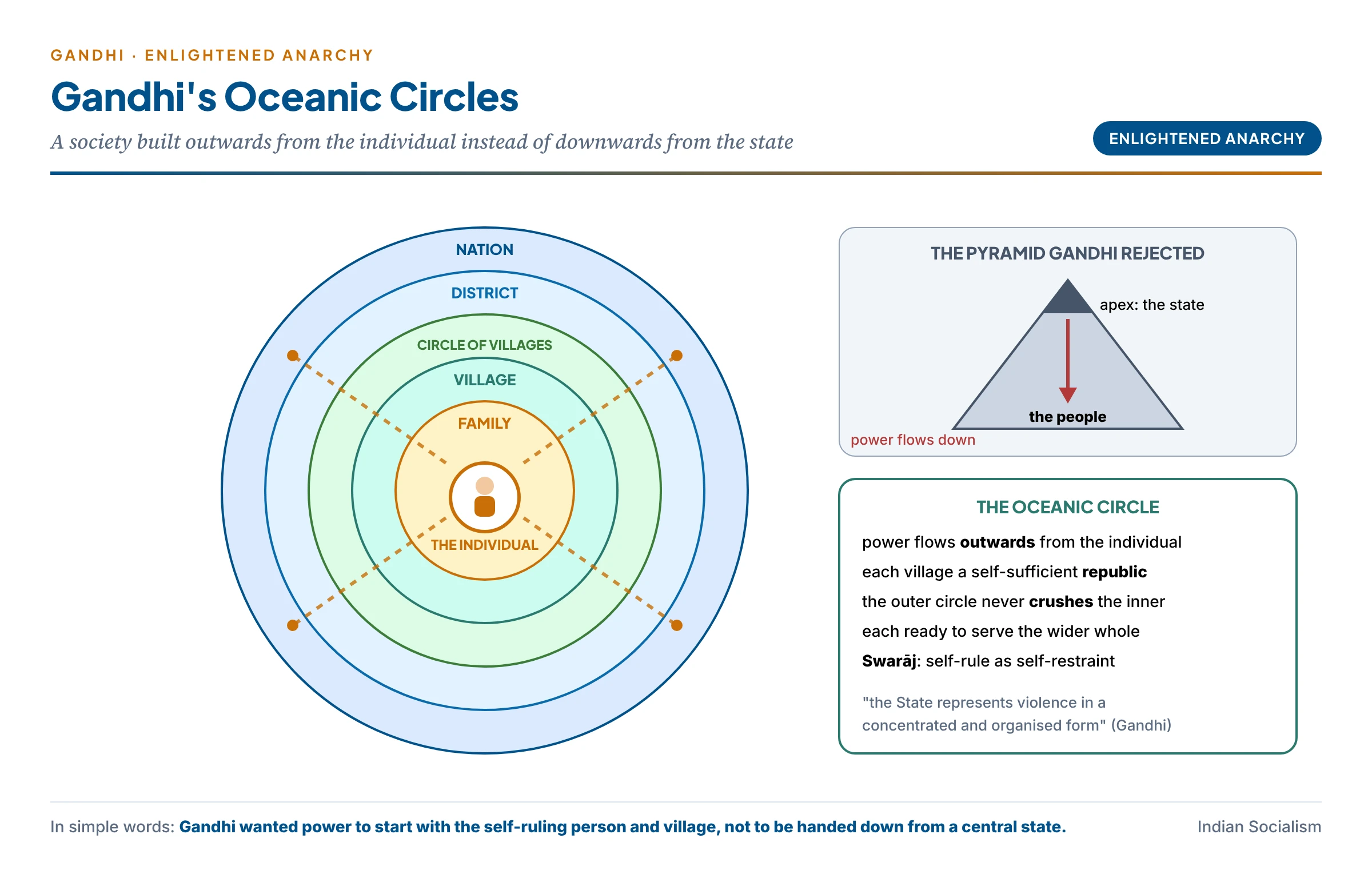
Evaluating Gandhi as a Political Anarchist
Why Gandhi can be called an anarchist:
- His ideal is explicitly stateless: “there is no political power because there is no State”.
- He rejects the state’s violence as morally illegitimate, like Tolstoy.
- Decentralisation and self-rule: village republics and oceanic circles replace the hierarchical state, close to Proudhon’s and Kropotkin’s federations.
- Civil disobedience: he taught that citizens may break unjust laws openly and accept the penalty, a direct challenge to the state’s claim to unconditional obedience (as with Thoreau).
- Influences: Tolstoy (The Kingdom of God Is Within You), Thoreau (Civil Disobedience), Ruskin, Kropotkin’s ideals of mutual aid.
Why he is not a typical anarchist:
- Not a revolutionary anarchist: he rejected violence absolutely, unlike Bakunin.
- A pragmatic minimal-statist: he accepted that the ideal is never fully realised, and supported a limited state, elections, the Congress and later the constitutional order.
- Religious and moral basis: his anarchism grows from Truth, ahiṁsā and self-purification, not from secular reason (Godwin) or class analysis (Kropotkin).
- Duty before rights: he stressed duties and self-restraint, while most anarchists stress liberty from external authority.
- Nationalist leader: he led a movement to create an independent Indian state.
- Trusteeship allowed state regulation of wealth (see below).
Verdict: Gandhi is best described as a philosophical, spiritual or “enlightened” anarchist in his ideal, and a decentralist, minimum-state democrat in practice. His anarchism is a direction, the ever-greater replacement of coercion by self-rule, rather than a programme to abolish the state at once.
Sarvodaya: The Welfare of All
- Origin: in 1904 Gandhi read John Ruskin’s Unto This Last (1860) on a train journey and said it “brought about an instantaneous and practical transformation” in his life; he translated it into Gujarati in 1908 as “Sarvodaya”.
- Three lessons Gandhi drew from Ruskin:
- The good of the individual is contained in the good of all.
- A lawyer’s work has the same value as a barber’s, since all have the same right to earn their livelihood from their work.
- A life of labour, the life of the tiller of the soil and the handicraftsman, is the life worth living.
- Against utilitarianism: not “the greatest good of the greatest number”, which can sacrifice the minority, but the good of all, beginning with the last and the least (antyodaya).
- After Gandhi: the Sarvodaya Samaj (1948); Vinoba Bhave’s Bhoodan (land-gift) movement from 1951 (beginning at Pochampally in Telangana), in which landowners donated land to the landless, and Gramdan (village-gift); JP joined the movement in 1954.
Trusteeship
- Idea: the rich should regard their surplus wealth not as their own but as held in trust for society, taking only what they need for an honourable livelihood and using the rest for the community.
- Basis: the Upaniṣadic ideal of non-possession (Īśāvāsya Upaniṣad: “enjoy by renouncing; do not covet anyone’s wealth”), aparigraha, and faith that human nature is never beyond redemption.
- Method: not expropriation by force, but change of heart, persuasion, public opinion and, if necessary, non-violent non-cooperation with owners who refuse.
- The Practical Trusteeship Formula (drafted by his colleagues from a draft by the economist M. L. Dantwala, and revised by Gandhi):
- Trusteeship provides a means of transforming the present capitalist order into an egalitarian one. It gives no quarter to capitalism, but gives the owning class a chance of reforming itself.
- It does not recognise any right of private ownership of property except so far as it may be permitted by society for its own welfare.
- It does not exclude legislative regulation of the ownership and use of wealth.
- Under state-regulated trusteeship, an individual will not be free to hold or use wealth for selfish satisfaction or in disregard of the interests of society.
- Just as a decent minimum living wage is fixed, a limit on maximum income should be fixed, and the gap should keep narrowing.
- The character of production will be determined by social necessity, not by personal whim or greed.
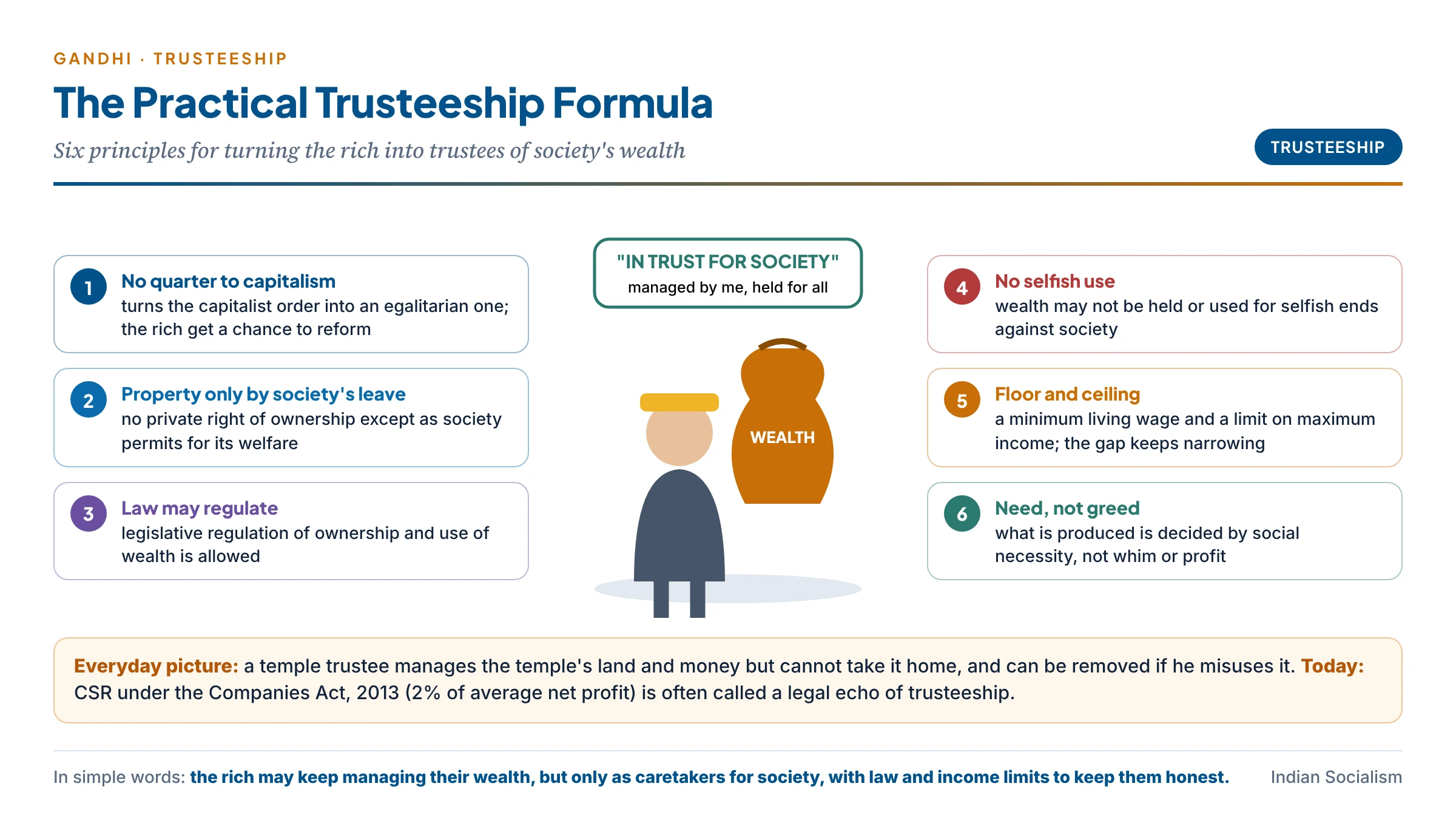
In simple words
A temple trustee looks after the temple’s land and money but cannot take it home; he must use it for the temple and the devotees, and he can be removed if he misuses it. Gandhi asked every rich person to see their factory or estate the same way: managed by them, but held for society, with the law able to step in if they betray the trust.
Criticisms of trusteeship:
- It depends on a change of heart, and offers no effective sanction if the owner refuses: the socialist objection.
- Ambedkar: it leaves the poor dependent on the conscience of the rich; he preferred constitutional state socialism.
- Marxists: it is a defence of property dressed in moral language; classes do not give up power voluntarily.
- Defence: the formula itself allows legislative regulation, a ceiling on incomes and production for need, which is more radical than its critics admit; and its spirit survives in stewardship ethics and corporate social responsibility.
The Distinctive Features of Gandhian Socialism
Gandhi accepted the word “socialism” in his own sense: “Socialism is a beautiful word and so far as I am aware in socialism all the members of society are equal — none low, none high… This socialism is as pure as crystal. It therefore requires crystal-like means to achieve it. Impure means result in an impure end. Hence the prince and the peasant will not be equalised by cutting off the prince’s head” (Harijan, 6 July 1947).
Its features:
- Spiritual and moral basis: equality flows from the oneness of all life and from Truth and ahiṁsā, not from materialism.
- Non-violent means: “crystal-like” means; satyāgraha instead of class war.
- Class cooperation, not class conflict; capital and labour as partners.
- Equality of all labour: a barber’s work equals a lawyer’s; “economic equality is the master key to non-violent independence”.
- Bread labour: everyone should do some manual work to earn their bread (an idea he took from Tolstoy and the Russian writer T. M. Bondaref).
- Trusteeship in place of either private greed or state ownership.
- Decentralisation: village self-sufficiency, cottage and village industries, khadi, production by the masses rather than mass production.
- Swadeshi: preferring the goods and services of one’s neighbourhood; local economies serving local needs.
- Limited, humane technology: Gandhi did not oppose all machines, but machines that displace labour and concentrate wealth: “I want to save time and labour, not for a fraction of mankind, but for all.”
- Aparigraha and limited wants: the good life is simple; “the world has enough for everyone’s need, but not for everyone’s greed” (a saying widely attributed to him).
- Dignity of the individual at the centre, with the minimum state.
- Inclusion: the removal of untouchability, communal harmony and the uplift of women and the poor were part of his “constructive programme”.
The Contemporary Relevance of Gandhian Socialism
- Inequality: with India’s top 1% holding about 40% of wealth (World Inequality Lab, 2022–23), the call for ceilings on wealth and trusteeship is more pointed than ever.
- Environment and climate: limited wants, local production and need-not-greed are central to sustainable development and climate ethics.
- Decentralised democracy: the 73rd and 74th Constitutional Amendments (1992) created panchayats and municipalities, a partial realisation of gram swarāj; Article 40 directs the state to organise village panchayats.
- Livelihoods: MGNREGA (rural employment), self-help groups of women, khadi and village industries, and the cooperative movement follow Gandhian lines of labour-based, local development.
- Corporate social responsibility: Section 135 of the Companies Act, 2013 requires large companies to spend 2% of their average net profits on social causes, often described as a legal echo of trusteeship.
- Dignity of labour: the gig and informal economy revives questions of fair wages and the worth of manual work.
- Non-violent protest remains the main democratic method of dissent in India and worldwide.
- Limits: a village-based, low-technology economy cannot by itself provide modern medicine, defence or mass employment; trusteeship lacks enforcement; Ambedkar warned that villages could be “dens of localism and ignorance” and fortresses of caste.
In simple words
A Gandhian village is like a joint family that also runs its own shop. It grows its own food, spins its own cloth, settles quarrels in its own panchayat, and the richest member manages the family land for everyone, not for himself. The idea is attractive for its self-reliance and fairness, but the family still needs a hospital, a school and roads that no single village can build alone.
Marxism and Sarvodaya Compared
| Point | Marxism | Sarvodaya (Gandhi) |
|---|---|---|
| Philosophy | Dialectical materialism; matter is primary | Spiritual: Truth (God), ahiṁsā, oneness of life |
| Human nature | Shaped by class; selfish under capitalism | Basically good and non-violent; capable of change of heart |
| Target | Satisfaction of material needs | Satisfaction of material and spiritual needs |
| Social relations | Class conflict is inevitable and ends in revolution | Class cooperation; harmony of interests |
| Means | Revolution, if necessary violent; dictatorship of the proletariat | Non-violence, satyāgraha, persuasion; means and ends are one |
| Property | Abolition of private ownership of means of production by the proletarian state | Trusteeship; voluntary limitation and state regulation |
| Technology | Large-scale industry; the more productive the better | Small-scale, decentralised, labour-based production |
| State | Seized, then withers away | Minimised now; stateless Rāma Rājya as ideal |
| Organisation | Supremacy of the communist party | Partyless village democracy |
| Procedure of change | Change the substructure and the rest transforms automatically | Change must cover both substructure and superstructure, starting with the individual |
| End | Classless, stateless society | Sarvodaya: welfare of all in a stateless, non-violent society |
- Common ground: both condemn exploitation, the misery of the masses and the concentration of wealth; both aim at a stateless, equal society; both value labour.
- The decisive difference is the relation of means and ends: for Gandhi, a revolution won by violence will produce a violent society; for Marx, the violence of the old order makes force unavoidable.
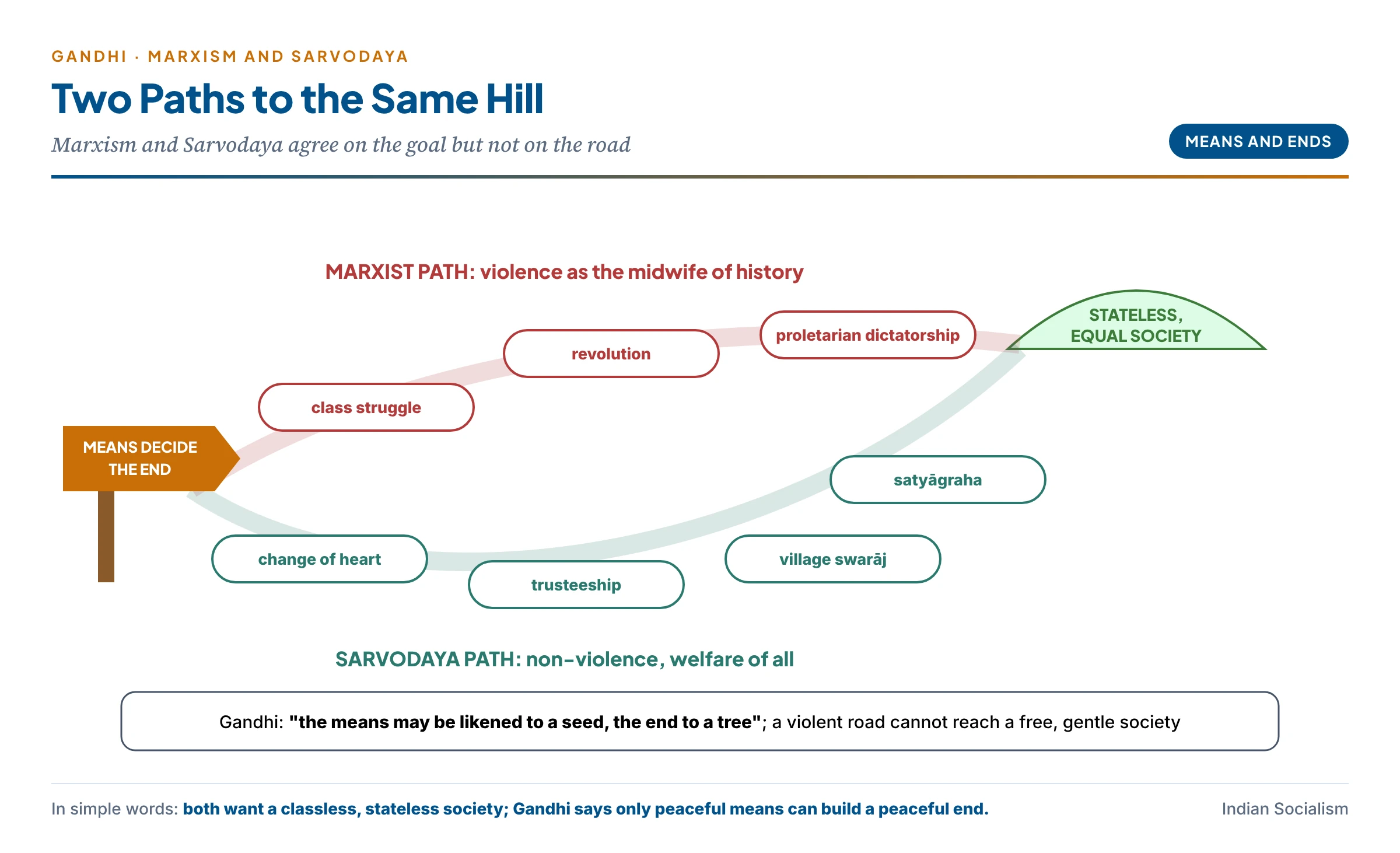
Acharya Narendra Deva (1889–1956)
- A founder of the Congress Socialist Party and a pioneer of modern socialist thought in India; scholar of Buddhism and educationist (Kashi Vidyapith; Vice-Chancellor of Lucknow and Banaras universities).
- He combined Marxism and Gandhism: a typical Indian socialist synthesis.
- Material welfare and spiritual emancipation together, for all deprived sections of society.
- Human freedom is a moral concept, realised only in an atmosphere of economic equality: capitalism gives only formal freedom; socialism ensures substantive freedom.
- Democratic socialism: he insisted that socialism must be democratic and humanist, and rejected the authoritarianism of the Soviet model.
- A broad alliance: India’s masses do not form a single, uniform class, so workers, peasants and intellectuals must cooperate and collaborate to fight imperialism and capitalism together, an Indian adaptation of Marx’s proletarian revolution.
- Main work: Socialism and the National Revolution (1946).
Jawaharlal Nehru (1889–1964)
- Influences: Fabian socialism in Britain, Marxism, and Gandhi; he admired Soviet planning but rejected its dictatorship.
- At the Lucknow Congress (1936) he declared that the key to the solution of India’s and the world’s problems lay in socialism, used “not in a vague humanitarian way but in the scientific, economic sense”.
- Democratic socialism: he relied on the socialistic method of planning for economic development within the democratic framework of the Constitution; the Avadi resolution (1955) set the goal of a “socialistic pattern of society”.
- The mixed economy: the public sector at the “commanding heights” (steel, power, heavy industry, the “temples of modern India”), alongside a regulated private sector.
- He constantly tried to balance the claims of democracy and socialism in his pursuit of social progress in India and the world.
- Criticisms: bureaucratic planning, the licence-permit raj, slow growth, neglect of agriculture and primary education in the early plans.
Jayaprakash Narayan (1902–1979)
- From Marxist to democratic socialist to Sarvodaya worker: a Marxist as a student in America; co-founder of the Congress Socialist Party (Why Socialism?, 1936); joined Vinoba’s Bhoodan in 1954.
- A humanistic and democratic form of socialism, with the socialisation of the major means of production.
- Indian roots: the basic philosophy of socialism fits the long-cherished Indian value of loka-saṅgraha.
- Socialism joined with Sarvodaya: class cooperation, not class war.
- Key formula: the precedence of lokniti (the politics of the people) over rājniti (the politics of power), and of lokśakti (people’s power) over rājśakti (state power).
- Partyless democracy: parties divide and corrupt; a Sarvodaya-based socialist programme should be carried out through village and community self-government without party competition.
- Total Revolution (Sampoorna Kranti, 1974): his call during the Bihar movement for transformation in social, economic, political, cultural, intellectual, educational and spiritual life together.
- Criticism: like communitarianism, JP’s thought has a strong moral philosophy but a weak political philosophy: it does not explain how a partyless democracy would make decisions, resolve conflicts or check power.
| Issue | Marxian socialism | JP’s socialism |
|---|---|---|
| Target | Satisfaction of material needs | Satisfaction of material and spiritual needs |
| Status of classes | Class conflict inevitable; final revolution | Class cooperation through Sarvodaya |
| Procedure of revolution | Change the substructure; the rest transforms automatically | Must comprehend both substructure and superstructure |
| Organisation recommended | Supremacy of the communist party | Partyless democracy |
Ram Manohar Lohia (1910–1967)
- “Equal irrelevance” of capitalism and communism to Asia: both are products of European industrial civilisation, centralised and large-scale (Marx, Gandhi and Socialism, 1963).
- The four-pillar state (chaukhambā rāj): power shared among village, district, province and centre, a decentralised socialist democracy.
- Seven revolutions (sapta kranti): against inequality between men and women, against inequality of colour and race, against caste, against foreign domination, for economic equality, for privacy against undue interference, and against weapons, for non-violent satyāgraha.
- Caste and socialism: caste is the main form of inequality in India; he demanded special opportunity (reservations) for backward castes, women, Dalits and tribals.
- Small-unit technology suited to India’s labour-rich economy.
M. N. Roy (1887–1954): From Communism to Radical Humanism
- A founder of the Mexican Communist Party and of the Communist Party of India; debated Lenin on the colonial question at the Second Congress of the Communist International (1920); later expelled from the Communist International (1929).
- Radical (New) Humanism: morality, rationality and freedom are its three pillars. Man is essentially rational: his nature is “not to believe, but to question, to inquire and to know”; morality rests on reason; freedom is the result of the human quest for existence at a higher level; he proclaims the sovereignty of man on the authority of modern science; education is indispensable for humanism.
- His attack on Marxism:
- Dialectical materialism: dialectics explains the movement of ideas; Marx arbitrarily applied it to the material world.
- Economic determinism: the means of production are a creation of the human mind; how then can they determine the forms of human consciousness? Man, the creator of machines, is greater than the means of production.
- Class struggle: Marx ignored the middle class.
- Surplus value: no system can survive without taking some surplus.
- Revolution: social change should come through persuasion and education.
- Socialism as the ideology of the proletariat: the intellectual and cultural backwardness of the proletariat does not allow it a long-distance view; Marx and Engels themselves came from the middle class, and Lenin gave the leading role to the “vanguard”.
- Withering away of the state: the state is the political organisation of society, so it cannot cease to exist after class distinctions are abolished.
- Political proposals: partyless democracy through organised people’s committees; the Twenty-Two Theses of Radical Democracy (1946).
- Criticisms of Roy: critics say there is nothing new in new humanism, which repeats older humanist ideas; its materialism may lead to consumerism and environmental degradation.
Common confusion
Did M. N. Roy remain a Marxist all his life? No. Roy began as one of the leading Marxists of Asia and helped found the Communist Party of India, but from the late 1930s he broke with Marxism. He rejected economic determinism, class struggle as the sole motor of history, and the dictatorship of the proletariat, and founded Radical Humanism, which puts the free, rational individual at the centre. He is therefore studied both as an Indian Marxist and as one of Marxism’s most important critics.
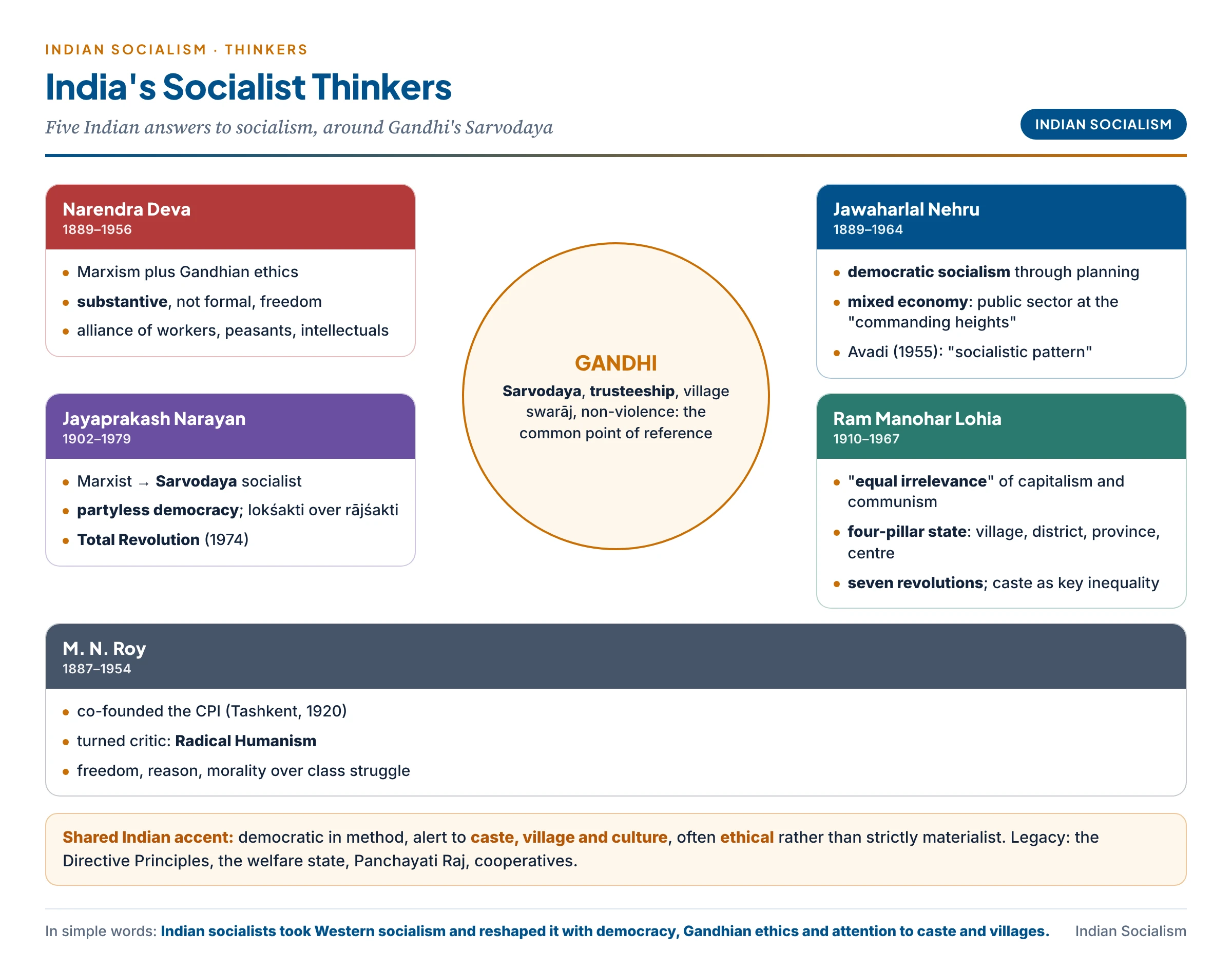
Critical Evaluation
Criticisms of Gandhian and Indian Socialism
- Romanticism of the village: Ambedkar called the Indian village “a sink of localism, a den of ignorance, narrow-mindedness and communalism”; decentralisation may hand power to dominant castes.
- Trusteeship lacks teeth: it depends on the goodwill of the rich.
- Economic realism: small-scale production cannot meet the needs of a large, modern nation.
- Partyless democracy is vague: JP and Roy did not show how decisions and accountability would work without parties.
- Nehruvian socialism became bureaucratic and slowed growth.
Strengths
- Moral seriousness: the unity of means and ends is a lasting answer to the failures of violent revolution.
- Indian conditions: these thinkers adapted socialism to a society of villages, castes and religions, which Marx’s model did not fit.
- Democracy: Indian socialism was overwhelmingly democratic, and shaped the Directive Principles and India’s welfare laws.
- Ecological foresight: need-not-greed and local production anticipate today’s environmental thinking.
Critics and Defenders
Criticism — Critics
- Ambedkar: the village is a den of caste; trusteeship leaves the poor at the mercy of the rich; a strong constitutional state is needed.
- Marxists: class cooperation is an illusion; owners do not give up power voluntarily.
- Liberal economists: village economics and anti-machinery ideas would keep India poor.
- Critics of JP and Roy: partyless democracy lacks a workable institutional design.
Defence — Defenders and strengths
- Gandhi: crystal-pure socialism needs crystal-pure means.
- Narendra Deva: socialism must give substantive, not merely formal, freedom.
- JP: people’s power over state power keeps democracy alive.
- Lohia: caste, gender and race inequalities must be fought alongside class.
- Today: Panchayati Raj, cooperatives, CSR and climate ethics carry Gandhian ideas forward.
Cross-Tradition Comparison
| Point | Gandhi | Tolstoy | Thoreau | Kropotkin | Marx |
|---|---|---|---|---|---|
| Basis | Truth, ahiṁsā, Gītā | Sermon on the Mount | Conscience, nature | Science of mutual aid | Historical materialism |
| View of state | Concentrated violence; minimal | Organised violence; abolish | Best governs least; resist unjust law | Abolish; replace with communes | Class instrument; withers away |
| Means | Satyāgraha, constructive work | Non-resistance, refusal | Civil disobedience | Revolution and mutual aid | Revolution, dictatorship |
| Property | Trusteeship | Give it up | Simple living | Common ownership | Social, then common ownership |
| Economy | Village industries, khadi | Peasant labour | Self-reliance | Free communes, need-based | Planned, large-scale |
Indian Connect — Indian Connect
- Gandhi’s anarchism and socialism are rooted in Indian ideals: swarāj as self-restraint (from the Upaniṣadic and Gītā tradition), aparigraha (Jaina and yogic non-possession), ahiṁsā (Jaina, Buddhist and Hindu), and the Īśāvāsya Upaniṣad’s teaching of enjoying by renouncing.
- The Directive Principles carry Gandhi’s legacy: Article 40 (village panchayats), Article 43 (cottage industries), Article 46 (welfare of weaker sections), Article 47 (prohibition and nutrition) and Article 48 (cattle and agriculture).
- Sarvodaya gave India a word for a socialism that is spiritual, non-violent and inclusive, distinct from both Western social democracy and Soviet communism.
Synthesis (Siddhānta)
- Gandhi is an anarchist in his ideal of a self-ruling, stateless society, and a minimum-state democrat in practice. His central contribution is the unity of means and ends: equality cannot be built by violence.
- Gandhian socialism (Sarvodaya, trusteeship, bread labour, decentralisation, swadeshi) offers a non-violent, spiritual and ecological socialism whose relevance has grown with inequality and climate change, though it needs a capable state and modern economy alongside it.
- Marxism and Sarvodaya share the goal of a stateless, equal society but differ completely in philosophy and means.
- Indian socialists (Narendra Deva, Nehru, JP, Lohia, Roy) adapted socialism to India: democratic in method, attentive to caste, village and culture, and often ethical in foundation. Their legacy lives in the Directive Principles, the welfare state, Panchayati Raj and the cooperative movement.
Previous Year Questions
- 2021Discuss the distinctive features of Gandhian Socialism and its contemporary relevance.
- 2019Evaluate Mahatma Gandhi as a political anarchist.
- 2005What is humanism? What are its different kinds? In what way, if any, is M. N. Roy’s radical humanism different from Marxism? Discuss.