

Political Ideologies: Anarchism; Marxism and Socialism
Official Syllabus: Paper II, Section A, Unit 5
Democratic socialism seeks socialist goals (equality, welfare, social control of the economy) by democratic means: elections, parliaments, laws and trade unions, while keeping civil liberties and political competition. It became the most influential form of socialism in the twentieth century, from the British welfare state to the Nordic model to Nehru’s India. But it raises sharp questions that UPSC has asked again and again: Is democratic socialism a contradiction in terms? Is socialism the fulfilment of democracy? Does combining them produce a more equitable society? How does socialism differ from Marxism, and is it merely a weaker version of it? Why is freedom the most contested issue between socialism and liberalism? This article answers each, sets out a three-way comparison of anarchism, Marxism and democratic socialism, and ends with socialism in the Indian Constitution, including the Supreme Court’s 2024 rulings.
In simple words
A family can make sure every child gets a fair share in two ways. The parents can decide everything by force, or the family can sit together, discuss and agree on rules that look after the weakest member. Democratic socialism chooses the second way for a whole nation: a fairer sharing of wealth, decided by votes and discussion, not imposed by a party or a revolution.
Context & Problem
- Why democratic socialism arose: by 1900 workers in Western Europe had won the vote, legal trade unions and seats in parliament. Revolution looked less necessary and less likely (Bernstein, the Fabians: Article 8).
- The twentieth century tested it: Labour governments in Britain (1945–51: the National Health Service, nationalisation), Social Democrats in Sweden (from 1932), the German SPD’s acceptance of the market at Bad Godesberg (1959), and Nehru’s planning in India.
- The question it faces from both sides:
- Marxists: you cannot vote capitalism away; reform only stabilises it.
- Liberals and libertarians: socialism needs planning and coercion, so it will destroy democracy and freedom.
Core Doctrine
Democratic Socialism: Meaning and Main Tenets
- Democratic socialists use democratic methods to achieve socialist goals and oppose revolution.
- They give equal importance to democracy and socialism, believing that both stand for improving the condition of the ordinary person.
- Two factors decide how far a state can go: a strong public opinion in favour of socialism, and a strong resource base for the state.
- Notable examples: the Scandinavian nations and India.
Main tenets of democratic socialism:
- Essential means of production and distribution under state or social ownership (in practice, the “commanding heights” such as energy, railways, banks, steel).
- Satisfaction of moral as well as material needs: education, recreation, preservation of art and culture, not just income.
- Freedom of thought and expression, essential for the development of personality.
- Free competition for power through elections and parties.
- A sense of community and social solidarity.
Democratic socialism and social democracy:
- Democratic socialism (in the stricter sense) aims to go beyond capitalism gradually, by extending public and cooperative ownership.
- Social democracy accepts a market economy but tames it with a welfare state, progressive taxation, regulation and strong unions.
- Over time most Western socialist parties moved from the first to the second; the “Third Way” of the 1990s (Anthony Giddens, Tony Blair) went further, accepting markets and globalisation with targeted social investment, which critics saw as abandoning socialism.
The Nordic model:
- Universal welfare (free health care and education, generous unemployment and parental benefits), financed by high, progressive taxes.
- Strong trade unions and nationwide collective bargaining between unions and employers.
- A dynamic private market economy open to trade.
- Result: among the lowest inequality and highest levels of social mobility, trust and gender equality in the world. It shows that socialist values can be pursued with mixed institutions.
Is Democratic Socialism a Contradiction in Terms?
Arguments that it is a contradiction:
- Marxist argument: the state in a capitalist society is a class state; capitalism cannot be reformed through democratic means. Real socialism needs the overthrow of that state, so “democratic socialism” ends as democratic capitalism.
- Liberal-libertarian argument (Hayek, Friedman): socialism needs central planning; planning means the state decides what to produce, who works where and how much each gets; this requires coercion and the suppression of dissent. Milton Friedman: since freedom is the essence of democracy, it is compatible only with capitalism, not with its antithesis, socialism; a socialist society cannot protect individual freedoms.
- Ends vs process: socialism is a fixed goal (common ownership, equality); democracy is an open process in which voters may at any time reject that goal. A socialist government that respects democracy must accept being voted out and its reforms reversed.
- Liberty vs equality: equality of outcome requires constant redistribution, which limits property and contract; the more socialist, the less liberal.
Arguments that it is not a contradiction:
- Shared aim: both democracy and socialism aim at the welfare and self-government of the ordinary person. Democracy is political equality; socialism extends equality to the economy.
- Democracy needs socio-economic equality: without education, health and economic security, the vote is formal. Ambedkar warned in the Constituent Assembly (25 November 1949) that India was entering “a life of contradictions”: “one man one vote and one vote one value” in politics, but inequality in social and economic life; the contradiction must be removed or “those who suffer from inequality will blow up the structure of political democracy”.
- Practice: Britain’s welfare state, the Nordic countries and India’s mixed economy combined free elections and civil liberties with large public sectors and welfare, for decades.
- Reply to Friedman: his view is biased. He assumes that individuals are the ultimate contracting parties in capitalism; in reality, markets are dominated by competition among big firms. Such markets cannot be praised as the custodian of individual freedom.
- Planning need not be total: democratic socialism uses indicative planning, public services and regulation, not command of every detail.
- Laski and Nehru convincingly brought out the unity of goals of democracy and socialism, and the need to combine the two principles in a sound social policy.
Conclusion: democratic socialism is a tension, not a contradiction. The tension between majority choice and socialist goals, and between liberty and equality, is real, but it can be managed by constitutionalism (rights that no majority may abolish) and by treating socialist institutions as democratically revisable means. The twentieth-century record shows the combination is possible.
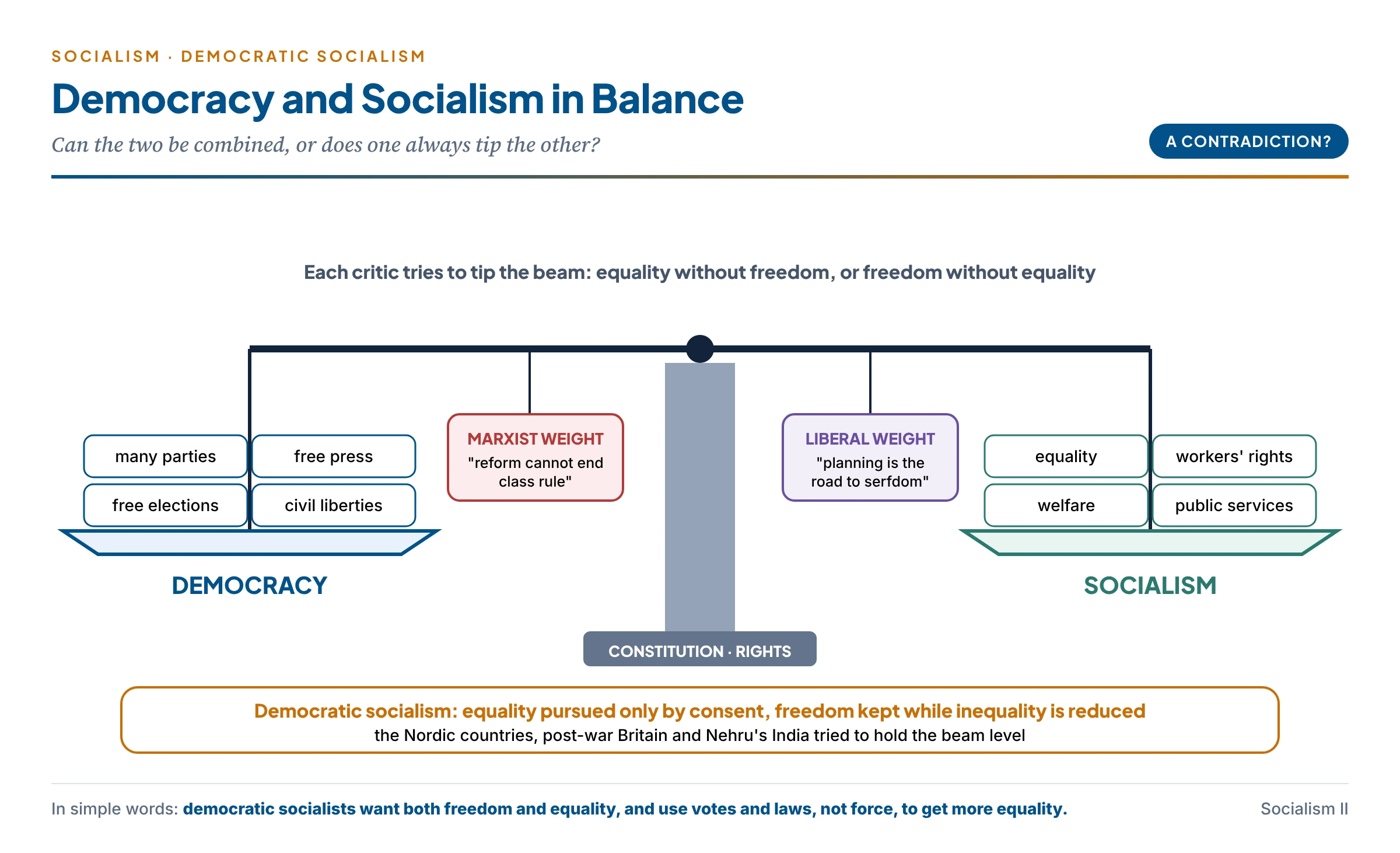
“Socialism Itself Is the Fulfilment of Democracy”
What the claim means:
- Democracy promises rule by the people and equality of citizens. In a society of great economic inequality, power drifts to the wealthy: they own media, fund parties and control jobs. Democracy remains unfulfilled.
- Socialism completes democracy by extending it from the political to the economic and social spheres: workplace democracy, public control of key resources, equal access to education and health.
- Supporters:
- Marx: true democracy is possible only in a classless society; in this sense socialism is synonymous with true democracy.
- Laski: political liberty without economic equality is unreal; liberty and equality are complementary, and great inequalities of wealth make the rights of the poor a formality.
- Ambedkar: political democracy cannot last unless it rests on social democracy, a way of life recognising liberty, equality and fraternity.
- Macpherson: democracy must become developmental, enabling everyone to use and develop their capacities.
Criticisms of the claim:
- Socialism without democracy (the Soviet Union, Maoist China) produced not the fulfilment but the destruction of democracy. So socialism fulfils democracy only when it is itself democratic.
- Democracy can be fulfilled in other ways: social liberalism and the welfare state (Green, Keynes, Rawls) also extend real freedom without socialist ownership.
- Democracy is about procedure too: free elections, rights and the possibility of changing government are ends in themselves, not mere means to equality.
- Risk of paternalism: “fulfilment” can become a pretext for the state deciding what citizens “really” need.
Balanced view: democratic socialism can be seen as the fulfilment of democracy in the sense that it extends equality and self-government into economic life. Authoritarian socialism is its negation. The claim holds only if “socialism” itself means democratic socialism.
In simple words
A school gives every student one vote for class monitor. But if some students cannot attend because they must work at home, cannot read the candidates’ posters, or are too hungry to care, the election is democratic only on paper. Feeding, teaching and freeing those students does not replace the election; it makes the election real. That is the sense in which socialism can “fulfil” democracy.
Does Combining Democracy and Socialism Produce a More Equitable Society?
- Evidence for:
- The Nordic social democracies have some of the lowest income inequality and highest social mobility in the world.
- In India, the broadly socialist policy mix from the 1950s to about 1980 (nationalisation of key sectors, strong regulation, top income-tax rates as high as 97.5% in the 1970s) coincided with a fall in the top 1% income share to about 6% by 1982; after liberalisation, the share rose steadily to about 23% by 2022–23 (World Inequality Lab).
- Kerala combined democratic politics with land reform, public health and education to reach human-development levels near those of rich countries on modest incomes.
- Evidence against or limits:
- Slow growth: India’s “Hindu rate of growth” (about 3.5% a year) under planning left many poor; growth after 1991 lifted hundreds of millions out of extreme poverty.
- Inefficiency of some public enterprises and the “licence-permit raj”, which bred corruption.
- Dependence on resources: welfare states need a strong economy and high tax capacity.
- Balanced answer: democracy plus socialist policies reduces inequality where there is strong state capacity, public support and economic growth to finance it. Equity and efficiency must be balanced; the lesson of India is that both planning without growth and growth without redistribution fall short.
Socialism and Marxism: The Basic Differences
| Point | Socialism (especially democratic) | Marxism |
|---|---|---|
| Scope | A broad family (utopian, Fabian, guild, democratic, Gandhian) | A specific doctrine within the socialist family |
| History | Older than Marx (Owen, Saint-Simon, Fourier) | From the 1840s |
| Philosophical basis | Ethical, humanitarian, sometimes religious or Kantian | Dialectical and historical materialism |
| View of history | No fixed law; reform possible at any time | History moves by class struggle towards communism |
| Class relations | Class cooperation and common interest possible | Class conflict inevitable and irreconcilable |
| Method | Evolutionary, constitutional, parliamentary | Revolutionary, often violent |
| State | A neutral instrument that can be used for welfare | Executive committee of the bourgeoisie; must be smashed |
| Transition | Gradual reform; no dictatorship | Dictatorship of the proletariat |
| Property | Mixed economy; public ownership of key sectors | Abolition of private ownership of the means of production |
| Democracy and rights | Multi-party democracy; civil liberties valued | “Bourgeois” democracy distrusted; one party leads |
| Religion | Often tolerant; Christian and Gandhian socialisms exist | “Opium of the people” |
| Final goal | Egalitarian welfare society with democratic freedoms | Classless, stateless communist society |
Is Socialism a Weaker Version of Marxism?
Yes (the Marxist and radical view):
- Socialism shares Marxism’s critique of capitalism but lacks the will to end it; it settles for reform and so legitimises the bourgeois state.
- Fabians and revisionists rejected many Marxist tenets without suitable alternatives; their socialism depends on the middle class and on capitalist growth.
- By accepting the market, social democracy has often diluted its egalitarian goals (the Third Way).
No (the democratic socialist view):
- “Weaker” assumes Marxism is the standard. Socialism is the wider and older tradition; Marxism is one branch of it.
- Different, not diluted: democratic socialism rests on a different philosophy (ethics, not historical necessity), a different view of the state and a commitment to liberty that Marxism lacks.
- Stronger in results: democratic socialism produced lasting welfare states with freedom; Marxist states produced dictatorships that mostly collapsed.
- Stronger morally: it respects the unity of means and ends; it does not sacrifice present generations for a promised future.
Conclusion: socialism is not a weaker but a broader and more democratic version of the same impulse. It is “weaker” only in revolutionary rhetoric; in durability, freedom and achievement it has proved stronger.
Socialism versus Liberalism: Why Freedom Is the Contested Ideal
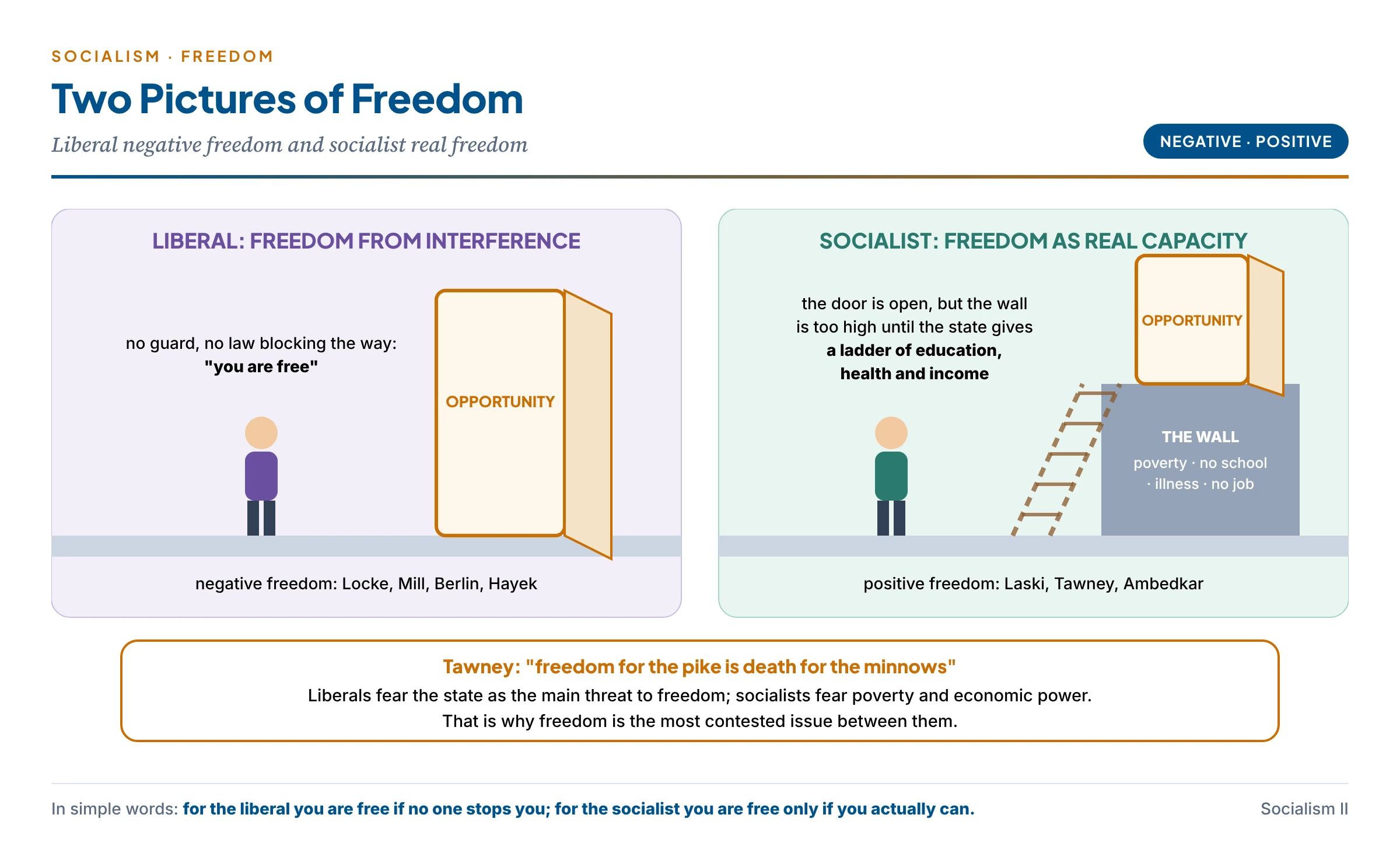
Both liberals and socialists claim to stand for individual freedom. Yet freedom is precisely the issue on which they disagree most. The reasons:
| Point | Liberal view of freedom | Socialist view of freedom |
|---|---|---|
| Meaning | Negative: absence of interference (Hobbes, Locke, Mill, Berlin, Hayek) | Positive and real: the power and resources to act and develop |
| Main threat | The state and its coercion | Economic power: poverty, exploitation, monopoly |
| Property | Private property is a condition of freedom | Concentrated property is power over others |
| Market | A sphere of free choice and contract | A sphere of hidden coercion (the worker “free” to starve) |
| State | Must be limited to protect freedom | Must act to create the conditions of freedom |
| Equality | Equality before law and of opportunity | Equality of condition as precondition of freedom |
| Rights given priority | Civil and political rights (negative rights) | Socio-economic rights (positive rights) |
| Individual and society | The individual comes first; society is an aggregate | The individual is social; freedom is realised in community |
- Why the conflict is deep:
- They define freedom differently: freedom from interference versus freedom to live a full life.
- They locate coercion differently: in the state versus in the economy.
- Each sees the other’s remedy as a threat to freedom: liberals fear the socialist state (Hayek’s “road to serfdom”); socialists fear the liberal market (economic coercion, monopoly, media power).
- A logical outcome of pushing negative liberty to its limit is anarchy (or libertarian anarchism); a logical outcome of pushing positive liberty to its limit is the paternalist state.
In simple words
A public library has no guard at the door: anyone may enter. For the liberal, that is freedom. The socialist adds: but a child who cannot read, or works all day in a field, or lives too far away without a bus, is not really free to use it. Freedom, for the socialist, needs the door left open and the ladder to reach it.
- Convergence: social liberalism (Green, Hobhouse, Rawls) moved towards positive freedom and welfare, while democratic socialism accepted civil liberties and markets. The modern welfare democracy is their meeting ground, though they still argue over how far it should go.
A Liberalist or a Socialist — Who Strengthens the State More?
- The liberal individual strengthens the state by:
- insisting on rights, rule of law and limited power, which make the state legitimate and trusted;
- enterprise and innovation, which build the economic base that pays for the state;
- civic vigilance against tyranny.
- The socialist individual strengthens the state by:
- solidarity and willingness to pay taxes for common services;
- demanding welfare and equality, which give citizens a stake in the state and reduce conflict;
- duty-mindedness: socialism, like idealism and Gandhism, tends to put duty above right.
- Balanced answer: a strong state needs both: liberal citizens who keep it accountable and socialist citizens who keep it inclusive. A state of pure liberals risks inequality and division; a state of pure socialists risks overreach and dependence. India’s Constitution, combining Fundamental Rights and Directive Principles, reflects this balance.
Socialism and Nationalism
- Marx described nationalism as false consciousness, a bourgeois idea of class harmony; “the proletarians have nothing to lose but their chains”; workers have no fatherland.
- Early Marxists saw no difference in organising class struggle at national and international level.
- Lenin, fighting imperialism, upheld the right of nations to self-determination and hoped the Russian revolution would spark an international one.
- Stalin later insisted on building socialism in one country.
- Champions of international socialism hold that when socialism becomes nationalism, it ceases to be socialism (the warning of “national socialism”, the Nazis’ misuse of the word).
- Today many socialist states enjoy full sovereignty and play major roles in world politics; in countries like China, nationalism rather than socialism now plays the key role in support for the ruling regime.
Can Gender Equality Be Realised within a Socialist Regime?
- The socialist case:
- Engels (The Origin of the Family, 1884): women’s subordination began with private property and the patriarchal, monogamous family designed to pass property to legitimate heirs: “the world-historic defeat of the female sex”. Abolishing private property and bringing women into public production would end it.
- August Bebel (Woman and Socialism, 1879) and socialist feminists: capitalism profits from women’s unpaid domestic work and low wages.
- Achievements: the Soviet Union granted women’s suffrage (1917), easy divorce, legal abortion (1920) and mass female employment; the Nordic social democracies lead the world in gender equality through paid parental leave, public childcare and equal-pay policies.
- The limits:
- Soviet women faced a “double burden”: full-time jobs plus housework; few reached top leadership.
- Patriarchy predates capitalism and survives under all economic systems; it is also cultural and religious, so economic change alone cannot end it.
- Liberal democracies have also made large gains through rights, education and law.
- Conclusion: socialist policies (welfare, childcare, equal pay, economic independence) are powerful conditions for gender equality, especially when combined with democracy; but equality cannot be realised “only” within a socialist regime, nor automatically by it. It needs cultural change, rights and women’s own political agency.
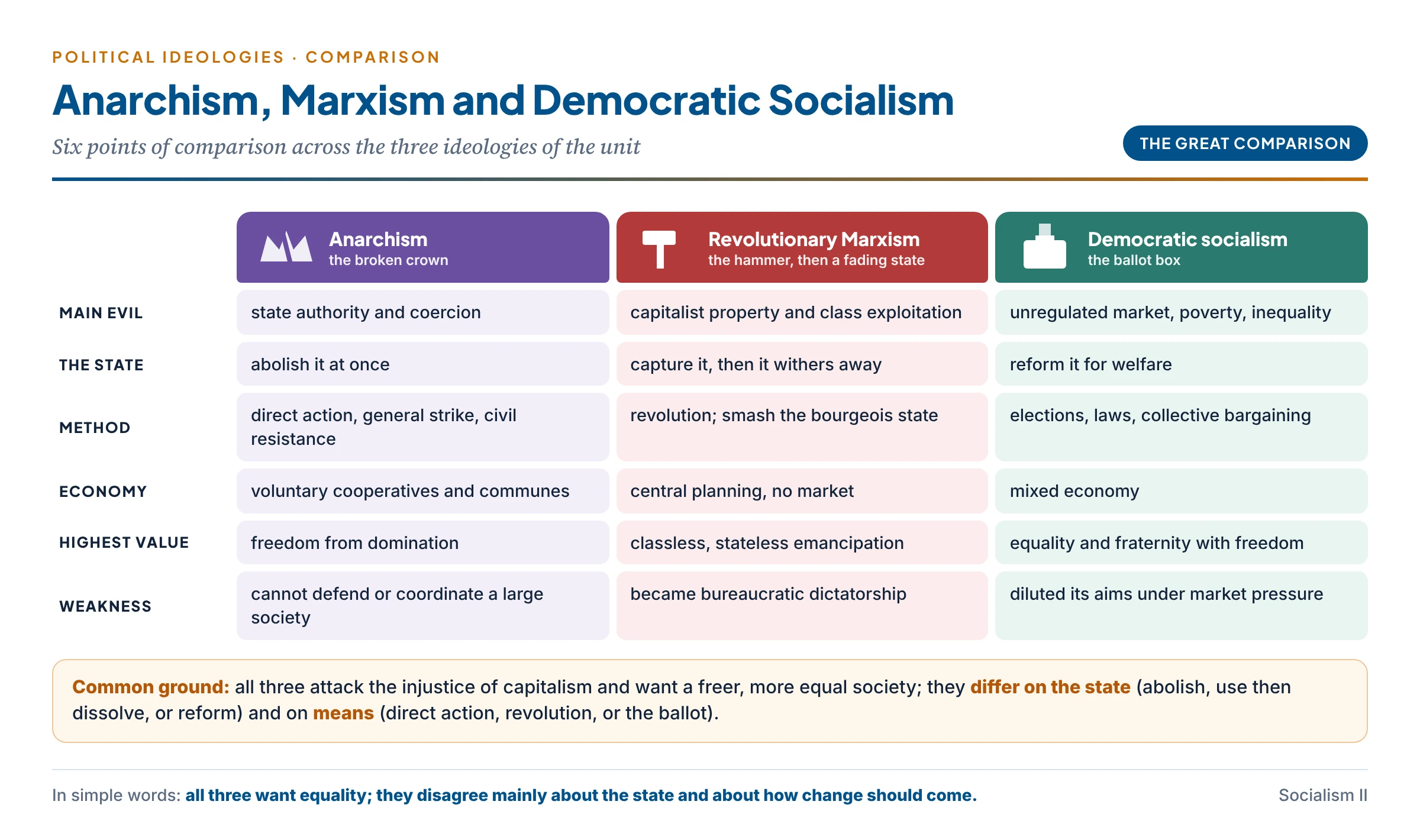
The Three Ideologies Compared
| Dimension | Anarchism | Revolutionary Marxism | Democratic socialism |
|---|---|---|---|
| Primary evil | State authority and coercion (with private property) | Capitalist private property and class exploitation | Unregulated market, inequality and poverty |
| Human nature | Naturally cooperative and self-governing | Creative producer, alienated by class society | Social and cooperative, corrupted by market greed |
| Role of the state | Illegitimate; must be abolished at once | Class instrument; captured as dictatorship of the proletariat, then withers away | Legitimate democratic instrument, reformed for welfare and redistribution |
| Method | Direct action, general strike, voluntary secession, civil resistance | Revolutionary insurrection; destruction of the bourgeois state | Constitutional legislation, elections, collective bargaining |
| Economy | Voluntary cooperatives, mutual aid, decentralised communes | Centralised state planning; abolition of the market | Mixed economy: public ownership of commanding heights with regulated private enterprise |
| Ultimate value | Freedom from domination | Classless, stateless emancipation | Equality and fraternity with freedom |
| Historical flaw | Cannot organise large-scale defence or coordinate complex societies | Degenerated into bureaucratic dictatorship (the Gulag, the Cultural Revolution) | Compromised with neo-liberal capitalism; diluted its egalitarian aims |
Socialism in the Indian Constitution
The original design:
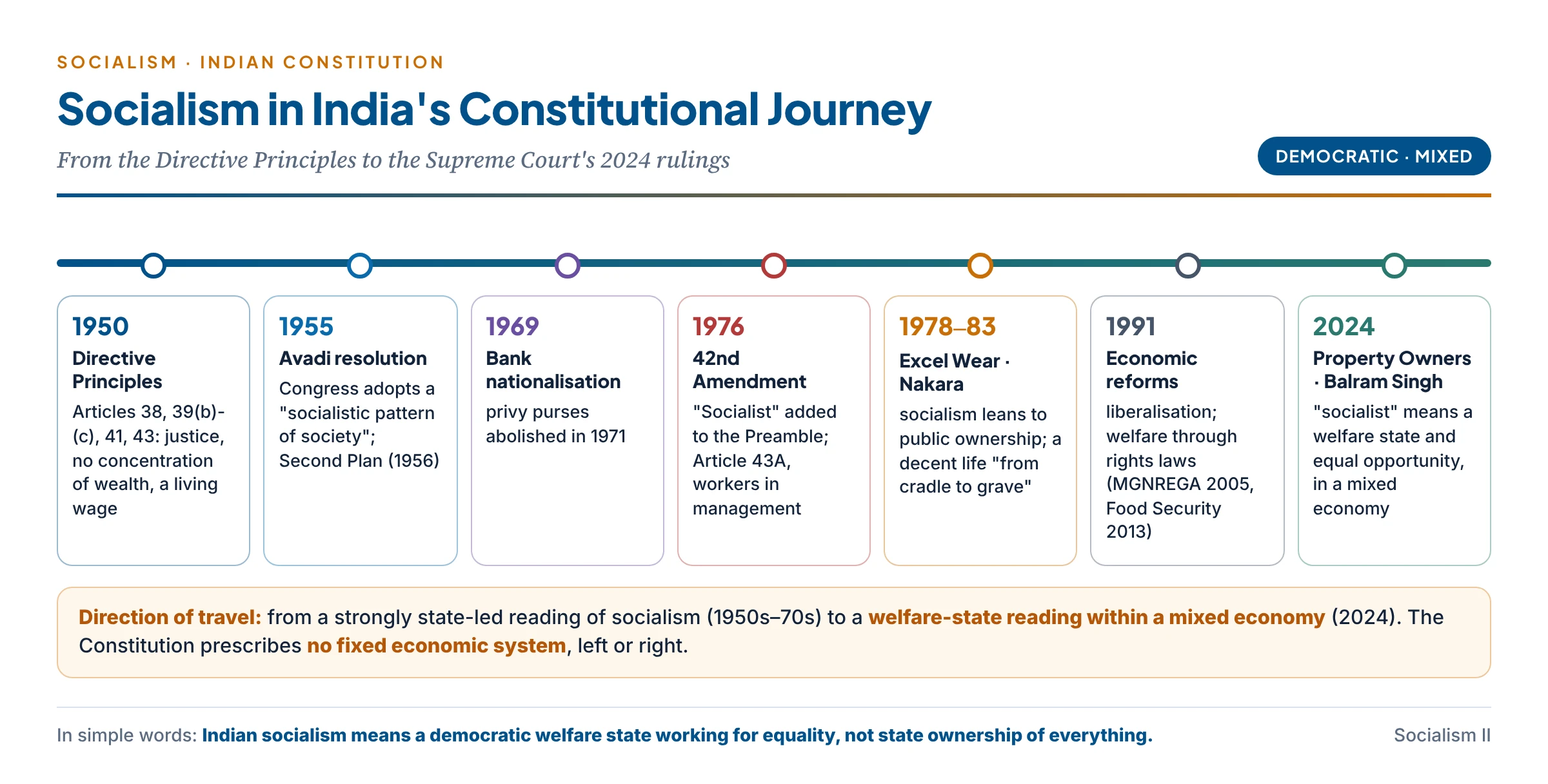
- The Constitution of 1950 did not use the word “socialist” in the Preamble, but its Directive Principles of State Policy (Part IV) are strongly socialist in content:
- Article 38: a social order in which justice, social, economic and political, informs all institutions; minimise inequalities of income, status and opportunity.
- Article 39(b) and (c): the ownership and control of the material resources of the community to be so distributed as best to subserve the common good; the economic system must not result in the concentration of wealth and means of production to the common detriment.
- Article 41: right to work, education and public assistance; Article 42: just and humane conditions of work and maternity relief; Article 43: a living wage; Article 43A (1976): workers’ participation in management; Article 47: nutrition and public health.
- Ambedkar explained that the Constitution did not fix any particular economic system; the Directive Principles set the goal of economic democracy, leaving the means to elected governments. Separately, in his memorandum States and Minorities (1947), he had proposed “State Socialism” (state ownership of key industries and of agricultural land, with collective farming) written into the Constitution itself, so that no legislature could undo it, combined with parliamentary democracy.
Policy:
- Nehru’s democratic socialism: the Avadi session of the Congress (1955) adopted the goal of a “socialistic pattern of society”; the Second Five-Year Plan (1956, the Mahalanobis model) gave the public sector the “commanding heights”; the Industrial Policy Resolution of 1956.
- Indira Gandhi: bank nationalisation (1969), abolition of privy purses (1971), and the 42nd Amendment (1976), which added “Socialist” (with “Secular” and “Integrity”) to the Preamble.
- 1991: liberalisation, privatisation and globalisation reforms moved India towards a market economy, while welfare continued through rights-based laws such as MGNREGA (2005), the right to work, and the National Food Security Act (2013).
What the courts have said:
- Excel Wear v Union of India (1978): the word “socialist” may lead the Court to lean in favour of nationalisation and state ownership, though private ownership was also recognised.
- D. S. Nakara v Union of India (1983): the basic framework of socialism is to provide a decent standard of life to working people and security from cradle to grave.
- Property Owners Association v State of Maharashtra (5 November 2024, nine judges, 8:1): not all privately owned property is “material resources of the community” under Article 39(b). The majority held that Justice Krishna Iyer’s earlier view (that all private resources fall within it) rested on “a rigid economic theory” favouring state control, while the framers, following Ambedkar, did not tie the Constitution to socialism or capitalism but to the aspiration of a welfare state. Whether a private resource becomes a community resource depends on its nature, its impact on community well-being, its scarcity, and the consequences of its concentration in private hands. Justices Nagarathna (partly) and Dhulia (fully) dissented, Justice Dhulia pointing out that inequality has not declined.
- Dr Balram Singh v Union of India (25 November 2024): the Court dismissed petitions challenging the words “socialist” and “secular” in the Preamble. “Socialist” denotes the State’s commitment to be a welfare State and to ensuring equality of opportunity; neither the Constitution nor the Preamble mandates a specific economic policy, left or right; India has consistently followed a mixed economy, and socialism does not restrict private entrepreneurship or the right to trade under Article 19(1)(g).
Common confusion
Does “socialist” in the Preamble mean India must follow a state-controlled economy? No. The Supreme Court held in 2024 that “socialist” in the Indian context means a welfare State committed to equality of opportunity and economic and social justice. It does not prescribe any particular economic policy and does not restrict private enterprise. Indian socialism is democratic and mixed, not Marxist.
Critical Evaluation
Criticisms of Democratic Socialism
- From the left: it legitimises capitalism; it relies on growth and becomes dependent on business confidence; the Third Way abandoned socialism.
- From the right: high taxes and regulation reduce incentives and growth; welfare creates dependence; public enterprises are inefficient.
- Fiscal limits: ageing populations and globalised capital make high-tax welfare states harder to sustain.
- Uneven success: what worked in small, homogeneous Nordic states with strong institutions worked less well in poor, diverse societies like India.
Strengths
- It combines equality and freedom better than any other socialist form.
- It created universal health care, education and social security in many democracies.
- It respects the unity of means and ends.
- It adapts: it can learn, reform and respond to voters.
Critics and Defenders
Criticism — Critics
- Luxemburg and Lenin: reform cannot abolish the class state.
- Hayek: planning leads to serfdom.
- Friedman: freedom is compatible only with capitalism.
- Public-choice critics: bureaucracies and interest groups capture the welfare state.
- Experience: India’s licence-permit raj and slow growth.
Defence — Defenders and strengths
- Laski and Nehru: democracy and socialism share one goal.
- Ambedkar: political democracy needs social and economic democracy to survive.
- Macpherson: markets run by big firms are not guardians of freedom.
- Nordic evidence: low inequality with high freedom and prosperity.
- The Supreme Court (2024): socialism as a welfare-state commitment within a democratic, mixed economy.
Cross-Tradition Comparison
| Thinker | View of socialism | Relation to democracy |
|---|---|---|
| Nehru | Democratic socialism through planning and a public sector | Socialism must come through democratic consent |
| Ambedkar | State Socialism in the economy, constitutionally entrenched | Combined with parliamentary democracy; political democracy must rest on social democracy |
| Lohia | “Equal irrelevance” of capitalism and communism; decentralised “four-pillar state” (village, district, province, centre) | Small-unit democracy and the “seven revolutions” against inequality of caste, gender, race and wealth |
| JP | Sarvodaya-based socialism | Partyless democracy, people’s power over state power |
| Gandhi | Trusteeship; socialism of non-violence | Decentralised village democracy |
Indian Connect — Indian takeaways
- India’s version of socialism has always been democratic: it grew from the national movement, Nehru’s Fabian outlook and Ambedkar’s constitutionalism, not from revolution.
- Ambedkar’s “life of contradictions” speech is the classic Indian statement of why political democracy needs socialism-like equality to survive.
- The 2024 judgments confirm that Indian socialism today means a welfare-state commitment within a mixed economy, while the dissent in the Article 39(b) case keeps alive the older egalitarian reading.
Synthesis (Siddhānta)
- Democratic socialism is not a contradiction but a managed tension: between majority rule and socialist goals, between liberty and equality. It is best held together by constitutional rights and by treating socialist institutions as means open to democratic revision.
- Socialism fulfils democracy only when it is itself democratic: it extends equality into economic and social life without destroying political freedom.
- Socialism and Marxism share a critique of capitalism but differ in philosophy, method, view of the state and attitude to liberty. Socialism is broader, older and more democratic, not a “weaker” Marxism.
- Freedom divides liberals and socialists because they define it and locate its enemies differently; the welfare democracy is their meeting ground.
- India’s constitutional socialism, as the Supreme Court read it in 2024, is a commitment to welfare and equal opportunity within a mixed economy: socialism as a direction of policy, not a fixed economic system.
Previous Year Questions
- 2019Can gender equality be realized within a socialist regime? Analyse.
- 2016“Socialism itself is the fulfilment of democracy.” Analyse.
- 2013Does the combination of democracy and socialism lead to a more equitable society?
- 2011What are the basic differences between Marxism and Socialism?
- 2011Can it be said that Socialism is a weaker version of Marxism?
- 2011Is Democratic Socialism a contradiction in terms? Discuss.
- 2010Which type of individual according to you can contribute more to strengthen the state – a liberalist or a socialist?
- 2004Despite their self-proclaimed commitment to the ideal of individual freedom, this ideal is one of the most contentious issues between socialism and liberalism. Why? Discuss.