

Political Ideologies: Anarchism; Marxism and Socialism
Official Syllabus: Paper II, Section A, Unit 5
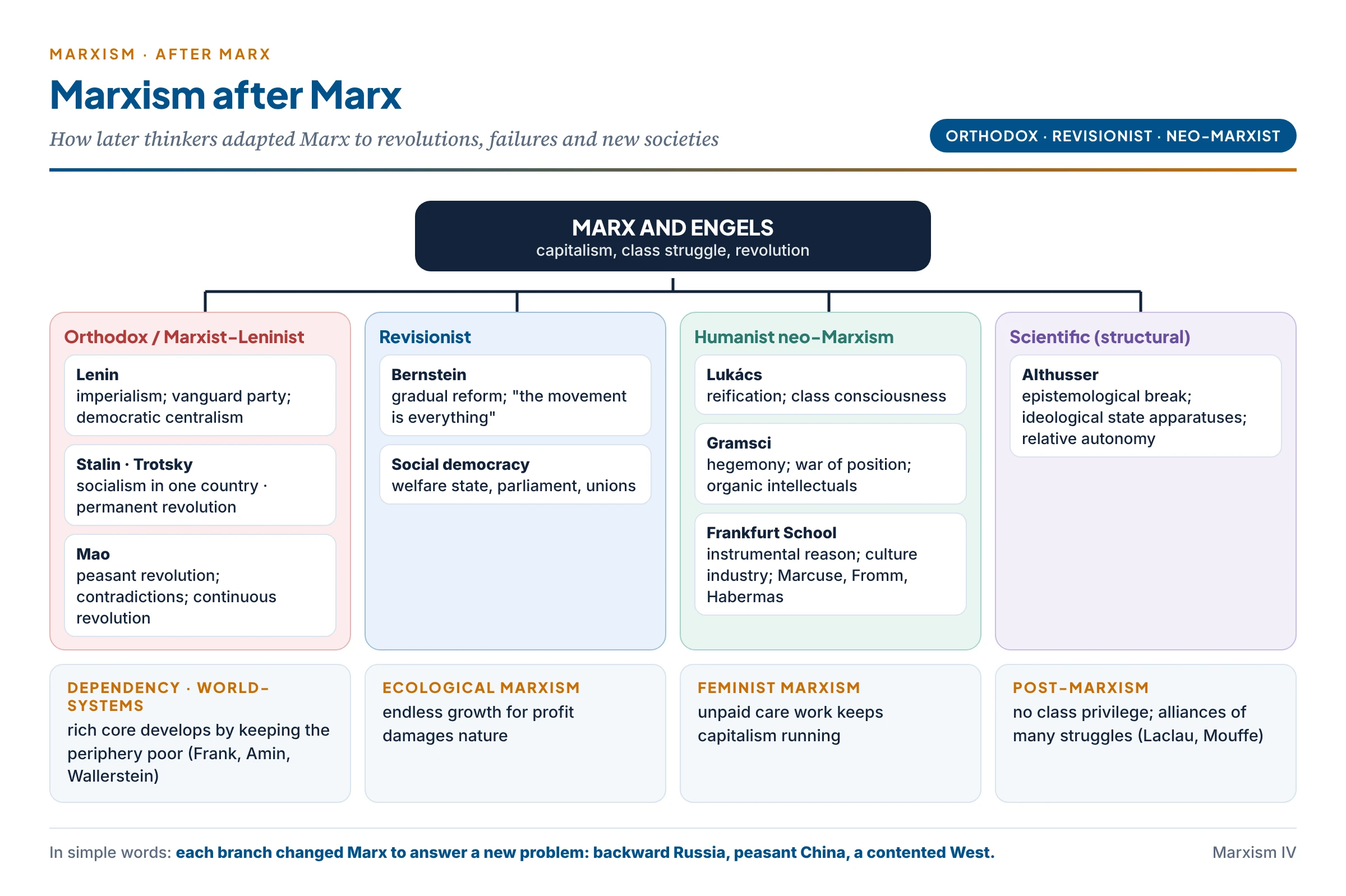
Marx died in 1883 expecting revolution in the advanced industrial countries. Instead, revolution came in backward Russia (1917) and peasant China (1949), while Western workers voted for reformist parties and the welfare state softened capitalism. Marxists spent the twentieth century explaining and adapting this surprise. Lenin added the vanguard party and the theory of imperialism; Mao turned the peasantry into the revolutionary class; Gramsci explained why the West did not revolt, through his theory of hegemony; the Frankfurt School examined how consumer culture and technology tame people; Althusser rebuilt Marxism as a science of structures. This article surveys these developments, then makes the overall evaluation UPSC asks for: Marxism as a political ideology, its criticisms and significance, its relevance today and its future in a free-market world.
In simple words
Think of Marx’s theory as a family recipe written for one kitchen (nineteenth-century England). Later cooks found different ingredients in their own kitchens: Lenin had a few workers and many peasants; Mao had almost only peasants; Gramsci found the customers happy with the old dish. Each changed the recipe to fit. Some changes kept the taste, others made a new dish under the old name. Evaluating Marxism means asking which parts of the recipe still work.
Context & Problem
- After Marx: the Second International (1889–1914) of socialist parties treated Marxism as a science of inevitable progress. Karl Kautsky led the “orthodox” view; Eduard Bernstein “revised” it, arguing for gradual reform (Article 8).
- The great shocks:
- 1914: socialist parties supported their own governments in the First World War: nationalism beat class.
- 1917: the first Marxist revolution happened in Russia, a mainly peasant country.
- 1918–23: revolutions in Germany and Hungary failed.
- 1920s–30s: Stalinism in the USSR; fascism in Italy and Germany won many workers.
- So the questions became: Why did revolution not happen where Marx predicted? Why did workers accept capitalism? What went wrong in the Soviet Union? Can Marxism still explain the world?
Core Doctrine
Classical Marxism after Marx: The Main Strands
The developments after Marx fall broadly into orthodox or Marxist-Leninist strands (Lenin, Stalin, Trotsky, Mao), which focused on the party, the state and revolution, and neo-Marxism, which focused on culture, consciousness and structures. Neo-Marxism itself has two strains:
- Humanistic strain: based on the young Marx (the 1844 Manuscripts) and on critical theory; its dominant themes are alienation and the ways to human emancipation (Lukács, Gramsci, the Frankfurt School, Fromm).
- Scientific (structural) strain: interested in structures, and in the relative importance of cultural, ideological and social factors in society (Althusser).
Lenin: Imperialism, the Party and the Revolution
Imperialism, the Highest Stage of Capitalism (1916):
- Capitalism had moved from free competition to monopoly: giant firms and banks merged into finance capital.
- Monopolies exported capital to colonies, divided the world among themselves, and fought imperialist wars (such as the First World War) over markets and raw materials.
- Super-profits from the colonies allowed capitalists to bribe a “labour aristocracy” of better-paid Western workers, which explains why they became reformist.
- So the revolution could break out at the “weakest link” in the imperialist chain, a backward country like Russia, and colonial liberation movements became allies of the proletarian revolution.
The vanguard party (What Is to Be Done?, 1902):
- Left to themselves, workers develop only “trade-union consciousness”, the wish for better wages within capitalism.
- Revolutionary consciousness must be brought from outside by a disciplined vanguard party of professional revolutionaries, mostly intellectuals.
- Democratic centralism: free discussion before a decision; iron discipline after it; lower bodies obey higher ones.
- Against Bernstein: Lenin rejected gradual reform and parliamentary socialism; only revolution could overthrow the bourgeois state.
State and Revolution (1917): the bourgeois state must be smashed, not taken over; the dictatorship of the proletariat would be “democracy for the vast majority”, leading to the withering away of the state.
In power: “War Communism”, the Red Terror, a one-party state; then the New Economic Policy (1921), which allowed small private trade.
Criticisms of Lenin: Rosa Luxemburg (1904) attacked Lenin’s “ultra-centralism” as a danger to the workers’ own initiative; the young Trotsky (1904) predicted that the party organisation would substitute itself for the party, the central committee for the organisation, and finally a single dictator for the central committee. Critics see in Leninism the seed of Stalinism.
Stalin and Trotsky
- Stalin: “socialism in one country” (build socialism in the USSR without waiting for world revolution); forced collectivisation of agriculture (famine in Ukraine, 1932–33); Five-Year Plans of rapid industrialisation; the Great Terror and labour camps; a personality cult.
- Trotsky: “permanent revolution”, international and continuous; in The Revolution Betrayed (1936) he condemned the Soviet state as a degenerated workers’ state ruled by a privileged bureaucracy. He was murdered on Stalin’s orders in 1940.
Mao Zedong: Marxism in a Peasant Country
- The peasantry as the main revolutionary force: in China the industrial working class was tiny; Mao organised the poor peasants in the countryside, encircling the cities.
- “Political power grows out of the barrel of a gun”: revolution through protracted people’s war, guerrilla warfare from rural base areas.
- New Democracy: a first stage uniting workers, peasants, petty bourgeoisie and the “national bourgeoisie” against imperialism, feudalism and bureaucratic capitalism.
- On Contradiction (1937): every process has a principal contradiction and secondary ones; contradictions can be antagonistic (with enemies, settled by force) or non-antagonistic (among the people, settled by discussion and education).
- The mass line: “from the masses, to the masses”: leaders gather the scattered ideas of the people, systematise them and return them as policy.
- Continuous revolution: class struggle continues under socialism; hence the Great Leap Forward (1958–62, which caused a terrible famine) and the Cultural Revolution (1966–76).
- Maoism is shaped by particular circumstances: anti-imperialism, a peasant society and national liberation. It inspired revolutionary movements in the Third World, including India’s Naxalite movement.
- After Mao: Deng Xiaoping’s reforms from 1978 introduced “socialism with Chinese characteristics”: markets, private enterprise and foreign investment under one-party rule. Communist China thus switched to market socialism.
Western Marxism: Lukács and Gramsci
Georg Lukács (History and Class Consciousness, 1923):
- Reification: under capitalism, relations between people take on the character of things, extending Marx’s commodity fetishism to all of life, including bureaucracy, law and science.
- Class consciousness: the proletariat, as the class that experiences reification most fully, can see society as a whole; the party expresses its “imputed” consciousness.
Antonio Gramsci (1891–1937), Italian communist leader imprisoned by Mussolini, wrote the Prison Notebooks (1929–35).
- Influences: Machiavelli (the party as the “Modern Prince” that unites and leads the people) and the Italian philosopher Benedetto Croce (the importance of ideas and culture).
- The question: why did the revolution succeed in Russia but fail in the West?
- Answer — two kinds of rule:
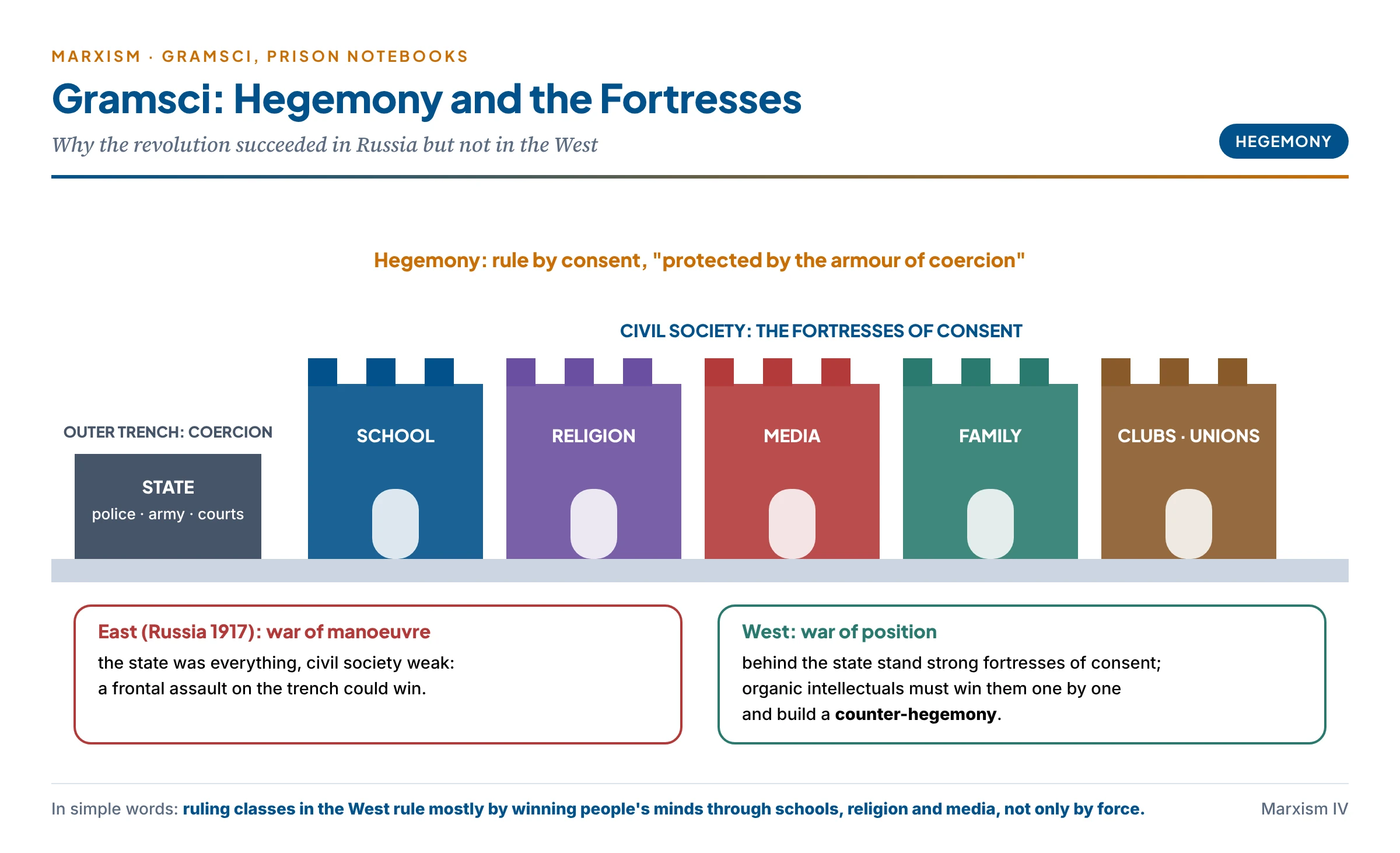
- Political society (the state) rules through coercion: police, army, courts.
- Civil society (church, schools, media, family, trade unions, clubs, parties) rules through consent.
- Hegemony: the ruling class dominates not only by force but by winning consent: its values come to seem like common sense. Gramsci described the state as “hegemony protected by the armour of coercion”.
- Marx’s base–superstructure model was an oversimplification because it ignored the role of these other factors (culture, ideology, institutions of civil society).
- East vs West: in Russia, the state was everything and civil society weak, so a “war of manoeuvre” (frontal assault on the state) could succeed. In the West, behind the state stood “a powerful system of fortresses and earthworks” of civil society, so revolutionaries needed a long “war of position”: winning hearts and minds, institution by institution.
- Intellectuals: traditional intellectuals (priests, professors) appear independent but usually support the ruling order; each rising class needs its own organic intellectuals to build a counter-hegemony.
- Historic bloc: an alliance of classes and groups held together by a shared world-view.
- Hence the working class cannot directly seize power in developed capitalist states; it must first become hegemonic in civil society.
In simple words
A shopkeeper can keep customers by locking the door (coercion) or by making them believe this is the only good shop (consent). The second is cheaper and lasts longer. Gramsci says ruling classes in the West rule mostly the second way, through schools, religion, films and newspapers that make the present order feel natural and normal. That is hegemony.
The Frankfurt School and Critical Theory
- The Institute for Social Research at Frankfurt (founded 1923): Max Horkheimer, Theodor Adorno, Herbert Marcuse, Erich Fromm, and later Jürgen Habermas.
- Critical theory: social theory should not merely describe society but criticise it in the interest of human emancipation.
- Critique of both Western capitalism and Soviet state socialism, which they saw as two forms of domination.
- Dialectic of Enlightenment (Horkheimer and Adorno, 1944): reason, meant to liberate, has become instrumental reason, calculation for control and profit; science and technology, instead of freeing people, became tools of domination: they “killed humanism”.
- The culture industry: films, radio and popular music are mass-produced like goods; they standardise taste and make people passive and conformist.
- Marcuse, One-Dimensional Man (1964): advanced industrial society creates false needs through advertising; people “recognise themselves in their commodities”. They behave like a herd of sheep, lose the capacity for critical reasoning, and accept the system because it delivers goods. Even sexual freedom is used to sell products (“repressive desublimation”). Hope lies with outsiders (students, minorities, the Third World) and a “Great Refusal”.
In simple words
A phone company sells you a new model every year. You did not need it, but advertising made the old one feel shameful, and buying the new one feels like freedom of choice. Marcuse’s point is that people who are kept busy choosing between products stop asking whether they can choose a different way of living. The cage is comfortable, so no one tries the door.
- Fromm: Escape from Freedom (1941), on why people embrace authoritarianism; Marx’s Concept of Man (1961), which made the humanist Marx widely known.
- Habermas: moved critical theory towards communication: emancipation comes through free, rational discussion in the public sphere; capitalist democracies face a “legitimation crisis” when they cannot meet the expectations they raise.
Structural Marxism: Louis Althusser
- Against humanist Marxism: Althusser saw an “epistemological break” around 1845 between the young, humanist, Hegelian Marx and the mature, scientific Marx of Capital. Concepts like “alienation” and “human essence” belong to pre-scientific ideology.
- Theoretical anti-humanism: history is a “process without a subject”; individuals are bearers of structures, not authors of history.
- Overdetermination and relative autonomy: events are caused by many levels together (economic, political, ideological); the economy is determining only “in the last instance”, and “the lonely hour of the last instance never comes”.
- Ideological state apparatuses (1970): besides the repressive state apparatus (police, army, courts), the state includes ideological apparatuses: schools, family, church, media, which reproduce the relations of production by shaping people’s beliefs. The school is the dominant one in modern capitalism.
- Interpellation: ideology “hails” individuals and turns them into subjects (“Hey, you there!”), who then accept their roles as natural.
Later Developments
- Dependency theory (Andre Gunder Frank, Samir Amin) and world-systems theory (Immanuel Wallerstein): in the twentieth century the focus of struggle shifted to developing nations fighting colonialism and neo-colonialism. Rich “core” countries develop by keeping the “periphery” underdeveloped.
- Ecological Marxism: capitalism’s drive for endless growth and profit causes environmental destruction (a “metabolic rift” between society and nature).
- Feminist Marxism: unpaid domestic and care work (social reproduction) keeps capitalism running.
- Post-Marxism (Ernesto Laclau and Chantal Mouffe, 1985): rejects economic determinism and class privilege; politics is built from alliances of many struggles (workers, women, ecology, minorities) around shared discourses.
Critical Evaluation: Marxism as a Political Ideology
Criticisms
Theoretical:
- Unscientific (Popper): Marxism began as a testable theory, but when its predictions failed, its followers reinterpreted theory and facts to save it, making it unfalsifiable. Its historicism (claim to know history’s laws) leads to closed societies.
- Economic reductionism: caste, religion, nation, gender, race and ideas are reduced to class.
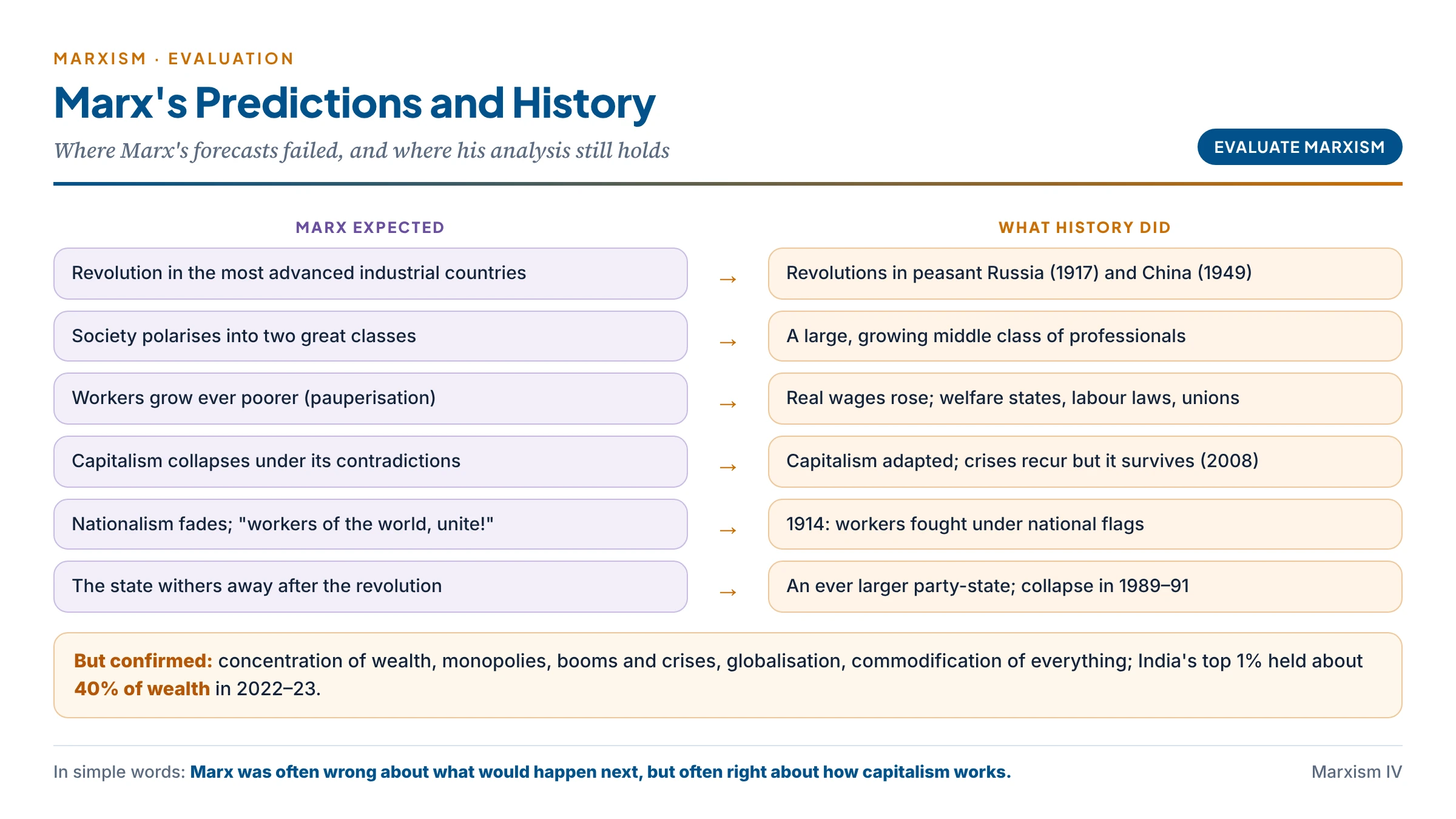
- Failed predictions (Bernstein and others): capitalism did not collapse; the middle class grew; workers’ living standards rose; revolutions came in agrarian countries; nationalism beat internationalism.
- The economic calculation problem (Ludwig von Mises, 1920; Hayek): without market prices, central planners cannot know the real costs and values of millions of goods, so planned economies become wasteful.
- Positive liberty and tyranny (Berlin): the claim to know people’s “true” interests licenses forcing them.
- No theory of post-revolutionary politics: Marx left no account of institutions to check the new power.
- Ambedkar: class theory cannot explain caste; violence and dictatorship cannot build a moral society.
- Feminists and ecologists: Marx neglected gender and treated nature as raw material for ever-growing production.
Practical (critical appraisal):
- The “dictatorship of the proletariat” was reduced to mere dictatorship: people were denied democratic rights and civil liberties.
- Widespread protests and resistance led to the collapse of communism in Eastern Europe by the end of the 1980s (the fall of the Berlin Wall, 1989) and in the Soviet Union in 1991.
- Communist China switched to market socialism.
- Economic failure: shortages, low productivity and lack of incentives; ecological disasters such as the shrinking Aral Sea.
- Human cost: famines, purges, labour camps.
Significance and Strengths
- A liberating force: Marxism inspired the Bolshevik Revolution (1917) in Russia and the Communist Revolution (1949) in China, and gave hope to the oppressed and to anti-colonial movements across Asia and Africa.
- It changed capitalism: fear of revolution and the pressure of labour movements produced the welfare state, labour laws, the eight-hour day, social insurance and progressive taxation.
- It transformed social science: class analysis, ideology critique, historical sociology and political economy.
- Marx and Engels were great humanists who believed in constant debate to find the truth; the core of their thought is the emancipation of human beings.
- While the real message of communism remains relevant, its distortion is very injurious to humanity and must be resisted resolutely.
Common confusion
Did the collapse of the Soviet Union prove Marx wrong on everything? Not on everything. It discredited Soviet-style one-party central planning, which Marx never described in detail. Marx’s analysis of capitalism (its tendency to concentrate wealth, its cycles of boom and crisis, its globalisation and its power to commodify everything) has often been confirmed. Many economists who reject Marxist politics still use parts of Marx’s analysis.
Relevance Today
Where Marx still speaks:
- Inequality: the World Inequality Lab estimates that by 2022–23 the richest 1% in India received about 23% of national income and held about 40% of national wealth, the highest levels in the century-long record; global inequality has grown similarly. Thomas Piketty’s Capital in the Twenty-First Century (2013) argued that, left alone, returns on wealth tend to grow faster than the economy, so inherited wealth concentrates, an echo of Marx’s accumulation.
- Crises: the 2008 global financial crisis revived interest in Marx’s theory of crisis; the phrase “Marx was right” appeared even in mainstream newspapers.
- Globalisation: the Manifesto’s description of capital “nestling everywhere, settling everywhere” and creating “a world after its own image” reads like a description of global supply chains.
- Alienation and precarity: gig workers, algorithmic control, burnout and insecure contracts. India’s Labour Codes, in force from 21 November 2025, for the first time recognised gig and platform workers for social security, with platform companies (aggregators) paying 1–2% of their annual turnover into a welfare fund, while trade unions warned that other rules weakened workers’ bargaining power. Both sides of the debate use the language Marx made familiar.
- Commodification: health, education, data and even personal attention are turned into commodities.
- Ecology: endless growth versus planetary limits; ecological Marxists blame capitalism’s drive for profit.
- Politics: Occupy Wall Street (2011, “We are the 99%”), the revival of democratic socialism in Western politics, and labour movements draw on Marxist analysis.
Where Marx is outdated:
- The revolutionary programme (violent revolution, dictatorship of the proletariat, abolition of markets) has failed wherever tried.
- Class structure has fragmented: professionals, service workers, the self-employed and the global middle class do not fit the two-class model.
- Markets have proved efficient at innovation and growth; even China relies on them.
- Democracy and rights are now seen as essential, not “bourgeois” extras.
The Future of Marxism in a Free-Market World
- As a blueprint for society, Marxism has little future: the free-market economy, with private enterprise, global trade and democracy, has become dominant; Fukuyama declared the “end of history”.
- As a critique and a method, Marxism has a strong future:
- Wherever markets produce inequality, crises, alienation and ecological damage, Marx’s questions return.
- Hybrid forms: democratic socialism, the welfare state, the social market economy, cooperatives and public ownership of essential services keep Marxist goals within democratic frameworks.
- New Marxisms: ecological, feminist and post-Marxist versions adapt the theory to climate change, gender and identity.
- Global South: dependency and world-systems analysis still explain unequal development.
- Likely future: Marxism will survive not as a single party doctrine but as one voice in a plural debate, keeping capitalism under critical watch. Without such a critique, free-market societies lose the means to see who pays the costs of their success.
Critics and Defenders
Criticism — Critics
- Popper: historicism; unfalsifiable; leads to closed societies.
- Mises and Hayek: central planning cannot calculate; it leads to serfdom.
- Berlin: positive liberty as a mask for coercion.
- Bernstein: the predictions of collapse and polarisation failed.
- Ambedkar: violence and dictatorship cannot create a moral order; class misses caste.
- History: 1989 and 1991.
Defence — Defenders and strengths
- Gramsci and the Frankfurt School: Marxism explains why capitalism survives: through hegemony and culture.
- Lenin and dependency theorists: imperialism explains revolutions in the “weakest links” and unequal development.
- Piketty and inequality research: wealth concentration confirms the tendency Marx identified.
- Humanist Marxists: the critique of alienation remains a moral standard for work and society.
- Welfare state: much of what made capitalism humane came from Marxist pressure.
Cross-Tradition Comparison
| Point | Marxism after Marx | Indian experience |
|---|---|---|
| National question | Lenin: support anti-colonial national movements | M. N. Roy at the Second Congress of the Communist International (1920) argued that colonial bourgeois nationalists (like Gandhi’s Congress) were not truly revolutionary; Lenin backed alliances with them. Roy helped found the Communist Party of India in Tashkent (1920) |
| Peasant revolution | Mao: peasants encircle the cities | Telangana armed struggle (1946–51); Naxalbari (1967) and the Naxalite movement inspired by Mao |
| Parliamentary path | Bernstein, Eurocommunism | Kerala elected the communist government of E. M. S. Namboodiripad in 1957; long Left Front rule in West Bengal and Tripura |
| Hegemony and culture | Gramsci | Subaltern Studies historians used Gramsci’s term “subaltern” to write history from below |
| Critique of Marxism | Popper, Hayek | Ambedkar (caste, means), Lohia (equal distance from capitalism and communism), M. N. Roy (radical humanism), Gandhi (non-violence, trusteeship) |
Indian Connect — Indian takeaways
- Indian Marxists had to adapt Marx to a society of peasants, castes and colonial rule, much as Lenin and Mao did for Russia and China.
- The Indian Left has followed both paths: parliamentary (Kerala, West Bengal) and armed Maoist (Naxalism), and the contrast between them mirrors the global debate between democratic and revolutionary Marxism.
- Gramsci’s idea of the subaltern reshaped Indian historiography, showing how peasants, tribals and Dalits resisted elite domination.
Synthesis (Siddhānta)
- Marxism after Marx shows a theory adapting to its own failures: Lenin explained revolution in the “weakest link”, Mao rooted it among peasants, Gramsci explained why the West stayed capitalist, and the Frankfurt School explained how consumer society absorbs protest.
- As a political ideology, Marxism’s record is double: a powerful liberating critique that inspired anti-colonial struggles and the welfare state, and a revolutionary programme that produced dictatorship, famine and repression.
- Its lasting value lies in analysis: of inequality, crisis, alienation, ideology and hegemony. Its failure lies in politics: it lacked democratic safeguards and underrated markets, rights and the plurality of human identities.
- The future of Marxism in a free-market world is as a critical conscience of capitalism, joined with democracy and rights, not as a replacement for them.
Previous Year Questions
- 2025Evaluate Marxism as a Political Ideology.
- 2020How far is Marxism as a philosophical doctrine relevant in the present context? Justify your answer.
- 2019What do you consider to be the future of Marxism in the context of the prevalent free market economy?