

Political Ideologies: Anarchism; Marxism and Socialism
Official Syllabus: Paper II, Section A, Unit 5
Marx’s theory of history leads to a political conclusion: the state is an instrument of class rule, and the workers must seize it through revolution, use it for a time as a “dictatorship of the proletariat”, and then let it wither away in a classless, stateless communist society. This article follows that road step by step: the Marxist theory of the state, the theory of revolution, the dictatorship of the proletariat, the two phases of communism (and so the difference between socialism and communism), the withering away of the state and the ideal communist society. It then takes up three questions UPSC has asked: why Marxism criticises “pure” democracy (2026), whether Marxism curbs individual freedom (2017, 2018), and how Marx distinguishes equity from equality (2022).
In simple words
Imagine a cricket match in which one team owns the ground, pays the umpires and wrote the rules. Every decision may follow the rule book, yet the game is never fair. Marx says the capitalist state is such an umpire: neutral in form, partial in fact. His remedy is not a better umpire but a new game: the players take over the ground, and once there are no rival owners left, the umpire is no longer needed.
Context & Problem
- Liberals saw the state as a neutral umpire created by social contract to protect everyone’s rights. Hegel saw it as the highest ethical community, “the march of God on earth”.
- Marx rejected both. Looking at the nineteenth-century state, with its property qualifications for voting, laws against trade unions, police breaking strikes and armies used against workers’ uprisings (Paris, June 1848), he concluded that the state serves the owning class.
- So the political question for Marxism is: how can the exploited class end its exploitation, when the state itself stands guard over it?
Core Doctrine
The Marxist Theory of the State
Origin:
- The state has not always existed. In primitive communism there was no private property, no classes and no state; disputes were settled by custom and the community.
- Engels, The Origin of the Family, Private Property and the State (1884): when private property and the division of society into classes with irreconcilable interests arose, a special power was needed to keep these conflicts “within the bounds of order”. The state is “a product of society at a certain stage of development”, “the admission that this society has become entangled in an insoluble contradiction with itself”.
- So the state arises when and because class antagonisms cannot be reconciled.
Nature:
- The state is an instrument of class domination, created by the owning class for its own protection.
- “The executive of the modern state is but a committee for managing the common affairs of the whole bourgeoisie” (The Communist Manifesto).
- Its core consists of coercive institutions: police, army, prisons, bureaucracy and courts. Lenin called them “special bodies of armed men”.
- Its primary function is the protection of private property and of the conditions of exploitation.
- Each type of society has its state: the slave-owners’ state, the feudal state, the bourgeois state. In each, the economically dominant class is also politically dominant.
- The superstructure supports it: law, morality, religion and education present the interest of the ruling class as the general interest.
- Relative independence: in The Eighteenth Brumaire of Louis Bonaparte (1852), Marx noted that when classes are evenly balanced, the state can appear above them, as under Napoleon III. Later Marxists debated whether the state serves capital because capitalists directly control it (the “instrumental” view) or because its structure forces it to protect capitalism whoever is in office (the “structural” view).
| Point | Liberal view | Hegelian view | Marxist view |
|---|---|---|---|
| Origin | Social contract | Unfolding of Spirit | Class antagonism |
| Nature | Neutral umpire | Ethical whole; end in itself | Instrument of the ruling class |
| Function | Protect rights of all | Realise freedom | Protect property; hold down the exploited |
| Future | Permanent | Permanent | Withers away |
The Theory of Revolution
- Revolution is “the midwife” of social change: “Force is the midwife of every old society pregnant with a new one” (Capital).
- Why revolution is necessary: the dominant class always has a vested interest in the existing system and will not give up its power until forced to by the new revolutionary class. Hence revolution is an essential partner of class conflict.
- Each new epoch is born of revolution: in the French Revolution the feudal order was overthrown by the capitalist order.
- The final revolution: the proletarian revolution will bring the final emancipation of mankind, because there is no class below the proletariat that could be exploited once it comes to power.
Factors that produce revolution:
- The contradictions of capitalism (crises, pauperisation, polarisation) generate class consciousness.
- The forces of production are dynamic, the relations of production static: the relations become fetters that only revolution can break.
- The two classes’ interests are antagonistic: the profit of one is the loss of the other, so the conflict cannot be resolved peacefully. Marx therefore justified violent revolution.
- After the revolution: socialisation of private property, then the dictatorship of the proletariat.
- A nuance often missed: in a speech at Amsterdam in 1872, Marx allowed that in countries such as England, America and Holland, with strong democratic institutions, workers might achieve their goal by peaceful means. Engels in 1895 praised the German socialists’ success with universal suffrage.
Criticisms of the theory of revolution:
- Gandhi: only non-violent change is permanent, because it rests on consent; violence breeds counter-violence.
- When change comes through violence, the culture of violence becomes legitimate in ordinary politics: the revolution “devours its own children”.
- Violent revolution has no role in modern democracies, where peaceful change is possible.
- Significance: Marx still deserves credit for a many-sided idea of revolution that covers every aspect of life, economic, political and cultural, not just a change of rulers.
Common confusion
Was “permanent revolution” Mao’s doctrine? Not originally. The phrase comes from Marx and Engels’s 1850 Address to the Communist League, and was developed by Leon Trotsky: in backward countries the bourgeois revolution must grow without pause into a socialist one, and the revolution must spread internationally. Mao Zedong held a related idea of “continuous revolution”: contradictions continue even under socialism, so class struggle must be waged again and again, as in the Cultural Revolution (1966–76). Crediting “permanent revolution” to Mao merges the two.
The Dictatorship of the Proletariat
- The phrase means the class rule of the proletariat, not the rule of one dictator. “Between capitalist and communist society lies the period of the revolutionary transformation of the one into the other. Corresponding to this is also a political transition period in which the state can be nothing but the revolutionary dictatorship of the proletariat” (Critique of the Gotha Programme, 1875).
- It is still class rule, but rule of the majority over the former minority of exploiters, the reverse of all earlier states.
- Its purposes:
- Suppress counter-revolution and liquidate the remnants of capitalism.
- Protective, developmental, and educational and cultural roles: defend the revolution, build the economy, and form a new socialist consciousness.
- Develop the productive forces to the fullest to meet social needs, preparing the way for the classless society.
- The model of the Paris Commune (1871), as Marx described it in The Civil War in France: officials elected and recallable at any time, paid workers’ wages, the standing army replaced by the armed people, and a body that was “working, not parliamentary“, both making and carrying out laws.
- Lenin’s version: the revolution needs a disciplined vanguard party of professional revolutionaries (What Is to Be Done?, 1902), organised by “democratic centralism”. In State and Revolution (1917) he described the dictatorship of the proletariat as “democracy for the vast majority” and suppression of the exploiters.
- In practice in the Soviet Union and elsewhere, it became the dictatorship of the party, then of a leader, over the proletariat itself, exactly as Bakunin had warned.
The Two Phases of Communism: Socialism and Communism
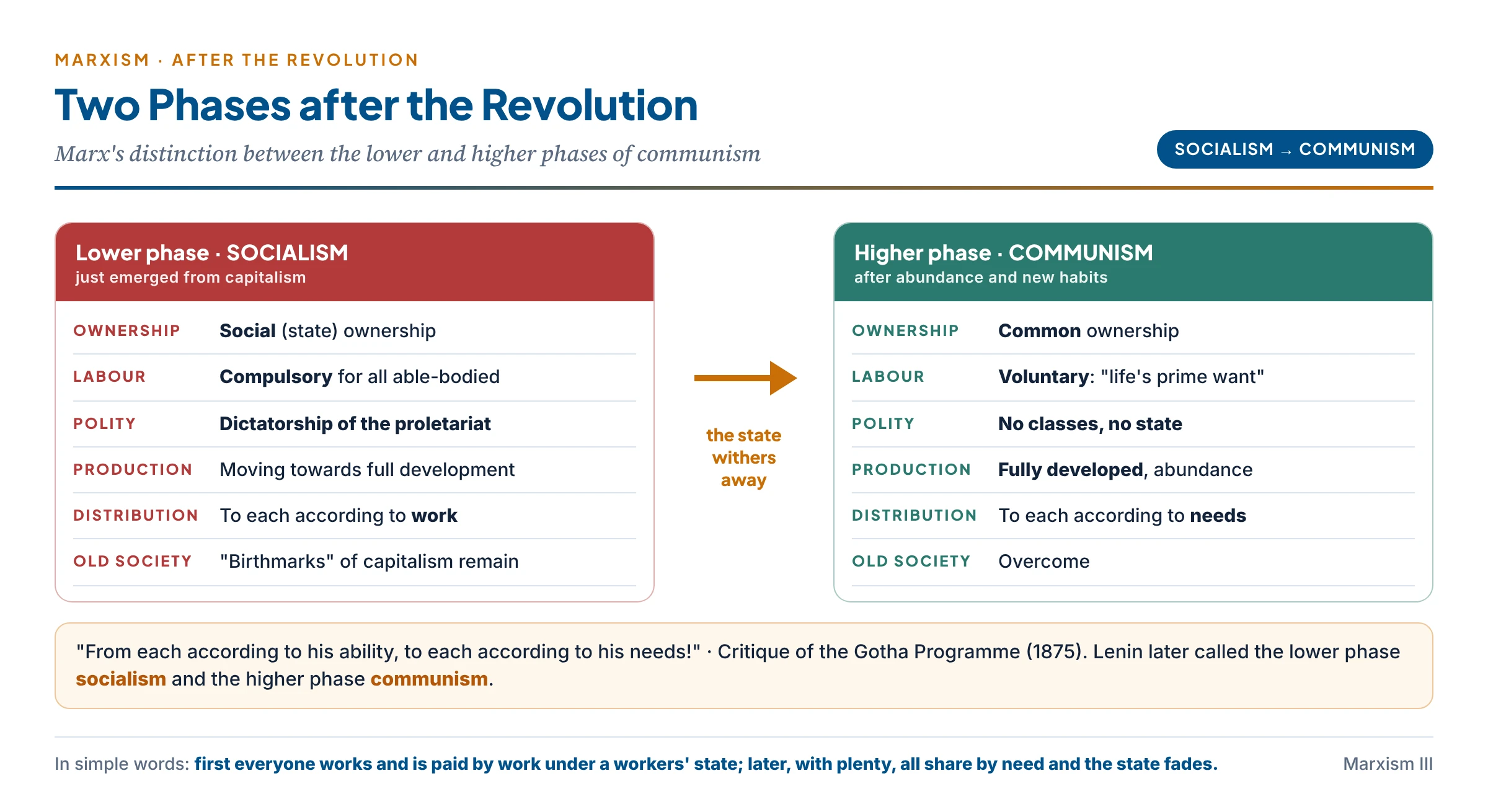
In the Critique of the Gotha Programme, Marx distinguished two stages after the revolution. Lenin later called the first “socialism” and the second “communism”.
Lower phase (socialism):
- Society has just emerged from capitalism and still bears its “birthmarks” in economy, morals and intellect.
- Means of production are socially owned; the state (as dictatorship of the proletariat) still exists.
- Distribution according to work: each worker receives back from society, after deductions for common needs, in proportion to the labour contributed.
- Labour is compulsory for all able-bodied people: “he who does not work, neither shall he eat”.
Higher phase (communism):
- After the enslaving division of labour and the antagonism between mental and physical labour have vanished, labour becomes “life’s prime want”, and the productive forces have grown so that “all the springs of co-operative wealth flow more abundantly”.
- Only then “can the narrow horizon of bourgeois right be crossed in its entirety and society inscribe on its banners: From each according to his ability, to each according to his needs!”
- No classes, no state, common ownership, voluntary labour.
| Point | Socialism (lower phase) | Communism (higher phase) |
|---|---|---|
| Major means of production | Social (state) ownership | Common ownership |
| Status of labour | Compulsory for all able-bodied | Done voluntarily by all able-bodied |
| Status of polity | Dictatorship of the proletariat | Classless, stateless |
| Forces of production | Moving towards full development | Fully developed, abundance |
| Principle of distribution | From each according to ability, to each according to work | From each according to ability, to each according to needs |
| Remnants of the old society | “Birthmarks” of capitalism remain | Overcome |
Socialism and communism as two distinct ideologies (2024): In everyday political language the words also name two different ideologies, not just two stages:
| Point | Socialism (broad family) | Communism (Marxist-Leninist) |
|---|---|---|
| Scope | Wide family: utopian, Fabian, democratic, market, guild, Gandhian | Specific doctrine of Marx, Engels, Lenin |
| Method | Mostly evolutionary, democratic, parliamentary | Revolutionary; seizure of state power |
| Property | Public ownership of key sectors; mixed economy possible | Abolition of private ownership of means of production |
| State | Welfare state; permanent | Dictatorship of proletariat, then withering away |
| Party system | Multi-party democracy | Leading role of one party |
| Rights | Civil and political rights plus socio-economic rights | Socio-economic rights first; “bourgeois” liberties suspect |
| Examples | Nordic social democracy; Nehru’s India; UK Labour (1945) | USSR; Maoist China; Cuba |
The Withering Away of the State
- Once private ownership of the means of production is socialised and class divisions dissolve, the coercive state machine loses its reason for existing.
- Engels, Anti-Dühring: “The first act by virtue of which the state really constitutes itself the representative of the whole of society — the taking possession of the means of production in the name of society — this is, at the same time, its last independent act as a state… The government of persons is replaced by the administration of things… The state is not ‘abolished’. It withers away.”
- The phrase “administration of things” echoes Saint-Simon: the art of governing people would give way to the art of administering production.
- Lenin: the state will wither away when people become accustomed to observing the elementary rules of social life without force.
Is the withering-away thesis defensible?
- Against it:
- History: every “transitional” dictatorship became permanent; the Soviet state grew bigger, not smaller.
- The state does more than class rule: defence, coordination, public goods and the settlement of non-class disputes would remain even without classes.
- Bureaucracy (Weber) has its own interests and expands itself.
- M. N. Roy: the state is the political organisation of society, so it cannot cease to exist after classes are abolished.
- Marx gave no theory of political institutions after the revolution, which left the field open to party dictatorship.
- For it (as an ideal): many functions today are already run by cooperation and self-regulation; the goal of reducing coercion remains valuable; and the anarchists share the end, if not the means.
The Ideal Communist Society
- The highest stage of social development, free from all contradictions, permanent and everlasting.
- Free of private property, class divisions and the state.
- Institutions that arose from private property, such as marriage and the family in their bourgeois form, would cease to exist in that form, and free will would be the basis of all relationships. (The Manifesto speaks of abolishing the bourgeois family, which rests on capital and private gain.)
- “In place of the old bourgeois society, with its classes and class antagonisms, we shall have an association, in which the free development of each is the condition for the free development of all” (The Communist Manifesto).
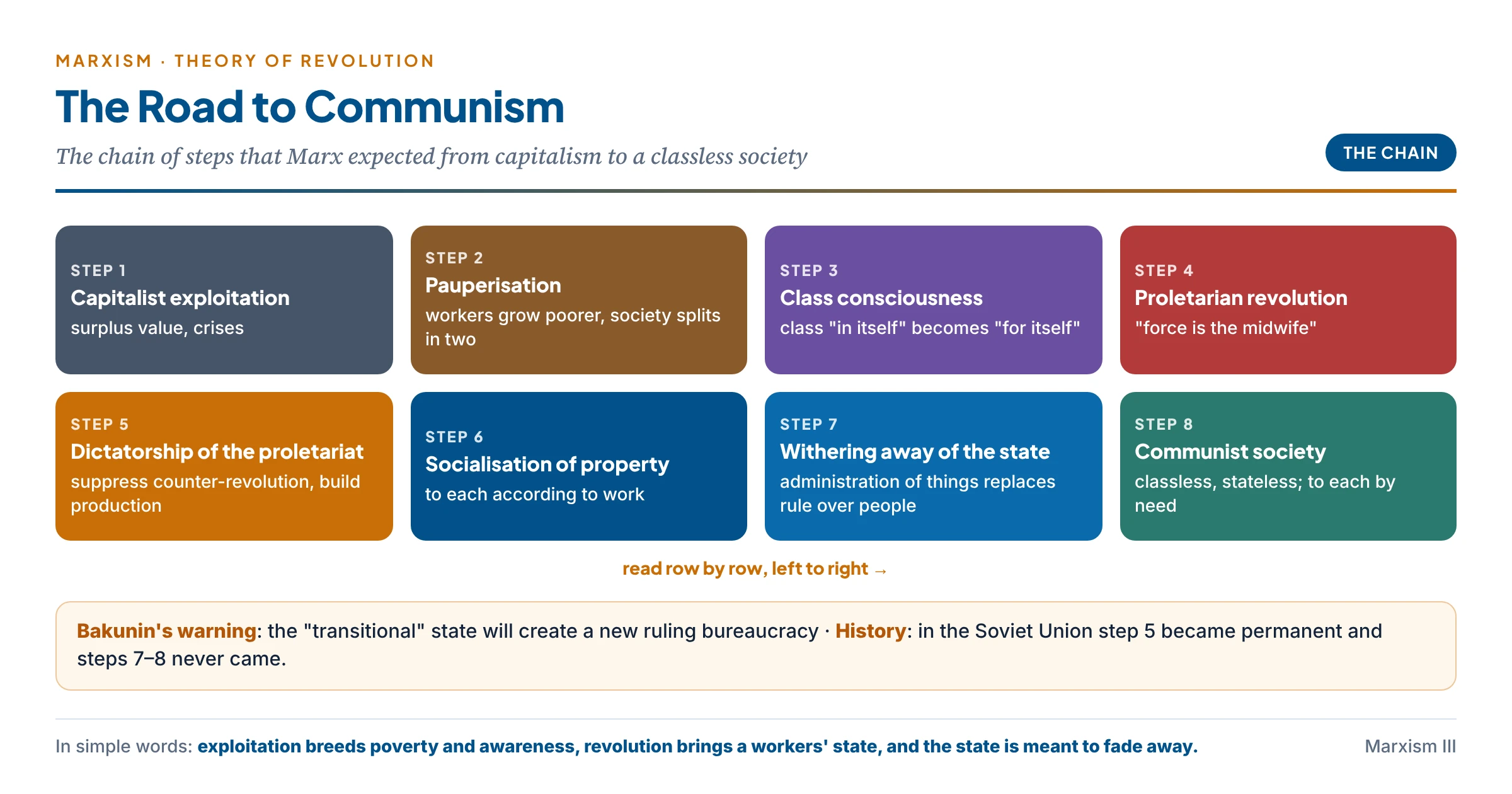
- The chain in one line: pauperisation of the proletariat → class consciousness → revolution → dictatorship of the proletariat → ideal communist society.
Why Marxism Criticises “Pure” Democracy
The 2026 paper asked on what grounds Marxism criticises pure democracy, meaning democracy that is purely formal, political and procedural (one person, one vote; elections; parliament; legal rights), as in liberal or “bourgeois” democracy.
Ground 1 — Political equality amid economic inequality:
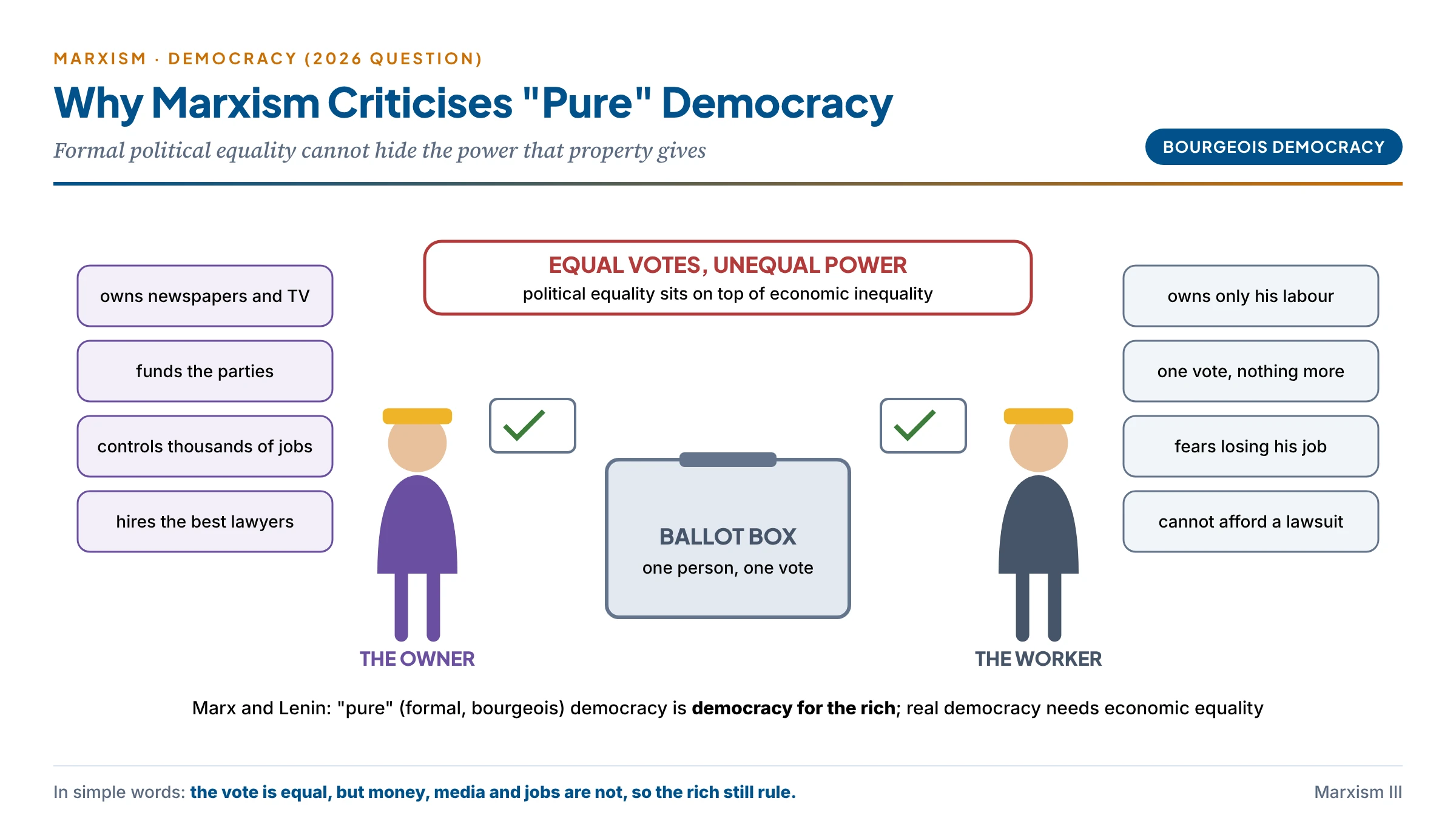
- Liberal democracy gives equal votes but leaves unequal property untouched. The worker and the factory owner have one vote each, but one owns the newspapers, funds the parties and controls jobs.
- So democracy is formal, not real: equal in the ballot box, unequal everywhere else. Marx said democracy harbours capitalism, in which the majority of workers are deprived of power.
Ground 2 — The state remains a class state whoever wins:
- Because the state’s structure protects private property, changing governments does not change the system. Marx on parliamentary elections: instead of deciding “once in three or six years which member of the ruling class was to misrepresent the people in Parliament”, the Commune made representatives directly responsible.
Ground 3 — Bourgeois rights are rights of the egoistic individual:
- In On the Jewish Question (1843), Marx distinguished political emancipation (equal citizenship) from human emancipation. Liberal democracy splits each person into a citizen (equal in the state) and a bourgeois (selfish competitor in civil society). The “rights of man” (liberty, property, security) protect man as an isolated, egoistic monad, separated from the community.
Ground 4 — Consent is manufactured:
- The ruling class controls the means of mental production: press, schools, churches, today television and social media. Voters’ preferences are shaped by ruling ideas (ideology, false consciousness); later Gramsci called this hegemony.
Ground 5 — Representation separates rulers from ruled:
- Parliamentary democracy creates a professional political class and a permanent bureaucracy, distant from the people. Marx praised the Commune as a “working, not a parliamentary body”, with recallable delegates.
Ground 6 — It is democracy for the minority:
- Lenin: bourgeois democracy is “democracy for an insignificant minority, democracy for the rich”. Real democracy requires economic democracy.
The Marxist alternative: “people’s” or socialist democracy:
- True democracy can be realised only in a classless society or a socialist state that represents the uniform interest of the working class, the majority. So socialism is true democracy.
- Features: collective ownership (a commune system) of everything, including the products of labour; a pyramidal structure of direct elections; recognition of the vanguard of the proletariat; representatives removable for violating voters’ instructions.
- Critical estimate of people’s democracy:
- It was installed in the USSR after 1917 and in China after 1949, but failed in both, partly through the abolition of incentives for better work.
- Though called a “democracy”, it failed to safeguard individual liberty.
- The vanguard of the proletariat culminated in authoritarianism and dictatorship, the very opposite of democracy.
- The phrase “people’s democracy” is tautological: democracy already means rule of the people.
Liberal vs socialist democracy:
| Issue | Liberal democracy | Socialist (people’s) democracy |
|---|---|---|
| Major means of production | Private ownership | Public ownership |
| Purpose of production | Primarily private profit | Fulfilment of social needs |
| Rights given priority | Civil and political rights | Socio-economic rights |
| Political parties | Several, freely competing for power | Monopoly of one party representing the working class |
| Elections | Universal adult franchise; free competition | Approval of candidates nominated by the ruling party |
| Main decision-maker | Elected government | The party in power |
| Bureaucracy and judiciary | Politically neutral | Committed to the party in power |
Evaluation: the Marxist critique exposes real weaknesses of formal democracy (money power, media control, inequality), and many of its demands (universal suffrage, welfare, labour rights) were later achieved within democracy. But its alternative, one-party “people’s democracy”, destroyed the political freedoms that alone allow the people to correct their rulers. Democracy as an ideal needs to be achieved in all spheres: in the legal and political sphere through constitutional structures, in the economic sphere through a more equal (socialist) mode of production, and in the cultural sphere through new values of human equality.
In simple words
At a school election every student has one vote. But if one candidate owns the only notice board, the loudspeaker and the canteen, and can promise or refuse jobs, the vote is equal only on paper. This is the Marxist complaint about “pure” democracy: political equality on top of economic inequality.
Does Marxism Curb Individual Freedom?
Marx’s own idea of freedom:
- Freedom is positive and real, not just the absence of interference: the capacity to develop one’s powers, which requires freedom from want and from exploitation.
- Bourgeois freedom is mainly the freedom of capital: freedom to buy and sell, including labour power. For the worker, “free” labour means being free to sell himself or starve.
- The goal is human emancipation: the leap from the kingdom of necessity to the kingdom of freedom, where “the free development of each is the condition for the free development of all”.
- Marx himself began as a fighter for press freedom, editing a newspaper closed by the Prussian censor.
The case that Marxism curbs freedom:
- Theory: the dictatorship of the proletariat, the vanguard party and the dismissal of “bourgeois” liberties as class tools leave no protection for individual rights against the revolutionary state.
- Isaiah Berlin: positive liberty, the idea of a “true” or “real” self that the state may force us to realise, has been the excuse for tyranny; Marxism is a prime example.
- Hayek and Friedman: central planning gives the state control over jobs, goods and information, and economic control means control over all of life.
- Popper: a closed system that claims to know history’s laws cannot tolerate dissent.
- Practice: Soviet labour camps (the Gulag), the purges, forced collectivisation, censorship, the Berlin Wall, China’s Cultural Revolution and the crushing of protest in Hungary (1956), Czechoslovakia (1968) and Tiananmen Square (1989).
- “In the name of social justice”: equality of condition was enforced by restricting choice of work, residence, speech and religion.
The case that Marxism expands freedom:
- Freedom needs material conditions: a starving man is not free; Marxism made socio-economic rights (work, health, education, housing) part of freedom.
- The distortion is not the theory: Marx expected the dictatorship to be brief and democratic (the Paris Commune); its authoritarian form owed much to Lenin’s party and to Russian backwardness.
- Democratic Marxists defended liberty: Rosa Luxemburg warned the Bolsheviks that “freedom only for the supporters of the government… is no freedom at all. Freedom is always the freedom of the one who thinks differently.”
- Marx’s critique of liberal freedom pushed liberalism itself to adopt welfare and labour rights, expanding real freedom.
Balanced answer: Marxism as practised by communist states curbed individual freedom severely, and Marxist theory contains no safeguards against this. But Marx’s critique of merely formal freedom is valid: real freedom needs both civil liberties and material security. The lesson of the twentieth century is that social justice pursued without political freedom ends in neither.
Equity and Equality in Marxian Philosophy
The 2022 paper asked for the difference between equity and equality in Marx.
- Equality here means applying the same standard to everyone (equal pay per hour of work, equal rights).
- Equity means fairness that takes account of differences in people’s needs and situations.
- Marx’s argument (Critique of the Gotha Programme):
- In the lower phase (socialism), each worker is paid according to work. This is an “equal right”, since the same measure (labour) is applied to all.
- But people are unequal: one is stronger and works more, one is married with many children, another single. Applying an equal standard to unequal people produces unequal results.
- So “this equal right is an unequal right for unequal labour… It is, therefore, a right of inequality, in its content, like every right.”
- To avoid this, “right instead of being equal would have to be unequal”. That is possible only in the higher phase, where distribution follows needs: “to each according to his needs”.
- So for Marx: formal equality (equal rights, equal measure) is a bourgeois ideal that leaves real inequality intact; true justice is equity based on need, possible only when abundance and a new consciousness have overcome the “narrow horizon of bourgeois right”.
- Marx also mocked socialists who demanded a “fair distribution” within capitalism: distribution follows from the mode of production, so justice cannot be achieved by redistributing within an exploitative system. For Marxists, justice is not possible in a capitalist system; it can only be replaced, not reformed.
In simple words
Three children are given one roti each (equality). But one has not eaten since morning, one has already eaten, and one is a toddler. Giving two to the hungry child, half to the full one and one to the toddler is equity. Marx’s “to each according to needs” is equity of this kind for a whole society.
Critical Evaluation
Criticisms
- The state is not only a class instrument: it can act against capital (factory laws, progressive tax, nationalisation, welfare).
- Revolution led to dictatorship, not freedom; the “transition” never ended.
- No institutional theory of post-revolutionary politics.
- Withering away proved utopian.
- Liberal democracy proved reformable; workers gained through votes and unions.
Strengths
- Exposes class bias in law and state.
- Puts socio-economic rights on the agenda of democracy.
- Distinguishes formal and real equality, a distinction now standard in constitutional law (substantive equality).
- Offers an ideal, the free development of each as the condition of the free development of all, that remains attractive.
Critics and Defenders
Criticism — Critics
- Bakunin: the dictatorship of the proletariat will become a red bureaucracy.
- Berlin, Hayek, Popper: positive liberty and planning lead to tyranny.
- Weber: bureaucracy will grow under socialism, not wither.
- M. N. Roy: the state as political organisation of society cannot disappear.
- History: USSR, Maoist China, Eastern Europe.
Defence — Defenders and strengths
- Engels and the 1872 Marx: peaceful, democratic transition is possible where institutions allow it.
- Luxemburg: socialism must include full freedom for dissent.
- Macpherson: liberal democracy must become developmental and egalitarian to be real.
- Constitutional practice: substantive equality and social rights owe much to the Marxist critique.
- Kerala (1957): an elected communist government working within democracy.
Cross-Tradition Comparison
| Point | Marx | Gandhi | Ambedkar |
|---|---|---|---|
| Goal | Classless, stateless society | Sarvodaya; stateless Rāma Rājya | Liberty, equality, fraternity |
| Means | Class struggle, revolution, dictatorship | Non-violence, satyāgraha, trusteeship | Constitutional democracy, law, moral reform |
| State | Class instrument; withers away | “Violence in a concentrated form”; minimal | Strong welfare state needed to protect the weak |
| Ends and means | Revolutionary end justifies force | Means and ends are inseparable | Means must preserve liberty |
| Caste | A superstructure of class | Moral reform of caste Hindus | Caste is a graded inequality needing its own annihilation |
Indian Connect — Indian Connect: Buddha or Karl Marx
- In Buddha or Karl Marx (1956), Ambedkar found that the Buddha and Marx agreed on much: the world suffers from exploitation and sorrow; private property brings power to some and sorrow to others; the good society removes this cause.
- They differed on means: Marx relied on violence and the dictatorship of the proletariat; the Buddha on persuasion, moral discipline and voluntary change. Ambedkar asked how long the dictatorship would last and what would replace it, and concluded that force alone cannot create a new society; only morality (the Buddhist saṅgha and dhamma) can sustain it.
- India’s own practice combined the two traditions: communist parties have won and lost elections in Kerala, West Bengal and Tripura within a democratic constitution, while the violent Naxalite strand (from Naxalbari, 1967) rejected the democratic path.
Synthesis (Siddhānta)
- Marx’s political theory runs from class state to revolution, dictatorship of the proletariat, socialism, communism and the withering away of the state. Its strength lies in exposing the class content of formal institutions; its weakness, in having no protection against the new power it creates.
- Its critique of pure democracy is valuable: formal equality without economic and social equality is incomplete democracy. Its remedy, one-party people’s democracy, failed. The better answer is democracy extended to every sphere: constitutional, economic and cultural.
- On freedom, the record of communist states is a warning; Marx’s own aim, “the free development of each”, is a challenge that liberal societies have not yet met for everyone.
- Marx’s distinction of equality and equity anticipates modern substantive equality: treating people fairly means attending to unequal needs.
Previous Year Questions
- 2026On what grounds does Marxism criticize pure democracy?
- 2024Compare socialism and communism as two distinct political ideologies.
- 2022Explain the difference between the notion of equity and equality with reference to Marxian philosophy.
- 2018Are Marxian Socialism and individual freedom consistent? Discuss critically.
- 2017Does Marxism curb individual freedom in the name of protecting social justice? Discuss