

Political Ideologies: Anarchism; Marxism and Socialism
Official Syllabus: Paper II, Section A, Unit 5
Marxism is the body of ideas founded by Karl Marx (1818–1883) and Friedrich Engels (1820–1895) to give socialism a “scientific” foundation. Earlier socialists had pictured a just society and hoped to persuade the rich to build it; Marx called them utopian. He set out instead to show how history actually moves: through changes in the way people produce their livelihood, and through the struggle between the classes those changes create. This article covers Marxism’s philosophical foundations: the move from Hegel to Marx, dialectical materialism, historical materialism with its base and superstructure, the stages of history, class and class struggle, and the Marxist account of religion, nationalism and ideology as tools that hold class society together.
In simple words
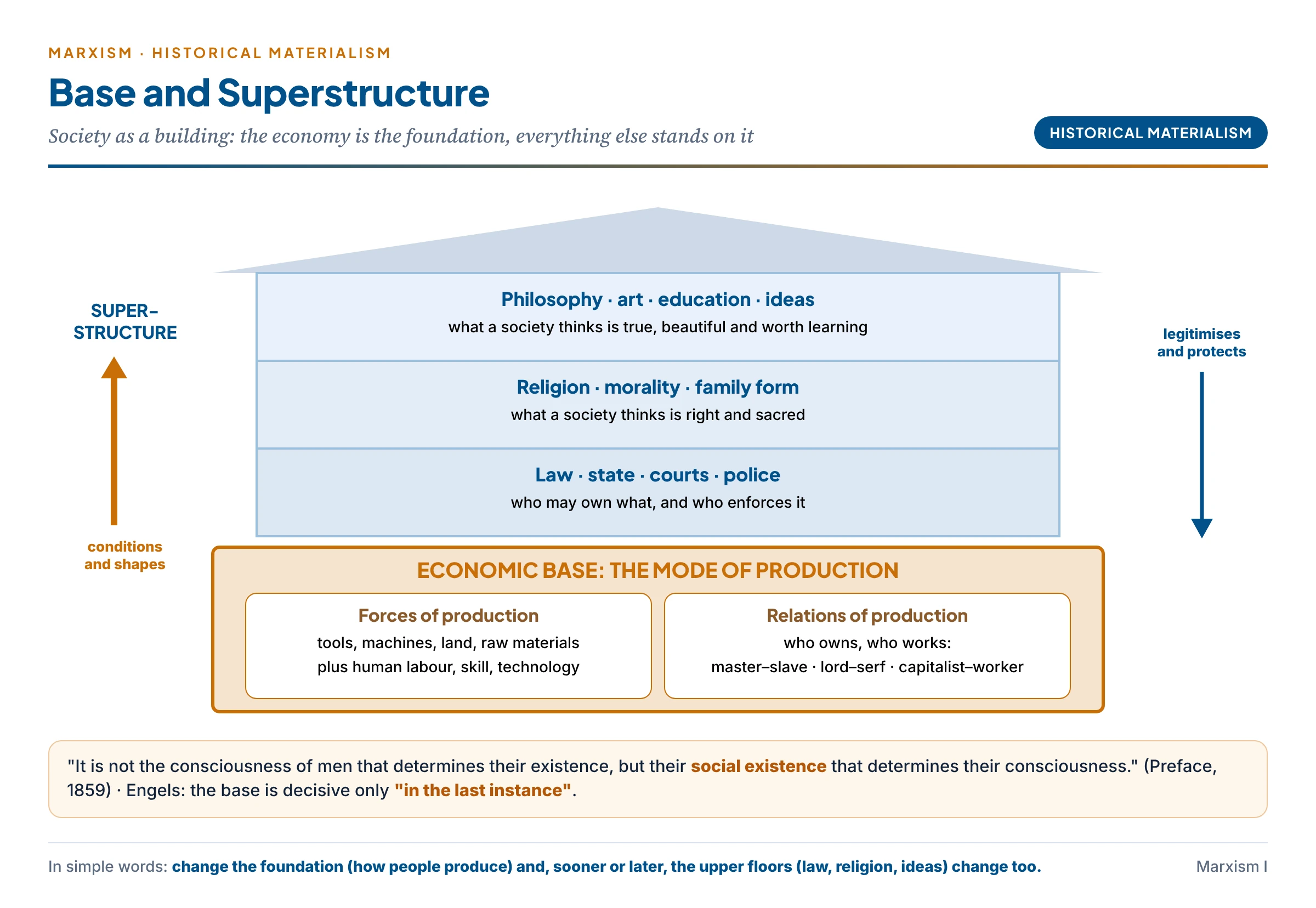
Think of society as a building. The foundation is the economy: how people produce food, clothes and goods, and who owns the land, factories and machines. On top stand the upper floors: laws, government, religion, schools, art and moral ideas. Marx’s central claim is that the shape of the foundation decides the shape of the upper floors. If the foundation changes, as when farming gives way to factories, sooner or later the whole building has to be rebuilt.
Context & Problem
Marx, Engels and Their Times
- Marx, born in Trier in Germany, studied law and philosophy and became a radical journalist; expelled from Germany, France and Belgium, he spent most of his life in London, often in poverty, writing Capital in the British Museum reading room.
- Engels, the son of a German cotton manufacturer who ran the family mill in Manchester, wrote The Condition of the Working Class in England (1845) and supported Marx financially for decades.
- The problem they faced: the Industrial Revolution had created enormous wealth alongside child labour, sixteen-hour working days, slums and periodic crises. Liberalism’s promise of freedom through laissez-faire and the free market had not made workers free.
- Marxism appeared as a response to an oppressive capitalist system, a theory that would explain capitalism scientifically and show how workers could overthrow it.
Three Sources of Marxism
Lenin later described Marxism as combining three currents of European thought:
- German philosophy: Hegel’s dialectic and Feuerbach’s materialism.
- English political economy: Adam Smith’s and David Ricardo’s labour theory of value, which Marx turned into the theory of surplus value (Article 5).
- French socialism: Saint-Simon, Fourier, Proudhon and the revolutionary traditions of 1789 and 1848, which supplied the goal of a classless society.
Main Works
| Work | Year | Key idea |
|---|---|---|
| Economic and Philosophic Manuscripts | 1844 | Alienation (published only in 1932) |
| Theses on Feuerbach | 1845 | Praxis: “the point is to change” the world |
| The German Ideology (with Engels) | 1845–46 | Historical materialism; ruling ideas of the ruling class |
| The Poverty of Philosophy | 1847 | Attack on Proudhon; class “in itself” and “for itself” |
| The Communist Manifesto (with Engels) | 1848 | Class struggle; call to revolution |
| Preface to A Contribution to the Critique of Political Economy | 1859 | Classic summary of base and superstructure |
| Capital, Volume I | 1867 | Surplus value, exploitation, laws of capitalism |
| The Civil War in France | 1871 | The Paris Commune as a workers’ state |
| Critique of the Gotha Programme | 1875 | Two phases of communism; dictatorship of the proletariat |
| Engels: Anti-Dühring; Origin of the Family, Private Property and the State; Dialectics of Nature | 1878; 1884; written 1870s–80s | Laws of dialectics; origin of the state; withering away |
What “Marxism” Includes
- Marx’s thought is an umbrella that covers Marxian socialism, communism and scientific socialism.
- Praxis: theory and practice must go together. Knowledge grows out of human activity that changes the world, and should return to it: “The philosophers have only interpreted the world, in various ways; the point is to change it” (eleventh Thesis on Feuerbach).
- A materialist approach: Marx begins from real, living human beings who must eat, drink and find shelter before they can think, pray or do politics.
- Critique of idealist political philosophy: Marx attacked thinkers from Plato onwards who treated the division between mental and manual labour as natural. Plato’s rule of philosopher-kings, with workers fit only for manual jobs, was for Marx an ideological justification of class rule.
Core Doctrine
From Hegel to Marx
Hegel’s dialectic (in brief):
- Reality is a process in which Spirit (Geist, Absolute Idea) develops itself through contradiction towards full self-consciousness and freedom.
- Each stage contains a contradiction that drives it beyond itself; the higher stage cancels, preserves and lifts up (Aufhebung) the earlier ones. The popular formula thesis → antithesis → synthesis summarises this movement.
- History is the march of freedom: from the oriental world, where one (the despot) was free, through the Greek and Roman world, where some were free, to the modern Germanic world, where all are free. The nation-state is the highest expression of ethical life.
Feuerbach’s materialism:
- Ludwig Feuerbach (The Essence of Christianity, 1841) argued that God is a projection of human qualities: humans made God in their own image and then bowed before him.
- Marx accepted the materialism but criticised Feuerbach for being contemplative: he explained religion but did not see that it arose from real social suffering, which must be changed in practice.
Marx’s inversion of Hegel:
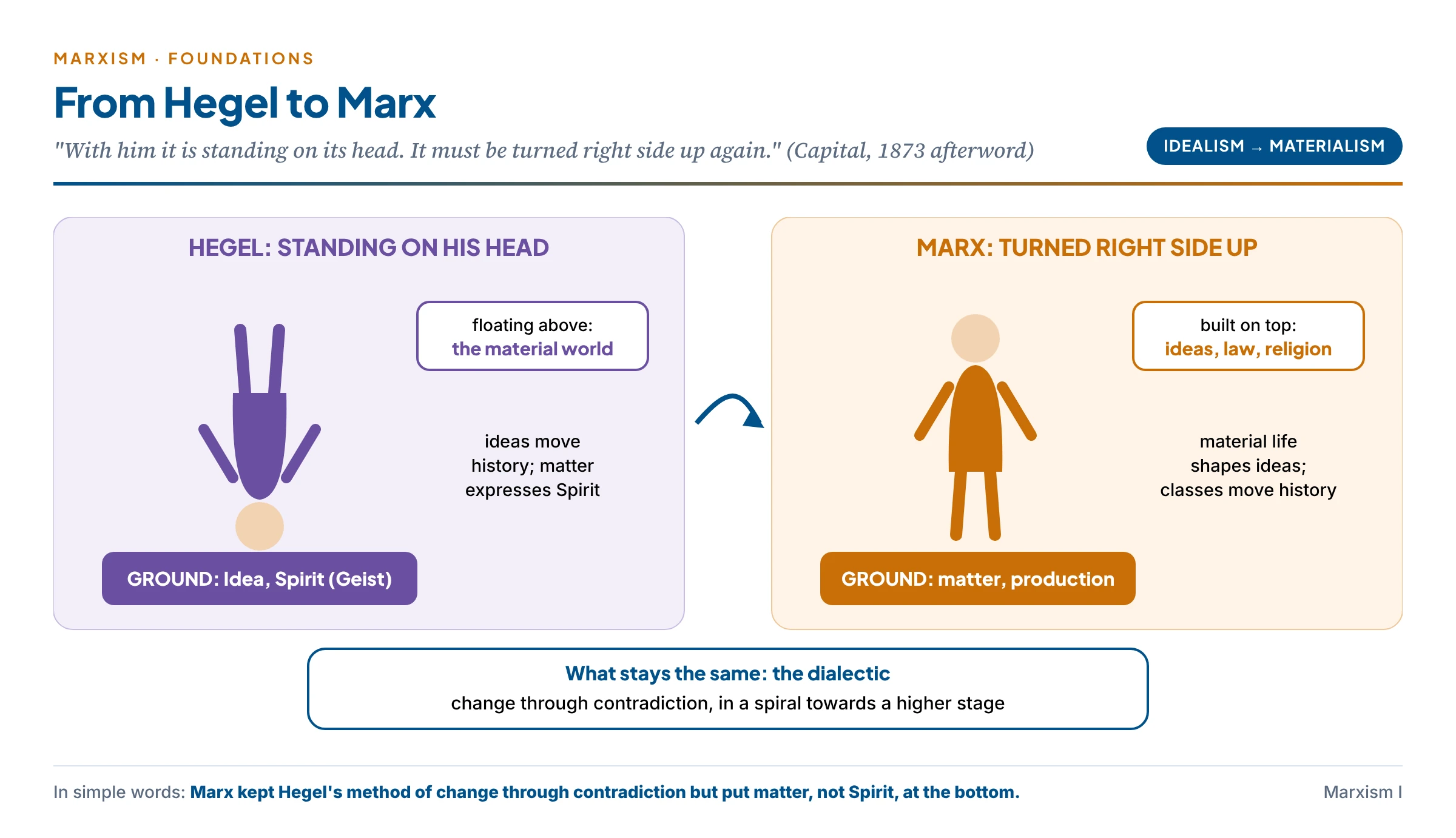
- Marx kept Hegel’s method (dialectic: change through contradiction) but rejected Hegel’s idealism (that Spirit or ideas are primary).
- “With him [Hegel] it [the dialectic] is standing on its head. It must be turned right side up again” (Afterword to the second edition of Capital). For Marx, ideas reflect material life, not the other way round.
| Point | Hegel | Marx |
|---|---|---|
| Philosophical basis | Idealism: Spirit is ultimate reality | Materialism: matter is ultimate reality |
| Path of development | Dialectical | Dialectical |
| What moves history | Spirit realising itself; war among nations | Class conflict rooted in production |
| Final stage | Supremacy of the nation-state | Classless, stateless society |
| Role of philosophy | Understand the world after the event (“the owl of Minerva flies at dusk”) | Change the world |
Dialectical Materialism
Dialectical materialism is the philosophical basis of classical Marxism: the view that matter is the essence of the universe, and that matter is always in motion and development through contradiction.
- Materialism: the world exists independently of our minds; consciousness is a product of highly organised matter (the brain) and of social life.
- Dialectics: the world is not a collection of fixed things but a process:
- Everything is connected with everything else.
- Everything changes: nothing is permanent.
- Change comes from internal contradictions, the struggle of opposing forces within a thing.
- Change is progressive, moving towards higher forms, and culminates (for society) in the classless communist society.
- The world is imperfect and ever-changing, and change is purposive in the sense of moving towards perfection.
- The term “dialectical materialism” was coined after Marx by Marxists such as Joseph Dietzgen and Georgi Plekhanov; Marx himself spoke of his “materialist method”, and Engels systematised the laws.
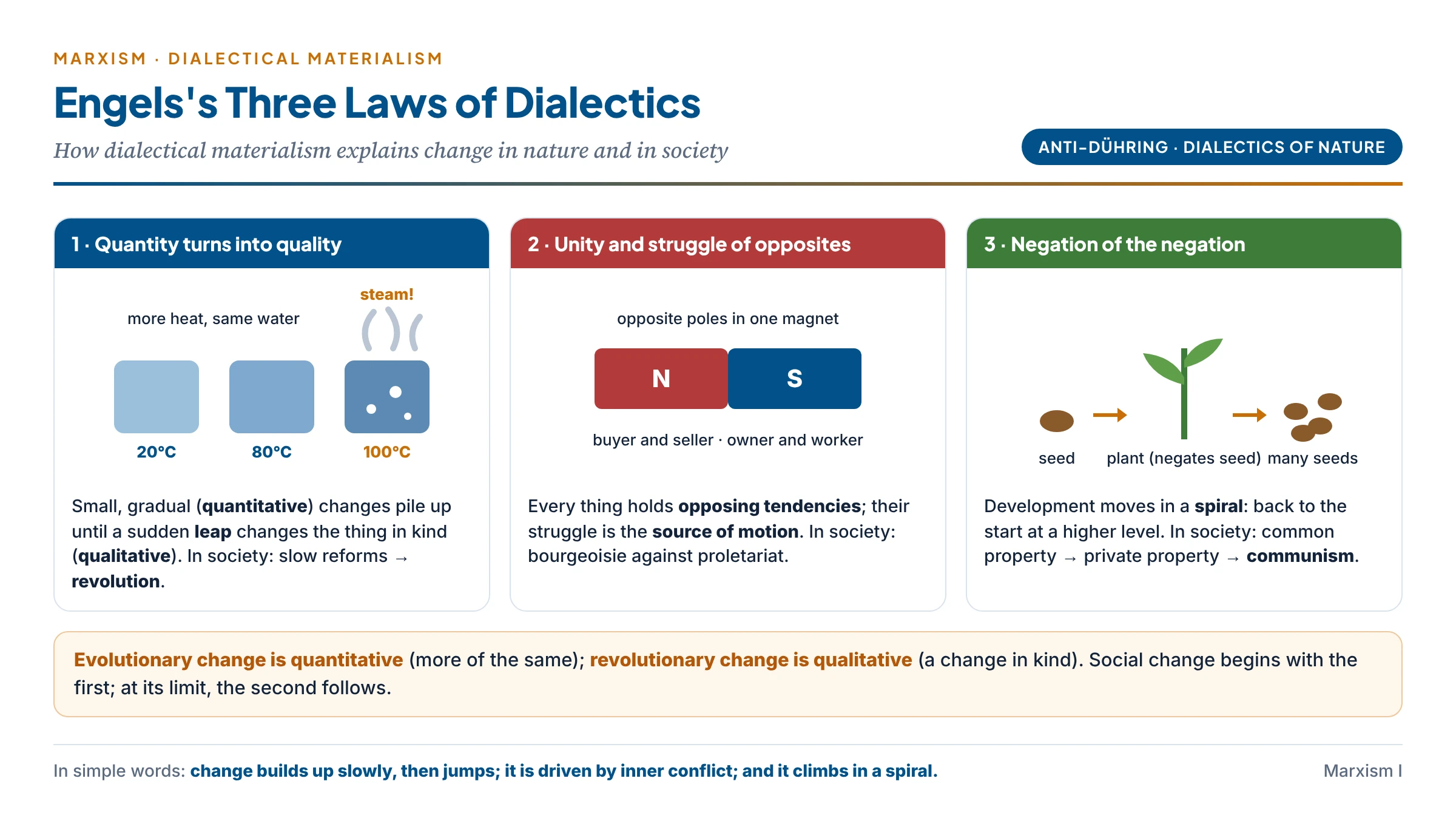
Engels’s three laws of dialectics (from Anti-Dühring and Dialectics of Nature):
- The transformation of quantity into quality: small, gradual (quantitative) changes pile up until they produce a sudden leap, a change in kind (qualitative). Heating water degree by degree changes nothing visible, until at 100°C it boils and becomes steam.
- The unity and struggle of opposites: every thing contains opposing tendencies (positive and negative charge; buyer and seller; bourgeoisie and proletariat). Their struggle is the source of motion.
- The negation of the negation: development moves in a spiral. A seed is “negated” by the plant that grows from it; the plant is negated in turn when it produces many new seeds, a return to the starting point at a higher level. In society, primitive common property is negated by private property, which will be negated by communism, common property at a higher level.
Two types of change:
- Evolutionary change is slow, quantitative change within the existing order.
- Revolutionary change is a sudden, qualitative leap to a new order.
- Social change begins with evolutionary changes; when they reach their limit, a revolutionary change follows.
Common confusion
Is evolutionary change “qualitative” and revolutionary change “quantitative”? No, it is the other way round. The two terms are often swapped. Evolutionary (gradual) change is quantitative: more of the same, like water getting hotter. Revolutionary change is the qualitative leap: a change in kind, like water turning into steam, or feudal society turning into capitalist society.
Criticisms of dialectical materialism:
- If the world is ever-changing, why should the communist society be final and everlasting? Either dialectics stops, or communism too will be overturned.
- Not every change is progressive: history shows reversals, such as the rise of Nazism and fascism after democracy in Europe.
- Overemphasis on matter leads to the erosion of moral and spiritual values.
- Dialectics in nature is doubtful: critics say that boiling water and growing seeds are just ordinary causal processes, not “contradictions”; logic forbids real contradictions.
- Karl Popper: dialectics is so flexible that any outcome can be fitted to it, so it explains nothing and cannot be tested.
Historical Materialism
Historical materialism (Engels’s term; Marx called it the “materialist conception of history”) is the application of dialectics to social life, the scientific or empirical basis of classical Marxism. It is also called economic determinism, because economic factors play the deciding role in the development of society.
Key terms:
- Means of production: the tools, machinery, land, factories and raw materials used to produce.
- Forces of production: means of production plus human labour power (skills, knowledge, technology).
- Relations of production: the relations between classes in the production process, above all who owns the means of production and who works them (master and slave, lord and serf, capitalist and wage worker).
- Mode of production: forces of production plus relations of production together, the economic system of a society (slave, feudal, capitalist).
Base and superstructure:
- The mode of production is the base (substructure) of society.
- Law and political institutions, religion, morals, philosophy, art and ideas make up the superstructure. They are shaped by the base and in turn legitimise and stabilise it.
- Marx’s classic statement (1859 Preface): “The mode of production of material life conditions the general process of social, political and intellectual life. It is not the consciousness of men that determines their existence, but their social existence that determines their consciousness.”
How societies change:
- The forces of production keep developing (new tools, new techniques).
- The relations of production stay fixed (old property laws and class relations).
- At a certain point, the old relations become “fetters” on the new forces: they block further growth.
- Then “begins an epoch of social revolution”: the old relations break down, and new ones emerge that fit the new forces.
- The superstructure (law, state, religion, ideas) is then transformed, more or less rapidly.
In simple words
A growing child’s shoes fit well at first. The child keeps growing (the forces of production), but the shoes stay the same size (the relations of production). After a while the shoes pinch and block walking: they have become “fetters”. Sooner or later they are thrown away and a bigger pair is bought: that is Marx’s social revolution.
- Example: the growth of trade, towns and machine industry clashed with feudal relations (serfdom, guild restrictions, aristocratic privilege). Industrialisation broke feudalism, and capitalism emerged, with the bourgeois revolutions in England (1640s, 1688) and France (1789) remaking the political superstructure.
Common confusion
Did Marx and Engels say that the economy alone decides everything? No. Engels wrote in a letter of 1890 (to Joseph Bloch) that the economic factor is “ultimately” the determining element, but not the only one. Political forms, law, philosophy and religion also act back on the base and influence the course of history. If anyone twists this into saying the economy is the only cause, Engels said, they turn the theory into a “meaningless, abstract, senseless phrase”. Later Marxists speak of the superstructure’s “relative autonomy”.
The Stages of History
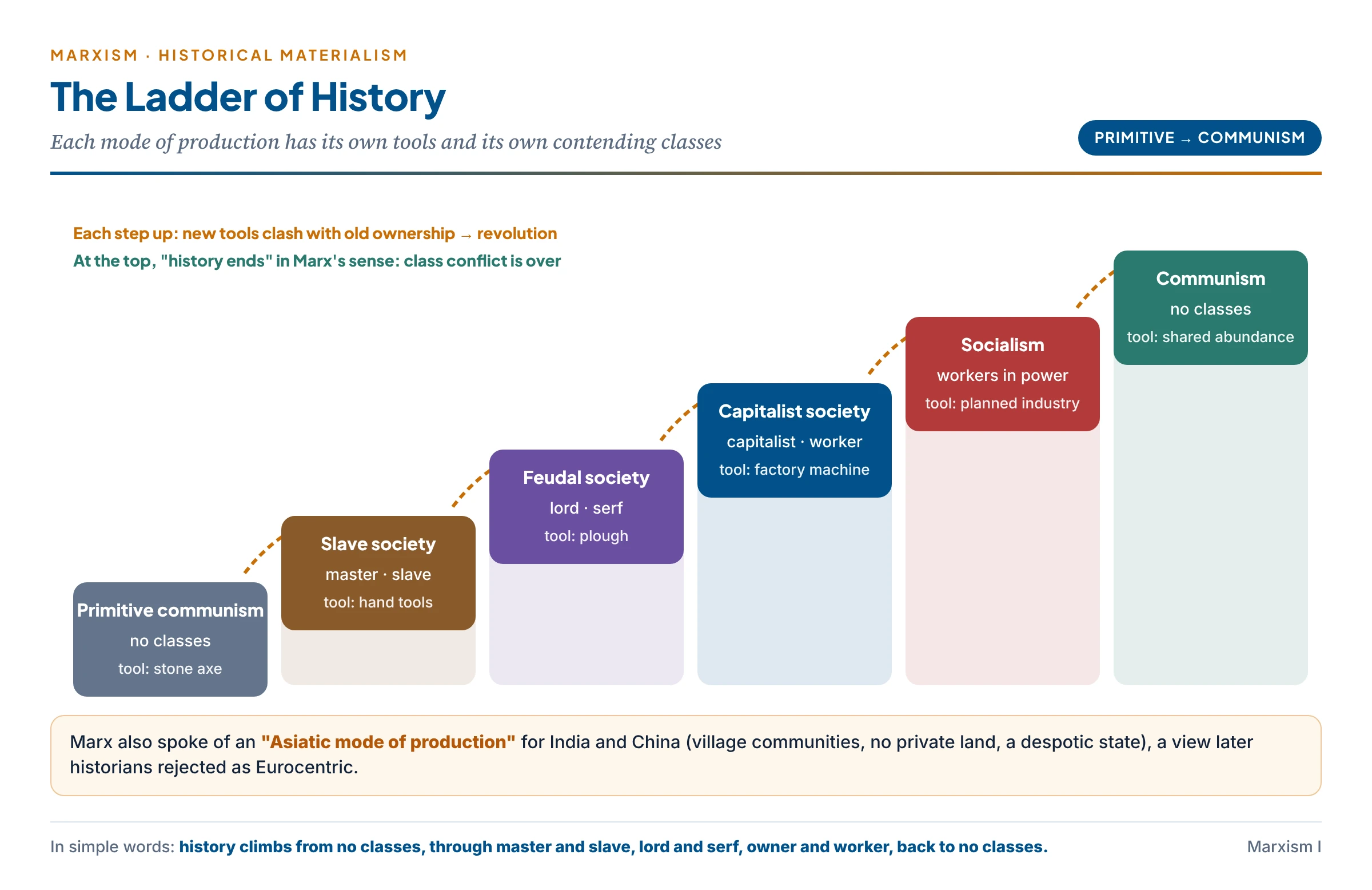
Applying historical materialism to the economic development of society, Marx identified a sequence of modes of production:
| Epoch | Mode of production | Cause of class division | Social formation | Contending classes |
|---|---|---|---|---|
| Primitive | Common hunting, gathering; universal labour the main source of production | None yet | Primitive communism | No classes |
| Ancient | Household-based small-scale production | Emergence of private property | Slave-owning society | Master and slave |
| Medieval | Large-scale agriculture | Rise of feudalism | Feudal society | Lord and serf |
| Modern | Large-scale machine production | Rise of capitalism | Capitalist society | Capitalist and worker |
| Future I | Social ownership after revolution | Socialist revolution | Socialist society | Workers in power vs remnants of the former capitalist class |
| Future II | Common ownership, abundance | No class division | Communist society | No contending classes |
- Marx also spoke of an “Asiatic mode of production” for societies like India and China: village communities with no private ownership of land, ruled by a despotic state that controlled irrigation. He believed this made them stagnant, a view later historians rejected as Eurocentric.
- History ends in Marx’s special sense when class contradictions end: “prehistory” closes and truly human history begins.
Criticisms of historical materialism:
- Too much weight on economics: many events cannot be explained by economic factors alone: the Partition of India, the Arab–Israel conflict, religious and national wars.
- Power does not always follow wealth: Marx holds that the class with economic power also controls social and political power. The ancient Indian varṇa system contradicts this: the Brāhmaṇa, often poor, held the highest status, above the wealthy merchant.
- Determinism ignores accidents and individual choices: a war, a plague, a leader’s decision.
- Ideas can shape the economy: Max Weber (The Protestant Ethic and the Spirit of Capitalism, 1905) argued that Calvinist religious ideas helped create the capitalist spirit, reversing Marx’s direction of cause.
- Wrong predictions: revolutions came not in advanced industrial countries (England, Germany) as Marx expected, but in backward, peasant societies (Russia 1917, China 1949).
- Popper’s objection: “historicism” claims to know the laws of history, but history is shaped by the growth of knowledge, which cannot be predicted.
Relevance of historical materialism to social development and change:
- Technology and society: the printing press, the steam engine, the computer and the internet each reshaped work, family, politics and ideas, as the theory predicts.
- Today’s examples:
- Platform capitalism and the gig economy: apps that own no taxis or restaurants control millions of workers; new relations of production (the “platform worker”, neither employee nor independent) produced new laws, such as India’s recognition of gig and platform workers in the Code on Social Security, 2020 (in force from 21 November 2025).
- Automation and AI are changing class structure and raising questions of ownership of data and machines.
- Globalisation moved factories to low-wage countries and changed the working class in both rich and poor nations.
- Method of social science: even non-Marxists use the idea that economic interests and material conditions shape law, politics and culture.
- Indian history: historians such as D. D. Kosambi and R. S. Sharma applied historical materialism to India, explaining, for example, the growth of land grants and “Indian feudalism” in early medieval times.
- Limits: it must be combined with caste, religion, gender, ecology and ideas as independent forces. Ambedkar argued that in India caste is not just a division of labour but a division of labourers, which a purely class-based theory cannot explain.
Class and Class Struggle
Class struggle is the sociological basis of Marxism.
- “The history of all hitherto existing society is the history of class struggles. Freeman and slave, patrician and plebeian, lord and serf, guild-master and journeyman, in a word, oppressor and oppressed, stood in constant opposition to one another” (The Communist Manifesto).
- Class is a group of people occupying the same position in the mode of production, above all owning or not owning the means of production.
- Since private property emerged, society has been divided into antagonistic classes:
- Dominant class (also called the ruling or exploiting class): in capitalism, the bourgeoisie (owners of capital).
- Dependent class (also called the ruled or exploited class): in capitalism, the proletariat (wage workers who own nothing but their labour power).
- Other groups: the petty bourgeoisie (small shopkeepers, artisans, peasants), which Marx expected to sink into the proletariat, and the lumpenproletariat (the very poor, criminals, vagrants), whom he distrusted as unreliable.
- Two stages of class formation:
- Class in itself: people share the same economic position (class origin) but are not yet aware of it.
- Class for itself: they become conscious of their common interest, organise and act together (class consciousness).
- Polarisation: capitalism will divide society more and more into two great hostile camps, with a small, very rich class at the top and a vast, impoverished proletariat below.
- Self-destruction: every stage of social development that falls short of perfection contains the seeds of its own decay. Capitalism will collapse under the burden of its own contradictions; the bourgeoisie produces “its own grave-diggers”.
- Features of class struggle:
- It is the engine of social change.
- It is all-inclusive: in the end everyone joins one side or the other.
In simple words
Think of a tug of war that has gone on for thousands of years with different teams: masters and slaves, lords and serfs, owners and workers. The rope is the surplus that working people produce. Each time the losing team grows strong enough, it pulls the rope over the line, and a new match begins with new teams. Marx thought the workers’ victory would be the last match, because there would be no one left below them to pull against.
Criticisms of class struggle:
- Gandhi: the main element of social life is cooperation, not conflict.
- Marx ignored the middle class, which has grown rather than vanished.
- Nationalism proved stronger than class feeling: in 1914 workers of Europe went to war against one another under their national flags.
- In the globalised era, the class structure has changed: a new class of salaried professionals (managers, engineers, IT workers) are very affluent without being capitalists.
- Weber: inequality has three dimensions, class (economic), status (honour) and party (power), not class alone.
- Ralf Dahrendorf: in modern society conflict is about authority in organisations more than about ownership.
Religion, the State and Nationalism as Class Instruments
Marx saw the major institutions of the superstructure as instruments that help the ruling class keep its position.
1. Religion: “the opium of the people”
- “Religious suffering is at one and the same time the expression of real suffering and a protest against real suffering. Religion is the sigh of the oppressed creature, the heart of a heartless world, and the soul of soulless conditions. It is the opium of the people” (Introduction to A Contribution to the Critique of Hegel’s Philosophy of Right, 1844).
- When no one’s real needs are met in society, religion becomes everyone’s refuge.
| Opium | Religion |
|---|---|
| Detaches people from the real world and creates an unreal one | Focuses on other-worldly things (heaven, next birth) |
| Makes people inactive | Makes people passive towards class oppression |
| Induces addiction | Induces dependence on ritual and priest |
| Helps one forget suffering for a while | Consoles suffering for a short time without curing it |
- Religion is false consciousness: it restrains revolutionary feeling and helps maintain the status quo. “Abolishing religion as the illusory happiness of the people is required for their real happiness.”
- Note that Marx’s line also has sympathy: religion is a “protest” and “the heart of a heartless world”. He wanted to abolish the conditions that need religion, not to persecute believers.
2. The state
- A class instrument: the owning class created it for its own protection. It consists of coercive institutions (police, army, bureaucracy, courts) whose primary function is the protection of private property. (Article 6 explains the Marxist theory of the state in full.)
3. Nationalism
- Also false consciousness: a bourgeois idea that preaches class cooperation and social harmony within the nation, hiding the conflict between capitalists and workers.
- It maintains the status quo and divides the workers of the world. Hence the Manifesto’s closing call: “The proletarians have nothing to lose but their chains. They have a world to win. Working men of all countries, unite!”
Critical Evaluation
Criticisms of Marx’s Foundations
- Economic reductionism: caste, religion, nation, gender and ideas are reduced to reflections of the economy.
- Determinism vs freedom: if history follows laws, why call on workers to choose revolution?
- Unfalsifiability (Popper): failed predictions were reinterpreted rather than admitted.
- Failed prophecies: capitalism did not collapse; workers’ living standards rose; revolutions happened in the “wrong” countries.
- Ambedkar’s critique: class analysis cannot explain caste; economic change without social reform leaves the untouchable still oppressed.
Defences and Lasting Insights
- Society is historical: institutions that look natural (private property, the market, the family form) have a history and can change.
- Material interests matter: law, politics and ideas are deeply shaped by who owns what.
- Ideology critique: asking “whose interests does this idea serve?” is now a basic tool of social science.
- Later Marxists corrected determinism: Engels’s letters, Gramsci’s hegemony, the Frankfurt School and Althusser’s “relative autonomy” (Article 7).
Critics and Defenders
Criticism — Critics
- Popper: historicism and dialectics cannot be tested; they lead to closed societies.
- Weber: ideas and religion can shape the economy; class is not the only form of inequality.
- Gandhi: cooperation, not conflict, is the law of social life.
- Ambedkar: caste is a graded inequality that class theory cannot explain.
- Common objection: the predicted polarisation and collapse never came.
Defence — Defenders and strengths
- Engels: the economy is decisive only “in the last instance”; the superstructure acts back.
- Historians (Kosambi, R. S. Sharma, E. P. Thompson): historical materialism illuminates long-run social change.
- Gramsci and the Frankfurt School: culture and ideology matter, refining rather than abandoning Marx.
- Relevance: technology, inequality and the gig economy show material conditions shaping society today.
Cross-Tradition Comparison
| Point | Marx | Indian parallels and contrasts |
|---|---|---|
| Matter and change | Dialectical materialism: matter in constant development | Cārvāka materialism: only matter (four elements) is real, but no theory of historical development; Sāṃkhya: unconscious prakṛti evolves through the tension of the three guṇas, a dialectic-like process but guided towards the liberation of puruṣa |
| Everything changes | Nothing is permanent; contradiction drives change | Buddhist kṣaṇikavāda and pratītyasamutpāda: everything is momentary and arises dependently; but the goal is liberation from craving, not revolution |
| Stages of history | Primitive communism → communism | Yuga cycle (Kṛta, Tretā, Dvāpara, Kali): decline, not progress; cyclical, not linear |
| Social division | Class by ownership | Varṇa–jāti: status by birth and ritual purity; Ambedkar: caste is a “division of labourers”, graded inequality |
| Religion | Opium of the people; false consciousness | Vivekananda: religion as service of the poor; Ambedkar: religion must rest on liberty, equality, fraternity; he chose Buddhism, not atheism |
Indian Connect — Indian takeaways
- Indian Marxists had to answer the caste question: is caste just a form of class (part of the superstructure), or an independent structure? Ambedkar insisted on the second, and argued that economic revolution without social revolution would fail.
- Kosambi described Indian history through changes in production (the iron plough, the spread of settled agriculture), while recognising the role of religion and caste in integrating tribes into society.
- M. N. Roy, once a leading communist, later rejected economic determinism: the means of production are themselves a creation of the human mind, so mind cannot be a mere product of production (Article 10).
Synthesis (Siddhānta)
- Marx’s foundations combine a philosophy (dialectical materialism), a theory of history (historical materialism) and a sociology (class struggle). Together they explain society as a historical, changing structure driven by production and conflict.
- As strict determinism they fail: history is shaped also by ideas, religion, caste, nation, gender and chance, and the predicted collapse of capitalism did not come.
- As a method they remain powerful: look at who produces, who owns, and who benefits; ask how material change reshapes law, politics and culture; and treat no institution as eternal.
- For a 2026 reader, historical materialism helps explain the platform economy, automation, inequality and globalisation, while Indian experience shows that it must be combined with the analysis of caste and culture.
Previous Year Questions
- 2023Explain Historical Materialism and discuss its relevance in the context of social development and change.
- 2020How far is Marxism as a philosophical doctrine relevant in the present context? Justify your answer.