

Political Ideologies: Anarchism; Marxism and Socialism
Official Syllabus: Paper II, Section A, Unit 5
Anarchism is the political ideology that holds that society can and should be organised without the coercive authority of the state. The word comes from the Greek an-archos, “without a ruler”. Anarchists see the state as immoral, coercive, unnecessary and harmful to human development, and want to replace it with voluntary cooperation, free associations and federations built from below. Yet anarchism is not one doctrine. It runs “from extreme socialism to extreme individualism”: from Kropotkin’s communes where everything belongs to everyone, to Stirner’s egoist who owes nothing to anyone. This article explains what all anarchists share, the main kinds of anarchism, and whether anarchism is an independent ideology or, as the 2026 paper suggested, a child of liberalism and socialism.
In simple words
Think of a school picnic. One way to organise it is for the principal to give orders and punish anyone who disobeys. Another is for the students to form small groups, agree on who brings what, and settle quarrels among themselves. The anarchist believes the whole of society could run like the second picnic: order would come from agreement and cooperation, not from a ruler with a stick.
Context & Problem
Why Anarchism Arose
- The modern state grew huge in the eighteenth and nineteenth centuries: standing armies, police, prisons, taxes, conscription and bureaucracy.
- Industrial capitalism created great wealth for a few and misery for many; the state’s police and courts protected the owners.
- Liberalism promised freedom, but for most workers the freedom was formal: free to sign a contract, free to starve.
- Socialists proposed to use the state to end exploitation. Anarchists replied that a state run by socialists would still be a state, an instrument of domination.
- So anarchism answers a double problem: how to be free from both the boss and the ruler.
A Short History
- William Godwin, An Enquiry Concerning Political Justice (1793): the first systematic case against government.
- Pierre-Joseph Proudhon, What Is Property? (1840): the first person to call himself an “anarchist” with pride.
- Max Stirner, The Ego and Its Own (1844): radical individualist egoism.
- Mikhail Bakunin: led the anti-authoritarian wing of the First International; his clash with Marx split the International in 1872.
- The Paris Commune (1871): a short-lived self-governing city, admired by both anarchists and Marxists.
- Peter Kropotkin, The Conquest of Bread (1892) and Mutual Aid (1902): anarcho-communism with a scientific basis.
- Leo Tolstoy, The Kingdom of God Is Within You (1894): Christian, non-violent anarchism.
- Emma Goldman (1869–1940): anarchism joined to women’s freedom.
- Spain, 1936–39: anarchist trade unions ran factories and farms in Catalonia and Aragon during the Civil War, until crushed by Franco and undermined by the communists.
- Today: anarchist ideas live on in anti-globalisation protests, the Occupy movement, cooperatives, mutual-aid networks, the Zapatistas in Mexico and the Kurdish experiments in self-rule in northern Syria (Rojava).
Core Doctrine
What All Anarchists Share
- Rejection of the state: the state is an unnecessary evil, not, as liberals say, a necessary one.
- Opposition to law, not to order: anarchists oppose coercive law but not order. They believe people can keep order without law, police and prisons.
- Faith in human nature: human beings are social, rational and cooperative by nature; it is the state and private property that make them selfish and violent.
- Freedom as living by one’s own conscience: the state is an external agency that forces us to act in a particular way, so it destroys moral freedom.
- Opposition to all hierarchy: most anarchists also reject other coercive hierarchies such as church, army, patriarchal family and capitalist workplace.
- Acceptance of rational authority: most anarchists accept the authority of experts in their field (a doctor about medicine, a builder about bridges) and decisions freely taken in common. What they reject is authority that claims obedience simply because it commands.
- Decentralisation and federation: society should be a network of small, self-governing communities and associations, linked by free agreement from the bottom up.
The Main Arguments Against the State (Tenets)
- No real consent: people come under the state’s authority by birth or by conquest, not by consent. No one ever signed the social contract.
- The state destroys freedom: freedom means living by one’s own conscience; the state forces us to obey regardless of conscience.
- The state creates dependence: people learn to wait for the state to solve problems, so natural cooperation and self-help wither away.
- The state rests on violence: police, prisons, armies and the threat of punishment stand behind every law. Gandhi said that human beings are by nature non-violent, but the state rests on violence.
- The state protects privilege: it guards the property of the rich and the power of rulers.
- Power corrupts those who hold it: even good people, once in office, begin to serve their own interests (Bakunin’s warning against “red bureaucrats”).
- Organised religion supports the state: some anarchists (Bakunin) reject church authority because it prepares the mind to accept the authority of the state. Others (Tolstoy, Gandhi) are deeply religious.
In simple words
Imagine a cricket team without a captain. The anarchist does not say “no rules” or “no coach”. The team still follows the rules of the game it agreed to, still listens to the coach on technique (expert authority), and decides batting order together. What it refuses is a captain who can punish players for disagreeing.
The Revolutionary Theory of Justice
- The state inflicts violence on the individual every moment: the threat of fines, jail and force is always present, and people live in constant fear of it.
- Some revolutionary anarchists therefore argued that anarchist violence is only a response to the violence of the state. This led in the 1880s–1900s to “propaganda of the deed”: bombings and the assassinations of rulers by anarchists (for example of the Italian King Umberto I in 1900 and of US President McKinley in 1901).
- Most anarchists, especially Kropotkin in later life, Tolstoy and Gandhi, rejected terrorism: violence breeds a new authority and corrupts the cause.
Common confusion
Does “anarchy” mean chaos and disorder? No. In everyday speech “anarchy” means chaos, but anarchists use it to mean order without a ruler. Proudhon put it as “anarchy is order” (the slogan is often given as “anarchy is order without power”). The anarchist claim is that coercive government is itself a cause of disorder, and that real order comes from cooperation.
Kinds of Anarchism
Anarchists agree on the “no” (no state) but disagree on the “yes” (what should replace it). The two great families are individualist anarchism, which starts from the free individual, and social (collectivist) anarchism, which starts from the community.
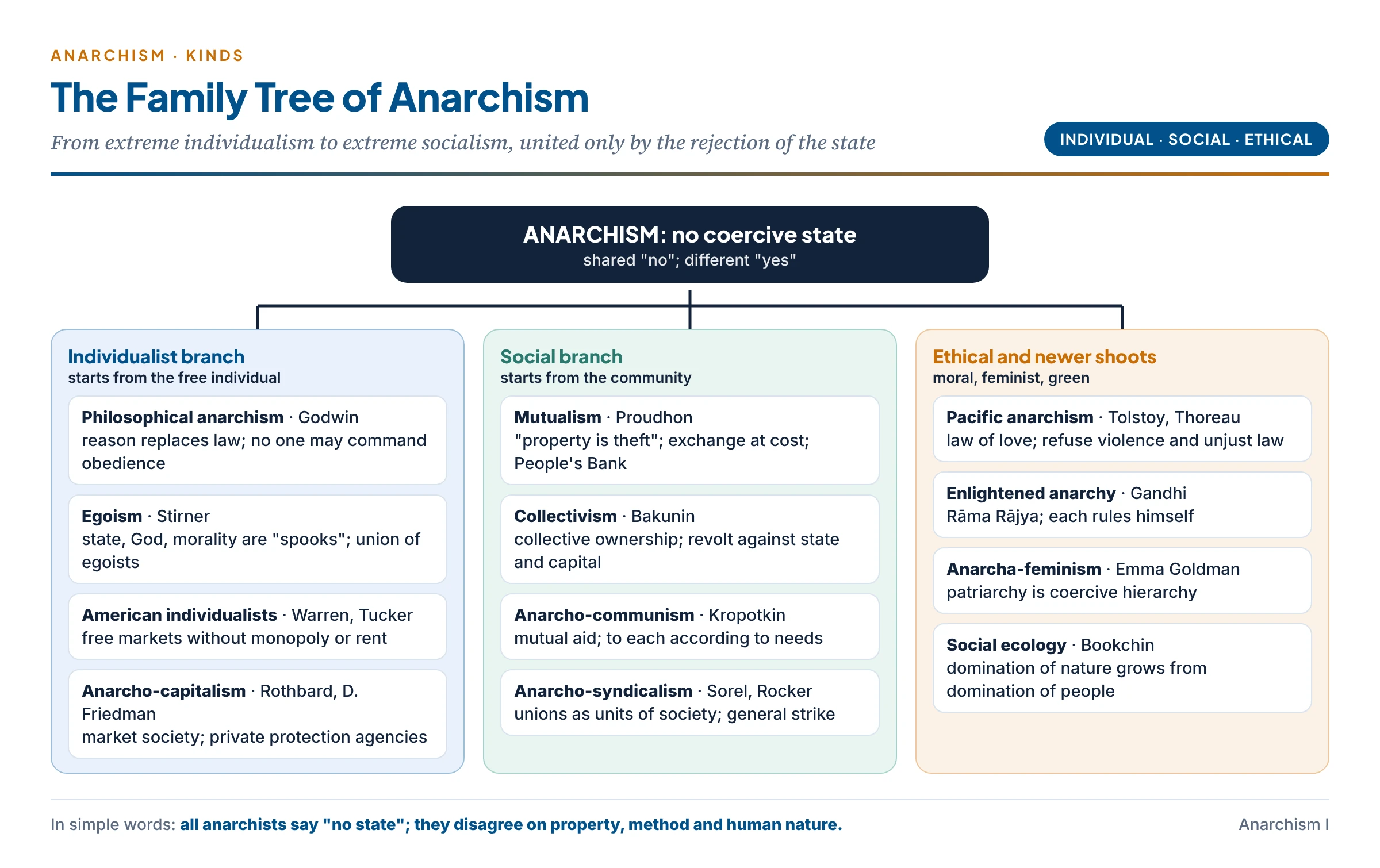
1. Philosophical (Individualist) Anarchism — William Godwin
- Godwin (1756–1836) is regarded as the first anarchist thinker, though he did not use the word.
- Human beings are rational and “perfectible”: they can always improve through reason and discussion.
- Government corrupts private judgement: law makes people obey out of fear rather than understanding; each person should act on their own reasoned judgement of justice.
- No one has the right to command another’s obedience. There is no such thing as legitimate authority over a rational adult.
- Property: Godwin judged property by need and benefit; a famous example asks whether one should save the wise Archbishop Fénelon or one’s own mother from a fire. He says Fénelon, because justice, not personal feeling, should decide.
- Ideal: a loose federation of small, self-governing parishes, where public opinion and discussion replace law and punishment.
- Method: education and rational persuasion, not revolution.
- Philosophical anarchists also accept rational authority: the expertise of a doctor and basic social norms such as keeping contracts.
2. Egoist Anarchism — Max Stirner
- In The Ego and Its Own (1844), Stirner declares that the individual ego, the “Unique One”, is supreme.
- State, God, Morality, Humanity, Society, even “Man” are “spooks”, abstract ideas that people have made into idols and then serve as slaves.
- The egoist recognises no duty to anything outside himself; he may form a voluntary “union of egoists” for mutual benefit, and leave it when he wishes.
- Criticism: Stirner’s egoism gives no reason to respect others’ freedom; it can justify the strong exploiting the weak. Marx and Engels attacked him at length in The German Ideology.
3. Mutualism — Pierre-Joseph Proudhon
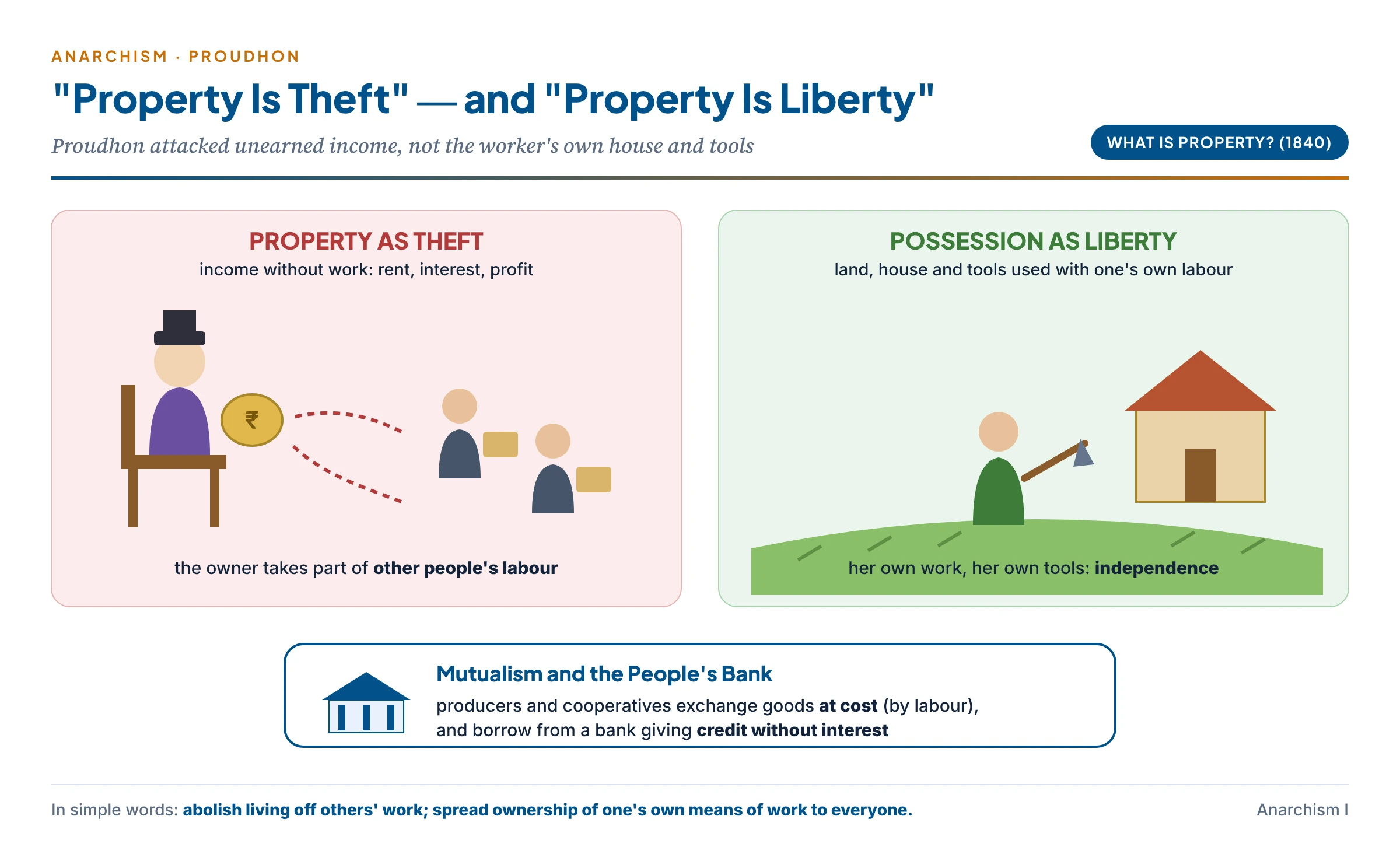
- Proudhon (1809–1865) asked “What is property?” and answered: “Property is theft!”
- He did not reject all possession:
- Property as theft means income without work: rent, interest and profit taken by owners from the labour of others.
- Possession as liberty means the house, land and tools a person uses with their own labour. He later wrote that “property is liberty”, meaning possession of this kind protects the individual against the state.
- Mutualism: independent producers and workers’ cooperatives exchange goods at cost, measured by the labour that went into them, through a People’s Bank offering free credit (loans without interest).
- Federalism: society should be a network of autonomous associations linked by the federal principle, by contract, from below.
In simple words
A landlord who owns ten flats and lives on the rent without working has property in Proudhon’s bad sense: he takes part of other people’s labour. A carpenter who owns her own tools and her own small house has possession in the good sense: it protects her independence. Proudhon wanted to abolish the first and spread the second to everyone.
- Method: peaceful direct action and the practice of mutualism, building the new society inside the old, not seizing state power.
- Socio-economic equality is a necessary condition of freedom, and equality cannot exist with private property and the state. That is why mutualism is called socialist anarchism.
- His most famous line against the state: “To be governed is to be watched, inspected, spied upon, directed, law-driven, numbered, regulated, enrolled, indoctrinated, preached at, controlled, checked, estimated, valued, censured, commanded…” He also wrote that the government of man by man is servitude.
4. Collectivist (Revolutionary) Anarchism — Mikhail Bakunin
- Bakunin (1814–1876) is the founder of the modern anarchist movement.
- Collective ownership of land and the means of production by free associations of workers, but payment according to work done (not yet according to need).
- Revolution: the state and capital must be destroyed together, through a popular insurrection of workers and peasants. He famously wrote that “the passion for destruction is a creative passion”.
- After the revolution: autonomous communes federated from the bottom upwards.
- Against God and the state (God and the State, written 1871): religion is the ideological support of tyranny. Turning Voltaire’s line around, Bakunin wrote: “If God really existed, it would be necessary to abolish him.”
- Against Marx: Bakunin warned that a “dictatorship of the proletariat” would become the rule of a new privileged minority of ex-workers turned bureaucrats: “When the people are being beaten with a stick, they are not much happier if it is called ‘the People’s Stick’.” He also said: “I am not a communist, because communism concentrates all the forces of society in the state.”
- On freedom and socialism he gave the most quoted summary of social anarchism: “Liberty without socialism is privilege and injustice; socialism without liberty is slavery and brutality.”
5. Anarcho-Communism — Peter Kropotkin
- Kropotkin (1842–1921), a Russian prince turned geographer and revolutionary.
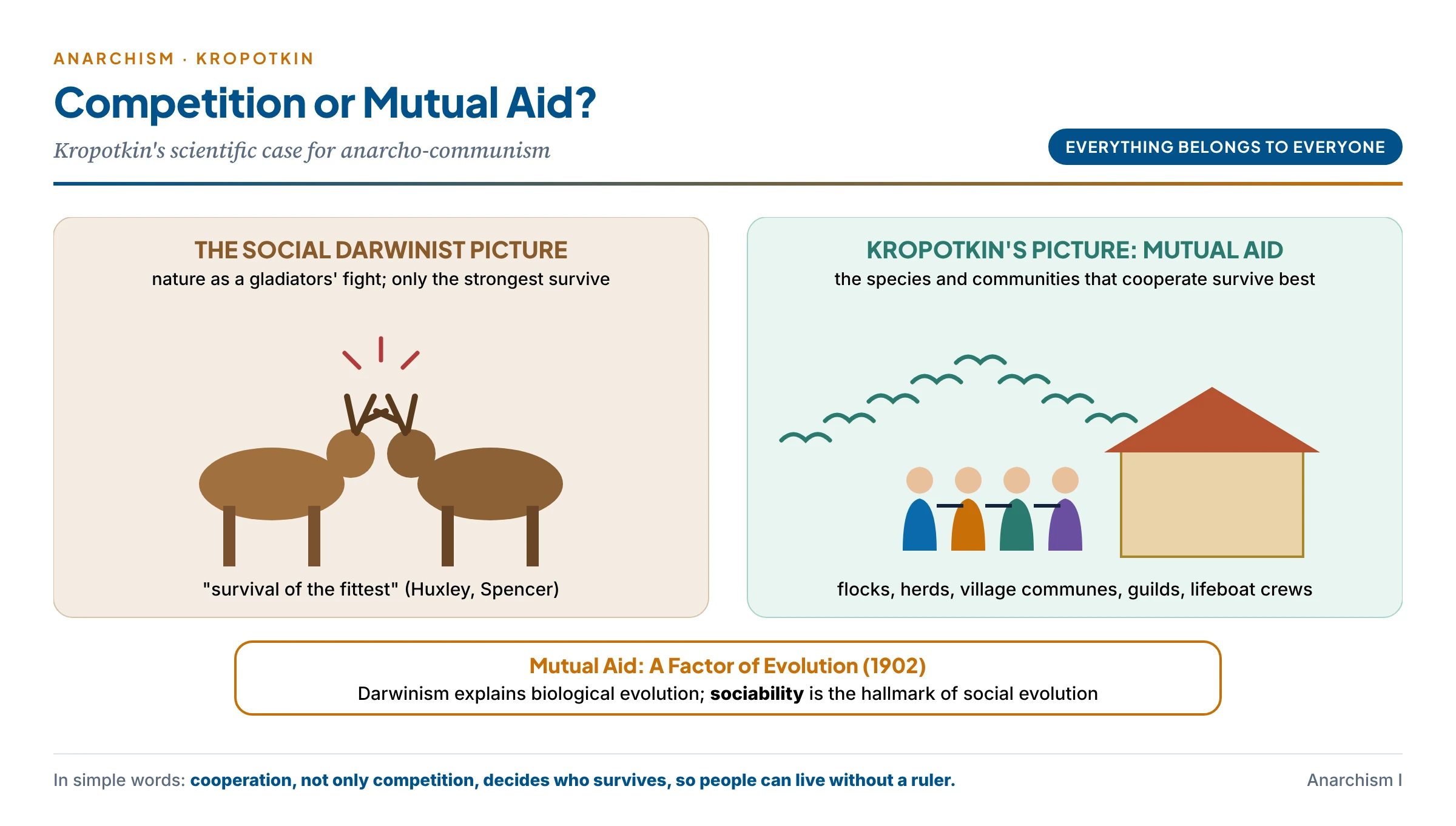
- Mutual Aid: A Factor of Evolution (1902): against the Social Darwinists (such as T. H. Huxley), who saw nature as a gladiators’ fight, Kropotkin showed from animal life and human history that species and communities that cooperate survive best. Darwinism describes biological evolution, but sociability is the hallmark of social evolution.
- The Conquest of Bread (1892): abolish money, wages and private ownership. Goods produced in common should be kept in common stores, and everyone takes according to need: “from each according to ability, to each according to needs”. Everything belongs to everyone.
- He drew on examples of self-help: village communes, medieval guilds, lifeboat societies, the Red Cross.
- Combined work: he wanted factories and fields side by side, and brain work combined with manual work.
6. Anarcho-Syndicalism — Georges Sorel and the Revolutionary Unions
- Syndicat is the French word for trade union.
- Trade unions are the instruments of class struggle and the basic units of the new society, replacing both capitalist firms and the state.
- Direct action: strikes, boycotts, sabotage and, above all, the general strike of all workers, which would bring capitalism to a halt.
- Georges Sorel (Reflections on Violence, 1908): laws and institutions contain hidden “structural violence”; the general strike works as a “myth”, an inspiring picture that mobilises the masses whether or not it is literally achieved.
- Rudolf Rocker (Anarcho-Syndicalism, 1938) was its leading theorist; the Spanish CNT union was its largest practical form.
7. Pacific (Christian) Anarchism — Leo Tolstoy
- Tolstoy reached anarchism on moral and religious grounds, from the law of love in Christ’s Sermon on the Mount: “resist not evil”, turn the other cheek.
- Respond to evil with love, not hatred. The state fights one evil with another (war, prison, execution), so it is organised violence.
- Private property causes inequality and exploitation; both state and property should be given up for the moral regeneration of humanity.
- Method: refusal to take part in violence: no military service, no oaths, no taxes for war.
- Henry David Thoreau (Civil Disobedience, 1849) belongs to the same family: he went to jail rather than pay taxes to a government that supported slavery.
- Tolstoy’s ideas deeply influenced Gandhi, who called Tolstoy’s book “overwhelming”.
8. Enlightened Anarchism — Mahatma Gandhi
- Gandhi’s ideal is Rāma Rājya, an ideal, stateless society in which order comes from voluntary cooperation.
- Human beings are by nature non-violent, but the state rests on violence; the state discourages self-dependence and cooperation, while the aim of life is swarāj, self-rule.
- His famous description: “In such a state everyone is his own ruler. He rules himself in such a manner that he is never a hindrance to his neighbour. In the ideal state therefore there is no political power because there is no State.”
- Article 10 discusses Gandhi’s anarchism, Sarvodaya and trusteeship in full.
9. Libertarian Anarchism (Anarcho-Capitalism)
- A contemporary version of individualist anarchism: develop a “market society” until the state dissolves and society is regulated entirely by supply and demand.
- Murray Rothbard and David Friedman: even police, courts and defence could be supplied by private, competing agencies.
- Earlier American individualists such as Josiah Warren and Benjamin Tucker wanted free markets without capitalist monopoly and rent, so they were closer to Proudhon.
- Their idea of a “natural society”: power and authority radically decentralised, all relations voluntary contracts.
- Criticism: social anarchists say anarcho-capitalism is not anarchism at all, because capitalist ownership is itself a hierarchy; it would replace the state with private power.
Common confusion
Are Hayek and Nozick “libertarian anarchists”? No. Herbert Spencer, Hayek and Nozick are sometimes listed as libertarian anarchists, but Hayek and Nozick defended the state. Nozick’s Anarchy, State, and Utopia (1974) argues against the anarchist: a minimal state (police, courts, defence) arises justly and is necessary. Hayek wanted a limited state governed by the rule of law. They are libertarians or classical liberals. The true anarcho-capitalists are thinkers like Murray Rothbard and David Friedman, who reject even the minimal state.
10. Anarcha-Feminism
- Patriarchy and traditional gender roles are forms of involuntary, coercive hierarchy that should be replaced by free association.
- The struggle against patriarchy is part of the class struggle and the anarchist struggle against the state and capitalism.
- It questions the authority of the family and of marriage as a property relation.
- Emma Goldman: a saying attributed to her, “if I can’t dance, it’s not my revolution”, sums up her view that liberation must include personal and sexual freedom. She also campaigned for birth control and against marriage as economic dependence.
11. Green (Social-Ecology) Anarchism
- Murray Bookchin (Post-Scarcity Anarchism, 1971; The Ecology of Freedom, 1982): the domination of nature grows out of the domination of humans by humans.
- Remedy: small, ecological, self-governing communities; “libertarian municipalism”, direct democracy of neighbourhood assemblies. It inspired the Rojava experiment.
Methods of Anarchism
| Method | Meaning | Who |
|---|---|---|
| Education and persuasion | Change minds; let reason replace law | Godwin |
| Mutualist building | Cooperatives, free credit, building the new society inside the old | Proudhon |
| Revolution / insurrection | Destroy state and capital together | Bakunin |
| General strike, direct action | Unions paralyse capitalism | Sorel, syndicalists |
| Non-violent refusal | Civil disobedience, non-cooperation | Thoreau, Tolstoy, Gandhi |
| “Prefigurative” politics | Live now the way the future society should live (consensus, mutual aid) | Modern movements |
Is Anarchism an Independent Ideology, or Inspired by Liberalism and Socialism?
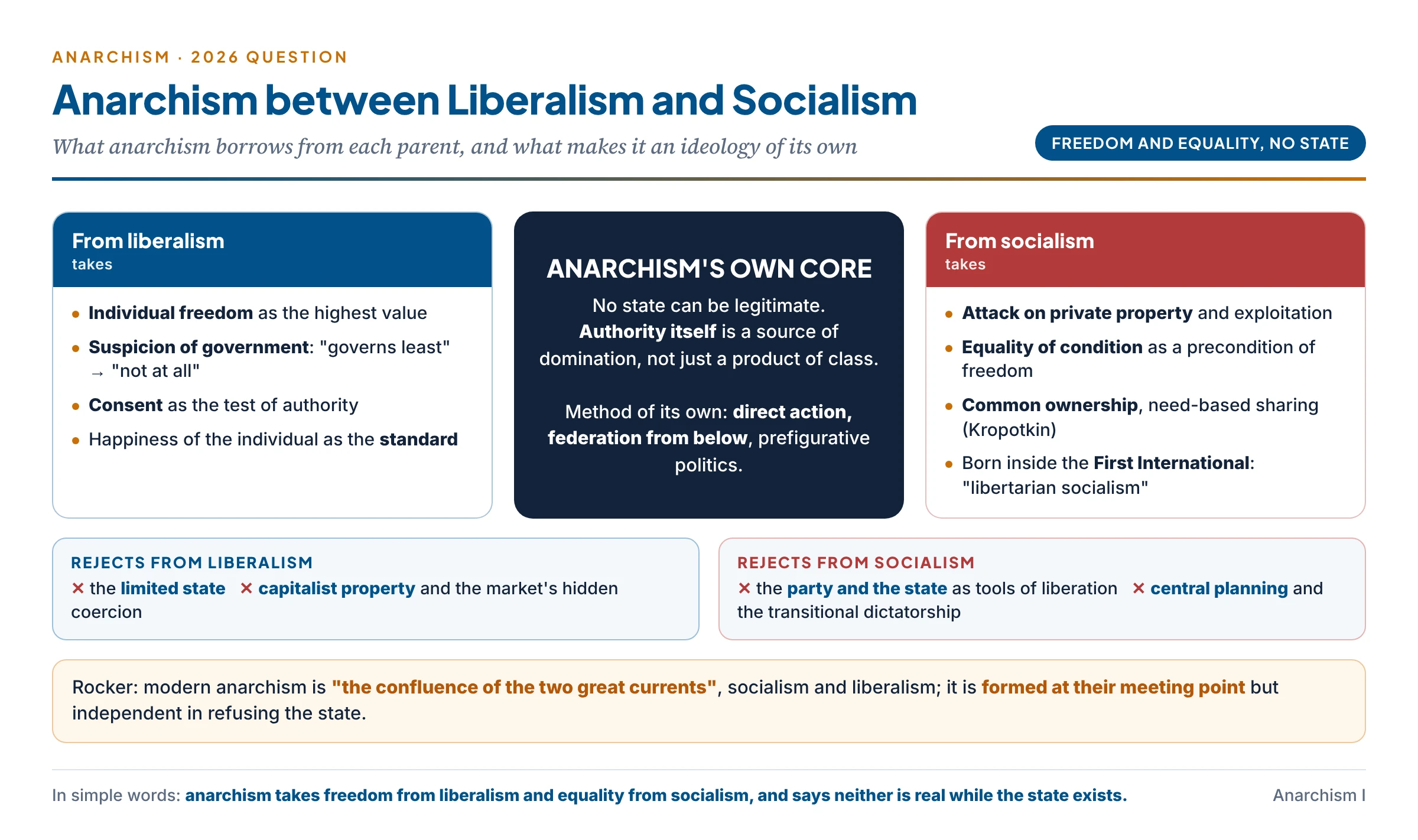
The 2026 paper asked this directly. The honest answer is both: anarchism draws heavily on liberalism and socialism, but it combines them in a way that makes it distinct.
The case that anarchism is inspired by liberalism:
- Individual freedom is the highest value, as in liberalism; anarchism shares the liberal idea that the happiness of the individual is the standard of all social matters.
- Suspicion of the state: liberals call the state a necessary evil; anarchists drop the word “necessary”. Jefferson: “that government is best which governs least”; the anarchist, with Thoreau: “that government is best which governs not at all.”
- Consent: liberals say legitimate authority needs consent; anarchists point out that no real consent was ever given.
- Individualist anarchism (Godwin, Stirner, the American individualists, anarcho-capitalists) is close to radical liberalism; anarcho-capitalism grows out of neo-liberal market thinking.
The case that anarchism is inspired by socialism:
- Private property is attacked as the root of exploitation (Proudhon, Bakunin, Kropotkin).
- Equality of condition is a precondition of real freedom.
- Social anarchism began inside the socialist movement, in the First International, and calls itself libertarian socialism or “voluntary socialism”.
- Common ownership and need-based distribution (Kropotkin) are communist goals.
- Rudolf Rocker: “In modern Anarchism we have the confluence of the two great currents which before and since the French Revolution have found such characteristic expression in the intellectual life of Europe: Socialism and Liberalism.”
The case that anarchism is independent:
- Its central claim is its own. Neither liberalism nor socialism rejects the state as such. Liberals keep a limited state; socialists use the state; only anarchists deny that any state can be legitimate.
- It rejects what is central to each parent. It rejects the liberal defence of capitalist property and the state, and the socialist (especially Marxist) reliance on party, state and centralised planning.
- Its critique of power is broader than economics. For Marx, the state is a product of class exploitation; for the anarchist, authority itself is an independent source of oppression. Abolishing classes would not abolish domination if the state remained.
- It has its own method: direct action, federation from below, prefigurative politics, refusal of party politics.
- It has non-Western and religious roots too: Tolstoy’s Christianity, Gandhi’s ahiṁsā, Taoist ideas of rule by non-action (Laozi), and the communal traditions Kropotkin found in village life.
- It is internally plural: from Stirner to Kropotkin to Tolstoy. No single “parent” can explain all of them.
Conclusion: anarchism is best seen as an independent ideology formed at the meeting point of liberalism and socialism: it takes freedom from liberalism and equality from socialism, and insists, against both, that neither can be real while the state exists.
Critical Evaluation
Strengths of Anarchist Thought
- It exposes the violence hidden in the state: police, prisons and war rest on force, however legitimate they seem.
- It reminds us that cooperation and self-help are real human capacities, as shown in disasters, villages and voluntary groups.
- It predicted that Marxist states would become bureaucratic dictatorships (Bakunin).
- It inspires decentralisation, cooperatives, mutual aid and grassroots democracy.
Weaknesses
- Utopian and incoherent: it describes what it rejects better than what it wants, and its strands contradict one another (Stirner vs Kropotkin; violent Bakunin vs non-violent Tolstoy).
- One-sided view of the state: it sees only the state’s coercion, not its protective and welfare roles (schools, hospitals, roads, rights).
- One-sided view of human nature: it assumes people are good; Hobbes argues that even a bad authority is better than the war of all against all.
- Syndicalism may replace the “state monster” with a “group monster”: powerful unions could oppress minorities.
- No answer to large-scale problems such as terrorism, communal violence, pollution, pandemics and climate change (examined in Article 3).
Critics and Defenders
Criticism — Critics
- Hobbes: without a sovereign, life is “solitary, poor, nasty, brutish and short”.
- Marx and Engels: anarchists ignore the material, class basis of the state; the state can only wither away after classes vanish.
- Nozick: a minimal state arises justly even from an anarchic starting point.
- Liberals: the state protects rights against private violence and monopoly.
- Common critique: the strands contradict each other; anarchism is a mood, not a programme.
Defence — Defenders and strengths
- Kropotkin: mutual aid is a law of nature and history.
- Rocker: anarchism unites the best of liberalism (freedom) and socialism (equality).
- Bakunin’s prophecy: the “People’s Stick” proved true in twentieth-century communist states.
- Chomsky: every structure of authority must justify itself; if it cannot, it should be dismantled.
- Practice: cooperatives, Spain 1936, mutual-aid networks and self-governing communities show anarchist ideas can work on a small scale.
Cross-Tradition Comparison
| Point | Western anarchism | Indian parallels |
|---|---|---|
| Ideal | Stateless society of free associations | Rāma Rājya; the Mahābhārata’s account of an age when people protected one another through dharma without a king |
| Basis of order | Reason (Godwin), mutual aid (Kropotkin), love (Tolstoy) | Dharma and self-restraint (ātma-saṁyama) |
| Attitude to coercion | Rejects state violence | Gandhi: ahiṁsā; the state as “concentrated violence” |
| Unit of society | Commune, union, parish | Gram swarāj: self-sufficient village republic |
| Method | Revolution or non-violent refusal | Satyāgraha, non-cooperation |
Indian Connect — Indian Connect
- The Śānti Parva of the Mahābhārata describes a golden age when there was “neither kingdom nor king, neither punishment nor punisher”; people protected one another through dharma. Only when dharma declined did people ask for a king, a story close to the anarchist view that the state is a product of moral decline.
- Buddhist texts (the Aggañña Sutta) also describe kingship arising by agreement after greed and private property appeared, an early social contract account.
- Gandhi is the great Indian anarchist thinker, though he accepted that the ideal is never fully realised and settled for a minimum state (Article 10).
- Vinoba Bhave’s Sarvodaya movement and Jayaprakash Narayan’s “partyless democracy” kept alive the dream of self-governing village communities.
Synthesis (Siddhānta)
- Anarchism is a family of ideologies united by one claim: coercive authority, above all the state, is illegitimate. Its members differ on property (Stirner vs Kropotkin), on means (Bakunin vs Tolstoy) and on human nature.
- It is neither purely liberal nor purely socialist. It is liberal in its love of freedom and socialist in its demand for equality, and distinct in refusing the state that both parents accept.
- As a complete blueprint, it struggles with the scale and dangers of modern society. As a critical standard, it is powerful: it makes every state justify its power and points to forms of cooperation the state too often crowds out.
- Contemporary relevance: decentralisation (Panchayati Raj), cooperatives (Amul), open-source software, mutual-aid groups during the pandemic and community management of forests all show anarchist principles working inside a democratic state.
Previous Year Questions
- 2026Analyze: “Anarchism is not an independent political ideology in itself, rather it is inspired by liberalism on the one hand and socialism on the other.”
- 2021Discuss anarchism as a political ideology. Is it possible to dispense with political authority completely? Give reasons for your answer.
- 2012Critical notes: Political ideology of Anarchism.