

Sovereignty: Austin, Bodin, Laski, Kautilya.
Official Syllabus: Paper II, Section A, Unit 2
The earlier articles studied four thinkers one at a time. This article puts them side by side and tests them. Bodin and Austin defend monism — one supreme, unlimited and indivisible sovereign in every state; Laski defends pluralism — authority shared among the state and many other associations; Kautilya builds a hierarchical but welfare-bound sovereignty out of seven elements. Who is right, and who is most consistent? Behind these legal theories stands a deeper question — who is the real sovereign: a ruler, the law, or the people? — answered by Rousseau’s popular sovereignty and challenged by Gandhi’s vision of self-rule without a coercive state. Finally, the whole idea has to face the twenty-first century, where globalisation, international law, regional unions, global markets and digital networks seem to erode sovereignty from above, while regions, groups and civil society press on it from below. This article covers the monism–pluralism debate, a four-thinker comparison, the specific pairings (Bodin–Austin, Austin–Kautilya), who is most consistent, popular sovereignty, Gandhi’s critique, the tension between individual freedom and state sovereignty, and sovereignty in times of globalisation.
In simple words
Think of a family deciding where to go on holiday. In one family the father alone decides and everyone follows — that is monism. In another, the children decide their activities, the mother decides the budget, the grandparents decide the dates, and the father only coordinates — that is pluralism. In a third, the family follows a written agreement everyone signed — that is constitutional (popular) sovereignty. Each model has its strengths: the first is quick but risky, the second fair but slow, the third stable but needs everyone’s continued consent.
Context & Problem
Why Compare the Theories?
- One concept, many answers. All four thinkers agree that a state needs some final authority; they disagree on who holds it, whether it has limits, and whether it can be shared.
- Different historical problems.
- Kautilya (Mauryan India): building a strong, prosperous kingdom among rival states.
- Bodin (sixteenth-century France): ending religious civil war by placing one supreme power above all factions.
- Austin (nineteenth-century England): giving the science of law a clear foundation — law as the command of a determinate sovereign.
- Laski (early twentieth century): protecting individuals and groups — churches, trade unions, professions — from an all-powerful state after the First World War.
- Each answer fits its time. A theory that answers civil war (Bodin) will stress unity; a theory that answers state absolutism (Laski) will stress limits and sharing.
The Central Questions
- Location: Where is sovereignty — in a person, a body, the law, or the people?
- Limits: Is sovereignty illimitable, or limited by divine and natural law, custom, morality, rights or international law?
- Divisibility: Is sovereignty one and indivisible, or can it be divided among governments and groups?
- Basis: Does the sovereign rest on force, on law, on consent, or on welfare?
- Reach: Is the state’s sovereignty still real in a globalised world?
Core Doctrine
Monism vs Pluralism
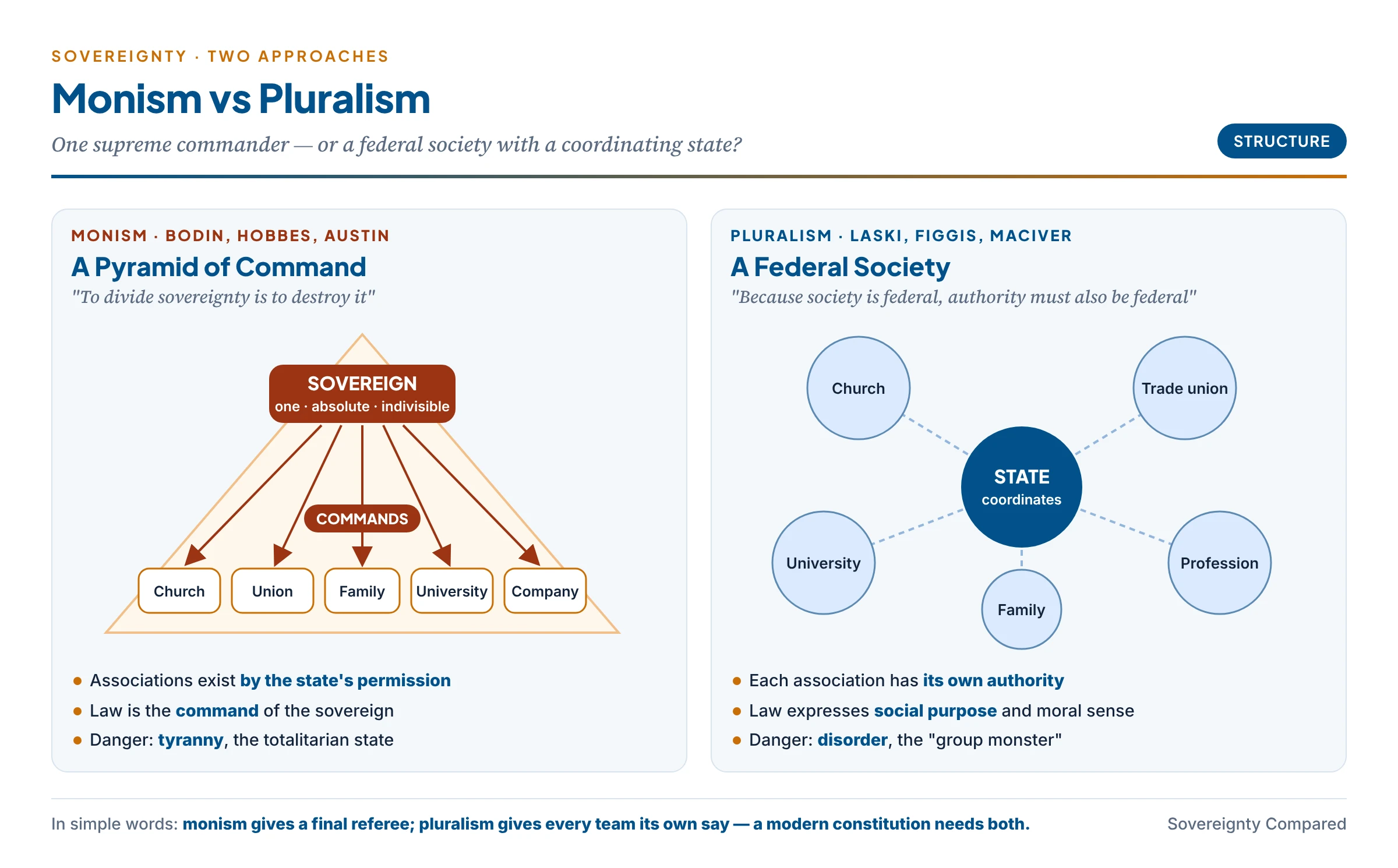
Monistic theory (Bodin, Hobbes, Austin; the idealists in their own way):
- One sovereign in every state — a determinate person or body whose will is final.
- Legally unlimited (absolute) and indivisible: “To divide sovereignty is to destroy it.”
- Universal: every person and association within the territory is subject to it; associations exist by the state’s permission.
- Law is the command of the sovereign; there is no law above it within the state.
- Permanent and inalienable: it lasts as long as the state, and cannot be given away without destroying the state.
- Merits: clarity, unity, order, a single point of final decision; the basis of the modern nation-state and of international law.
Pluralistic theory (Laski, Figgis, Maitland, Cole, Duguit, MacIver, Barker):
- Society is federal: people belong to many associations — family, church, trade union, profession, university — each meeting a different need.
- The state is one association among many, special because it coordinates and has the widest membership, but not supreme in every sphere.
- Sovereignty is divisible: “Because society is federal, authority must also be federal.”
- Limits on the state: rights, morality, public opinion, international obligations and the loyalty people owe to other groups.
- Law expresses social purpose and moral consciousness, not merely command.
- Merits: liberty, decentralisation, respect for groups, democratic participation.
| Point | Monism | Pluralism |
|---|---|---|
| Holder | One determinate sovereign | Shared among state and associations |
| Nature | Absolute, indivisible | Limited, divisible |
| State’s position | Supreme over all associations | First among equals; coordinator |
| Associations | Exist by state’s permission | Have their own original authority |
| Law | Command of the sovereign | Expression of social purpose and moral sense |
| Basis of obedience | Habit of obedience, sanction | Consent, performance, rights |
| Main danger | Tyranny, totalitarianism | Disorder, neo-feudal anarchy |
| Thinkers | Bodin, Hobbes, Austin | Laski, Figgis, MacIver, Barker, Duguit |
Criticisms of each:
- Against monism:
- Unreal in practice — even the strongest government bends to public opinion, custom, courts, groups and international pressure.
- Hard to locate in federal and constitutional states (where is Austin’s sovereign in the United States or India?).
- Dangerous — it can justify the totalitarian state that swallows all groups.
- Ignores morality — it separates law from justice.
- Against pluralism:
- Who settles conflicts? If the church and the trade union clash with the state, someone must decide finally — and that someone is sovereign.
- Divided sovereignty is self-contradictory — a final authority that is not final.
- Powerful groups — giant corporations, sectarian organisations — can oppress individuals as much as a state; “the state monster is replaced by a group monster“.
- Pluralism slides back into monism — Laski himself later admitted that a government needs commanding power to carry out social and economic reforms.
Synthesis: The modern constitutional state combines both: legally, there must be a final authority (monism’s truth — in India, the Constitution as interpreted by the courts); politically and morally, that authority is limited, shared and accountable (pluralism’s truth — federalism, local self-government, rights, free associations).
In simple words
A football match needs a referee whose decision is final on the field — otherwise every foul becomes a fight. That is monism’s truth. But the referee does not choose the teams, write the rules alone, or tell the players what to eat at home; clubs, leagues and fans have their own authority. That is pluralism’s truth. A good game needs both.
The Four Thinkers Compared
| Point | Bodin | Austin | Laski | Kautilya |
|---|---|---|---|---|
| Period | Sixteenth-century France | Nineteenth-century England | Early twentieth century | Mauryan India, around the fourth century BCE |
| Definition | Absolute and perpetual power of a commonwealth | Determinate human superior habitually obeyed, not obeying a like superior | Sovereignty shared; state one association among many | Supreme authority of the king heading the seven elements |
| Approach | Political–legal, historical | Analytical, legal (positivist) | Sociological, pluralist, ethical | Practical statecraft (arthaśāstra) |
| Source of authority | Divine order and historical legitimacy | Habit of obedience | Consent of the governed; performance | Dharma, daṇḍa and welfare of the people |
| Limits | Divine law, natural law, fundamental laws, private property | None legally | Rights, morality, groups, international law | Dharma, the ministers’ counsel, people’s welfare |
| Divisible? | No | No | Yes | Hierarchical, not divided — but works through seven elements |
| Law | Command, but under natural law | Command of the sovereign | Social purpose; legitimacy of claims | Four sources: dharma, vyavahāra, custom, royal edict |
| Democracy | Favours monarchy; people unfit to rule | Sovereign may be a body; people incapable of deciding political matters directly | Strongly democratic, decentralised | Monarchy, but paternal and welfare-oriented |
| External side | Treaties, war and peace among sovereigns | International law only “positive morality” | International community limits the state | The maṇḍala of kings |
| Main criticism | Too absolute, yet self-contradictory | Unrealistic, ignores custom and morality | Weakens authority needed in crises | Justifies a strong state and realpolitik; depends on a wise ruler |
Common confusion
Are the famous lines attributed to these thinkers always their exact words? Not always. Many popular tables put neat sentences in quotation marks — for example, lines for Bodin and Kautilya that are really summaries of their views. Use the well-established statements (Bodin’s “absolute and perpetual power of a commonwealth”; Austin’s “determinate human superior”; Laski’s “because society is federal, authority must also be federal”; Kautilya’s “in the happiness of the subjects lies the happiness of the king”) and present the rest as paraphrase. Also note that some notes write “Bodin’s six features” while discussing Austin; the six features — absolute, universal, permanent, inalienable, exclusive, indivisible — are the standard summary of Austin’s sovereignty.
Bodin and Austin Compared
Similarities:
- Monists — both hold that every state must have one supreme sovereign.
- Legislative power is the essence of sovereignty: Bodin’s first mark is making law without the consent of others; Austin’s law is the sovereign’s command.
- Indivisible and permanent — dividing sovereignty destroys the state.
- The sovereign is above positive law — he cannot be bound by his own laws.
- Order first — both see sovereignty as the cure for disorder (religious civil war for Bodin; confused legal theory for Austin).
Differences:
| Point | Bodin | Austin |
|---|---|---|
| Limits | Bound by divine law, natural law, fundamental laws (such as the Salic law) and respect for private property | Legally unlimited — no law binds the sovereign |
| Law and morality | Law must conform to natural justice | Law and morality strictly separated |
| Nature of approach | Political, historical, partly moral | Purely legal and analytical |
| Who is sovereign | Typically the monarch; the “royal monarchy” is best | Any determinate person or body — e.g. King, Lords and Commons |
| Test of sovereignty | The marks of sovereignty (legislation, war and peace, appointment of officers, final appeal, pardon, coinage, taxation) | Habitual obedience by the bulk of society; no habitual obedience to another |
| Consistency | Absolute yet limited — accused of contradiction | Logically consistent, but unrealistic |
| Influence | Theory of absolute monarchy; the modern state | Analytical jurisprudence and legal positivism |
Verdict: Bodin is richer but less consistent; Austin is cleaner but narrower. Bodin keeps sovereignty tied to justice and property; Austin gives the lawyer a precise test. Bodin’s sovereignty “floats in the air” when its limits have no earthly enforcer; Austin’s floats when its “determinate superior” cannot be found in a federal or constitutional state.
Austin and Kautilya Compared
Where Austin’s sovereignty goes along with Kautilya’s:
- A determinate, supreme authority — Austin’s determinate human superior; Kautilya’s svāmī at the head of the seven elements.
- Sanction and force — Austin’s command backed by sanction; Kautilya’s daṇḍa, without which the strong devour the weak (mātsya-nyāya).
- The ruler as law-giver — for Austin all positive law is command; for Kautilya the royal edict (rājaśāsana) prevails when it conflicts with the other sources of law.
- Habitual obedience and order — both see obedience as the mark of a functioning state.
- Independence from outside — Austin’s sovereign is not habitually obedient to any other superior; Kautilya’s state guards its external sovereignty through the maṇḍala.
- Unity, not division — neither accepts sovereignty divided among rival authorities.
Where they part:
| Point | Austin | Kautilya |
|---|---|---|
| Morality | Law separated from morality | Sovereignty bound by dharma and rājadharma |
| End of the state | Not discussed — a theory of law, not of purpose | Welfare and happiness of the people (yogakṣema) |
| Structure | A single legal point of final command | An organic body of seven interdependent elements |
| Sovereign | A person or a body (even a legislature) | A king, trained and disciplined |
| Sources of law | Only the sovereign’s command | Dharma, legal transactions, custom and royal edict |
| Duty of the ruler | No legal duties | Many duties — protection, justice, welfare, care of the weak |
| External relations | International law is not true law | Detailed theory of inter-state relations (maṇḍala) |
| Nature | Formal, analytical | Practical and normative |
Verdict: Austin’s concept goes along with Kautilya’s only up to a point — both make the ruler’s command and sanction central. But Austin’s sovereign is legally unlimited and morally neutral, while Kautilya’s is ethically limited, duty-bound and welfare-oriented. Kautilya’s svāmī is closer to a constitutional, welfare-oriented authority than to Austin’s purely legal superior.
Who Is Most Consistent — Austin, Bodin or Laski?
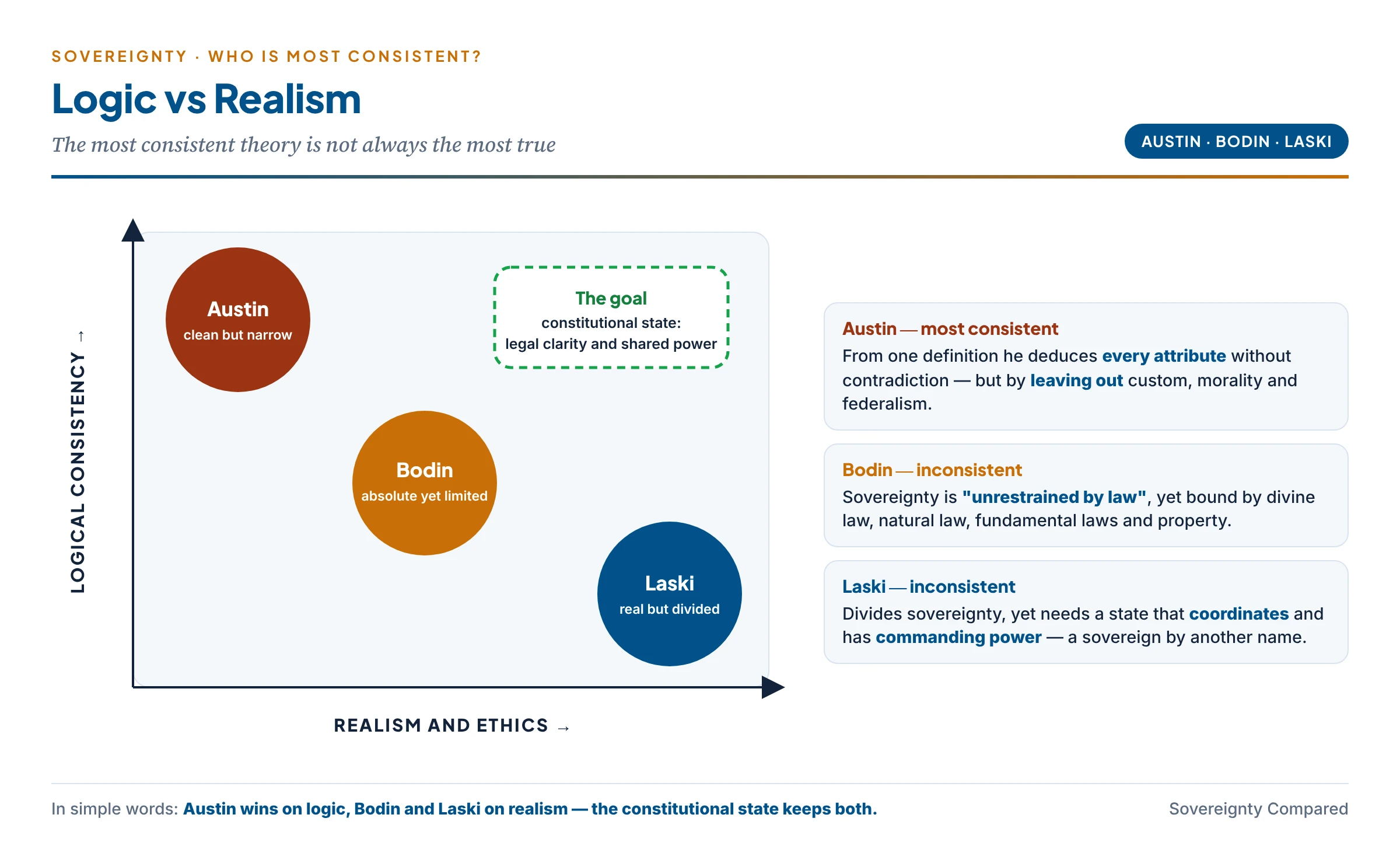
- Bodin is inconsistent. He calls sovereignty “absolute” and “unrestrained by law”, yet binds it by divine law, natural law, fundamental laws and the rights of property. If the sovereign is bound, he is not absolute; if he is absolute, the limits are only moral advice.
- Laski is inconsistent. He rejects sovereignty and divides authority among associations, yet admits that the state must coordinate them, settle their conflicts and have commanding power for reforms. A coordinator whose decision is final is a sovereign by another name. His later turn towards Marxism also changed his view of the state.
- Austin is the most consistent. Starting from a clear definition — a determinate superior, habitually obeyed, not obeying another — he deduces all the attributes: absolute, universal, permanent, inalienable, exclusive, indivisible. There is no internal contradiction; even pluralism, pressed to its logical end, falls back on monism.
- But consistency is not the same as truth. Austin is consistent because he narrows the question to law and leaves out custom, morality, public opinion and federal structure. Bodin and Laski are less consistent because they try to account for more of reality — justice, rights, groups.
- Conclusion: In logic, Austin is most consistent; in realism and ethics, Bodin’s limits and Laski’s pluralism capture important truths. The best view keeps Austin’s clarity about legal sovereignty while accepting Laski’s insight that political authority is limited and shared.
In simple words
A railway timetable that ignores fog, strikes and festivals is perfectly consistent — every train fits neatly. But it is useless on a winter morning. A timetable that allows for delays is messier but closer to reality. Austin wrote the neat timetable; Bodin and Laski wrote the messy but realistic ones.
Is Sovereignty Illimitable and Logically Indivisible?
- The monist claim: a sovereign limited by someone else is not sovereign — the limiter is; a divided sovereignty is two sovereigns, or none. So, logically, sovereignty must be illimitable and indivisible.
- The logical truth: in any functioning legal system there must be a final point of decision; otherwise disputes never end. This much is sound.
- The limits in fact:
- Self-limitation — a sovereign can bind itself through a constitution, as in the United States and India.
- Moral and social limits — public opinion, custom, religion, the fear of revolt (Bryce, Dicey’s “political sovereign”).
- Legal limits — courts can strike down laws; India’s basic structure doctrine places some features of the Constitution beyond even Parliament’s amending power.
- International limits — treaties, human rights law, trade rules and the UN Charter.
- Divisibility in fact: federalism divides powers between the Union and the states; the United States splits power among Congress, President, courts and states. Legal sovereignty may rest in the Constitution itself, while its exercise is divided.
- A helpful distinction: sovereignty as a final legal authority is indivisible; the powers through which it works can be divided among many organs.
Popular Sovereignty: Rousseau
- The idea. Sovereignty belongs to the people as a whole, expressed through the general will (volonté générale). Government is only the people’s agent.
- Actual will and real will.
- Actual will — the momentary, selfish desire of the lower self: jumping a red light because one is in a hurry.
- Real will — the rational, long-term will of the higher self, aimed at the common good: waiting at the red light because orderly traffic serves everyone, including oneself.
- The general will is the sum of the real wills of all citizens; it always aims at the common good.
- Features of popular sovereignty: inalienable (cannot be handed over), indivisible, infallible in aim, absolute, and cannot be represented — Rousseau mocked the English people as free only during parliamentary elections.
- Right and duty. Popular sovereignty is a right, because it is founded on the will of the people, and a duty, because it must be exercised for the public good.
- “Forced to be free.” Whoever refuses to obey the general will may be compelled to do so by the whole body — which, says Rousseau, means only that he is forced to be free.
- Criticisms:
- Workable only in a small, uniform community, like a Swiss canton — not in large, diverse states.
- Who knows the general will? The difference between will and reason is unclear; a leader or party can claim to speak for the “real will”.
- The “superior will” is an idealist notion that can lead to absolutism; Talmon traced “totalitarian democracy” to Rousseau, and Berlin warned that “positive liberty” can justify coercion in the name of people’s “true” selves.
- Minorities may be crushed in the name of the general will.
- Legacy. Liberal democracy accepts popular sovereignty together with constitutionalism: the people are sovereign, but they act through elected representatives under a constitution that protects rights. India’s Preamble begins with “We, the people of India“, who “give to ourselves this Constitution”. Theocratic orders reject both popular sovereignty and the rule of a common law for all citizens.
Gandhi’s Critique of State Sovereignty
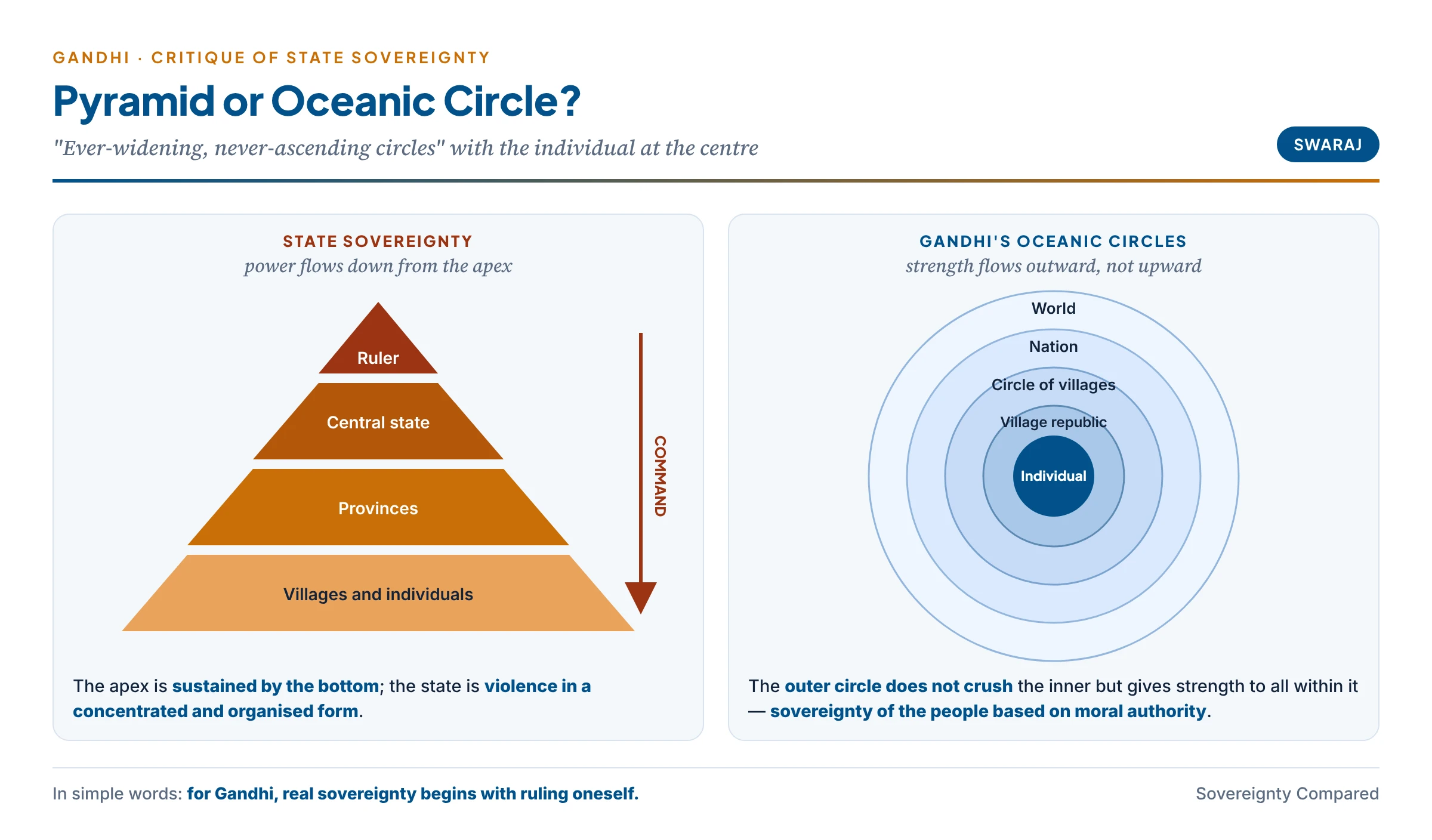
- The state as organised violence. Gandhi wrote that the state represents violence in a concentrated and organised form; the individual has a soul, but the state is a soulless machine that can never be weaned from the violence to which it owes its existence.
- Enlightened anarchy. The ideal is a society where everyone is his own ruler, ruling himself so that he is never a hindrance to his neighbour; in such an ideal state there is no political power because there is no state. Political power is not an end, but a means to enable people to better their condition.
- Practical compromise. Since the ideal is not fully realisable, Gandhi accepted “that government is best which governs the least” and favoured a minimal, decentralised state.
- Swaraj. Real swaraj is self-rule in a double sense — self-control of the individual and self-government of the community. It rests on the sovereignty of the people based on pure moral authority, not on the power of armies.
- Oceanic circles. Gandhi’s model of the polity is not a pyramid with the apex sustained by the bottom, but an oceanic circle whose centre is the individual, ready to sacrifice for the village, the village for the circle of villages, and so on — ever-widening, never-ascending circles, where the outer circle does not crush the inner but gives strength to all within it.
- Against monism and with pluralism. Gandhi rejects the concentration of sovereignty in a centralised state; his village republics and trusteeship decentralise power. But unlike Laski, he grounds authority in truth and non-violence (satya and ahiṃsā), not in group interests.
- Criticisms:
- Utopian — a large modern society needs coordination, defence and law.
- Villages may be sites of caste domination; Ambedkar called the village “a sink of localism, a den of ignorance”.
- External threats — a stateless or minimal state may not defend itself.
- Relevance: Panchayati raj (73rd and 74th Constitutional Amendments, 1992), cooperative federalism, non-violent mass movements and environmental decentralisation carry Gandhi’s critique into practice.
Indian Connect — Indian takeaways
- Kautilya gives a monist’s strong centre with an ethicist’s duties — the king is supreme but bound by dharma and the people’s welfare.
- Gandhi inverts monism: sovereignty belongs to the self-ruling individual and the village, and the state is at best a necessary evil.
- The Indian Constitution blends these: popular sovereignty (“We, the people”), a strong Union for unity and defence, federal division of powers, local self-government, and fundamental rights that limit the state.
Individual Freedom and State Sovereignty: The Anarchist Challenge
- The question. If the state is sovereign — supreme, absolute, coercive — can the individual be free?
- Anarchists say no. For Godwin, Proudhon, Bakunin, Kropotkin and Tolstoy, sovereignty means coercion, and coercion is the opposite of freedom. “Property is theft” and the state is its guardian; free individuals can cooperate voluntarily without a sovereign. Gandhi’s “enlightened anarchy” is a moral version of the same claim.
- Monists say freedom needs a sovereign. For Hobbes, without a common power life is “solitary, poor, nasty, brutish, and short”; for Bodin, liberty and property are secure only under a sovereign who ends civil war.
- Liberals say freedom needs a limited sovereign. Locke: the end of law is “not to abolish or restrain, but to preserve and enlarge freedom”. Constitutionalism and rights reconcile sovereignty with liberty.
- Rousseau and the idealists argue that true freedom is obedience to the general will or the rational state — at the risk of “forcing” people to be free.
- Laski places rights before the state: the state is to be judged by how far it secures the conditions for individual self-development; allegiance depends on performance.
- Resolution. Freedom and sovereignty are consistent when sovereignty is constitutional, accountable and rights-protecting. The anarchist warning remains valuable: every sovereign power needs checks.
Sovereignty in Times of Globalisation
How sovereignty seems to be eroded from above:
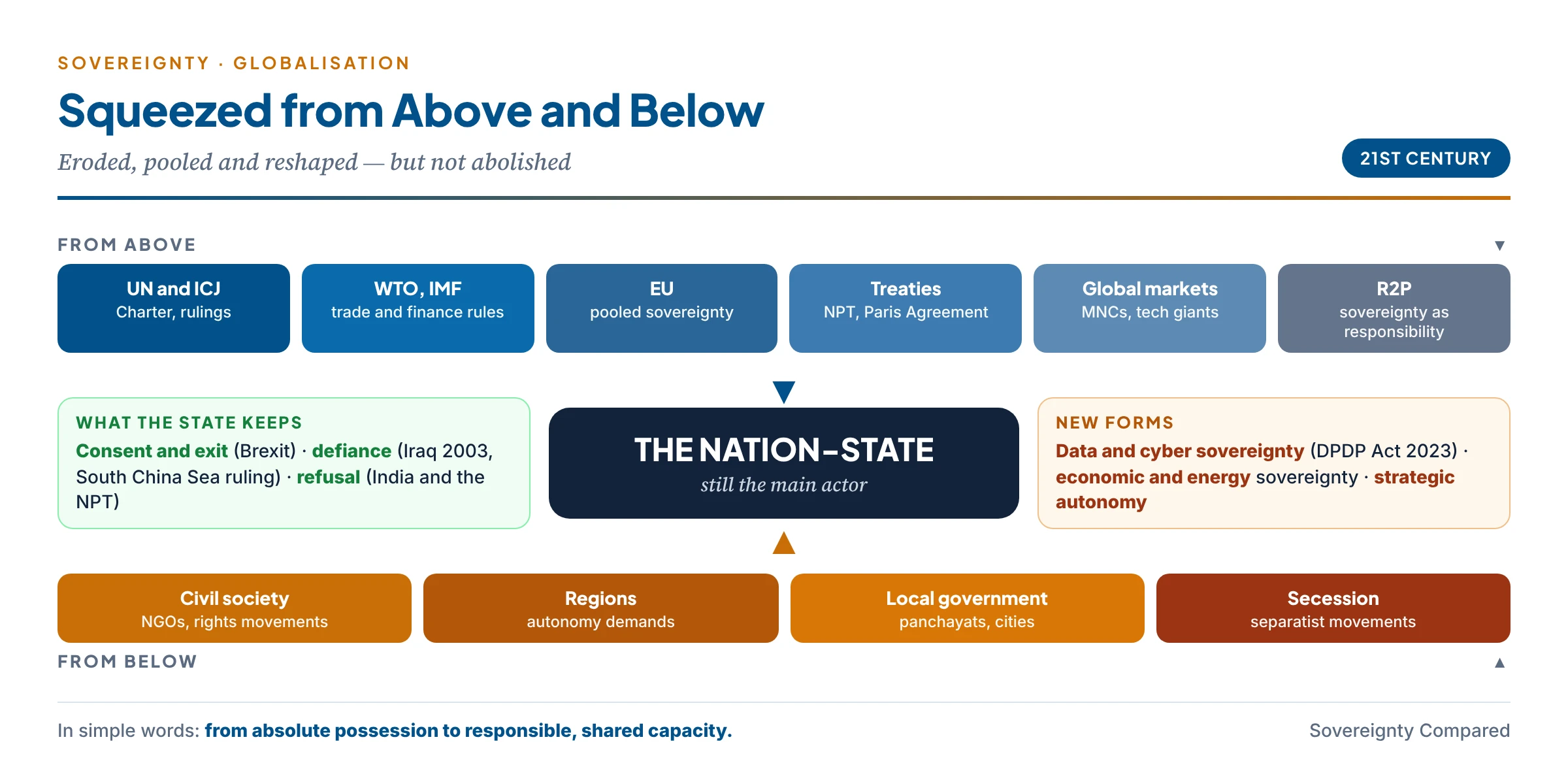
- International organisations — the UN, WTO, IMF, World Bank and International Court of Justice make rules and rulings that bind or pressure states.
- Treaties and regimes — the NPT, CTBT, the Paris Agreement on climate change, human-rights covenants.
- Regional unions — the European Union practises pooled sovereignty: member states transfer powers over trade, currency (the euro) and much law to common institutions.
- Global markets and multinational corporations — capital flows, credit ratings and tech giants limit what national governments can do.
- Humanitarian intervention — the Responsibility to Protect (R2P), endorsed at the UN World Summit in 2005, says that sovereignty is a responsibility: if a state fails to protect its people from genocide, war crimes, ethnic cleansing and crimes against humanity, the international community may act.
- Global problems — climate change, pandemics, terrorism, cyber-attacks — cannot be solved by any single state.
How sovereignty is eroded from below:
- Civil society and NGOs, human-rights movements, and transnational activist networks.
- Regionalism, autonomy and secessionist movements within states.
- Decentralisation to local governments.
Why sovereignty remains relevant:
- Consent is itself sovereign. States join the UN, WTO or EU by their own decision and can leave; choosing to be guided by others is also a free act (as Sartre said of human choice). Brexit — the British vote of 2016 to “take back control”, followed by departure from the EU in 2020 — showed that pooled sovereignty can be taken back.
- States still defy international bodies. The United States invaded Iraq in 2003 without Security Council authorisation; China rejected the 2016 South China Sea arbitration ruling under UNCLOS; Britain long disregarded the 2019 ICJ advisory opinion on the Chagos Archipelago before agreeing, in a treaty signed in May 2025, to transfer sovereignty to Mauritius while keeping the Diego Garcia base on a long lease.
- States choose not to sign. India has not signed the NPT or the CTBT, which it regards as discriminatory — an exercise of sovereign choice.
- Territorial sovereignty still matters. The Russian invasion of Ukraine (2022) was condemned worldwide precisely as a violation of Ukraine’s sovereignty and territorial integrity.
- New forms of sovereignty. States now assert economic, energy, cyber and data sovereignty — control over data generated within their territory. India’s Digital Personal Data Protection Act, 2023 and data-localisation rules, and the EU’s data-protection regime, are examples.
- The state still delivers. In the COVID-19 pandemic, it was national governments that closed borders, ran vaccination drives and paid for relief.
Changed meaning of sovereignty:
- From absolute to responsible — R2P and human rights.
- From exclusive to shared — pooled sovereignty in the EU; cooperative federalism inside states.
- From control to capacity — what counts is a state’s ability to act effectively, often through cooperation.
- Organised hypocrisy. Stephen Krasner argued that the classic norms of sovereignty (non-intervention, exclusive authority) have always been violated when powerful states found it convenient; sovereignty is a set of norms, honoured selectively.
- Post-Westphalian sovereignty. Many scholars speak of a “post-Westphalian” order in which authority is layered — local, national, regional, global — rather than concentrated in the nation-state alone.
India’s experience:
- Constitutional sovereignty. India’s sovereignty belongs to the people and is expressed through the Constitution; Parliament is supreme in law-making but not sovereign in Austin’s sense — the basic structure doctrine (1973) limits even constitutional amendments.
- Federal structure. Powers are divided between the Union and the states; local self-government adds a third tier.
- Article 370 judgment (December 2023). The Supreme Court held that Jammu and Kashmir did not retain any element of internal sovereignty after accession and the making of the Indian Constitution; Article 370 was a feature of asymmetric federalism, not sovereignty. Federal autonomy is not sovereignty.
- Strategic autonomy. India’s foreign policy guards sovereign decision-making while engaging in multilateral cooperation — the WTO, climate negotiations, the G20 and the Quad.
In simple words
Joining a cooperative housing society does not mean you lose ownership of your flat. You agree to common rules about parking, water and repairs because cooperation makes everyone’s life better — and you vote on those rules. Globalisation is similar: states accept common rules to solve common problems, but they remain the owners who signed up and who can, in the end, withdraw.
Other Challenges to the Classical Doctrine
| Thinker | Challenge to Austinian sovereignty |
|---|---|
| H. L. A. Hart | Law rests on a rule of recognition accepted by officials, not on habits of obedience to a person; the sovereign model cannot explain continuity of law, legal limits on legislatures or powers-conferring rules |
| Léon Duguit | Law comes before the state; it rests on social solidarity; the state is a set of public services, not a sovereign will |
| R. M. MacIver | The state is an association within society, with limited functions; sovereignty is a legal concept, not an absolute power over society |
| Carl Schmitt | “Sovereign is he who decides on the exception” — the real sovereign is revealed in an emergency, when normal law is suspended; a warning about emergency powers |
| Marxists | The state’s sovereignty is a mask for the rule of the dominant class |
| Feminists | The sovereign “public” sphere ignores power within the “private” family |
Critical Evaluation
Criticisms of the Classical Doctrine as a Whole
- Out of touch with reality — no modern state is legally unlimited and undivided.
- Legal fiction — sovereignty is a formal idea that hides where real power lies (corporations, parties, elites).
- Danger to liberty — absolute sovereignty can justify totalitarian states.
- Danger to peace — absolute external sovereignty makes international law and cooperation difficult.
- Outdated in a globalised world — interdependence makes exclusive control impossible.
Defences
- Final authority is needed — without it, disputes never end and order collapses.
- Sovereignty protects the weak state — non-intervention shields small states against powerful ones.
- Sovereignty is the basis of international law — only sovereign states can sign treaties and be held responsible.
- Self-government needs sovereignty — democracy is the people’s sovereignty in action.
- Adaptable — the concept has absorbed constitutionalism, federalism, human rights and pooled sovereignty without disappearing.
Critics and Defenders
Criticism — Critics
- Pluralists (Laski, Figgis): sovereignty ignores the federal nature of society and the rights of groups.
- Anarchists and Gandhi: state sovereignty is organised violence against the free individual.
- Globalists and cosmopolitans: absolute sovereignty blocks solutions to global problems and shields abusive governments.
- Marxists: sovereignty masks the rule of the dominant class.
Defence — Defenders and strengths
- Monists (Bodin, Hobbes, Austin): order and law need one final authority.
- Realists: sovereignty and the balance of power remain the basis of international order.
- Small and post-colonial states: non-intervention guards their hard-won independence.
- Democrats: popular sovereignty is the foundation of self-government and constitutional rights.
Cross-Tradition Comparison
| Point | Western monism (Bodin, Austin) | Western pluralism (Laski) | Kautilya | Gandhi |
|---|---|---|---|---|
| Holder of sovereignty | One determinate sovereign | Society, through many associations | The king, as head of seven elements | The self-ruling individual and community |
| Basis | Command and obedience | Consent and performance | Dharma, daṇḍa, welfare | Truth, non-violence, moral authority |
| Shape | Pyramid | Federal network | Organic body with a head | Oceanic circles |
| Role of force | Sanction behind law | Minimal | Daṇḍa essential but just | Rejected; non-violence |
| External side | Independence, non-intervention | International community | Maṇḍala, balance of power | World federation of free nations |
Indian Connect — Key takeaways
- Kautilya and Bodin share a strong centre limited by a higher order (dharma; divine and natural law).
- Kautilya and Austin share command and sanction, but Kautilya adds duties and welfare that Austin’s legal theory leaves out.
- Gandhi and Laski both decentralise authority; Gandhi grounds it in non-violence and self-rule, Laski in group rights and consent.
- India’s constitutional sovereignty — “We, the people”, federalism, panchayats, fundamental rights and the basic structure — is a living synthesis of these strands.
Synthesis (Siddhānta)
- Each theory holds a part of the truth.
- Bodin — sovereignty must serve justice; a power above law still needs limits.
- Austin — law needs a clear final authority.
- Laski — authority is shared, limited and justified by service.
- Kautilya — sovereignty is strong but duty-bound, and must be protected among other states.
- Rousseau — the people are the ultimate sovereign.
- Gandhi — real sovereignty begins with self-rule and moral authority.
- The modern synthesis — constitutional popular sovereignty: sovereignty belongs to the people, is expressed through a constitution, is exercised by divided and accountable organs, is limited by rights, and is shared, in some fields, through international cooperation.
- In a globalised world, sovereignty has changed from an absolute possession to a responsible capacity — states remain the main actors, but act more and more through cooperation, and are judged by how they protect their people.
“Because society is federal, authority must also be federal.” — Harold Laski
Previous Year Questions
- 2026Explain the contrast between the monistic and pluralistic approaches to sovereignty.
- 2020State and explain the relevance of the doctrine of sovereignty in times of globalization.
- 2019Discuss how far Austin’s concept of sovereignty goes along with Kautilya’s concept of sovereignty.
- 2019Evaluate Mahatma Gandhi as a political anarchist.
- 2017Discuss in the context of Anarchy whether the freedom of an individual is consistent with the sovereignty of the state?
- 2012Who amongst Austin, Bodin and Laski is the most consistent in his analysis of the concept of sovereignty?
- 2009Compare Bodin’s and Austin’s views on sovereignty.
- 2006Explain the notion of sovereignty. Critically consider in this context the claim that sovereignty is illimitable and logically indivisible.