

Social and Political Ideals: Equality, Justice, Liberty.
Official Syllabus: Paper II, Section A, Unit 1
Equality is the ideal that all human beings have equal moral worth and should be treated as equals. It is a distinctively modern ideal: for most of history, inequality was thought natural or divinely ordained — of castes, estates, races, sexes. Yet “equality” does not mean that everyone must be treated identically, or end up with the same income. The real questions are: equal in what? — rights, opportunities, resources, welfare, capabilities, outcomes — and which differences may justify unequal treatment? This article explains the meaning of equality, Rousseau’s distinction between natural and artificial inequality, J. S. Mill’s account of equality, the dimensions of equality (formal and substantive; legal, political and socio-economic; of opportunity and of outcome), the debate on reverse discrimination, the modern theories of Rawls, Dworkin, Walzer and Sen (“Equality of What?”), the Marxian view of equality and equity, the main criticisms of equality as a political ideal, and the Indian constitutional scheme. How equality relates to liberty, justice and fraternity is the subject of the next article.
In simple words
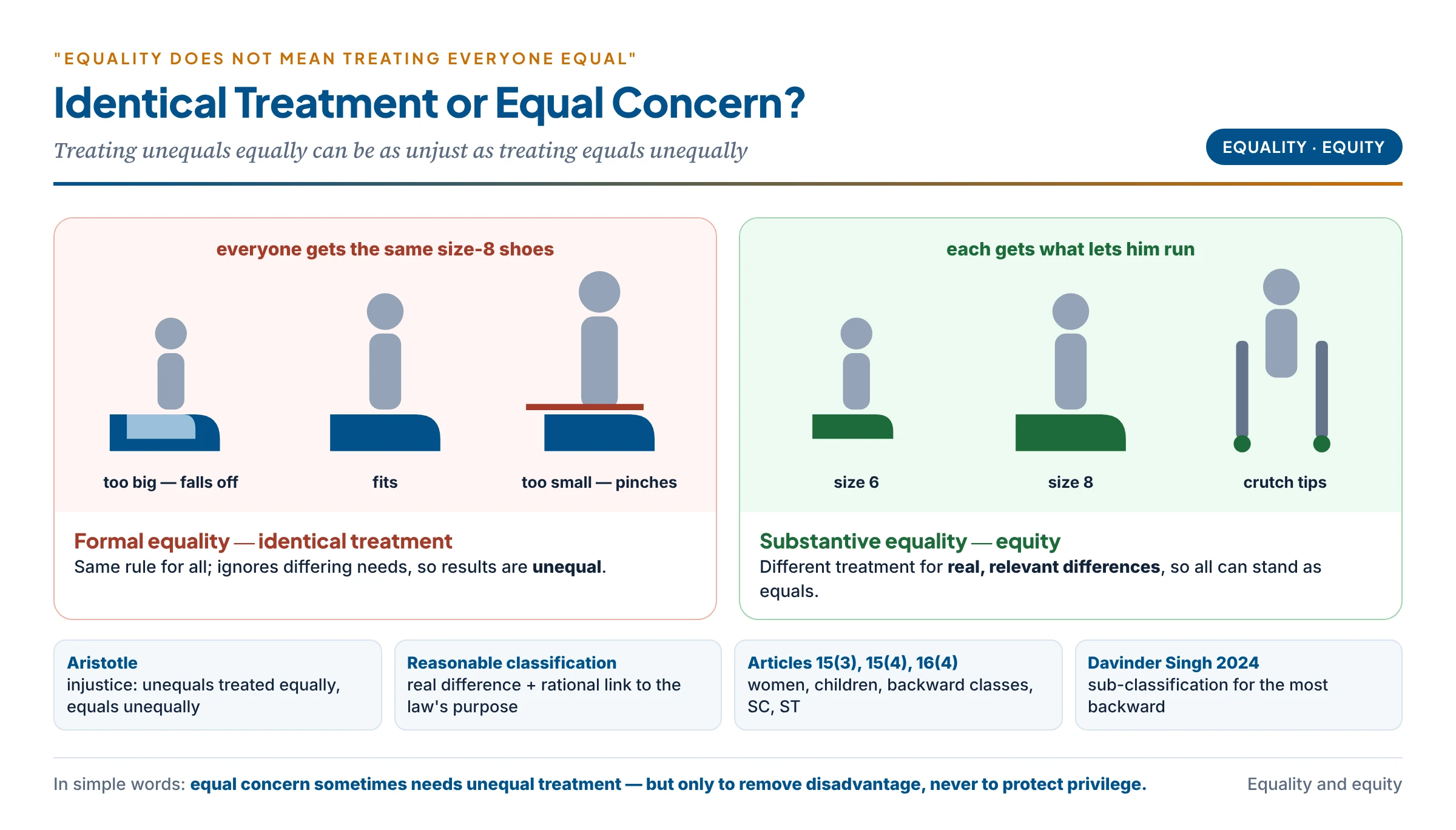
A teacher gives every student in her class the same pair of size-8 shoes for a school race. Some shoes pinch, some fall off, and a student who uses crutches gets shoes he cannot use at all. Another teacher gives each student shoes that fit — and crutch-tips for the student who needs them. The first teacher practised identical treatment; the second practised equality of concern — which sometimes means treating people differently so that they can stand equally.
Context & Problem
Meaning of Equality
- Core idea. All human beings, as human beings, have equal moral worth and are entitled to equal concern and respect (Dworkin’s phrase).
- Not identity. “Equality does not mean treating everyone the same.” Human beings differ in needs, talents and circumstances; equality asks that these differences not become grounds for privilege or exclusion.
- Harold Laski‘s two elements of equality:
- Absence of special privilege — no one enjoys rights or advantages denied to others by birth, wealth, caste or creed.
- Adequate opportunities laid open to all — everyone has the chance to develop his personality.
- R. H. Tawney spoke of equality of consideration: institutions should give equal weight to the needs of all, even though needs differ.
- “All of us do not have equal talents, but all of us should have equal opportunity to develop our talents” (John F. Kennedy).
- Egalitarianism holds that all human beings have equal social and political rights.
Traditional Justifications of Inequality
- Divine order: inequality as ordained by God or by cosmic law — the varṇa hierarchy, the “great chain of being”, the divine right of kings.
- Nature: Plato (men of gold, silver and bronze) and Aristotle (natural slaves; “treat equals equally and unequals unequally”) saw inequality as natural. Aristotle’s formula, applied this way, served to maintain existing inequalities.
- Custom and social justice of the time: whether an inequality is seen as reasonable or unreasonable depends on the prevailing idea of social justice — slavery was thought just in slave-owning societies.
- Liberty without equality. Absolute liberty results in matsya-nyāya; if liberty is not to degenerate into licence, it must be qualified by equality.
Core Doctrine
Rousseau: Natural and Artificial Inequality
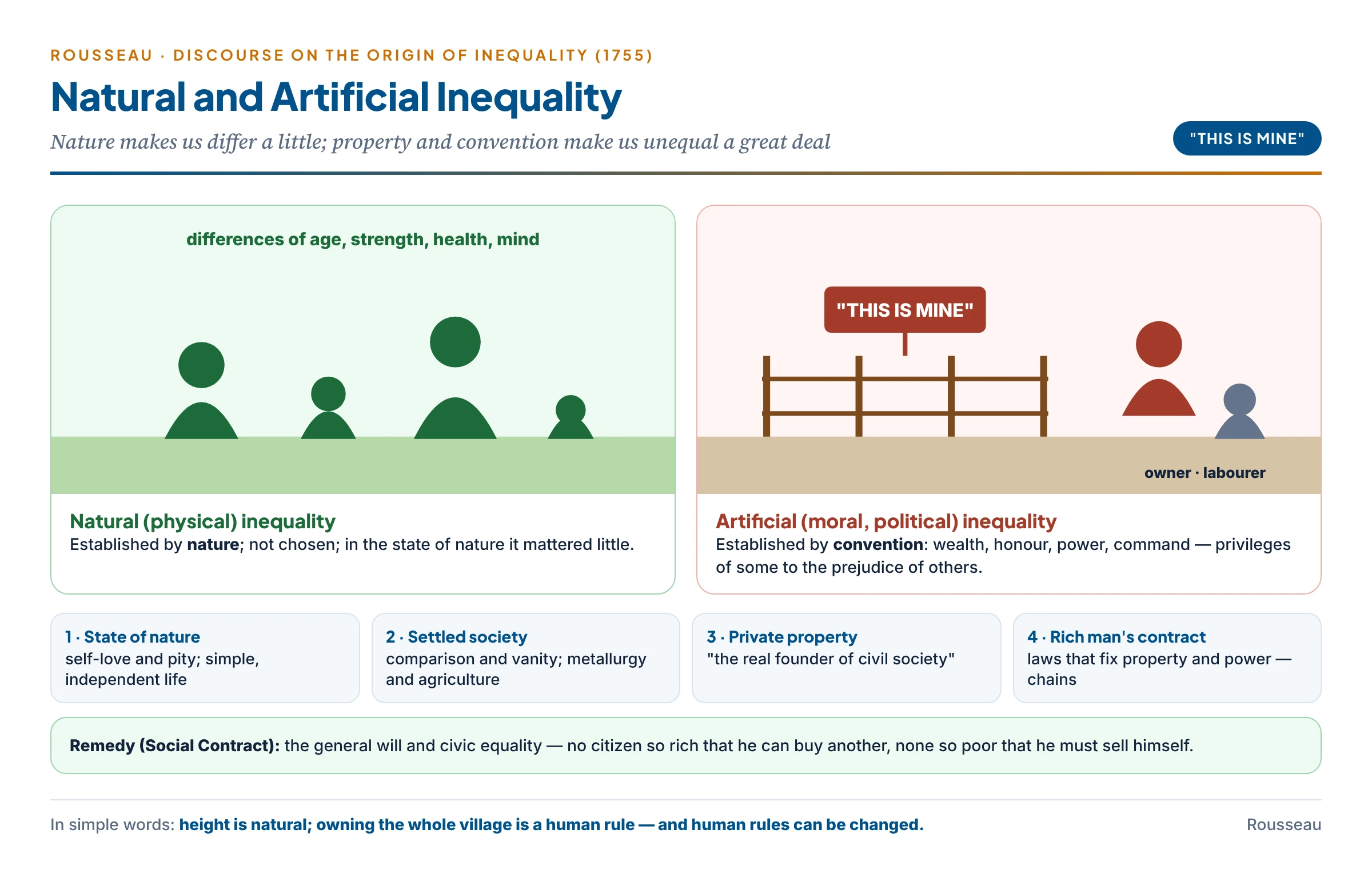
Jean-Jacques Rousseau, in his Discourse on the Origin of Inequality (1755), distinguished two kinds of inequality:
- Natural (physical) inequality — established by nature: differences of age, health, bodily strength, and qualities of mind or soul. It does not depend on human choice.
- Artificial (moral or political, conventional) inequality — established, or at least authorised, by human convention and consent: the privileges some enjoy to the prejudice of others — being richer, more honoured, more powerful, or able to make others obey. It is largely man-made.
Rousseau’s argument:
- No natural link between the two. It is absurd to ask whether those who command are naturally better than those who obey; artificial inequality does not follow from natural inequality.
- The state of nature. Early human beings lived simply, independently, moved by self-love (amour de soi, the natural care for one’s own preservation) and pity (compassion for others’ suffering). Natural inequality made little difference.
- The fall into society. With settled life, comparison and vanity (amour-propre, the desire to be esteemed above others) arose; with metallurgy and agriculture, labour was divided and land was claimed. “The first man who, having enclosed a piece of ground, bethought himself of saying ‘This is mine’, and found people simple enough to believe him, was the real founder of civil society.“
- The rich man’s contract. Private property produced conflict; the rich then proposed a social contract — laws and government — that fixed their property and power under the appearance of protecting all. So political inequality was made permanent.
- Remedy. In The Social Contract (1762), Rousseau’s legitimate state rests on the general will and civic equality: no citizen should be so rich that he can buy another, and none so poor that he must sell himself.
- Significance. Rousseau showed that most significant inequalities are social constructions, open to criticism and change — a foundation for later socialist and democratic thought.
In simple words
Two children differ in height — that is natural inequality; nobody chose it, and it matters little. But if the taller child’s family owns all the village land and the shorter child’s family must work it for a daily wage, that is artificial inequality — created by human rules about property, and so open to being changed by human rules.
Common confusion
Does Rousseau say that social inequality grows out of natural inequality? No — that is the view he rejects. Rousseau insists there is no essential connection between the two: it would be absurd to ask whether those who command are naturally better than those who obey. Natural differences mattered little in the state of nature; artificial inequality arose from property, comparison and convention. (The phrase “noble savage”, often attached to him, is not Rousseau’s own.)
J. S. Mill on Equality
John Stuart Mill is best known for liberty, but equality runs through his work. Its salient features:
- Equality as part of justice and utility. In Utilitarianism (1863), Mill accepts Bentham’s dictum, “everybody to count for one, nobody for more than one“. Each person has an equal claim to happiness and to the means of happiness; all unequal treatment needs justification by social utility. Social progress, he says, has been a series of transitions from customs once thought necessary — slavery, serfdom, aristocracy of colour and sex — to recognised injustices.
- Sexual equality. In The Subjection of Women (1869), written with the influence of Harriet Taylor Mill:
- The legal subordination of one sex to the other is “wrong in itself” and one of the chief hindrances to human improvement; it should be replaced by “a principle of perfect equality, admitting no power or privilege on the one side, nor disability on the other”.
- What is called the “nature of women” is an artificial thing, the product of forced repression and unnatural stimulation; we cannot know women’s capacities until they are free.
- Marriage under the law of his time made the wife almost a slave of her husband; the family was a school of despotism and should become a school of equality and sympathy.
- Equality would double the mental resources available to humanity and benefit women’s own happiness and freedom of choice.
- In Parliament (1867) Mill moved an amendment for women’s suffrage.
- Political equality — with qualifications. In Considerations on Representative Government (1861) he supported universal suffrage (including women) and proportional representation to protect minorities — but also proposed plural votes for the more educated and a basic literacy requirement. Equality of political voice, for Mill, had to be balanced with competence.
- Economic equality and opportunity.
- In Principles of Political Economy, Mill argued that while the laws of production are like natural laws, the distribution of wealth is “a matter of human institution solely” — society can change it.
- He supported limits on inheritance, taxation of unearned increments in land, workers’ cooperatives, public education, and a “stationary state” in which the struggle for wealth gives way to improvement of life.
- He favoured equality of opportunity and a society open to talent, against inherited privilege.
- Equality and liberty in tension. Influenced by Tocqueville, Mill feared that democratic equality of conditions could produce conformity and the tyranny of the majority — hence his insistence on individuality and minority protection.
- Limits of Mill’s egalitarianism. His plural voting, his “competent judges” of higher pleasures, and his acceptance of colonial rule over “backward” peoples show an elitist strand alongside his egalitarianism.
Indian Connect — Mill and the Indian social reformers
Mill’s Subjection of Women was widely read by Indian reformers. Its arguments — that women’s “nature” is shaped by custom, that the family must become a school of equality, and that law should end women’s disabilities — echo in the work of Jyotirao and Savitribai Phule on women’s education, Pandita Ramabai, and later in Ambedkar’s bill to codify Hindu law, which sought equal rights for women in marriage, divorce and inheritance. Mill himself, however, worked for the East India Company and defended British rule as a stage of tutelage — a reminder that he did not extend equal liberty to colonised peoples.
Dimensions of Equality
1. Formal and substantive equality
- Formal equality — the absence of discrimination: the same rules for all (equality before law, equal voting rights).
- Substantive equality — the formal rule is relaxed in favour of the needy and vulnerable so that people can actually enjoy equal standing.
- Legal and political equality are generally formal (associated with liberalism); socio-economic equality meets the demands of substantive equality (associated with socialism).
2. Legal equality
- Equal legal status for all individuals regardless of birth, physical or mental capacity, or other differences.
- Won only after prolonged struggle. Example: the Manusmṛti prescribed different punishments for the same offence according to the caste of the offender — the opposite of legal equality.
- It means equal subjection of all citizens to the law and equal protection of the laws.
- It is secured only when all citizens can equally afford to approach the courts for redress of injustice; so it is not adequate without changes in the socio-economic structure (hence free legal aid, Article 39A).
3. Political equality
- Equal political rights for citizens: the right to be represented in decision-making bodies on an equal footing; no one barred from office on grounds of gender, race, caste or creed.
- It derives from the belief that every person, as a rational being, is capable of political judgement, whatever his physical or mental capacity, wealth or education.
- It began as a progressive idea and led to the establishment of democracy in the West; universal adult franchise is its main institution.
4. Socio-economic equality
- Social equality — removal of discrimination based on social status (caste, race, gender).
- Economic equality — reduction of gross inequalities of income and wealth; the right to equal satisfaction of basic needs such as education and employment, and affordable access to essential services — transport, health care.
- State regulation of working conditions, minimum wages, compensation and pensions also serve socio-economic equality.
- So long as equality is not extended to the economic sphere, legal and political equality will continue to serve the richer classes without substantial benefit to the masses.
- Socio-economic equality depends on the prevailing concept of social justice.
5. Equality of opportunity and equality of outcome
- Equality of opportunity — an important tenet of egalitarianism: creating conditions in which everyone has the same starting point or equal life-chances, reducing the effect of inequalities attached to social, cultural or economic background. It accepts differential rewards according to differential talents, skills and effort.
- Equality of outcome — equal distribution of rewards and social goods.
- Equality of condition — reducing inequalities in people’s actual living conditions so that opportunities are real.
6. Simple and complex equality (Walzer) — simple equality makes one good (money) dominant and shares it out; complex equality keeps each good in its own sphere so that no single advantage dominates all others (see the article on the critics of Rawls).
Rational Grounds of Discrimination
Equality of opportunity may be applied in two distinct situations, which justify reasonable differences of treatment:
- Special provision in case of need.
- Applies to the division of liabilities and of concessions.
- Examples: progressive taxation, affordable public goods and services, merit-cum-means scholarships, affirmative action.
- Special reward for excellence.
- Also a basic tenet of equality.
- Comes into play when basic needs have largely been met; special talents and efforts may receive special rewards provided they benefit society.
- The principle of excellence treats service rendered to society as the sole criterion for distinction and reward; it should also promote the spirit of fraternity.
“Equality Does Not Mean Treating Everyone Equal”
- Aristotle’s insight: injustice arises both when equals are treated unequally and when unequals are treated equally. Identical treatment of people in very different situations produces unequal results.
- Equity: Aristotle’s equity (correcting the rigidity of general rules) underlies the modern distinction: equality gives everyone the same; equity gives each what he needs to reach a fair standing.
- Reasonable classification. The Indian Supreme Court allows the state to classify people for different treatment if the classification rests on an intelligible differentia (a real difference) that has a rational nexus with the object of the law (State of West Bengal v. Anwar Ali Sarkar, 1952). In E. P. Royappa (1974), the Court added that equality is antithetical to arbitrariness.
- Constitutional examples: special provisions for women and children (Article 15(3)); for socially and educationally backward classes, Scheduled Castes and Scheduled Tribes (Articles 15(4), 16(4)); for economically weaker sections (Articles 15(6), 16(6), upheld in Janhit Abhiyan, 2022); and the sub-classification of Scheduled Castes so that the most backward among them benefit (State of Punjab v. Davinder Singh, 2024).
- But the danger: “treating unequals unequally” can also be used to justify hierarchy — as Aristotle did with slavery. Differential treatment is legitimate only when it reduces unjust disadvantage, not when it entrenches privilege.
The Debate on Reverse Discrimination (Affirmative Action)
Arguments that it is needed:
- Compensation for the deprivation of adequate opportunities for development in the past — centuries of exclusion (untouchability, slavery).
- Substantive equality — formal equality alone freezes historical disadvantage.
- Proportional representation — establishing real equality in proportion to their numbers in public life.
- Need, not merely merit — when opportunities for advancement are scarce, they should be allocated not only by “merit” (which reflects privilege) but also by need.
- It enables deprived sections to escape a competition in which they start far behind; it also builds role models and diversity.
Arguments that it is not needed:
- Neo-conservatism: equality applies only to equality of opportunity; trying to establish equality of outcome through affirmative action will erode respect for merit and authority.
- Against procedural justice: sections are favoured collectively rather than individuals as deprived persons; the rich and socially advantaged among the deprived groups may get preference over genuinely poor persons from other groups.
- Unjust to the present generation: it penalises people today for injustices done by earlier generations.
- Stigma: it may hurt the self-respect of those who gain positions through it and create a feeling of inferiority.
- Capture by the vocal: in a country of widespread poverty and scarcity, the more alert and vocal sections of so-called backward classes may corner all benefits meant for the deprived — hence the need for the creamy layer rule (Indra Sawhney, 1992) and for sub-classification.
- Balanced view. Affirmative action is justified as a means to substantive equality and to dismantle caste and gender hierarchies, provided it is targeted (creamy layer, sub-classification), reviewed periodically, combined with quality education so that it does not replace building capability, and aimed at a society where it is no longer needed.
Modern Theories: Equality of What?
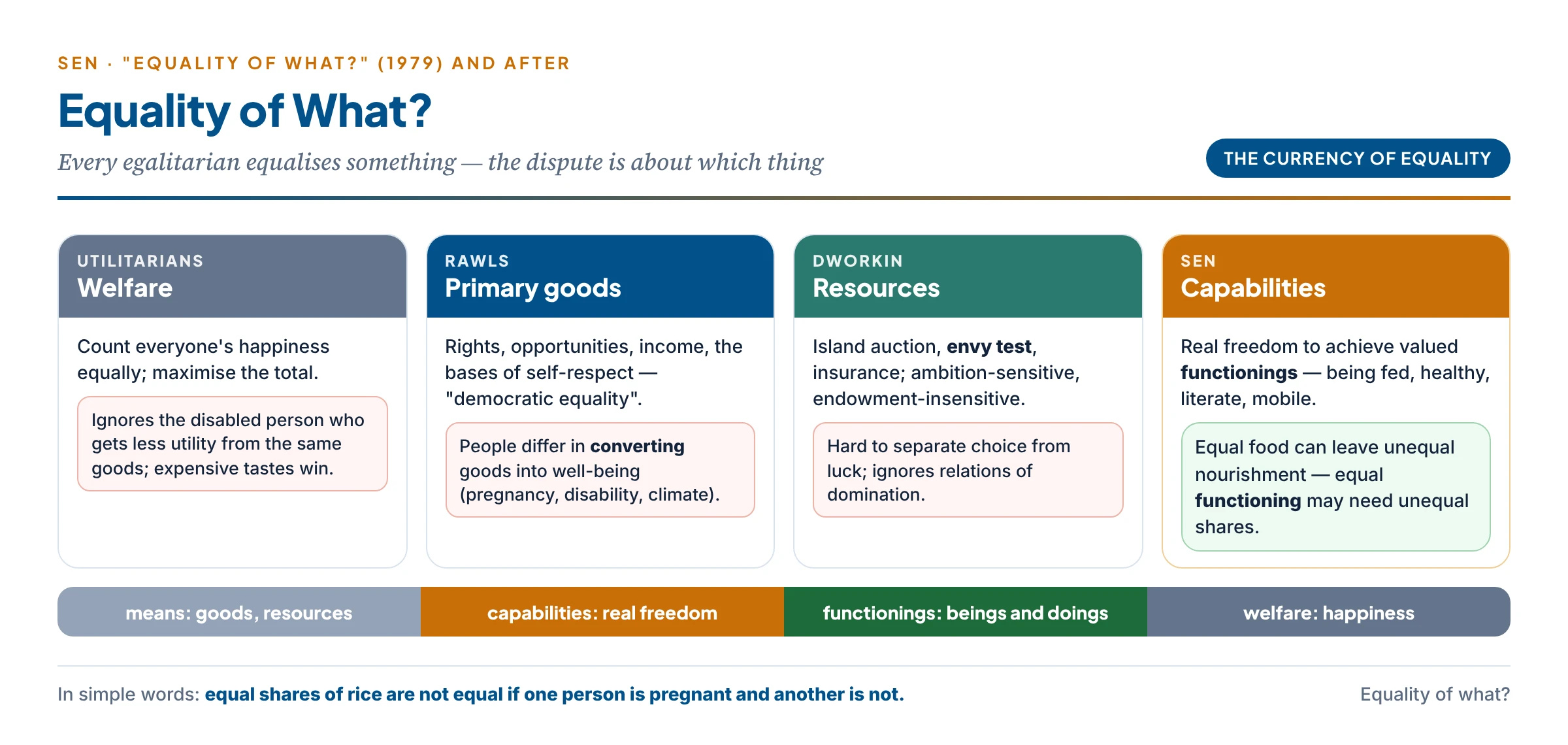
1. Rawls — democratic equality. Rawls interprets his second principle in four ways and chooses the last:
- Natural liberty — careers open to talents plus market efficiency (formal equality of opportunity).
- Liberal equality — fair equality of opportunity plus efficiency.
- Natural aristocracy — careers open to talents, with the better-off helping the worse-off.
- Democratic equality — fair equality of opportunity combined with the difference principle: no one gains from natural or social luck except in ways that benefit the least advantaged.
- The currency of equality, for Rawls, is primary goods.
2. Dworkin — equality of resources.
- Government must treat citizens with equal concern and respect (Taking Rights Seriously, 1977; Sovereign Virtue, 2000).
- Distribution should be ambition-sensitive (people bear the costs of their choices — effort, lifestyle, risks) but endowment-insensitive (people should not suffer for brute luck — handicaps, lack of talent, birthplace).
- The island auction: shipwrecked survivors on an island receive equal shares of clamshells and bid for its resources. A distribution is equal if it passes the envy test — no one prefers anyone else’s bundle of resources to his own.
In simple words
Imagine ten friends shipwrecked on an island. Each gets the same number of shells to bid for land, trees, tools and fish. When the auction ends, if no one would swap his bundle for anyone else’s, the division is equal — even though the bundles differ, because each chose what suited his own plans. That is Dworkin’s envy test.
- Hypothetical insurance: since people face different risks of handicap or low earning power, imagine what insurance they would buy against such bad luck behind a “thin” veil; taxes fund the payouts.
- Example (the tennis player and the gardener): two people with equal land; one turns it into a tennis court hoping for a sports career and fails; the other grows fruit and prospers. The failed tennis player chose his risk — Dworkin’s equality would not require the gardener to compensate him.
3. Luck egalitarianism and its critics.
- Luck egalitarians (G. A. Cohen, Richard Arneson) say inequalities due to unchosen luck are unjust; those due to choice are not.
- Relational (democratic) egalitarians such as Elizabeth Anderson reply that the point of equality is not to compensate bad luck but to end oppression and let people relate as equals — no domination, no caste-like hierarchy, no humiliating means-tests that judge whether the poor “deserve” help.
4. Sen — “Equality of What?” (1979).
- Sen examined three answers and rejected each:
- Utilitarian equality — equal weight to everyone’s utility in maximising the total; but it can neglect a disabled person who gets less utility from the same resources.
- Total utility equality (equal welfare) — but people with expensive tastes would get more.
- Rawlsian equality of primary goods — but people differ in converting goods into well-being (the pregnant woman, the disabled person).
- His answer: basic capability equality — equality in people’s real freedom to achieve valuable functionings (being nourished, healthy, educated, mobile, taking part in community life).
- Example: giving everyone the same amount of food leaves some better fed than others, since needs differ; equality of functioning may require unequal distribution of food.
5. Walzer — complex equality (see the article on the critics of Rawls).
“Unless the Ideal of Equality Is Embedded within a Broader Theory, It Can Be Given No Specific Content”
- The claim. Equality by itself is a formal principle — “treat like cases alike” — which tells us nothing until we know which cases are alike and in what respect. Some writers (such as Peter Westen, “The Empty Idea of Equality”, 1982) argue that equality is empty: all the work is done by the substantive rules that define who is “alike”.
- Evidence for the claim:
- Aristotle’s formula fitted slavery and aristocracy.
- Utilitarians, Rawlsians, Dworkinians, Marxists and Sen all affirm “equality” but disagree completely on what to equalise — the answer comes from their broader theories of the person, of justice and of society.
- Whether reservations are “equal treatment” depends on a broader theory of history, caste and justice.
- Against the claim:
- Equality is not wholly empty: it carries a substantive commitment to equal moral worth and against arbitrary privilege — which already rules out slavery, caste and legal discrimination.
- It places the burden of justification on those who would treat people differently.
- Verdict. Equality has a core meaning (equal worth, no arbitrary privilege), but its specific content — equality of what, among whom, by what means — does come from a broader theory of politics and society.
The Marxian Notion of Equality and Equity
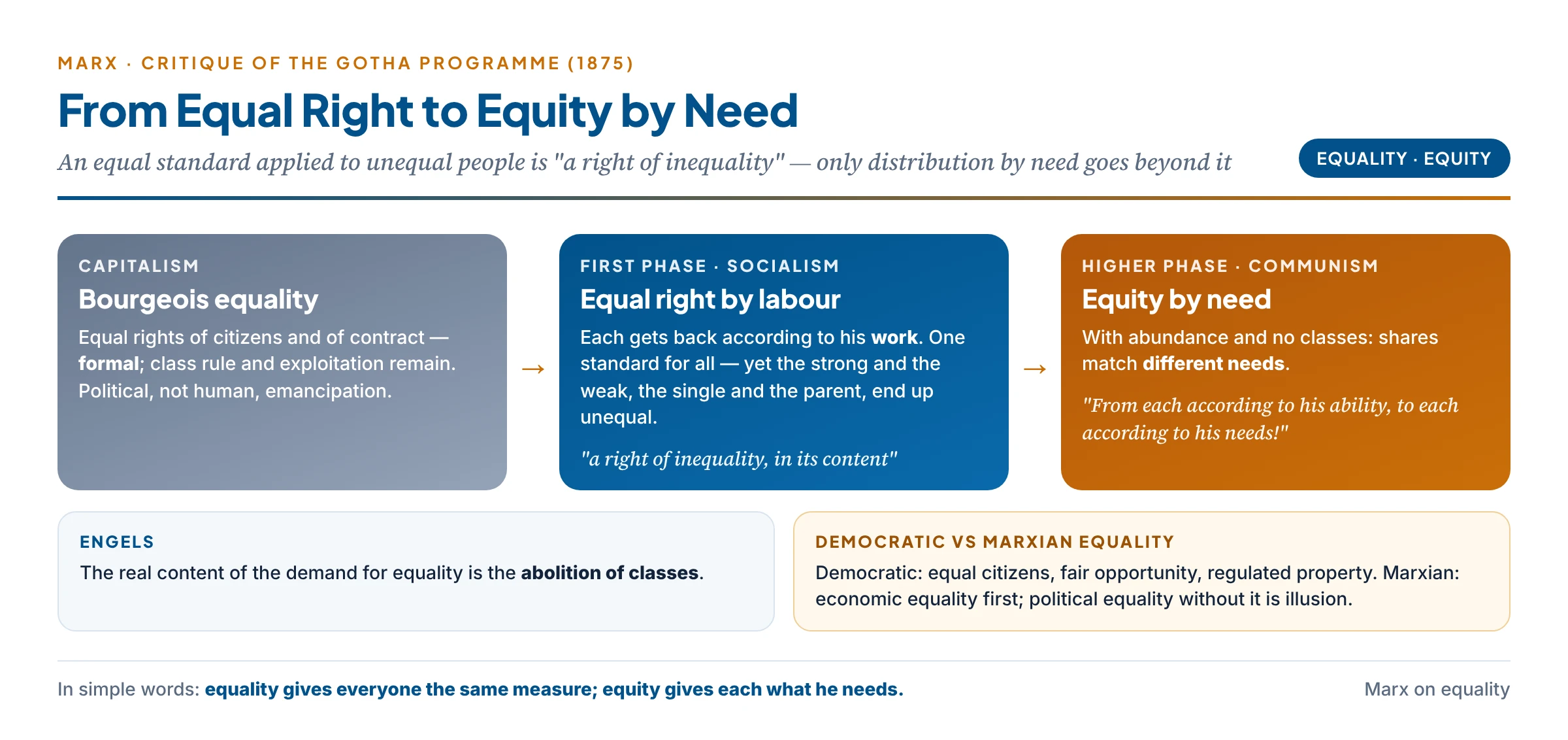
- Bourgeois equality is formal. Legal and political equality in capitalist society hide economic inequality and class domination. In On the Jewish Question (1843), Marx argued that political emancipation (equal rights of citizens) is not human emancipation: the “rights of man” are the rights of the egoistic, propertied individual.
- Equality as abolition of classes. Engels: the real content of the proletarian demand for equality is the demand for the abolition of classes; any demand for equality that goes beyond that is absurd.
- Equality and equity in the Critique of the Gotha Programme (1875):
- First phase (socialism) — each receives back from society according to the labour he contributes. This is an equal right — the same standard (labour) applied to all — but it is “a right of inequality, in its content, like every right“: one worker is stronger, another weaker; one is married with children, another single. Equal pay for equal labour gives unequal real well-being.
- Higher phase (communism) — “From each according to his ability, to each according to his needs!” This is equity: not the same standard for all, but distribution according to different needs. Only here, Marx says, can “the narrow horizon of bourgeois right be crossed in its entirety”.
In simple words
Two workers in a cooperative each work eight hours and each get the same wage — equality. But one supports four children and an old mother, the other lives alone. At the end of the month one family is comfortable, the other is short of food. Marx’s higher principle — to each according to needs — is equity: the same contribution, but shares that match different needs.
- So, for Marx: equality (an equal standard) is a stage still marked by bourgeois right; equity (according to need) is the goal — and it is possible only with abundance and the end of class society.
Democratic Equality and Marxian Equality
| Basis | Democratic (liberal) equality | Marxian equality |
|---|---|---|
| Main content | Equal rights before law; equal vote; equal (fair) opportunity | Abolition of classes; social ownership; distribution by need |
| Sphere | Mainly legal and political, with some welfare | Mainly economic — the base of all other inequalities |
| Private property | Accepted, regulated | Means of production socialised |
| Method | Constitutional reform, elections, welfare state | Class struggle, revolution, transition period |
| Rawls’s version | “Democratic equality”: fair opportunity plus difference principle | Rejected as bourgeois justice within capitalism |
| View of the other | Marxian equality threatens liberty and incentive | Democratic equality is formal and hides class rule |
| End-state | A fair society of free and equal citizens with differences of income | A classless, stateless society; “to each according to needs” |
- Fundamental distinction. Democratic equality treats people as equal citizens with equal rights in a society that remains economically unequal; Marxian equality treats economic equality as the foundation and sees political equality without it as illusory. Democratic socialism (and India’s Directive Principles) tries to bridge the two.
Critical Evaluation
Equality as a Political Ideal: Criticisms
- Equality destroys liberty (Hayek, Friedman, Nozick) — enforcing equal outcomes needs continuous coercion; “liberty upsets patterns”.
- Conformity (Tocqueville, Mill) — equality of conditions breeds uniformity of opinion and the tyranny of the majority.
- Levelling down — strict equality would prefer a world where the better-off are made worse off even if no one gains; this seems perverse. Kurt Vonnegut’s story “Harrison Bergeron” (1961) imagines a society that handicaps the gifted to make everyone equal.
- Natural inequality (elitists, conservatives such as Burke) — people differ in talents; hierarchy is natural and useful.
- Incentives — equality of outcome weakens effort and innovation.
- Emptiness — “equality” is formal and gets its content from other theories (see above).
Equality as a Political Ideal: Defence
- Equal moral worth is the foundation of democracy and human rights.
- Equality is the condition of real liberty (Tawney, Laski) — without it, freedom belongs to the strong.
- Self-respect and fraternity — gross inequality humiliates and divides; equality makes social solidarity possible (Ambedkar).
- Equality need not mean uniformity — modern egalitarians aim at fair opportunity, capabilities and relations of equality, not identical outcomes.
- Indian experience — caste shows the moral cost of a society built on graded inequality.
Critics and Defenders
Criticism — Critics of equality
- Hayek, Nozick: coercion against liberty.
- Tocqueville: conformity, tyranny of majority.
- Levelling down: equality for its own sake.
- Elitists: hierarchy natural and useful.
- Westen: an empty formal idea.
Defence — Defenders of equality
- Equal moral worth underlies all rights.
- Tawney, Laski: equality makes liberty real.
- Sen, Dworkin: equality of the right thing.
- Anderson: no domination, equal standing.
- Ambedkar: no democracy amid graded inequality.
Cross-Tradition Comparison
| Theme | Western thought | Indian thought and practice |
|---|---|---|
| Inequality as natural | Plato’s metals; Aristotle’s natural slaves | Varṇa as birth-based hierarchy; the Manusmṛti‘s graded punishments |
| Critique of birth-based inequality | Rousseau: inequality is artificial | Buddha, Basavanna, Kabir, Phule, Ambedkar: worth is not by birth |
| Equality of the sexes | Mill’s Subjection of Women | Savitribai Phule, Pandita Ramabai; Ambedkar’s bill to codify Hindu law |
| Equity, not identity | Aristotle’s equity; Marx’s “to each according to needs” | Articles 15(4), 16(4), 46; protective discrimination |
| Spiritual equality | All persons as ends in themselves (Kant) | Sama-darśana in the Gītā — the wise see the same Self in a Brahmin, a cow, an elephant, a dog and an outcaste |
Indian Connect — Equality in the Constitution of India
The Preamble promises “equality of status and of opportunity“. Article 14 combines the British idea of equality before law with the American idea of equal protection of the laws; Article 15 forbids discrimination on grounds of religion, race, caste, sex or place of birth; Article 16 guarantees equality of opportunity in public employment; Article 17 abolishes untouchability; Article 18 abolishes titles. The Directive Principles add socio-economic equality — Article 38(2) asks the state to minimise inequalities in income, status and opportunities; Article 39 asks for equal pay for equal work and against concentration of wealth. The Constitution (106th Amendment) Act, 2023 reserves one-third of seats in the Lok Sabha and state assemblies for women, to take effect after the next delimitation.
Synthesis (Siddhānta)
- Equality means equal moral worth and equal concern, not identical treatment. Its specific content — equality of what — comes from broader theories: rights and opportunities (liberals), primary goods (Rawls), resources (Dworkin), capabilities (Sen), equal standing (Anderson), classlessness and need (Marx).
- Rousseau showed that most inequalities are artificial; Mill extended equality to women and to distribution while fearing conformity; Marx exposed the formality of bourgeois equality and pointed to equity by need.
- Formal equality must be joined with substantive equality — through reasonable classification, affirmative action targeted at the genuinely disadvantaged, and universal public goods.
- Contemporary relevance. Debates on reservations and their sub-classification, EWS quotas, women’s reservation, minimum wages, progressive taxation and universal health and education are applied debates about which equality we want — and how to reconcile it with liberty and merit, the subject of the next article.
“The legal subordination of one sex to the other is wrong in itself.” — J. S. Mill
Previous Year Questions
- 2025Discuss the salient features of equality according to J.S. Mill.
- 2022Explain the difference between the notion of equity and equality with reference to Marxian philosophy.
- 2021How does Rousseau distinguish between natural and artificial inequality? Explain.
- 2017Discuss the different aspects of the fundamental distinction between democratic equality and the Marxian notion of equality.
- 2015“Equality does not mean treating everyone equal”. Discuss.
- 2004Critically examine – “Unless the ideal of equality is embedded within a broader theory of politics and society, it can be given no specific content.”
- 2002Critically examine – “The concept of equality as a political ideal.”