

Social and Political Ideals: Equality, Justice, Liberty.
Official Syllabus: Paper II, Section A, Unit 1
Liberty is the ideal most closely tied to what it means to be human: the capacity to think, choose and act for oneself. Yet no word in political philosophy is used in more senses. For some, liberty is simply the absence of restraint — being left alone by the state and by others. For others, liberty is the presence of conditions — education, health, income, a voice in government — without which “freedom” is empty. This article explains the meaning of liberty, its scope (liberty and licence, liberty and authority), its dimensions (civil, political and economic), the two great traditions of negative liberty (Hobbes, Bentham, the classical economists, Berlin) and positive liberty (Green, Hobhouse, Laski), J. S. Mill’s harm principle, Isaiah Berlin’s “Two Concepts of Liberty”, and modern attempts to go beyond the debate — MacCallum, Charles Taylor and Philip Pettit. The next article takes up liberty in Marx, Marcuse, Macpherson, Gandhi and Sen, liberty in a technological society, and freedom as mokṣa.
In simple words
A man is locked in a room. Unlock the door and he is “free” in one sense — no one stops him leaving. But if he has a broken leg, no money and nowhere to go, is he really free? The first answer (open door) is negative liberty; the second (the ability to actually go somewhere) is positive liberty. Most of the debate about liberty is about how these two answers relate.
Context & Problem
Meaning of Liberty
- The words. “Liberty” comes from the Latin liber, “free”. Liberty and freedom are usually used interchangeably. Strictly, freedom is the wider notion and liberty one of its aspects. Liberal writers use the two words for the same idea; Marxist writers prefer “freedom”.
- Two senses of freedom:
- Freedom as a quality of human beings.
- Human beings, unlike other animals, are capable of freedom. Survival is the end of animal existence; human life is more. As the Supreme Court said in Maneka Gandhi (1978), human life is not mere animal existence but a life of freedom and dignity.
- Being rational, human beings have vision and imagination; they have built institutions, civilisations and cultures in pursuit of this freedom. Freedom is the distinctive quality of man.
- Friedrich Engels defined this freedom through the distinction between necessity and freedom. Necessity is the condition of life governed by the laws of nature; it is “blind only in so far as it is not understood“. Freedom does not consist in escaping these laws but in knowing them and making them work towards definite ends — control over external nature and over ourselves, founded on knowledge of natural necessity. In short, freedom is obtaining scientific knowledge of nature’s laws and applying them for the benefit of humankind.
- Freedom as a condition of human beings.
- Here we enter the realm of liberty, usually defined as the absence of constraint.
- Constraints may be external (laws, force, other people) or internal (ignorance, fear, addiction, superstition).
- Politics deals mainly with external restraints; political philosophy deals with both.
- Freedom as a quality of human beings.
- Freedom in the widest sense means that a person feels neither internal nor external constraint — freedom from physical pain, disease, ignorance, fear and want, as well as from coercion.
- A slave may feel contented with his lot; people may be slaves of superstition, irrational customs and social practices; others may be swayed by consumer culture — a culture that treats the consumption of goods and services as the highest aim of life and the symbol of social prestige — and become indifferent to deeper joys. None of these is truly free.
- Liberty is a condition of life because we are rational creatures. Its absence is akin to slavery; in philosophy, to bondage.
Various Interpretations of Liberty
| School | What liberty means |
|---|---|
| Negative liberals | Absence of restraints |
| Positive liberals | Availability of opportunities for the maximum development of the individual |
| Idealists (Hegel, Bosanquet) | The state embodies reason; freedom lies in obedience to the order of an ideal state |
| Anarchists | Moral autonomy — acting according to one’s own conscience, without coercive authority |
| Marxists | Freedom from exploitation and alienation, possible only after the end of class society |
| Elitists | Society divides into elite and masses; liberty is possible only under the rule of an elite, which presupposes political inequality |
| Gandhians | Swarāj — self-rule and self-control |
- Liberalism as a whole seeks to evolve rules and procedures that secure the liberty of the individual.
Core Doctrine
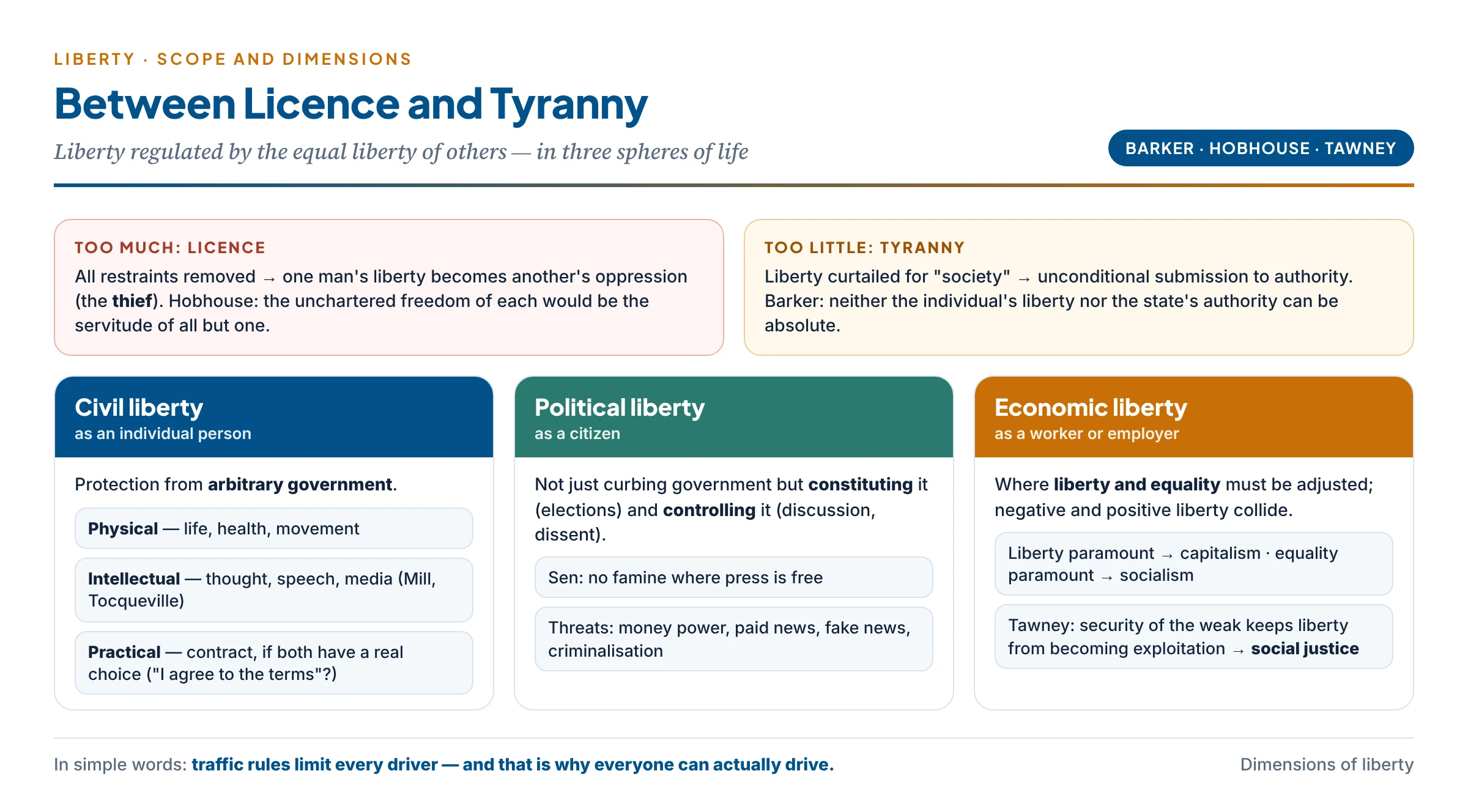
The Scope of Liberty: Liberty and Licence
- The problem of liberty is the adjustment of claims between the individual and society; the state enters as the agency that regulates their relations.
- If the individual’s claim is stretched too far, liberty becomes licence.
- If liberty is severely curtailed in the supposed interest of society, the result is unconditional submission to authority — a loss of liberty amounting to tyranny.
- Licence means removing all restraints on individual action, with utter disregard for the interests of others.
- One man’s liberty becomes another’s oppression. A thief’s “liberty” to choose his occupation would threaten everyone’s security.
- It goes against the social contract, by which people accept limits for mutual security.
- It defeats liberty itself. L. T. Hobhouse: “The unchartered freedom of each would be the conditional servitude of all but one” — freedom to be enjoyed by all must impose some restraint on all.
- Ernest Barker (Principles of Social and Political Theory): “the need of liberty for each is necessarily qualified and conditioned by the need of liberty for all.”
- So liberty must be regulated so that no one uses his freedom to destroy the freedom of others. Such a situation of unlimited freedom would be self-contradictory.
In simple words
Traffic rules restrict you: stop at red, keep to the left, drive below the speed limit. Yet without them, no one could drive anywhere safely — the roads would be chaos. Rules that restrict everyone equally can increase everyone’s real freedom to move. That is why liberty is not the absence of all rules but the absence of unreasonable ones.
Liberty and Authority
- Regulation needs authority. If liberty must be limited by the equal liberty of others, someone must regulate it — the state. Regulating liberty means recognising the state’s authority over the individual.
- Why regulation is needed. In a perfect world, rational agents would pursue what is good for themselves and for society, and no regulation would be necessary. In the real world people are at different stages of moral development; so authority is needed to regulate liberty in order to safeguard liberty itself.
- Barker’s three conditions. Liberty within the state is relative and regulated — the greatest common measure of liberty possible for all. It involves:
- The need of each to enjoy similar and equal liberty with others.
- The need of all to realise liberty in the sphere of their capacities.
- The authority of the state to regulate liberty — and limits on that authority. If the individual’s liberty cannot be absolute, neither can the state’s authority.
- The old question. If the individual is imperfect and must be regulated, can the state be assumed perfect and its authority unlimited? The conflict between liberty and authority has always been a central issue in political theory. D. D. Raphael (Problems of Political Philosophy) notes that most theorists recognise the conflict and seek a balance:
- Hobbes curtails liberty severely for the sake of order and the greater good of the state.
- Locke and Mill limit state authority to leave as much room as possible for liberty.
- Legitimacy, not mere force. The state’s authority is better justified when backed by moral support and legitimacy rather than coercion. Legitimate restrictions create a moral obligation to obey; people support the state’s actions. Equally, a sensible legislature, even one legally all-powerful like the British Parliament, pays more regard to what it can effectively and acceptably do than to what it legally may do.
- Non-negotiable spheres. Some liberties are so basic that any compromise is a total compromise — freedom of speech and expression, the independence of the media and of the judiciary. “The love of liberty is the love of others; the love of power is the love of ourselves” (William Hazlitt).
- Unrestricted does not mean unregulated. Formally, liberty is “absence of restraint” — but this means absence of unreasonable restraint, not unregulated, unchecked, absolute liberty.
Indian Connect — Liberty and authority in the Indian Constitution
Article 19 grants six freedoms — speech and expression, assembly, association, movement, residence and profession — but each may be limited by “reasonable restrictions” under clauses 19(2) to 19(6), on grounds such as public order, morality, security of the state and the rights of others. This is Barker’s “greatest common measure” of liberty in constitutional form. In K. S. Puttaswamy (2017), the judges stressed that liberty and privacy are not gifts of the Constitution but inherent rights it recognises and protects. In Anuradha Bhasin (2020), on internet shutdowns in Jammu and Kashmir, the Court held that restrictions must meet the test of proportionality — society needs security, but at the least possible cost to liberty.
Dimensions of Liberty
- Civil liberty — liberty of a person in the capacity of an individual (Barker); an essential feature of liberal democracy. Civil liberties protect the individual from arbitrary acts of government: personal freedom, freedom of movement, thought and expression, faith and worship, association and peaceful assembly, fair trial, equality before law. It has three parts:
- Physical freedom — freedom from injury or threat to life, health and bodily movement; curtailed only in the interest of public safety, law and order, by procedure established by law.
- Intellectual freedom — freedom of thought, belief, speech and the media.
- Tocqueville, in the classic debate between liberty and equality, warned that equality of conditions in democracy tends towards a homogenisation of opinion — a “tyranny of the majority” — leading to centralised power.
- J. S. Mill, deeply influenced by Tocqueville, held that even if one person’s opinion differs from the rest of society, society has no right to suppress it: if the opinion is right, society gains the chance to exchange error for truth; if wrong, the clash produces a clearer perception of truth.
- Practical freedom — freedom of contract: voluntary agreements for mutual advantage, provided no damage is inflicted on a third party. Freedom of contract presupposes substantial equality between the parties — each must have a real choice to accept or reject. Where there is no such equality, one party acts under compulsion. Example: “Do you agree to the terms and conditions?” on a phone app — there is no real choice.
- Political liberty — liberty of a person in the capacity of a citizen.
- The traditional view: political liberty means curbing the power of government.
- In modern democracies, where the people themselves constitute the government, political liberty means constituting government (by free elections — a general act of consent) and controlling it (by continuous discussion, dialogue and dissent).
- It is the right to be represented in decision-making bodies and, more broadly, to influence and shape public policy by free advocacy.
- Amartya Sen (Poverty and Famines): no famine has occurred in a country with a free press and government by discussion.
- Threats: elections fought with money and muscle power, biased media, criminalisation of politics, paid news, “manufacturing consent“, and fake news. Then political liberty cannot secure substantive freedom.
- Economic liberty — liberty of a person in his capacity as a worker or economic agent — both employer and employee.
- The most debated sphere: here the claims of liberty and equality must be adjusted, and negative and positive liberty come into direct confrontation. Where liberty is paramount → capitalism; where equality is paramount → socialism.
- R. H. Tawney (Equality): when liberty is construed realistically — implying not merely civil and political rights but the security of the economically weak — a large measure of equality keeps liberty from becoming exploitative and self-defeating.
- Economic liberty reaches its logical conclusion in the concept of social justice.
Negative Liberty
- Definition. Liberty as the absence of restraints — especially restraint by the state.
- Proponents: Hobbes (“liberty is the absence of external impediments”; liberty lies in “the silence of the laws”), Adam Smith, Jeremy Bentham, James Mill, Herbert Spencer; in the twentieth century Isaiah Berlin, F. A. Hayek, Milton Friedman and Robert Nozick (the libertarian revival).
- Historical role. It was the doctrine of the rising capitalist class against feudalism: free trade, free labour, free contract.
- Its main ideas:
- “Everyone knows his own interest best; the state should not decide his ends and purposes.”
- Limited state and laissez-faire — freedom from government interference in economic affairs.
- Society seen as an aggregate of atomised individuals, joined by a bond of mechanical unity.
- Law and liberty are contradictory: law interferes in individual life, while the basic thrust of liberty is non-interference. (Bentham: “every law is an infraction of liberty”.)
- Liberty and equality are contradictory: inequality is a natural outcome of liberty; any attempt at equality brings state interference and hampers liberty.
- Freedom is not the conditions of freedom (Berlin): freedom can exist even where its conditions are absent, so the state should not try to create those conditions.
- The Stoic and the capitalist. The Stoics said a slave could be as free as an emperor on his throne if he lived by his conscience and became indifferent to consequences — even death. Similarly, champions of capitalism argued that the worker is as free as the capitalist — both are free to deal with each other. But the worker’s real choice may be between working under oppressive conditions or starving; that is no test of liberty.
- Criticism:
- Its logical outcome is anarchy.
- In practice only the strong realise their liberty, at the cost of the weak — ending in matsya-nyāya.
- It grants freedom to do everything without any assurance that it can be realised.
- It misunderstands the relation between liberty and equality.
- It can produce vast economic inequality.
Does Negative Freedom Ensure Choice without Fulfilment?
- Yes — in a sense. Negative freedom guarantees that no one blocks my choice: I may apply for any job, buy any house, start any business, travel anywhere.
- But it gives no assurance that I can actually do these things. A landless labourer is “free” to buy land and “free” to send his children to a private school — the law does not stop him — but poverty does. Hence the saying that “the law, in its majestic equality, forbids the rich as well as the poor to sleep under bridges”.
- Hence positive liberty — and the welfare state — try to add the conditions that make choice effective. As Sen puts it, the freedom to choose depends on the capacity to choose; otherwise it is mere rhetoric.
J. S. Mill: On Liberty and the Harm Principle
John Stuart Mill (On Liberty, 1859) is the classic defender of individual liberty — and at the same time the bridge from negative to positive liberalism.
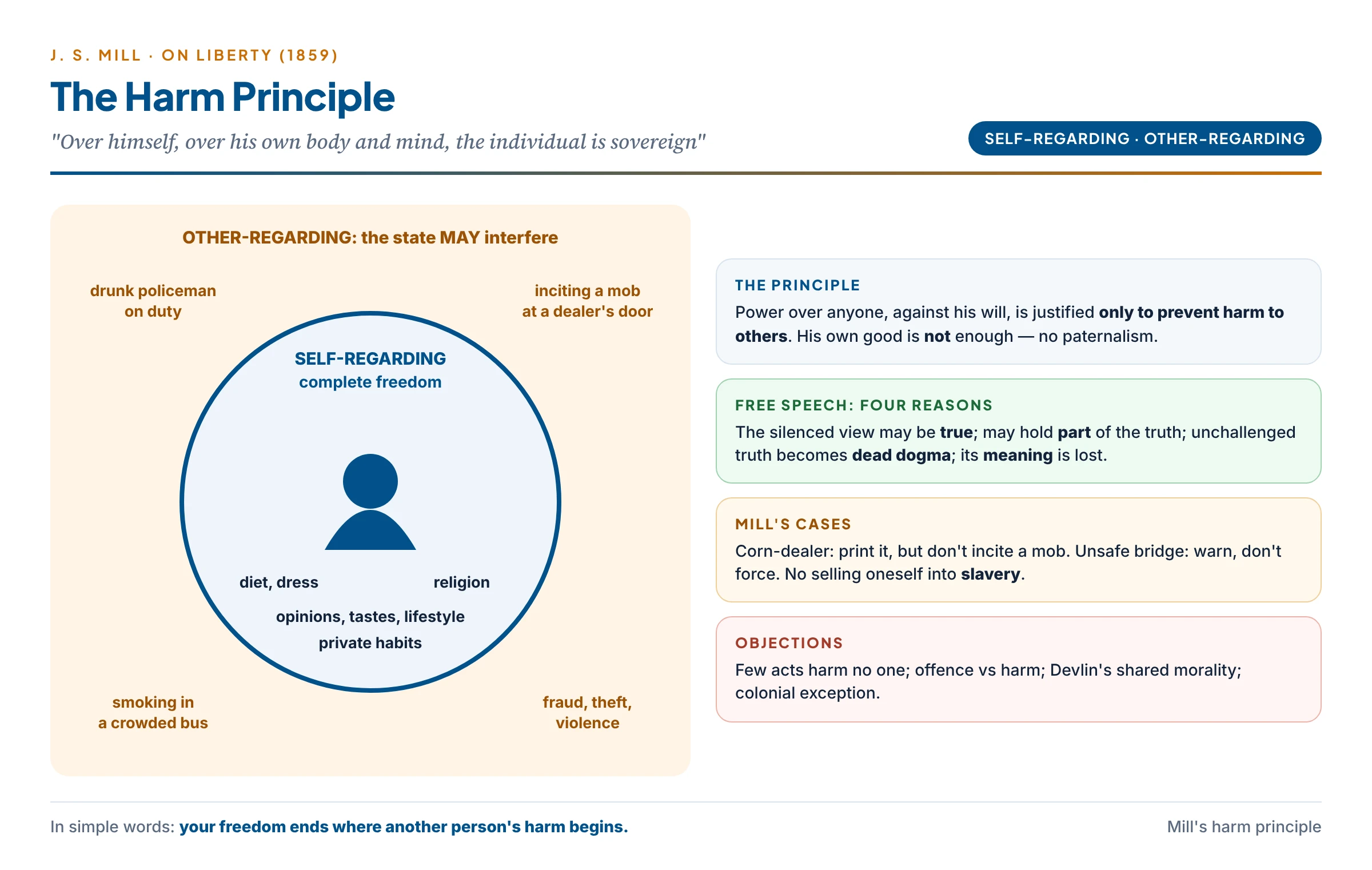
- The harm principle. “The only purpose for which power can be rightfully exercised over any member of a civilised community, against his will, is to prevent harm to others. His own good, either physical or moral, is not a sufficient warrant.”
- Self-regarding and other-regarding actions:
- Self-regarding actions — whose effects are confined to oneself (diet, dress, religion, private habits) — deserve complete freedom: “Over himself, over his own body and mind, the individual is sovereign.”
- Other-regarding actions — those that affect others — give the community the right to interfere.
- No paternalism. A person cannot rightfully be compelled to do something because it will be better for him or make him happier.
- Two forms of liberty:
- Liberty of thought and expression — to think and freely express one’s ideas.
- Liberty of action (tastes and pursuits) — which complements freedom of thought; plus liberty of association.
- Mill’s arguments for free speech:
- The silenced opinion may be true; to suppress it assumes our own infallibility.
- Even a false opinion may contain part of the truth.
- Even the whole truth, if not challenged, becomes a dead dogma, held as prejudice.
- Its meaning will be lost and it will cease to influence conduct.
- “If all mankind minus one were of one opinion, and only one person were of the contrary opinion, mankind would be no more justified in silencing that one person, than he, if he had the power, would be justified in silencing mankind.”
- Individuality. Individuality is an element of well-being; society progresses through “experiments of living“. The great danger in modern democracy is not the tyranny of government alone but the tyranny of the majority — of custom and public opinion — which crushes eccentricity and originality.
- Mill’s examples:
- The opinion that corn-dealers starve the poor may be printed in the press, but may justly be punished when delivered to an excited mob outside a corn-dealer’s house — then it becomes an instigation to harm.
- A person about to cross an unsafe bridge may be warned or even stopped for a moment to make sure he knows the danger — but not forced if he knows and still chooses to cross.
- One may not sell oneself into slavery: “It is not freedom to be allowed to alienate his freedom.”
- Drunkenness is self-regarding — but a soldier or policeman drunk on duty may be punished.
- Limits Mill set. The harm principle applies only to adults in civilised societies; Mill excluded children and — controversially — “backward states of society”, a view now criticised as colonial.
- Mill and positive liberty. Mill saw the development of personality as the ultimate goal of life; he realised that the working class were deprived of their due share under laissez-faire individualism. He supported a sound theory of taxation, limits on inheritance, and state provision of education — which made him a forerunner of positive liberalism.
In simple words
Smoking alone in your own room harms mainly you — Mill would leave you free. Smoking in a crowded bus harms others — the state may stop you. Driving fast on an empty private track is your risk; driving drunk on a public road endangers others. Mill’s test always asks: is anyone else being harmed?
Criticism of Mill:
- The line is hard to draw. Almost every action affects others somehow; few acts are purely self-regarding (James Fitzjames Stephen, Liberty, Equality, Fraternity, 1873).
- Offence vs harm. Must society tolerate acts that deeply offend but do not physically harm?
- Morality and law. In the Hart–Devlin debate (1959 onwards, after the Wolfenden Report), Lord Devlin argued that society may enforce shared morality to hold itself together; H. L. A. Hart defended Mill’s view that the law should not punish private conduct that harms no one.
- Colonial exception. Mill denied liberty to “barbarians” — a paternalist and imperial limit to his principle.
- Elitism. His “competent judges” of higher pleasures, and his support for plural votes for the educated, sit uneasily with equal liberty.
Indian Connect — Mill’s harm principle in Indian courts
In Shreya Singhal v. Union of India (2015), the Supreme Court struck down Section 66A of the IT Act, which punished “offensive” online messages. It distinguished discussion, advocacy and incitement: only speech that reaches the level of incitement may be curbed — very close to Mill’s corn-dealer example. In Navtej Singh Johar (2018), the Court decriminalised consensual same-sex relations, holding that constitutional morality must prevail over public morality — Hart’s side of the Hart–Devlin debate.
Positive Liberty
- Definition. Liberty as access to the opportunities essential for the development of personality — the capacity to realise one’s potential.
- Proponents: T. H. Green, L. T. Hobhouse, Harold Laski; Mill as forerunner; later Rawls, Sen.
- Origin. It arose because negative liberty and laissez-faire produced miserable conditions for workers and consumers in industrial society.
- T. H. Green (lecture on “Liberal Legislation and Freedom of Contract”, 1881): freedom is “a positive power or capacity of doing or enjoying something worth doing or enjoying, and that, too, something that we do or enjoy in common with others“. He supported factory laws, public education and licensing laws on drink as measures that enlarge real freedom.
- Harold Laski (A Grammar of Politics): liberty is “the eager maintenance of that atmosphere in which men have the opportunity to be their best selves“.
- Main ideas:
- Law and liberty are complementary: the purpose of law is to create the conditions essential for the full development of the individual.
- Liberty and equality are complementary: liberty is the availability of essential conditions for realising one’s potential; when these are made available to all, that is equality.
- Freedom and the conditions of freedom are intimately related.
- Sen: the freedom to choose depends on the capacity to choose; otherwise it is rhetoric.
- The welfare state follows from positive liberty: it seeks to remove internal constraints (ignorance, disease, want) as well as external ones, safeguards liberty and meets basic needs, especially for those who cannot afford them.
- Criticism:
- It increases the role of the state — and so the danger of authoritarianism.
- Marxists: the state is always a class instrument serving the dominant class; welfare cannot free workers.
- Gandhi: increasing the role of the state kills self-dependence and initiative.
- A threat to liberty: an expanding state can become a threat to the very liberty it claims to enlarge.
- Hayek: the welfare state is unrealisable given scarce resources, and leads to the “road to serfdom”.
Is Liberty a Positive and Equal Opportunity of Self-Realisation?
- Yes, in the positive liberal view. Green, Hobhouse and Laski define liberty as the opportunity to be one’s best self; Laski adds that it must be equal — no privileges for some that deny opportunity to others. Liberty then means equal opportunity of self-realisation: education, health, work and a voice for all.
- Support from India. Ambedkar’s linking of liberty with equality and fraternity, the Directive Principles, and the Supreme Court’s reading of Article 21 as a right to live with dignity follow this view.
- Objections:
- Berlin: calling self-realisation “liberty” confuses liberty with other values (equality, welfare) and risks authorities deciding what our “true self” should realise.
- Libertarians: the state that guarantees opportunity must tax and regulate — reducing liberty.
- Balanced view. Liberty is at least freedom from coercion; but for freedom to have value for all, it must include equal opportunity for self-development. Rawls’s distinction helps: liberty (no interference) and the worth of liberty (the means to use it).
Isaiah Berlin: “Two Concepts of Liberty” (1958)
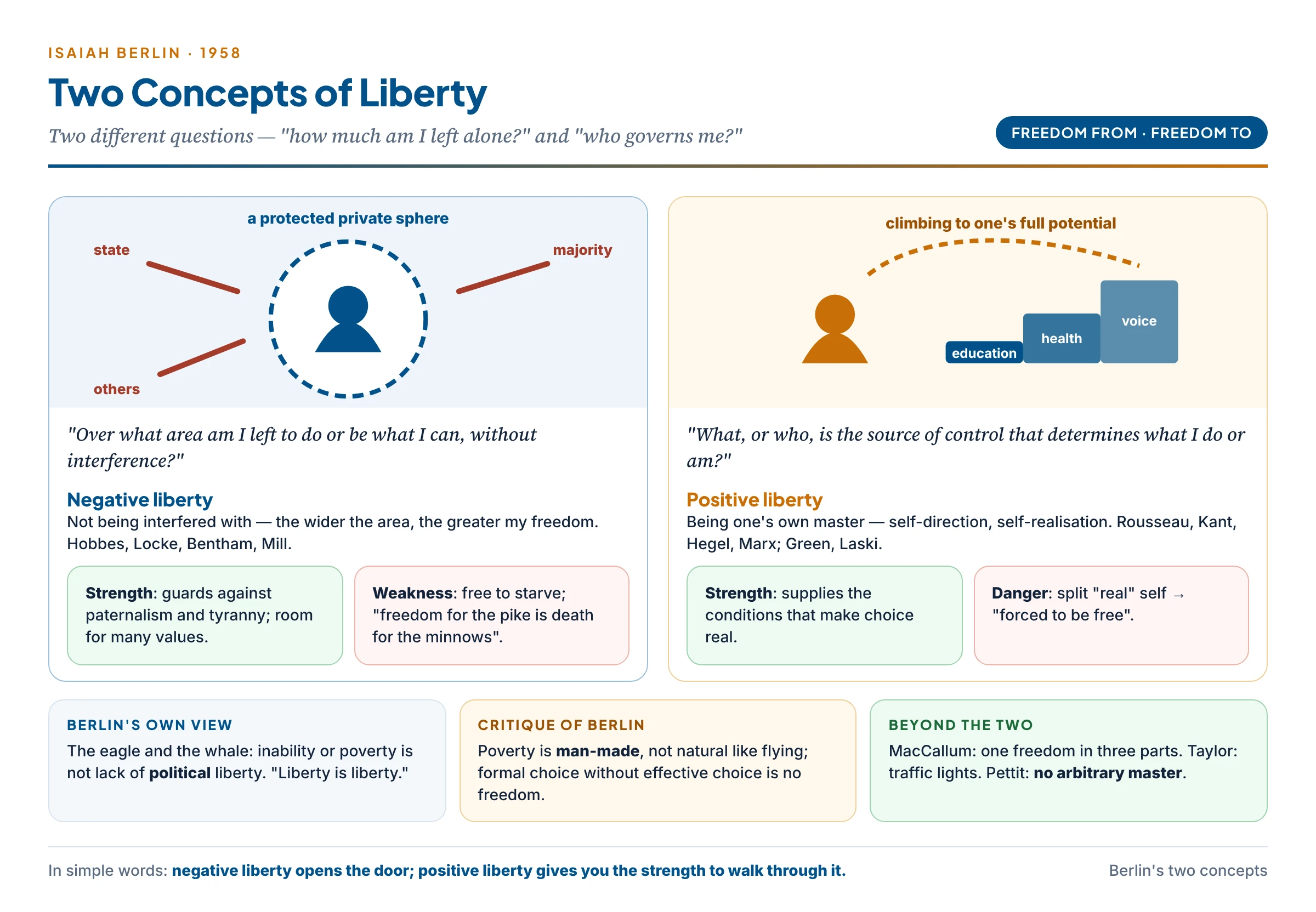
Isaiah Berlin‘s Oxford lecture is the most famous analysis of liberty. He distinguished two questions:
- Negative liberty — answers the question: “What is the area within which the subject is or should be left to do or be what he is able to do or be, without interference by other persons?”
- “By being free in this sense I mean not being interfered with by others. The wider the area of non-interference, the wider my freedom.”
- Associated with Hobbes, Locke, Bentham, Mill and classical liberalism.
- Positive liberty — answers the question: “What, or who, is the source of control or interference that can determine someone to do, or be, this rather than that?”
- It derives from the wish of the individual “to be his own master” — self-direction, self-mastery, self-realisation.
- Associated with Rousseau, Kant, Hegel, Marx and the idealists.
In simple words
A strict guardian says to a teenager: “Your real self wants to study medicine, not music; when I forbid music classes, I am only helping you become who you really are.” Berlin’s warning is exactly this: once someone claims to know your “true self” better than you do, he can coerce you in the name of your own freedom.
Berlin’s warning about positive liberty:
- The divided self. Positive liberty splits the self into a higher, rational, “real” self and a lower, empirical self of passions and desires.
- The larger self. The “real self” is then identified with something larger — a tribe, race, church, state or class, the “general will” of society.
- Forced to be free. Those who claim to know our “real” interests can then coerce us in the name of our own freedom — Rousseau’s phrase that a man may be “forced to be free“. This is how positive liberty has been twisted into totalitarian tyranny.
- The retreat to the inner citadel. Another form of positive liberty seeks freedom by eliminating desires one cannot satisfy — the Stoic, the ascetic, the quietist who becomes “free” by wanting nothing. Berlin sees this as a sublime but political retreat.
Berlin’s own position:
- The state can secure only negative liberty. Positive liberty depends on an individual’s own will and capacity, beyond the state’s scope; the capacity or incapacity to fulfil one’s desires belongs to the man himself.
- The eagle and the whale. “If I cannot fly like an eagle or swim like a whale, I am by no means deprived of political liberty.” Likewise, if a man is too poor to afford something that is not legally forbidden, he cannot say he has been deprived of political liberty.
- Liberty is liberty. “Everything is what it is: liberty is liberty, not equality or fairness or justice or culture, or human happiness or a quiet conscience.” Liberty must not be confused with its conditions or with other values.
- “Freedom for the pike is death for the minnows” — a phrase made famous by R. H. Tawney and repeated by Berlin: unrestricted liberty of the strong destroys the weak; so liberty must sometimes be limited for the sake of other values. Berlin admits the trade-off but insists we call it a loss of liberty, not a gain.
- Value pluralism. Human values are many and may conflict; no single formula reconciles them. This is why a wide area of negative liberty is needed — to let people choose among values.
Common confusion
Did Berlin reject positive liberty as worthless? No. Berlin accepted that both concepts express real human values, and that the desire to be one’s own master is noble. His warning was historical and political: positive liberty has been more easily perverted into justifications for tyranny, because it allows rulers to speak in the name of people’s “real selves”. He also admitted that negative liberty, unlimited, can produce great injustice (“freedom for the pike is death for the minnows”).
Critical estimate of Berlin:
- Moral and material spheres confused. In the moral sphere, a person alone is responsible for his choices; but in the material sphere, disabilities are often products of social arrangements that political action can change. Berlin treats poverty like the inability to fly.
- Formal vs effective choice. Choices may be formally unlimited but there is no freedom unless they are effectively available.
- Natural vs social limits. Berlin fails to distinguish natural limitations (flying like an eagle) from socio-economic limitations (poverty), which are human-made and removable.
- Equality distorted. By equating socio-economic inequality with natural and moral inequality, he projects a distorted view of equality.
Beyond the Dichotomy
- MacCallum’s three-part concept. Gerald MacCallum argued that there is really one concept of freedom with three parts: someone is free from some obstacle to do or become something. Negative and positive theorists simply stress different parts — the obstacles, or the doing.
- Charles Taylor: opportunity vs exercise.
- Negative liberty is an opportunity concept: freedom is what options are open to you.
- Positive liberty is an exercise concept: freedom is actually controlling your life.
- Traffic lights example: Britain has many traffic lights restricting movement; a dictatorship with few traffic lights but no freedom of religion imposes fewer restrictions in number. Yet no one thinks the dictatorship freer. We must weigh the significance of liberties — which means asking what matters for a human life, a positive-liberty question.
- Philip Pettit: republican liberty as non-domination.
- Freedom is not just non-interference but non-domination — not living under the arbitrary power of another.
- The kind master: a slave whose master never interferes is still unfree, because he lives at the master’s mercy. A citizen under a just law that interferes is not dominated.
- Pettit’s “eyeball test“: free citizens can look one another in the eye without fear or deference.
- This view helps explain why caste, patriarchy and bonded labour are unfreedom even when no one is being actively stopped.
Are “Freedom From” and “Freedom To” Mutually Exclusive?
- The case for exclusivity. Berlin’s warning: “freedom to” (self-realisation) can justify coercion that destroys “freedom from” (non-interference); libertarians say taxation for “freedom to” violates “freedom from”.
- The case against. They are two aspects of one freedom (MacCallum): every freedom is freedom from something to do something. Freedom from want, ignorance and fear is the condition of the freedom to choose a life; and freedom to participate in government protects freedom from arbitrary rule.
- Synthesis. They are complementary but in tension: too much stress on “freedom to” endangers individual rights; too much stress on “freedom from” leaves the poor with empty choices. A liberal democracy with fundamental rights and a welfare state tries to hold both.
Negative Liberty versus Positive Liberty: Ultimate Personal Freedom or Full Potential?
The 2026 paper asked whether negative liberty embodies the idea of ultimate personal freedom, while positive liberty enables individuals to achieve their full potential.
- Negative liberty as ultimate personal freedom:
- It marks out a private sphere no one may enter — conscience, speech, privacy, lifestyle.
- It treats the individual as sovereign over his own life (Mill) and as the best judge of his interests.
- It protects against paternalism and tyranny — no one may decide our “real” good for us (Berlin).
- But it may be empty without means; “ultimate” freedom for the strong can be ruin for the weak.
- Positive liberty as achieving full potential:
- It provides the conditions — education, health, income, participation — without which potential cannot be realised (Green, Laski, Sen’s capabilities).
- It aims at self-mastery — freedom from ignorance, addiction, superstition.
- It makes freedom equal in worth for all.
- But it risks paternalism: someone else defines “full potential” and enforces it.
- Synthesis. The two are not rivals but partners: negative liberty guards the space in which a person chooses; positive liberty supplies the capacity to use that space. The Indian Constitution reflects this: Part III guarantees negative liberties; Part IV and the dignity reading of Article 21 pursue positive liberty.
Critical Evaluation
Critics and Defenders
Criticism — Critics of negative liberty
- Matsya-nyāya: only the strong are free.
- Freedom without assurance of fulfilment.
- Formal choice: free to starve.
- Ignores internal constraints — ignorance, want.
- Mill’s line between self and others is blurred.
Defence — Defenders of negative liberty
- Guards the private sphere from state and majority.
- Berlin: no one may decide my “real self”.
- Value pluralism needs room for choice.
- Harm principle protects dissent and minorities.
- Shreya Singhal: speech curbed only at incitement.
Cross-Tradition Comparison
| Theme | Western thought | Indian thought |
|---|---|---|
| Freedom from | Hobbes: absence of external impediments; Mill’s harm principle | Freedom from bondage (bandhana); Articles 19–22 |
| Freedom to | Green, Laski: capacity to be one’s best self | Swarāj as self-rule; Article 21 read as life with dignity |
| Self-mastery | Positive liberty; Stoic inner freedom | Yoga’s control of the mind; Gītā’s sthitaprajña, the person of steady wisdom |
| Danger of the “real self” | Berlin: forced to be free | Gandhi: freedom imposed from above is not swarāj |
| Non-domination | Pettit: no arbitrary master | Ambedkar: caste as graded domination; Article 17, Article 23 (no forced labour) |
Indian Connect — Self-mastery in Indian thought
Indian traditions have always treated the deepest freedom as inner: the Gītā’s person of steady wisdom who is not driven by desire, Yoga’s mastery over the fluctuations of the mind, the Buddha’s freedom from craving. This resembles Berlin’s “retreat to the inner citadel” and positive liberty as self-mastery. Gandhi joined this inner freedom to political freedom: “swarāj” meant both self-rule of the nation and rule over oneself. The next article examines this idea, and freedom as mokṣa, in detail.
Synthesis (Siddhānta)
- Liberty has two faces: freedom from coercion and freedom to live a life of one’s choosing. Each without the other is incomplete.
- Liberty is not licence; it is regulated by the equal liberty of others, under an authority that is itself limited and legitimate.
- Mill gives the best defence of the private sphere and of free speech; Green and Laski show that freedom needs conditions; Berlin warns against tyranny in the name of the “real self”; Pettit adds that freedom means no arbitrary master.
- Contemporary relevance. Debates on free speech online, privacy and surveillance, internet shutdowns, reasonable restrictions, welfare rights and bonded labour are all debates about the balance of negative and positive liberty — a balance the Indian Constitution seeks through Fundamental Rights, Directive Principles and the dignity reading of Article 21.
“Freedom for the pike is death for the minnows.” — R. H. Tawney (quoted by Isaiah Berlin)
Previous Year Questions
- 2026Negative liberty seems to embody the idea of ultimate personal freedom, whereas positive liberty enables individuals to achieve their full potential. Discuss.
- 2016Is liberty a positive and equal opportunity of self-realization? Discuss.
- 2007Negative freedom can perhaps ensure freedom to choose, but without any credible assurance for its actual fulfillment.
- 2003Critically examine – “Freedom from” and “Freedom to” are mutually exclusive.
- 2000J.S. Mill on Liberty. (Short notes)
- 1997Write critical notes on Liberty. (Short notes)