

Social and Political Ideals: Equality, Justice, Liberty.
Official Syllabus: Paper II, Section A, Unit 1
Rawls’s A Theory of Justice rests on three central features: (1) an account of how to think about justice — from the original position, behind the veil of ignorance; (2) an account of the relation between the individual and the community — the individual comes prior to the community and its ends; and (3) the two principles that individuals would choose. In the 1970s and 1980s each of these features came under attack. Communitarians — Michael Sandel, Alasdair MacIntyre, Michael Walzer and Charles Taylor — said Rawls’s self is an empty, “unencumbered” chooser cut off from community, and that his universal principles ignore the shared meanings of real societies. Feminists, led by Susan Moller Okin, said his theory left the family — the first school of justice and injustice — outside its scope. Marxists and G. A. Cohen said liberal justice makes peace with capitalism and lets the talented demand unequal rewards. Other critics questioned the hypothetical contract, the risk-averse chooser, and the place of disabled people in a theory of cooperation. This article sets out each critique with the liberal replies, and ends with Rawls’s own answer in Political Liberalism (1993).
In simple words
Rawls asks us to imagine ourselves without our religion, caste, family, language and life-plans, and then choose rules. A communitarian asks: who is left once all that is stripped away? A woman asks: what about the kitchen and the nursery, where the rules of “fairness” were never applied? These questions are the heart of the critiques of Rawls.
Context & Problem
Liberalism and Its Critics
- What communitarians share. Human beings are social beings; their identity is formed by communities — family, nation, religion, tradition. A political theory must begin from shared values and the common good, not from isolated individuals and their rights.
- What they attack. Liberal individualism: the idea that the individual is prior to society, chooses his own ends, and that the state should be neutral among conceptions of the good.
- The main texts. Sandel, Liberalism and the Limits of Justice (1982); MacIntyre, After Virtue (1981) and Whose Justice? Which Rationality? (1988); Walzer, Spheres of Justice (1983); Taylor, “Atomism” (1979) and Sources of the Self (1989).
- The issue at stake. Is justice the first virtue of society, as Rawls said — or is it a remedial virtue, needed only where community has broken down?
Core Doctrine
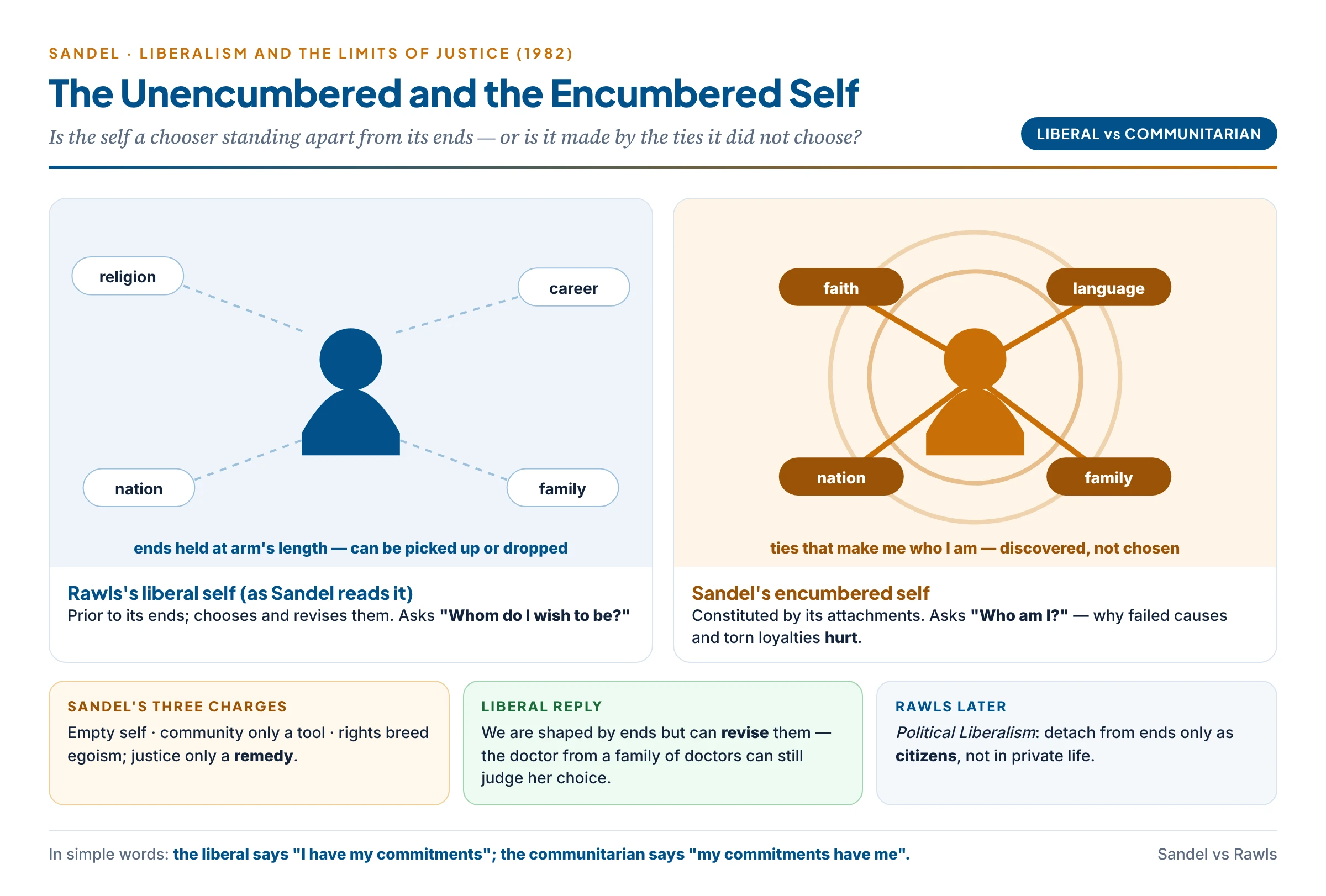
Sandel’s Critique I: The “Unencumbered Self”
Sandel’s claim. Rawls’s theory rests on a particular conception of the self, which is implausible and not neutral.
- The self prior to its ends. Rawls’s self is entirely prior to its ends — goals, attachments, commitments — which it merely “has” and can choose or drop. Sandel calls this an unencumbered self. But that is not how we see ourselves:
- When I talk about myself, I do not see a disembodied chooser; I see someone located in time and place, in a network of deep relationships that matter to me.
- I identify with my ends; they are part of who I am. They could not be part of me if I were entirely prior to them.
- We do not choose our ends; we discover them. Rawls’s voluntaristic conception (ends are chosen) is wrong. Instead of asking “Whom do I wish to be?“, we should ask “Who am I?” — and find the answer in the communities that made us.
- Example: failed causes. When a political cause we deeply believe in fails, or a close relationship breaks, we do not merely feel that a goal was not met — we feel shaken to the core, as if we ourselves had failed. An unencumbered self cannot explain this.
- Example: torn loyalties. We feel torn between commitments to family, friends and country. If we could simply choose among them, choosing would be easy and painless. That it is painful shows the commitments are constitutive of us.
- Liberalism is not neutral. If the liberal self is an autonomous chooser of its ends, then a liberal state will favour ways of life that are reflectively chosen over those held through tradition and community — so its claim to be neutral between conceptions of the good is doubtful.
The liberal reply:
- Rawls does not deny that we are constituted by our ends. He claims only that we have the capacity to revise them. We may be unable to think of ourselves with no ends at all, but we can certainly imagine having different ends in five years.
- Example: an ultra-orthodox woman may be unable to imagine her life taking a different path — but that is likely due to her social conditioning and education. What matters is that people can, under the right conditions, revise their ends.
- Influenced is not determined. Our choices are shaped by family and society — nobody denies this. But we can step back and evaluate them.
- Example: a woman knows she chose medicine partly because she comes from a family of doctors, yet she can have independent reasons for thinking it a good and worthy choice.
- Commitment is not passive acceptance. The liberal view actually makes better sense of the value of commitment: a commitment one could revise but chooses to keep is worth more than an attachment one has never examined.
- Sandel must say either that people lack the capacity to revise their ends (false), or that they should not be encouraged to use it — which is an illiberal and paternalist position.
Sandel’s Critique II: The Individual and the Community
Sandel’s claims:
- Community as a mere instrument. The liberal individual is self-interested and values community only instrumentally, as useful for his own interests. Rawls’s own description of society as a “scheme of social cooperation” for producing and sharing benefits and burdens shows this — a thin picture compared with richer ideas of communal life.
- No unchosen obligations. The liberal accepts only obligations he has voluntarily taken on — the logic of the social contract. But in the family this makes no sense: we do not choose our obligations to our parents, and we cannot legitimately walk out of our commitments to our children.
- Retreat into private life. The liberal individual is under no duty to take an interest in the political and social life of the community — a poor account of citizenship.
The liberal reply:
- Rawls’s contract is not Hobbes’s or Locke’s. In Hobbes and Locke people contract in their own interest to escape the state of nature. In Rawls, the parties behind the veil choose principles because they are just, not because they serve a known interest. The point of the contract is to find just principles.
- Liberals accept unchosen obligations — such as those to elderly parents — but deny that they require sacrificing all our important ends. The real disagreement is about the content of such obligations, not their existence. (Would Sandel say that a parent is morally obliged to face certain death to rescue a child?)
- Community is valued, not merely used. Rawls says people form associations — religious, cultural, professional — as part of their conception of the good. A just society is “a social union of social unions“. Liberals value political participation; they only deny that the state should impose one way of life as the only worthwhile one. Sandel, by contrast, wants the state to promote the community’s way of life.
- The original position need not be individualistic. Rawls imagined the parties as representatives of families; nothing stops them from representing communities too, as Rawls later allowed in The Law of Peoples (1999).
Sandel’s Critique III: Rights and Justice
Sandel’s claims:
- Rights fail to promote community values. Under strong free-speech rights, a community that finds pornography degrading may be unable to restrict it. Why should the individual’s right to publish anything outweigh the community’s values?
- Rights breed an individualistic, egoistic ethos. People who see themselves mainly as rights-bearers assert their rights at the first opportunity and become confrontational instead of conciliatory.
- Justice is only a remedy. Rights and justice are needed only where community has failed. If people were united by shared understandings, rights and justice would be unnecessary — as in a loving family. We should build shared understandings, not rely on rights.
The liberal reply:
- Rights build communities. Political rights — to speak, assemble and participate — are how communities form and shape their values. National communities won statehood by asserting such rights.
- Rights are compatible with care. Most of the time families and friends care for each other without invoking rights. Rights matter for the cases where relationships break down: children’s rights do not replace parental love; they protect the child when parents fail. Spouses’ rights do not deny that marriage should be loving; they give redress when the marriage collapses.
- Disagreement is normal, not a defect. Even a close, fraternal community will disagree — on dividing resources, on cloning, abortion or immigration. That such disagreements need principles of justice does not show the community is flawed — unless all diversity is bad.
MacIntyre: Virtue, Narrative and Tradition
- The moral crisis. In After Virtue, Alasdair MacIntyre argues that modern moral debate is interminable — rights against utility, liberty against equality — because we have lost the shared framework of the virtues and the common good that gave moral words their meaning.
- The narrative self. A person’s life is a story (narrative), and I can answer “What am I to do?” only if I can answer “Of what story or stories do I find myself a part?” — as someone’s son or daughter, a member of this town, this nation, this tradition.
- Justice depends on tradition. In Whose Justice? Which Rationality? he argues that there is no tradition-free, universal reason. Each tradition (Aristotelian, Augustinian, liberal) has its own conception of justice. Liberalism is itself a tradition, not a neutral standpoint.
- Against Rawls (and Nozick). Both leave out desert and the virtues — the idea that people should receive what they deserve by their contribution to a shared way of life.
Taylor: Against Atomism
- Atomism. Charles Taylor criticises the “atomist” view that individuals are self-sufficient and that rights come before society.
- The social thesis. Human capacities for autonomy and choice can develop only within a society — a language, a culture, institutions. So asserting rights to autonomy commits us to sustaining the society that makes autonomy possible.
- Recognition. In “The Politics of Recognition” (1992), Taylor argues that identity depends on recognition by others; misrecognition (treating a culture as inferior) is a real harm. This opens the way to group rights for cultural communities.
Walzer’s Critique I: Particularism versus Universalism
- Two concerns. Walzer (Spheres of Justice, 1983) asks (a) how to think about justice and (b) how to distribute goods.
- Rawls’s universalism. Rawls’s principles, chosen without knowing one’s culture, claim to apply to all individuals and societies.
- Walzer’s particularism. A society is just if its life is lived “in a way faithful to the shared understandings of its members”. Justice is rooted in the distinct understandings of places, honours, jobs and things that make up a shared way of life; to override those understandings is to act unjustly.
- Why particularism? We are one another’s equals as producers of social meanings. To respect each other as such is to respect people’s opinions and not to impose on them a conception of life with which they do not identify.
- Examples: ancient Athens used public funds for some goods and not others according to its own conception; a caste society distributes goods according to its own understanding of caste. If its members accept that understanding, Walzer asks, who are we to say they are wrong?
- Implication: justice across borders is hard to conceive, since different national communities have different conceptions.
The universalist liberal reply:
- Respecting opinions is not making them right. We can respect people’s opinions and still think justice demands certain arrangements. Many liberals think capital punishment is unjust while respecting a society’s decision to keep it; the decision is respected, not thereby made just.
- “We are one another’s equals” is itself contested. Many cultures have denied that all human beings have equal moral status — slave-owners, racists, those who treat some people as untouchable or women as inferior. If Walzer can hold equality to be true though not universally held, why not other universal principles — that everyone’s basic needs should be met (so Athens was unjust to leave the poor without relief), or that the caste system is unjust?
- Inconsistency. Walzer says a community “by definition” does not let its members starve, and so the British, by letting the Irish starve in the 19th-century potato famine, showed they did not see the Irish as part of their community. But many communities have let some members starve; on what ground can he criticise them? He also says guest workers should be granted citizenship rights — a universal principle, argued without reference to the host country’s shared meanings.
- Relativism. Like all relativist theories, Walzer’s must explain why some practices are acceptable and others not. It clashes with deep intuitions — slavery is wrong even where accepted. And communities are not homogeneous: some members think women are second-class citizens, others do not. Either we cannot adjudicate between them (and the critic has no role), or we need a standard outside shared meanings. As Okin notes, “shared understandings” are usually those articulated by the privileged — the dominant race, class and gender.
Walzer’s Critique II: Complex Equality and the Spheres of Justice
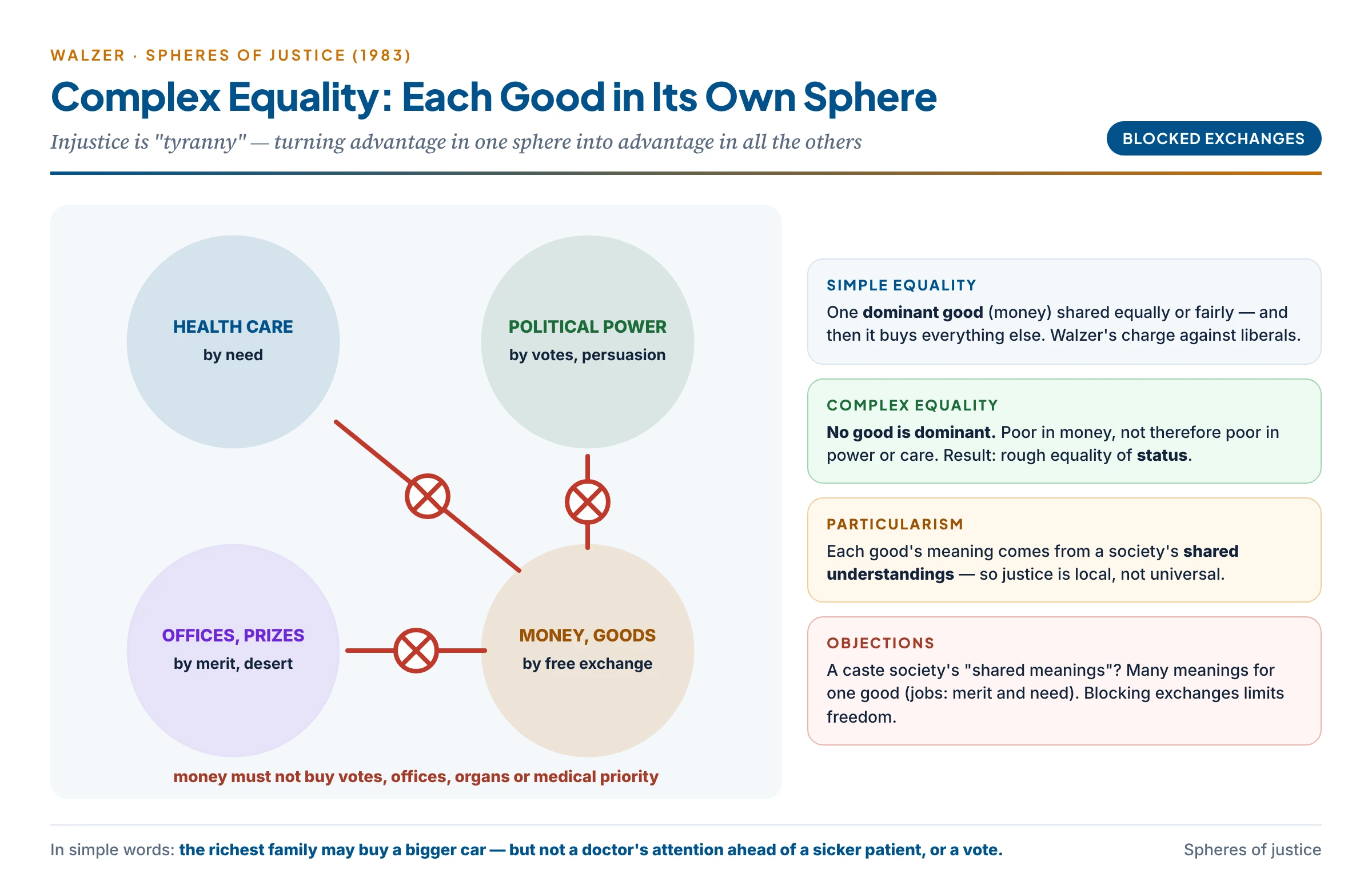
- Different goods, different principles. Goods — membership, security and welfare, money and commodities, offices, hard work, free time, education, kinship and love, divine grace, recognition, political power — have different social meanings, and so belong to different spheres with different distributive principles (need for health care, desert for prizes, free exchange for commodities, democratic election for power).
- Simple equality (Walzer’s term for what Rawls and most liberals defend): one dominant good — usually money — is shared out equally or fairly, and it buys everything else.
- Complex equality: no good is dominant. Being worse off in one sphere (money) must not make me worse off in another (health care, political power).
- Blocked exchanges: what money cannot buy — votes, public offices, organs, court verdicts, honours, love, basic health care.
- Tyranny, for Walzer, is the conversion of advantage in one sphere into advantage in another — wealth buying office, office buying wealth.
- Result. Some will do better in one sphere, others in another, and so all will enjoy roughly equal social status.
In simple words
Think of a school. The best footballer wins the sports trophy; the best student wins the academic prize; the most helpful student is chosen class monitor by vote; and medical care in the infirmary goes to whoever is ill. It would be unjust if the richest boy’s father could buy the trophy, the prize, the monitor’s badge and the first place in the infirmary queue. Walzer’s complex equality keeps each good in its own sphere.
Assessing complex equality:
- Its appeal. It captures a common intuition: one attribute should not decide every dimension of life.
- A feminist edge — and a tension. From a feminist view, gender is exactly such an attribute: it shapes access to money, power, jobs and even love. So complex equality calls for radical change in most societies. But this is in tension with Walzer’s respect for shared understandings, since those understandings are mostly shaped by dominant males and work against women.
- Objections:
- No real alternative to simple equality. Agreeing that some goods are not for sale (votes) does not require Walzer’s theory. With health care, what we really object to is unequal access; we think individuals should have equal access whether or not they use it — not that health care has some inherent meaning.
- One good, many meanings. In liberal democracies, a job means a reward for merit but also a source of self-respect and livelihood — suggesting need. Complex equality does not tell us which meaning to follow.
- Cross-sphere principles. Some moral ideas cut across spheres — such as individual responsibility: some say a person whose illness results from his own choices (heavy smoking) has a weaker claim to scarce medical care. Walzer’s separation of spheres cannot account for this.
- When does equality exist? If some people outrank others in most spheres — high marks, good jobs, honours — the result is not equality of status. Walzer would answer that exchanges between spheres must be blocked; but blocking is often unfeasible (good degrees do lead to good jobs) and restricts individual freedom.
The Feminist Critique: Okin and the Family
Susan Moller Okin (Justice, Gender, and the Family, 1989) argued that Rawls’s theory is not sensitive enough to gender and the family — but that, read through these lenses, it is more radical than it first appears.
Gender:
- Language and assumptions. Rawls always writes “he”, “him”, “his”. More deeply, he describes the parties as fathers concerned for their sons, implying that politics is men’s business while the family is women’s.
- The veil hides sex. Rawls later said the parties do not know their sex. Then, being risk-averse, they would never choose rules that systematically disadvantage one sex — which calls into question the entire gender system on which most societies are organised (from political rights to workplace practices and family roles).
- Can we think away gender? Some argue gender is too much a part of who we are to be “set aside” behind a veil — a communitarian-style objection.
- Gender-neutral laws can discriminate. Suppose a law pays anyone — man or woman — who stays at home to look after young children a pensionable salary equal to the minimum wage. The law is neutral, but under present social expectations mostly women will take it up and remain economically dependent. Formal neutrality does not remedy gender discrimination.
- Marriage is a basic institution. Rawls might say income division between husband and wife is a private choice outside justice. But for Rawls justice applies to the basic structure because its effects are profound and present from the start — and marriage and the family are exactly such an institution.
In simple words
Two children grow up in the same street, go to the same free school and sit the same exam — “equal opportunity”. But at home, one is expected to fetch water, cook and look after younger siblings before studying, while her brother is told his only job is to study. The rules outside the house are fair; the rules inside it are not. Okin’s point is that justice that stops at the front door cannot deliver equal opportunity.
The family:
- Heads of households. Rawls’s parties represent households — in his time, typically the husband and father — assuming he would represent all members fairly. Why should all adults not be present?
- Justice stops at the door. Rawls applies principles of justice to people as economic and political agents, not to the distribution of burdens and benefits within the family. This ignores those — mostly women — whose labour for husbands, children and the elderly is unpaid.
- The family shapes opportunity. What happens in the family deeply affects children’s opportunities. A child raised with strict ideas of proper jobs and proper education for boys and girls cannot take up the opportunities formally offered; pressures against the parents’ wishes may amount almost to coercion.
- The first school of justice. If children are to develop a sense of justice, as Rawls hopes, the family itself must be just. “The personal is political.”
Indian Connect — The family as a school of justice in India
Okin’s critique has special force in India. Much of women’s unpaid care work remains invisible in national accounts; son preference and dowry show how family norms shape life-chances before birth; and laws on inheritance and personal matters long treated daughters unequally. The Hindu Succession (Amendment) Act, 2005 gave daughters equal coparcenary rights in joint family property, and the Supreme Court in Vineeta Sharma (2020) held that this right belongs to daughters by birth. These reforms apply principles of justice inside the family — exactly what Okin demanded of Rawls.
The Marxist Critique
- Justice within capitalism. Rawls’s theory is liberal, distributive and procedural: it seeks justice within the framework of capitalism. For Marxists, capitalism cannot be reformed into justice; it can only be replaced, since exploitation lies in production, not merely in distribution.
- Formal liberty. Equal basic liberties mean little to workers who lack the means to use them.
- The veil is empty. Real people are shaped by class; deliberations behind a veil that removes class are meaningless and hide real conflicts of interest.
- Collectivist critique. Rawls provides a justification for existing capitalist systems — a more humane face for an unequal order.
G. A. Cohen: Incentives and the Personal Is Political
- The incentive argument questioned. The difference principle allows inequalities that benefit the worst-off — but why are they needed? Because, Rawls says, the talented will not work to full capacity unless paid more.
- Cohen’s objection. In a just society, everyone accepts the principles of justice and lives by them. If the talented truly believed that unnecessary inequalities are unjust, they would work to full capacity without demanding extra pay. Then society could have an arrangement better for the worst-off than the incentive society — the talented work hard for equal pay. The “necessity” of incentives exists only because the talented choose to demand them.
In simple words
A brilliant surgeon tells the government: “I will work full hours only if you pay me five times what a nurse earns.” The extra pay may well help the poor — because without it she would work less. But Cohen asks: if the surgeon herself believes in equality, why does she make the demand at all? The inequality is “necessary” only because she chooses to make it necessary.
- Rawls’s reply. Principles of justice apply to the basic structure — to choices that can be legally enforced — not to people’s uncoerced choices in the market.
- Cohen’s rejoinder. The basic structure is defined as institutions with a profound effect on people’s lives — and the market is one of them. So justice must reach personal conduct too: to be just is not only to obey laws that implement just principles, but to live up to those principles in one’s private conduct. The title of one of his essays asks the egalitarian: “If you’re an egalitarian, how come you’re so rich?“
Other Criticisms
- The hypothetical contract (Dworkin). “A hypothetical contract is not simply a pale form of an actual contract; it is no contract at all.” Example: yesterday you would have sold me your painting for ₹100; today you discover it is worth ₹1,000. That you would have agreed yesterday does not oblige you today.
- Rawls’s reply: unlike Hobbes and Locke, for whom the contract creates the obligation (to keep the peace), Rawls’s contract is a device for discovering what justice requires; the obligation comes from the principles being just. So the objection misses its target — but it teaches us what the original position is for.
- Risk aversion. Rawls assumes the parties avoid risks and so choose maximin. But many people gamble and take risks regularly; why assume extreme caution?
- Reciprocity and exclusion. Rawls sees society as a cooperative venture: if I contribute and you benefit, you should contribute too. Two problems:
- Non-contributors — the severely mentally or physically disabled — fall outside the scope of justice. (Martha Nussbaum‘s Frontiers of Justice, 2006, presses this, along with justice across nations and towards animals.)
- Does everyone benefit? A religious fundamentalist gains little from a tolerant society; a very talented or very rich person might gain more under rules that reward natural and social advantage. Why should they abide by the principles, or even stay? If self-interest guides people behind the veil, it can guide them once the veil is lifted.
- State neutrality. Rawls’s first principle supports a neutral state — no established church, no favouring of one way of life. But:
- Is a law recognising marriage only between a man and a woman neutral? It privileges one form of partnership.
- If a minority religion needs extra funds to maintain its places of worship, does neutrality require giving it, or forbid it? Neutrality in rights may need non-neutrality in resources.
- Priority of liberty questioned. Would people really choose liberty first? Many might care more about their standard of living than about civil liberties; in many countries outside the West, people might rank something like the difference principle above the liberty principle.
- Choice and responsibility. The difference principle does not distinguish inequalities due to bad luck from those due to choices. Example: I turn my land into a tennis court hoping to become a professional player, though I have no other income; you grow fruit and vegetables and prosper. Years later I am poorer than you. Should you be taxed to help me? I chose the risk. (This line of thought leads to “luck egalitarianism” — see the Equality article.)
- Sen’s critique — primary goods ignore differences in converting goods into well-being; the search for a perfectly just society is unnecessary — is treated in the next article.
Common confusion
Do the communitarians reject justice and rights altogether? No. Sandel, Walzer, MacIntyre and Taylor do not say justice is unimportant or that rights should be abolished. They deny that justice is the first virtue in Rawls’s sense, that rights are prior to the common good, and that principles can be worked out apart from the shared life of a community. Walzer even calls his book a theory of justice and of equality — “complex equality”. The dispute is about the basis and scope of justice, not its existence.
Critical Evaluation
Rawls’s Response: Political Liberalism
In Political Liberalism (1993), Rawls revised the presentation of his theory in ways that answer some communitarian concerns:
- Political, not metaphysical. Justice as fairness is a political conception, not a comprehensive moral or metaphysical doctrine. Its conception of the person — free and equal citizen able to revise his ends — applies only in the political domain: in public life citizens can detach from their ends; in their private lives as parents, churchgoers, workers and members of associations they need not. This political conception is compatible with many comprehensive doctrines about what persons really are.
- Not universal, but democratic. The theory does not claim to hold for all times and places; it works out the fundamental shared ideas of a democratic political culture. In this sense it is sensitive to the shared understandings of a given society — moving closer to Walzer. (Whether all societies should become democratic is a separate question.)
- Communal goods valued. A well-ordered society values political participation; citizens are united around the shared goal of realising justice.
- Reasonable pluralism and overlapping consensus. Free institutions inevitably produce a plurality of reasonable comprehensive doctrines (religious, philosophical, moral). Justice must be one that citizens holding different doctrines can each endorse from within their own view — an overlapping consensus — and political debate must use public reason, arguments others can accept. A well-ordered society (one effectively regulated by a public conception of justice that all accept) is therefore possible only as an overlapping consensus, not as agreement on one whole philosophy of life.
The communitarian rejoinder:
- Metaphysics cannot be avoided. In questions such as abortion and bioethics, we must know what a person is before we can decide whether a foetus is a person. Since these questions concern what the law should say, they fall within a theory of justice; so it cannot avoid metaphysical assumptions.
- Divided selves? Rawls draws a sharp line between the personal and the political: detach from your ends in politics, keep them in private life. Can people really behave so differently in the two domains?
- Civic humanism. Rawls values political goods but insists the good life need not be the political life; communitarians who hold the civic-humanist ideal (that political participation is part of the highest human good) remain unsatisfied.
Assessing the Debate
- What liberals learned. Sandel’s critique forced liberals to be clearer about the role of community; they developed accounts of rights that explain the importance of political participation.
- What Walzer showed. Principles of justice depend partly on social context, and different goods may need different principles.
- The narrowing gap. Once Rawls conceded that some disagreements are reasonable, the difference between communitarians and non-absolutist liberals became one of which principles are universal, not whether any are. Some critics even say Political Liberalism turned Rawls into a kind of communitarian; others say it abandoned the ambition of A Theory of Justice.
- “Fewer differences than similarities”? Both sides value community and individual freedom; they differ in priority and in how far the state should promote a way of life.
Critics and Defenders
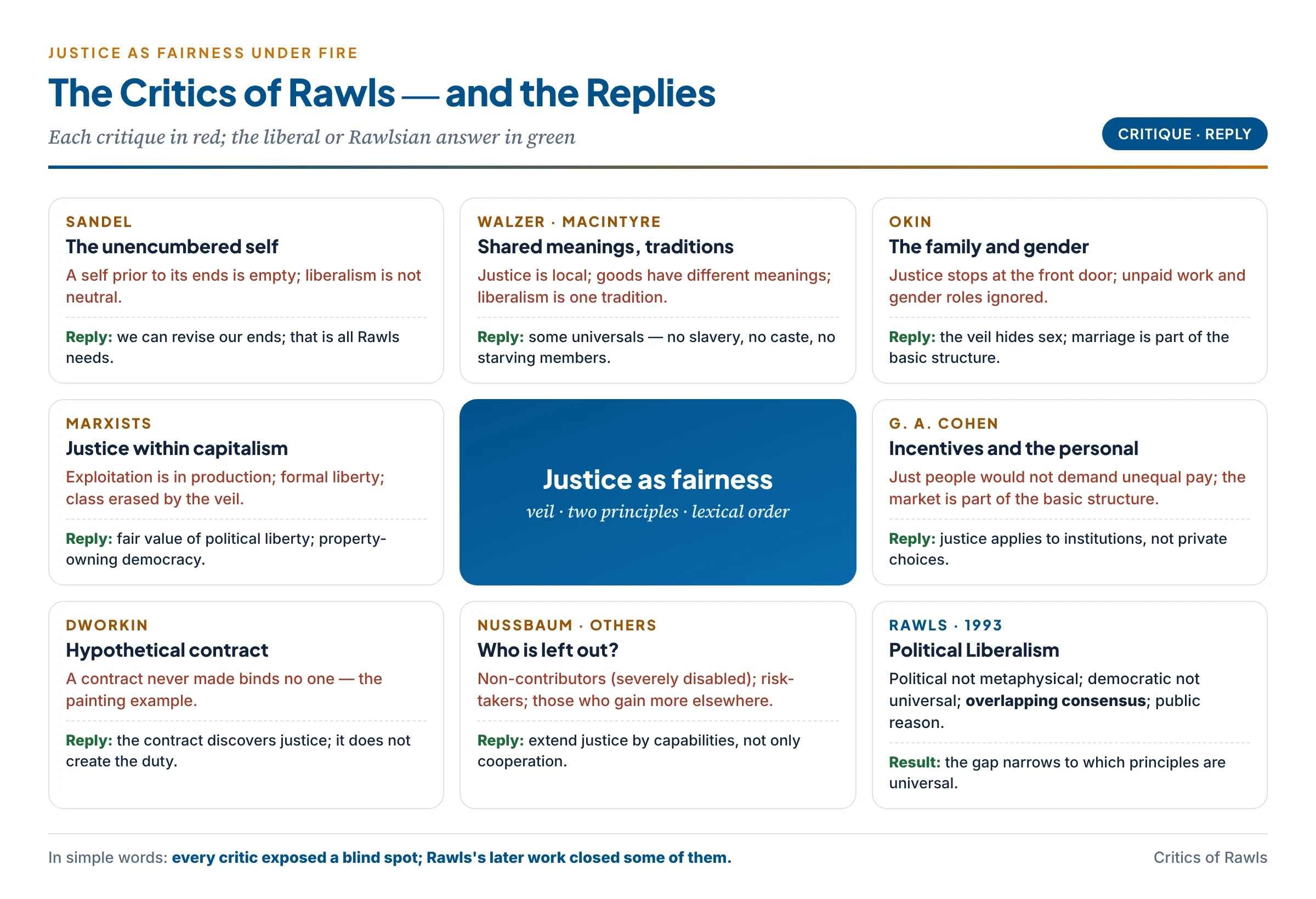
Criticism — Critics of Rawls
- Sandel: unencumbered self; rights over community.
- MacIntyre: justice depends on tradition and virtue.
- Walzer: particular meanings; complex equality.
- Okin: family and gender left outside justice.
- Marxists, Cohen: capitalism, incentives, the personal.
- Dworkin, Nussbaum: hypothetical contract; disabled excluded.
Defence — Liberal replies and Rawls’s defence
- Capacity to revise ends, not an empty self.
- Unchosen obligations accepted, within limits.
- Rights protect when relationships break down.
- Universal minimums condemn caste and slavery.
- Political Liberalism: overlapping consensus.
- Veil hides sex: the theory can reach the family.
Cross-Tradition Comparison
| Theme | Rawls (liberal) | Communitarians | Indian thought |
|---|---|---|---|
| The self | Unencumbered chooser who can revise ends | Encumbered, narrative, constituted by community | Self embedded in family, jāti, dharma — yet the Upaniṣadic and Buddhist self seeks freedom from all such ties |
| Priority | Right before the good; rights first | Common good first | Dharma — duties first; Gandhi: rights flow from duties |
| Universal or particular | Universal (early), democratic (later) | Particular, tradition-bound | Sādhāraṇa dharma (universal duties) and viśeṣa dharma (duties of station) |
| Family | Outside the basic structure (early) | A community of love, prior to justice | Joint family; reforms from the codification of Hindu law in the 1950s to the 2005 inheritance reform |
| Group life | Neutral state; voluntary associations | Recognition of communities | Articles 25–30: religious and cultural rights of communities |
Indian Connect — Gandhi: rights from duties
Gandhi wrote to UNESCO in 1947 that he learned from his illiterate but wise mother that “all rights to be deserved and preserved came from duty well done“. Like the communitarians, he rejected the idea of the isolated rights-bearer; the self is bound to family, village and humanity by duties. But unlike Walzer’s acceptance of shared meanings, Gandhi used moral reason and non-violent struggle to reform the shared meanings of his own society — most of all untouchability — showing that respect for community need not mean accepting its injustices.
Synthesis (Siddhānta)
- The critiques improved Rawls. Sandel exposed the thinness of the “unencumbered self”; Walzer showed that justice must respect the different meanings of goods; Okin carried justice into the family; Cohen showed that justice concerns personal conduct as well as institutions; Nussbaum widened its scope to the disabled.
- The liberal core survives. People can revise their ends; rights protect individuals when community fails; and some principles — against slavery, caste, the starvation of members — must be universal, or justice becomes a mirror of whatever a society already believes.
- A balanced position joins the liberal priority of basic rights with the communitarian insight that identity, solidarity and fraternity matter. The Indian Constitution reflects such a balance: individual Fundamental Rights, community rights for minorities and cultures, and the state’s power to reform unjust community practices (Articles 15, 17, 25(2)).
- Contemporary relevance. Debates on uniform civil code and personal laws, minority rights, gender justice in the family, and commodification of health and education are living versions of the liberal–communitarian–feminist debate.
Previous Year Questions
- 2016A well-ordered society, according to Rawls, is effectively regulated by a public conception of justice. Do you agree? Give reasons.
- 2011Can issue relating to gender discrimination be met by the conception of justice as fairness? Discuss.
- 2007According to some liberal political thinkers, social and economic inequalities can be justified only if they work to the advantage of the least advantaged members of the society. Is this view consistent with the liberalism’s cardinal advocacy of individual freedom? Discuss.