

Social and Political Ideals: Equality, Justice, Liberty.
Official Syllabus: Paper II, Section A, Unit 1
Justice is the ideal that decides who gets what, and why — which benefits and burdens each person should receive, and on what ground. Liberty and equality often pull in different directions: complete liberty lets the strong swallow the weak, while forced equality can crush individual effort. Justice is the ideal that settles such conflicting claims by giving each person his due. This article explains what the word means, why societies need justice at all, the two great classical theories — Plato’s justice as harmony and Aristotle’s justice as proportional equality — and the modern kinds of justice: legal, political and socio-economic, procedural and substantive, retributive and distributive, and the three rival principles of rights, desert and need. Later articles in this unit build on this base: Rawls, Nozick, the critics of Rawls, Sen, and finally liberty and equality.
In simple words
Three children want one cake. One says, “I baked it.” Another says, “I am the hungriest.” The third says, “Our mother promised it to me.” Each claim sounds reasonable, and they cannot all be fully met. A rule that decides fairly among such claims — and that all three can accept — is what we call justice.
Context & Problem
Meaning of Justice
- The word. “Justice” comes from the Latin justitia, built on jus — right or law. The Roman lawyers defined it as “the constant and perpetual will to render to each his due” (suum cuique tribuere). The idea of “giving each his due” runs through almost every theory of justice; theories differ on what is due and why.
- Justice as synthesis. Justice is often described as the ideal that synthesises conflicting claims — for example, the claim of liberty and the claim of equality. It does not pick one value and throw the other away; it finds the right balance between them.
- Modern meaning. Today justice is mainly about the allocation of benefits and burdens in a society — income, jobs, education, health care, political power, taxes, punishments.
- Indian terms. Classical India spoke of ṛta (the cosmic order), dharma (right conduct and duty, including the king’s duty to protect), nyāya (just judgement, realised justice) and daṇḍa (the rod of punishment that prevents disorder). The law of karma was understood as a moral law of justice in the universe: every act brings its due result.
Common confusion
Does “justice” come from a Latin word meaning “to synthesise”? No. Many notes say the word “justice” comes from a Latin word meaning “synthesise”. It comes from jus — right or law (some writers also connect it with jungere, “to join”). What is true is the idea behind that phrase: justice joins together or reconciles competing claims such as liberty and equality.
Why Do Societies Need Justice?
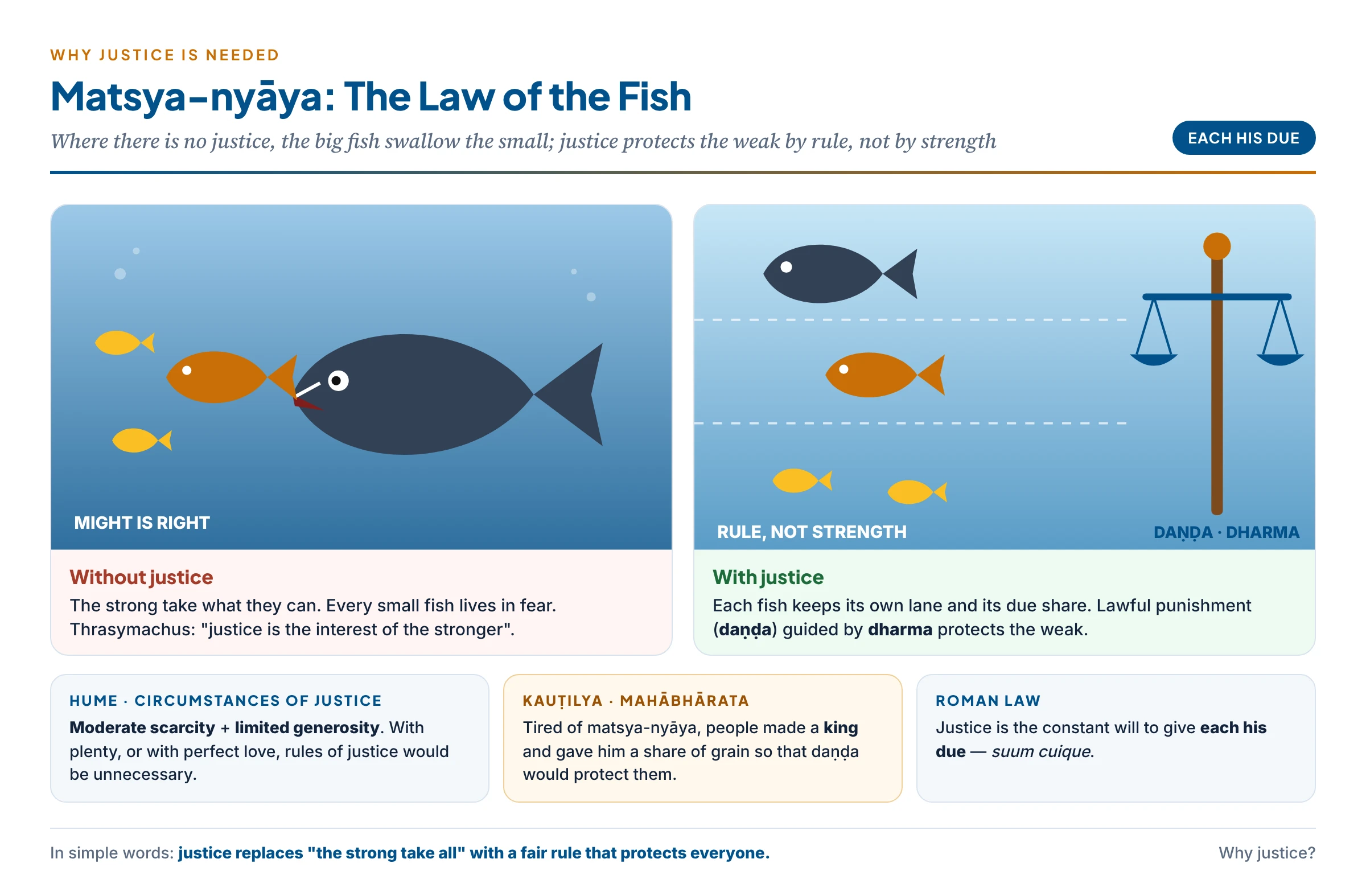
- Two conditions make justice necessary. David Hume called them the circumstances of justice:
- Moderate scarcity — there is not enough of everything for everyone to have all they want, but not so little that cooperation is pointless.
- Limited generosity — people care mostly for themselves and their own, not equally for everyone.
- Where justice has no work to do. If goods were unlimited, or if everyone loved others as much as themselves, nobody would need rules about shares. Some systems also leave no room for a search for justice:
| System | How goods are allocated | Why the question of justice does not arise |
|---|---|---|
| Purely authoritarian | By the command of the established authority | The ruler’s word settles everything; no one may question it |
| Purely competitive | By the free play of market forces | Whatever the market yields is simply accepted |
| Hypothetical communist society | “To each according to need” in a world of plenty | With abundance, there is nothing to dispute |
- So the search for justice belongs to an open society under scarcity — a society where people may question the rules and where goods are limited.
Indian Connect — Matsya-nyāya: the law of the fish
Indian political thought described the condition without justice as matsya-nyāya — “the law of the fishes”, in which the big fish swallow the small. Kauṭilya’s Arthaśāstra and the Mahābhārata (Śānti Parva) say that people, tired of matsya-nyāya, made a king and agreed to pay him a share of their produce so that daṇḍa (lawful punishment) would protect the weak. Justice is thus the opposite of “might is right”.
From Ancient to Modern Views
- Ancient (classical) view. For Plato and Aristotle, justice was a virtue — of the soul and of the city. It meant dutifulness, harmony and right order. Inequality of classes was taken for granted.
- Medieval view. Justice was tied to divine law and natural law (Aquinas) — the order God gave the world.
- Modern view. Justice became a question of rights and fair distribution among free and equal citizens. It is now discussed as legal, political and socio-economic justice, and since the 1970s mainly through the debate between Rawls, Nozick, the communitarians and Sen.
Core Doctrine
Plato’s Theory of Justice
Plato, in the Republic, asks, “What is justice, and is the just person happier than the unjust?” Plato answers by first rejecting three popular definitions and then building an ideal city.
Three rejected definitions:
- Cephalus — justice is telling the truth and paying one’s debts. Plato’s reply: if a friend lends you a weapon and later, in a fit of madness, asks for it back, returning it would not be just. A fixed rule cannot be the definition.
- Polemarchus — justice is giving each his due, which means helping friends and harming enemies. Plato’s reply: harming anyone makes him worse, and a just person cannot make anyone worse; and we often mistake who our friends are.
- Thrasymachus — justice is the interest of the stronger: rulers make laws for their own benefit and call obedience “justice”. Plato’s reply: a true ruler, like a true doctor or a ship’s captain, works for the good of those in his care, not for himself.
- Glaucon’s challenge. Glaucon restates the problem: perhaps justice is only a compromise (a social contract) — people agree not to harm each other because they fear being harmed. He tells the story of the Ring of Gyges, which makes its wearer invisible: would anyone stay just if he could never be caught? Plato must show that justice is good in itself, not only for its rewards.
Justice in the state:
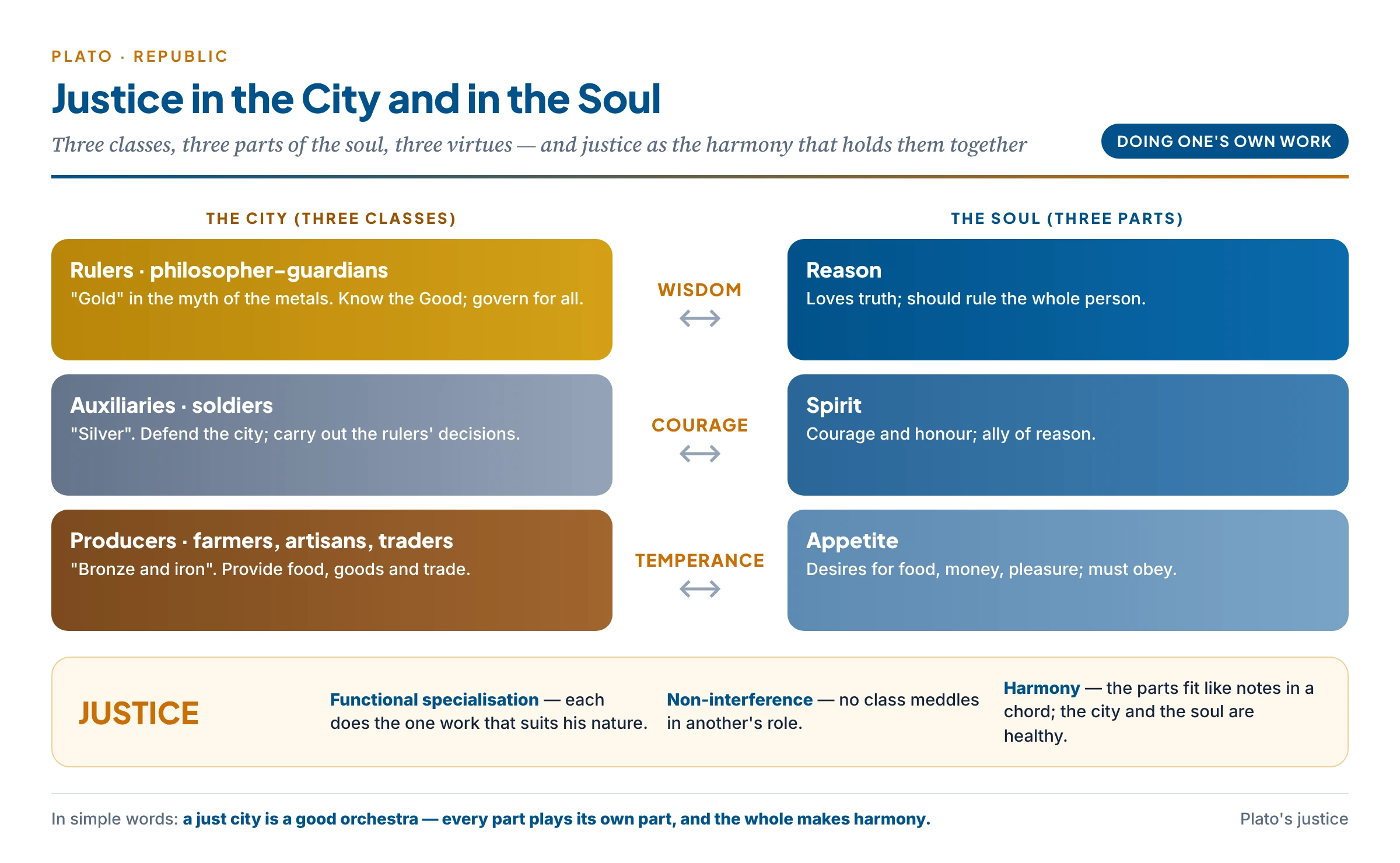
- Three classes, each marked by a dominant trait and a matching virtue:
| Social class | Dominant part of the soul | Virtue that fits it |
|---|---|---|
| Rulers (philosopher-guardians) | Reason — love of knowledge | Wisdom |
| Auxiliaries (soldiers) | Spirit — courage, honour | Courage |
| Producers (farmers, artisans, traders) | Appetite — desire for goods | Temperance (voluntary self-restraint) |
| The whole city | All three in their right places | Justice |
- Justice is the fourth virtue — the virtue of the social order as a whole. The first three belong to particular classes; justice belongs to the arrangement.
- Plato’s definition. Justice is “doing one’s own work and not meddling” in the work of others. Each class performs the function for which it is best fitted and does not interfere with the others.
- Three principles follow:
- Functional specialisation — each person does the one job that suits his nature.
- Non-interference — no class takes over another’s role (a trader must not try to rule).
- Harmony — the parts fit together like the notes of a chord.
Justice in the individual:
- The soul has the same three parts — reason, spirit and appetite. A person is just when reason rules, spirit supports reason, and appetite obeys.
- So justice is inner health of the soul; injustice is a civil war inside the person. This answers Glaucon: the just person is happier, because his soul is in order.
- Justice at two levels: for the individual, it is the dominance of the trait that suits his class; for society, it is the three classes doing their duty without interfering.
In simple words
Think of an orchestra. The violins, the drums and the flutes each play their own part. If the drummer decided to conduct, or every player tried to play the melody, there would be noise. Plato’s justice is the city playing like a good orchestra: each part does its own work, and the whole makes harmony.
How the ideal state secures justice:
- Education — a long, state-run education selects and trains the guardians; philosophy is its highest stage.
- The myth of the metals (the “noble lie”) — citizens are told that God mixed gold in the rulers, silver in the auxiliaries and bronze or iron in the producers. Children are not bound to their parents’ class: a gold child born to bronze parents must be raised up, and a bronze child of gold parents moved down.
- Communism for the guardians — rulers and soldiers have no private property and no private families, so that personal interest cannot corrupt them.
- Women guardians — women of ability may be trained and serve as guardians alongside men; the difference between the sexes is not, for Plato, a difference in fitness to rule.
- The philosopher-king — the state will be just only when “philosophers become kings or kings become philosophers”, because only those who know the Form of the Good can rule wisely.
Criticism of Plato’s theory:
- Arbitrary psychology. His division of the soul and the matching of classes to soul-parts is not proved; people are not simply “gold” or “bronze”.
- Sanctions social discrimination. Fixed functions by nature resemble a hereditary hierarchy such as the varṇa system, even though Plato allows movement between classes.
- Authoritarianism. Unlimited power for the philosopher-king and no constitutional checks. Karl Popper (The Open Society and Its Enemies) called Plato’s ideal state a blueprint for a closed, totalitarian society.
- Destroys liberty. Individuals cannot choose their work, family or opinions; the poets are censored; rulers may lie for the public good.
- Ignores the individual. The good of the whole is everything; the individual’s own rights count for nothing.
Plato’s Ideal State and the Liberty of Citizens
The 2026 paper asked whether Plato’s ideal state is compatible with the rights and liberties of individual citizens. The answer has two sides.
- Why it seems incompatible:
- No choice of occupation — your nature, judged by the rulers, fixes your role.
- No private property or family for the guardians; marriages arranged by the state.
- Censorship — poets and stories that might corrupt the young are banned.
- The noble lie — rulers may deceive citizens for their good.
- No rights against the state — there is no idea of individual rights that limit government; the citizen exists for the city.
- Why Plato thought it was freedom, not slavery:
- Freedom as self-mastery. For Plato, a person ruled by his appetites is a slave even if no one restrains him. True freedom is the rule of reason in the soul — which the just city helps every class to achieve.
- Each person flourishes by doing what suits his nature; no one is forced into a role he cannot perform well.
- Merit, not birth, decides class — a radical idea in its time, including for women.
- Balanced view. Plato offers positive liberty (rational self-mastery) but almost no negative liberty (a protected private zone). Modern liberal thought — and the later critique of “positive liberty” by Isaiah Berlin (see the Liberty article) — sees exactly this as the danger: once the rulers claim to know your “true self”, they may force you to be “free”.
Plato’s Critique of Democracy
The 2025 paper asked about Plato’s critique of democracy, which follows directly from his theory of justice.
- Rule by the unqualified. In the ship of state image, the sailors quarrel over the helm and flatter the shipowner (the people), though none has learned navigation; the true navigator, who studies the stars, is called a useless star-gazer. Governing is a skill, like medicine or navigation, and needs knowledge.
- Equality to equals and unequals alike. Democracy “dispenses a kind of equality to equals and unequals alike” — it ignores real differences of wisdom. This violates functional specialisation, the heart of Plato’s justice.
- Excess of liberty. In democracy everyone does as he likes; respect for law, parents and teachers weakens; at last the people turn to a demagogue who promises them everything, and excessive liberty turns into tyranny.
- The doctor and the pastry-cook. In the Gorgias, a doctor and a pastry-cook are tried before a jury of children: the cook, who gives them sweets, wins, though the doctor gives them health. Democratic politicians, Plato says, are pastry-cooks.
- Memory of Socrates. Athenian democracy put Socrates to death; for Plato this showed the rule of opinion over knowledge.
- Replies to Plato. Aristotle answered that the many, taken together, may judge better than the few — as a feast to which many contribute is better than one given by a single man. Modern defenders add that only democracy lets the governed remove bad rulers peacefully, and that no class of rulers can be trusted with unchecked power.
Indian Connect — Plato and the varṇa ideal
Plato’s three classes are often compared with the varṇa order and with the Gītā’s idea of svadharma — “better is one’s own duty, though imperfectly done, than the duty of another well done”. Both link justice to doing one’s own function. Two differences matter: Plato places people by merit and education, not by birth; and his rulers are philosophers, not priests. B. R. Ambedkar, in Annihilation of Caste, compared cāturvarṇya with Plato’s ideal and rejected both for the same reason: they sort human beings into a few fixed types and ignore that every individual is unique and capable of many things.
Aristotle’s Theory of Justice
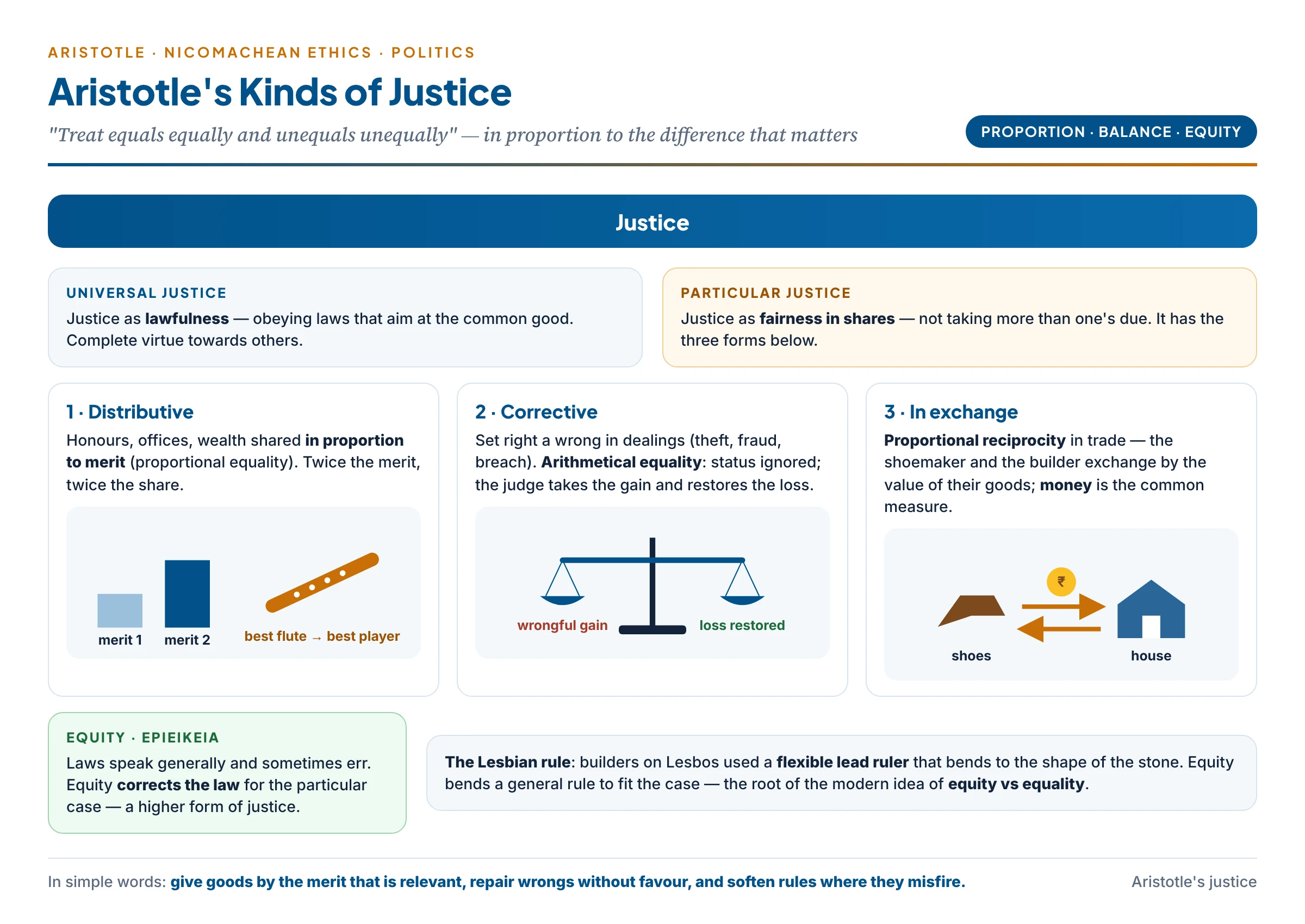
Aristotle (Nicomachean Ethics and Politics) gives the most influential classical analysis. His central formula: “treat equals equally and unequals unequally” — in proportion to the relevant difference.
Universal and particular justice:
- Universal (general) justice — justice as lawfulness, i.e. obeying laws that aim at the common good. In this broad sense justice is complete virtue in relation to others.
- Particular justice — justice as fairness in shares (not taking more than one’s due). It has two main forms:
- Distributive justice — how the community distributes honours, offices, wealth among its members.
- The rule is proportional (geometrical) equality: shares should be in proportion to merit. If A is twice as deserving as B, A gets twice as much.
- Injustice here is disproportion — giving equal shares to unequals, or unequal shares to equals.
- The hard question is what counts as merit. Democrats say free birth, oligarchs say wealth or noble birth, aristocrats say virtue. Aristotle’s own answer for political office: contribution to the good life of the city — virtue and practical wisdom.
- Corrective (rectificatory or retributive) justice — how to set right a wrong in private dealings, whether voluntary (sale, loan) or involuntary (theft, assault).
- The rule is arithmetical equality: the court ignores who the parties are — “it makes no difference whether a good man has defrauded a bad man or a bad man a good one”. It looks only at the gain and the loss and restores the balance.
- The judge is a mediator who takes away the wrongdoer’s gain and gives it back to the loser.
- Justice in exchange. In trade, the rule is proportional reciprocity — a shoemaker and a builder exchange according to the value of their products; money serves as the common measure.
- Political justice is justice among free and equal citizens under law. Part of it is natural (valid everywhere) and part conventional (fixed by local law).
In simple words
Aristotle’s own example: if you have one excellent flute to give away, give it to the best flute player — not to the richest or the best-born person in town. Wealth and birth have nothing to do with playing the flute. Distributive justice means giving a good according to the merit that is relevant to that good.
Equity (epieikeia):
- Laws must speak in general terms, and so in some cases they give a wrong result. Equity corrects the law where it errs because of its generality — it does what the lawgiver would have done if he had foreseen the case.
- Aristotle’s image is the Lesbian rule — a flexible lead ruler used by builders on the island of Lesbos, which bends to fit the shape of the stone. Equity bends the general rule to fit the particular case.
- Equity is not opposed to justice; it is a higher form of justice. This idea lies behind the modern distinction between equality (same rule for all) and equity (fair treatment according to need and circumstance).
Criticism of Aristotle’s theory:
- Favours the privileged. Proportional equality can freeze existing inequalities: if merit is judged by wealth or birth, the rich get more and the gap widens.
- Slavery and women. Aristotle defended natural slavery and held women to be naturally subordinate — “unequals” by nature. His formula is only as good as the judgement of who is “equal”.
- Formula without content. “Treat equals equally” tells us nothing until we know which differences are relevant. This is the starting point of modern theories of equality (see the Equality article).
- Lasting value. Still, his distinctions between distributive and corrective justice and his idea of equity remain the basic vocabulary of law and political philosophy.
Common confusion
Did Aristotle base distributive justice on “property and tradition”? Not as his own view. Many notes say Aristotle distributed goods according to property and tradition. Aristotle reports that oligarchs measure merit by wealth and democrats by free birth; his own standard for political honours is virtue — one’s contribution to the good life of the city. It is true, however, that his scheme accepted slavery and class differences, which is why critics say it favours the privileged.
“Justice Is Treating Equals as Equals and Unequals as Unequals”
This Aristotelian formula (asked in 2008) is both true and dangerous.
- Its truth:
- Justice is not identical treatment. Giving the same medicine to the sick and the healthy, or the same exam to a blind student without a scribe, is unequal in effect.
- Modern law uses this idea in reasonable classification: a law may treat groups differently if the difference is real and related to the law’s purpose (progressive taxation, special help for disabled persons, reservations for historically excluded groups).
- Its danger:
- Who decides who is “equal”? Aristotle used the formula to justify slavery; caste society used similar reasoning to justify untouchability.
- It needs a theory of relevant differences. Need, effort, talent, past injustice and citizenship are relevant for some goods but not others.
- Synthesis. The formula is a valid formal principle (treat like cases alike) but must be joined with a substantive principle — such as Rawls’s difference principle or Sen’s capabilities — that tells us which inequalities are just.
The Modern View of Justice: Three Dimensions
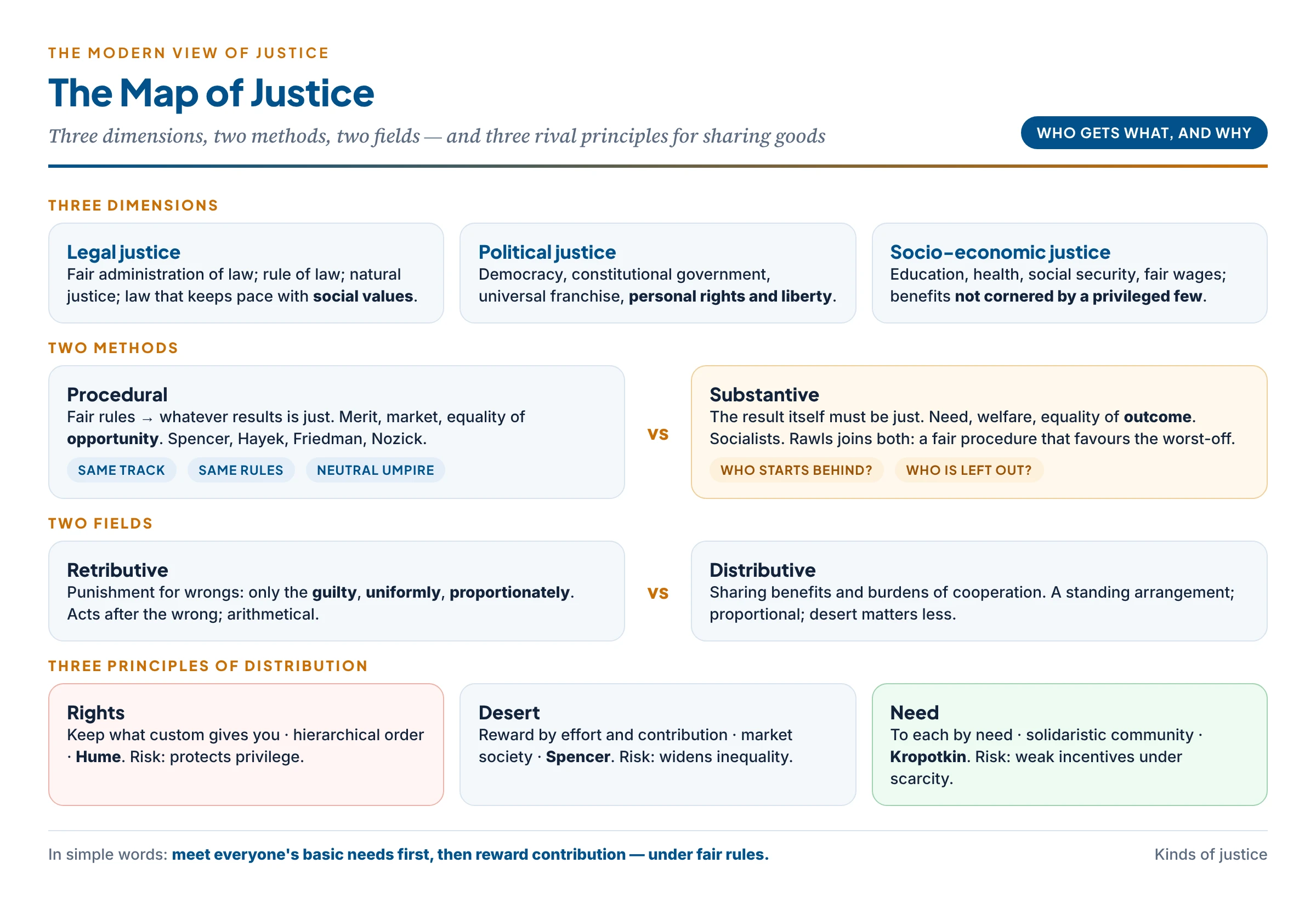
- Legal justice
- Efficient administration of law: equality before law, fair trial, independent judiciary, rule of law.
- It also demands that the law itself embody human values according to the prevailing social conscience. A law that fails to change with social values becomes a dead weight on the wheels of progress, and may be thrown off by violent upheaval.
- Includes the principles of natural justice: hear the other side (audi alteram partem) and no one should be judge in his own cause.
- Political justice
- Democratic institutions, rule of law and constitutional government; free and fair elections; universal adult franchise.
- Full guarantees of personal rights and liberty.
- In short, political justice means that every citizen has access to a fair mechanism for resolving conflicting claims.
- Socio-economic justice
- Concerned with the social and economic development of all human beings without discrimination, so that each person can develop to his best.
- Its goal is close to human development: access to education, health care, social security and labour rights; fair distribution of wealth; equality of opportunity; no gross inequality of outcome.
- Social justice means reordering society so that its material and moral benefits are not cornered by a tiny privileged class but reach the masses, especially the lower, weaker and underprivileged sections.
Procedural and Substantive Justice
- Procedural justice — an outcome is just if it results from a just procedure. The procedure comes first.
- Race analogy: justice means laying down fair rules — same starting line, same track, no pushing. Whoever wins under fair rules deserves to win.
- Rooted in the liberal tradition; defended by Herbert Spencer, F. A. Hayek, Milton Friedman, Robert Nozick. It treats the rules of the market economy as the model rules of human behaviour.
- Strength: it rules out all discrimination. Weakness: it stretches open competition too far — people do not start the race equal.
- Spencer applied Darwin’s idea to society — “survival of the fittest” — so the weak have no claim on the strong.
- The neo-Marxist C. B. Macpherson replied that a free-market society destroys the creative freedom of most people, who must sell their labour on others’ terms.
- Substantive justice — the allocation itself must be just; procedure is secondary.
- Corresponds to the philosophy of socialism.
- Demands that the opportunity of self-development be progressively extended to the underprivileged and disadvantaged.
- John Rawls tried to reach the goals of substantive justice through the method of procedural justice — a fair procedure (the original position) designed so that its outcome favours the least advantaged (see the next article).
| Basis | Procedural justice | Substantive justice |
|---|---|---|
| Criterion of distribution | Merit, voluntary exchange | Need |
| Kind of equality | Equality of opportunity | Equality of outcome |
| Focus | Means (fair rules) | Ends (fair results) |
| Supporters | Liberals, libertarians | Socialists |
| Practical form | Market-based system | State-regulated or state-controlled economy |
| Sen’s terms | Close to nīti (right rules and institutions) | Close to nyāya (justice realised in people’s lives) |
In simple words
Procedural justice is like a fair cricket match: same rules for both teams, a neutral umpire — and whoever scores more wins. Substantive justice asks a further question: did one team come with bats and pads while the other came barefoot, without having eaten? A fair match between unequal teams may still produce an unfair result.
Retributive and Distributive Justice
Retributive justice is concerned with punishment for wrongdoing. David Miller lists three conditions for just punishment:
- Punish only those found guilty through proper procedure.
- Impose penalties uniformly — like crimes, like punishments.
- Keep the scale of the penalty proportionate to the offence.
Distributive justice is concerned with the allocation of benefits and burdens — income, wealth, jobs, education, health care, taxes — according to principles of social justice.
The grounds of the distinction (asked in 1998):
- What is distributed. Distributive justice shares out goods and burdens of social cooperation; retributive justice responds to wrongs with punishment.
- When it acts. Distribution is a standing arrangement made in advance; retribution acts after a wrong has been done.
- The kind of equality. Following Aristotle, distribution uses proportional equality (shares match merit or need), while correction uses arithmetical equality (the parties’ status is ignored; only harm and gain count).
- The role of desert. Punishment must be deserved — no guilt, no punishment. Distribution, according to Rawls, should not be based mainly on moral desert, because talents and family background are matters of luck; desert matters in retribution but much less in distribution.
- Critical note. The two overlap: a society that distributes unjustly (extreme poverty, exclusion) may be less entitled to punish those it has wronged — a point made by many critics of criminal justice. And modern restorative justice (repairing harm through victim–offender dialogue) blurs the line further.
Principles of Distributive Justice: Rights, Desert and Need
David Miller identified three rival principles, each matching a type of social order:
| Criterion of justice | Social order it fits | Classical exponent |
|---|---|---|
| Protection of acknowledged rights | Hierarchical order — each rank keeps what custom gives it | David Hume (18th century) |
| Distribution according to desert | Competitive market society | Herbert Spencer (19th century) |
| Distribution according to need | Solidaristic community | Peter Kropotkin (19th century) |
Analysis:
- Rights (as customarily acknowledged) — tends to be discriminatory: it can protect slavery, caste privileges and inherited estates. Aristotle’s defence of slavery and the caste system are examples.
- Desert — rules out inherited privilege and rewards effort, but by itself it can widen inequality and human misery, since those who cannot compete are left behind.
- Need — the most humane principle, but fully possible only when goods and services are abundant. Under scarcity it may kill incentive and discourage talent.
- A workable solution is a judicious combination of desert and need:
- First, people should learn to limit their wants, as Gandhi taught.
- Then the state should guarantee minimum needs — survival, health, education — to all.
- Beyond that, each person’s reward should depend on his contribution to the social good.
Critical Evaluation
Critiques of the Classical Theories
- Hierarchy taken for granted. Both Plato and Aristotle assume natural inequality among human beings. Modern theories begin from the opposite assumption — fundamental moral equality.
- The individual lost in the whole. Plato’s justice is a property of the city; the individual’s own claims (to choose his life, to speak, to dissent) are not recognised. Hence Popper’s charge of totalitarianism.
- Formal emptiness. “Each his due” and “treat equals equally” need a further theory of what is due and which differences matter. Without one, they can justify almost anything.
- Defence. Yet the classical theories saw truths the moderns sometimes forget: justice is a virtue of character as well as of institutions; a just society needs citizens who feel justice; and justice aims at harmony and the common good, not only at fair shares.
Critiques of the Modern Kinds
- Procedural justice ignores unequal starting points; substantive justice risks a powerful state deciding everyone’s share. The best modern theories (Rawls, Sen) try to combine fair procedure with attention to outcomes.
- Marxist critique. For Marx, “justice” in a class society is the justice of the ruling class; bourgeois justice protects private property. A communist society of plenty would go beyond the need for justice, distributing “to each according to his needs”.
- Feminist critique. Classical and modern theories alike leave the family outside justice, though most unpaid work and much domination happens there (see the article on the critics of Rawls).
Critics and Defenders
Criticism — Critics of the classical view
- Popper: Plato’s ideal state is a closed, totalitarian society.
- Liberals: no individual rights, no negative liberty.
- Ambedkar: fixed types ignore each person’s uniqueness.
- Egalitarians: Aristotle’s proportion favours the rich.
- Modern thinkers: “each his due” is an empty formula.
Defence — Defenders and lasting strengths
- Justice as harmony of soul and society.
- Merit, not birth, for Plato’s classes.
- Distributive vs corrective — still the legal vocabulary.
- Equity corrects the rigidity of law.
- Justice as virtue — institutions need just citizens.
Cross-Tradition Comparison
| Theme | Plato / Aristotle | Indian tradition |
|---|---|---|
| Basis of justice | Harmony of classes; proportion to merit | Dharma and ṛta — cosmic and social order |
| Each his due | Each class does its own work | Svadharma — each does his own duty |
| Disorder without justice | Thrasymachus: might is right | Matsya-nyāya — big fish eat small fish |
| Guardian of justice | Philosopher-king | King’s daṇḍa guided by dharma |
| Corrective justice | Arithmetical restoration by a judge | Vyavahāra — law of disputes in the Dharmaśāstras |
| Critique of hierarchy | Popper (closed society) | Buddha’s rejection of birth-based worth; Ambedkar |
Indian Connect — Justice in the Constitution of India
The Preamble promises citizens “Justice, social, economic and political” — the three dimensions of the modern view. Legal justice is secured by Articles 14 (equality before law) and 21 (life and personal liberty with fair procedure, after Maneka Gandhi, 1978); political justice by universal adult franchise (Article 326); and socio-economic justice by the Directive Principles — Article 38 (a social order informed by justice), Article 39 (fair distribution of material resources, equal pay), and Article 39A (equal justice and free legal aid). The Constitution thus joins the classical idea of justice as the foundation of the political order with the modern idea of justice as fair distribution.
Synthesis (Siddhānta)
- Justice is the master ideal of social and political life: it gives each person his due and reconciles liberty and equality.
- Plato teaches that justice is harmony — of the soul and of the city — and that it needs knowledge and virtue; his error was to sacrifice the individual to the whole.
- Aristotle gives the lasting tools: distributive (proportional) and corrective (arithmetical) justice, and equity; his error was to accept natural hierarchy.
- Modern justice has three dimensions — legal, political, socio-economic — and two methods, procedural and substantive; the main principles of distribution — rights, desert and need — must be combined rather than chosen one at a time.
- Contemporary relevance. The question “who gets what, and why?” lies behind every debate on reservations, taxation, welfare schemes, minimum wages, legal aid and punishment. The next articles show how Rawls tried to answer it with a fair procedure, how Nozick and the communitarians challenged him, and how Sen turned from the ideal of a perfectly just society to the removal of real injustices.
“Justice is the first virtue of social institutions, as truth is of systems of thought.” — John Rawls
Previous Year Questions
- 2026Is Plato’s vision of an ideal state compatible with the rights and liberties of individual citizens? Discuss.
- 2025Comment on Plato’s critique of Democracy.
- 2024Briefly discuss Plato’s concept of justice.
- 2013Explain and evaluate Aristotle’s concept of justice.
- 2008“Justice is treating equals as equals and unequals as unequals.” Discuss.
- 1998The notion of justice is usually divided into distributive and retributive justice. Explain the distinction and critically discuss the grounds on which the distinction is made.