

Aurobindo: Evolution, Involution; Integral Yoga.
Official Syllabus: Paper I, Section B, Unit 20
Sri Aurobindo (1872–1950) is the one modern thinker in the UPSC Indian Philosophy syllabus, and the only one who builds a complete system out of evolution. His starting point is a complaint: philosophy has split reality in two. The materialist accepts Matter and denies Spirit; the ascetic accepts Spirit and denies Matter. Each is right in what it affirms and wrong in what it denies. Aurobindo’s answer is Pūrṇādvaita (integral non-dualism): one Reality, Saccidānanda (Existence–Consciousness–Bliss), which is both silent Being and dynamic Becoming, and which has really become this world out of delight (līlā) through its own creative power (Māyā, rightly understood). This article lays the foundation for the whole unit: Aurobindo’s life and sources, the two negations and why both fail, the nature of Brahman as Saccidānanda, Being and Becoming, Consciousness-Force (Cit-Śakti), his new reading of Māyā and Līlā, the place of Ignorance, the main criticisms of his metaphysics, and a full comparison with Śaṅkara.
In simple words
Think of a dancer and the dance. The dance is not a trick or a dream; it really happens, and every movement expresses the dancer. Yet the dancer is not used up by the dance; after it, she is still fully herself. For Aurobindo, the world is the dance and Brahman is the dancer. The materialist sees only the movements and denies the dancer; the ascetic sees only the dancer and calls the dance an illusion. Aurobindo says: both are real, and the dance exists for joy.
Context & Problem
Life, Works and Turning Points
- Born Aurobindo Ghose on 15 August 1872 in Calcutta; educated in England (St Paul’s School and King’s College, Cambridge) from the age of seven, so he met European thought first and Indian thought later.
- Nationalist phase. Returned to India in 1893; worked in Baroda; became a leading voice of the radical wing of the freedom movement after the 1905 partition of Bengal; edited the paper Bande Mataram; argued for complete swarāj and passive resistance instead of petitions.
- The turn inward. During a year in Alipore jail (1908–09) he had decisive spiritual experiences; in 1910 he withdrew from politics and settled in Pondicherry, where he spent forty years developing Integral Yoga.
- The Mother. Mirra Alfassa (Mira Richard), called “The Mother”, became his spiritual collaborator; the Sri Aurobindo Ashram took shape in 1926.
- Died on 5 December 1950.
- Main works:
- The Life Divine — the metaphysics: Saccidānanda, involution, evolution, Supermind, the gnostic being.
- The Synthesis of Yoga — the principles and method of Integral Yoga.
- Savitri: A Legend and a Symbol — an epic poem of the soul’s journey.
- Letters on Yoga, Essays on the Gita, The Mother.
- Social and political works: The Human Cycle, The Ideal of Human Unity, and the early articles New Lamps for Old (a critique of the Moderates).
- Tributes. Rabindranath Tagore saw in him the voice through which India would speak to the world; Romain Rolland called him the most complete synthesis yet realised of the genius of Asia and the genius of Europe.
Sources of His Thought
- Indian: the Vedas and Upaniṣads above all, the Gītā, Vedānta, Sāṃkhya, Yoga and Tantra. Of these, Advaita Vedānta is the most central — he keeps its non-dualism but rejects its world-negation.
- Western: Hegel (the Absolute developing itself in history), Bergson (creative evolution, intuition), Whitehead (reality as process) and Kant, together with modern evolutionary science.
- His method — integral knowledge. No single faculty can reveal the whole of reality. Sense-experience, reason and intuition must be integrated; reason organises what experience and intuition reveal. This is why his philosophy is called integral.
- A free Vedāntin. The Life Divine is inspired on almost every page by the seers of the Vedas and Upaniṣads. Aurobindo can be read as a free commentator on Vedānta, coming after Śaṅkara, Rāmānuja, Madhva, Nimbārka and Vallabha — and his work is a living answer to the false belief that Indian philosophy stopped after the sixteenth century.
Names of the System
| Name | What it stresses |
|---|---|
| Pūrṇādvaita (integral non-dualism) | One Reality, but integral — it includes the world instead of cancelling it |
| Pūrṇa Yoga / Integral Yoga | The practical path: union with the Divine in all parts of life |
| Pūrṇavāda (integralism) | Every partial truth is kept and placed in a larger whole |
| Neo-Vedānta | A modern, world-affirming reading of the Upaniṣads |
| Integral Idealism / Realistic Monism | Reality is consciousness (idealism), yet the world is fully real (realism) |
- One line that sums him up: Matter is the form of Spirit; Spirit is the soul of Matter; Life is Spirit fulfilling itself in Matter; Mind is Life becoming aware of itself; Supermind is the truth-consciousness of Spirit.
- The question he asks. Other Indian schools ask how we know, how we err, what the categories of reality are, how to still the mind, or what finally is. Aurobindo asks a new question: what is consciousness becoming?
Core Doctrine
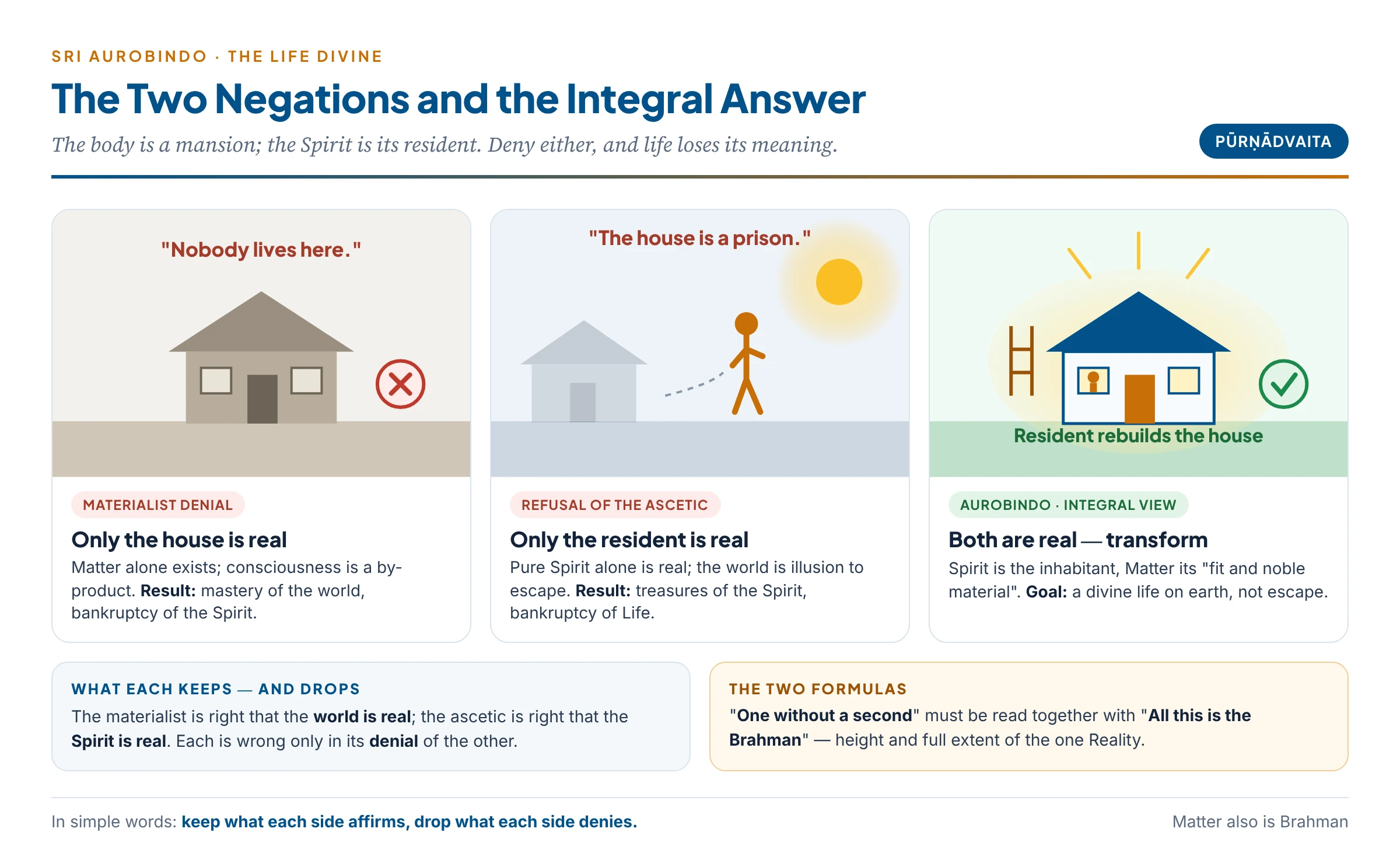
The Two Negations
Aurobindo opens The Life Divine by diagnosing two opposite errors that had come to dominate human thought — one in Europe, one in India.
“In Europe and in India, respectively, the negation of the materialist and the refusal of the ascetic have sought to assert themselves as the sole truth and to dominate the conception of Life.” — Sri Aurobindo
| The Materialist Denial | The Refusal of the Ascetic | |
|---|---|---|
| Affirms | Matter, the physical world, the senses | Pure Spirit, the silent Self |
| Denies | Spirit — consciousness is a by-product of matter | Matter and the world — an illusion to be escaped |
| Indian form | Cārvāka | Māyāvāda (world as illusion), monastic world-flight |
| Typical result | Mastery of the world, but bankruptcy in the things of the Spirit (Europe) | Treasures of the Spirit, but bankruptcy of Life (India) |
| Its truth | The world is real; science and its methods matter | The Spirit is real; the experience of the silent Self is genuine |
| Its error | Denying everything beyond the senses | Denying the world in which Spirit manifests |
Why the Materialist Denial Fails
- The senses are limited. The materialist says only matter exists because only matter is perceived. But the existence of matter itself is known through the senses, and the senses have a limited range. A claim that rests on limited instruments cannot be declared the exclusive truth.
- “The Unknown is not the Unknowable.” The materialist’s strongest weapon is agnosticism: whatever lies beyond the senses is unknowable. Aurobindo replies that this stretches “unknowable” to cover everything merely unknown. Human beings have faculties — intuition, spiritual experience — that can grow to know what the senses cannot.
- Even the senses go beyond themselves. Instruments and subtle experience already reveal facts beyond the reach of the bodily organs; there is no reason to treat inner experience as a false witness when it reports supraphysical facts. Its reports must be tested by reason, like all evidence — but not thrown out.
- It leads to meaninglessness. If only matter is real, the life of the individual and the race becomes a brief nervous spasm of matter; ethics and ideals become “nobler delusions”.
- But it carries its own cure. The materialist denial is more insistent and more easily popular, yet less enduring, because its own spirit of inquiry will push past its limits.
- Its service to the Divine. Aurobindo does not sneer at materialism. Atheism and agnosticism cleared away superstition and trained the mind in rigour; “error is continually the handmaid and pathfinder of Truth”. Their real gains must be kept.
Why the Refusal of the Ascetic Fails
- The experience is genuine. At the gates of the Transcendent stands the pure, silent, inactive Self of the Upaniṣads. When the mind passes those gates suddenly, it receives an overwhelming sense that the world is unreal and only the Silence is real. This is one of the most convincing experiences a human mind can have.
- But the conclusion is partial. From this experience comes the second negation, which is more complete, more final and more perilous than the materialist one, because it calls individuals and whole societies away from life.
- Its history in India. For about two thousand years, since Buddhism disturbed the balance of the older Vedic outlook, this revolt of Spirit against Matter has dominated the Indian mind: life seen as a chain of karma, bondage by birth, liberation by cessation of birth; the goal placed beyond the world — in Vṛndāvana (Goloka), Brahmaloka, Nirvāṇa or the featureless Absolute.
- The logical flaw. If reality is exclusively spiritual, then matter too is spiritual — and so it cannot be rejected as unreal. The outright rejection of the material contradicts the very monism the ascetic proclaims.
- Height without extent. The ascetic grasps the Reality in its full height but not in its full extent. The Upaniṣadic formula “One without a second” (ekam evādvitīyam) has not been read in the light of the equally binding formula “All this is the Brahman” (sarvaṃ khalv idaṃ brahma).
- Its even greater service. Asceticism has rendered a still greater service to life than materialism: it keeps alive the pure spiritual impulse, and in practice an element of ascetic discipline is indispensable to human perfection.
In simple words
A person lives in a house. One visitor says, “There is only the house; nobody lives here.” Another says, “Only the resident matters; the house is a prison — leave it.” Aurobindo says: the resident is real and the house is real, and the right task is neither to deny the resident nor to abandon the house, but for the resident to rebuild the house into a fit home.
Matter Also Is Brahman
- The foundation of a divine life on earth.
“The affirmation of a divine life upon earth and an immortal sense in mortal existence can have no base unless we recognise not only eternal Spirit as the inhabitant of this bodily mansion, the wearer of this mutable robe, but accept Matter of which it is made, as a fit and noble material out of which He weaves constantly His garbs, builds recurrently the unending series of His mansions.” — Sri Aurobindo
- The Upaniṣadic support. In the Taittirīya Upaniṣad, the seeker Bhṛgu asks his father Varuṇa what Brahman is. Through disciplined reflection he first discovers that Matter (anna) is Brahman — from matter beings are born, by it they live, into it they return — and then rises step by step to Life, Mind, Knowledge and Bliss as Brahman. Aurobindo takes this ladder seriously: “Matter also is Brahman”, and the physical universe is the external body of the Divine.
- The need for intermediate terms. Spirit and Matter look like total opposites. To identify them convincingly we need a series of ascending terms between them — Life, Mind, Supermind and the grades that link Mind to Supermind. Without this ladder, Spirit and Matter remain partners in an “unhappy wedlock”, and divorce (rejecting one) seems the only reasonable solution.
- The failure of earlier dualisms.
- Sāṃkhya: the passive, luminous Puruṣa and the mechanically active Prakṛti have nothing in common; their conflict ends only when Prakṛti’s activity ceases before Puruṣa.
- Śaṅkara: the wordless, inactive Self and the Māyā of many names and forms are equally irreconcilable; the conflict ends only when the illusion dissolves into eternal Silence.
- Two aspects of one reality. For Aurobindo, Matter and Spirit are two ends of one spectrum, two aspects of one Reality. And if Matter is to ascend to Spirit, Spirit must already have descended into Matter — the seed of the doctrine of involution and evolution (Article 2).
- Integralism. Seen against the Indian map, Aurobindo reconciles the two extremes — Cārvāka and Advaita — and every school in between, keeping each one’s affirmation and dropping its denial.
Common confusion
Is Aurobindo a materialist because he affirms Matter? No. He affirms Matter as a form of Spirit, not as the only reality. The materialist says “only Matter”; Aurobindo says “Matter is Spirit in its most concealed form, and it is destined to reveal the Spirit within it”. He is a spiritual monist who refuses to throw away the world.
Brahman: The Supreme Reality
- How he arrives at it. In cosmic consciousness there is a meeting place where Matter becomes real to the Spirit and Spirit becomes real to Matter. From this experience Aurobindo builds his concept of Brahman as the one Reality that holds both.
- Brahman in itself. Brahman — the Divine, the Absolute — is eternal, absolute and infinite. In itself it is indeterminate, indefinable and free; it cannot be fully described either positively or negatively.
- Indescribable but not unknowable. Unlike Kant’s unknowable thing-in-itself, Brahman can be known, because the spiritual being in us is in essence the Divine itself. It is known not by concepts but by identity — by becoming one with it.
- Beyond all pairs, yet holding them. Brahman manifests as indeterminate and determinate, nirguṇa and saguṇa, one and many, being and becoming — and yet transcends all of them. Where logic sees a contradiction, Aurobindo sees the “logic of the Infinite”: what is magic to our finite reason is natural to the Infinite.
- Three poises of the one Brahman.
- Transcendent — beyond the universe, indeterminable.
- Cosmic — as Īśvara, the Lord of the universe.
- Individual — as the self in each being.
All that exists is Brahman and nothing else; Brahman is one in many and many in one at the same time.
- Material and efficient cause. The world is made of Brahman and by Brahman. Because God is both immanent in the world and transcendent beyond it, Pūrṇādvaita is often classed as panentheistic — everything is in God, but God is more than everything.
Saccidānanda: The Highest Positive Expression
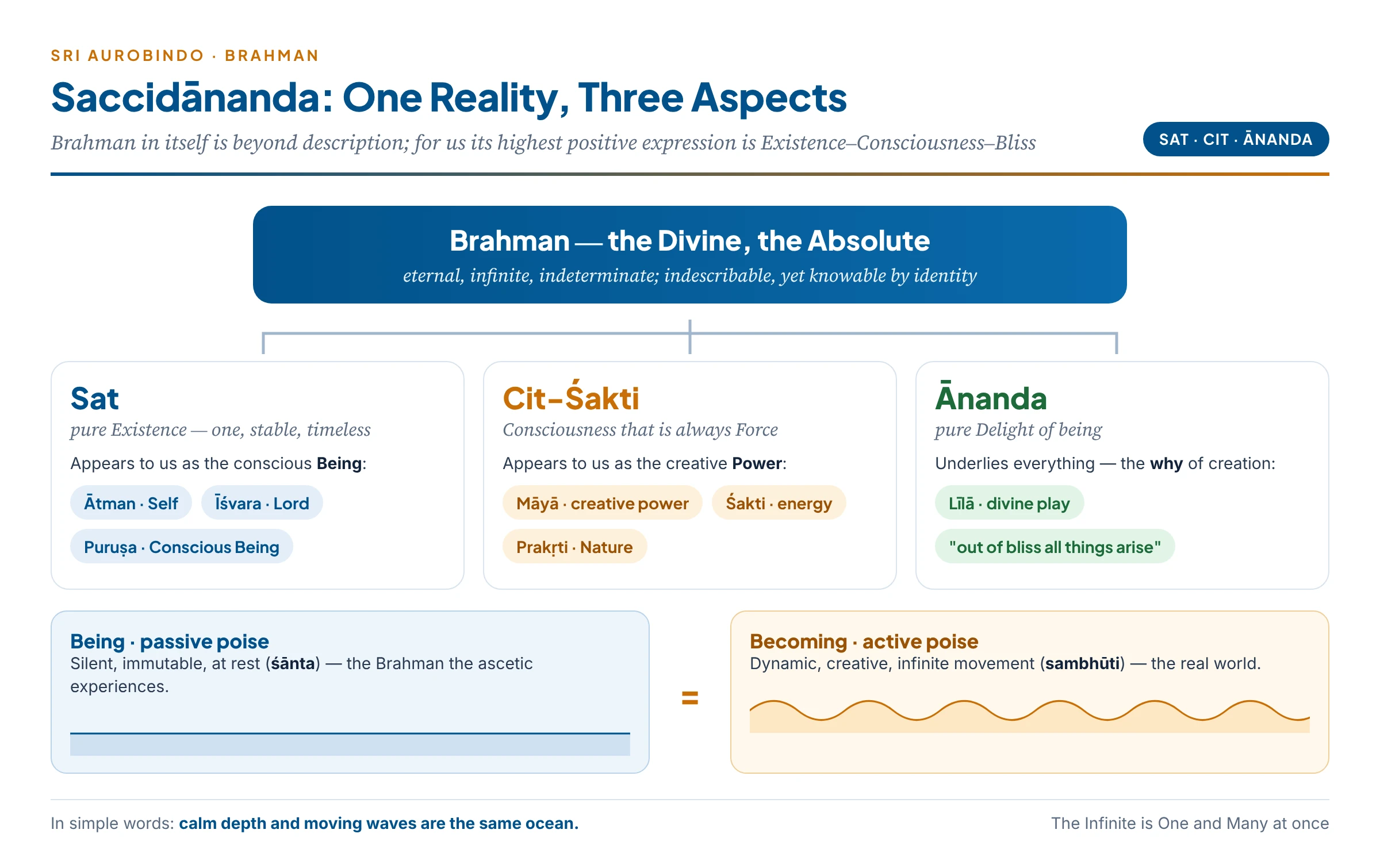
For us, the highest positive expression of Brahman is Saccidānanda — Sat (Existence), Cit (Consciousness-Force) and Ānanda (Bliss), all in one.
| Aspect | Meaning | How it appears to us |
|---|---|---|
| Sat | Pure, infinite Existence — timeless, spaceless, one and stable | As Ātman (Self), Īśvara (Lord) and Puruṣa (Conscious Being) |
| Cit (always Cit-Śakti) | Consciousness that is always also Force | As Māyā (creative power), Śakti (energy) and Prakṛti (Nature) |
| Ānanda | Pure Delight of being | Underlies all manifestation — the reason why there is a world |
- Each triad is one reality seen three ways. Ātman–Īśvara–Puruṣa is the conscious Being; Māyā–Śakti–Prakṛti is its Power. These were separated by different Indian schools; Aurobindo shows they are poles of one Saccidānanda, and taken together they reconcile all apparent contradictions.
- Consciousness-Force creates. In Aurobindo’s words, Consciousness-Force “measures the Immeasurable, informs the Formless and embodies the Spirit”.
- Bliss gives the “why” of creation. The Divine manifests as this world out of sheer bliss, as the Taittirīya Upaniṣad says: out of bliss all things arise.
“World-existence is the ecstatic dance of Shiva which multiplies the body of the God numberlessly to the view… its sole absolute object is the joy of the dancing.” — Sri Aurobindo
- The Supreme and its movement. The Supreme in itself is “timeless and spaceless pure Existence, one and stable”, to which measure and measurelessness do not apply; yet it manifests as “measureless movement in time and space”.
- Self-limitation for joy. Out of sheer joy, the one Saccidānanda limits and individualises himself and appears as innumerable real Selves of Bliss, each always conscious of its essential unity with Saccidānanda.
- Unity and multiplicity. Reality is essentially one, but creation rests on a twofold principle of unity and multiplicity: creation expresses the one Reality in terms of the many. The levels of being (Article 2) are reality seen from the point of view of creation.
- The Supermind. The self-consciousness of Brahman, which is at the same time its power of self-manifestation, Aurobindo calls the Supermind — the “Real-Idea” or “Truth-Consciousness” (Article 3).
Being and Becoming: Two Poises of One Reality
- The old wedge. Classical Advaita separated Being (the changeless Brahman) from Becoming (the changing world) and declared Becoming an inexplicable appearance (mithyā).
- Aurobindo’s reconciliation. Being and Becoming are two inseparable aspects of the same Divine:
- In its passive poise, Brahman is eternal, silent, immutable Being (śānta).
- In its active poise, Brahman is dynamic, infinite Becoming (sambhūti).
- No contradiction. Movement does not cancel stability; plurality does not destroy unity. The sea is not less the sea because it has waves.
- The Infinite is not weak. An Infinite that could remain One only by abolishing the Many would be limited and impotent. The true Infinite can be One and Many at once; the Many are the real, joyful self-expression of the One.
- Why it matters. If Becoming is real, then change, history and evolution are real and meaningful — the ground for Aurobindo’s whole evolutionary vision.
In simple words
An ocean is calm in its depths and full of waves at its surface. The waves are not fake; they are the ocean moving. Nor does the ocean stop being one ocean because it has a million waves. Brahman’s Being is the calm depth; its Becoming is the moving surface; both are the same water.
Consciousness as Force: Cit-Tapas or Cit-Śakti
- Consciousness is never passive. For Aurobindo, consciousness is not a mere witness. It is inherently creative energy — Tapas (concentrated energy) or Śakti (power).
- Against two passive pictures of consciousness:
- Sāṃkhya’s inactive Puruṣa, which only witnesses while unconscious Prakṛti does all the work.
- Advaita’s static nirguṇa consciousness, untouched by any activity.
- Existence, consciousness and force go together. Wherever there is existence there is consciousness, and wherever there is consciousness there is force.
- Even matter is conscious — asleep. In apparently dead matter, consciousness is not absent but involved, sunk in a deep swoon that Aurobindo calls the Inconscient. Energy in matter is this hidden Consciousness-Force at work.
- Prakṛti is the Śakti of Puruṣa. This dissolves Sāṃkhya dualism: Nature is not a separate unconscious principle but the power of the conscious Being itself. Puruṣa and Prakṛti are united in Saccidānanda.
Indian Connect — Śakti from the Tantras
The idea that consciousness and power are inseparable comes from the Tantric and Śākta traditions, where Śiva (pure consciousness) is powerless without Śakti (energy), and Śakti is never apart from Śiva. Aurobindo gives this old insight a cosmic and evolutionary form: the Divine Mother, the Consciousness-Force, is the active creator of the universe.
Māyā and Līlā Reinterpreted
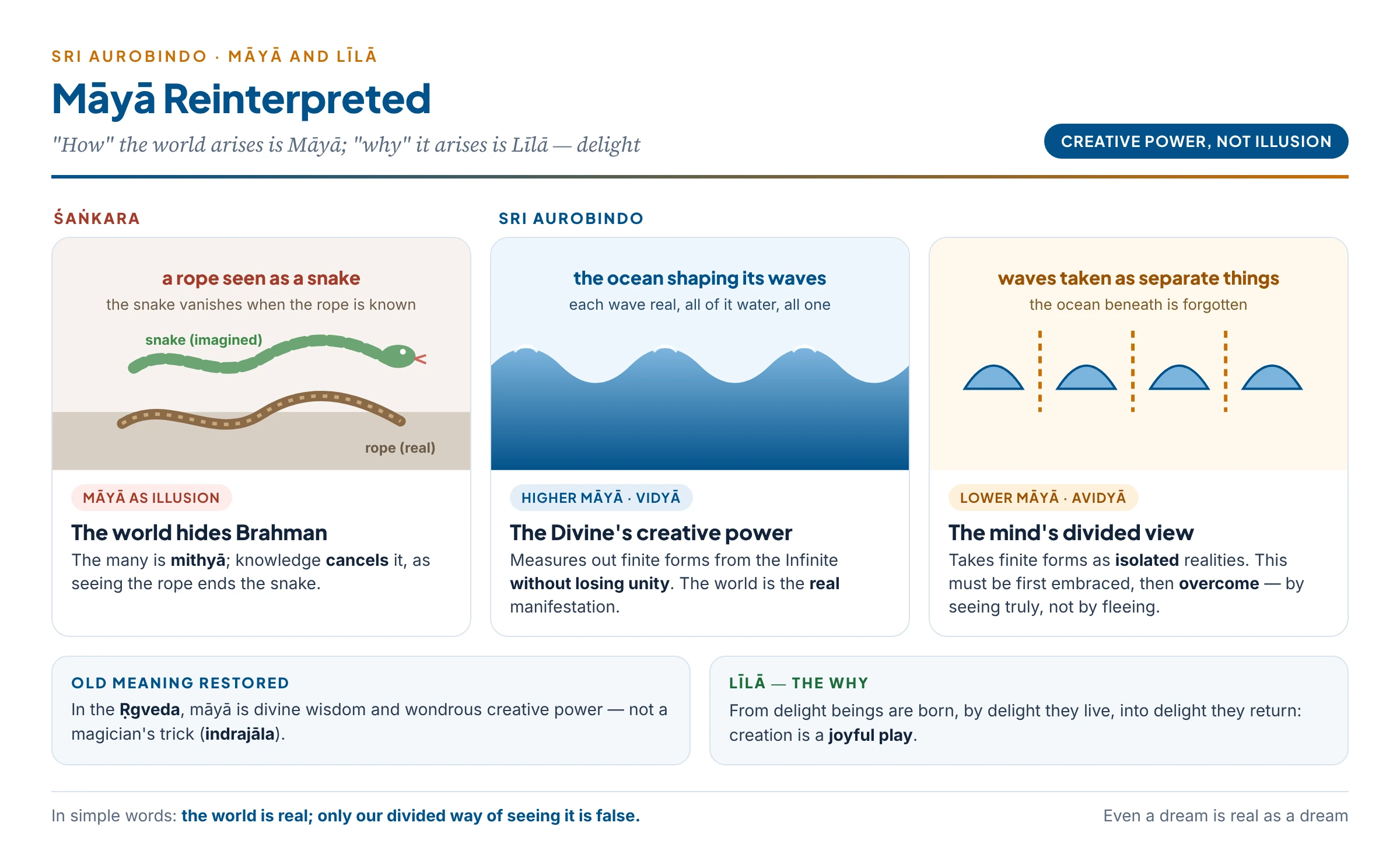
- Two questions about creation. To the question “why” creation? the answer is Līlā (divine play). To the question “how” creation? the answer is Māyā (creative power). The words are Vedāntic; the meanings are Aurobindo’s own.
- Līlā — creation as delight.
- Delight (Ānanda) is the secret of creation: it is the root of birth, the reason things remain in existence, and the end into which creation returns. The Taittirīya Upaniṣad says that from Ānanda all beings are born, by Ānanda they live and grow, and into Ānanda they depart.
- So creation is not a fall, a mistake or a punishment — it is a joyful game, played for no outside purpose.
- When we realise that the whole rhythm of the universe expresses delight, we become one with it. This delight of the world-process, seen from the side of Saccidānanda, is Līlā.
- Māyā — creative power, not illusion.
- In the Ṛgveda, māyā meant the divine wisdom and wonderful creative power by which the gods shape forms — not a magician’s trick (indrajāla).
- For Aurobindo, Māyā is the power of Saccidānanda to comprehend, contain and measure out finite forms from the Infinite Existence without losing its unity.
- The world is not unreal. Even if it were a dream, it would be real as a dream — real to itself in the present. And it is not a dream: it is the real manifestation of the Divine.
- Higher and lower Māyā.
- Higher Māyā (divine Māyā, Vidyā-Māyā) — the Divine’s sovereign power to manifest the Infinite in finite forms while knowing them as one.
- Lower Māyā (Avidyā-Māyā) — the divisive mental consciousness that takes finite forms as separate, self-standing realities and forgets their unity. This is the Māyā of Ignorance.
- The sense in which the world may be called illusion. Aurobindo keeps one meaning of the old word: if the world is viewed in relation to the supremely Real, it is not the essential truth of infinite existence, and our separative view of it is mistaken. So the deluding Māyā must first be embraced and then overcome — not by fleeing the world, but by seeing it truly.
Common confusion
Does Aurobindo reject the idea of Māyā completely? No. He rejects Māyā as cosmic illusion that makes the world false. He accepts Māyā as the Divine’s creative power (higher Māyā) and admits a lower Māyā — the mind’s habit of seeing things as separate. The world is real; what is false is our divided way of seeing it.
Ignorance: The Divine Hiding Itself
- Creation as the plunge of the Spirit into Ignorance. Our world arises when the Divine consciousness concentrates on parts of itself and holds back the knowledge of the whole.
- Ignorance is not a separate power. It is a partial self-withholding of the Divine consciousness — part and parcel of that consciousness, not its negation. It is knowledge hiding itself and appearing as something else.
- Some knowledge remains even in ignorance. Even in matter there is a very dim sentience; below even that lies the Inconscient, the complete self-concealment of Spirit.
- Two kinds of creation. The Absolute can create out of the fullness of its self-knowledge — a higher creation, a greater world that seers and sages glimpse. The question of creation is usually raised about the lesser world we live in, and this world is created through Ignorance.
- A mixed world. That is why our world is a mixture of light and darkness, truth and falsity. Yet because it is a self-concealment of the Divine, it is real and has a purpose — the gradual unveiling of the Divine within it.
In simple words
A great actor playing a beggar can be so absorbed in the role that, for the length of the play, he seems to forget he is a famous artist. The forgetting is real, and so is the play; yet the actor never stops being himself, and at the end he steps out of the role. Creation through Ignorance is like this: the Divine “forgets” itself in Matter, really plays the part, and slowly remembers itself through evolution.
Indian Connect — Avidyā in Aurobindo and Śaṅkara
For Śaṅkara, avidyā is beginningless, indescribable ignorance that superimposes an unreal world on Brahman; when knowledge dawns, the world is sublated. For Aurobindo, ignorance is the Divine’s deliberate self-limitation; when knowledge dawns, the world is transformed, not cancelled. The same word names a cosmic error in one system and a cosmic strategy in the other.
Integral Advaita as a Synthesis of the Vedānta Schools
| School | Truth it emphasised | Its place in Aurobindo |
|---|---|---|
| Śaṅkara’s Advaita | The transcendent Brahman beyond the world | Brahman in its transcendent, indeterminable poise |
| Rāmānuja’s Viśiṣṭādvaita | The cosmic aspect — God with souls and matter as his body | Brahman as Īśvara in cosmic existence |
| Madhva’s Dvaita | The individual souls, distinct and dependent on God | Brahman manifest as real individual selves |
- One Reality, three poises. Aurobindo affirms the truth of each school and harmonises them in Pūrṇādvaita. The old quarrel between nirguṇa and saguṇa Brahman is settled: both are true aspects of one Reality.
Critical Evaluation
Objections to Aurobindo’s Metaphysics
- Lack of scriptural orthodoxy. The idea of an evolution of consciousness towards a supramental stage is not clearly found in the Upaniṣads or the classical Vedānta texts; it looks more like speculation than interpretation of scripture.
- The Supermind seems ad hoc. Introduced to bridge the One and the Many, it is hard to define philosophically and appears designed to solve a problem rather than discovered.
- The problem of verification. The system rests on inner spiritual experience, not rational demonstration. Unlike Nyāya or Advaita, it offers no worked-out theory of pramāṇas. Are these universal truths or one mystic’s experiences?
- Ambiguity about evolution. Matter → life → mind → Supermind is appealing, but scientifically vague; “divine descent” and “spiritual ascent” seem symbolic rather than demonstrable.
- Elitism. Talk of “supramental man” and the “divinisation of life” inspires visionaries but is remote from ordinary people.
- The problem of evil and suffering. If the world is the real manifestation of the Divine, and creation is delight, why is there so much pain, cruelty and injustice? The vision can seem over-optimistic.
- Logical tension. How can one Reality be both changeless Being and changing Becoming? Appeals to the “logic of the Infinite” can look like an escape from logic.
- General charges. Some critics call the system an emotional and poetic expression rather than philosophy, an impractical imagination, too dependent on mystical experience and lacking logical grounds.
Replies and Strengths
- On scripture. Aurobindo never claimed to be a mere commentator. He holds that the Veda and the Upaniṣads themselves affirm the world (“All this is Brahman”, the Bhṛgu ladder) and that later world-negating schools narrowed them.
- On the Supermind. It is not invented from nothing: it develops the Vedic ṛta-cit (truth-consciousness) and the Upaniṣadic vijñāna. Every monism needs some account of how the One becomes the Many; Aurobindo makes that link explicit instead of calling the Many an illusion.
- On verification. All metaphysics at its frontier relies on some form of insight; Advaita too finally rests on anubhava (direct realisation). Aurobindo insists that experience be tested and ordered by reason — that is the meaning of integral knowledge.
- On evil. Ignorance and suffering belong to the stage of evolution, not to the goal. Pain arises from division and ignorance, and the whole movement of evolution is towards their removal. The system is hopeful, not blind: it admits darkness but denies it the last word.
- On logic. Ordinary logic is built for finite objects. John Hick, writing on religious pluralism, takes up Aurobindo’s phrase “the logic of the infinite” to ask whether predicates that clash when applied to finite things — personal and impersonal, for instance — may be complementary when applied to an infinite Reality.
- Strengths. It ends the opposition of science and spirituality, gives the world, the body and history real value, reconciles the Vedānta schools, and grounds ethics in the unity of all beings.
Critics and Defenders
Criticism — Critics
- Speculative: evolution of consciousness not found in classical texts.
- Unverifiable: rests on mystical experience, no pramāṇa theory.
- Ad hoc Supermind: a bridge built to order.
- Over-optimistic: does not explain evil and suffering.
- Elitist and poetic: inspiring but remote from common life.
Defence — Defenders and strengths
- Rooted in the Veda: “Matter also is Brahman”, “All this is Brahman”.
- Reason plus experience: integral knowledge tests insight by reason.
- Supermind explains the One and the Many without calling the world false.
- Evil belongs to the stage, not the goal of evolution.
- Reconciles materialism and spirituality, science and religion, the Vedānta schools.
Cross-Tradition Comparison
Śaṅkara and Sri Aurobindo
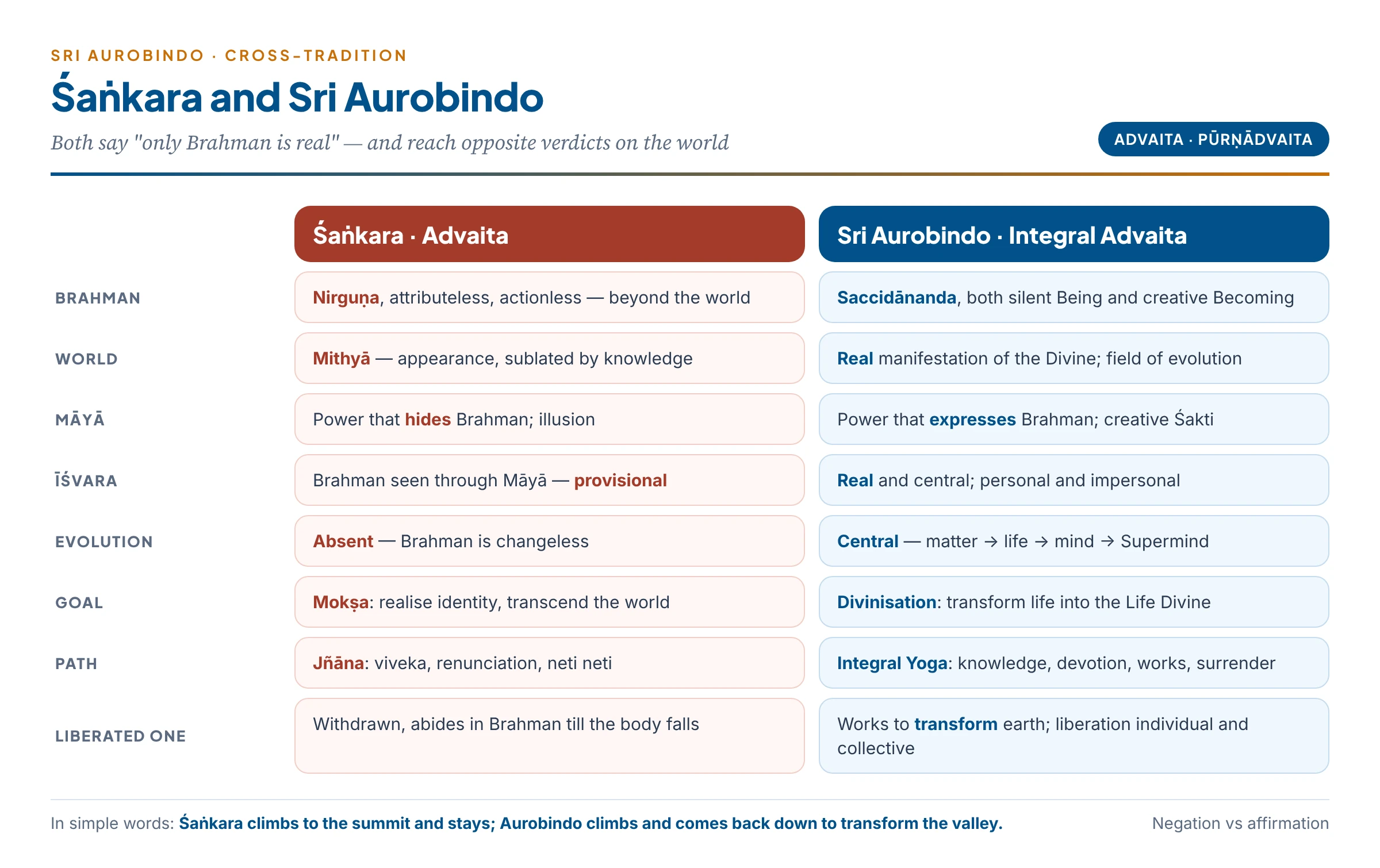
| Aspect | Śaṅkara (Advaita Vedānta) | Sri Aurobindo (Pūrṇādvaita) |
|---|---|---|
| Ultimate Reality | Nirguṇa Brahman — attributeless, beyond the world | Integral Reality — Saccidānanda, both static and dynamic |
| World | Mithyā — appearance, not ultimately real | Real manifestation of the Divine; field of divine play and transformation |
| Māyā | Negative — source of illusion, to be transcended | Positive — creative power (Śakti), vehicle of divine evolution |
| Self and Brahman | Ātman is identical with Brahman; avidyā causes bondage | The self is an evolving manifestation of the Divine, destined for supramental realisation |
| Īśvara | Brahman seen through Māyā — provisional, not ultimate | Real and central, both personal and impersonal, active in evolution |
| Evolution | Absent — Brahman is timeless and changeless | Central — the cosmos evolves from matter to life, mind and Supermind |
| Goal | Mokṣa — realising identity with Brahman; transcending the world | Divinisation — transforming human life into the Life Divine |
| Path | Jñāna-yoga — viveka, renunciation, śravaṇa–manana–nididhyāsana | Integral Yoga — knowledge, devotion, works and surrender to the Divine Śakti |
| Method of knowledge | Neti neti — removal of ignorance by negation | Aspiration, rejection of ego, surrender, integration of all yogas |
| Attitude to life | World-negating; embodied life is bondage | World-affirming; life is sacred and must be transformed |
| Liberated person | Withdrawn, abiding in Brahman-consciousness until the body falls | Engaged with life, working for the transformation of earth-consciousness |
| Scope of liberation | The individual soul freed from rebirth | Individual and collective — humanity’s evolution to higher consciousness |
| Tone | Negation, abstraction, transcendence | Affirmation, synthesis, dynamism |
| Influence | Classical Indian thought; basis of much later Vedānta | Modern Indian thought; synthesis of East and West; spiritual basis for social renewal |
Indian Connect — Key takeaways
- Same non-dualism, opposite verdict on the world: both say “only Brahman”, but for Śaṅkara the world is mithyā, for Aurobindo it is Brahman’s real becoming.
- Māyā changes its job: from the power that hides Brahman to the power that expresses Brahman.
- The goal moves from escape to transformation: not leaving the world, but making it divine.
- Aurobindo still respects Śaṅkara’s experience: the silent Brahman is real; it is only one poise of the integral Reality.
Other Indian Comparisons
| School | Its position | Aurobindo’s correction |
|---|---|---|
| Cārvāka | Only matter is real; consciousness is a product of the four elements | Matter is real but is Spirit involved; consciousness is primary, not a by-product |
| Sāṃkhya | Two eternal reals — inactive Puruṣa and unconscious Prakṛti | Prakṛti is the Cit-Śakti of Puruṣa; both are united in Saccidānanda |
| Buddhism | The world is impermanent and suffering; nirvāṇa is release from it | The world is not mere suffering; its impermanence is the movement of evolution |
| Rāmānuja | Souls and matter are real as the body of God | Agrees on reality and God’s immanence; adds evolution and a dynamic Supermind |
Western Parallels
| Thinker | Similarity | Difference |
|---|---|---|
| Hegel | The Absolute develops itself; becoming is real; history has a goal | Hegel’s Absolute unfolds through rational dialectic; Aurobindo’s through spiritual consciousness, known by experience, not concepts alone |
| Spinoza | One infinite substance; everything is in God | Spinoza’s God is impersonal necessity; Aurobindo’s Divine is conscious, blissful and personal too |
| Kant | The highest reality lies beyond the categories of the understanding | For Kant it is unknowable; for Aurobindo it is knowable by identity |
| Bergson | Reality is creative movement; intuition goes deeper than intellect | Bergson’s élan vital is blind; Aurobindo’s evolution is guided by Supermind |
| Whitehead | Reality is process; God is involved in the world’s becoming | Whitehead has no ladder of planes or descent of a higher consciousness |
Synthesis (Siddhānta)
- The core insight. Both the materialist and the ascetic are partial in their negation of each other. The materialist’s truth (the world is real) and the ascetic’s truth (the Spirit is real) are both kept; only their denials are dropped. What remains is one Reality, Saccidānanda, that is silent Being and creative Becoming at once.
- The world regains its dignity. Matter is not a prison and not a dream; it is Spirit in its most concealed form, with a future.
- Māyā and Līlā are rehabilitated. Māyā is the Divine’s creative power; Līlā is the delight for which the world exists; Ignorance is a self-concealment with a purpose.
- A bridge built. Between the two hemispheres of Spirit and Matter, Aurobindo places a ladder — Life, Mind, Supermind — which the next articles explore: the descent of Spirit (involution) and its ascent (evolution), the Supermind, the triple transformation and Integral Yoga.
- Contemporary relevance.
- Science and spirituality. A worldview in which evolution is real and meaningful lets the discoveries of science sit alongside the claims of spiritual experience.
- Ecology and the body. If Matter is Brahman, the earth and the body deserve reverence, not contempt.
- Ethics of unity. If all beings are forms of one Divine, care for others follows naturally — Aurobindo’s integral humanism has been read as a spiritual ground for justice, liberty, equality and fraternity.
“We perceive that in the Indian ascetic ideal the great Vedantic formula, ‘One without a second’, has not been read sufficiently in the light of that other formula equally imperative, ‘All this is the Brahman’.” — Sri Aurobindo
Previous Year Questions
- 2025“Both Ascetic and materialist are partial in their negation of each other.” Explain Sri Aurobindo’s integral philosophy in the light of the above statement.