

Schools of Vedānta: Brahman; Īśvara; Ātman; Jīva; Jagat; Māyā; Avidyā; Adhyāsa; Mokṣa; Apṛthaksiddhi; Pañcavidhabheda.
Official Syllabus: Paper I, Section B, Unit 19
Madhva (Madhvācārya, 13th century) gives Vedānta its most uncompromising realism and pluralism. Where Śaṅkara says “only Brahman is real, the many is appearance” and Rāmānuja says “the many is real but inseparable from God”, Madhva says difference itself is real, eternal and essential. God (Viṣṇu), souls and matter are eternally distinct; souls are distinct from one another; material things are distinct from one another. This is the doctrine of five-fold difference (pañcavidhabheda), the heart of his Dvaita (dualism) — which he himself called Tattvavāda, “the doctrine of reality”. Reality is divided into the independent (svatantra) — God alone — and the dependent (paratantra) — everything else. This article covers Madhva’s theory of knowledge and the witness (sākṣī), his God and arguments for God, the category of viśeṣa, the five differences and why they are real, souls and their gradation, the real world, and the four grades of liberation, with comparisons to Śaṅkara and Rāmānuja.
In simple words
Look at a box of crayons. Each crayon is different from every other, and each is different from the box that holds them; the box itself depends on the factory that made and maintains it. Nothing ever melts into anything else. Madhva sees reality this way: God is the “factory” on whom all depends; souls and things are the many crayons — each real, each different, forever.
Context & Problem
Life and Works
- Born at Pājaka near Uḍupi (Karnataka); traditionally 1238–1317 (another tradition gives 1199–1278).
- Names. Named Vāsudeva at birth; on renunciation under Acyutaprekṣa, called Pūrṇaprajña; later Ānandatīrtha. His followers regard him as an incarnation of Vāyu, the wind-god and chief servant of Viṣṇu.
- The Uḍupi Kṛṣṇa temple, which he founded, remains the centre of his tradition.
- Works. About 37 works, including commentaries on the Brahma-sūtra (Madhva-bhāṣya, Anuvyākhyāna), the Gītā and the Upaniṣads, and independent works such as Viṣṇu-tattva-nirṇaya and Tattva-saṅkhyāna.
- Successors. Jayatīrtha (the great commentator) and Vyāsatīrtha (the great dialectician, author of Nyāyāmṛta).
- School. Known as Brahma-sampradāya or Sad-Vaiṣṇavism. Madhva regarded Śaṅkara’s system as a dangerous misreading of the Vedas and attacked it more fiercely than anyone.
The Problem Madhva Faced
- Advaita makes difference unreal — and with it, devotion, ethics and God’s supremacy.
- Viśiṣṭādvaita keeps difference but makes souls and matter God’s body, which (Madhva thinks) still blurs the line between God and creatures and threatens God’s perfection.
- Madhva’s solution. Take difference with full seriousness: it is not a relation added to things but their very nature. God is utterly independent and perfect; everything else is real but dependent.
Core Doctrine
Theory of Knowledge: Pramāṇas, Sākṣī and Intrinsic Validity
- Kevala-pramāṇa and anu-pramāṇa.
- Kevala-pramāṇa — valid knowledge itself, the cognition that grasps its object as it is.
- Anu-pramāṇa — the means that lead to it: perception, inference and testimony (āgama).
- The witness (sākṣī). The soul’s own intuitive faculty of awareness — the highest means of knowledge.
- It directly knows the self, the mind and its states, pleasure and pain, time, space and even ignorance (“I do not know”).
- It is infallible — what the sākṣī knows is always true.
- It certifies the validity of all other knowledge.
- Intrinsic validity (svataḥ-prāmāṇya). Knowledge is valid by itself; its validity is grasped by the sākṣī, not by later tests.
- The principle of the foundational (upajīvya). A source that another source depends on cannot be overturned by it. Scripture depends on perception (we hear the words through the senses); so scripture cannot be interpreted to deny what perception reveals — such as difference. Hence the Advaitic reading of the Upaniṣads, which denies perceived difference, must be wrong.
- Domains. In worldly matters perception is supreme; for God and the supersensible, scripture (the Vedas) is supreme. The Vedas are authorless (apauruṣeya) and eternal; God is their great teacher, not author.
Svatantra and Paratantra: Two Orders of Reality
- Reality is real. Everything that exists is real; nothing is mithyā.
- But not equally independent.
- Svatantra (independent) — Viṣṇu alone, who depends on nothing for His existence, knowledge or activity.
- Paratantra / asvatantra (dependent) — everything else: souls, matter, time, space, karma, even Lakṣmī. They are real, often eternal, but they exist, know and act only by God’s will.
- Reality is not the same as independence. Śaṅkara assumes that what is dependent is unreal; Madhva separates the two: a thing can be fully real and wholly dependent.
God: Viṣṇu as Brahman
- Brahman = Viṣṇu = Nārāyaṇa = Hari, a personal God with infinite auspicious qualities and no defects.
- Saguṇa. “Nirguṇa” means free from the guṇas of prakṛti (sattva, rajas, tamas), not free from all qualities. “Neti neti” means God is different from everything finite.
- Only the efficient cause (nimitta-kāraṇa). God creates, sustains and dissolves the world but is not its material cause.
- If God were the material cause, He would change and share the imperfections and evil of the world.
- The material cause is prakṛti, real and eternal, which God shapes and controls.
- Creation is sport (līlā), without any need or purpose for God; it is a constant dependence, not a one-time event.
- His body is non-material, made of knowledge and bliss; His qualities are identical with Him (distinguished only by viśeṣa).
- Lakṣmī, His consort, is eternally free (nitya-muktā) but slightly lower than God and dependent on Him.
- The supreme ruler of souls. He binds and releases, damns and redeems, according to the souls’ nature and karma; He is pleased only by devotion.
- No internal difference (svagata bheda). Unlike Rāmānuja’s God, Madhva’s God has no real internal parts; His qualities and acts are one with Him.
Madhva’s Arguments for the Existence of God
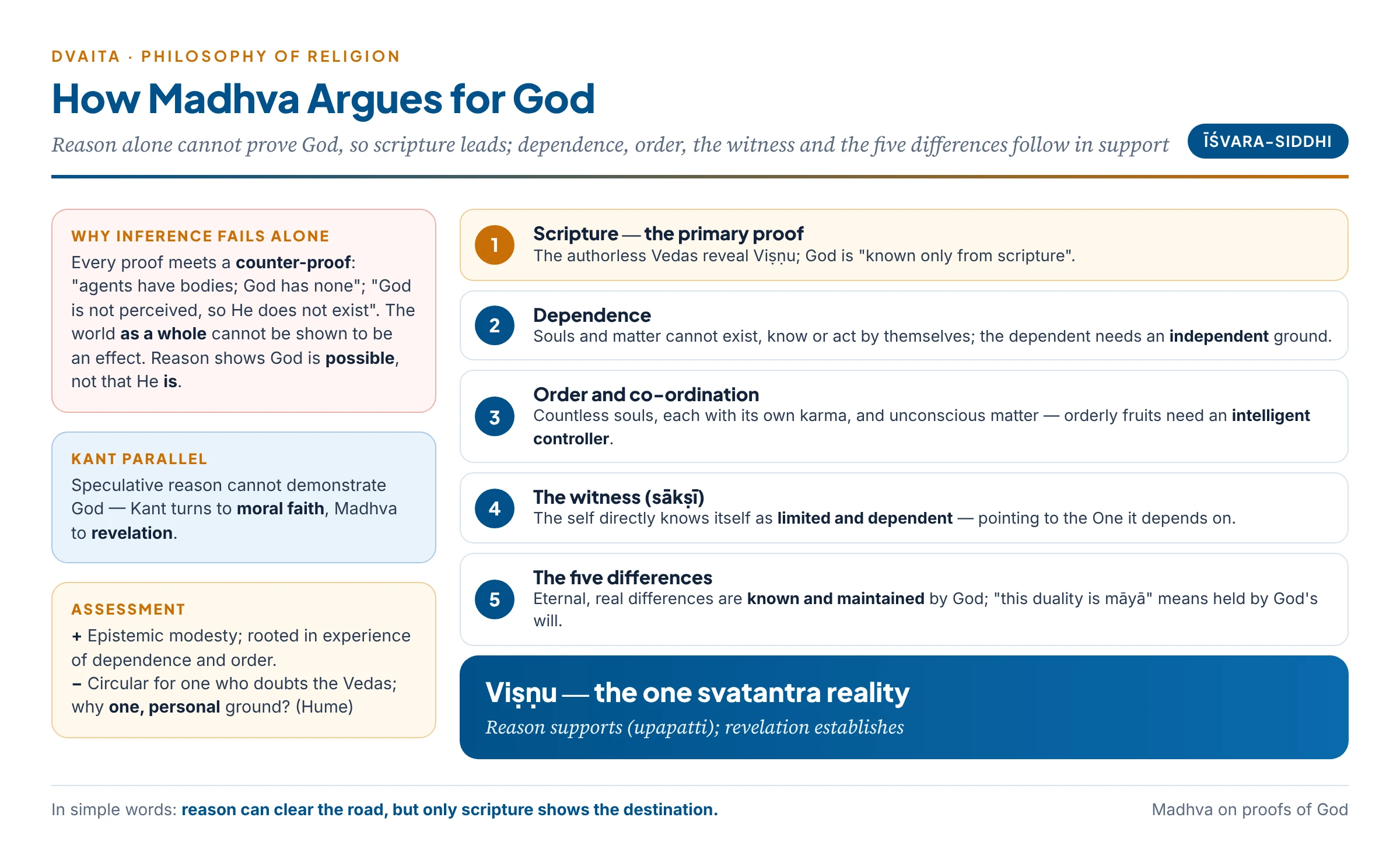
- Inference alone cannot prove God.
- Every inference for God can be met by an equal counter-inference — “the world is not made by an intelligent agent, because agents have bodies, and God has none”; or “God does not exist, because He is not perceived”.
- The Nyāya argument from effect-hood (the world is an effect, so it has a maker) is inconclusive: we cannot show that the world as a whole is an effect, and all makers we know are embodied and limited.
- So reason can show God’s possibility but not His existence; at best it supports (upapatti, anukūla-tarka) what scripture reveals.
- 1. Scripture — the primary proof. The authorless Vedas reveal Viṣṇu as the supreme, independent Lord. God is “known only from scripture” (śāstra-yoni).
- 2. The argument from dependence. All souls and matter are dependent — they do not exist, know or act by their own power. What is dependent requires an independent ground. That ground is Viṣṇu. (Compare the cosmological argument from contingency.)
- 3. The argument from order and co-ordination. Souls are countless, each with its own karma; matter is unconscious. The orderly distribution of bodies, experiences and fruits according to karma requires an intelligent controller who knows every soul’s deserts. (Compare the design argument.)
- 4. The witness’s testimony. The sākṣī directly knows the self as limited and dependent (“I am not my own master”) — and so points to the One on whom it depends.
- 5. The five differences require a Lord. The eternal, real differences among souls and things are known and maintained by God. Madhva reads the Māṇḍūkya verse “if the world existed, it would cease” realistically: the world, being beginningless, does not cease; “this duality is māyā” means it is known and protected by God’s will (māyā = God’s will), not that it is illusion.
- Evaluation.
- Strength — epistemic modesty: Madhva, like Kant, sees that speculative reason cannot demonstrate God.
- Strength — the dependence and order arguments draw on genuine features of experience.
- Weakness — resting the case on scripture is circular for one who doubts the Vedas.
- Weakness — the dependence argument faces Hume’s objection: why one independent ground, and why a personal one?
Viśeṣa: The Principle of Distinctness
- The problem. God and His qualities are identical; a substance and its qualities are identical. Yet we speak of them as different (“God is merciful”, “the cloth is white”). How?
- Madhva’s answer: viśeṣa. A unique power of distinctness in every substance that allows us to distinguish without real difference — a “difference-substitute” (bheda-pratinidhi).
- What it does.
- Explains how one thing can have many qualities without becoming many.
- Avoids an infinite regress of relations between substance and qualities.
- Prevents identity from collapsing into bare sameness.
- Influence. Caitanya’s school borrows viśeṣa for its “inconceivable difference-in-identity”. In the West, Leibniz’s principle of the identity of indiscernibles — no two things are exactly alike — is a related idea.
Svarūpa-bheda: Difference as the Very Nature of Things
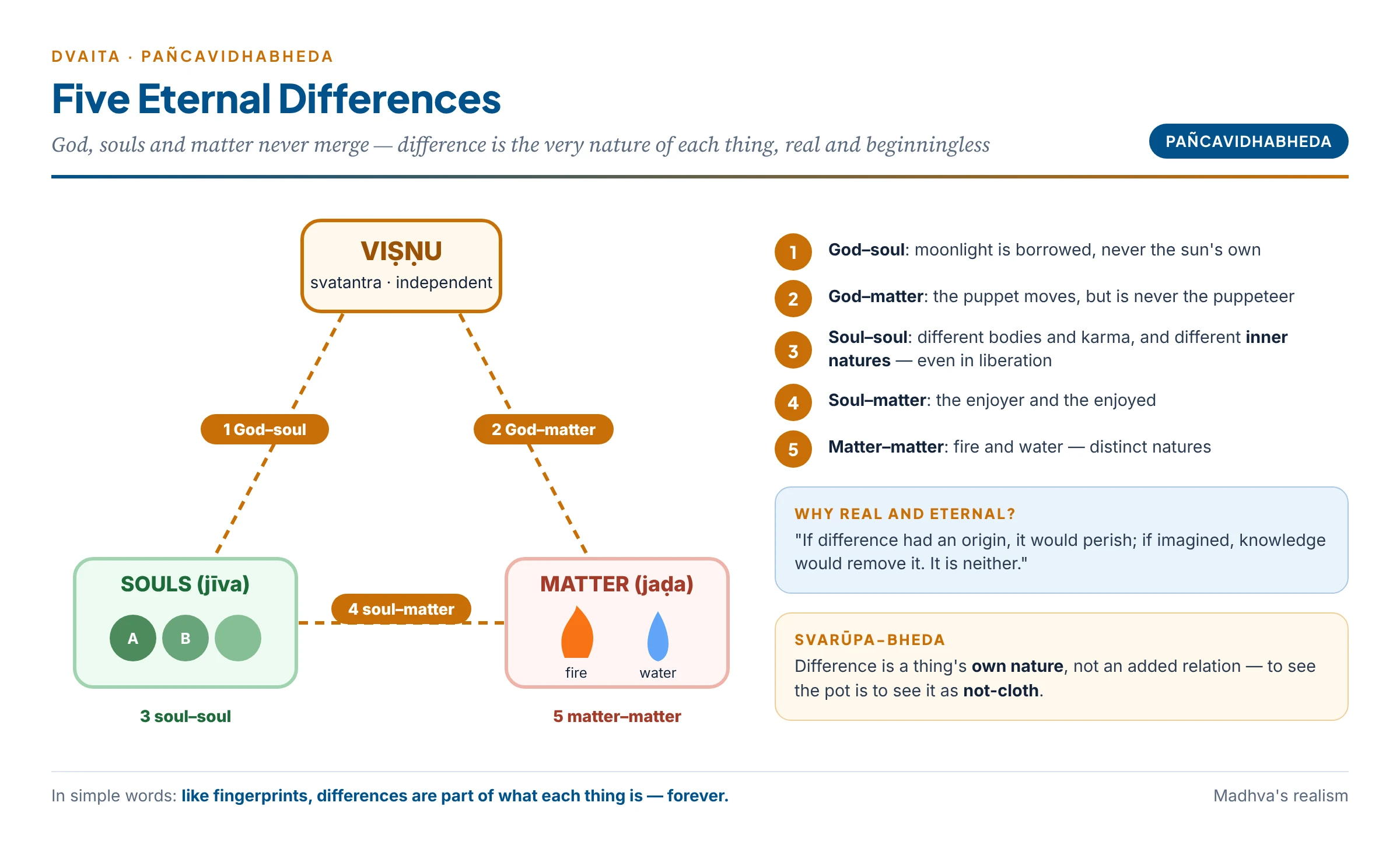
- Difference is not added to a thing. It is not an accidental (āgantuka) relation between two already-existing things; it is the thing’s own nature (svarūpa).
- To know a thing is to know its difference. When I see a pot, I see it as this pot — distinct from the cloth beside it. Grasping a thing and grasping its difference from others are one act.
- This answers the Advaitic objections. Advaitins (Śrīharṣa, Citsukha) argue: to perceive difference we must first perceive the two terms, which already presupposes difference — a circle; and if difference is a relation, it needs another relation — a regress. Madhva replies: since difference is the thing’s essence, perceiving the thing is perceiving its difference; no circle, no regress.
Pañcavidhabheda: The Five-fold Difference
| No. | Difference | Between | Illustration |
|---|---|---|---|
| 1 | Jīva–Īśvara | Soul and God | Moonlight and sunlight — the moon’s light is borrowed, dependent, never the sun’s |
| 2 | Jaḍa–Īśvara | Matter and God | Puppet and puppeteer — moved, but never the mover |
| 3 | Jīva–jīva | One soul and another | Two persons — each with his own nature, karma and bliss |
| 4 | Jaḍa–jīva | Matter and soul | The enjoyed and the enjoyer — food and the eater |
| 5 | Jaḍa–jaḍa | One material thing and another | Fire and water — distinct natures |
- Real and beginningless. “If difference had an origin, it would perish; if it were imagined, it would be removed by knowledge. It is neither; therefore it is eternal and real.”
- God–soul difference in detail: God is independent, omniscient, omnipotent, all-pervading, ever free; the soul is dependent, of limited knowledge and power, atomic, bound by karma. Even in liberation the soul never becomes God.
- God–matter difference: God is conscious and changeless; matter is unconscious and changing; God controls, matter is controlled.
- Soul–soul difference is both:
- Extrinsic — different bodies, minds and karma.
- Intrinsic — different inner natures and capacities for bliss, which persist even in liberation.
- Matter–matter difference: each material thing has its own nature (different proportions of the guṇas).
Common confusion
Pañcavidhabheda is not Rāmānuja’s “five forms of God”. Because both lists have five items and both belong to Vaiṣṇava Vedānta, students sometimes mix them. Rāmānuja’s five forms (para, vyūha, vibhava, antaryāmin, arcā) are five ways God manifests. Madhva’s pañcavidhabheda is five eternal differences among God, souls and matter. One is about God’s self-manifestation; the other about the structure of reality.
Why Differences Have Separate Existence and Constitute the Nature of Things
- The question. Why does Dvaita hold that differences are real in their own right and form the unique nature of things, rather than being appearances (Śaṅkara) or internal distinctions within one whole (Rāmānuja)?
- 1. Perception testifies to difference. Every perception is of this as distinct from that. Perception is the foundational source (upajīvya); scripture cannot be read to overturn it.
- 2. Inference supports it. “The soul is different from God, because it is subject to ignorance and suffering, which God is not — as a pot, having features a cloth lacks, is different from a cloth.”
- 3. Scripture teaches it.
- The Muṇḍaka speaks of two birds on one tree — one eats the fruit, the other only watches: soul and God.
- The same Upaniṣad: “Om is the bow, the self the arrow, Brahman the target” — archer, arrow and target are distinct.
- “Tat tvam asi” is read either as “atat tvam asi” — “thou art not That” (the words “sa ātmā tat tvam asi” can be divided as “sa ātmā atat tvam asi”) — or as a statement of similarity and dependence, as one says of a trusted minister, “he is the king”.
- 4. Knowledge itself is grasping difference. To know anything is to distinguish it; a reality without difference would be unknowable.
- 5. Difference is the thing’s svarūpa. Since difference is not a relation but the thing’s own nature, it exists with the thing — “separately” in the sense that it does not depend on any other principle — and gives each thing its uniqueness.
- Contrast. For Rāmānuja, differences belong within one organic identity (God and His body); for Madhva, they are absolute — nothing is a mode or part of anything else; God is related to the world only as independent to dependent.
In simple words
Your fingerprint is not something added to your finger from outside; it is simply what your finger is. No two fingers anywhere have the same print. Madhva says difference is like a fingerprint: not an extra relation stuck on to things, but part of what each thing is — which is why each soul and each thing is unique forever.
Significance of the Five Differences
- Grounds devotion (bhakti). Love needs a lover and a beloved; worship needs a worshipper and the worshipped. Without real difference, devotion is self-deception.
- Grounds ethics and responsibility. Each soul is distinct, with its own karma and its own destiny; no one can shelter behind a cosmic identity.
- Secures realism. The world is real, and scientific and practical knowledge of it is valid.
- Secures God’s supremacy. God is utterly independent and perfect; creatures can never usurp His place or taint Him with their imperfections.
- Refutes Advaita. The five differences, being real and beginningless, rule out the claim that difference is mithyā.
- Basis of gradation (tāratamya). Since souls differ intrinsically, there is a hierarchy among them — even in liberation.
Jīva: The Individual Soul
- Real and eternal, atomic in size, by nature conscious and blissful, though its bliss is obscured in bondage.
- A real agent — but a dependent one. The soul knows, acts and enjoys, but only by God’s power; God is the independent agent, the soul a dependent one.
- Reflection (pratibimba) of God. Madhva calls the soul a “reflection” of God — not to make it unreal, but to show its dependence, as a reflection depends on the original.
- Infinite in number, each unique in nature: qualitative and quantitative pluralism (unlike Rāmānuja’s qualitatively alike souls).
- Gradation (tāratamya). Souls are ranked from Lakṣmī and Vāyu at the top down to the lowest.
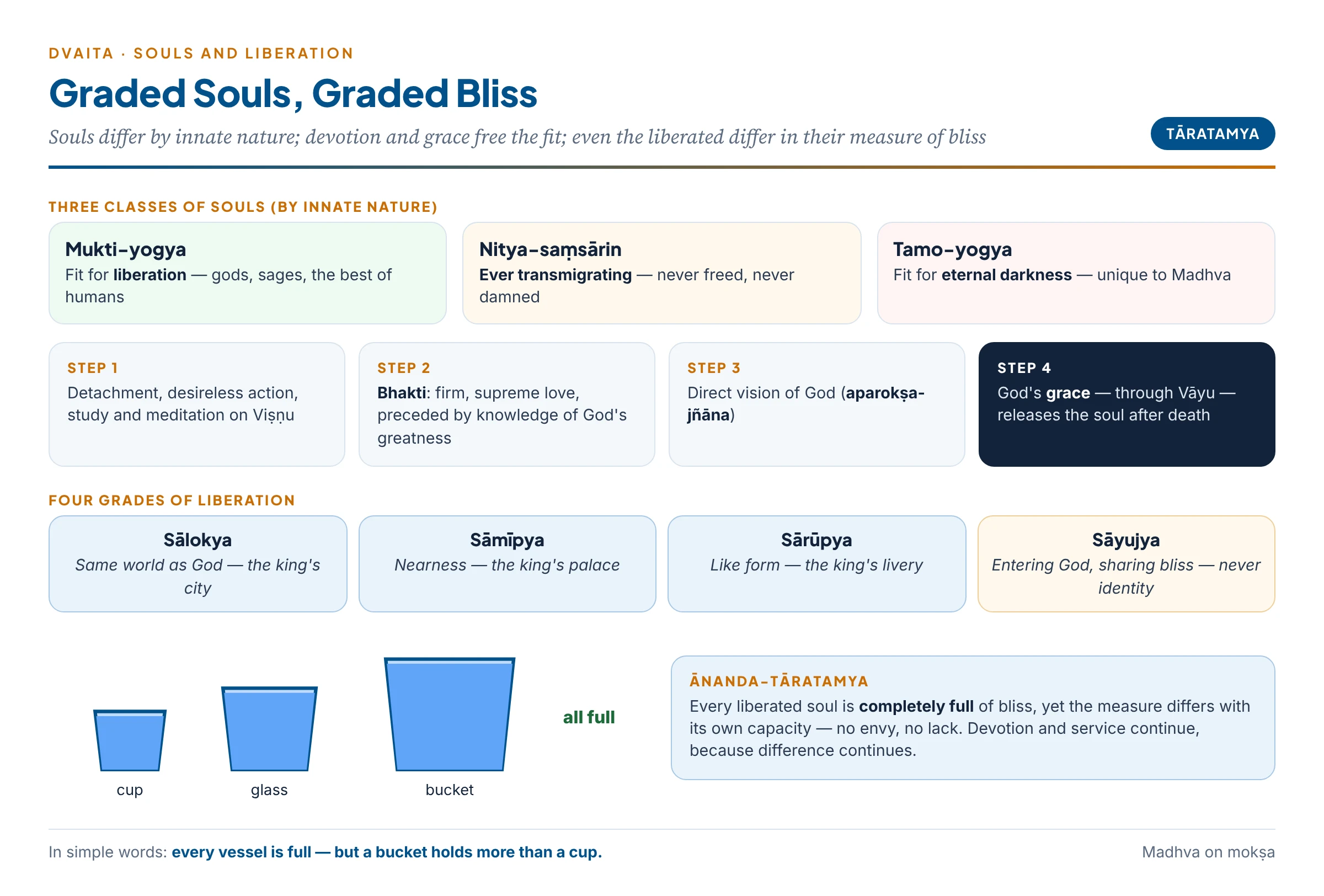
- Three classes of souls.
- Mukti-yogya — fit for liberation (gods, sages, the best of humans).
- Nitya-saṃsārin — eternally transmigrating, never liberated, never damned (middling souls).
- Tamo-yogya — fit for eternal darkness (andhatamas), the demonic souls.
- Destiny follows nature. A soul’s class depends on its innate nature (svarūpa-yogyatā); karma and effort work within it.
Common confusion
Is eternal damnation found anywhere else in Indian philosophy? Madhva is unique among Vedāntins in teaching that some souls are destined for eternal darkness. The nearest Indian parallel is Jainism’s abhavya souls, which can never attain liberation — but Jainism does not consign them to an eternal hell. All other Vedānta schools hold that every soul can eventually be liberated.
Jagat: The Real World
- The world is real, not mithyā. It is produced from prakṛti, which is real, eternal and the material cause, under God’s control.
- Prakṛti is unconscious, changing, composed of the three guṇas; God works on it as efficient cause.
- Satkāryavāda for matter. Effects exist in subtle form in prakṛti before they appear.
- Creation is continuous dependence. The world depends on God at every moment for its existence, as light depends on a lamp.
- Māyā = God’s will (īśvarecchā) or power and knowledge — sometimes identified with Lakṣmī — not illusion.
- Avidyā is the soul’s real, positive ignorance of its own nature and of God, which God sustains and can remove; it is located in the soul, not in Brahman.
- Dreams are real creations (from impressions, by God’s will) for the dreamer; the world is compared to a dream only for its impermanence, never for unreality.
Bondage and Liberation (Mokṣa)
- Bondage — the soul’s real ignorance and karma, which hide its blissful nature; it is beginningless and maintained by God’s will.
- Liberation is by God’s grace (prasāda), won through devotion.
- What devotion is. “Firm, supreme love for God, preceded by knowledge of His greatness, surpassing all other attachments” (māhātmya-jñāna-pūrvaḥ sudṛḍhaḥ sarvato’dhikaḥ snehaḥ).
- The path.
- Detachment and moral discipline; desireless action.
- Study (śravaṇa), reflection (manana) and meditation (upāsanā) on Viṣṇu.
- Devotion grows into direct vision of God (aparokṣa-jñāna).
- Pleased, God grants grace — often through Vāyu, the mediator — which removes bondage.
- Liberation after death. Though one who has seen God lives on until his remaining karma is exhausted, full liberation comes only when the body falls.
- Four grades of liberation.
| Grade | Meaning | Simple picture |
|---|---|---|
| Sālokya | Living in the same world as God (Vaikuṇṭha) | Living in the king’s city |
| Sāmīpya | Living near God | Living in the king’s palace |
| Sārūpya | Having a form like God’s | Wearing the king’s livery |
| Sāyujya | Entering God and sharing His bliss — but not becoming one with Him | Sitting at the king’s table |
- Graded bliss (ānanda-tāratamya). Even the liberated enjoy different degrees of bliss according to their intrinsic natures — “as vessels of different sizes are all full, yet hold different amounts”. Each is fully satisfied; none envies another. This doctrine is unique to Madhva.
- Devotion requires difference even in liberation: the liberated soul serves and worships God eternally.
In simple words
Fill a teacup, a glass and a bucket to the brim with water. Each is completely full — none can hold a drop more — yet the bucket holds far more than the cup. Madhva’s liberated souls are like this: every one is perfectly full of bliss, but the amount differs according to each soul’s own capacity.
Critical Evaluation
Objections to Dvaita
- The identity texts are strained. Reading “tat tvam asi” as “atat tvam asi” (“thou art not That”) or as mere similarity seems forced; “ahaṃ brahmāsmi” (“I am Brahman”) is harder still.
- Graded bliss diminishes liberation. If some liberated souls have less bliss, liberation is not perfect; hierarchy seems to carry worldly inequality into heaven.
- Eternal damnation contradicts divine compassion. A God of infinite goodness consigning souls to eternal darkness for their innate nature seems unjust.
- Predestination and freedom. If a soul’s class is fixed by nature, moral effort and responsibility seem pointless.
- The reality of difference is questioned. Advaitins (Śrīharṣa, Citsukha) argue that difference cannot be coherently defined or perceived.
- God only an efficient cause. An eternal, independent prakṛti beside God seems to limit God — a second ultimate, even if dependent.
- Pluralism and unity. Madhva has no answer to the Upaniṣadic longing for oneness — “where there is duality, there is fear”.
Dvaita Replies and Strengths
- Perception and scripture both show difference; an interpretation that denies it violates the foundational source.
- Graded bliss is not inequality of satisfaction — every liberated soul is full; differences reflect natures, not favouritism.
- Damnation follows the soul’s own nature; God does not create evil natures, which are beginningless.
- Prakṛti is dependent, so it does not limit God’s supremacy; dependence, not origin, defines creatureliness.
- The great debate. Vyāsatīrtha’s Nyāyāmṛta attacked Advaita point by point; Madhusūdana Sarasvatī’s Advaitasiddhi replied; the exchange (continued by later commentators) is counted among the finest in Indian dialectics.
Critics and Defenders
Criticism — Critics
- Advaitins: difference cannot be defined or perceived without circularity; the identity texts are distorted.
- Moral critics: eternal damnation and predestination clash with divine goodness and human freedom.
- Rāmānuja’s followers: absolute difference loses the Upaniṣadic unity of God and world.
- Madhusūdana: point-by-point refutation of the Nyāyāmṛta in the Advaitasiddhi.
Defence — Defenders and strengths
- Madhva: difference is the very nature of things; perception, inference and scripture all attest it.
- Jayatīrtha and Vyāsatīrtha: rigorous logical defence of realism and the five differences.
- Strength: clear basis for devotion, ethics and individual responsibility.
- Strength: epistemic modesty about proofs of God, like Kant.
- Strength: God’s absolute independence and perfection fully protected.
Cross-Tradition Comparison
Madhva, Śaṅkara and Rāmānuja
| Point | Śaṅkara (Advaita) | Rāmānuja (Viśiṣṭādvaita) | Madhva (Dvaita) |
|---|---|---|---|
| Reality | Brahman alone | One God qualified by souls and matter | God, souls, matter — eternally distinct |
| Difference | Mithyā | Internal (svagata), real | Absolute, essential (five-fold) |
| God’s causality | Material and efficient (via māyā) | Material and efficient (via body) | Efficient only |
| Souls | Brahman itself | Many, qualitatively alike | Many, qualitatively different, graded |
| World | Mithyā | Real, God’s body | Real, dependent on God |
| Māyā | Indescribable power of appearance | God’s real creative power | God’s will |
| Tat tvam asi | Identity | One God in two modes | “Thou art not That” / similarity |
| Liberation | Identity; jīvanmukti | Likeness, equal bliss, no damnation | Four grades, graded bliss, eternal damnation for some |
Madhva and Rāmānuja on Liberation
- Agreements. Both make bhakti and grace the means; both deny identity in liberation; both place the liberated in Vaikuṇṭha in service of Viṣṇu; both deny full liberation before death.
- Differences.
- Bliss: Rāmānuja — equal for all liberated; Madhva — graded (ānanda-tāratamya).
- Grades: Madhva — four grades (sālokya to sāyujya); Rāmānuja — one state of likeness (sādharmya).
- Who can be liberated: Rāmānuja — all souls eventually; Madhva — only the mukti-yogya; some eternally bound, some damned.
- Relation: Rāmānuja — the liberated are God’s body (inseparable modes); Madhva — they remain absolutely distinct dependants.
- Mediation: Madhva gives Vāyu a role as mediator of grace; Rāmānuja stresses prapatti and Lakṣmī’s intercession.
- Devotion: Madhva defines it as love preceded by knowledge of God’s greatness; Rāmānuja as steady remembrance that becomes vision.
Western Parallels
| Point | Madhva | Western parallel | Similarity | Difference |
|---|---|---|---|---|
| Predestination | Three classes of souls by innate nature | Calvin — the elect and the reprobate | Destiny fixed beyond human choice | Calvin grounds it in God’s decree, Madhva in beginningless natures |
| Creator–creature gap | God and souls eternally distinct | Aquinas, Christian theism | God utterly transcendent; no identity | Christian matter created from nothing; Madhva’s prakṛti eternal |
| Uniqueness | Viśeṣa; every soul unique | Leibniz — identity of indiscernibles | No two things alike | — |
| Proofs of God | Reason inconclusive; scripture primary | Kant — speculative proofs fail; moral faith | Limits of theoretical reason | Kant turns to morality, Madhva to revelation |
Indian Connect — Key takeaways
- Dvaita and Nyāya–Vaiśeṣika share realism and pluralism; Madhva even adopts viśeṣa, but rejects Nyāya’s inference to God.
- Dvaita and Jainism both posit souls that can never be liberated (abhavya / nitya-saṃsārin and tamo-yogya).
- Dvaita and Caitanya: Caitanya’s school, historically linked to Madhva’s, borrows viśeṣa for “inconceivable difference-in-identity”.
Synthesis (Siddhānta)
- Dvaita (Tattvavāda): reality is real and divided into the independent (Viṣṇu) and the dependent (souls, matter, time…).
- Knowledge: three means plus the infallible sākṣī; intrinsic validity; perception is foundational and cannot be overturned by scripture.
- God: Viṣṇu, full of auspicious qualities, only the efficient cause, creator, sustainer, damner and redeemer, pleased by devotion; qualities identical with Him through viśeṣa.
- Arguments for God: inference inconclusive; scripture primary, supported by dependence, order, the witness and the five differences.
- Pañcavidhabheda: God–soul, God–matter, soul–soul, soul–matter, matter–matter — eternal, real, the very nature of things.
- Significance: devotion, ethics, realism, God’s supremacy, refutation of Advaita, and gradation.
- Souls: atomic, blissful, dependent agents, qualitatively different and graded; three classes — fit for liberation, eternally transmigrating, fit for darkness.
- World: real, from eternal prakṛti; māyā is God’s will; avidyā the soul’s real ignorance.
- Liberation: devotion preceded by knowledge of God’s greatness → direct vision → grace; four grades; graded bliss; only after death.
- Contemporary relevance.
- Respect for individuality. Every soul is unique and irreplaceable — a metaphysical basis for the dignity of each person.
- Realism. A world fully real supports scientific inquiry and environmental responsibility.
- Humility of reason. Madhva’s view that reason cannot prove God anticipates modern philosophy of religion’s caution about theistic proofs.
“In Madhva’s doctrine Hari is supreme; the world is real; difference is real; the souls are servants of Hari, of higher and lower grades; liberation is the pure experience of one’s own bliss; pure devotion is its means; perception, inference and scripture are the means of knowledge; and Hari is known through all the Vedas.” — verse attributed to Vyāsatīrtha
Previous Year Questions
- 2026Why does the Dualistic School of Vedānta consider that differences (Bhedas) have separate existence and constitute the unique nature of things? Answer with reference to the theory of five-fold difference (Pañcavidhabheda).
- 2026Explain and examine Madhvācārya’s arguments for the existence of God.
- 2022How does the concept of Liberation (Mokṣa) of Madhvācārya differ from that of Rāmānujācārya? Explain.
- 2021Explain the status of jīva and jagat in the philosophy of Madhvācārya.
- 2020Point out the significance of the five-fold differences in the Dualistic School of Vedānta.
- 2015Write short note on Pañcavidhabheda.
- 2013Describe the five types of differences (Pañcavidhabheda). Bring out their philosophical significance for Madhva’s theory.
- 2005The nature of Brahman, Jīva and Jagat according to Madhva (short note).
- 2004Madhva’s conception of mokṣa (note).