

Schools of Vedānta: Brahman; Īśvara; Ātman; Jīva; Jagat; Māyā; Avidyā; Adhyāsa; Mokṣa; Apṛthaksiddhi; Pañcavidhabheda.
Official Syllabus: Paper I, Section B, Unit 19
Rāmānuja (1017–1137) gives Vedānta a theistic and realistic reading. There is only one ultimate reality — Brahman — so his system is a non-dualism (advaita). But that one Brahman is qualified (viśiṣṭa) by real souls (cit) and real matter (acit), which are related to Him as a body is related to its soul. Hence the name Viśiṣṭādvaita: “non-dualism of the qualified (Brahman)“, often called qualified monism. The world is not an appearance (as in Śaṅkara) but God’s real body; souls are not Brahman in disguise but His real, eternal modes. The key to the whole system is a special relation — apṛthaksiddhi, inseparable dependence — which holds the many inside the one without destroying either. This article explains Rāmānuja’s Brahman, the three reals (tattva-traya), apṛthaksiddhi, the body–soul relation, souls and matter, attributive consciousness (dharmabhūtajñāna), creation as real transformation, his theory of knowledge and error, and the difficulties critics find in relating God to souls and matter.
In simple words
Think of a person and her body. You cannot meet “the person” anywhere except in and through her body; yet the person is not the same as the body — she controls it, holds it together and uses it for her purposes. Rāmānuja says the whole universe of souls and matter is like God’s body, and God is the soul of that body. One person, many limbs; one God, many souls and things.
Context & Problem
Life and Background
- Born at Śrīperumbūdūr near Kāñcī (Tamil Nadu); studied first under Yādavaprakāśa, a bhedābheda teacher, and broke with him over the interpretation of the Upaniṣads.
- Successor of Yāmuna (Yāmunācārya), head of the Śrīvaiṣṇava order, he became head of the temple-monastery of Śrīraṅgam.
- Two streams joined. He united the Upaniṣadic tradition of Vedānta with the devotional tradition of the Ālvārs — the Tamil saint-poets of Viṣṇu — and the Pāñcarātra Āgamas, which he accepted as authoritative.
- Works. Śrībhāṣya (commentary on the Brahma-sūtra), Vedārtha-saṅgraha, Gītā-bhāṣya, Vedānta-sāra, Vedānta-dīpa.
- Later tradition. Vedānta Deśika (Venkaṭanātha) and Piḷḷai Lokācārya developed the system; their followers became the northern (Vaḍakalai) and southern (Teṅkalai) schools.
The Problem Rāmānuja Faced
- How does the one become many? The Upaniṣads say both “all this is Brahman” (unity) and that Brahman is the Lord distinct from souls and world (difference).
- Śaṅkara’s answer keeps unity by making the many mithyā — appearance through māyā.
- Rāmānuja’s dissatisfaction.
- It makes the world and the individual soul unreal, and devotion to a personal God a lower truth.
- It requires a mysterious, indescribable māyā, which he thinks cannot be defended.
- It reads the Upaniṣadic texts of difference as merely provisional.
- His solution. Accept both sets of texts as true: Brahman is one, but a one that contains real difference inside it, as an organism contains its limbs — “identity qualified by difference“.
Why the Name “Viśiṣṭādvaita”?
- Advaita (non-dualism): there is only one ultimate reality, Brahman; nothing exists independently of Him — no second reality outside.
- Viśiṣṭa (qualified): this one Brahman is qualified by cit and acit, which are real and eternal.
- The formula. Brahman is “qualified by inseparable attributes” (apṛthaksiddha-viśeṣaṇa-viśiṣṭaṃ brahma).
- Other names. Qualified monism, organic monism, attributive monism, “identity-in-and-through-difference“.
Core Doctrine
Theory of Knowledge: Three Means and Determinate Knowledge
- Three means of valid knowledge (pramāṇa): perception, inference and testimony (śabda) — scripture being supreme for knowing God.
- All knowledge is determinate (savikalpa). We never know a bare “something” without qualities.
- Indeterminate perception (nirvikalpa) is not knowledge of a quality-less object; it is simply the first perception of an object, already with some features.
- Determinate perception (savikalpa) is a later perception, in which we recognise the object as belonging to a class (“this is a cow, like the one I saw before”).
- Consequence. Since every knowledge is of a qualified object, a quality-less (nirviśeṣa) Brahman can never be known by any means — this is the base of his attack on Śaṅkara.
- Unity of scripture. The Pāñcarātra is authoritative; Pūrva Mīmāṃsā (inquiry into ritual) and Uttara Mīmāṃsā (Vedānta) form one single science — knowledge of duty precedes and prepares knowledge of Brahman.
- Judgement is a synthesis of distincts. A judgement such as “the cloth is white” does not assert bare identity; it asserts that one substance is qualified by two different features. Likewise “this is that Devadatta” — the same man qualified by this time-and-place and that time-and-place. Śaṅkara drops both qualifications to reach pure identity; Rāmānuja keeps both.
Tattva-traya: The Three Reals
- Three ultimate realities, all real and eternal:
- Cit — conscious, individual souls (jīvas).
- Acit — unconscious matter.
- Īśvara — God, Brahman, the Lord.
- Not three independent reals. Cit and acit are real but dependent; only Īśvara is independent. They form one organic unity — God qualified by souls and matter.
- Scriptural basis. The Śvetāśvatara speaks of the enjoyer (bhoktṛ, the soul), the enjoyed (bhogya, matter) and the mover (preritṛ, God) — “all three are Brahman”.
Brahman: Saviśeṣa — Personal and Full of Good Qualities
- Brahman = Īśvara = Nārāyaṇa / Viṣṇu, with his consort Lakṣmī, dwelling in Vaikuṇṭha. There is no distinction between Brahman and Īśvara (unlike Śaṅkara).
- Saviśeṣa (with attributes). Brahman is saguṇa — possessed of infinite auspicious qualities (ananta-kalyāṇa-guṇa): omniscience, omnipotence, compassion, love, beauty.
- Satya, jñāna, ananta — reality, knowledge, infinity — and sat–cit–ānanda are His qualities, not His bare essence.
- Heya-pratyanīka — He is opposed to all evil; nothing defective can touch Him.
- What “nirguṇa” texts mean. When scripture calls Brahman “without qualities”, it means He is free from bad qualities (and from the guṇas of matter), not that He has no qualities at all.
- Three kinds of difference (bheda).
- Sajātīya — from things of the same kind (one tree from another tree).
- Vijātīya — from things of a different kind (a tree from a stone).
- Svagata — internal difference within a thing (the leaves, branches and trunk of one tree).
- Brahman has no sajātīya difference (no second God) and no vijātīya difference (nothing outside Him), but has svagata difference — souls and matter within Him. (Śaṅkara denies all three.)
- Material and efficient cause. Brahman is both: the material cause through His body (cit–acit), the efficient cause through His will.
Refutation of the Quality-less Brahman (Nirviśeṣa)
- No means of knowledge reveals it. Perception, as shown, is always of a qualified object.
- Language cannot express it. Every word has a root and a suffix and conveys a qualified meaning; a sentence relates several meanings. Even “the quality-less” describes Brahman by a quality.
- Inference works through marks and features — it can prove only what has features.
- Scripture describes Brahman with qualities everywhere; the negative texts deny bad qualities and limitations, and “one without a second” denies another equal reality, not internal difference.
- Consciousness is always someone’s consciousness and always of something; objectless, subjectless consciousness is never found.
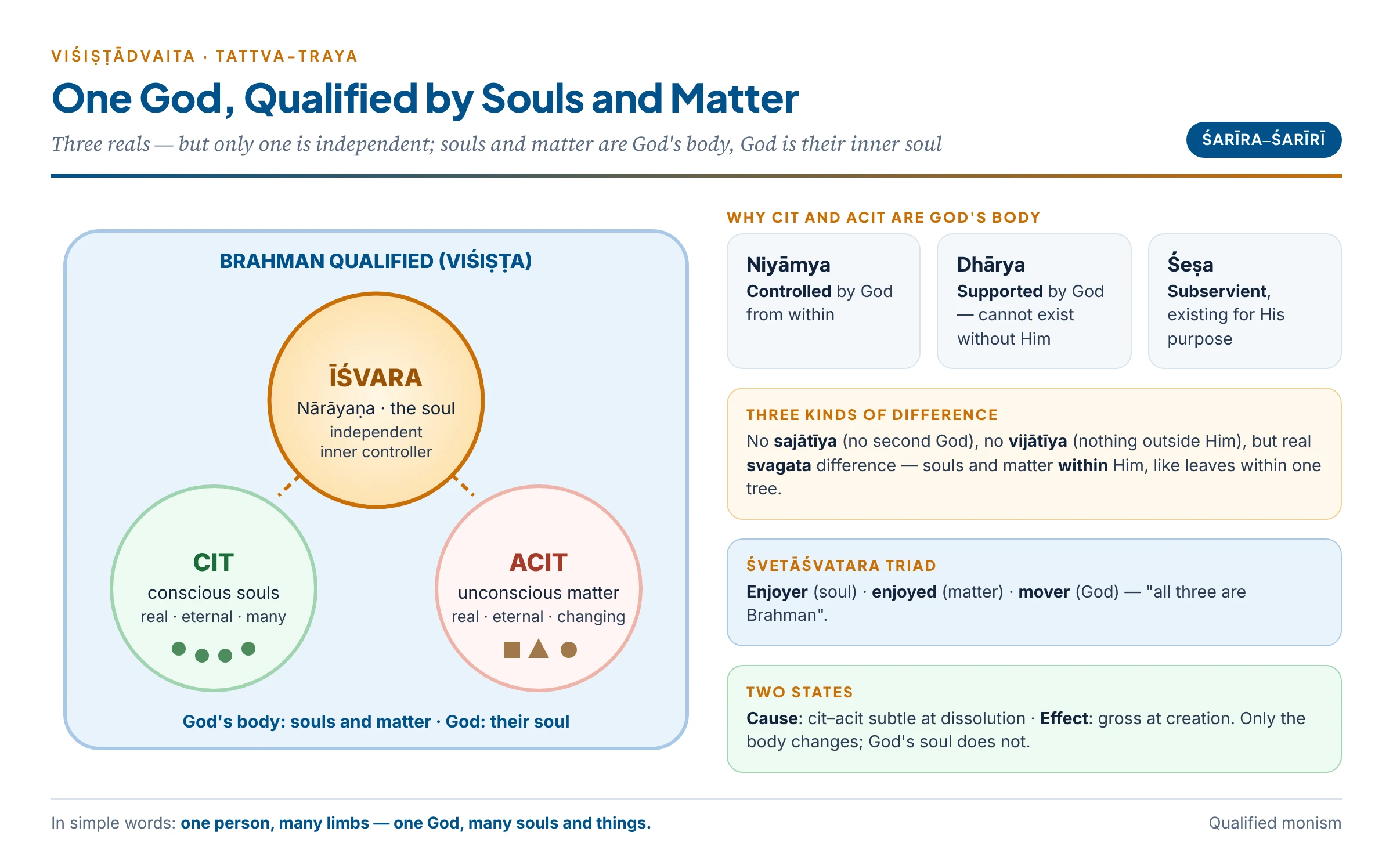
Śarīra–Śarīrī: The World as God’s Body
- The definition of body. “Any substance which a conscious being controls completely, supports completely and uses for its own purposes, and which is entirely subordinate to it, is the body (śarīra) of that being.”
- Three marks of being God’s body.
- Niyāmya — controlled by God from within.
- Dhārya — supported by God; it cannot exist without Him.
- Śeṣa — subservient, existing for God’s purpose, as a servant for a master.
- God as the inner controller (antaryāmin). The Upaniṣad says: “He who dwells in the earth, whom the earth does not know, whose body the earth is, who controls the earth from within — He is your Self, the inner controller, the immortal.” The same is said of water, fire, the soul and everything.
- One relation seen in five ways.
| Pair | God is… | Cit–acit are… | Simple example |
|---|---|---|---|
| Ādhāra–ādheya | Support | Supported | A table supports a book |
| Niyantṛ–niyāmya | Controller | Controlled | A driver controls a car |
| Śeṣin–śeṣa | Principal, owner | Accessory, servant | A master and servant |
| Prakārin–prakāra | Substance | Mode | A lotus and its blueness |
| Aṃśin–aṃśa | Whole | Part | A tree and its leaves |
- Why this matters. The body–soul model lets Rāmānuja say both: the world is real (a real body) and one with God (it has no being apart from its soul). All words ultimately denote God — “the cow” denotes the cow-body and, through it, the soul within and God within the soul.
Apṛthaksiddhi: The Inseparable Relation
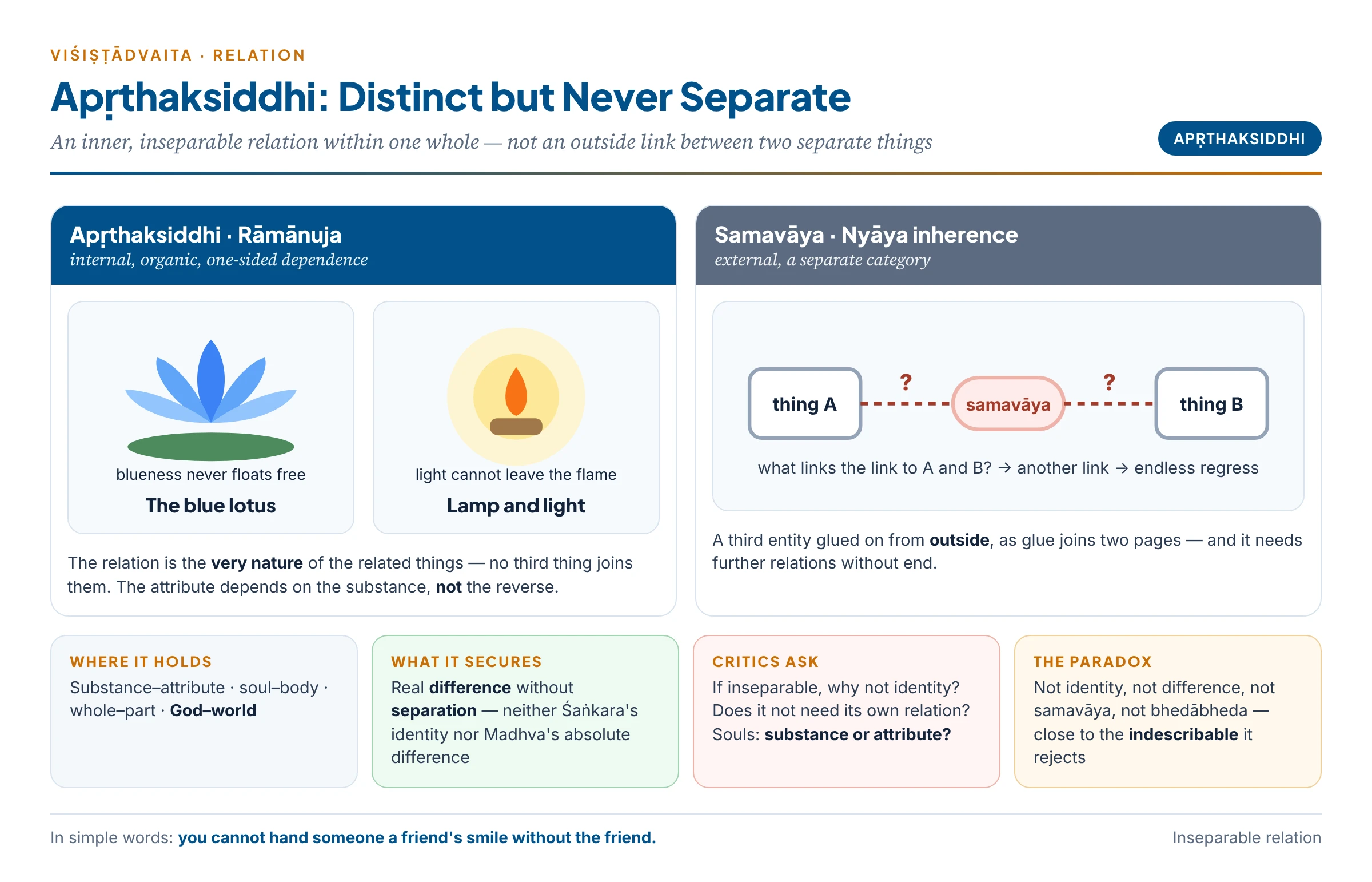
- Meaning. Apṛthak = not separate; siddhi = existence or establishment. Apṛthaksiddhi is the relation in which one entity cannot exist or be known apart from another, though the two remain distinct.
- Where it holds.
- Substance and attribute — the lotus and its blueness.
- Soul and body — the soul and the body it controls.
- Whole and part — the tree and its branches.
- God and the world — Brahman and cit–acit.
- The examples.
- The blue lotus. Blueness is not the lotus, yet blueness cannot exist apart from the lotus; we never find “blue” floating free.
- Lamp and light. Light is distinct from the flame, yet it cannot be separated from it.
- Features of the relation.
- Internal — it belongs to the very nature (svarūpa) of the related things; no third thing joins them.
- Inseparable — the dependent term cannot exist apart.
- Vital and organic — like a living body, not like bricks glued together.
- One-sided dependence — the attribute depends on the substance, not the substance on the attribute; souls depend on God, God does not depend on souls.
- Why not Nyāya’s samavāya (inherence)?
- Samavāya is external — a separate category that comes from outside to tie two different things, as glue ties two pages.
- It leads to infinite regress — if samavāya is a third thing relating A and B, what relates samavāya to A and to B? Another relation, and so on without end.
- Apṛthaksiddhi avoids this because it is not a third entity; it is the very nature of the related terms. In short, samavāya joins two different things from outside; apṛthaksiddhi is a distinction within one organic whole.
- Why the relation is crucial. It allows real difference (souls and matter are not God) without separation (they cannot exist apart from God) — avoiding both Śaṅkara’s denial of difference and Madhva’s absolute difference.
In simple words
Try to hand someone “the smile” of a friend without the friend. Impossible — the smile is real and different from the face, but it has no existence apart from the face. That is apṛthaksiddhi. Souls and the world are God’s “smile”: real, distinct, but never existing apart from Him.
Critical Comments on Apṛthaksiddhi
- Redundancy. If the attribute can never exist apart from the substance, why call it different at all? Inseparability looks like identity under another name.
- Regress returns. Advaitins ask: does apṛthaksiddhi relate itself to its terms without any further relation? If yes, why not say the same of samavāya? If no, regress follows.
- The dependence problem. Souls are called substances (they have their own attributes, such as knowledge) and also attributes of God. A dependent attribute with its own substantiality is hard to understand.
- Mixing of models. Substance–attribute, body–soul and whole–part are three different relations; Rāmānuja uses them interchangeably as if they were one.
- Advaita’s objection. A relation between two real distincts keeps duality; mere “inseparability” cannot convert two into one.
- Nyāya’s objection. It is only samavāya renamed.
- The paradox. The relation is said to be not identity (abheda), not difference (bheda), not samavāya and not identity-and-difference (bhedābheda). Then it seems indescribable — close to the anirvacanīya Rāmānuja condemns in Śaṅkara, or to the “inconceivable” (acintya) of Caitanya.
- Defence. Rāmānuja replies that inseparability is a fact of experience (we never see a colourless lotus or a lightless flame), and that every relation must finally be self-linking; inseparability is the most natural candidate.
Bhedābheda and Viśiṣṭādvaita
| Point | Bhedābheda (Bhāskara, Yādava, later Nimbārka) | Viśiṣṭādvaita (Rāmānuja) |
|---|---|---|
| Formula | Identity and difference, equally real | Identity qualified by difference |
| Status of difference | Co-equal with identity | Subordinate — attributes depend on the substance |
| What changes in creation | Brahman itself (Bhāskara: through real limiting adjuncts) | Only Brahman’s body, not His soul |
| Rāmānuja’s objection | If Brahman really becomes the soul, Brahman suffers the soul’s ignorance and pain | — |
Creation: Brahma-pariṇāmavāda
- Two states of Brahman.
- Kāraṇa-brahman (Brahman as cause) — at dissolution (pralaya), cit and acit exist in a subtle (sūkṣma) state, without distinct names and forms.
- Kārya-brahman (Brahman as effect) — at creation, they become gross (sthūla) — the visible world of names and forms and embodied souls.
- Real transformation. The world is a real transformation (pariṇāma) of Brahman’s body, as milk really becomes curd — Brahma-pariṇāmavāda, a form of satkāryavāda (the effect pre-exists in the cause).
- God’s soul does not change. Only the body changes, as a person remains the same through childhood, youth and old age while the body changes.
- Why create? Sport and karma reconciled. Creation is God’s līlā (sport) — He needs nothing. Yet the variety of creatures — happy and unhappy — follows the souls’ own past karma, so God is neither cruel nor partial.
- The process.
- God wills to become many (out of compassion and sport).
- Subtle prakṛti evolves into the categories (mahat, ahaṅkāra, mind, senses, subtle and gross elements), much as in Sāṃkhya, but under God’s control.
- Trivṛtkaraṇa (tripartition): God makes each of the three elements fire, water and earth tripartite — half of itself and a quarter of each of the other two — so that every object contains all elements.
- Maintenance by God’s will; dissolution is the re-absorption of everything into the subtle state.
Common confusion
Trivṛtkaraṇa is not a mixing of the three guṇas. Some notes describe tripartition as the mixing of sattva, rajas and tamas. In the Chāndogya, which Rāmānuja follows, trivṛtkaraṇa mixes the three elements — fire, water and earth — each becoming half itself and a quarter of each of the other two. It is the elemental basis of his theory of error (every object contains a little of everything).
Acit: Three Kinds of Matter
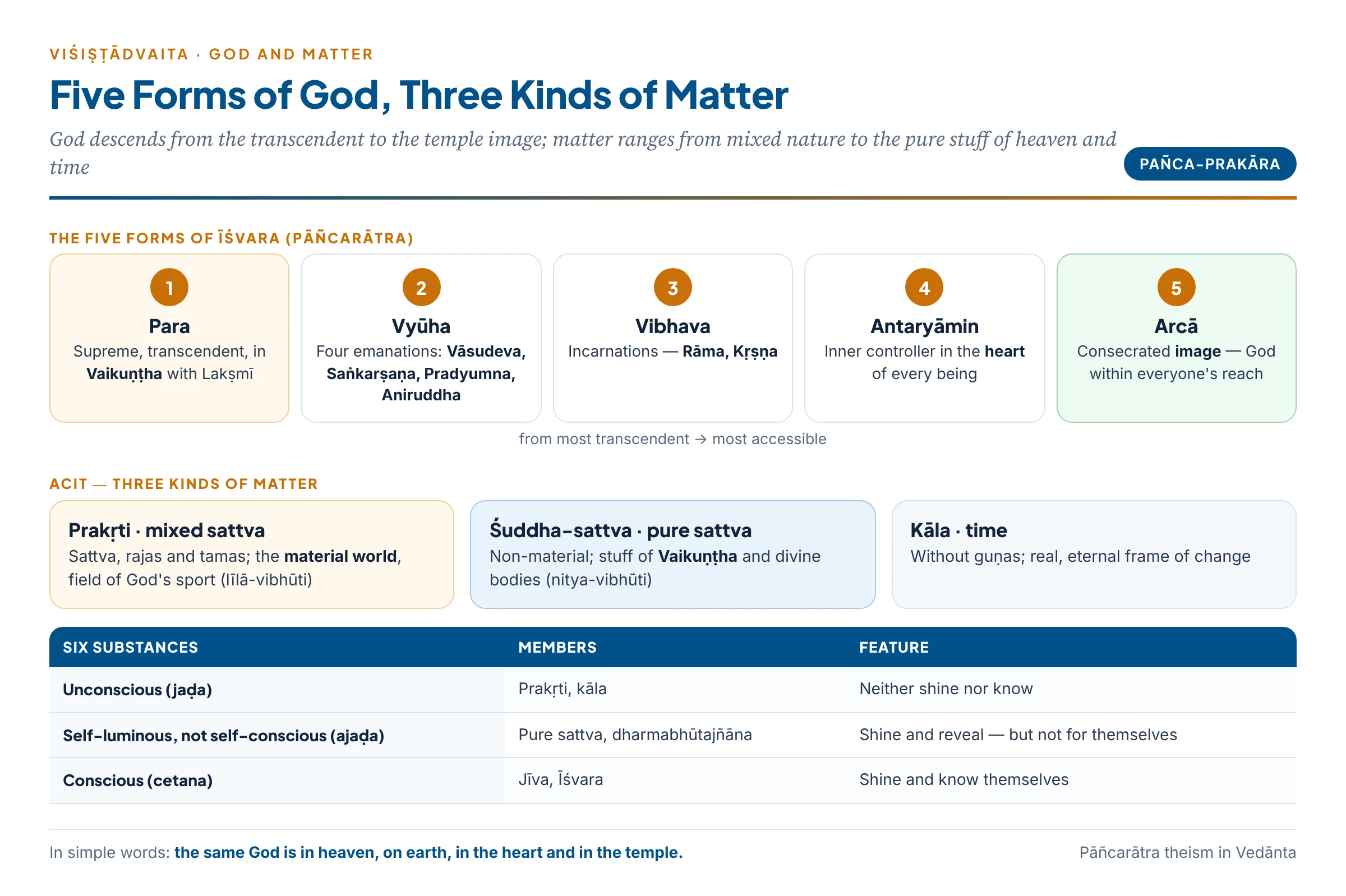
- Prakṛti (miśra-sattva — mixed sattva). Matter composed of sattva, rajas and tamas; the stuff of the material world; the field of God’s sport (līlā-vibhūti). Real, eternal, changing.
- Śuddha-sattva (pure sattva — nitya-vibhūti). Non-material, pure, without rajas and tamas; the stuff of Vaikuṇṭha and of the divine bodies of God and the liberated souls; God’s eternal glory.
- Kāla (time). Devoid of all guṇas (sattva-śūnya); real, eternal, the frame of change.
- Differences from Sāṃkhya. Prakṛti is not independent but God’s body and controlled by Him; it does not evolve by itself; and besides prakṛti there are pure sattva and time.
- Six substances (dravya).
| Group | Substances | Feature |
|---|---|---|
| Unconscious (jaḍa) | Prakṛti, kāla | Neither self-luminous nor conscious |
| Self-luminous but not self-conscious (ajaḍa) | Śuddha-sattva, dharmabhūtajñāna | Shine and reveal, but not for themselves |
| Conscious (cetana) | Jīva, Īśvara | Self-luminous and aware of themselves |
- Māyā in Rāmānuja. Māyā is God’s real, wonderful power of creating a real world — not illusion. “If the world were mithyā, the Vedas, which are part of the world, would also be mithyā.”
The Five Forms of God
- Para — the supreme form, transcendent, in Vaikuṇṭha with Lakṣmī, attended by the eternal and liberated souls.
- Vyūha — four emanations for creation, maintenance, dissolution and worship: Vāsudeva, Saṅkarṣaṇa, Pradyumna, Aniruddha.
- Vibhava — incarnations (avatāras) such as Rāma and Kṛṣṇa.
- Antaryāmin — the inner controller dwelling in the heart of every being.
- Arcā — the consecrated image in temples and homes — God accessible to everyone.
Jīva: The Individual Soul
- Real, eternal, distinct. Each soul is a real, eternal substance, distinct from God, from other souls, and from body, senses, mind, breath and even its own cognitions.
- Atomic (aṇu) in size. It resides in the heart but pervades the body by its knowledge, as a lamp in a corner lights the room.
- Consciousness as essence and attribute. The soul is consciousness (jñāna-svarūpa) and has consciousness (jñānāśraya) — it is a real knower, doer and enjoyer.
- Many. Souls are infinite in number and qualitatively alike — all of the nature of consciousness — but numerically different: qualitative monism, quantitative pluralism.
- Three classes.
- Nitya — eternally free, never bound (e.g. Garuḍa, Śeṣa/Ananta, the attendants of Viṣṇu).
- Mukta — liberated, once bound.
- Baddha — bound, wandering through bodies of gods, humans, animals and plants because of karma.
- Śeṣatva. The soul’s essential nature is to be subservient to God (śeṣa), as a part to the whole; its highest fulfilment is service.
- Free will. God as inner controller permits (anumati) the soul’s free choices and gives fruits according to them; He is the impartial dispenser, so the soul is responsible.
Dharmabhūtajñāna: Attributive Consciousness
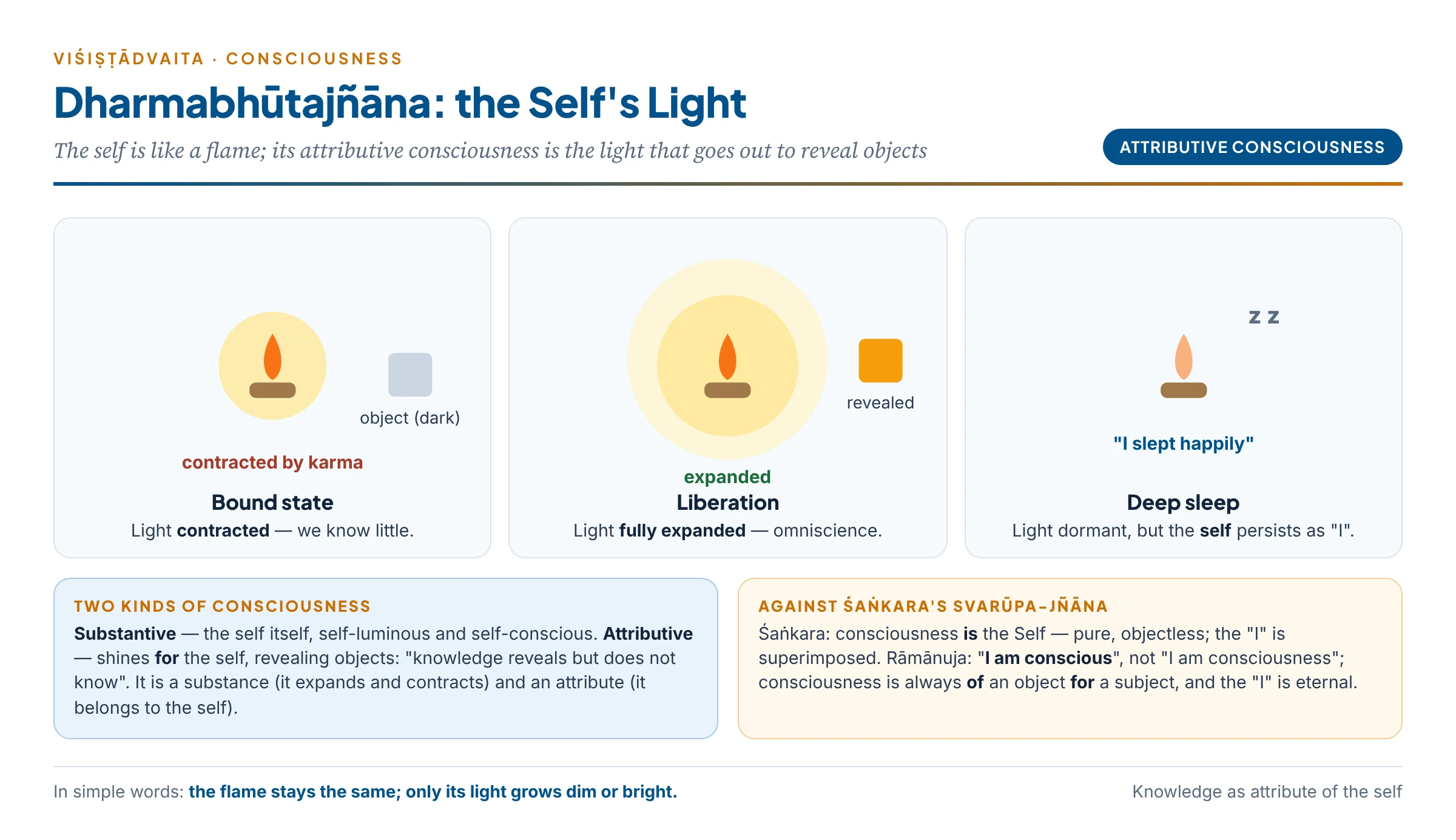
- Two kinds of consciousness in the self.
- Substantive consciousness — the self itself, self-luminous and self-conscious; it shines for itself (it is pratyak, inward).
- Attributive consciousness (dharmabhūtajñāna) — the knowledge the self has; it shines for the self, revealing objects to it, but does not know itself (it is parāk, outward). “Knowledge reveals, but does not know.“
- The lamp image. The self is like the flame, attributive consciousness like the light going out from it to illuminate objects.
- It is both a substance and an attribute. It has states — it expands and contracts — so it is a substance; it belongs to the self, so it is an attribute.
- In the bound state, karma contracts it — we know little.
- In liberation, it expands fully — the liberated soul becomes omniscient (though not omnipotent).
- In deep sleep, it is dormant, but the self persists as the “I” — hence “I slept happily“.
- “I am conscious”, not “I am consciousness”. Consciousness is the attribute of the “I”; the “I” (the self, the ego in the true sense) is real and continues even in liberation.
| Point | Śaṅkara — svarūpa-jñāna | Rāmānuja — dharmabhūtajñāna |
|---|---|---|
| Consciousness is | The Self itself, its very essence | An attribute of the self (besides its essential consciousness) |
| Subject–object | Pure, objectless, subjectless | Always of an object, for a subject |
| Change | Changeless; changes belong to the mind | Expands and contracts |
| The “I” | Ego (ahaṅkāra) is superimposed, false | The “I” is the real self, eternal |
| Deep sleep | Pure consciousness without objects | Self persists; attributive consciousness dormant |
| In liberation | Identity with Brahman | Full expansion — omniscience, individuality kept |
In simple words
A torch has a dial: turn it one way and the beam narrows to a small circle; turn it the other way and it floods the whole room. The bulb is the same throughout. For Rāmānuja the self is the bulb, and its attributive consciousness is the beam — narrowed by karma in bondage, opened fully in liberation.
Sat-khyāti: All Knowledge Is True
- Every cognition is true (yathārtha-khyāti / sat-khyāti). Error is not the perception of what is not there, but the partial perception of what is there.
- The shell–silver. By tripartition, every object contains a little of every element; the shell really contains silver-particles. We see the silver part and miss the predominant shell part. The error is incomplete knowledge, shown up by practical failure (we cannot use it as silver).
- The yellow conch. The yellowness of the bile in a jaundiced eye is really transmitted to the conch.
- Mirage — real water-particles in sunlight; dreams — real objects created by God for the dreamer’s karma, lasting as long as the dream.
- Why it matters. If error contained something unreal, the whole world could be called unreal (as in Śaṅkara). By making every cognition true, Rāmānuja secures realism.
Tat Tvam Asi in Viśiṣṭādvaita
- Co-ordinate predication (sāmānādhikaraṇya). Two words with different meanings can refer to one substance — “the cloth is white“, “this is that Devadatta“.
- “That” refers to Brahman as the cause of the world, omniscient and omnipotent; “thou” refers to Brahman as the inner controller embodied in the individual soul.
- The meaning. The same Brahman is qualified in two ways — as cause and as the soul’s inner self. The sentence teaches unity of the one God in His two modes, not the identity of the finite soul with God.
In simple words
“The boy I taught in Class 5 is the doctor treating me today.” Two descriptions — a schoolboy then, a doctor now — refer to one and the same person. Neither description is dropped; both qualify one person. Rāmānuja reads “That thou art” the same way: “That” (God as cause of the world) and “thou” (God as the soul’s inner self) are two descriptions of one God.
Critical Evaluation
Difficulties in Relating Brahman to Cit and Acit
- Does the body’s imperfection touch God? If souls and matter are God’s body, God’s body undergoes change, ignorance and suffering. How can its soul remain perfect?
- Rāmānuja’s reply: as a soul is not changed by the body’s growth and decay, God is not touched; the imperfections come from the karma of souls, and God is “opposed to all evil”.
- Counter: an embodied human soul does suffer through its body; so the analogy suggests God too would suffer.
- Half a hen. “One cannot keep half a hen for cooking and the other half for laying eggs.” One cannot maintain that God’s soul is changeless while His body suffers change — either the whole changes or nothing does.
- Substance or attribute? Souls and matter are called substances (in themselves) and attributes (in relation to God). The same thing cannot be both independent enough to be a substance and dependent enough to be an attribute. (In the West, Spinoza made finite things modes, Descartes made them substances; Rāmānuja tries to have both.)
- The body analogy breaks down.
- A soul depends on its body for experience; God depends on nothing.
- For an ordinary soul the body is an accident it leaves at death; but cit–acit are eternal and inseparable from God. Is God’s body then an accident? If so, God would be like a bound soul who should shake it off.
- Rāmānuja answers that ignorance, not embodiment, causes bondage — but then why does he deny jīvanmukti and insist the body must fall before liberation?
- Immanent soul or transcendent Person? If God is the soul within the universe, how is He also a Person in Vaikuṇṭha with Lakṣmī, served by eternal souls? Personal theism and Upaniṣadic absolutism do not fit easily.
- Pure sattva seems arbitrary. If God’s body is made of prakṛti and souls, why add a non-material pure sattva as the stuff of His abode? And how can sattva exist apart from rajas and tamas, its inseparable companions?
- Freedom and evil. If God controls all from within, how is the soul free? And why does He allow suffering in His own body? Rāmānuja appeals to karma and God’s permission — critics find this pushes the problem back.
- The Radhakrishnan remark. Rāmānuja’s accounts of the other world “carry no conviction“; his followers move “with as much Olympian assurance through the chambers of the Divine Mind as Milton through the halls of heaven“.
- The overall verdict of critics. The system is “a house divided against itself” — Upaniṣadic absolutism pulling one way and Pāñcarātra theism the other. As one famous formula puts it, “Rāmānuja’s Absolute is Śaṅkara’s Brahman bound to the world, while Śaṅkara’s Absolute is Rāmānuja’s Īśvara liberated from the world.“
Rāmānuja’s Defences and Strengths
- Experience supports him. We experience a real world and real selves; a philosophy that preserves both is closer to experience than one that calls them mithyā.
- No indescribable māyā. All relations are explained by apṛthaksiddhi and the body–soul model, not by an inexplicable principle.
- Scripture as a whole. He accepts both unity and difference texts, instead of treating one set as provisional.
- Religion and ethics secured. A real soul, a real world and a personal God make devotion, moral effort and grace fully meaningful.
- Organic monism. The unity of an organism — one life in many limbs — is a better model of reality than either bare identity or bare plurality.
Critics and Defenders
Criticism — Critics
- Advaitins: inseparability cannot unite two real distincts; the system keeps duality.
- The half-hen argument: God’s soul cannot stay perfect while His body suffers.
- Substance–attribute tension: souls cannot be both independent substances and dependent attributes.
- Radhakrishnan: Vaikuṇṭha stories carry no conviction; personal theism and absolutism clash.
- Madhva: real difference is diluted by calling souls God’s body.
Defence — Defenders and strengths
- Rāmānuja: one reality, really qualified — unity and difference both taken seriously.
- Apṛthaksiddhi: an internal, organic relation that avoids samavāya’s regress.
- Realism: sat-khyāti and pariṇāma secure a real world and real souls.
- Theism: a God of infinite good qualities, accessible in five forms, grounds devotion.
- Synthesis: Upaniṣads, Gītā, Pāñcarātra and the Ālvārs woven into one system.
Cross-Tradition Comparison
Rāmānuja and Western Thinkers
| Point | Rāmānuja | Western parallel | Similarity | Difference |
|---|---|---|---|---|
| God and world | World is God’s body; God its soul | Spinoza — finite things are modes of one substance | One reality with real modes | Spinoza’s God is impersonal; Rāmānuja’s is a loving Person |
| Relation | Apṛthaksiddhi — inseparable dependence | Hegel — identity-in-difference, concrete universal | Unity that contains difference | Hegel’s Absolute develops through history |
| Immanence and transcendence | God within all and beyond in Vaikuṇṭha | Panentheism (all in God, God more than all) | God includes and exceeds the world | — |
| Substance and attribute | Souls are substances and attributes | Descartes — finite substances; Spinoza — modes | Tries to combine both | Hence the “substance or attribute?” difficulty |
| Error | All cognition true, error partial | Direct realism | World as perceived is real | Rāmānuja’s physics of tripartition is unique |
Indian Connect — Key takeaways
- Rāmānuja and Śaṅkara agree that Brahman is the one reality; they differ on whether the many is real (body of God) or mithyā.
- Rāmānuja and Madhva agree that souls and matter are real; Madhva makes difference absolute, Rāmānuja makes it internal to one God.
- Rāmānuja and Bhāskara both accept real transformation; for Rāmānuja only God’s body transforms.
Synthesis (Siddhānta)
- Viśiṣṭādvaita is non-dualism of the qualified Brahman: one reality, qualified by real souls and real matter.
- Brahman is saviśeṣa — Nārāyaṇa, full of auspicious qualities, opposed to all evil, with only internal (svagata) difference; Brahman and Īśvara are one.
- Tattva-traya: cit, acit and Īśvara — three reals, one organic unity.
- Śarīra–śarīrī: the world is God’s body — controlled, supported and used by Him; God is the inner controller.
- Apṛthaksiddhi: an internal, inseparable relation (blue lotus, lamp and light), not samavāya — the key to “identity qualified by difference”.
- Creation is real transformation of God’s body from subtle to gross; sport and karma reconciled; trivṛtkaraṇa mixes fire, water and earth.
- Acit: prakṛti, pure sattva and time; six substances; māyā is God’s real power.
- Jīva: real, eternal, atomic, knower–doer–enjoyer, subservient to God, free under God’s permission; three classes.
- Dharmabhūtajñāna: the self’s attributive consciousness that expands and contracts — “I am conscious”, not “I am consciousness”.
- Sat-khyāti: all knowledge true; error partial.
- Difficulties: God’s perfection versus the body’s imperfection, substance versus attribute, transcendence versus immanence, pure sattva, freedom and evil — the price of combining absolutism with personal theism.
- Contemporary relevance.
- Ecology. A world that is God’s body is sacred and real — a ground for ecological reverence.
- Dignity of the individual. Real, eternal souls with free will give a metaphysical basis to individual dignity and responsibility.
- Inclusive devotion. God accessible in the temple image and the heart made religion available to all — Rāmānuja famously shared the sacred mantra publicly so that all could be saved.
“He who dwells in all beings, whom all beings do not know, whose body all beings are, who controls all beings from within — He is your Self, the inner controller, the immortal.” — Bṛhadāraṇyaka Upaniṣad
Previous Year Questions
- 2026Critically explain Rāmānuja’s conception of Brahman with special reference to the difficulties in explaining the relation of Brahman to Spirit (Cit) and Matter (Acit).
- 2024“In Viśiṣṭādvaita philosophy, the relationship between God and the world is parallel to that between an individual self and its body.” Critically discuss.
- 2022Explain the relation between the God and the Self according to Rāmānujācārya.
- 2020Discuss the nature of God in Hinduism with special reference to Viśiṣṭādvaita (Qualified non-dualism).
- 2017Explain Rāmānuja’s conception of God and examine the difficulties he faced in explaining the relation of God to matter and spirits.
- 2012Do you agree with Rāmānuja’s view that the nature of Brahman is qualified? Give reasons.
- 2010How is Rāmānuja’s concept of dharmabhūtajñāna different from Śaṅkara’s concept of svarūpajñāna? Explain.
- 2006Discuss the Metaphysics of Ācārya Rāmānuja.
- 2004Why is Rāmānuja’s philosophy called Viśiṣṭādvaita? Discuss fully.