

Mīmāṃsā: Theory of Knowledge.
Official Syllabus: Paper I, Section B, Unit 18
If every cognition is valid by itself (Article 7), how can there be error at all? When someone sees a glittering shell on the beach and says “This is silver“, what has gone wrong — and where? The two Mīmāṃsā schools give strikingly different answers. Prabhākara holds that no cognition is ever false: the “error” is really two true cognitions — a perception of “this” and a memory of silver — whose difference we fail to notice. His theory is akhyāti (“non-apprehension”). Kumārila holds that error is a positive wrong judgment: two real things are wrongly related — viparīta-khyāti (“contrary apprehension”). Nyāya, with its anyathā-khyāti, sides broadly with Kumārila and attacks Prabhākara. The 2026 paper asked about exactly this clash; the 2022 and 2002 papers asked how the two Mīmāṃsakas square their theories of error with self-validity.
In simple words
You wave at a stranger across the road, sure it is your cousin. Prabhākara would say: you saw a tall man in a blue shirt (true), you remembered your cousin (true), and you simply did not notice that the two were different people. Kumārila would say: you judged “that man is my cousin” — a single, positive, mistaken judgment that joined two real things wrongly. Both agree the man and your cousin are real; they disagree on whether you made a mistake of omission or of commission.
Context & Problem
- Khyāti. Khyāti means “cognition” or “appearance”; theories of error are called khyāti-vādas. Every Indian school had one, and each reflects its metaphysics.
- The stock examples.
- Shell–silver (śukti-rajata): a shell glittering in sunlight is seen as silver.
- Rope–snake (rajju-sarpa): a rope in dim light is seen as a snake.
- The yellow conch: a jaundiced eye sees a white conch as yellow.
- The red crystal: a clear crystal near a red flower looks red.
- Two moons: pressing the eyeball while looking at the moon makes two moons appear.
- The Mīmāṃsā difficulty. Mīmāṃsā holds that every cognition is intrinsically valid and that the world is real. Error seems to threaten both: an erroneous cognition is a cognition that is not valid, and its object (the silver) is not really there.
- Knowledge and illusion are bound together. Knowledge and illusion are opposed, yet inseparable: we learn that an earlier cognition was an illusion only when a later cognition corrects it. Illusion is itself a kind of cognition — not valid, but still a cognition. Error is also subjective: the same rope may look like a snake to one person and not to another, at one time and not another (as a straight road ahead seems to rise or dip, or a mirage seems to be water).
Core Doctrine
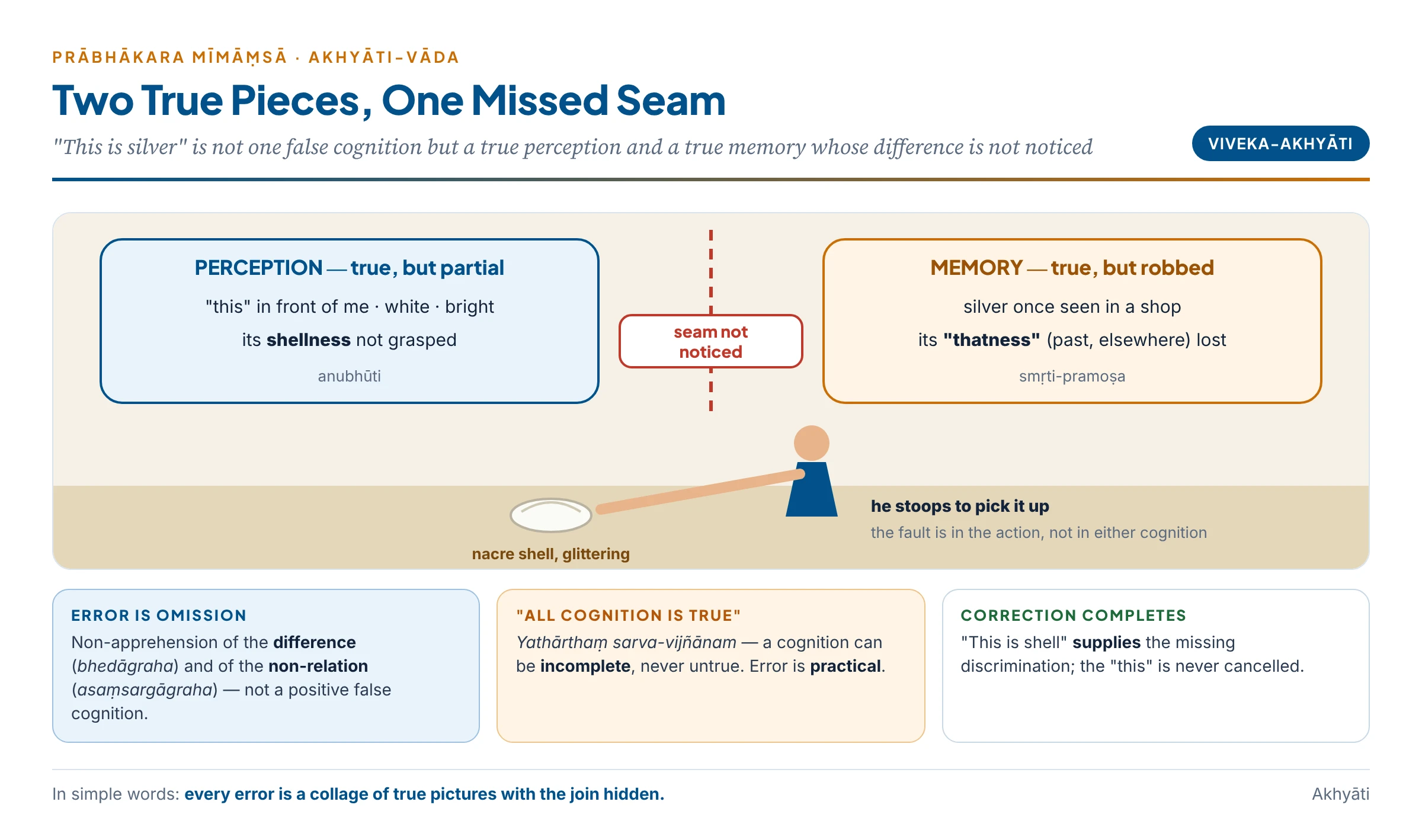
1. Prabhākara’s Akhyāti-vāda: Error as Non-Discrimination
- No cognition is false. In strict accordance with intrinsic validity, Prabhākara does not admit error in the logical sense. “All cognition is true” (yathārthaṃ sarva-vijñānam). To experience is always to experience validly. A cognition may be less than true — incomplete — but it can never be untrue.
- Only two kinds of cognition. Prabhākara recognises just apprehension (anubhūti) and memory (smṛti). There is no third class of “erroneous cognition”: so-called error is a mixture of the two.
- Two cognitions, not one. “This is silver” is not a single cognition but a composite of two:
- a perception of the “this” in front of us, together with qualities it shares with silver — whiteness, brightness — but minus its shellness;
- a memory of silver seen earlier (in a shop), revived by these common qualities.
- Memory robbed of its “thatness”. Normally memory presents its object as “that” — past, elsewhere. Here, owing to some defect, the silver is recalled merely as silver, “robbed of its thatness” (pramuṣita-tattāka-smaraṇa); the fact that it is only a memory is forgotten (smṛti-pramoṣa).
- Non-discrimination. The two cognitions and their objects are distinct and unrelated; what goes wrong is that we fail to grasp the difference between them — between the perceived “this” and the remembered “silver”. This failure is called:
- akhyāti — non-apprehension;
- viveka-akhyāti or bhedāgraha — non-apprehension of the distinction;
- asaṃsargāgraha — non-apprehension of the non-relation between the two.
- An error of omission. Error is only non-apprehension, not mis-apprehension; an error of omission, not of commission. It is negative — a want of knowledge — not a positive false cognition.
- The error is practical. Because the distinction is not noticed, we behave toward the shell as we would toward silver — we stoop to pick it up. It is this behaviour that is faulty; error is practical (it fails to “work”), not logical.
- Correction completes; it does not cancel. When we later say “This is shell“, nothing earlier is contradicted — the “this” is never sublated. The shell was never mis-perceived as silver, because “shell” never entered consciousness. The correction simply supplies the missing discrimination.
In simple words
A photo collage: a picture of a beach and a cut-out of a silver coin lie side by side with the join hidden. Each piece is a true picture of something real. The “error” is only that you missed the seam. Prabhākara thinks every error is a missed seam between a true perception and a true memory.
2. Prabhākara’s Three Patterns of Error
- Perception + perception. A jaundiced person sees a white conch as yellow. Two partial perceptions arise: the conch as “this” minus its whiteness, and the yellowness of the bile in the eye minus its being bile. Their distinction is not grasped. Likewise, a white crystal beside a red flower looks red: the crystal minus its whiteness, and the redness of the flower, are not distinguished.
- Memory + memory. A person recollects that he saw a long snake on the road yesterday, when really it was a rope: the memory of the rope as “that” minus its ropeness, and the memory of a snake robbed of its thatness, are not distinguished.
- Perception + memory. The shell–silver case: a present perception and a revived memory are not distinguished.
- In all cases the explanation is the same: non-apprehension of the distinction between two partial but true cognitions.
3. Kumārila’s Viparīta-khyāti-vāda: Error as Wrong Synthesis
- Agreement with Prabhākara. Kumārila agrees that in “this is silver” two elements are present: the shell perceived as “this” without its shellness, and silver revived in memory merely as silver, owing to the common whiteness and brightness.
- Disagreement. Mere non-discrimination cannot explain error. Kumārila holds that there is a positive wrong synthesis of the perceived and the remembered elements:
- Error is a single cognition — a unitary judgment “this is silver” — not two cognitions falling apart.
- Error is positive misapprehension — an error of commission, not merely of omission.
- The shell is misperceived as silver: one thing is apprehended as another that it is not.
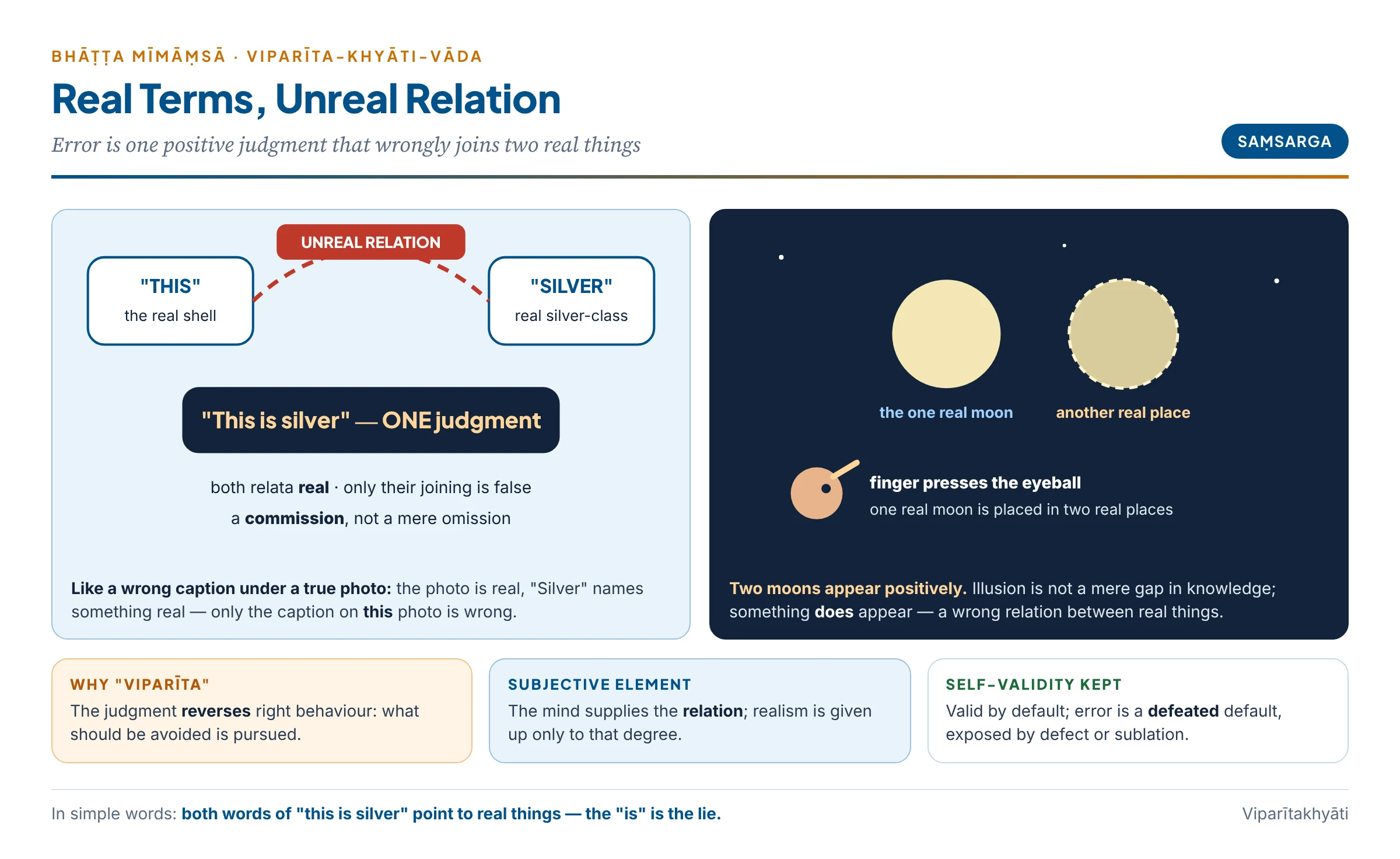
- Both terms real, the relation unreal. In the judgment “this is silver”, both the subject (“this”, the shell) and the predicate (“silver”, the silver-class existing elsewhere in the world) are real. Error consists in relating these two really existing but separate things in the subject–predicate way. “Error always attaches to the wrong relation (saṃsarga), not to the objects related, which are always real.“
- The two moons. No one can deny that illusory objects sometimes appear positively. If one presses the eyeball while looking at the moon, two moons positively appear. Two real parts of space are wrongly attributed to the one real moon, so the one moon appears in two places. The rope–snake illusion is similar: the real rope is brought under the real serpent-class.
- Why “viparīta”. The wrong judgment makes one behave in a way that is the reverse of the right one — reaching for what is to be avoided, fleeing what is harmless. Hence the name: error as the reversal (viparīta) of right behaviour — “the appearance of what is not to be done as what is to be done” (akāryasya kāryatayā bhānam).
- A subjective element. In admitting a wrong synthesis created by the mind, Kumārila gives up his realism to a degree: the relata are real, but the relation in error is not.
In simple words
Kumārila’s error is like a wrong caption under a correct photo. The photo (the shell) is real; the caption “Silver” names something real too — there is silver in the world. The mistake is the caption attached to this photo: the relation “this = silver”. Fix the caption and nothing in the photo or in the world changes.
4. Why Prabhākara and Kumārila Differ despite Both Accepting Self-Validity
The 2022 paper asked why and how the two differ in interpreting erroneous cognition in spite of both accepting intrinsic validity.
| Point | Prabhākara — akhyāti | Kumārila — viparītakhyāti |
|---|---|---|
| Is any cognition false? | No — all cognition is true; error is incomplete knowledge | Yes — error is a real misapprehension, though validity is the default |
| How many cognitions in “this is silver”? | Two (perception + memory) | One unitary judgment |
| Nature of error | Non-apprehension of the distinction — omission | Positive misapprehension — commission |
| Where the fault lies | In not noticing a difference | In a wrong relation (saṃsarga) between real terms |
| Logical distinction between truth and error | None — only practical | Yes — error is a cognitive fact |
| Subjective element | None — strict realism | Admitted in the relation |
| What correction does | Supplies the missing discrimination | Cancels the false relation |
| Why they differ | Takes self-validity strictly: a self-valid cognition cannot be false | Takes self-validity as presumptive: valid until defeated by defect or sublation |
| Test of truth | Practical — truth is what works | Non-contradiction |
- The root of the difference. Both hold that validity is intrinsic; they read “intrinsic” differently.
- Prabhākara reads it strictly: a cognition, as cognition, is valid; therefore a false cognition is a contradiction in terms. He must explain error without any false cognition.
- Kumārila reads it as presumptive: every cognition claims truth and is to be accepted until a defect or a contradicting cognition is found. So a cognition can turn out false — its intrinsic validity is set aside by extraneous conditions (Article 7).
- Their realism, too, differs in strength. Prabhākara keeps realism pure — knowledge never misrepresents its object; Kumārila is ready to admit an ideal element in error.
In simple words
A traffic signal is trusted unless it is visibly broken. Kumārila‘s self-validity is like that — a strong presumption that can be overturned. Prabhākara‘s is stronger: a signal can never really show the wrong colour; if you crash, it is because you did not notice which light was lit. One makes mistakes possible but rare; the other makes them a kind of inattention.
5. Is the Mīmāṃsā Explanation of Error Consistent with Self-Validity?
The 2002 paper asked this directly.
- Prabhākara: consistent — at a price.
- Consistent: if all cognitions are true, there is no false cognition to embarrass the theory of self-validity.
- The price: error disappears as a cognitive fact. Yet the deceived man is plainly deceived — he takes himself to see silver. A theory that cannot say he believes falsely has not explained error; it has explained it away.
- And it is odd that the “test” of truth falls back on Nyāya’s pragmatic criterion — truth is what works, error what fails — which Prabhākara elsewhere rejects.
- Kumārila: consistent — if validity is presumptive.
- Consistent: an erroneous cognition, while it lasts, is accepted as true (its intrinsic claim), and is later set aside by extraneous factors — the defect (distance, glare) or the sublating cognition “this is shell”. This is just intrinsic validity plus extrinsic invalidity.
- The problem: if a false cognition carries the same assurance of truth as a true one, the “intrinsic validity” of a cognition tells us nothing about whether it is actually true. Critics say the theory becomes only a theory of belief, not of truth.
- The reply: Mīmāṃsā never claimed that intrinsic validity guarantees truth; it claims that truth is the default, error the exception discovered later — “the falsification of the truth-claim in some cases does not affect the normal acceptance of it”.
- The verdict. Both theories are internally consistent with self-validity; Prabhākara’s at the cost of denying error, Kumārila’s at the cost of making self-validity defeasible and admitting a subjective element.
Common confusion
Do Prabhākara and Kumārila say that error lies in “memory dominating perception” or in “memory superimposed on perception”? That phrasing, found in some notes, blurs the two theories. Both admit a perceived element (“this”) and a remembered element (“silver”). For Prabhākara these remain two separate, true cognitions whose difference is not noticed — there is no superimposition and no single false cognition. For Kumārila there is a single judgment in which the real “this” is wrongly related to the real silver-class; the error lies in the relation, not in memory as such. “Superimposition” (adhyāsa) is properly the Advaita term.
6. The Nyāya Anyathā-khyāti and Its Critique of Akhyāti
- Anyathā-khyāti. Anyathā means both “otherwise” and “elsewhere“. In error, the presented object is perceived otherwise than it is, and the represented object exists elsewhere — the silver is in the market. Shell and silver are both real; only their synthesis “this silver” is unreal.
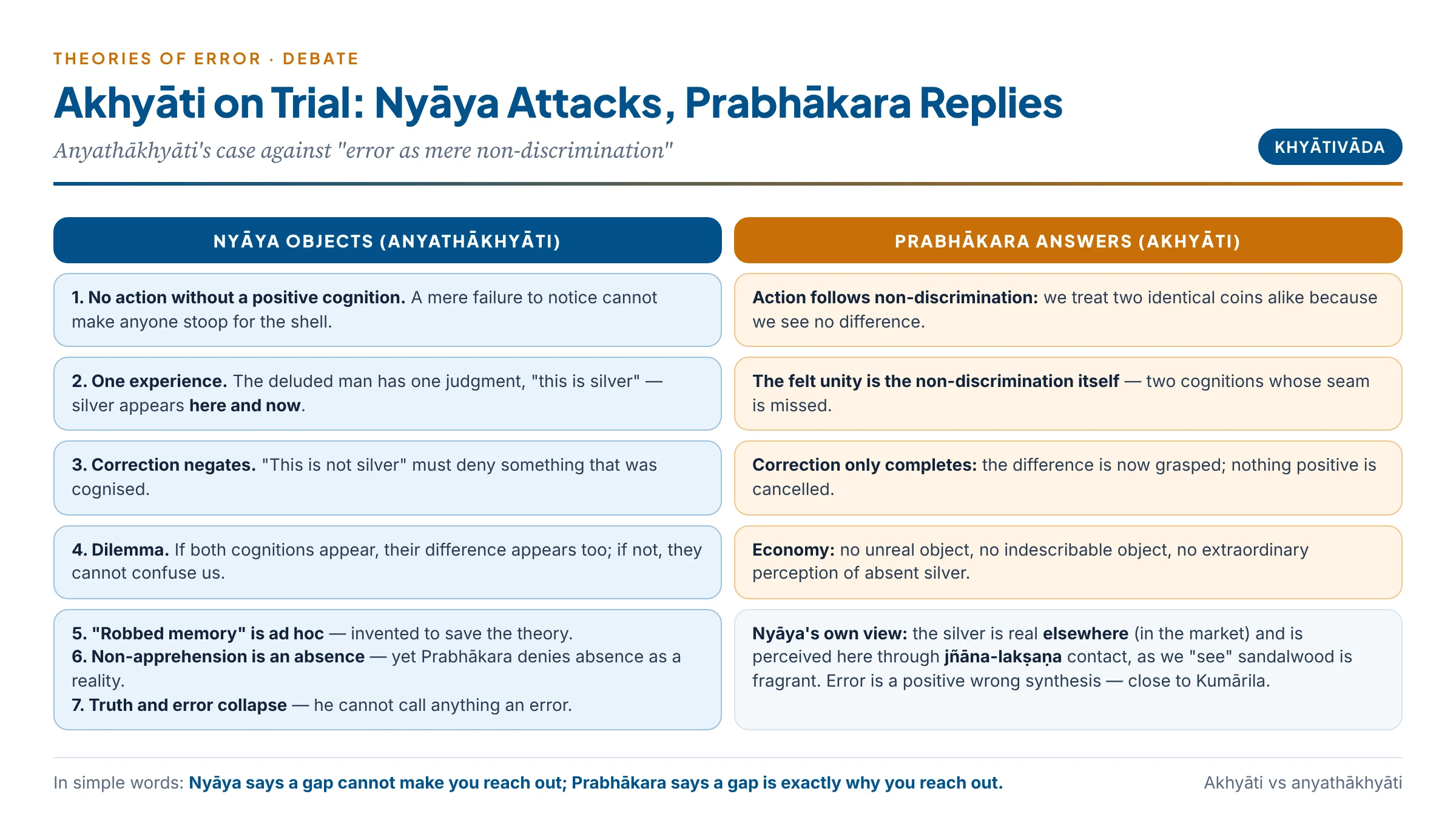
- Close to Kumārila. Like Kumārila, Nyāya says error is a positive wrong synthesis of presented and represented elements, and admits a subjective element: “What is set aside by true knowledge is the wrong apprehension, not the object” (Vātsyāyana); “a real object is mistaken as another real object which exists elsewhere” (Gaṅgeśa).
- Where Nyāya differs from Kumārila.
- To keep error perceptual, Nyāya says the absent silver is actually perceived through an extraordinary contact — jñāna-lakṣaṇa (“contact through a cognition”), the same contact by which we “see” that sandalwood is fragrant. Kumārila needs no extraordinary perception.
- Nyāya holds both validity and invalidity extrinsic; Kumārila holds validity intrinsic.
- The anyathākhyāti attack on akhyāti (the 2026 question).
- No action without a positive cognition. A mere failure to notice a difference is negative; it cannot prompt anyone to stoop for the shell. Purposeful action needs a positive, determinate cognition — “this is silver” — that presents the “this” as silver.
- The unity of the experience. The deluded person has one experience, expressed in one judgment with a single subject: “this is silver“. He does not experience “a this” and “a silver-memory” side by side. Akhyāti fails to account for the presentative character of illusion: the silver appears here and now, vividly, not as a memory.
- Correction negates something. The later cognition “this is not silver” is a negation. It must negate something that was cognised — the relation “this–silver”. If nothing false was apprehended, the correction would have nothing to deny.
- A dilemma. Do the two cognitions appear in consciousness or not? If they do, their difference would appear too, and there would be no confusion. If they do not, they are nothing to us and cannot cause the confusion.
- “Robbed memory” is ad hoc. Memory normally presents its object as “that” — past and elsewhere. The claim that in error memory is robbed of its “thatness” is invented just to save the theory.
- Prabhākara cannot appeal to non-apprehension. He rejects absence as a reality (Article 5); yet his whole account of error rests on a non-apprehension — an absence of cognition doing causal work.
- Truth and error collapse. If no cognition is false, there is no logical difference between truth and error, and Prabhākara himself has no right to call anything an “error” — or to criticise his opponents as mistaken.
- Prabhākara’s replies.
- Action follows non-discrimination. We behave toward things whose difference we do not grasp as if they were one — as we treat two identical coins as interchangeable. Action needs only the absence of a known difference.
- The felt unity is the non-discrimination itself: what is felt as “one” experience is just two cognitions whose distinction is missed.
- Correction only means “the difference is now grasped”; nothing positive is cancelled.
- Economy. Akhyāti needs no unreal object (against the Buddhist), no indescribable object (against Advaita), and no extraordinary perception of absent silver (against Nyāya). It explains error with only true perceptions and true memories.
7. Criticisms of Kumārila’s Viparītakhyāti
- From Nyāya. Kumārila’s view is in substance anyathākhyāti; but without jñāna-lakṣaṇa he cannot explain how the absent silver comes to be presented at all.
- From the realist side. Admitting a subjective relation in error opens the door to idealism: if the mind can create one false relation, why not others?
- From Advaita. The silver in the illusion is neither simply real (it is cancelled) nor simply remembered (it is presented here and now). Kumārila gives too much reality to memory and to the silver-elsewhere; the illusory silver is indescribable (anirvacanīya).
- Kumārila’s reply. The relation is unreal, but the relata are real; an unreal relation between real things is all that error requires. Nothing is created out of nothing.
8. The Wider Map of Indian Theories of Error
- The realist’s dilemma. If the silver is real, how can it be cancelled later? If it is unreal, how can it appear? Realist and idealist schools resolve this differently.
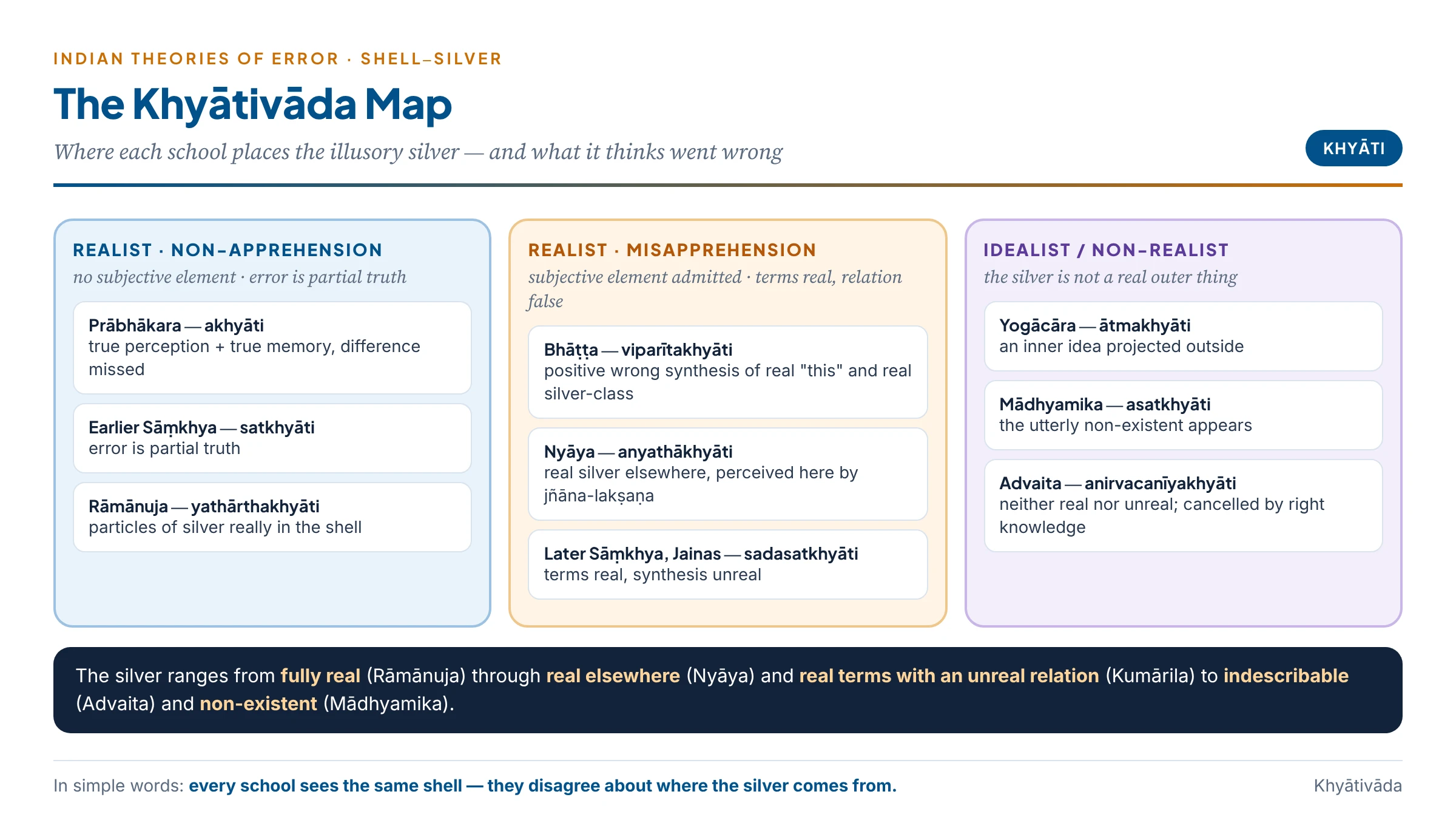
| School | Theory | Status of the illusory silver | Explanation of error |
|---|---|---|---|
| Prābhākara Mīmāṃsā | Akhyāti (non-apprehension) | Real — remembered silver | Non-discrimination of a true perception and a true memory |
| Bhāṭṭa Mīmāṃsā | Viparītakhyāti (contrary apprehension) | Real terms, unreal relation | Positive wrong synthesis of real “this” and real silver-class |
| Nyāya–Vaiśeṣika | Anyathākhyāti (apprehension otherwise/elsewhere) | Real — in the market | Real silver elsewhere perceived here through jñāna-lakṣaṇa |
| Earlier Sāṃkhya | Satkhyāti | Real | Error is partial truth, like akhyāti |
| Later Sāṃkhya, Jainism | Sadasatkhyāti (real-unreal) | Terms real (sat), synthesis unreal (asat) | Wrong synthesis of two real cognitions — close to Kumārila |
| Rāmānuja (Viśiṣṭādvaita) | Satkhyāti / yathārthakhyāti (“akhyāti mixed with satkhyāti”) | Real — particles of silver really in the shell | All cognition is of the real; through the mixing of elements (pañcīkaraṇa), the shell really contains some silver; error is incomplete grasp |
| Yogācāra Buddhism | Ātmakhyāti (self-appearance) | A form of the mind | An inner idea is projected as an outer object |
| Mādhyamika Buddhism | Asatkhyāti (appearance of the non-existent) | Unreal — like a hare’s horn | The utterly non-existent appears as existent |
| Advaita Vedānta | Anirvacanīyakhyāti (indescribable appearance) | Neither real nor unreal | Ignorance hides the shell and projects silver on it; cancelled by right knowledge |
- Two realist groups.
- Error as non-apprehension (no subjective element; error is partial truth): Prabhākara’s akhyāti, earlier Sāṃkhya’s satkhyāti, Rāmānuja’s yathārthakhyāti.
- Error as misapprehension (a subjective element admitted; error is partial misrepresentation): Kumārila’s viparītakhyāti, Nyāya’s anyathākhyāti, later Sāṃkhya’s and the Jainas’ sadasatkhyāti.
- A note on the Buddhist labels. Orthodox tradition ascribes asatkhyāti to the Mādhyamika and ātmakhyāti to the Yogācāra; some scholars argue these labels are unfair to the Buddhists, whose views are closer to Advaita’s indescribability, and that ātmakhyāti fits only the school that treats momentary cognitions as the sole reality. Against ātmakhyāti, critics say that if error were an idea projected outward, we should say “I am silver“, not “this is silver“; and if everything is only idea, the distinction of knower, known and knowledge collapses.
- Another way of grouping. Some teachers sort all theories into two families: asatkhyāti (error is cognition of the non-existent — Mādhyamika) and satkhyāti in a broad sense (error concerns something existent that is wrongly grasped — Yogācāra, Prābhākara, Bhāṭṭa and Nyāya), with each school claiming its own version.
Common confusion
Do the Jainas hold “satyakhyāti” and does Sāṃkhya hold “satkhyāti” in the sense of “mistaking one real thing for another”? Some notes give the Jainas a “satyakhyāti (partial truth mistaken as whole)” and present Sāṃkhya’s view as “real-as-real misapprehension”. The standard account is different. The Jainas and later Sāṃkhya hold sadasatkhyāti: the two elements are real (sat), their synthesis unreal (asat) — very close to Kumārila. Earlier Sāṃkhya’s satkhyāti is close to Prabhākara: error is partial truth with no subjective element. And Rāmānuja’s satkhyāti says the silver is really present in the shell in minute quantity.
Indian Connect — Why theories of error reveal metaphysics
- A school’s theory of error shows what it thinks is real: realists keep the silver real somewhere; idealists make it mental; Advaita makes it indescribable — a model for the status of the world itself.
- Prabhākara is the purest realist: knowledge never misrepresents.
- Kumārila is a realist who concedes a subjective element — the bridge between Mīmāṃsā and Nyāya.
Critical Evaluation
Objections Summarised
- Against akhyāti: action needs a positive cognition; illusion is presentative and unified; correction negates something; the two-cognition dilemma; “robbed memory” is ad hoc; non-apprehension is an absence Prabhākara cannot accept; truth and error collapse.
- Against viparītakhyāti: how is absent silver presented without extraordinary perception? A subjective relation threatens realism; Advaita: the silver is neither real nor merely remembered.
- Against both (Advaita): neither correspondence can be the nature of truth nor practical success its test; realism cannot escape the dilemma “if the silver is real, how is it cancelled; if unreal, how does it appear?”
Strengths
- Akhyāti is economical, keeps cognition infallible in itself, and explains error as a failure of discrimination — a genuinely common source of mistakes.
- Viparītakhyāti respects the phenomenology of error — illusions positively appear — and keeps a clear logical distinction between truth and error while preserving self-validity as a default.
- Both locate the source of error in defects (distance, light, disease, haste), not in reality itself.
Critics and Defenders
Criticism — Critics
- Nyāya against Prabhākara: no action from mere non-apprehension; illusion is one presentative cognition; correction negates a false relation; robbed memory is ad hoc; truth and error collapse.
- Nyāya against Kumārila: without jñāna-lakṣaṇa the absent silver cannot be presented.
- Advaita against both: the silver is neither real nor remembered — it is indescribable; realism cannot explain cancellation.
- Realists against Kumārila: a subjective relation opens the door to idealism.
Defence — Defenders and strengths
- Akhyāti: no unreal object, no indescribable object, no extraordinary perception — maximal economy and pure realism.
- Akhyāti: explains many real mistakes as failures to notice differences.
- Viparītakhyāti: respects the positive appearance of illusions (two moons) and keeps truth and error distinct.
- Both: consistent with self-validity — one strictly, one presumptively.
- Both: trace error to defects in conditions, not to the world.
Cross-Tradition Comparison
Error East and West
| Indian view | Claim | Western parallel |
|---|---|---|
| Prabhākara — error is incomplete knowledge | Cognition is never false, only partial | Spinoza: “falsity consists in the privation of knowledge which inadequate ideas involve” — error is lack, not a positive thing |
| Perception matched with the wrong memory | Perceived “this” + remembered silver | Plato’s Theaetetus: the wax tablet — error as fitting a present perception to the wrong memory-imprint |
| Kumārila — error is a wrong judgment | Real terms, wrong relation | Descartes: error lies in judgment, when the will affirms beyond what the intellect clearly perceives |
| Nyāya — real object elsewhere | Silver in the market | Naïve realism strained by illusion; sense-data theorists (Russell, Moore) reply that we directly see only appearances |
| Yogācāra — mind projects | The silver is an idea | Berkeley: objects are ideas; illusion is an irregular idea |
| Advaita — indescribable | Neither real nor unreal | Meinong‘s non-existent objects; contemporary “disjunctivism” denies a common real element between seeing and seeming to see |
Two Mīmāṃsā Theories at a Glance
| Point | Akhyāti | Viparītakhyāti |
|---|---|---|
| Founder | Prabhākara | Kumārila |
| Other names | Vivekākhyāti, bhedāgraha, asaṃsargāgraha | Viparītagraha, saṃsargagraha |
| Error is | Omission | Commission |
| Number of cognitions | Two | One |
| Allied theories | Earlier Sāṃkhya, Rāmānuja | Nyāya, later Sāṃkhya, Jainas |
Indian Connect — Key takeaways
- Prabhākara’s akhyāti and Kumārila’s viparītakhyāti are two ways of holding self-validity together with error: deny error, or make validity a default.
- The 2026 debate is really akhyāti versus the misapprehension family — Nyāya fighting on Kumārila’s side.
- Advaita’s anirvacanīyakhyāti grew out of this realist impasse.
Synthesis (Siddhānta)
- Prabhākara (akhyāti): no cognition is false; “this is silver” is two true cognitions — a perception of “this” and a memory of silver robbed of its “thatness” — whose distinction is not apprehended; error is an omission, practical not logical, and correction only supplies the missing discrimination.
- Kumārila (viparītakhyāti): error is one positive judgment wrongly relating two real things; the relata are real, the relation unreal; error is an act of commission that reverses right behaviour (two moons, rope–snake).
- The two differ, despite sharing intrinsic validity, because Prabhākara reads validity strictly and Kumārila presumptively; both theories are consistent with self-validity — one by denying error, the other by making invalidity extrinsic.
- The anyathākhyātivādins attack akhyāti: no action from mere non-apprehension, the unity and vividness of illusion, the negation in correction, the two-cognition dilemma, robbed memory, and the collapse of truth and error. Akhyāti replies with economy and the non-discrimination account of action.
- Across India, theories of error divide into non-apprehension (akhyāti, satkhyāti, yathārthakhyāti), misapprehension (viparītakhyāti, anyathākhyāti, sadasatkhyāti) and idealist (ātmakhyāti, asatkhyāti, anirvacanīyakhyāti) families.
- Contemporary relevance.
- Cognitive psychology finds both kinds of error: source-monitoring errors (treating a memory or imagination as a present perception — close to Prabhākara’s “robbed memory”) and misattribution in judgment (close to Kumārila).
- Eyewitness testimony: witnesses blend what they saw with what they later heard — a practical form of non-discrimination.
- Machine perception: an AI “seeing” a cat in a cloud combines a real input with a learned pattern — a wrong synthesis of real elements.
“Error always attaches to the wrong relation, and not to the objects related, which are always real.” — The Bhāṭṭa Mīmāṃsakas
Previous Year Questions
- 2026Critically explain the arguments presented by the Akhyātivādins for explaining erroneous cognition. Evaluate the arguments against Akhyātivādins by the Anyathākhyātivādins.
- 2022In-spite of accepting the intrinsic validity of knowledge, why and how Prabhākara and Kumārila differ in their interpretation of erroneous cognition? Discuss.
- 2002What is Svataḥ prāmāṇyavāda according to Mīmāṃsakas? Is their explanation of error consistent with it? Discuss fully.
- 2001Kumārila Bhaṭṭa’s explanation of perceptual error. Notes.