

Yoga: Citta; Cittavṛtti; Kleśas; Samādhi; Kaivalya.
Official Syllabus: Paper I, Section B, Unit 17
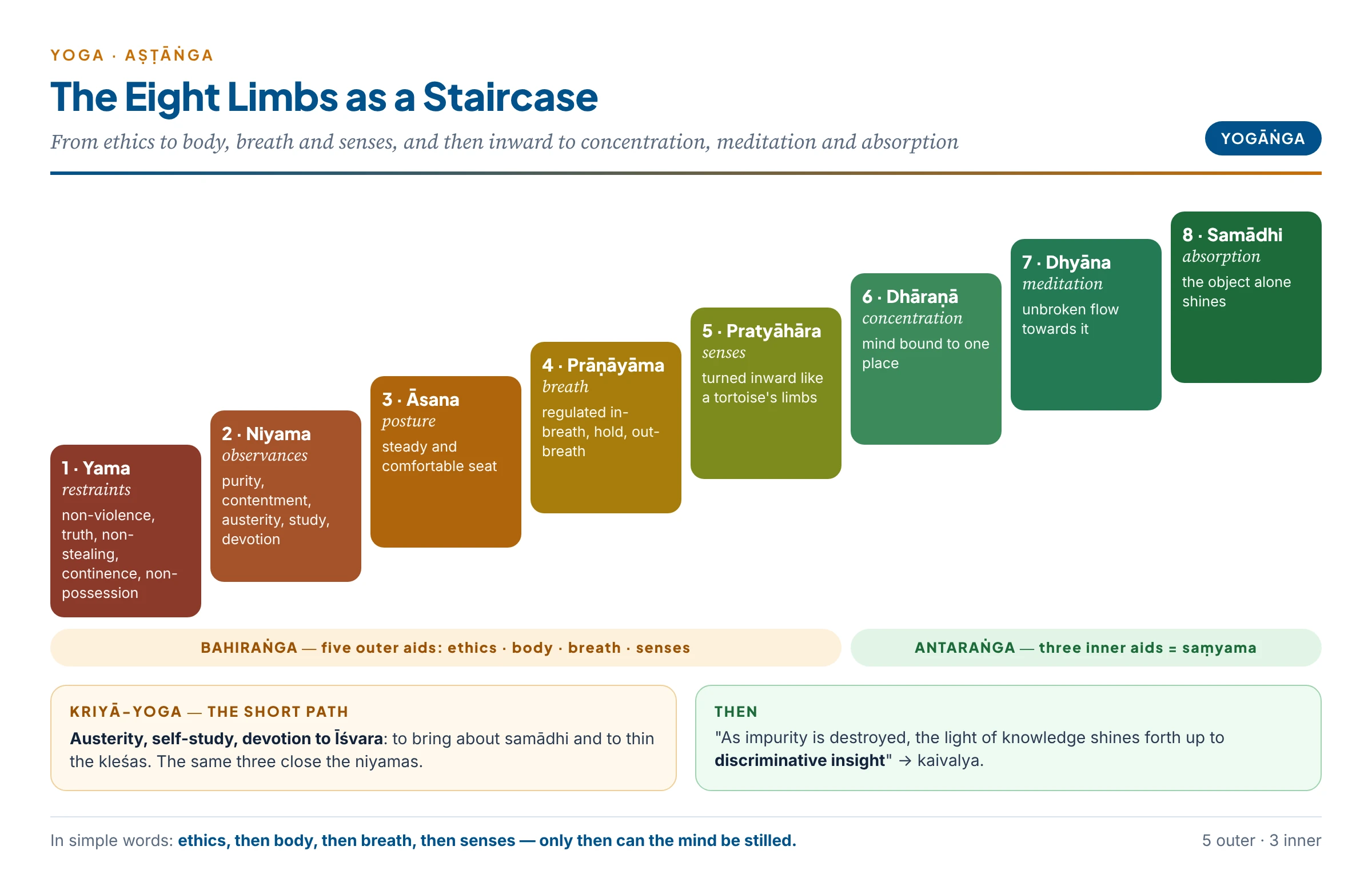
If the kleśas are the disease, Aṣṭāṅga Yoga — the “eight-limbed yoga” — is the treatment. Patañjali lists eight aids to yoga (yogāṅga): yama (restraints), niyama (observances), āsana (posture), prāṇāyāma (breath control), pratyāhāra (withdrawal of the senses), dhāraṇā (concentration), dhyāna (meditation) and samādhi (absorption). “From the practice of the limbs of yoga, as impurity is destroyed, the light of knowledge shines forth up to discriminative insight.” The path starts with ethics, passes through the body and breath, turns the senses inward, and ends in the mind’s total absorption. Alongside it stands a shorter discipline, kriyā-yoga — austerity, self-study and devotion to God. This article explains each limb with its meaning, examples and purpose, the division into outer and inner limbs, the joint practice called saṃyama, the supernormal powers (siddhis) and why they are traps, the significance of the path, and its criticisms.
In simple words
To see the bottom of a well you must first stop people throwing rubbish in (ethics), then stop the ground shaking (posture), then stop the wind (breath), then close the lid on outside noise (senses), and finally let the water settle completely (concentration, meditation, absorption). The eight limbs are these steps, in this order — each one makes the next possible.
Context & Problem
Why a Practical Path Is Needed
- The impure mind cannot see. “A man cannot realise spiritual truths so long as his mind is tainted with impurities and his intellect vitiated by evil thoughts. It is in the pure heart and the clear understanding that the truth of the spirit is revealed.”
- Liberation needs insight; insight needs purity. Sāṃkhya–Yoga holds that liberation comes through spiritual insight (prajñā) into the self as distinct from body and mind. “But spiritual insight can be had only when the mind is purged of all impurities and rendered perfectly calm and serene.”
- Control, not destruction, of the body. Yoga “does not want to kill the body; on the other hand, it recommends its perfection“. “A sound mind needs a sound body.” Physical health “is not the end of human life, it is still one of its essential conditions”. Man is not “a physical machine to which spiritual life is attached from outside”: the body is “the instrument for the expression of spiritual life”.
- The obstacles. “Sensual attachment and passions distract the body as well as the mind. They must be conquered.” Because we have a body, senses and mind with different needs, we are “drowned in the river of bondage”; to get free, the body, senses and mind must all be brought under control.
- The answer. “To overcome the hindrances, Yoga gives us the eightfold path of discipline (Aṣṭāṅga Yoga)” — “a practical method in the form of regulatory guidelines for those who wish to attain liberation by their own spiritual efforts“.
Core Doctrine
1. Kriyā-yoga: The Yoga of Action
- Definition. “Austerity (tapas), self-study (svādhyāya) and devotion to Īśvara (Īśvara-praṇidhāna) constitute kriyā-yoga.”
- Its two purposes. It is practised “to bring about samādhi and to attenuate the kleśas” (Article 4).
- For whom? It is a preparatory discipline for the person whose mind is not yet steady — a practical yoga for daily life before the deeper stages.
- Its place in the eight limbs. The same three appear again as the last three niyamas, so kriyā-yoga is both a separate short path and a part of the longer one.
- Theory and praxis together. Kriyā-yoga purifies, the eight limbs discipline, and the pramāṇas give right understanding — “Yoga is neither mere metaphysics nor mere technique but a holistic discipline” (Article 1).
2. Yama: The Five Restraints
“Yama establishes the foundation of spiritual practice by purifying interpersonal behaviour. Without this moral groundwork, higher yoga is unstable.” It means “complete abstention from all evil courses and tendencies of life”.
- Ahiṃsā — non-violence. Abstention from injury to any life in thought, word and deed. It is the root of the other yamas. Example: Gandhi made ahiṃsā the basis of political action. Fruit: “When non-violence is established, hostility is abandoned in the presence” of the yogī.
- Satya — truthfulness. Truth in thought and speech, aligned with the welfare of others. Example: “If you tell one lie, you must tell many more lies to hide it”; the truthful mind is free from this burden. Fruit: the words of the truthful come true.
- Asteya — non-stealing. Not taking what belongs to others — and not even desiring others’ wealth; not stealing ideas either (claiming another’s work as one’s own). Fruit: “all jewels come to him”.
- Brahmacarya — continence. Control of carnal desires and passions; originally celibacy, more broadly the regulation of sensual and sexual energy. Fruit: vigour (vīrya).
- Aparigraha — non-possessiveness. Freedom from greed; non-acceptance of unnecessary gifts; not hankering after luxuries like gold and diamonds. Fruit: knowledge of the “how and why” of one’s births.
- The great vow. When these are practised “unlimited by birth, place, time or circumstance“, they become the “great vow” (mahāvrata), binding everywhere and always.
- Jaina parallel. The five yamas are the five vows of Jainism — non-violence, truth, non-stealing, celibacy, non-possession.
- Counter-thoughts. When disturbed by violent or false thoughts, cultivate the opposite (pratipakṣa-bhāvanā), reflecting that such thoughts bring endless pain and ignorance.
In simple words
Try to meditate right after cheating a friend, lying to your parents and stealing from a shop. The mind will keep replaying the fear of being caught and the guilt. That is why yoga starts with yama: a clean conscience is the first condition of a calm mind. Ethics here is not decoration; it is mental hygiene.
3. Niyama: The Five Observances
Niyama “is concerned with individual discipline and inner purification”; it “regulates the practitioner’s internal life, preparing citta for concentration”.
- Śauca — purity. Two kinds:
- External (bāhya): purifying the body by washing and pure food; cleanliness of dress, hair and nails.
- Internal (ābhyantara): purifying the mind by cultivating friendliness, kindness and cheerfulness towards the virtuous and indifference to the vices of others.
- Santoṣa — contentment. “The habit of being content with what comes of itself without undue exertion.” Example: a student who is content to be a student does his work well instead of fretting to be a CEO tomorrow. Contentment does not kill aim; it kills greedy hurry.
- Tapas — austerity. “The habit of enduring cold and heat“, hunger and thirst, and of observing austere vows — building will-power through self-restraint.
- Svādhyāya — self-study. “The regular habit of study of religious books” and repetition of mantras; reflection on sacred texts. Each person may study the scripture of his own faith.
- Īśvara-praṇidhāna — devotion to God. “Meditation of and resignation to God” — surrendering the ego and the fruits of action. “From devotion to Īśvara comes the perfection of samādhi” (Article 7).
4. Āsana: Posture
- Definition. “Posture is steady and comfortable” (sthira-sukham āsanam). Patañjali’s concern is stability for meditation, not complex exercise.
- Kinds. Padmāsana (lotus), vīrāsana (hero), bhadrāsana and others; later traditions add many — śīrṣāsana, mayūrāsana, garuḍāsana, cakrāsana. They should be “learnt only under the guidance of experts”.
- Purpose.
- “If the body is not completely free from diseases and other disturbing influences, it is very difficult to attain concentration.”
- Postures keep the body healthy and bring “all the limbs, especially the nervous system, under control”, so that they do not disturb the mind.
- Mastered by relaxing effort and meditating on the infinite, posture makes one unaffected by the pairs of opposites — heat and cold, pleasure and pain.
- Regularity. Posture practised “once in a blue moon has no meaning”; it must be regular.
5. Prāṇāyāma: Regulation of Breath
- Definition. Once posture is steady, prāṇāyāma is “the regulation (literally, the cutting off of the flow) of inhalation and exhalation“. Prāṇa means life-force or vital energy; āyāma means extension or control.
- Three phases. Pūraka (inhalation), kumbhaka (retention) and recaka (exhalation); breath may be suspended after exhalation, after inhalation, or simply held. Its length is measured by place, time and number, becoming long and subtle.
- Why breath? “So long as the function of breathing continues, the mind also goes on fluctuating and noticing the current of air in and out. If and when it is suspended, the mind is in a state of undisturbed concentration.”
- Gradual practice. It must grow slowly — thirty seconds today, forty tomorrow — and “must be performed under expert guidance, otherwise it may have bad after-effects”.
- Effects. It strengthens the heart (doctors too recommend graded breathing exercise for weak hearts), steadies body and mind, “reduces the influence of rajas and tamas”, and “destroys the veil over the inner light“, making the mind fit for concentration.
6. Pratyāhāra: Withdrawal of the Senses
- Definition. “When the senses do not come into contact with their objects and follow, as it were, the nature of the mind, that is pratyāhāra.”
- Image. Like a tortoise drawing its limbs into its shell, the yogī draws the senses inward.
- Effect. “In this state the mind is not disturbed by sights, sounds, etc., coming through the eye, the ear and other senses, but keeps all of them under perfect control.” The result is “supreme mastery over the senses”.
- Difficulty. “This state is very difficult, although not impossible, of attainment. It requires a resolute will and long practice.”
- Today. Pratyāhāra is the original “digital detox” — not being dragged by every notification.
In simple words
Think of a driver in heavy traffic. Yama–niyama are the traffic rules; āsana is sitting properly in the seat; prāṇāyāma is calming down instead of honking; pratyāhāra is not turning the head at every billboard. Only now can the driver keep full attention on the road — which is dhāraṇā. The outer limbs prepare; the inner limbs drive.
7. Bahiraṅga and Antaraṅga: Outer and Inner Limbs
- The division. The first five limbs — yama, niyama, āsana, prāṇāyāma and pratyāhāra — are the external aids (bahiraṅga-sādhana). The last three — dhāraṇā, dhyāna and samādhi — are the internal aids (antaraṅga-sādhana), “because they are directly related to some kind of samādhi”.
- Why “outer”? The first five deal with ethics, body, breath and senses; they are “merely preparatory to the later three”.
- A relative distinction. Patañjali adds that even the three inner limbs are “outer” in relation to the seedless (objectless) samādhi — for that, even concentration on an object must be left behind (Article 6).
| Aspect | Bahiraṅga (outer) | Antaraṅga (inner) |
|---|---|---|
| Limbs | Yama, niyama, āsana, prāṇāyāma, pratyāhāra | Dhāraṇā, dhyāna, samādhi |
| Nature | Ethical, physical, preparatory | Purely mental and spiritual |
| Goal | Purification, control over body and senses | Deep concentration, self-realisation |
| Image | Preparing the soil for a seed | The flowering of the seed |
| Today | Stress management (āsana, prāṇāyāma), ethical living, digital detox | Mindfulness, focus at work, peace-building |
| Outcome | Makes one fit for meditation | Leads towards kaivalya |
Common confusion
Are only the first three limbs “external”? No. Some notes say that “the first three are external and the last three internal”, leaving two limbs unaccounted for. Patañjali’s division is five and three: the first five (yama, niyama, āsana, prāṇāyāma, pratyāhāra) are external aids, and the last three (dhāraṇā, dhyāna, samādhi) are internal aids.
8. Dhāraṇā: Concentration
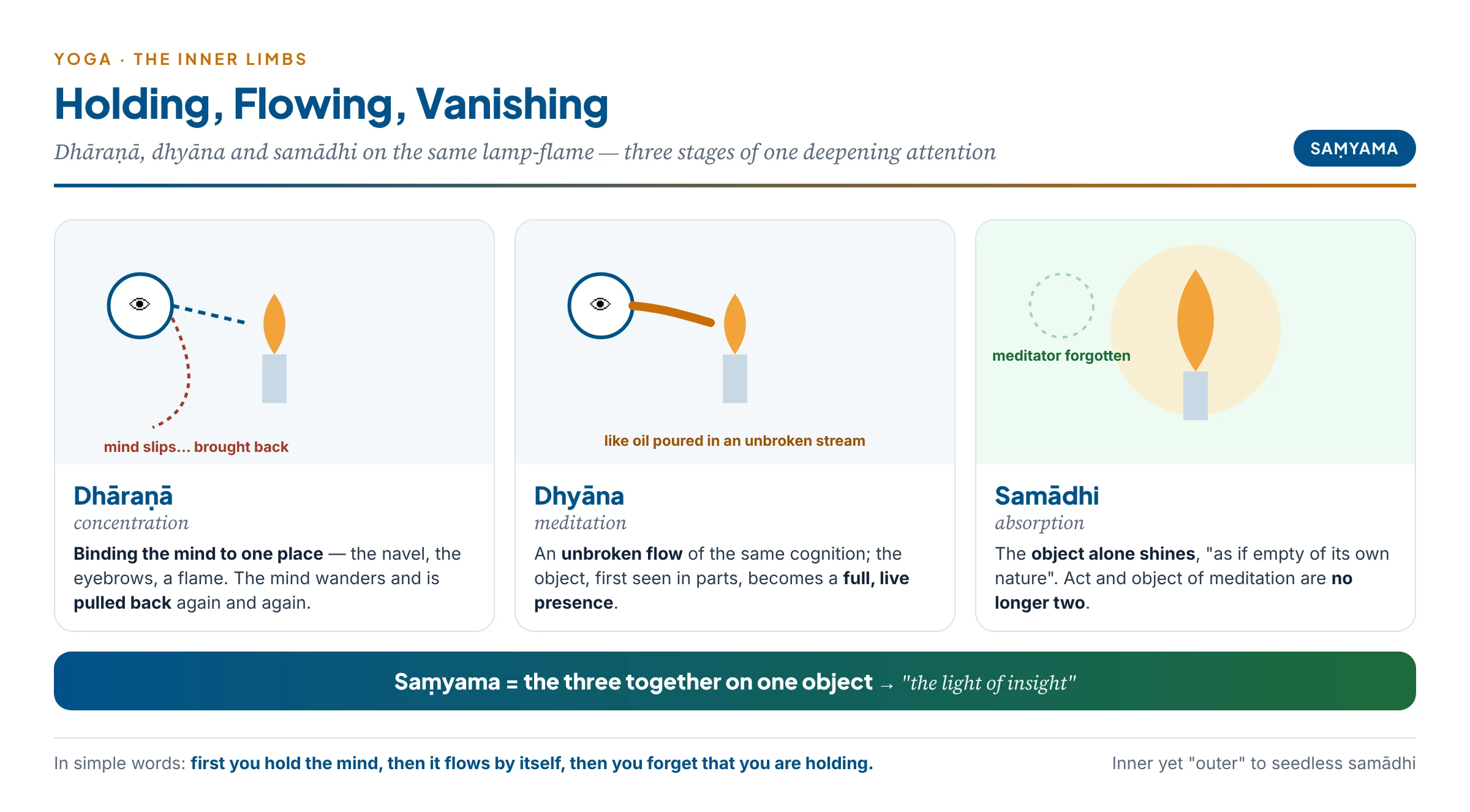
- Definition. “Dhāraṇā is the binding of the mind to one place” (deśa-bandhaś cittasya dhāraṇā).
- Objects. A part of one’s body — the navel, the mid-point of the eyebrows, the tip of the nose, the lotus of the heart — or something outside, like the moon, the flame of a lamp, an image of a deity, even a dot on a wall.
- Method. “By repeatedly bringing back the mind when it wanders, dhāraṇā trains one-pointedness.” The mind must be steady “like the unflickering flame of a lamp”.
- A test. “The ability to keep one’s attention steadily fixed on some object is the test of fitness for entering the next higher stage.”
9. Dhyāna: Meditation
- Definition. “Dhyāna is the uninterrupted flow of the cognition towards that object” (tatra pratyayaikatānatā dhyānam) — “a continuous stream of similar cognitions undisturbed by dissimilar cognitions”.
- Image. Like oil poured from one vessel into another, in an unbroken stream.
- What it reveals. It “gives a clear and distinct representation of the object, first by parts and aspects; but by long-continued meditation, the mind can develop the partial representation into a full and live presentation“. Example: we see a table’s top, legs and edges one at a time; in dhyāna the whole table is present to the mind at once.
- Dhāraṇā versus dhyāna. In dhāraṇā the mind is held and keeps slipping back; in dhyāna it flows to the object by itself.
In simple words
Learning to ride a bicycle: at first you grip the handle and keep correcting the wobble (dhāraṇā). Later the ride flows without effort (dhyāna). Finally you are so absorbed in the road that you forget you are riding at all — only the road is there (samādhi).
10. Samādhi as the Eighth Limb
- Definition. “When that same meditation shines forth as the object alone, as if empty of its own nature, it is samādhi.”
- Dhyāna versus samādhi. “In dhyāna, the act of meditation and the object of meditation remain separate. In samādhi they become one” — “only the object of thought remains shining in the mind, and we do not even know that there is a process of thought”.
- The limb and the goal. “This samādhi as a discipline is different from the samādhi or yoga defined as cittavṛtti-nirodha. The former is but the means for the attainment of the latter which is its end.” Its kinds are studied in Article 6.
11. Saṃyama: The Three Inner Limbs Together
- Definition. “The three together on one object are saṃyama.” Concentration, meditation and absorption must have the same object: first attended to, then meditated upon, then absorbed in.
- Fruit. “By mastery of saṃyama comes the light of insight” (prajñā-āloka). Applied to different objects, saṃyama yields knowledge of them — and also the powers described next.
12. Vibhūtis: The Supernormal Powers and Their Danger
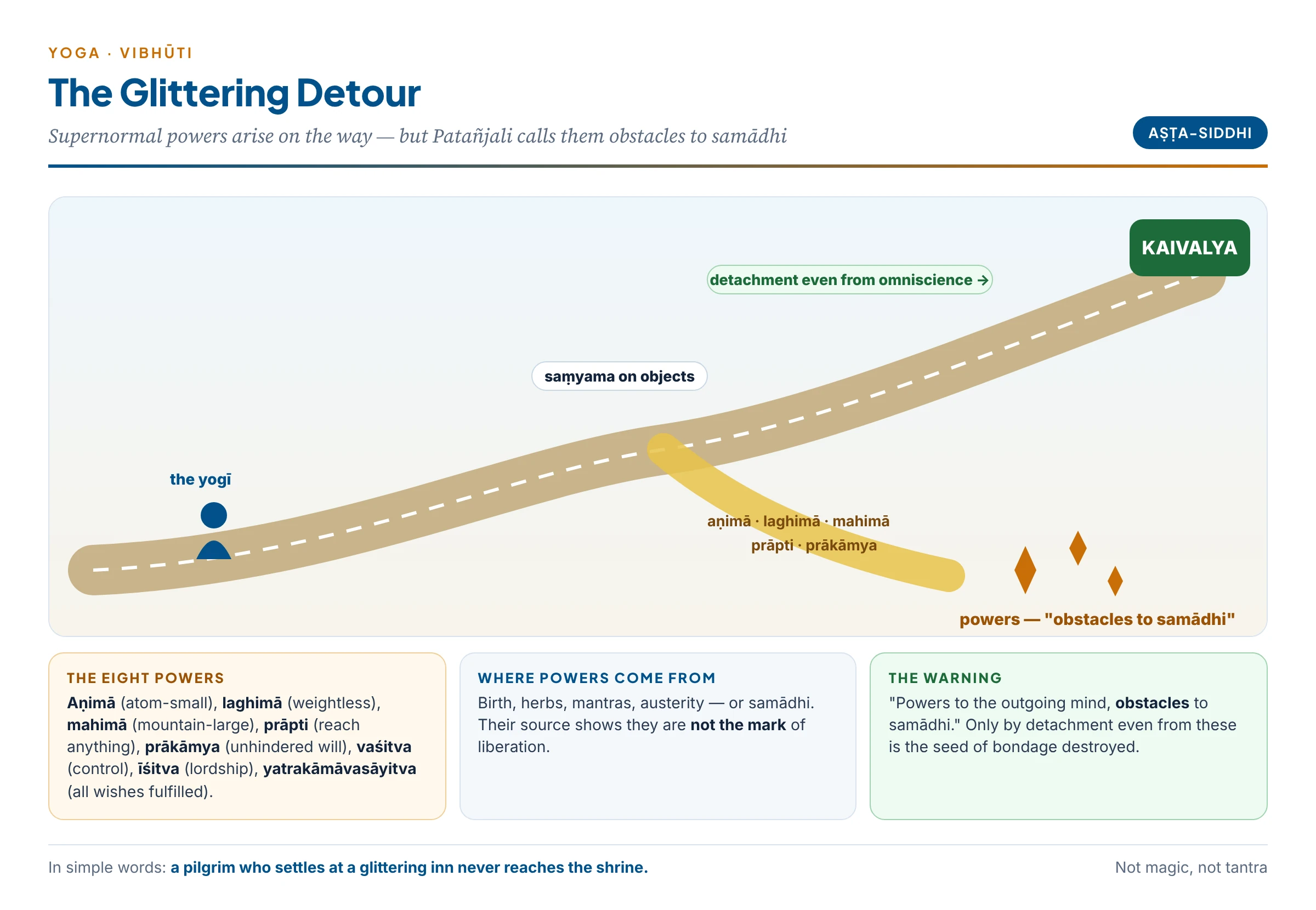
- The powers. By saṃyama, the yogī is said to gain extraordinary powers (siddhis): knowledge of past and future, of previous births, of others’ minds; taming even ferocious animals; becoming invisible; passing through walls; appearing in many places; supernatural sights, sounds and smells.
- The eight great powers (aṣṭa-siddhi):
- Aṇimā — becoming as small as an atom.
- Laghimā — becoming weightless, as light as air.
- Mahimā — becoming as large as a mountain.
- Prāpti — reaching or obtaining anything at will.
- Prākāmya — irresistible will; its wishes unobstructed.
- Vaśitva — control over all beings and elements.
- Īśitva — lordship over the creation and arrangement of things.
- Yatrakāmāvasāyitva — fulfilment of all desires.
- Sources of powers. Powers may come “from birth, herbs, mantras, austerity or samādhi“.
- The warning. “These are obstacles to samādhi, though they appear as powers to the outgoing mind.” The yogī “must not get entangled in the quagmire of supernormal powers”; “Yoga is for the attainment of liberation”. Even the power of omniscience must be renounced: “by detachment even from this, the seed of bondage is destroyed and kaivalya follows.”
Common confusion
Is Yoga a technique for gaining miraculous powers? No. Patañjali describes the powers in order to warn against them. They are by-products of concentration, called “obstacles to samādhi”. A yogī who stops at powers is like a pilgrim who settles down at an inn and forgets the shrine. The goal is kaivalya, not magic.
13. Aṣṭāṅga Yoga as the Method of Attaining Kaivalya
- Yama and niyama remove the gross impurities of conduct and weaken rāga and dveṣa.
- Āsana, prāṇāyāma and pratyāhāra quieten the body, breath and senses, closing the doors through which distraction enters.
- Dhāraṇā, dhyāna and samādhi make the mind one-pointed (ekāgra) and then restrained (niruddha).
- “As impurity is destroyed, the light of knowledge shines forth up to discriminative insight” (viveka-khyāti) — the direct realisation that Puruṣa is not citta.
- Discriminative insight destroys avidyā; the conjunction of seer and seen ends; kaivalya follows (Article 8).
Critical Evaluation
1. Significance of Aṣṭāṅga Yoga
- Ethical grounding. “Without yama and niyama, higher practices may collapse into egotism.” Morality stabilises social and personal life.
- Mind–body harmony. Āsana and prāṇāyāma harmonise physical health with inner calm.
- Psychological transformation. Pratyāhāra breaks habitual outwardness; dhāraṇā and dhyāna turn scattered attention into steady awareness.
- Liberation as goal. Samādhi fulfils yoga’s definition — the restraint of mental modifications, so that the seer abides in its true nature.
- Completeness. “Aṣṭāṅga Yoga bridges ethics, psychology and metaphysics, making it one of the most complete spiritual systems in world philosophy.”
2. Criticisms
- Overemphasis on discipline. Strict ethics, physical practice and meditation may produce feelings of inadequacy or failure in those who cannot keep up, discouraging them.
- Neglect of individual differences. Advanced limbs like dhāraṇā and samādhi may be inaccessible to many; a “one-size-fits-all” path may not suit everyone.
- Physical focus. The popular emphasis on postures can overshadow the spiritual goal; yoga is reduced to exercise, diluting Patañjali’s intent.
- Complexity. Mastering all eight limbs takes very long; seekers wanting quick results may become frustrated or burn out.
- Cultural context. Rooted in Indian traditions, the path may be misunderstood or fragmented when transplanted into very different cultures.
- Powers and science. To an unsympathetic critic the supernormal powers “can hardly be reconciled with the known laws of the physical or the psychical sciences” and look like magic.
- Asocial goal? The path seems directed at individual liberation through withdrawal, not at transforming society.
3. Replies
- Graded path. The limbs are stages, not a single test; even the first limbs bring real benefit, and kriyā-yoga gives a shorter path for the less advanced.
- Many entrances. Patañjali offers alternatives — devotion to Īśvara, the four attitudes, breath, any congenial object — so the path is not rigidly uniform.
- Powers are not the point. Yoga itself warns against powers, so their doubtful status does not touch the core of the path.
- Ethics is social. Non-violence, truth, non-stealing and non-possessiveness are thoroughly social virtues; a society of such people would be transformed.
Critics and Defenders
Criticism — Critics
- Too demanding: rigid discipline can discourage ordinary seekers.
- Uniform: one path for all temperaments.
- Distorted in practice: reduced to postures and fitness.
- Unscientific powers: siddhis look like magic.
- Individualistic: aims at private liberation through withdrawal.
Defence — Defenders and strengths
- Ethics first: the path begins with non-violence and truth, guarding against egotism.
- Graded and flexible: stages, kriyā-yoga and many alternative supports.
- Holistic: joins body, breath, senses and mind in one method.
- Powers renounced: Yoga itself calls them obstacles.
- Socially rich: the yamas are social virtues; Gandhi built politics on ahiṃsā.
Cross-Tradition Comparison
Paths of Discipline
| Point | Patañjali’s eight limbs | Buddhist Noble Eightfold Path | Jaina path | Western spiritual exercises |
|---|---|---|---|---|
| Ethics | Yama, niyama | Right speech, action, livelihood (śīla) | Five great vows | Stoic self-control; Christian virtues |
| Concentration | Āsana to samādhi | Right effort, mindfulness, concentration (samādhi) | Meditation to destroy karma | Ignatius Loyola’s spiritual exercises; Plotinus’ ascent |
| Wisdom | Viveka-khyāti | Right view and intention (prajñā) | Right knowledge | Philosophy as a way of life |
| Goal | Kaivalya of Puruṣa | Nirvāṇa without a self | Liberation of the soul | Union with God / tranquillity |
Indian Connect — Key takeaways
- The five yamas are the Jaina five vows; the inner limbs parallel Buddhist samādhi; Yoga’s path is thus part of a shared Indian ethics of discipline.
- The Buddha’s path and Patañjali’s are both eightfold and move from ethics to concentration to insight.
- Gandhi drew ahiṃsā, satya, aparigraha and brahmacarya from this common store and gave them public meaning.
Western Parallels
- Plato. The soul must be purified from bodily distraction before it can see the Forms — the same order as yama-niyama before samādhi.
- The Stoics. Daily exercises of attention, self-examination and endurance of hardship echo tapas and svādhyāya.
- Christian monasticism. Vows of poverty, chastity and obedience resemble aparigraha, brahmacarya and Īśvara-praṇidhāna; contemplative prayer resembles dhyāna.
Synthesis (Siddhānta)
- Kriyā-yoga — austerity, self-study and devotion to Īśvara — thins the kleśas and prepares for samādhi.
- Aṣṭāṅga Yoga is a graded path: yama and niyama (ethics), āsana and prāṇāyāma (body and breath), pratyāhāra (senses), then dhāraṇā, dhyāna and samādhi (mind). The first five are outer aids, the last three inner; the inner three on one object form saṃyama.
- Its logic: impurity is destroyed limb by limb until discriminative insight dawns and avidyā is removed — the method of attaining kaivalya.
- The powers that arise are real temptations, not goals; Yoga calls them obstacles to samādhi.
- A balanced view. The path is demanding and has often been reduced to postures or misread as magic; but as Patañjali framed it, it is one of the most complete disciplines of ethics, body and mind ever devised.
- Contemporary relevance.
- Public ethics. The yamas — non-violence, truth, honesty, restraint, non-possessiveness — are a ready code of integrity for public servants.
- Health. Āsana and prāṇāyāma are now widely used for stress, lifestyle disease and rehabilitation.
- Attention. Pratyāhāra and dhāraṇā answer the modern problem of constant distraction; dhyāna is the core of mindfulness programmes in schools and workplaces.
- International Day of Yoga has made yoga a global practice; Patañjali’s ordering — ethics first — is a reminder of its real purpose.
“From the practice of the limbs of yoga, as impurity is destroyed, the light of knowledge shines forth up to discriminative insight.” — Patañjali, Yoga Sūtra
Previous Year Questions
- 2015What is bondage according to Yoga philosophy? Explain the method of attaining Kaivalya in Patañjali’s Yoga Sūtra.
- 2012Critically evaluate the statement that “Yoga Sūtra emphasises more on praxis (action) than on theoria (reflection)”.
- 2011“Yoga is more than a psycho-physical exercise”. Analyse this statement and support your conclusion with arguments.