

Schools of Buddhism: Pratītyasamutpāda; Kṣaṇikavāda, Nairātmyavāda
Official Syllabus: Paper I, Section B, Unit 14
Mādhyamika (“the school of the middle“) is the Mahāyāna school founded by Nāgārjuna (c. 150–250 CE). Its central teaching is śūnyatā — usually translated “emptiness” or “voidness“. The word is easy to misread. Śūnyatā does not mean that nothing exists. It means that nothing has svabhāva (niḥsvabhāvatā) — no own-nature, no fixed essence that makes it what it is by itself, independent of causes, parts and the mind that names it. Things exist, but only dependently; and whatever exists dependently is “empty” of independent being. So Nāgārjuna can say that emptiness is simply dependent origination (pratītyasamutpāda) seen to its depths. With a sharp method of argument — the dialectic (prasaṅga) and the four-cornered negation (catuṣkoṭi) — he shows that every theory claiming to grasp the essence of things (existence, non-existence, cause, motion, self, even nirvāṇa) collapses into contradiction. What remains is a middle way between the extremes of eternalism and nihilism, held together by the doctrine of two truths.
In simple words
Ask “what is a rainbow, really?” It is not a thing by itself — take away the sun, the rain-drops or the eye that sees it from the right angle, and it is gone. Yet it is not nothing: you can see it, photograph it, and point it out to a friend. The rainbow is “empty“: real as a dependent appearance, unreal as an independent thing. Mādhyamika says that everything — tables, people, thoughts, even the Buddha’s teaching — is like the rainbow.
Context & Problem
Nāgārjuna and His School
- Nāgārjuna (c. 150–250 CE), a South Indian monk linked by tradition with Nāgārjunakoṇḍa in Andhra, is regarded as the second Buddha of Mahāyāna.
- Key works: the Mūlamadhyamakakārikā (“Fundamental Verses on the Middle Way”, the basic text), Vigrahavyāvartanī (“Dispeller of Disputes”, his reply to critics), Śūnyatāsaptati, Yuktiṣaṣṭikā, Vaidalyaprakaraṇa (against the Nyāya categories) and Ratnāvalī (“Precious Garland”, advice to a king).
- Successors:
- Āryadeva — Nāgārjuna’s disciple (Catuḥśataka).
- Buddhapālita and Candrakīrti (Prasannapadā, Madhyamakāvatāra) — the Prāsaṅgika line, which argues only by reductio (showing the opponent’s own view leads to absurdity), never putting forward a thesis of its own.
- Bhāvaviveka — the Svātantrika line, which allows independent arguments of one’s own at the conventional level.
- Śāntideva (Bodhicaryāvatāra) and Śāntarakṣita — who joined emptiness with the Bodhisattva ideal and with Yogācāra respectively.
- Background: the Prajñāpāramitā (“Perfection of Wisdom”) sūtras, whose famous line is “form is emptiness, emptiness is form“. Nāgārjuna gave these sūtras a philosophical defence.
- Names given by others: opponents called the school Śūnyavāda (“doctrine of the void”) and even Sarvavaināśikavāda (“doctrine of universal destruction”), reading it as nihilism. The school called itself Mādhyamika — the followers of the middle path.
What Problem Was Nāgārjuna Answering?
- The Abhidharma turn. After the Buddha, the realist schools (Vaibhāṣika/Sarvāstivāda, Sautrāntika — Article 7) broke the world into dharmas — ultimate, momentary elements — and held that each dharma has its own svabhāva (fixed nature: hardness for earth, feeling for vedanā). The Sarvāstivāda even held that dharmas exist in all three times (past, present, future).
- Nāgārjuna’s worry. This brought back, through the back door, exactly what the Buddha rejected: fixed essences. The Buddha had denied a permanent self in persons (pudgala-nairātmya); Nāgārjuna extends the denial to all elements (dharma-nairātmya, Article 5).
- The deeper problem. Philosophers keep asking “does it exist or not?“, “is the effect in the cause or not?“, “is the self the same as the body or different?” Nāgārjuna’s claim: every such question assumes that things have a fixed nature. Remove that assumption, and the questions — and the endless disputes between schools — dissolve.
Same Premise, Opposite Conclusions: “All Is Real” vs “All Is Void”
Both the Sarvāstivāda and the Mādhyamika begin from the Buddha’s dependent origination. Yet one concludes “everything is real” and the other “everything is void“.
- Sarvāstivāda (all is real).
- Dependent origination is a relation between things; a relation needs real terms to relate.
- So the dharmas that arise in dependence must be real elements with their own nature (fire is hot, earth is solid).
- Since a past cause must be real to produce an effect and the future must be real to be known, dharmas exist in all three times — sarvam asti, “all exists“.
- Mādhyamika (all is void).
- Whatever arises in dependence on other things does not exist by itself.
- To have own-nature (svabhāva) is to exist by itself.
- So whatever is dependently arisen has no own-nature — it is empty (śūnya). Since everything is dependently arisen, everything is empty.
- The difference lies in how “dependence” is read. The realist sees dependence as a link between real things; the Mādhyamika sees it as proof that there are no independent things to be linked. One stresses the terms, the other the relation.
Core Doctrine
1. Svabhāva: The Target of the Critique
- What svabhāva would be. If something had own-nature, that nature would have to be:
- Independent — not produced by causes or conditions (what is produced is borrowed, not “own”).
- Unchanging — a nature that could change would not be its own nature.
- Non-relational — not defined by anything else.
- Nāgārjuna’s test. Look for such a nature in anything — a pot, a person, fire, motion, time — and it is never found. Everything we meet is caused, changing and relative. So nothing has svabhāva.
- Why it matters. If things did have own-nature, they could never change: a seed with a fixed seed-nature could never become a sprout; suffering with a fixed nature could never end. Svabhāva would freeze the world. Emptiness is what makes change, growth and liberation possible.
2. Śūnyatā Is Dependent Origination — and the Middle Way
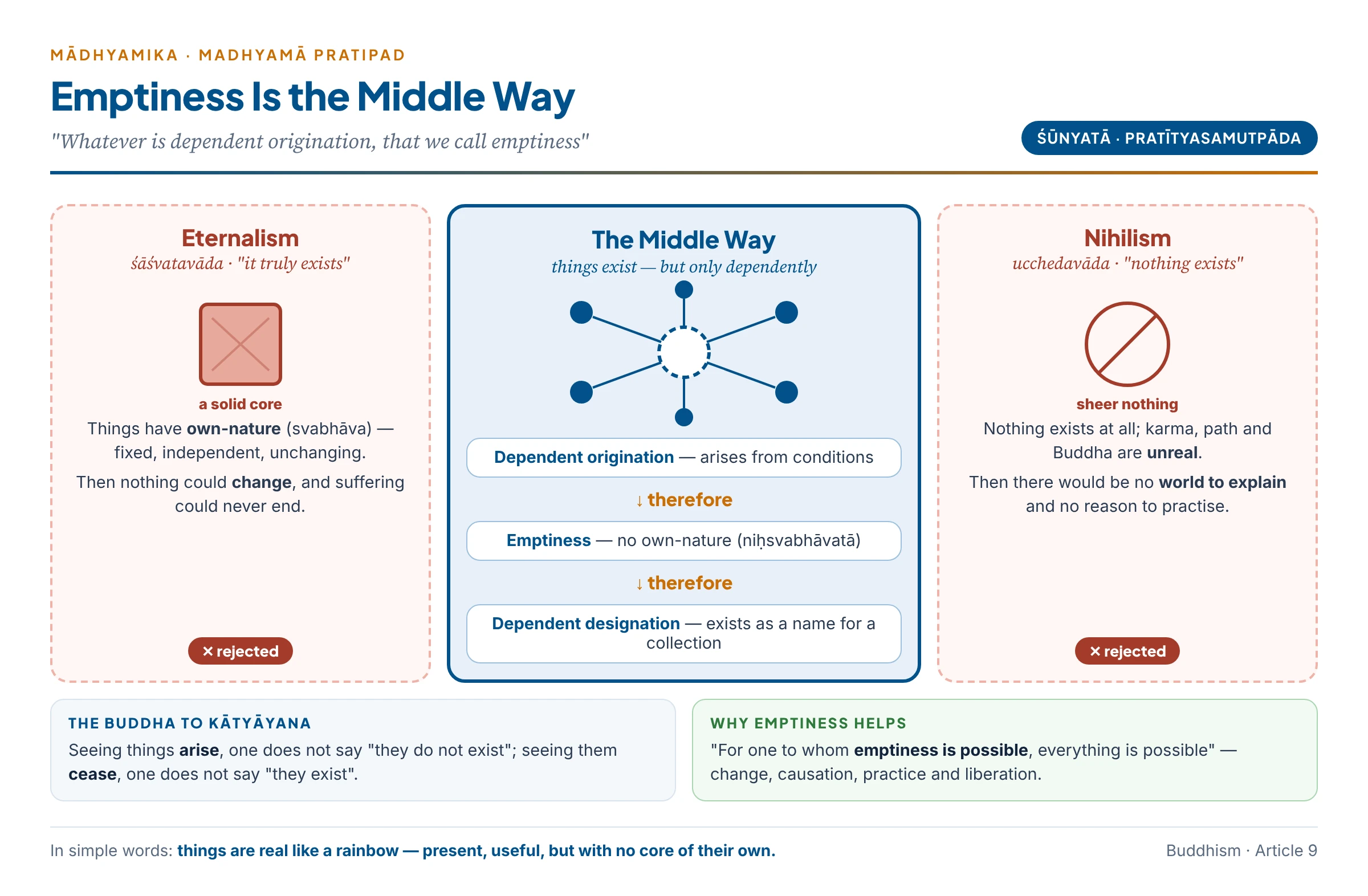
- The key verse. Nāgārjuna writes: “Whatever is dependent origination, that we call emptiness. That is a dependent designation, and that itself is the middle way.” (yaḥ pratītyasamutpādaḥ śūnyatāṃ tāṃ pracakṣmahe)
- Three things in one.
- Dependent origination — things arise depending on conditions.
- Emptiness — so they lack own-nature.
- Dependent designation (prajñaptir upādāya) — so they exist as names and concepts applied to collections of conditions (“chariot”, “person”, “forest”).
- And this is the middle way (madhyamā pratipad) — between “things truly exist” (eternalism, śāśvatavāda) and “things do not exist at all” (nihilism, ucchedavāda).
- The Buddha’s own middle way. The Buddha told Kātyāyana that the world mostly relies on two ideas, existence and non-existence; one who sees the arising of the world does not say “it does not exist”, and one who sees its ceasing does not say “it exists”. Nāgārjuna cites this sermon as the root of his philosophy.
- The reverse claim. “For one to whom emptiness is possible, everything is possible; for one to whom emptiness is not possible, nothing is possible.” Only an empty world can change, cause and be liberated.
In simple words
A team wins a cricket match. Where is “the team”? Not in any one player, not in the coach, not in the jersey, not in the name. Take all of them away and nothing called “the team” is left over. Yet the team really wins, gets a trophy and has fans. “Team” is a dependent designation — a useful name for a collection working together. Mādhyamika says every thing is like the team: real enough to function, empty of any core of its own.
3. The Two Senses of Śūnya
- Svabhāva-śūnya — empty of own-nature. All phenomena lack independent existence. This is the negative sense, applied to the world.
- Prapañca-śūnya — empty of conceptual elaboration. The ultimate truth is free of all plurality, concepts and words (prapañca). This is the sense applied to reality as known in wisdom.
- Indian parallel. The first sense resembles the Advaitic idea of māyā (the world as dependent appearance); the second resembles the Advaitic nirguṇa Brahman (reality beyond all description). Read in this way, śūnya means “indescribable” (anirvacanīya), not “nothing”.
- Two readings of the school.
- The absolutist reading: behind the negations lies an indescribable reality, free from the four alternatives (catuṣkoṭi-vinirmukta), known only in non-conceptual wisdom (prajñā). This brings Mādhyamika close to Advaita.
- The no-thesis reading: emptiness points to no hidden reality at all; it is only the removal of wrong views. Even “ultimate truth” is that there is only conventional truth.
- Both readings agree that śūnyatā is not nothingness.
4. The Method: Prasaṅga (Reductio)
- What it is. Nāgārjuna does not set up a counter-theory. He takes the opponent’s thesis, draws out its consequences (prasaṅga), and shows that they contradict the thesis itself or each other.
- Why this method. A counter-theory would itself claim to grasp the essence of things — and fall into the same trap. Reductio clears away views without adding a new one.
- The result. Every metaphysical theory, pushed to its limit, refutes itself. This exposes the limits of conceptual reason (buddhi) when it tries to grasp reality as it is.
- “I have no thesis.” In the Vigrahavyāvartanī Nāgārjuna says: “If I had any proposition, this fault would attach to me; but I have no proposition, so no fault attaches to me.“
5. The Catuṣkoṭi (Four-Cornered Negation)
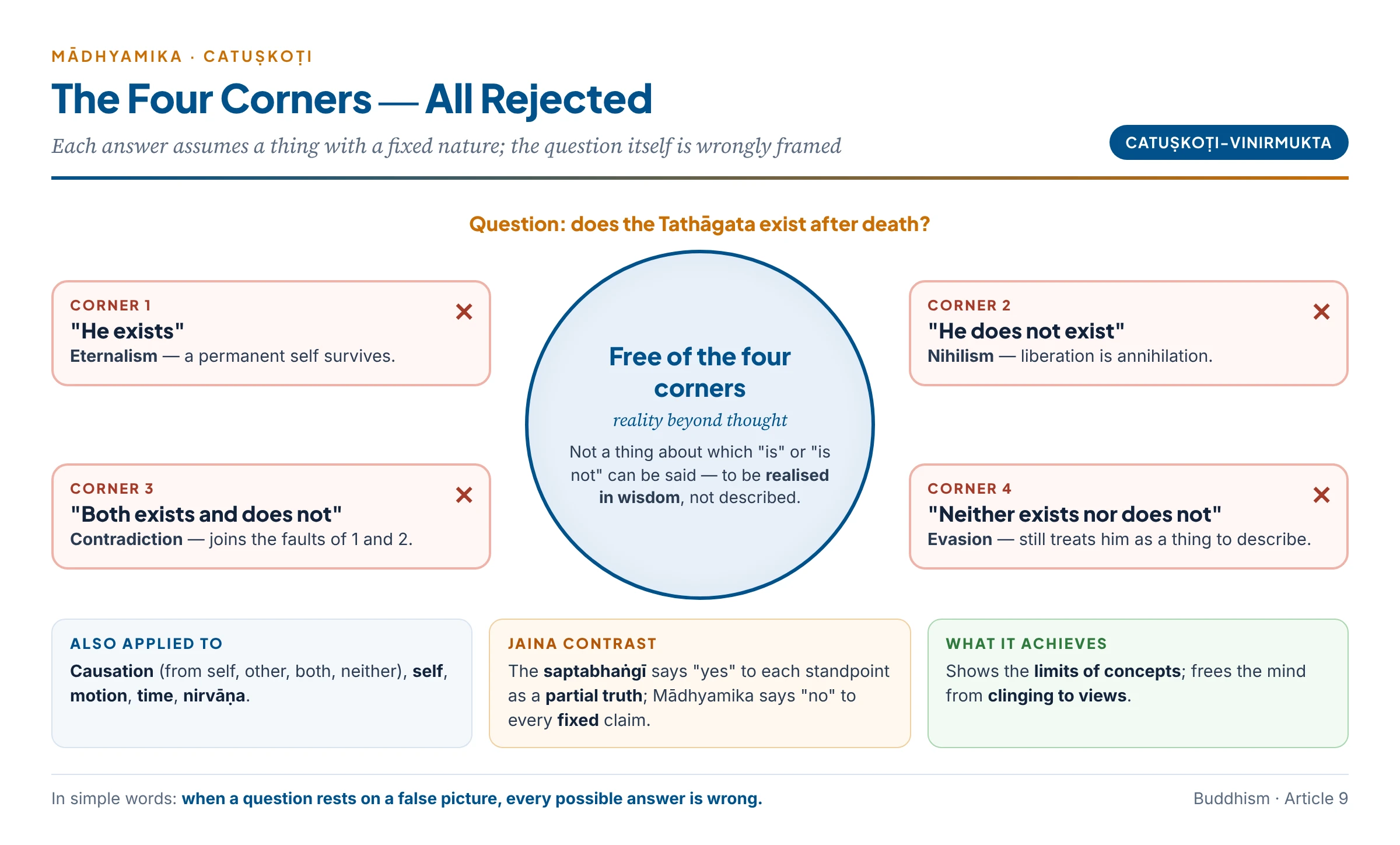
- The four corners. For any question about the nature of something, there seem to be four possible answers:
- It is (existence).
- It is not (non-existence).
- It both is and is not.
- It neither is nor is not.
- Nāgārjuna rejects all four when they are taken as descriptions of a thing’s own-nature. Each assumes a fixed essence of which “is” or “is not” can be said.
- The classic example — does the Tathāgata exist after death?
- “He exists” — eternalism: a permanent self survives.
- “He does not exist” — nihilism: liberation is annihilation.
- “Both” — a contradiction.
- “Neither” — an evasion, which still treats the Tathāgata as a thing about which a claim is made.
- All four are rejected; the question itself is wrongly framed, just as the Buddha left it unanswered (avyākṛta, Article 1).
- Applied everywhere. Nāgārjuna runs the four corners through causation (from itself, from another, from both, from neither), self, motion, time and nirvāṇa, and finds each alternative untenable.
- What the catuṣkoṭi shows about reality.
- Negatively, it shows that thought-categories (being, non-being, identity, difference) cannot capture reality.
- Positively (in the absolutist reading), reality is “free of the four corners” (catuṣkoṭi-vinirmukta) — beyond thought and language, to be realised, not described.
- Practically, it removes attachment to views (dṛṣṭi), which the Buddha saw as a root of suffering.
In simple words
Someone asks, “Has the lamp’s flame, after it is blown out, gone north, south, east or west?” Every answer is wrong — not because the flame is hiding somewhere strange, but because the question assumes the flame is a thing that must be somewhere. The catuṣkoṭi works the same way: it shows that “is”, “is not”, “both” and “neither” all rest on a false picture of things.
6. The Critique of Causation
Causation is the first target of the Mūlamadhyamakakārikā, because the realist picture of the world rests on it. The opening verse lists eight negations — the “eight no’s”:
| Pair | Denied |
|---|---|
| Arising – ceasing | No origination (anutpāda), no cessation (anirodha) |
| Permanence – annihilation | No eternity (aśāśvata), no destruction (anuccheda) |
| Unity – plurality | Not one (anekārtha), not many (anānārtha) |
| Coming – going | No coming (anāgama), no going (anirgama) |
- These are not denials that things appear to arise and pass; they deny that arising, ceasing and the rest belong to things by their own nature. Dependent origination so understood is called “the auspicious calming of conceptual proliferation” (prapañcopaśama).
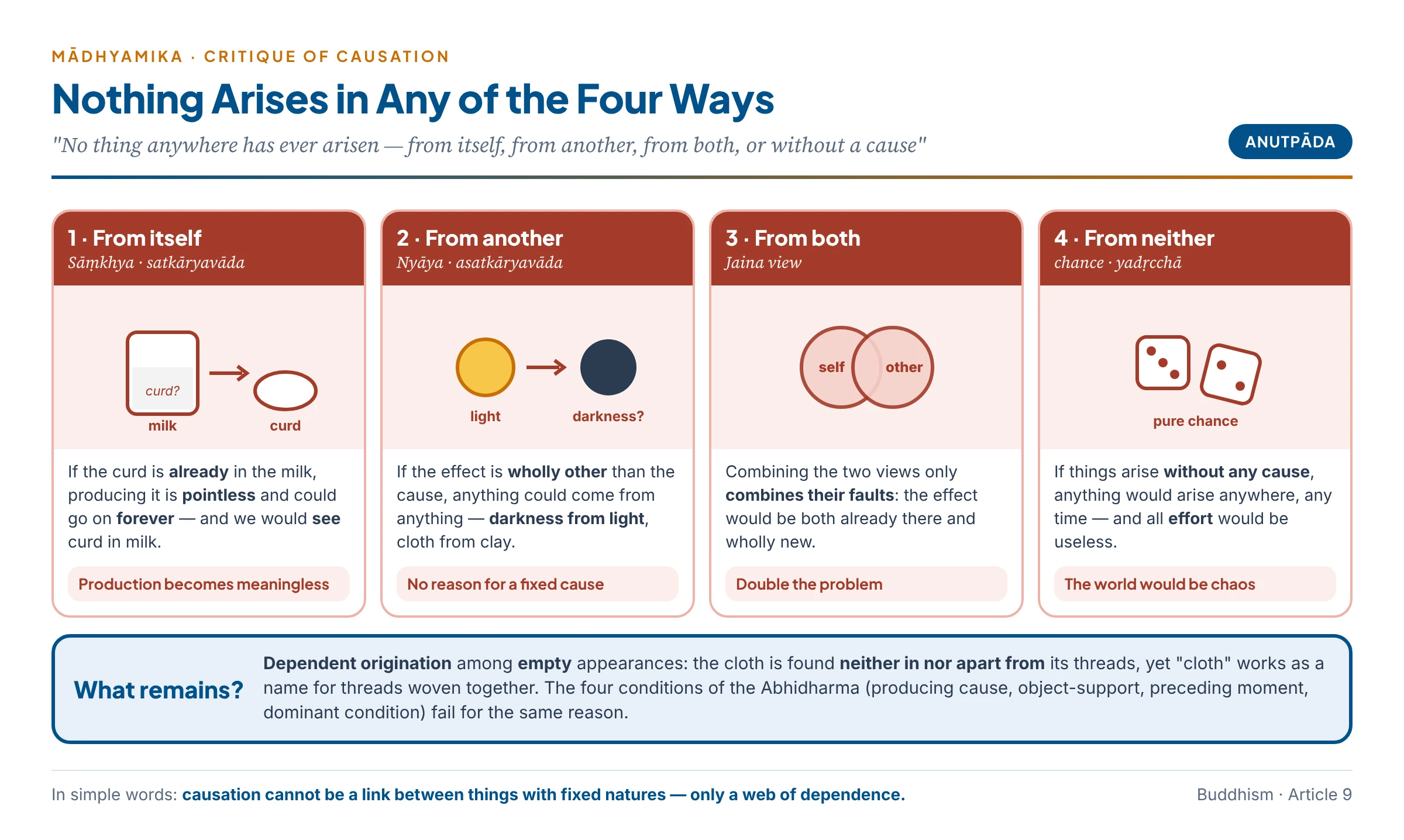
(a) The four ways a thing might arise — all rejected:
- From itself (the Sāṃkhya satkāryavāda). If the curd already exists in the milk, producing it is pointless — it is there already — and the process would never end, since what exists could be produced again and again. Also, if curd were already in milk, we would see it there.
- From another (the Nyāya-Vaiśeṣika asatkāryavāda / ārambhavāda). If the effect is wholly different from its cause, then anything could come from anything: darkness from light, cloth from clay. Why only cloth from threads?
- From both itself and another (the Jaina view). This combines the faults of both previous views.
- From neither — without cause (chance, yadṛcchā). Then anything would arise anywhere, at any time, and effort would be pointless.
- Conclusion: “No thing anywhere has ever arisen — from itself, from another, from both, or without a cause.” Causation as a relation between things with own-nature is unintelligible. Causation as dependence among empty appearances is all that remains — and that is dependent origination.
(b) The four conditions (pratyaya) of the Abhidharma — also rejected:
- Hetu-pratyaya (the producing cause, e.g. the seed): if the effect already exists, the cause is not needed; if it does not exist, the cause is the cause of nothing.
- Ālambana-pratyaya (the object-support of a cognition): if consciousness already exists, it needs no object; if it does not exist, there is nothing for the object to support.
- Samanantara-pratyaya (the immediately preceding moment): if the preceding moment has already ceased, how can a non-existent thing produce anything?
- Adhipati-pratyaya (the dominant condition, “this being, that arises”): if things have no own-being, the formula “this being” has no real “this” to refer to.
(c) Threads and cloth. Is the cloth in the threads? Then it would be seen there. Is it apart from the threads? Then it would be seen apart. It is found neither in nor apart from its causes — so it has no own-nature, though “cloth” works perfectly well as a name for threads woven together.
7. Motion, Self, Substance and Time
- Motion. Where does the act of going happen?
- Not on the path already gone over — the going there is finished.
- Not on the path not yet gone over — the going has not begun.
- Apart from these two, there is no third path “being gone over”.
- And the goer and the going cannot be separated: without going there is no goer, and without a goer there is no going. Neither has its own nature.
- (Compare Zeno’s paradoxes in Greek philosophy.)
- Self.
- If the self were the same as the five aggregates, it would arise and perish with them — many selves, not one.
- If it were different from them, it could never be perceived or known, since we know a person only through body, feelings and thoughts.
- So the self is neither the same as nor different from the aggregates — it has no own-nature. Even the aggregates themselves are empty.
- Substance and attribute. A substance without attributes is never perceived; attributes without a substance have nothing to stand in. Each is defined by the other — so neither is independently real.
- Time. The present and future are defined in relation to the past; if they depend on the past, they would have to be in it; if not, they would not be “present” or “future” at all. Time is not a thing with its own nature, only a relation among changing events.
- Bondage and liberation. If bondage were real by nature, it could never be removed; if a self had to be bound, the self would be fixed. Bondage and liberation are both empty — and so liberation is possible.
8. The Two Truths (Satya-dvaya)
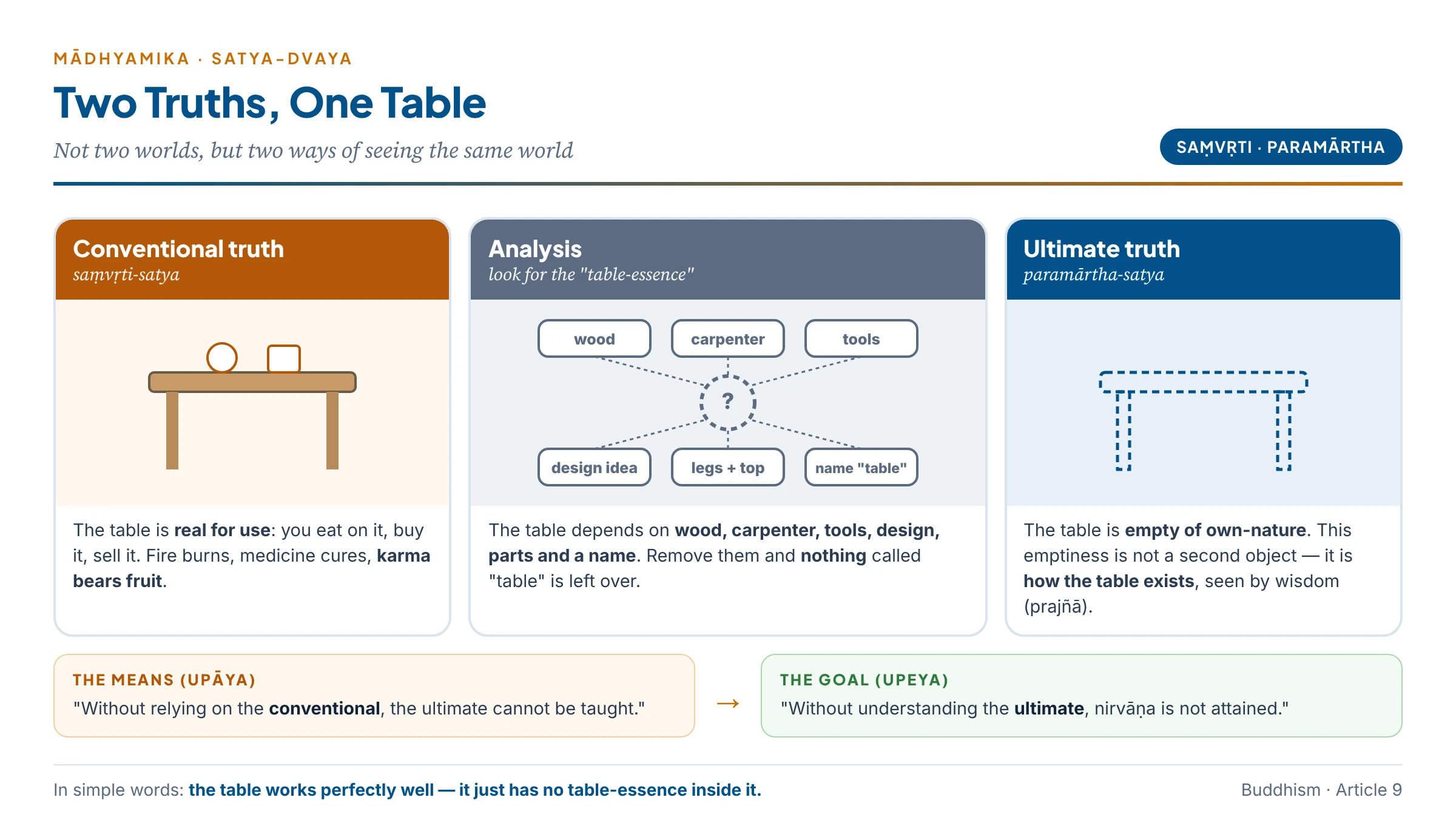
- The doctrine. Nāgārjuna: “The Buddhas teach the Dharma by relying on two truths — the worldly conventional truth and the ultimate truth. Those who do not understand the distinction between these two do not understand the profound teaching of the Buddha. Without relying on the conventional, the ultimate cannot be taught; without understanding the ultimate, nirvāṇa is not attained.“
- Conventional truth (saṃvṛti-satya or vyavahāra-satya).
- The world as it appears and as we speak of it: tables, people, causes, karma, the Buddha’s path.
- Saṃvṛti literally means “covering” — the everyday view that covers the emptiness of things; it also means mutual dependence and worldly convention.
- It is valid within its sphere: fire really burns, medicine really cures, good actions really bear good fruit — at the level of everyday life.
- Candrakīrti adds a distinction within conventional truth: the rope is conventionally real (tathya-saṃvṛti), while the snake seen in the rope is conventionally false (mithyā-saṃvṛti). So emptiness does not erase the difference between truth and error in daily life.
- Ultimate truth (paramārtha-satya).
- The emptiness of all things — their lack of own-nature.
- Known not by concepts but by non-conceptual wisdom (prajñā); beyond words, “the cessation of all verbal and conceptual elaboration“.
- Two truths, not two realities. These are two ways of seeing one world, not two worlds. The ultimate is not a second, hidden world behind this one; it is this world seen truly. In the no-thesis reading: “the ultimate truth is that there is only conventional truth“.
- Two sides of the same coin. Conventional truth is the means (upāya), ultimate truth the goal (upeya). Both are necessary: without the conventional, there would be no language to teach in; without the ultimate, no liberation.
- Rising through the lower. One must climb through the conventional truth to the ultimate, as one uses a ladder; one cannot jump directly. “To no one, nowhere, was any doctrine taught by the Buddha” — at the ultimate level, even teaching is empty, though conventionally the Buddha taught for forty-five years.
The table example:
- Conventionally, the table is real: you eat on it, sell it, move it.
- Analysed, the table depends on wood, the carpenter, his tools, the design idea, the legs and top arranged in a certain way, and the name “table”. Remove these and no “table-essence” is left over.
- Ultimately, the table is empty of own-nature — and that emptiness is not a second object; it is the way the table exists.
The chair example — outer and inner emptiness:
- Externally, a chair depends on its parts (legs, seat, back), the craftsmanship that shaped them, the space it occupies, and the label we give it.
- Mentally, even our image or idea of “chair” is a conventional construction — itself dependent and empty.
- Emptiness is not non-existence: the chair still holds you up; it simply holds you up as a dependent thing.
In simple words
A chemist knows that water is made of hydrogen and oxygen; yet at home she still says “pass me a glass of water“, not “pass me some hydrogen and oxygen”. Neither statement is false. One is the everyday level, useful for living; the other is a deeper level, useful for understanding. Mādhyamika’s two truths work like this, except that at the deepest level even “hydrogen” and “oxygen” turn out to have no own-nature.
9. Nirvāṇa and Saṃsāra
- Nirvāṇa negatively described. “What is neither abandoned nor attained, neither annihilated nor eternal, neither ceased nor produced — that is called nirvāṇa.” Nirvāṇa is not a thing that comes into being or a place one goes to.
- No difference between saṃsāra and nirvāṇa. “There is not the slightest difference between saṃsāra and nirvāṇa; the limit of nirvāṇa is the limit of saṃsāra.”
- This does not mean that ordinary life, as we now live it, is already liberation.
- It means that nirvāṇa is not another world: it is this very world seen without the illusion of own-nature. Saṃsāra is reality seen through ignorance; nirvāṇa is the same reality seen through wisdom.
- Hence nirvāṇa is the realisation of śūnyatā, and the calming of all conceptual elaboration.
- Ladder of teaching (from the Ratnāvalī). “As a grammarian first teaches the alphabet”, the Buddha taught according to the capacity of the hearer:
- To ordinary people — affirmation (there is a self, there is karma, do good).
- To the middling — negation (there is no self).
- To the best — emptiness, beyond both affirmation and negation.
- “By negation one goes to bad states, by affirmation to good states; by knowing what is beyond both, one is liberated.”
10. Prajñā and Karuṇā: Wisdom and Compassion
- Prajñā (wisdom) is the direct seeing of emptiness. It removes attachment — to self, to things, and even to views.
- Karuṇā (compassion) grows from the same seeing: if I and others are not separate, fixed selves but interdependent, the walls of selfishness fall. This is why the Mahāyāna Bodhisattva joins wisdom with compassion (Article 10).
- Emptiness and ethics go together. Far from destroying morality, emptiness is said to remove egoism, the root of immoral action.
11. Language and the Theory of Illusion (Māyopama)
- How language deceives. Every noun suggests a thing behind it: “self”, “time”, “cause”, “nirvāṇa”. This habit of reifying words — treating them as names of fixed entities — is conceptual proliferation (prapañca). Emptiness is its cure.
- The world as like an illusion (māyopama). The Mādhyamika compares the world to a dream, a mirage, a magic show, an echo, a reflection in a mirror, and Āryadeva’s “circle of a whirling firebrand” — appearances that are vivid and effective but have no substance behind them.
- Theory of error. In the rope–snake illusion, what appears (the snake) is simply not real — something non-existent appears as existent. This is called asatkhyātivāda (“the appearance of the unreal”) and is the theory of error ascribed to the Mādhyamika. (The Yogācāra holds ātmakhyātivāda — a mental form appears as external, Article 8.)
- Three levels of the illusion analogy.
- Metaphysical — things appear but lack own-nature.
- Epistemic — it supports the two truths: conventionally an appearance works; ultimately it is empty.
- Soteriological — liberation is like waking from a dream: not destroying anything, only seeing through it.
Common confusion
Śūnyatā is often translated “nothingness“, and the Mādhyamika is called a nihilist who says “nothing exists“. This is a misreading. Nāgārjuna denies own-nature (svabhāva), not existence in the everyday sense: things exist dependently. He rejects “nothing exists” (nihilism) as firmly as “things exist by themselves” (eternalism). He even warns that “emptiness wrongly grasped destroys the dull-witted, like a snake seized by the wrong end” — and that “those who make emptiness itself into a view are incurable.”
12. Is Śūnyavāda a Philosophical Doctrine?
- The difficulty. A doctrine normally asserts something about reality. Nāgārjuna says he has no thesis and calls emptiness “the relinquishing of all views“. So is it a doctrine at all?
- Why it is philosophy, though not a theory.
- It is a method — a rigorous dialectic that tests every theory of reality by its own standards.
- It is a critique of reason — like Kant’s Critique, it maps the limits of concepts when applied to ultimate questions.
- It has positive consequences: it explains why change, causation, karma and liberation are possible (because things are empty).
- It is therapy for the mind — it cures the disease of clinging to views; in this sense it is “not a view, but the medicine for views“.
- The medicine analogy. Emptiness is like a purgative: it removes the disease and must then leave the body too. If one clings to emptiness itself as a new theory, the medicine becomes a new disease.
- Emptiness of emptiness (śūnyatā-śūnyatā). Emptiness too is empty — it is not an absolute entity, only the absence of own-nature in things.
13. Nāgārjuna’s Contribution
- Founded Mādhyamika, giving the Prajñāpāramitā sūtras a rigorous philosophical form.
- Identified emptiness with dependent origination, deepening the Buddha’s central teaching and extending no-self from persons to all dharmas.
- Developed the dialectic (prasaṅga) and the critical use of the catuṣkoṭi, which influenced all later Indian debate.
- Systematised the two truths, a framework later used by Gauḍapāda and Śaṅkara (vyāvahārika and pāramārthika).
- Critiqued the means of knowledge (pramāṇa) and the Nyāya categories, forcing the Nyāya and Buddhist logicians to refine their epistemology.
- Shaped Mahāyāna Buddhism across Asia: the Chinese San-lun (Three Treatise) school, Tibetan Buddhism, and Zen (Chan) all treat him as a founder.
Critical Evaluation
A. The Charge of Nihilism
- The charge (Nyāya, Mīmāṃsā, Vedānta). “If everything is void, nothing exists — not the world, not the self, not even the Buddha’s teaching.” Opponents labelled the school Sarvavaināśikavāda.
- Mādhavācārya’s reading (in the Sarvadarśanasaṃgraha). The Mādhyamika reasons: the knower, the known and the knowledge are interdependent; if one of them is unreal, all are unreal. Just as the snake seen in a rope is unreal, so is the cognition of it, and so is the cogniser. Hence everything is void. On this reading the Mādhyamikas are sceptics who refute themselves — “self-condemned sceptics”.
- The Mādhyamika reply.
- Śūnyatā is not nothingness; it is the absence of own-nature.
- It is the middle path between eternalism and nihilism — nihilism is explicitly rejected as one of the extremes.
- Conventionally, fire burns, medicine cures, karma bears fruit; emptiness does not deny these, it explains them.
- Nihilism leads to despair; emptiness leads to freedom from clinging.
- The real danger is reification — treating things as having fixed essences — not emptiness.
- The Kāśyapaparivarta even says: “Better a self-view as high as Mount Meru than a view of emptiness wrongly held” — egoism can be cured, nihilism (the wrong grasp of emptiness) cannot.
B. The Self-Refutation Objection and the Vigrahavyāvartanī
The opponent’s three objections:
- If everything is empty, your statement “everything is empty” is also empty — so it cannot deny anything.
- If your statement is not empty, then not everything is empty, and your thesis is false.
- A negation needs proof (pramāṇa); but you say the means of proof are also empty — so your negation is unproved.
Nāgārjuna’s replies:
- Empty things can still work. A cart, a pot or a cloth is empty of own-nature, yet carries goods, holds water and keeps out cold. So an empty statement can still function — it can reveal that things lack own-nature.
- The magician’s phantom. “Just as a phantom created by a magician can stop another phantom, or a man in a dream can be stopped by another dream-figure”, so an empty statement can remove a wrong view about empty things.
- No thesis, no fault. “If I had any proposition, this fault would attach to me; but I have no proposition.” Nāgārjuna is not asserting a rival metaphysics; he only shows the opponent’s view to be self-contradictory.
- Negation makes known. His negation does not destroy something real; it makes known an absence — like saying “there is no water in the mirage” corrects a mistake without removing any water.
C. The Critique of the Means of Knowledge (Pramāṇa)
- The Nyāya position. Means of knowledge (perception, inference, etc.) establish their objects; so we can know the world as it is.
- Nāgārjuna’s questions — how is a pramāṇa itself established?
- By itself? The Naiyāyika says a pramāṇa reveals itself like fire lights itself up. Nāgārjuna: fire does not light itself — there was never darkness in the fire to be removed. Fire cannot burn itself.
- By another pramāṇa? Then that needs another, and so on — infinite regress.
- By its objects (prameya)? Then means and objects depend on each other, like father and son — the father makes the son a son, the son makes the father a father; neither is established first.
- By chance? Then it is not knowledge at all.
- Conclusion. Means and objects of knowledge are mutually dependent and therefore empty. They work conventionally — we rely on perception every day — but cannot establish an ultimate truth about the own-nature of things.
- Nyāya’s counter. The Naiyāyika replies that Nāgārjuna’s own arguments use reasoning and so presuppose valid pramāṇas; to deny them is to cut the branch one sits on.
D. The Charge of Moral Indifference
- The charge. “Accepting Śūnyavāda makes one indifferent to the pursuit of dharma”: if the four noble truths, the path, karma and the Buddha are all empty, why practise? In the Mūlamadhyamakakārikā, the opponent puts it sharply: if all is empty, there is no arising and ceasing, hence no four noble truths, no fruits of practice, no Saṅgha, no Dharma, no Buddha.
- Nāgārjuna turns the objection around.
- If suffering had own-nature, it could never arise (it would not depend on causes) and never cease (a fixed nature cannot change). So the first and third truths become impossible.
- If the path had own-nature, it could not be cultivated — what is fixed cannot be developed.
- If a non-Buddha had a fixed non-Buddha nature, no one could ever become a Buddha.
- So it is the svabhāva view, not emptiness, that destroys the Dharma. Emptiness is what makes practice meaningful.
- Ethics at the conventional level. Karma, merit and the precepts are fully valid conventionally; one rises through them to the ultimate.
- Compassion. Seeing interdependence weakens the ego and grounds karuṇā, the Bodhisattva’s compassion for all beings.
E. Other Criticisms
| Criticism | Who raises it | Mādhyamika reply |
|---|---|---|
| Nihilism — “nothing exists” | Nyāya, Mīmāṃsā, Vedānta | Śūnyatā = absence of own-nature, not of existence; nihilism is an extreme it rejects |
| Undermines knowledge — denies pramāṇas | Nyāya | Pramāṇas work conventionally; they cannot prove an ultimate essence |
| Self-contradiction — “all is empty” is itself empty | Nyāya, realists | Empty things work (cart, pot); phantom stops phantom; no thesis; emptiness of emptiness; the medicine leaves with the disease |
| Ethical irrelevance | Realists, Hīnayāna | Emptiness makes change and practice possible; karma valid conventionally; compassion follows |
| Too negative — mind at least must be real | Yogācāra | Consciousness too depends on objects; “a sword cannot cut itself” (Article 8) |
| Practically useless — pure negation guides no life | Common-sense critics | Emptiness is a skilful means (upāya); it frees from clinging, the root of suffering |
| Theory of illusion inconsistent — an illusion needs a real substratum | Advaita, Nyāya | The distinction between real rope and false snake holds conventionally; ultimately both are empty |
- The illusion debate in detail. The Advaitin argues that every illusion needs a real ground (adhiṣṭhāna): the snake appears on a real rope; a world with no real ground at all could not even appear. If everything were illusion, there would be no standard by which to call anything illusory. The Mādhyamika replies that “illusory” and “real” are relative, conventional distinctions; ultimately there is no need for an absolute ground — and positing one would be a new own-nature.
- Śaṅkara’s critique. Śaṅkara dismisses the doctrine of the void as contrary to all means of knowledge and “not worth refuting”. Yet his own two levels of truth closely follow Mādhyamika’s two truths — critics called Advaita “crypto-Buddhism” (pracchanna-bauddha).
Critics and Defenders
Criticism — Critics
- Nyāya, Mīmāṃsā, Vedānta: śūnyatā is nihilism (Sarvavaināśikavāda); denies the world, the self and the Dharma.
- Mādhavācārya: knower, known and knowledge are interdependent, so all is void — the Mādhyamikas are self-condemned sceptics.
- Nyāya: “all is empty” refutes itself; denying the pramāṇas uses the pramāṇas.
- Yogācāra: if mind is unreal, all reasoning — including Nāgārjuna’s — is unreal.
- Advaita: an illusion needs a real substratum; a groundless illusion is impossible.
- Ethical critics: emptiness makes one indifferent to dharma.
Defence — Defenders and strengths
- Middle way: rejects both eternalism and nihilism; śūnyatā = dependent origination.
- Two truths: everyday life, karma and ethics are conventionally valid; the ultimate is reached through them.
- Vigrahavyāvartanī: empty things work; phantom stops phantom; no thesis, no fault; negation makes known.
- Pramāṇa critique: fire cannot burn itself; means and objects depend on each other like father and son.
- Dharma requires emptiness: with fixed natures, suffering could not end and no one could become a Buddha.
- Therapy: emptiness is the medicine that cures clinging to views and grounds compassion.
Cross-Tradition Comparison
Mādhyamika and other Indian schools:
| Point | Mādhyamika | Compared with |
|---|---|---|
| Four alternatives | Rejects all four corners (is, is not, both, neither) as descriptions of own-nature | Jaina saptabhaṅgī: accepts each standpoint as a partial truth (“in some respect it is…”) — the Jaina says “yes” from every angle, the Mādhyamika “no” to every fixed claim |
| Causation | Rejects origination from self, other, both, neither | Sāṃkhya (from itself), Nyāya (from another), Jaina (from both) — each becomes one corner refuted |
| Two levels of truth | Saṃvṛti and paramārtha; two ways of seeing one world | Advaita: vyāvahārika and pāramārthika (plus prātibhāsika, the illusory) |
| Ultimate | Emptiness, beyond the four corners | Advaita: Brahman, pure being-consciousness-bliss — positive where Mādhyamika is negative |
| World | Like an illusion (māyopama), dependent appearance | Advaita: māyā, neither real nor unreal (anirvacanīya), resting on Brahman |
| Theory of error | Asatkhyāti: the unreal appears | Yogācāra: ātmakhyāti; Advaita: anirvacanīyakhyāti; Nyāya: anyathākhyāti |
Mādhyamika and Western philosophy:
| Western thinker | Idea | Parallel / difference |
|---|---|---|
| Kant | Antinomies: reason falls into contradictions when it goes beyond experience; phenomena vs things-in-themselves | Like the catuṣkoṭi, it shows the limits of reason; but Kant keeps a thing-in-itself, while Nāgārjuna denies any own-nature |
| Wittgenstein | Philosophical problems arise when “language goes on holiday“; philosophy is therapy; “whereof one cannot speak, thereof one must be silent” | Close to prapañca as reification by language and emptiness as therapy, not theory |
| Zeno | Paradoxes of motion | Nāgārjuna’s “gone, not-gone, being-gone” argument |
| Hume / sceptics | Doubt about causation and substance | Shares the critique of necessary connection and substance, but Nāgārjuna aims at liberation, not just doubt |
| Bradley | Relations make things unreal; “appearance and reality“ | Similar dialectic against relational thought; Bradley keeps an Absolute, as in the absolutist reading of śūnyatā |
| Hegel | Dialectic of opposites | Hegel synthesises opposites into higher truths; Nāgārjuna dissolves both sides without a synthesis |
Indian Connect — Key takeaways
- Mādhyamika is closest to Advaita: two truths, the world as illusion-like, an ultimate beyond words. Gauḍapāda’s doctrine of non-origination (ajātivāda) echoes the critique of causation.
- The key difference: Advaita affirms a positive ultimate (Brahman, the Self); Mādhyamika refuses to call the ultimate anything — even “being” or “self”.
- Against the Jainas: both use the four or seven alternatives, but the Jaina affirms all standpoints partially; the Mādhyamika negates all as ultimate claims.
Synthesis (Siddhānta)
- The doctrine. All things lack own-nature (niḥsvabhāvatā). This emptiness is dependent origination itself, and therefore the middle way between eternalism and nihilism.
- The method. Through prasaṅga and the catuṣkoṭi, every theory of essences — about causation, motion, self, time, the pramāṇas and nirvāṇa — is shown to contradict itself.
- The framework. The two truths keep everyday life, ethics and the path conventionally valid, while the ultimate truth is the emptiness of all things, known through wisdom beyond concepts.
- The goal. Nirvāṇa is not another world but this world seen truly — the calming of conceptual proliferation; wisdom and compassion arise together.
- The verdict. The charge of nihilism misreads the school; the stronger objections concern whether a philosophy with no thesis can defend itself, and whether an illusion can exist without any real ground. Nāgārjuna’s answer — that even emptiness is empty, a medicine that leaves with the disease — makes Mādhyamika one of the most radical and influential critiques of metaphysics in any tradition.
- Contemporary relevance.
- Interdependence and ecology. Nothing exists by itself; the ecological web, global supply chains and climate show how every “thing” is a node of relations.
- Physics. Quantum theory and relational interpretations describe properties as relations, not fixed intrinsic natures — a modern echo of niḥsvabhāvatā.
- Psychology. Clinging to fixed labels (“I am a failure”) causes suffering; therapies that teach seeing thoughts as passing, dependent events apply emptiness to mental health.
- Dialogue and tolerance. Holding views lightly — seeing every view as conditioned — reduces dogmatism and conflict.
- Language and identity. Group labels are dependent designations; treating them as fixed essences fuels division.
“Whatever is dependent origination, that we call emptiness; that is a dependent designation, and that itself is the middle way.” — Nāgārjuna
Previous Year Questions
- 2024How do the two schools of Buddhism arrive at two opposed conclusions, namely “everything is void” and “everything is real” from the same doctrine of Pratītyasamutpāda? Answer with arguments.
- 2017Elucidate the role of catuṣkoṭi in explaining the nature of reality according to Mādhyamika school of thought.
- 2014How does Nāgārjuna explain the concept of śūnyatā?
- 2013Comment: “Accepting Śūnyavāda makes one indifferent to the pursuit of dharma.” Examine in this context, Nāgārjuna’s arguments for Śūnyavāda.
- 2012Write a note on Nāgārjuna’s contribution to the Mādhyamika School of Buddhism.
- 2012Explain the theory of illusion accepted by Buddhist. Is it consistent with their philosophy? Give reasons for your answer.
- 2011Is Śūnyavāda a philosophical doctrine? Evaluate.
- 2008“The Mādhyamika philosophy tries to adopt the mean between extreme affirmation and extreme negation.” Comment.
- 2005State and discuss the Buddhist notion of Śūnyatā.
- 2001Nāgārjuna’s defence of Śūnyavāda. Notes.