

Schools of Buddhism: Pratītyasamutpāda; Kṣaṇikavāda, Nairātmyavāda
Official Syllabus: Paper I, Section B, Unit 14
After the Buddha, his followers divided into many schools. Indian writers, Buddhist and non-Buddhist alike, came to recognise four as the chief philosophical schools, sorted by two questions: is anything real — mind, matter or neither? and, for those who say the external world is real, how do we know it? The two realist schools of the Hīnayāna answer that both mind and matter are real. The Vaibhāṣikas hold that we perceive external objects directly (bāhya-pratyakṣa-vāda); the Sautrāntikas hold that we perceive only mental images and infer the objects behind them (bāhyānumeya-vāda). From this realist soil grew the great Buddhist theory of knowledge of Dignāga and Dharmakīrti — two sources of knowledge for two kinds of object, the apoha theory of meaning, and sharp debates with the Nyāya on the result of knowledge (pramāṇaphala), the knowledge of absence, substance and quality, and the nature of error.
In simple words
You see a star in the night sky. Its light left it thousands of years ago; the star may no longer even exist. What you “see” is the light arriving now, from which you infer a star. One school says: “Nonsense — I see the star itself.” Another says: “You see only the light; the star is inferred.” That is the quarrel between the Vaibhāṣika (direct realist) and the Sautrāntika (representative realist) — applied not just to stars but to everything we perceive.
Context & Problem
How the Schools Arose
- The nemesis of neglected metaphysics. The Buddha’s silence on metaphysical questions was interpreted in different ways; “Buddhism, though primarily an ethical-religious movement, came to give birth to about thirty schools“.
- Hīnayāna and Mahāyāna. The main religious division was into the Hīnayāna (“lesser vehicle”, self-named Theravāda in its surviving form, “the doctrine of the elders”), which flourished in the south and used Pāli, and the Mahāyāna (“great vehicle”), which flourished in the north and used Sanskrit.
- The four philosophical schools.
| Question | Answer | School |
|---|---|---|
| Is there any reality, mental or non-mental? | None — all is “void” (śūnya) of own-nature | Mādhyamika (Śūnyavāda) — Mahāyāna |
| Only the mental is real | Yogācāra (Vijñānavāda) — Mahāyāna | |
| Both mental and non-mental are real (“Sarvāstivāda” in the broad sense) | Realists — Hīnayāna | |
| How is external reality known? (asked of the realists) | By inference from mental images | Sautrāntika (Bāhyānumeya-vāda) |
| By direct perception | Vaibhāṣika (Bāhya-pratyakṣa-vāda) |
- Their philosophical weight. “This classification has much philosophical importance, even in the light of contemporary Western thought, where we find some of these different views advocated with great force.” The Vaibhāṣika anticipates the direct realists (Moore and the neo-realists); the Sautrāntika anticipates Locke’s representative realism; the Yogācāra, Berkeley’s idealism; the Mādhyamika, the critical dialectic of Kant and the anti-foundationalism of later philosophy.
Sarvāstivāda: The Common Ground
- “The doctrine that all exists.” The Sanskrit counterpart of the Pāli Theravāda is the more philosophical Sarvāstivāda, which “maintains the existence of all things, physical as well as mental“. Its main branch is the Vaibhāṣika; the Sautrāntika branched off from it as a critical reform movement.
- Shared tenets of both realist schools:
- No God — his place is taken by the Buddha and the law of karma.
- No soul — the “soul” is a series of fleeting ideas (pudgala-nairātmya).
- Matter is a series of momentary atoms of earth, water, fire and air.
- Everything is momentary; change is the rule of the universe.
- Liberation is the extinction of desires and passions.
- The Abhidharma. Both schools build on the Abhidharma — the systematic analysis of experience into ultimate elements called dharmas.
Common confusion
Were the Vaibhāṣikas a school of the 4th–5th century BCE? No. Some notes give this date. The Vaibhāṣikas are named after the Mahāvibhāṣā (“Great Commentary”) on the Sarvāstivāda Abhidharma, compiled in Kashmir around the time of King Kaniṣka — roughly the 1st–2nd century CE. The Buddha himself lived in the 5th–6th century BCE; a school based on a commentary written centuries after him cannot be older than the commentary. The Sautrāntikas emerged soon after (about the 2nd–4th century CE), and Vasubandhu’s Abhidharmakośa (4th–5th century CE) presents both views.
Core Doctrine
1. The Vaibhāṣika School (Bāhya-pratyakṣa-vāda)
Name and Sources
- The name comes from the Vibhāṣā or Abhidharma-mahāvibhāṣā, the commentary on the Abhidharma treatise Jñānaprasthāna (of Kātyāyanīputra), which the Vaibhāṣikas followed exclusively.
- Its classic summary is Vasubandhu’s Abhidharmakośa; its later defender is Saṅghabhadra.
Metaphysics
- Dharmas are ultimately real. Only the dharmas — the smallest units of physical and mental existence — are real (dravya-sat). Composite things like persons, tables and chariots are conceptual designations (prajñapti-sat).
- Each dharma has its own nature (svabhāva): heat for fire, hardness for earth, feeling for vedanā.
- Seventy-five dharmas. The Vaibhāṣika lists 75: 72 conditioned (saṃskṛta) and 3 unconditioned (asaṃskṛta) — space (ākāśa), cessation through wisdom (pratisaṅkhyā-nirodha, i.e. nirvāṇa), and cessation without wisdom (apratisaṅkhyā-nirodha, the non-arising of a thing for lack of conditions).
- Sarvāstitva — existence in the three times. Its hallmark doctrine: dharmas exist in past, present and future. Reasons:
- The Buddha spoke of past and future forms, feelings and so on.
- Every cognition needs an object; we can think of past and future things, so they must exist.
- Past causes produce present effects — a cause must exist to work.
- Karma done in the past bears fruit in the future; the past deed must still exist in some way.
- Momentariness with continuity. The Vaibhāṣika accepts momentariness — a dharma’s activity lasts a moment — but holds that past dharmas keep a status as “past dharmas” and future dharmas exist in a latent state. This “reconciles momentariness with the principle of karmic continuity”. Each conditioned moment bears four marks: arising, duration, decay, destruction.
- Causation. Causal relations are classified into many types — six causes (hetu) and four conditions (pratyaya) — rejecting any permanent substance as cause in favour of a network of conditions.
- No self. “What is conventionally called ‘self’ is only a collection of dharmas functioning together.”
Epistemology
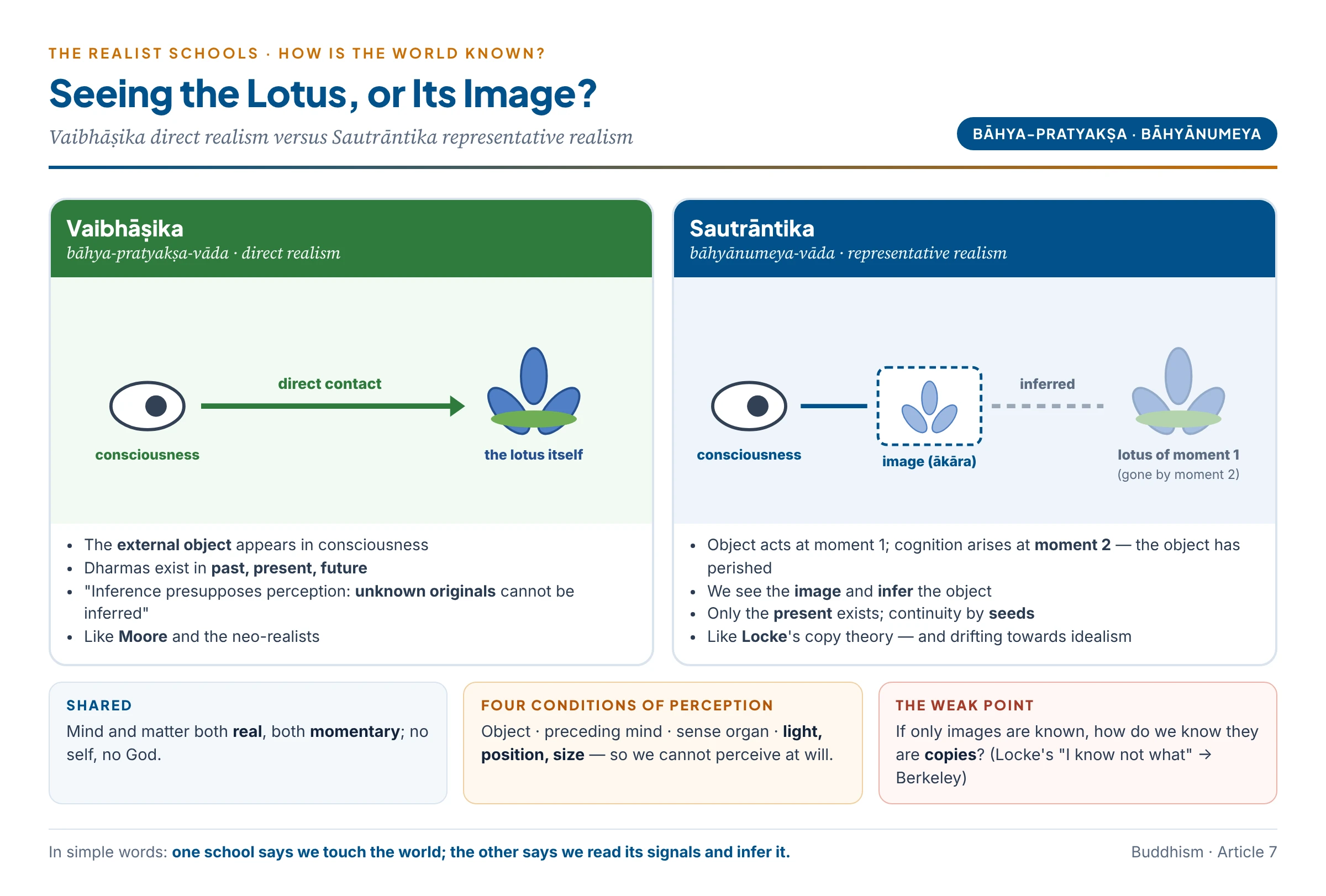
- Direct realism. “External objects are directly perceived.” When one perceives a blue lotus, the lotus itself — not merely its image — appears to consciousness. This is bāhya-pratyakṣa-vāda.
- Two pramāṇas.
- Perception (pratyakṣa) — direct, non-conceptual awareness of present dharmas (kalpanāpoḍha), through six faculties (five senses and mind).
- Inference (anumāna) — reasoning from causal or logical connection, e.g. fire from smoke.
- Testimony (śabda) is not an independent pramāṇa; it is reduced to inference.
- Error. Illusions come from abnormal conditions — defective senses, poor light — while the external object remains real. Mistaking a rope for a snake is a fault of perception, not proof that the world is unreal.
The Vaibhāṣika Argument Against the Sautrāntika
- “Unless we admit that external objects are perceived by us, their existence cannot be known in any other way.”
- Inference presupposes perception. We infer fire from smoke only because “in the past we have perceived both smoke and fire together. One who has never perceived fire cannot infer its existence from the perception of smoke.”
- A copy needs a known original. “To one unacquainted with an external object, the mental form would not appear to be the copy or sign of an extra-mental object, but as an original thing which does not owe its existence to anything outside the mind.” If we never knew the originals, “we cannot even say that our ideas are copies of the things-in-themselves”.
- The dilemma. “Either we have to accept subjective idealism (Vijñānavāda) or, if that has been found unsatisfactory, we must admit that the external object is directly known.”
- Western parallel. “Like many modern neo-realists“, and like Moore’s common-sense realism, the Vaibhāṣika holds that we are in direct contact with the world.
2. The Sautrāntika School (Bāhyānumeya-vāda)
Name and Sources
- From Sūtrānta — “those who rely on the Sūtras” (the Buddha’s discourses) rather than on the Abhidharma commentaries. Associated with Kumāralāta, Śrīlāta and Yaśomitra; Vasubandhu’s own commentary on the Abhidharmakośa often argues from the Sautrāntika side.
- It was “a critical reform movement within the Sarvāstivāda tradition”, “more critical in outlook”, and “transitional to Yogācāra idealism”.
Metaphysics
- Strict momentariness. “All conditioned entities exist only for a single moment.” Once a dharma perishes it no longer exists; the future has not yet come into being. “Only the present moment exists in reality.”
- Rejection of sarvāstitva. “A past dharma cannot be real because it has ceased, and a future dharma cannot be real because it has not arisen.” Existence in the three times “leads to contradictions”.
- Fewer real dharmas. The Sautrāntika cuts the dharmas from 75 to about 43, treating the rest as mental constructions. The unconditioned dharmas are mere absences: space is the mere absence of obstruction; nirvāṇa is the mere absence of defilements and of future birth — like a flame that has gone out.
- The theory of seeds (bīja-vāda). To explain continuity without existence in three times, actions leave latent seeds in the mental series; these are “causal potentials that mature into future experiences”. Karmic continuity is kept “without granting ontological status to past or future dharmas”.
- The person is “a convenient designation for the flow of momentary dharmas“, and the causal continuity of consciousness grounds ethical responsibility.
Epistemology: Representationalism
- The central claim. External objects are real, but not directly perceived. What appears in consciousness is a mental representation or image (ākāra) produced by causal contact with the object. “When seeing a blue lotus, what appears in consciousness is a mental image, not the lotus itself.”
- The time-lag argument (from momentariness):
- The external object is momentary.
- It acts on the sense organ at moment one.
- Sense-consciousness arises at moment two.
- By moment two, the object of moment one has already perished.
- So consciousness cannot grasp the object directly; it grasps the image left behind, from which it infers that the object existed. Hence bāhyānumeya-vāda — “the theory of the inferability of external objects”.
- Four conditions of perception. “A perception depends on four different conditions and not simply on the mind”:
- The object (ālambana-pratyaya), which imparts its form to consciousness.
- The immediately preceding state of mind (samanantara-pratyaya), which causes the consciousness of the form.
- The sense (adhipati-pratyaya), which decides whether the consciousness is visual, tactile and so on.
- Auxiliary conditions (sahakāri-pratyaya) — light, convenient position, perceptible magnitude.
- Why we cannot perceive at will. Since perception needs all four, “we cannot perceive at will any object at any time and place” — something an idealist must explain otherwise.
- Error. Since perception is always indirect, illusion is a misrepresentation within consciousness; inference can correct mistaken appearances.
- Critique of the Vaibhāṣika. “The mind cannot step outside itself to grasp objects directly”; cognition always takes place through mental images.
- The role of thought. “Like Kant“, the Sautrāntika “emphasizes the a priori element of thought-construction (kalpanā or vikalpa) in knowledge and paves the way for Vijñānavāda”.
The Sautrāntika Refutation of Idealism
Against the Yogācāra, who says there are no external objects, the Sautrāntika argues:
- “Like an external object” presupposes external objects. “Without the supposition of some external objects, it is not possible to explain even the illusory appearance of external objects.” The idealist says consciousness appears “as if external” — but “the phrase ‘like an external object’ is as meaningless as ‘like the son of a barren mother‘” if external objects never exist.
- We feel the pot as external. “Whenever we have the perception of a pot, the pot is felt as external and consciousness of it as internal.” From the start, object and consciousness are known as different.
- “I am the pot”? “If the pot perceived were identical with the subject, the perceiver would have said, ‘I am the pot‘.”
- Pot and cloth. “If there were no external objects, the distinction between ‘consciousness of a pot‘ and ‘consciousness of a cloth‘ could not be explained, because as consciousness both are identical.”
- Many perceivers. “Different individuals perceive the same object simultaneously”, which shows objects are not private mental constructs.
- Not at will. “The mind at will cannot create any object”; the form in consciousness is caused by the object.
- Western parallel. These arguments “anticipated long ago some of the most important arguments which modern Western realists like Moore use to refute the subjective idealism of Berkeley“. The Sautrāntika epistemology “resembles ‘representationism‘ or the ‘copy theory of ideas‘ which was common among Western philosophers like Locke“.
- Śaṅkara’s description. The Sautrāntika infers external objects from mental presentations “even as eating of good food is inferred through corpulence, or a country is inferred through its language“.
The Weakness of Representationalism
- “For inferring the existence of an external object it has to be perceived at least once.” But the Sautrāntika allows direct access only to the copy.
- “The improvability of the existence of objects based on representative realism landed John Locke in his dictum of ‘I know not what‘, which culminated in the subjective idealism of Berkeley. Likewise the Sautrāntika position will end up in Vijñānavāda.” Historically, this is exactly what happened: Dignāga and Dharmakīrti argued from Sautrāntika premises and ended as idealists.
- “It is said that both realists and idealists are successful in refuting each other’s positions but not so in establishing their own.”
3. Vaibhāṣika and Sautrāntika Compared
| Aspect | Vaibhāṣika | Sautrāntika |
|---|---|---|
| Affiliation | Main branch of Sarvāstivāda; follows the Mahāvibhāṣā | Reformist group within Sarvāstivāda; follows the Sūtras |
| Ontology | Realism — all dharmas exist (dravya-sat) | Critical realism — only present dharmas exist; external objects real but indirectly known |
| Time | Dharmas exist in past, present and future | Rejects sarvāstitva; only the present is real |
| Momentariness | Accepted, but reconciled with continuity by existence in three times | Strict momentariness; continuity by seeds |
| Number of dharmas | 75 (incl. 3 real unconditioned dharmas) | About 43; unconditioned dharmas are mere absences |
| Theory of seeds | Not central | Central: deeds leave seeds in the mental series |
| Self / person | No ātman; a collection of dharmas existing in three times | No ātman; a flow of momentary dharmas linked by seeds |
| External world | Direct realism — objects exist and are directly perceived | Representational realism — objects exist but are inferred |
| Perception | Direct awareness of external objects | Direct awareness only of internal images (ākāra) |
| Inference | Secondary; extends perception | Stronger role; needed to establish external objects |
| Error | Faulty sense conditions; the object stays real | Misrepresentation within consciousness |
| Western parallel | Moore, neo-realists | Locke, critical realists; and, in its stress on thought-construction, Kant |
| Standpoint | Naïve / direct realism within Buddhism | Critical realism, transitional to Yogācāra |
- How the Sarvāstivādins differ among themselves on knowledge of reality. Both agree that mind and matter are real; they differ on how matter is known — directly (Vaibhāṣika) or by inference from images (Sautrāntika) — and on what is real in time — all three times (Vaibhāṣika) or the present only (Sautrāntika).
4. Buddhist Epistemology (Pramāṇa-vāda): Dignāga and Dharmakīrti
Dignāga (5th–6th century CE) and Dharmakīrti (7th century CE) founded Buddhist logic and epistemology. Writing mostly from a Sautrāntika standpoint (and finally a Yogācāra one), they gave the Buddhist schools their theory of knowledge.
(a) Two Kinds of Object, Two Means of Knowledge
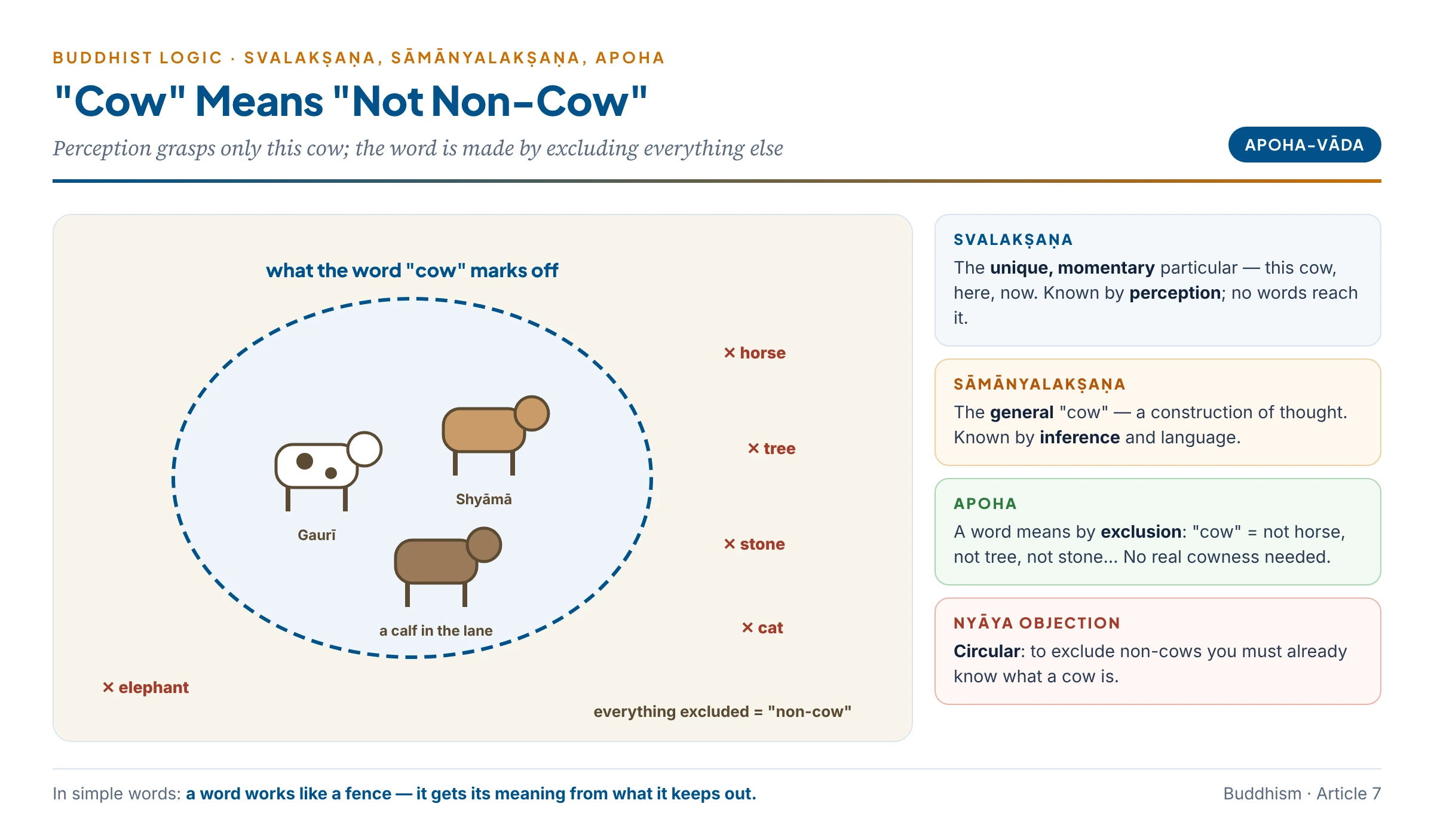
- The unique particular (svalakṣaṇa, “own-mark”) — the momentary, causally efficient real thing, “the this, the here, the now“, indescribable in words. It is grasped by perception.
- The general character (sāmānyalakṣaṇa, “common mark”) — universals, relations and concepts, which are constructed by thought. It is grasped by inference.
- Hence only two pramāṇas: “Conforming to the two kinds of objects… there are only two valid means of cognition — perception and inference.”
- Distinct spheres (pramāṇa-vyavasthā). Each pramāṇa has its own object; the same object is never known by both. The Nyāya opposes this with pramāṇa-samplava (“overlapping of pramāṇas”): one and the same fire can be perceived, inferred and told of.
(b) Perception
- Dignāga: perception is “free from conceptual construction” (kalpanāpoḍha) — free of names, genera, qualities, actions and relations. “The only object of perception is the unique momentary thing-in-itself shorn of all relations.”
- Dharmakīrti adds “non-erroneous” (abhrānta), to exclude sense-illusions such as seeing a double moon.
- Four kinds of perception (Dharmakīrti):
- Sense perception (indriya-pratyakṣa).
- Mental perception (mānasa-pratyakṣa) — the moment of mind that follows sense perception.
- Self-awareness (svasaṃvedana) — every cognition is aware of itself (“when I feel pain, I don’t need a second act of knowing to know that I am aware of it”).
- Yogic perception (yogi-pratyakṣa) — the direct insight of the meditator into truth.
- Against Nyāya and Vaiśeṣika. The Nyāya divides perception into indeterminate (nirvikalpaka) and determinate (savikalpaka), and counts both as perception; the Vaiśeṣika says an object qualified by five real predicables (generality, particularity, relation, quality, action) is perceived. Dignāga “condemns these five predicables to be mere fictions of the intellect“: only the bare particular is perceived; the rest is thought.
(c) Inference
- Two kinds: inference for oneself (svārthānumāna) and inference for others (parārthānumāna, put into words).
- Three marks of a valid reason (trairūpya) — the reason (hetu) must be:
- Present in the subject (pakṣa-dharmatā) — smoke is on the hill.
- Present in similar cases (sapakṣe sattva) — smoke is found where fire is, as in the kitchen.
- Absent in dissimilar cases (vipakṣe asattva) — smoke is not found where there is no fire, as in a lake.
- Three kinds of valid reason (Dharmakīrti):
- Effect (kārya-hetu) — smoke proves fire.
- Essential nature (svabhāva-hetu) — “this is a tree, because it is a śiṃśapā”.
- Non-perception (anupalabdhi-hetu) — “there is no jar here, because none is perceived though it would be perceived if present”.
- Two-membered syllogism. Against the Nyāya five members, Dignāga’s followers keep only the general rule with example and the application.
- Valid only empirically. Inference deals with constructed universals; it is valid “only on the phenomenal plane“, yet there “its authority is unquestionable”: “fire shall always be inferred from smoke“. “Those who deny the validity of inference involve themselves in self-contradiction,” since they expect their own meaning to be inferred from their words.
(d) Other Pramāṇas Reduced
| Pramāṇa claimed by others | Buddhist treatment |
|---|---|
| Testimony (śabda) | Valid only if it can be tested by reason; a form of inference |
| Comparison (upamāna) | A combination of perception and memory |
| Postulation (arthāpatti) | Reducible to inference: “all fat persons who do not eat by day eat by night; fat Devadatta does not eat by day; so he eats by night” |
| Non-cognition (anupalabdhi, abhāva) | Absence is a non-entity; its knowledge is perception of the bare place plus inference from non-perception |
| The Veda | Not authorless or eternal; words are reliable only as their speakers are |
(e) What Makes Knowledge Valid
- Non-belying cognition. Dharmakīrti defines a pramāṇa as “reliable (avisaṃvādin) cognition” — knowledge that does not mislead us when we act on it.
- Success in action. “Right knowledge is successful or efficacious knowledge.” The test is arthakriyā: does the “water” quench thirst, does the “fire” burn?
5. The Debate on Pramāṇa and Pramāṇaphala
What is the relation between the means of knowledge (pramāṇa) and its result (pramāṇaphala)?
The Nyāya View: Instrument and Result Are Different
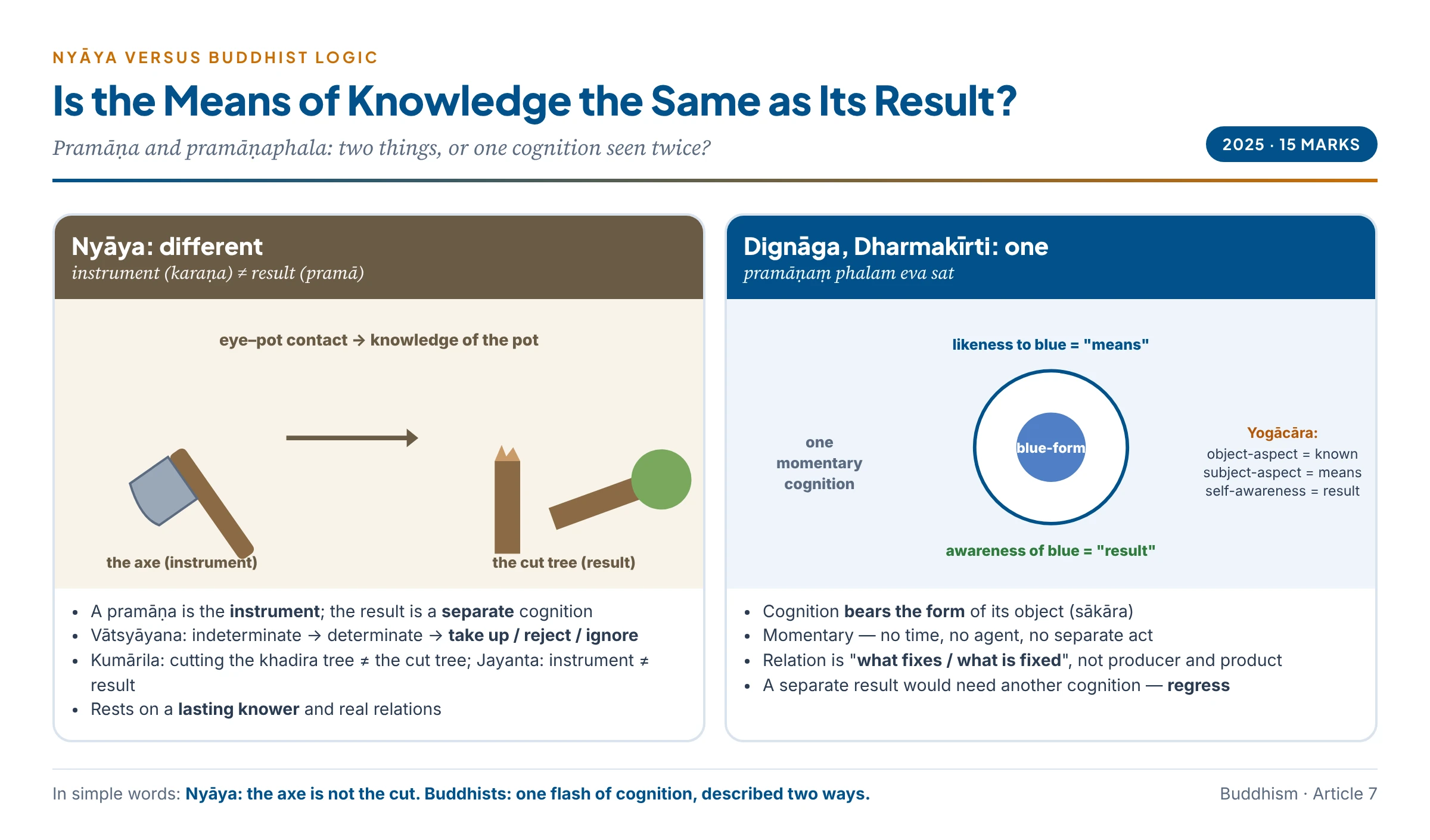
- A pramāṇa is the instrument (karaṇa) — the most effective cause — of valid knowledge (pramā). In visual perception, the contact of the eye with the pot is the pramāṇa; the knowledge of the pot is the result.
- Like an axe and the cutting. An instrument and what it produces are two things; the axe is not the cut. Kumārila (Mīmāṃsā) mocked the Buddhist view: the cutting of a khadira tree is not the cut tree.
- Layered results. Vātsyāyana: when indeterminate perception is the pramāṇa, determinate knowledge is its result; when determinate knowledge is the pramāṇa, the result is the decision to take up, reject or ignore the object (hāna-upādāna-upekṣā-buddhi).
- Jayanta Bhaṭṭa: “an instrument cannot be identical with the result produced by it.”
- Behind this: Nyāya realism — a lasting self who knows, sense organs, objects, and real relations between them.
The Buddhist View: Means and Result Are One Cognition
- Dignāga’s thesis. “The means of knowledge is really the result, because it is apprehended together with its activity” (savyāpāra-pratītatvāt pramāṇaṃ phalam eva sat). The distinction between them is only figurative (upacāra).
- Why.
- Momentariness: a cognition is a single momentary event; there is no time for an instrument to act and then a separate result to follow, and no lasting agent to wield an instrument.
- No real activity: things are “inactive and forceless“; a cognition does not “do” anything to an object.
- Cognition has form (sākāra-jñāna-vāda): a cognition arises bearing the form (ākāra) of its object — blue-shaped when it is of blue. Its likeness (sārūpya) to the object is called the pramāṇa; the awareness of blue that this likeness fixes is called the result. Both are aspects of one cognition.
- The Yogācāra version (Dignāga’s final view). The object-aspect of a cognition is the prameya (the known), the subject-aspect is the pramāṇa, and self-awareness (svasaṃvitti) is the phala. “These three cannot really be set apart.”
- Dharmakīrti’s refinement. The relation is not producer and product (janya-janaka), which would need two moments and two things, but “what fixes” and “what is fixed” (vyavasthāpaka and vyavasthāpya): the cognition’s likeness to blue fixes it as an awareness of blue. One property of one real cognition is the means; another is the result.
- Why it mattered. If the result were separate from the cognition, we would need a further cognition to know it, and so on without end; and a cognition with no form of its own could not tell blue from yellow.
In simple words
A footprint in wet sand has the shape of a foot. Is the shape how the sand “knows” the foot, or what it knows? Both — one impression, looked at in two ways. Dignāga says a cognition is like that footprint: its likeness to the object is the “means”, and the awareness of the object that this likeness fixes is the “result” — not two things, but one momentary event described twice.
Evaluation
- For the Nyāya. Common sense and language distinguish means and end; sense organs, light and attention are real causal factors distinct from the knowledge they produce; and the Buddhist view seems to make every cognition self-validating, even an illusion (a mirage also “has the form of water”).
- For the Buddhists. Once there is no lasting knower and cognitions are momentary, the instrument–result split has nowhere to live; the “instrument” talk is a useful way of speaking about one event. A mirage is excluded not by form alone but because it is not produced by a real particular and fails in action (no water to drink).
- The deeper issue. The debate is really about realism vs momentariness: an enduring knower using real instruments (Nyāya), or a flash of cognition carrying its object’s form (Buddhism).
6. How Do We Know “There Is No Jar on the Table”?
The Nyāya-Vaiśeṣika View: Absence Is Real and Perceived
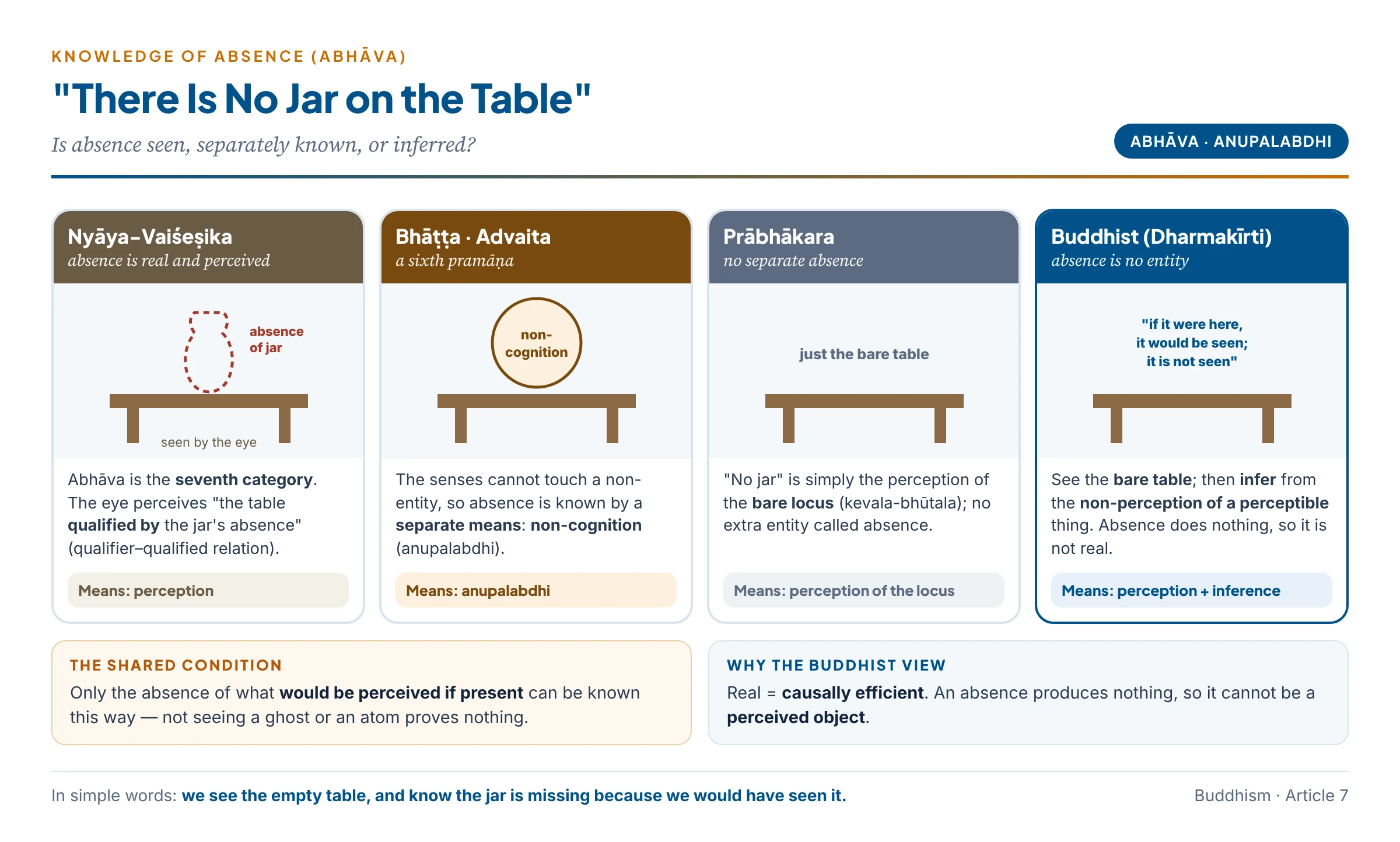
- Absence is a real category. The Vaiśeṣika adds abhāva (non-existence) as the seventh category, with four kinds: prior absence (the pot before it is made), posterior absence (after it breaks), absolute absence (no colour in air), and mutual absence (the pot is not the cloth).
- It is perceived. The absence of the jar is grasped by the eye through a special relation — the relation of qualifier and qualified (viśeṣaṇa-viśeṣya-bhāva): we perceive “the table qualified by the absence of a jar“. The same sense that would have seen the jar sees its absence.
- Condition. Only the absence of a perceptible thing can be perceived this way.
Other Brahmanical Views
- Bhāṭṭa Mīmāṃsā and Advaita: absence is known by a separate pramāṇa, non-cognition (anupalabdhi), because the senses cannot be in contact with a non-entity.
- Prābhākara Mīmāṃsā: there is no separate entity called absence; “no jar here” is simply the perception of the bare locus (kevala-bhūtala).
The Buddhist View (Dharmakīrti)
- Absence is not a real thing. Only what is causally efficient is real; an absence does nothing; so it is not a real entity and cannot be perceived as one.
- Two steps.
- Perception grasps only the table — the bare place (the “one thing” without the other).
- Inference from non-perception (dṛśyānupalabdhi): “If a jar were here, it would be seen, since all the conditions of seeing it (light, normal eyes, attention, nearness) are present; it is not seen; therefore there is no jar.”
- Non-perception of the perceptible. The reason works only for things that would be perceived if present. Not seeing a ghost or an atom proves nothing.
- Not a separate pramāṇa. Non-perception is one of the three valid reasons of inference, so Buddhism needs no extra pramāṇa for absence.
| School | Is absence real? | How “no jar here” is known |
|---|---|---|
| Nyāya-Vaiśeṣika | Yes — a real category (seventh padārtha) | Perception, through the qualifier–qualified relation |
| Bhāṭṭa Mīmāṃsā, Advaita | Yes | A separate pramāṇa: non-cognition (anupalabdhi) |
| Prābhākara Mīmāṃsā | No separate entity | Perception of the bare locus |
| Buddhism (Dharmakīrti) | No — absence has no causal power | Perception of the bare table + inference from non-perception of a perceptible |
7. Can Qualities Exist Without Substance? “Our Knowledge Is Confined to Qualities”
The Nyāya-Vaiśeṣika View
- Substance (dravya) is the substrate in which qualities (guṇa) and actions inhere through inherence (samavāya). A quality cannot exist without a substance.
- We perceive substance. I see the pot and touch the same pot; two senses grasp one object. This shows a substance distinct from its colour and its hardness.
- Recognition (“this is the same pot I saw yesterday”) requires an enduring substance.
The Buddhist View
- Only qualities (dharmas) are real. What sense perception gives is a colour-patch to the eye, a hardness to touch, a sound to the ear — momentary particulars. “Matter is only an aggregate of momentary atoms”; “substance” is a construction from qualities appearing together (saṅghāta).
- “Our knowledge is confined to qualities.” The claim that we know only qualities is the Buddhist (and phenomenalist) thesis; the Vaiśeṣika rejects it because it makes unity, identity and recognition impossible.
- Answer to the two-senses argument. The judgment “I see and touch the same pot” is a mental synthesis of different sense-data, not a perception of a hidden substrate.
- Nāgārjuna’s twist. “We know only the attributes; we do not know the substance. Without attributes we cannot know a substance, and without a substance attributes cannot exist. But attributes exist neither in the substance nor outside it.” So both substance and quality are relative and empty.
- Western echo. Locke called substance “something, I know not what” supporting the qualities; Berkeley dissolved the cherry into its sensible qualities; Hume called the substance an imagined bond. The Indian controversy anticipates this whole debate.
8. The Buddhist Theories of Error (Khyāti-vāda)
- Yogācāra — ātmakhyāti (“appearance of the self/cognition”). In an illusion of silver in a shell, the silver is a form of consciousness itself, projected outward as if external. “Nothing external — internal cognition appears as an external object.” Since for the Yogācāra all objects are mental, error differs from truth not in being mental but in being sublated and failing in practical efficacy.
- Mādhyamika — asatkhyāti (“appearance of the non-existent”). The object of an illusion is absolutely unreal (asat) — and, on ultimate analysis, so is the “real” object, since all things are like dreams, mirages and magic shows.
- Sautrāntika and Vaibhāṣika — illusion is a defect of conditions (Vaibhāṣika) or a misrepresentation in the image (Sautrāntika); the external thing remains real.
- Dharmakīrti distinguishes sense-illusions (double moon, caused by defective senses) from conceptual errors (taking a rope for a snake, which involves wrong construction).
- Rival theories. Nyāya — anyathākhyāti (a real object elsewhere, silver in the market, is wrongly perceived here); Prābhākara — akhyāti (two true cognitions, of shell and remembered silver, not distinguished); Advaita — anirvacanīyakhyāti (the illusory silver is neither real nor unreal).
Are These Theories Consistent with Buddhist Philosophy?
- Ātmakhyāti fits Vijñānavāda: if all objects are forms of consciousness, so is the illusory one. Problem: how then to tell error from truth, if both are equally mental? Reply: by sublation and success in action (dream water does not quench waking thirst).
- Asatkhyāti fits Śūnyavāda at the ultimate level. Problem: if the illusory object is absolutely non-existent, how can it appear at all? A hare’s horn never appears. Reply: at the conventional level, appearances are dependently arisen; only their own-nature is unreal — so it is better called “appearance of what lacks own-nature”.
- The realist theories fit the Hīnayāna schools, which keep a real external world against which error is measured.
- Verdict. Each Buddhist school’s theory of error is consistent with its own metaphysics; the difficulty lies in distinguishing valid from invalid cognition without a real external standard — which is why Dharmakīrti made practical success (arthakriyā) the mark of validity.
9. Apohavāda: Meaning Without Universals
- The problem. Realists (Nyāya-Vaiśeṣika, Mīmāṃsā) hold that a word like “cow” refers to a real universal, cowness (gotva), present in every cow. Buddhists deny real universals: only momentary particulars exist. How, then, can words have general meaning?
- The answer: exclusion (apoha). A word does not denote a positive universal; it denotes by excluding everything else. “Cow” means “not non-cow” — the exclusion of horses, trees, stones and everything that is not a cow.
- How it works. In perception, only this unique cow is given. In conceptual thought (vikalpa), we group particulars that do the same work (give milk, pull carts) by excluding those that do not. “When we say ‘tree‘, we do not perceive tree-ness; we simply exclude non-trees and group certain particulars conventionally.”
- Advantages.
- No reification of abstract categories.
- Language explained conventionally — words are useful tools without ultimate reference.
- Consistent with Buddhist ontology — only momentary particulars are real.
- Criticisms.
- Nyāya: circular. To exclude “non-cows”, we must already know what a cow is.
- Mīmāṃsā: negation presupposes affirmation. An exclusion needs a positive term to exclude from; the universal returns by the back door.
- Mādhyamika: apoha over-intellectualises meaning; even exclusions are empty.
| Aspect | Nyāya universals | Buddhist apoha |
|---|---|---|
| Ontology | Universals are real, eternal, inhering in particulars | Universals are unreal; only particulars (svalakṣaṇa) exist |
| Meaning of words | “Cow” denotes cowness | “Cow” means not non-cow |
| Reference | Positive | Negative (by exclusion) |
| Knowledge of class | Universals are perceived with particulars | Classes are conceptual constructions |
| Each side’s criticism | Apoha is circular | Universals are unnecessary and contradict impermanence |
In simple words
How does a child learn the word “dog“? Not by seeing some ghostly “dogness”. She meets Bruno, then Moti, then a stray in the lane, and learns where the word stops — the cat is “not a dog“, the calf is “not a dog“. The meaning of “dog” is fixed by its boundary. That is the apoha theory: words work by marking off, not by pointing at a hidden universal.
Indian Connect
- Nyāya-Buddhist debates shaped both sides: Uddyotakara, Vācaspati Miśra and Udayana built their defence of universals, absence and the self largely in reply to Dignāga and Dharmakīrti.
- The Jaina logicians (Akalaṅka, Hemacandra) accepted some Buddhist logic but rejected momentariness and apoha.
- Śaṅkara criticised the realist schools (Article 4) and the idealists (Article 8), but borrowed the Buddhist two-level view of truth.
Critical Evaluation
A. Critiques of the Realist Schools
- Śaṅkara: the aggregates cannot form. “The unintelligent momentary atoms and the momentary skandhas cannot form any systematic whole” without an intelligent uniting principle.
- Yogācāra: atoms cannot be perceived. An external object must be partless (an atom) or composite; atoms are too small to be perceived, and a composite cannot be perceived all at once or part by part. (Article 8.)
- Mādhyamika: own-nature is self-contradictory. If dharmas had svabhāva, they would be independent and changeless — and could not arise, act or perish.
- Sautrāntika against Vaibhāṣika: “existence in three times” contradicts momentariness and makes the past present.
- Vaibhāṣika against Sautrāntika: a copy-theory cannot even know that its images are copies.
- Nyāya against Buddhist epistemology: perception without concepts is dumb; the senses can grasp universals and absences; pramāṇas can overlap; apoha is circular.
B. Strengths
- Remarkable anticipations of Western debates — direct realism, representationalism, idealism, sense-data, nominalism.
- A rigorous logic — the three marks, the three kinds of reason, the analysis of perception — that set the standard for all later Indian logic.
- Economy: two pramāṇas, no real universals, no real absences — a minimalist theory of knowledge.
Critics and Defenders
Criticism — Critics
- Śaṅkara: momentary atoms and skandhas cannot form wholes; inference from images is like inferring food from corpulence.
- Yogācāra: external atoms are imperceptible; realism collapses.
- Vaibhāṣika (vs Sautrāntika): unknown originals cannot be inferred from copies.
- Nyāya, Kumārila: means and result differ like axe and cut; absence and universals are real and perceived; apoha is circular.
- Mādhyamika: dharmas with own-nature are a new dogmatism.
Defence — Defenders and strengths
- Vaibhāṣika: inference presupposes perception — so we must perceive the world directly.
- Sautrāntika: the time-lag argument; perception needs four conditions, so it is not at will; refutes idealism in Moore’s manner.
- Dignāga, Dharmakīrti: two objects, two pramāṇas; non-perception of the perceptible proves absence without a new pramāṇa.
- Pramāṇaphala: one momentary cognition, two aspects — no infinite regress.
- Apoha: meaning without metaphysical universals.
Cross-Tradition Comparison
| Buddhist position | Western parallel | Comment |
|---|---|---|
| Vaibhāṣika direct realism | Moore, neo-realists, naïve realism | The object itself is present in perception |
| Sautrāntika representationalism | Locke (ideas as copies); critical realists | Leads, as Berkeley showed, towards idealism |
| Sautrāntika time-lag argument | The starlight argument used by Russell and others | Perception is always of the past |
| Kalpanā — thought-construction in knowledge | Kant — concepts organise intuitions | Sautrāntika and Dignāga stress the mind’s constructive role |
| Svalakṣaṇa vs sāmānyalakṣaṇa | Russell — knowledge by acquaintance vs by description; sense-data vs constructions | Bare particulars vs general concepts |
| Apoha | Nominalism (Ockham, Hobbes); Saussure — meaning by difference | Words get meaning from contrast, not from universals |
| Substance as construction | Berkeley, Hume; Locke’s “I know not what“ | Qualities only, unity supplied by the mind |
| Arthakriyā as test of truth | Pragmatism (James, Peirce) | True knowledge is what works |
Indian Connect — Key takeaways
- The Nyāya stands for realism about substance, universals, absence, relations and the self; Buddhist epistemology for nominalism, momentariness and construction — Indian epistemology developed through their thousand-year debate.
- Sāṃkhya, like the Buddhists, held that cognition takes the form of its object (in buddhi), but kept a conscious puruṣa distinct from it — the basis of its separate reply on pramāṇa and phala.
- The movement Vaibhāṣika → Sautrāntika → Yogācāra mirrors naïve realism → Locke → Berkeley in the West.
Synthesis (Siddhānta)
- The realist pair. Both Vaibhāṣika and Sautrāntika hold that mind and matter are real and momentary, with no self and no God. The Vaibhāṣika adds existence in three times and direct perception; the Sautrāntika keeps only the present, explains continuity by seeds, and says external objects are inferred from mental images.
- Buddhist epistemology. Two kinds of object — unique particulars and constructed universals — and two pramāṇas, perception (non-conceptual, non-erroneous) and inference (three marks, three kinds of reason); other pramāṇas reduced; validity as non-belying, successful cognition; meaning by exclusion (apoha).
- The great debates. Against Nyāya realism: means and result of knowledge are one cognition in two aspects; absence is known by non-perception of the perceptible, not by perception of a real non-entity; substance is a construction from qualities; error is explained within each school’s metaphysics.
- The trajectory. The Sautrāntika’s representationalism slid, as Locke’s did, towards idealism — the Yogācāra of Article 8.
- Contemporary relevance.
- Cognitive science. Perception is now understood as the brain’s construction from sensory signals, with a measurable time-lag — close to the Sautrāntika picture.
- Artificial intelligence. Debates on whether machines grasp concepts or only patterns of difference echo apoha.
- Evidence and absence. In law and science, “absence of evidence” proves absence only if the thing would have been detected — Dharmakīrti’s rule of non-perception of the perceptible.
- Media literacy. Knowing that we receive representations, not the world itself, is the first rule of reading news and images critically.
“Whatever is capable of effective action is ultimately real.” — Dharmakīrti
Previous Year Questions
- 2025Present an exposition of the debate between Naiyāyikas and Buddhists with reference to the notion of Pramāṇa and Pramāṇaphala.
- 2018How do the Buddhists and the Nyaya philosophers explain our knowledge of “the absence of the jar on the table”? Answer in detail.
- 2017How do Madhyamika, yogacaravadins and sarvastivadins differ among themselves in concerning the nature of reality? How do Sarvastivadins differ among themselves with regard to knowledge of reality?
- 2015‘Our knowledge is confined to gunas only.‘ Examine this statement in the light of Vaisesika and Buddhist controversy.
- 2014Bring out the epistemological difference between Sautrantika and Vaibhasika school of Buddhism.
- 2012Explain the theory of illusion accepted by Buddhist. Is it consistent with their philosophy? Give reasons for your answer.
- 2010Can qualities exist without substance? Substantiate your views in the light of Nyaya-Buddhism controversy.
- 2009Compare the viewpoints of Nyaya, Vaisesika, Mimansa and Buddhism on the issue of knowledge of abhava.