

Schools of Buddhism: Pratītyasamutpāda; Kṣaṇikavāda, Nairātmyavāda
Official Syllabus: Paper I, Section B, Unit 14
Nairātmyavāda — the doctrine of no-self (Pāli anattā, Sanskrit anātman) — is the Buddha’s most radical and most misunderstood teaching. It denies that there is in a person any permanent, unchanging, independent self (ātman) — a soul that exists before birth, survives death, owns experiences and passes from body to body. What we call “I” is only a collection of five changing groups (pañca-skandha) of physical and mental processes, bound together by causation, and named by convention. Early Buddhism applied this to the person (pudgala-nairātmya); the Mahāyāna extended it to all things (dharma-nairātmya). Nairātmyavāda follows from dependent origination and is strengthened by momentariness; it is the ground of Buddhist ethics of non-attachment, and the target of every rival school.
In simple words
Look for the “cricket team“. You find eleven players, a captain, a coach, kits, a history of matches — but nowhere a twelfth thing called “the team” sitting apart from them. Yet “the team” is not nothing: it plays, wins and loses. It is a name for players working together. The Buddha says “I” is like “the team”: a name for body, feelings, perceptions, habits and awareness working together — with no extra owner hidden among them.
Context & Problem
The Self the Buddha Denied
- The Upaniṣadic ātman. The Upaniṣads taught a permanent, unchanging, blissful self, the witness of all experience, distinct from body and mind, identical with Brahman (“tat tvam asi“, “ayam ātmā brahma“).
- Other schools of his time and later.
- Sāṃkhya-Yoga — many eternal, pure-conscious puruṣas, inactive witnesses.
- Nyāya-Vaiśeṣika — an eternal, all-pervading ātman, a substance in which consciousness, desire and effort inhere as qualities.
- Jainism — many eternal jīvas, conscious by nature, of the size of the body they occupy.
- Mīmāṃsā — an eternal self that performs rituals and enjoys their fruits in heaven.
- The common features of “ātman”. It is permanent (nitya), unchanging (avikārin), independent, the owner of experiences (I have feelings), the inner controller, and the carrier from life to life.
- The Buddha’s denial is of exactly this. “Consistently with his theories of conditional existence and universal change, Buddha denies the existence of such a soul.”
The Two Extremes Again
- Eternalism (śāśvatavāda) — “there is a permanent self” (the Upaniṣads, Sāṃkhya, Jainism, Nyāya).
- Annihilationism (ucchedavāda) — “the self is destroyed at death” (the Cārvāka, who identify self and body).
- The middle. Buddhism denies both a permanent self and its annihilation: there was never a self to be preserved or destroyed, only a causal series that continues while its causes continue.
Core Doctrine
1. Meaning of the Terms
- Anattā / Anātman — “not-self“: none of the things we take as self is the self.
- Nairātmya — “selflessness“, the absence of ātman; Nairātmyavāda is the doctrine of that absence.
- Anattā and Nairātmya distinguished (as some notes use them):
| Aspect | Anattā-vāda | Nairātmya-vāda |
|---|---|---|
| Focus | No-self of individuals (humans and animals) | No-self (no own-essence) of all phenomena, living and non-living |
| Scope | Limited to beings | Extended to everything, even concepts |
| Development | Rooted in the Buddha’s teaching on suffering and attachment | Developed especially in the Mahāyāna (Nāgārjuna) |
| Link to emptiness | Stresses impermanence of the self | Tied directly to śūnyatā — nothing has independent existence |
| Schools | Early Theravāda and Abhidharma | Mādhyamika (and Yogācāra) |
- In practice most writers use the two words interchangeably; the sharper distinction is between pudgala-nairātmya and dharma-nairātmya (Section 7).
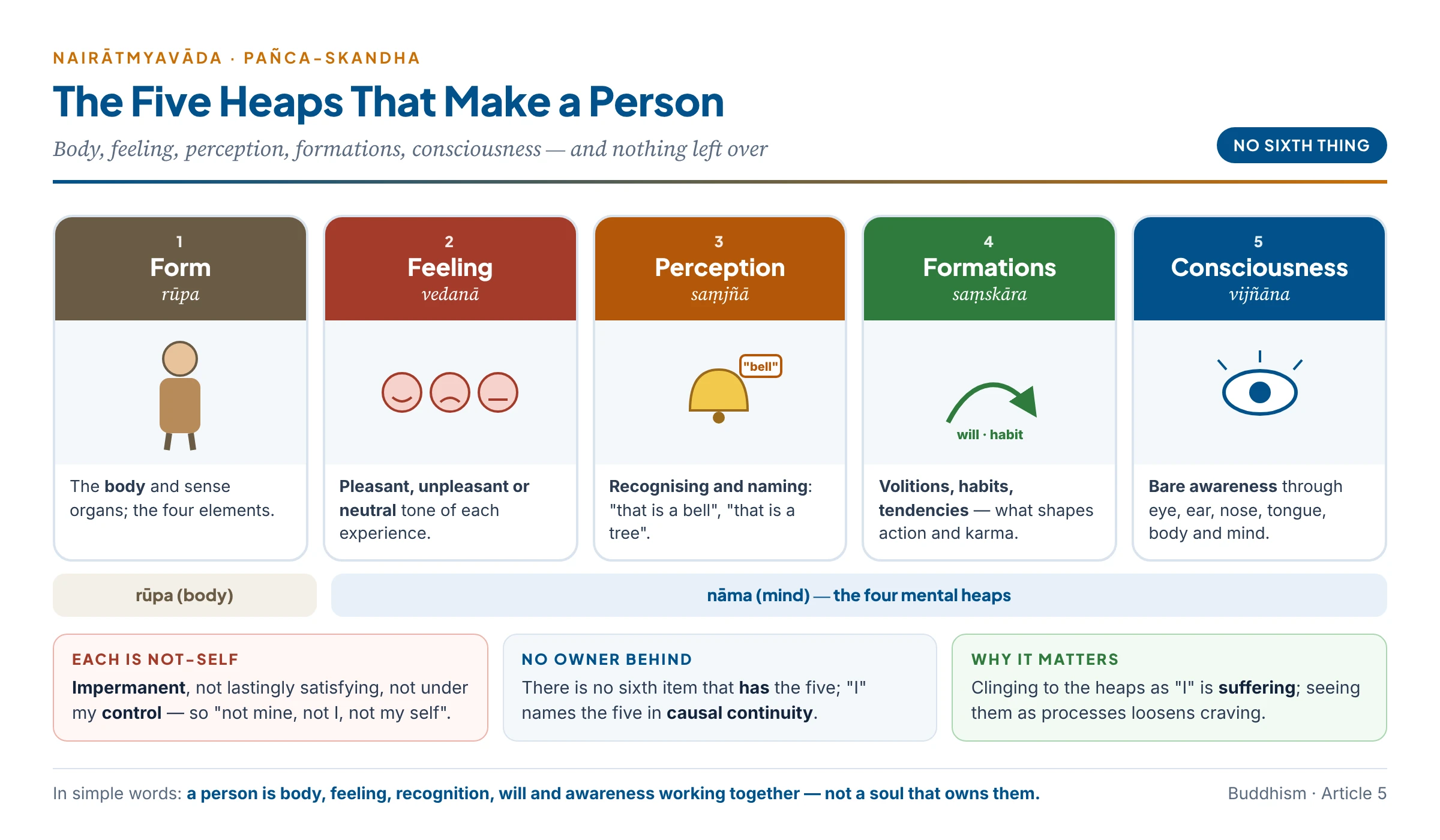
2. The Five Aggregates (Pañca-skandha)
“Skandha” means “heap” or “group“. The person, “as perceived from without and within”, is analysable into five groups of changing elements:
| # | Skandha | Meaning | Examples |
|---|---|---|---|
| 1 | Rūpa (form) | The material element — externally the physical world, internally the body and the sense organs | Flesh, bones, eyes, ears; the four elements |
| 2 | Vedanā (feeling) | The feeling-tone of an experience: pleasant, unpleasant or neutral | The pleasure of cool water; the pain of a burn |
| 3 | Saṃjñā (perception) | Recognising and labelling — noting what an object is | Recognising the sound of a bell, the shape of a tree |
| 4 | Saṃskāra (formations) | Volitions, impulses, habits, tendencies — all that shapes action and future experience | Decisions, opinions, prejudices, compulsions; karmic tendencies |
| 5 | Vijñāna (consciousness) | Bare awareness through each of the six senses (five senses and mind) | Seeing-consciousness, hearing-consciousness, mind-consciousness |
- Nāma and rūpa. The last four (mental) are together called nāma; with rūpa (bodily) they form nāma-rūpa, the fourth link of dependent origination.
- None is the self. Each skandha is impermanent and conditioned; none can be the permanent, controlling owner.
- Nothing beyond them. There is no sixth item, a self that has the five. “The soul or the ego denotes nothing more than this collection.”
- The source of suffering. Taking the skandhas as “I” and “mine” creates clinging (upādāna); hence the Buddha calls them the “five aggregates of clinging” (upādāna-skandha), and says “in short, the five aggregates of clinging are suffering”.
3. The Buddha’s Arguments for No-Self
(a) The Argument from Impermanence (the Discourse on the Characteristic of Not-Self)
The Buddha’s second sermon at Sārnāth argues step by step:
- “Is form permanent or impermanent?” — “Impermanent, Lord.”
- “Is what is impermanent suffering or happiness?” — “Suffering, Lord.”
- “Is it fitting to regard what is impermanent, suffering and subject to change as ‘This is mine, this I am, this is my self‘?” — “No, Lord.“
- The same is asked of feeling, perception, formations and consciousness.
- Conclusion. A self would have to be permanent and a source of lasting happiness; nothing we find is either; so nothing we find is the self.
(b) The Argument from Lack of Control
- “If form were self, form would not lead to affliction, and one could say of form: ‘Let my form be thus; let it not be thus.‘” But we cannot command the body not to age or fall ill, or the mind not to feel pain.
- A true self would be the inner controller; since we control none of the skandhas, none of them is the self.
(c) The Argument from Non-Observation
- When we look within, we find only particular feelings, perceptions, thoughts and bodily sensations — never a self apart from them. The self is never given in experience.
- The Western empiricist Hume reached the same result: “When I enter most intimately into what I call myself, I always stumble on some particular perception or other… I never can catch myself at any time without a perception.”
(d) The Argument from Analysis: The Chariot
- Analyse the person into parts, and the self is found neither in any part, nor in all the parts together, nor outside them (Section 4).
(e) The Argument from Dependent Origination and Momentariness
- Whatever is conditioned is not independent; whatever is momentary is not permanent. The self, if there were one, would have to be both independent and permanent. Everything is conditioned and momentary; so there is no self.
- How momentariness strengthens no-self.
- It turns “the self changes” into “there is nothing that stays the same for two moments” — no room even for a slowly changing soul.
- It shows that the “unity” of a person is the rapid succession of similar states, explaining why we wrongly believe in a self.
- It re-explains memory and identity causally, removing the main reasons for positing a soul.
(f) The Argument That a Permanent Self Would Make Religion Impossible
- Bondage and liberation — an unchangeable soul could neither become bound nor become free.
- Control of the body — regulating the body is an activity, and activity is change.
- Good and bad deeds — an unchangeable soul would perform neither, so karma would have nothing to work on.
- Rebirth — passing to a new body is a change of state, impossible for the changeless.
- (These arguments, set out in Article 4, turn the critics’ weapon around.)
(g) The Practical Argument: The Self-View Is the Root of Suffering
- Belief in a self (satkāya-dṛṣṭi, “the view of a real personality”) breeds ego, craving, possessiveness, fear of death and hostility.
- Two witty images. People who love a self they have never seen are like a man who says he loves “the most beautiful maiden in the land” but cannot say her name, caste or appearance — or who builds a staircase to a palace he has never seen.
In simple words
Ask someone with a heavy school bag to show you “the bag itself” apart from its cloth, zip, straps and stitching. Every part they point to is just a part. When all the parts are taken away, no bag is left. The bag was real enough to carry books — but it was never a thing in addition to its parts. The Buddha asks us to try the same search for “I“.
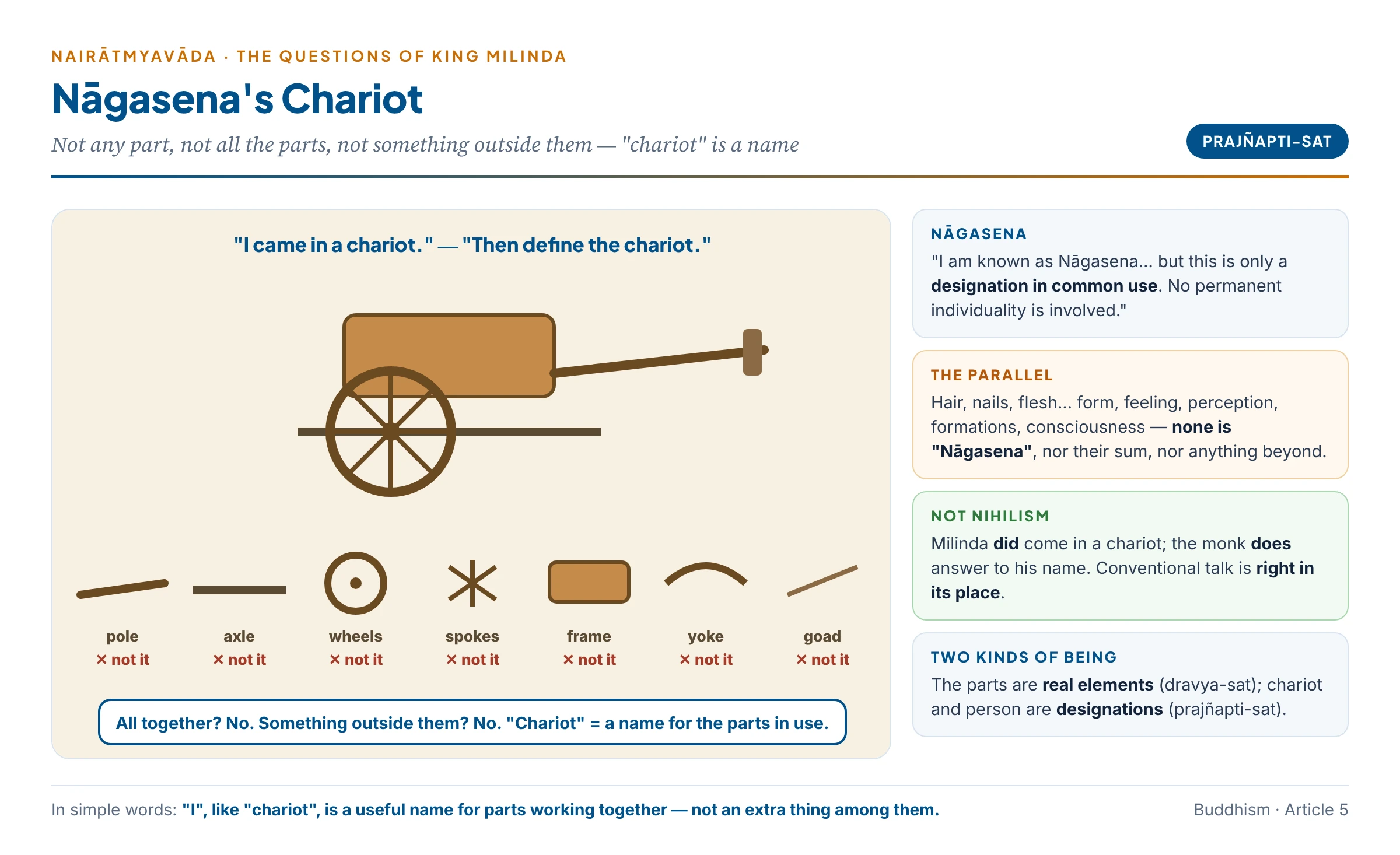
4. Nāgasena’s Chariot (The Questions of King Milinda)
The Greek king Milinda (Menander) asks the monk Nāgasena his name.
- Nāgasena’s opening. “I am known as Nāgasena… yet this is only a generally understood term, a designation in common use. There is no permanent individuality involved in the matter.“
- Milinda’s challenge. “If there is no permanent soul, who is it that enjoys robes, food and lodging? Who lives righteously? Who meditates? Who attains nirvāṇa? … Is it the hair on the body that is Nāgasena? The nails, teeth, skin, flesh, nerves, brain? Is it form, feeling, perception, formations, or consciousness? All these together? Something outside them?” — To each, Nāgasena answers no.
- The turn. “Great king, did you come on foot or in a chariot?” — “In a chariot.” — “Then define the chariot. Is the pole the chariot? The axle? The wheels? The spokes, the framework, the yoke, the goad?” — “No.” — “All these put together?” — “No.” — “Anything outside them?” — “No.“
- The conclusion. “Just as ‘chariot‘ is the designation in common use for pole, axle, wheels, spokes, framework, yoke and goad together, so ‘soul‘, ‘individuality‘, ‘being‘, ‘person‘ is only a generally understood symbol for the five skandhas. There is no permanent soul involved in the matter.”
- What the dialogue shows.
- Two kinds of existence. The skandhas exist as real elements (dravya-sat); the person, like the chariot, exists only as a designation (prajñapti-sat).
- Not nihilism. Milinda did come in a chariot; Nāgasena does answer to his name. Conventional talk is correct in its place.
- Mind and matter alike. “Both mind and matter, ‘soul‘ and ‘chariot‘ alike, are reduced to conventional symbols for the aggregate of ideas or of atoms.”
5. Saṅghātavāda: The Theory of Aggregates
- The theory. Complex entities — physical objects, living beings, mental states — are not independent, permanent substances but temporary collections of parts that give the appearance of a whole. “The so-called soul is an aggregate of the five fleeting skandhas; so-called matter is an aggregate of momentary atoms.”
- Its implications.
- Interdependence and impermanence — the whole exists only while its parts are arranged; the parts are in flux, so the whole is impermanent.
- No permanent essence — “self” and “substance” are conceptual labels for aggregates.
- The problem of identity dissolved — the belief that we are distinct and separate from others rests on an imagined “I” behind the aggregates.
- Non-attachment — seeing things as aggregates in flux loosens the desire for permanence in possessions, relationships and the self.
- Understanding suffering — attachment to any aggregate, physical or mental, ends in dissatisfaction.
- Liberation from the ego — realising that “self” is a combination of parts breeds humility, compassion and a sense of connection with others.
- Criticisms of saṅghātavāda.
- Nyāya — a whole (avayavin) is a new reality over and above its parts; a cloth is not merely threads. Substances have inherent qualities and are not reducible to parts.
- Sāṃkhya — Puruṣa (consciousness) and Prakṛti (matter) are distinct and permanent; aggregates presuppose a permanent ground.
- Jainism — the impermanence of phenomena does not cancel eternal substances such as jīva and pudgala, which keep their essential properties.
- Śaṅkara — “These two types of aggregates — external and internal — can never be formed at all“, since momentary, unintelligent parts cannot arrange themselves without a uniting intelligence.
6. The Conventional Person and the Pudgalavāda Controversy
- The burden and its bearer. In one sermon the Buddha says: “I will teach you the burden and the bearer of the burden: the five aggregates are the burden, and the person (pudgala) is the bearer.” Does this admit a self?
- The Pudgalavādins (Vātsīputrīyas). One early Buddhist group argued that there is a person, “neither identical with nor different from” the skandhas, neither real nor unreal — indescribable — which carries karma and rebirth.
- The mainstream reply.
- Vasubandhu: the “person” is either uncaused (then it is like the ātman of other schools) or caused by the changing skandhas (then it changes with them and is no lasting bearer). A person neither the same as nor different from the skandhas is “muddled“; it is only a conceptual construction.
- Śāntarakṣita: something that is neither real nor unreal is “like a sky-lotus” — a non-entity. “In order to be an entity, a thing must be either real or unreal.”
- The Buddha’s skill (upāya): he spoke of the person provisionally, “only to remove the false notion of non-existence” — so that hearers would not fall into annihilationism.
- The point. The conventional person is fully accepted for speech, morality and law; what is denied is a person as an ultimate entity.
7. Pudgala-Nairātmya and Dharma-Nairātmya
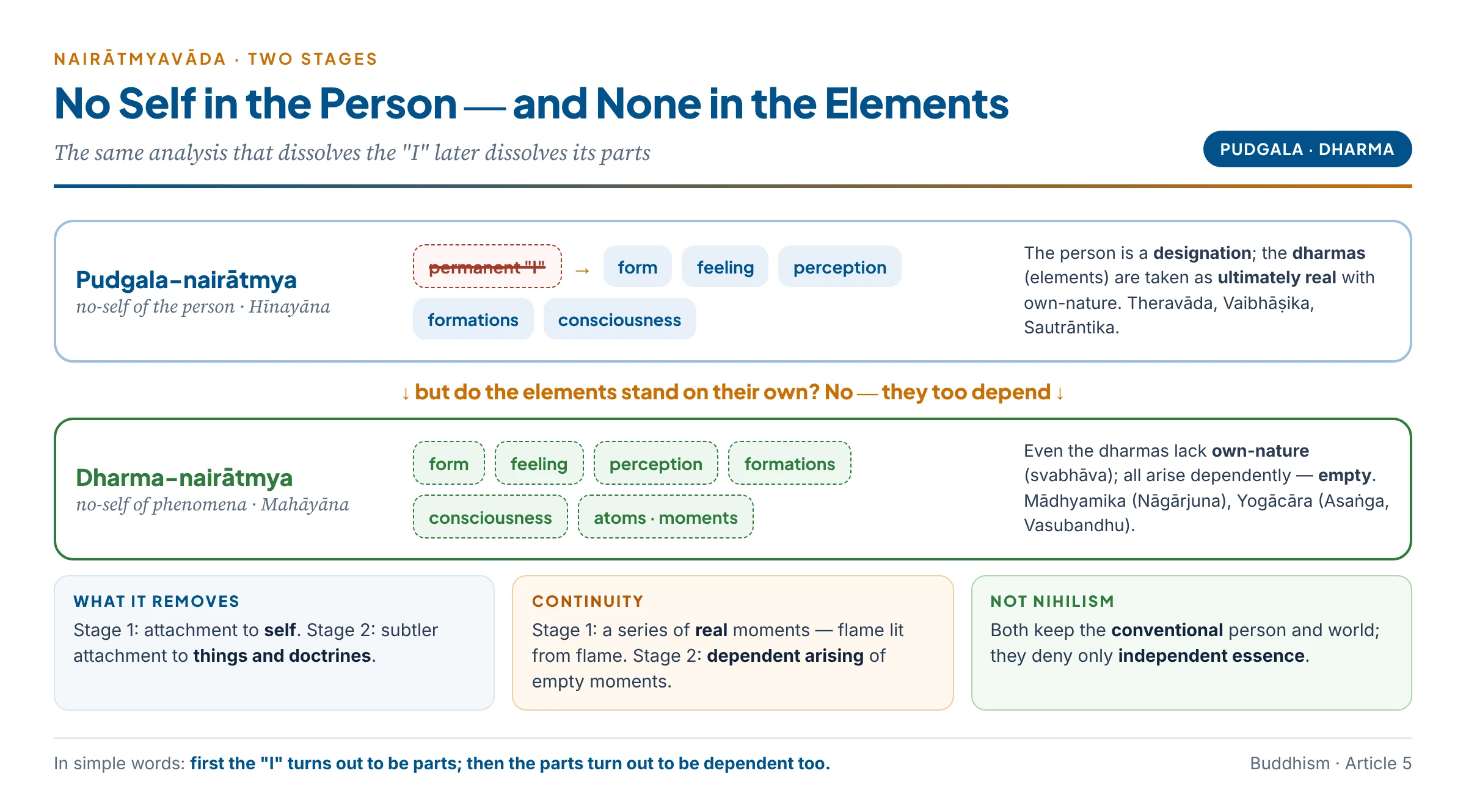
Buddhist denial of selfhood developed in two stages:
| Aspect | Pudgala-nairātmya (no-self of the person) | Dharma-nairātmya (no-self of phenomena) |
|---|---|---|
| Meaning | Denial of a permanent self (ātman) in the person | Denial of own-nature (svabhāva) even in the dharmas, the basic elements |
| Focus | The individual: rejects the Upaniṣadic ātman, accepts the conventional person | Ultimate reality: even the smallest units are empty |
| View of the person | A collection of skandhas; “I” is a designation (prajñapti) | The person is conventional, and so are the skandhas and dharmas that compose it |
| Status of the elements | Real: the dharmas exist ultimately (Abhidharma) | Empty: dharmas too arise dependently and lack own-nature |
| Continuity, karma, rebirth | Explained by the causal series of real dharmas — like a flame passed from lamp to lamp | Explained by dependent arising of empty persons and dharmas |
| Schools | Theravāda, Vaibhāṣika, Sautrāntika (Hīnayāna) | Mādhyamika (Nāgārjuna, Āryadeva) and Yogācāra (Asaṅga, Vasubandhu — in their own way) |
| Depth | The earlier, limited denial | The radical extension to everything |
In simple words
Walk into a forest and look for “the forest” itself: you find only trees — the forest is a name for trees together (this is pudgala-nairātmya: the person is a name for the skandhas). Now look at one tree: roots, trunk, branches, leaves, sap — no “tree-thing” beyond them either. And a leaf? Cells, water, sunlight… Each “unit” you stop at turns out to depend on smaller parts and outside conditions. Dharma-nairātmya is the decision not to stop: nothing, however small, has a self of its own.
- The step from one to the other. The Abhidharma took the person apart into dharmas and declared the dharmas real. The Mahāyāna asked: are the dharmas themselves independent? No — they too depend. So they too lack own-nature. The same reasoning that dissolved the person dissolves its parts.
- The Yogācāra form. For the Yogācāra, dharmas lack own-nature in the sense that the subject–object split and external objects are imagined; consciousness empty of that duality remains.
- Why it matters. Pudgala-nairātmya removes attachment to self; dharma-nairātmya removes the subtler attachment to things and doctrines — the “obscuration of knowledge” that, for the Mahāyāna, still remains in the Arhat.
8. Did the Buddha Deny Every Self?
- The strict reading (Hīnayāna, most modern scholars). The Buddha denied any permanent self; the person is the skandhas and nothing more. “The Hīnayāna interprets this as an outright denial of the ego and reduces it to the five states.”
- The restricted reading. Others argue that the Buddha denied only the empirical self — the ego identified with body and mind — and kept silent about a transcendental self:
- He says repeatedly “this is not my self” of each skandha, which seems to imply a self that is not the skandhas.
- He refused to say “there is no self” to Vacchagotta, lest he side with the annihilationists.
- He spoke of “an unborn, unbecome, unmade, unconditioned” — the goal beyond the skandhas.
- On this view the Upaniṣads and the Buddha differ less than they seem: the Upaniṣadic ātman/Brahman corresponds to the Buddhist Bodhi/Prajñā (the ultimate), and the empirical soul (jīvātman) to what the Buddha calls the five aggregates.
- The Mahāyāna development. Mahāyāna writers later spoke of a universal Great Self (mahātman), the Buddha-nature in all beings — the “restoration of the self in a more elevating and magnified form”.
- Assessment. The restricted reading fits the Buddha’s silences and Mahāyāna history; the strict reading fits the Abhidharma and the logicians. Both agree on the essential: nothing we can identify with — body, feeling, thought, awareness — is a permanent self, and clinging to it is suffering.
Common confusion
Does “no-self” mean that I do not exist? No. Nairātmya does not deny that there is a person who eats, thinks, speaks and is responsible — it denies that the person is a permanent, independent soul-substance behind these activities. “I” refers to a real process (the five skandhas in causal continuity), just as “the river” refers to a real flow of water. Saying “there is no self” in the Buddhist sense is like saying “there is no river-substance apart from the flowing water” — not that there is no river.
9. Ethical and Psychological Implications
- Non-attachment. With no permanent self to protect, clinging to possessions, status and identity loses its basis.
- Freedom from fear of death. “There is no unchanging self, so individuals do not need to cling to a static identity”; death is the end of a phase of a process, not the destruction of a thing.
- Humility and compassion. If the self is not an isolated entity but “deeply connected to others“, selfishness has no foundation; empathy grows.
- Responsibility remains. The series acts and reaps; morality operates at the conventional level, where the person is fully real (Article 4).
- The goal. Realising no-self is “essential for achieving enlightenment and ending the cycle of saṃsāra”.
Critical Evaluation
A. The Rival Critiques
- Śaṅkara: the self is self-evident. “Everything may be doubted, but the self can never be doubted, for the very idea of doubt presupposes the self.” The one who denies the self uses it in denying.
- Nyāya: the marks of the self. Desire, aversion, effort, pleasure, pain and cognition are qualities that need a substance to inhere in; memory and desire join past and present in one subject.
- The unity of consciousness. Five separate skandhas cannot produce the single experience “I see the red rose and enjoy its fragrance”; unity needs a unifier.
- Who is liberated? If there is no self, whose suffering ends in nirvāṇa? A goal with no one to reach it seems empty (Article 6).
- Jaina: the soul is directly known. Consciousness is the defining mark of the jīva and is known in every cognition; denying the knower is self-refuting.
- Sāṃkhya: a witness is needed. Unconscious aggregates cannot become conscious of anything without a conscious witness (Puruṣa).
B. Buddhist Replies
- Awareness without an owner. Consciousness is one of the skandhas; it is aware without needing a separate self to be aware through it. “Thinking happens; there is no thinker behind it.”
- Unity by causation. Experiences are unified because they arise in one causal stream, each moment taking up the content of the last.
- The denier does not presuppose a soul. Doubt presupposes a present act of doubting, not an eternal doubter.
- Liberation of a process. Nirvāṇa is the ending of a process of suffering; nothing more is needed (Article 6).
C. Is No-Self Consistent with the Rest of Buddhism?
- With karma and rebirth? Yes, if the series is enough (Article 4).
- With nirvāṇa and the Triratna? The subject of Article 6.
- With compassion? If there are no persons, whom do we help? The Mahāyāna answer: compassion is for suffering wherever it arises; no-self removes the boundaries that limit compassion.
Critics and Defenders
Criticism — Critics
- Śaṅkara: the self is beyond doubt; the denier uses it to deny it.
- Nyāya: desire, memory and effort are marks of a lasting substance.
- Sāṃkhya, Jaina: unconscious heaps need a conscious witness; consciousness defines the soul.
- Pudgalavādins (inside Buddhism): karma and rebirth need a person neither same as nor different from the skandhas.
- The unity objection: five heaps cannot yield one “I see and I enjoy”.
Defence — Defenders and strengths
- The Buddha: impermanent, unsatisfying, uncontrollable — so not self.
- Nāgasena: the self is a designation, like “chariot” — real in use, not a thing.
- Vasubandhu, Śāntarakṣita: an ineffable person is a sky-lotus.
- Momentariness: nothing stays the same even for two moments.
- Ethics: no-self roots out egoism and fear, and widens compassion.
Cross-Tradition Comparison
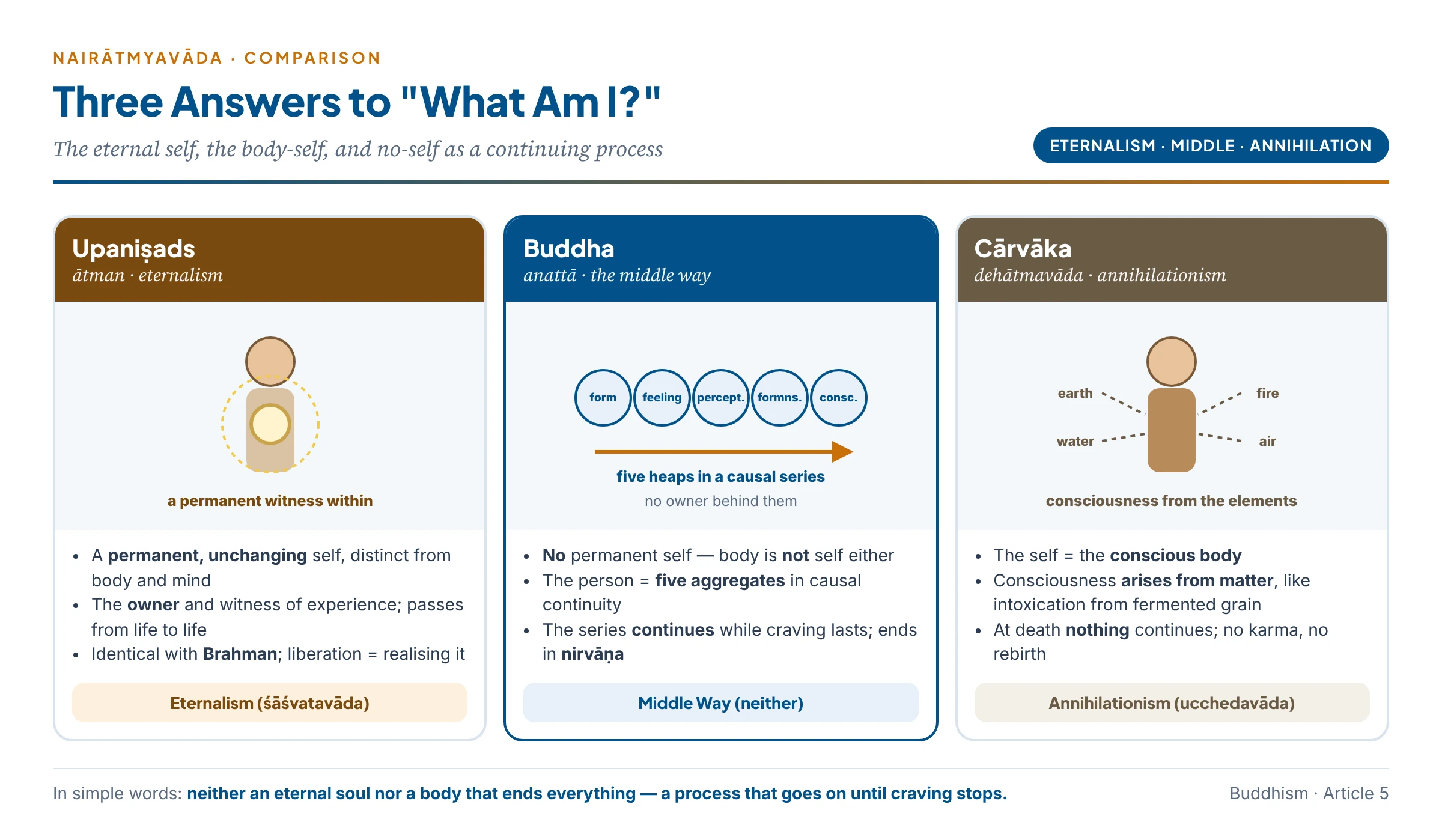
Cārvāka and Buddhism: Two Denials of the Soul
| Aspect | Cārvāka | Buddhism |
|---|---|---|
| What is denied | An immaterial, eternal soul distinct from the body | Any permanent self — immaterial or material |
| What the “self” is | The conscious living body (dehātmavāda) — “the soul is nothing but the conscious body” | The five aggregates in causal continuity — body and mental processes |
| Origin of consciousness | A product of the four elements in combination (bhūta-caitanya), like the intoxicating power of fermented ingredients | Not a by-product of matter; consciousness and name-and-form depend on each other |
| Is the body the self? | Yes | No — the body (rūpa) is one aggregate and “not my self“ |
| At death | The self is annihilated; nothing continues | The series continues while craving remains (rebirth) |
| Karma and afterlife | Rejected; no heaven, hell or rebirth | Accepted; karma works through the series |
| Goal | Pleasure in this life (kāma) | Nirvāṇa — the ending of the series of suffering |
| Epistemic ground | Perception alone; no inference to an unseen soul | Perception and inference; no-self proved by analysis and argument |
| Place among views | Annihilationism (ucchedavāda) — one of the extremes the Buddha rejected | The middle way between eternalism and annihilationism |
| Ethical result | Prudent hedonism | Non-attachment, compassion, the Eightfold Path |
- In a sentence. The Cārvāka rejects the transcendental self to keep a material self that ends at death; the Buddha rejects every self to explain a process that continues — and can be ended.
Other Comparisons
| Thinker / School | View of self | Compared with Nairātmyavāda |
|---|---|---|
| Upaniṣads / Advaita | The ātman is real, eternal, pure consciousness, identical with Brahman; body and mind are not-self | Both deny that body and mind are the self; Advaita finds a true Self beyond them, Buddhism (strictly read) finds none |
| Sāṃkhya | Many inactive puruṣas; the “I”-sense (ahaṃkāra) belongs to Prakṛti | Agrees that the ego-sense is a product; disagrees about the witness |
| Hume | “A bundle or collection of different perceptions, which succeed each other with an inconceivable rapidity” | The closest Western parallel; Hume did not draw the ethical and soteriological conclusions |
| William James | “The passing thought itself is the thinker“ | A stream without a separate owner — like santāna |
| Kant | The empirical self is a stream; the transcendental “I” is a formal condition of knowledge | Kant’s formal “I” answers the unity objection without a soul-substance |
| Strawson | Person is a primitive concept, not a bundle and not a pure ego | Agrees there is no Cartesian ego; disagrees that persons are reducible to parts |
| Parfit | Identity is “not what matters“; psychological continuity is | Parfit cited the Buddha’s view as his own |
| Modern cognitive science | The self as a model constructed by the brain | Echoes the view of the self as a construction on processes |
Indian Connect — Key takeaways
- The Buddha stands between the Upaniṣadic “the self is eternal” and the Cārvāka “the self is the body and ends at death” — the Middle Way applied to the person.
- Advaita and Buddhism agree that body and mind are not the self; they part over whether anything remains.
- The Jaina soul (conscious, changing in size and state, yet permanent) is an intermediate answer between the eternal ātman and the momentary series.
Synthesis (Siddhānta)
- The doctrine. There is no permanent, independent, controlling self in a person; the person is the five skandhas in causal continuity, and “I” is a designation like “chariot”. In its Mahāyāna form, even the elements lack own-nature (dharma-nairātmya).
- Its grounds. Impermanence, lack of control, non-observation, analysis, dependent origination and momentariness — and the fact that a permanent soul could neither act nor be freed.
- Its middle position. Against eternalism (the Upaniṣads, Sāṃkhya, Nyāya, Jainism) and against annihilationism (the Cārvāka).
- Its unresolved questions. The unity of experience, the owner of karma, and the subject of nirvāṇa — answered by the series, but pressed hard by every rival school.
- Contemporary relevance.
- Psychology. Therapies that loosen rigid self-images (in depression, anxiety, addiction) echo the insight that the self is a process, not a fixed thing.
- Neuroscience. No single “seat of the self” has been found in the brain; selfhood appears as a distributed, constructed process.
- Ethics and environment. Seeing oneself as interconnected rather than isolated supports compassion, non-violence and care for other beings and nature.
- Identity politics. Treating identities as constructed and changing rather than fixed essences can reduce conflict — a modern application of non-attachment to self-views.
“Just as the word ‘chariot’ is used when the parts are assembled, so the word ‘being’ is used when the aggregates are present.” — Vajirā (Saṃyutta Nikāya)
Previous Year Questions
- 2024Differentiate between the Carvākas refutation of self as a transcendental category and the Buddhist rejection of atma.
- 2021Distinguish between pudgala-nairätmyavada and dharma-nairätmyavada with reference to Buddhist Philosophy.
- 2020How does Buddhism explain Self in terms of Pancaskandhas? What is Liberation for Buddhism if there is no Soul?
- 2016How does Ksanikavada strengthen the arguments for ‘Nairatmyavada’? Explain.
- 2011Can Buddhism, because of its doctrine of ‘anatta’, be regarded as a religion or not? Discuss.
- 2008An examination of Buddhist Nairatmyavada. Short notes.