

Existentialism (Kierkegaard, Sartre, Heidegger): Existence and Essence; Choice, Responsibility and Authentic Existence; Being-in-the-world and Temporality.
Official Syllabus: Paper I, Section A, Unit 10
Kierkegaard, Heidegger and Sartre are often grouped together as “existentialists”, yet one was a passionate Christian, one claimed to be asking only about Being, and one was an atheist and political radical. What unites them is a shared conviction: the human being is not a thing with a fixed nature but an existence — free, finite, anxious, responsible — that must become itself. What divides them is how they understand freedom, authenticity, God, death and other people. This article brings the three thinkers side by side, adds the wider existentialist family (Nietzsche, Jaspers, Marcel, Beauvoir, Camus, Merleau-Ponty), follows existentialism into politics and society, sets out its strong and weak points, and compares it with Indian thought.
In simple words
Three doctors examine the same patient — a person who feels lost. Kierkegaard says: “Your despair is a sickness of the spirit; only a leap of faith to God will heal you.” Heidegger says: “You are lost in what ‘they‘ expect; face your own death and you will find yourself.” Sartre says: “There is no cure and no excuse — you are free; stop pretending otherwise and choose.” Same diagnosis — a self that has not taken hold of itself — three very different prescriptions.
Context & Problem
A Family, Not a School
- No single doctrine. Existentialism is a broad tradition, a family of thinkers sharing themes rather than a school with fixed tenets. It is less a system than an attitude or “mood” towards life — a practical way of dealing with existence.
- Who accepted the label? Only Sartre and Simone de Beauvoir ever openly called themselves existentialists. Gabriel Marcel coined the word “existentialist” (and was the first to apply it to Sartre), but later preferred to call himself “neo-Socratic“. Heidegger rejected the label; Camus insisted he was not an existentialist.
- The common core.
- Existence over essence — the human being has no pre-given nature; it becomes what it makes of itself.
- The concrete individual over abstract systems (Hegel), science and the crowd.
- Freedom, choice and responsibility as the heart of human being.
- Anxiety, despair, death, absurdity as revealing experiences.
- Authenticity — living as one’s own self — as the primary virtue.
Common confusion
Were Heidegger and Camus existentialists? Both rejected the label. Heidegger said his concern was the meaning of Being, not human existence as such; Camus called himself a thinker of the absurd and denied being an existentialist. Yet both are treated as part of the movement because their themes — anxiety, death, authenticity, the absurd, revolt — shaped it. Only Sartre and Beauvoir accepted the name.
Precursors and the Wider Family
- Pascal (the “heart” has reasons, the human being as a “thinking reed”), Dostoevsky (“if God did not exist, everything would be permitted”) and Nietzsche are major precursors.
- Nietzsche — “God is dead”, the herd, the will to power, the Übermensch, nihilism, “become what you are”. Unlike Sartre, Nietzsche denied free will: he called it an “error” and saw the will to power working through nature, life and mind (“nature as a whole is will to power”). With Marx and Freud he is one of the “masters of suspicion“.
- Karl Jaspers — first to call his work a philosophy of Existenz; paired Kierkegaard and Nietzsche as the two great “exceptions”; spoke of limit situations (suffering, guilt, death, struggle), “shipwreck“, philosophical faith and Transcendence. His aim: “to philosophise in view of the exception without being an exception”. In a 1935 lecture he warned of the calamity of devaluing Existenz in favour of a naive faith in science, and liked to quote Lichtenberg on the great books of Kierkegaard and Nietzsche: “Such works are mirrors: if a monkey peeks in, no apostle can look out.“
- Gabriel Marcel — Catholic convert, Christian existentialist; mystery versus problem, creative fidelity, hope, availability, communion; The Mystery of Being (Gifford Lectures).
- Martin Buber — the I–Thou relation versus the I–It relation; through every Thou we glimpse the eternal Thou.
- Simone de Beauvoir, Albert Camus, Maurice Merleau-Ponty and Emmanuel Levinas complete the French circle.
Core Doctrine
1. Existence and Essence in the Three Thinkers
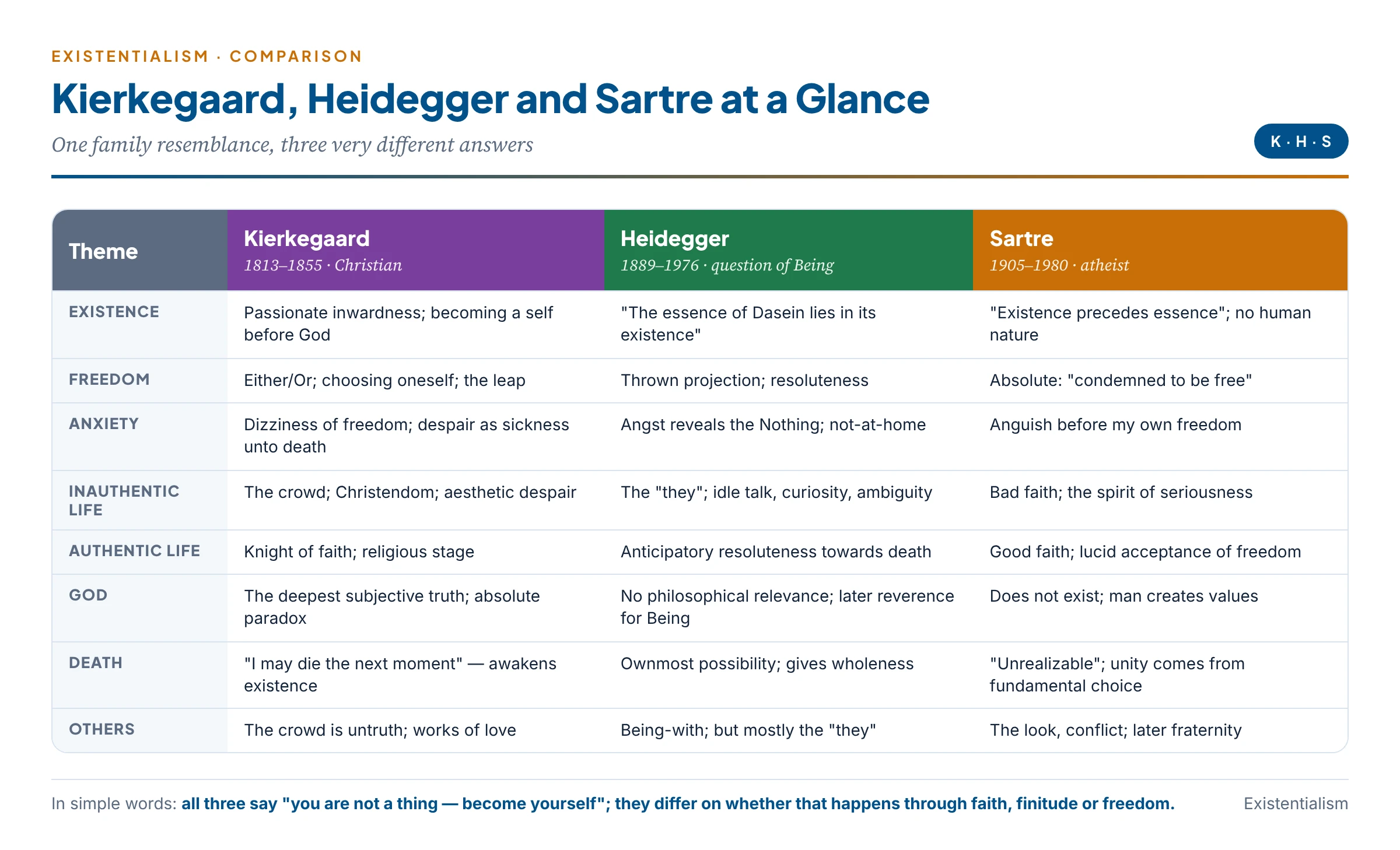
- Kierkegaard. “Existence” is the concrete, passionate, choosing life of the individual — what is left over when all abstract descriptions (“teacher”, “man”, “in love”) are given; a “surd” that thought cannot capture. “To think is one thing, to exist is another.” The self is a task: to become oneself before God.
- Heidegger. “The essence of Dasein lies in its existence.” Dasein has no fixed “what”; its being is to stand out (ek-sist) into its possibilities and towards Being. The point is ontological — a key to the question of Being.
- Sartre. “Existence precedes essence.” Man “first of all exists, encounters himself, surges up in the world — and defines himself afterwards”. There is no human nature, because there is no God to conceive it. Man is “nothing else but what he makes of himself“.
- Heidegger’s correction. In the Letter on Humanism Heidegger rejected Sartre’s slogan: reversing “essence precedes existence” into “existence precedes essence” is still a metaphysical statement; it keeps the old concepts and merely swaps their order.
| Kierkegaard | Heidegger | Sartre | |
|---|---|---|---|
| Key phrase | “To exist is to become oneself before God” | “The essence of Dasein lies in its existence” | “Existence precedes essence” |
| What “existence” means | Passionate, inward, choosing life | Ecstatic standing-out into possibilities and Being | Free self-making by a consciousness that is “nothing” |
| Aim | Becoming a Christian; salvation of the single individual | The meaning of Being (fundamental ontology) | Freedom, responsibility, humanism |
| Human nature | A synthesis of finite and infinite, grounded in God | No fixed nature; existentials (care, being-towards-death) | No nature at all; a universal “human condition” |
2. Starting Point and Method: A Synoptic Table
Existentialism grew alongside phenomenology. Placing the founder of phenomenology beside the three existentialists shows how each starts and where each goes.
| Husserl | Kierkegaard | Heidegger | Sartre | |
|---|---|---|---|---|
| Central problem | Certain knowledge; foundations of science | How to become a self (a Christian) | The meaning of Being | Human freedom |
| Starting point | Pure consciousness after the epoché | The existing individual’s inwardness | Dasein as being-in-the-world | Consciousness as nothingness (for-itself) |
| Consciousness | Intentional; constituted by a transcendental ego | Spirit, passion, inwardness | Replaced by Dasein and care | Intentional, empty, free, without an ego |
| Anxiety | Not a theme | Dizziness of freedom; sickness unto death | Angst reveals the Nothing and death | Anguish before one’s own freedom |
| Method | Descriptive phenomenology | Indirect communication; pseudonyms | Hermeneutic phenomenology | Phenomenological ontology |
| Path to authenticity | (Rigorous science, not authenticity) | Leap of faith; the knight of faith | Anticipatory resoluteness towards death | Good faith; lucid acceptance of freedom |
- Indirect communication. Many existentialists wrote through literature: Kierkegaard’s pseudonyms and parables, Nietzsche’s Zarathustra, Beauvoir’s novels, Marcel’s thirty plays, Sartre’s novels and plays, Camus’s fiction. Existentialism shaped and was shaped by Dostoevsky, Kafka, Beckett, Ionesco, Giacometti and Picasso.
3. Freedom and Choice
- Kierkegaard: choosing oneself. Freedom is the possibility of becoming a self; it is felt as the dizziness of anxiety. The great choice is the Either/Or — aesthetic or ethical — and finally the leap into faith. The ethical person “chooses to choose“; the highest freedom is to rest transparently in God.
- Heidegger: thrown projection. Freedom is not absolute: Dasein is thrown (facticity) and projects itself onto possibilities. Authentic freedom is resoluteness — taking over one’s thrownness and choosing in the light of death. The later Heidegger speaks of freedom as “letting beings be“.
- Sartre: absolute freedom. “Man is condemned to be free.” We are freedom; even not choosing is a choice; we are responsible for our emotions, our situation, and for the image of humanity we choose. Freedom is limited only by itself — the facts of my situation get their meaning from my project.
- Merleau-Ponty’s question. The “battle over existentialism”, Merleau-Ponty said, was about “what part freedom plays and whether we can allow it something without giving it everything“. Against Marxist materialists, he held that humans are more than the forces acting on them; against spiritualists, that freedom is situated and embodied (“I do not have a body; I am my body” — a view Marcel shared).
In simple words
Think of a sailor. Kierkegaard’s sailor steers by a star above (God); Heidegger’s sailor knows that the voyage will end, and so steers with care; Sartre’s sailor has no map and no star — every turn of the wheel is his own, and he cannot blame the wind. Merleau-Ponty adds: the sailor is not free of the sea — he steers with the waves and currents, not above them.
- Nietzsche’s contrast. Nietzsche denied free will, yet called for creating values: the free spirits and the Übermensch live a “higher ethic” after the death of God. Madame de Staël’s saying “to understand all is to forgive all” points to the deterministic side of such views.
4. Anxiety, Dread and Anguish
| Kierkegaard | Heidegger | Sartre | |
|---|---|---|---|
| Name | Anxiety, dread (Angest) | Anxiety (Angst) | Anguish (angoisse) |
| Object | Nothing — the possibility of possibility | Nothing in particular — being-in-the-world itself | Myself — my own freedom |
| Image | “The dizziness of freedom” — looking into the abyss | The world sinking into insignificance; “not-at-home” | The cliff path: nothing stops me from jumping |
| Versus fear | Fear has a definite object; anxiety does not | Fear is of something in the world | Fear is of the world; anguish is of myself |
| Role | Leads to faith (or despair) | Individualises; opens being-towards-death | Reveals responsibility; we flee it in bad faith |
- Shared insight. All three see anxiety not as a disorder but as a revealing mood — it shows us our freedom and our nothingness. All three distinguish it sharply from fear.
5. Authenticity: Three Roads
- The word. “Authenticity” (German Eigentlichkeit, from eigen, “own”) was coined in its technical sense by Heidegger; Sartre borrowed it. Kierkegaard had the idea under the names of becoming a self and inwardness.
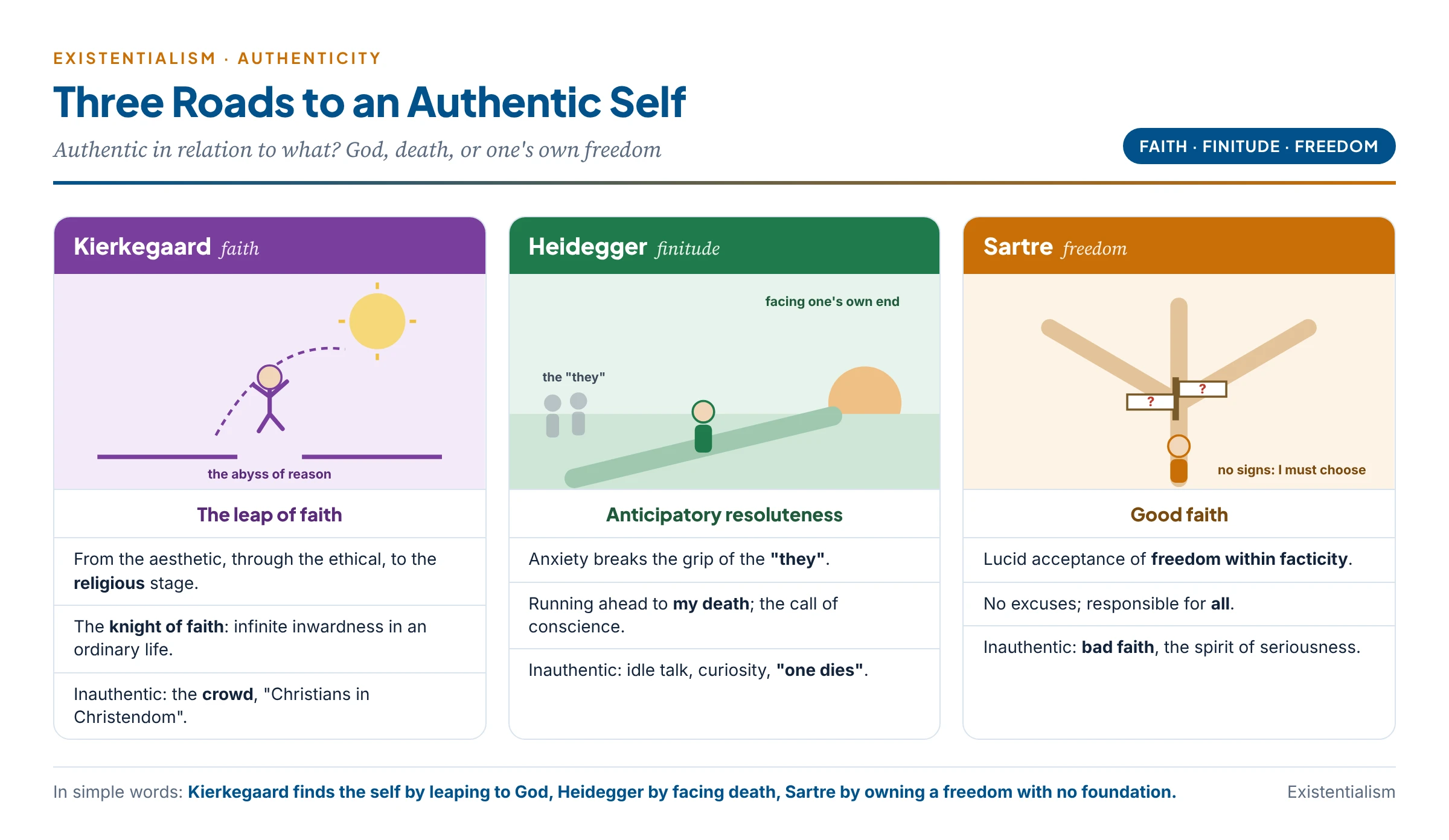
- Kierkegaard: the leap. Authentic existence is the religious stage — the knight of faith, who lives in the finite world with infinite inwardness, related to God through a leap beyond reason and the ethical. The inauthentic are the crowd, the “Christians in Christendom” who merely conform.
- Heidegger: resoluteness. Authentic Dasein takes itself back from the “they” by facing death, hearing the call of conscience, and choosing in anticipatory resoluteness.
- Sartre: good faith. Authenticity is the lucid acceptance of one’s freedom within one’s facticity, refusing the excuses of bad faith. It is “a constant effort of self-honesty”.
- Others. Buber and Marcel: authenticity in communion — the I–Thou relation leading to the eternal Thou. Camus: revolt — living lucidly in the absurd, rejecting both physical suicide and “philosophical suicide” (the leap into faith or a comforting system).
- Theists and atheists alike distinguish authentic from inauthentic existence; the difference lies in what authenticity is related to — God, Being, or one’s own freedom.
6. Is There an Ethics of Authenticity?
- The problem. If there are no given values, authenticity looks like a “gyroscope in moral free-fall” — a way of keeping one’s balance with no fixed ground, sailing “beyond the last lighthouse“. Is “moral creativity” just a cover for nihilism or opportunism?
- Style, not content. Authenticity describes an ethical style — how one chooses (lucidly, responsibly, without self-deception) — not a moral content (what one should choose). As Beauvoir said, existentialism offers no moral recipes.
- Art as a model. Nietzsche spoke of making life a work of art; Sartre compared moral choice to the making of a work of art — no fixed rules beforehand, yet the choice has a universal dimension.
- Freedom as the supreme value. For Sartre and Beauvoir, freedom is the ultimate value and authenticity the primary virtue. But this is not the “freedom of indifference” (choosing at random), nor the “spirit of seriousness” of the “serious man”, who treats values as fixed things in the world; that spirit, they said, leads to nihilism. Authentic freedom brings a sense of the joy and gratuity of existence.
- Could one be an “authentic Nazi”? Beauvoir’s answer in The Ethics of Ambiguity (1947): no. My freedom can will itself only by willing the freedom of others; it requires an “open future” for all. To leave others in slavery or oppression is inauthentic. Humans are “separate existents” who are nonetheless bound to each other, so laws valid for all can be built.
- The promised ethics. Being and Nothingness promised, in a footnote, an ethics of authenticity. Sartre’s attempts (Notebooks for an Ethics, published after his death) remained unfinished; there he describes authentic love and friendship as a gift-appeal, unlike the sadism and masochism of Being and Nothingness, and speaks of a “city of ends” with eye-level, egalitarian relations.
7. Death
- Kierkegaard. The “truth of my death” is subjective: a man invited to dinner may be killed by a falling roof tile on the way. To think “I may be dead the next moment” is not morbid; it awakens me to existence and away from petty projects.
- Heidegger. Death is Dasein’s ownmost, non-relational, certain, indefinite possibility, not to be outstripped. Running ahead to it (anticipation) individualises Dasein and makes authentic wholeness possible.
- Sartre’s objection. Sartre rejected Heidegger’s view. My death is foreign to my experience — an “unrealizable“, like Epicurus’ “where death is, I am not”. It comes from outside, at random, and can rob my life of meaning rather than giving it unity. Death turns me into a thing for others to interpret.
- Sartre’s alternative. The unity of a life comes not from death but from the fundamental choice (original project) — a pre-reflective choice of what we are, not just what we do. At bottom, this original choice is a futile pursuit of being a consciousness that is also self-identical — the impossible ideal of being God (the in-itself-for-itself): “man is a useless passion“. Existential psychoanalysis would uncover each person’s fundamental project — though, Sartre admitted, it “has yet to find its Freud”. A radical conversion of one’s project is possible but rare.
In simple words
Compare a life to a novel. For Heidegger, knowing that the book has a last page makes every chapter count. For Sartre, the last page will be torn out by someone else, at a random moment — so the novel’s unity must come from the theme the author chooses (the fundamental project), not from the ending.
- Literature. In Tolstoy’s The Death of Ivan Ilyich, Ivan becomes authentic only when he embraces his own death. In Saul Bellow’s Herzog, a character’s remark that “death is God” — the final horizon of meaning — shows how death replaces God in a secular age.
8. God
- Kierkegaard: theistic. God is the deepest subjective truth; the self finds itself only in relation to God. Faith is a leap to the absolute paradox (the God-man).
- Nietzsche: “God is dead”. Belief in God is no longer credible; with it falls the cosmic order and absolute values. Man must create his own values — a “heroic atheism“.
- Heidegger: bracketing God. God’s existence has no philosophical relevance for the analysis of Dasein; the self is found through death, not God. Yet his later reverence before Being drew comparisons with mysticism.
- Sartre: atheism as the starting point. “Existentialism is nothing else but an attempt to draw the full conclusions from a consistent atheistic position.” Because there is no God, there is no human nature, and man is the creator of values. Sartre also argued that existentialism is incompatible with theism: if God made us, our essence would precede our existence.
- Theistic humanism. Theistic existentialists reply:
- Atheism degrades the human being into a mere product of nature.
- Atheists say freedom is absolute and that theology is “anthropology upside down” (Feuerbach). Theists say freedom is genuine but created; the world is a gift.
- Marcel: creative fidelity; hope — hope in what does not depend on ourselves, a hope of humility, not pride (against Camus’s proud revolt). Marcel and Heidegger both opposed the technical world and calculative thinking.
- Jaspers: philosophical faith in Transcendence, glimpsed in limit situations; only humans ponder why they exist.
Common confusion
Are all existentialists atheists? No. Existentialism has a strong religious wing: Kierkegaard (its founder), Jaspers, Marcel, Buber, and in theology Tillich and Bultmann. Sartre’s atheism made “existentialism” sound godless, but Sartre himself spoke of two kinds — Christian existentialists and atheistic existentialists. What all share is the primacy of existence, freedom and authenticity, not a view about God.
9. The Other and Community
- No existentialist is a solipsist. Every existentialist recognises other people as real; they differ on whether others help or hinder authentic selfhood.
- Kierkegaard: the single individual stands alone before God; the crowd is “untruth”. Yet his Works of Love (1847) is a book about love of the neighbour.
- Heidegger: being-with (Mitsein) is a basic structure of Dasein — but in everyday life the others appear as the “they“. Authentic solicitude “leaps ahead” of the other, freeing him for his own possibilities.
- Sartre (early): the look of the Other makes me an object; relations are conflict — sadism or masochism; “Hell is other people” (the penultimate line of No Exit, 1944). Even the Other’s hateful stare is a mode of intersubjectivity.
- Sartre (later) and Beauvoir: fraternity, positive reciprocity, a “reign of liberty” and brotherhood; one cannot act directly on another’s freedom, but one can change the “bases and structures” of the other’s choices (as with the anti-Semite).
- Marcel: availability, fidelity, commitment, communion — close to Sartre’s later “fraternity”.
- Buber: the I–Thou encounter.
- Levinas: the face of the other person makes an ethical demand on me before I choose anything; justice arises with the third party.
- Camus (later): solidarity in revolt — “It may be shameful to be happy by oneself.“
- Commitment to the Transcendent, for the religious existentialists, is faith; for the atheists, commitment is to humanity and its freedom.
10. Existentialism and Society
Kierkegaard and Nietzsche — apolitical critics of the age:
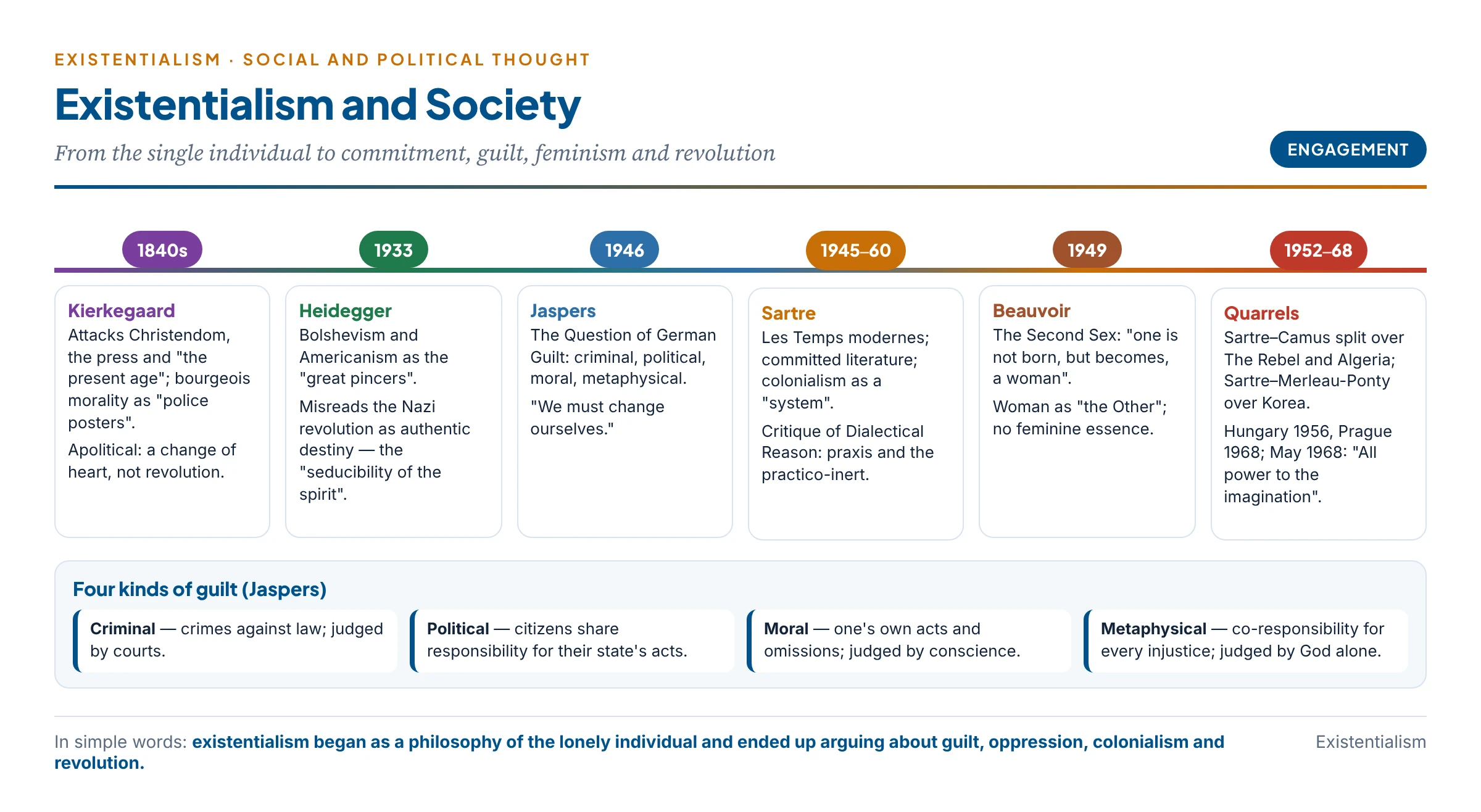
- Kierkegaard attacked Christendom — comfortable, complacent, tokenistic religion, with a state that employed a thousand officials (the clergy) to make everyone “Christian”. His own brother was a pastor.
- He attacked the press and public opinion (having been caricatured by the satirical paper The Corsair), and called bourgeois morality “a summary of police posters”.
- Writing while the 1848 revolutions happened outside his window, he called his time “the present age” — “a sensible, reflecting age, devoid of passion”, an “age of publicity“.
- He was elitist, apolitical and conservative: his Works of Love (the section on “mercifulness“) argues against communism; what is needed is a change of heart, not social upheaval.
- Nietzsche scorned the herd, democracy and pity (which he found demeaning), admiring higher types — the Greeks, Goethe. Neither addressed the “social question”.
Heidegger and Jaspers — Germany between the wars:
- Heidegger saw Bolshevism and Anglo-American materialism as the jaws of a “great pincers” crushing Europe. He misread the Nazi revolution of 1933 as an authentic collective being-with and destiny. A sympathetic biographer concludes that he learned, too late, the “seducibility of the spirit” by the will to power.
- Jaspers described Germany after the First World War as caught between “the Russian whip and Anglo-Saxon convention“. Married to a Jewish wife, he lost his professorship in 1937.
- After the war, in The Question of German Guilt (1946), Jaspers distinguished four kinds of guilt:
- Criminal guilt — for crimes against law, judged by courts.
- Political guilt — shared by citizens for the acts of their state.
- Moral guilt — for one’s own acts and omissions, judged by conscience.
- Metaphysical guilt — co-responsibility for every injustice in the world, especially those one failed to prevent; judged by God alone.
- Sartre’s play The Condemned of Altona (1959) is a parable of French guilt in Algeria.
- Jaspers set an ethical limit to politics against Machiavellian realism, and warned after the atomic bomb: “It is not enough to find new institutions; we must change ourselves.” Marcel added that suicide had become possible on a mankind-wide scale, and every choice increases or lessens that possibility.
- For Jaspers, ethics has the form of universality (an unconditional “ought”) but its content cannot be deduced; an ethos becomes rigid morality when it is exhausted in commands. “What is hidden in the ethical is more than merely ethical” — it points to the Encompassing.
Marcel — man against mass society:
- In Man against Mass Society (1951) Marcel attacked the “spirit of abstraction“: war turns persons into abstractions (the “enemy”), making killing easy — as in All Quiet on the Western Front.
- Masses produce abasement, alienation, fanaticism; propaganda works like an electric shock; people are trained, not educated.
- He favoured a communitarian order of intermediate groups (like guilds) between the individual and the state.
Sartre — from the individual to history:
- As a conscript and prisoner of war in the Second World War, Sartre “discovered society“. “We were never so free as under the Occupation” — because every act was a choice with consequences. “Everyone has the war he deserves.“
- He moved from the non-Communist Left to being a fellow traveller of the French Communist Party, broke with it over Hungary (1956), condemned the Soviet invasion of Prague (1968), and ended as a libertarian socialist, close to anarchism (“authority is the other in us“).
- He remained a moralist, focused on acts; social structures are the sedimentation of past actions. Yet he called colonialism a “system” — “the meanness is in the system” — while insisting on naming names of those responsible.
- “In history too, existence precedes essence“: history is made by human praxis, not by fixed laws.
- Search for a Method (1957): there are only individuals and real relations among them. Critique of Dialectical Reason (1960): praxis (free, purposeful activity) replaces the for-itself, and the practico-inert (the sedimented results of past action — tools, institutions, markets) replaces the in-itself. The practico-inert produces counter-finality: peasants cutting down trees for fields cause floods that destroy their fields. Here Sartre concedes how far social structures limit freedom.
In simple words
Think of a traffic jam. Each driver freely chooses to take the car to save time; together, their choices produce a jam that slows everyone. No one intended it, yet it now limits every driver’s freedom. That is Sartre’s practico-inert and counter-finality: our own past actions, piled up, come back to us as a hostile, thing-like force.
- Commitment. “There is only committed knowledge.” In What Is Literature? (1947–48) writing is a form of action — a gift-appeal to the reader’s freedom; prose must be committed (he later included the poetry of Black Francophone writers). He founded the journal Les Temps modernes (1945, named after Chaplin’s film Modern Times), whose opening statement asked writers to be “totally committed and totally free“. He declined the Nobel Prize (1964).
- May 1968. The students’ slogan “All power to the imagination” was Sartrean in spirit; Sartre supported the “Maoist” young radicals and wrote “The Communists Are Afraid of Revolution”. At his funeral (1980), it was said: “France has lost its conscience.“
The great quarrels:
- Sartre and Camus.
- Camus — born in Algeria (French father, Spanish mother), journalist and actor, editor of the Resistance paper Combat, sought by the Gestapo. Sartre had reviewed his novel The Outsider; Camus declined the lead in Sartre’s No Exit.
- They broke in 1952 after Camus’s The Rebel was savaged in Les Temps modernes: Camus rejected revolutionary violence and Soviet communism; Sartre accused him of a comfortable moralism.
- On Algeria, Camus sought a middle road — a federation, valuing French education and fearing pan-Arab expansionism; Sartre backed the revolution (his apartment was bombed twice). Camus opposed capital punishment and leaned to pacifism.
- Camus won the Nobel Prize (1957) and died in a car accident in 1960, aged 46. Many today see Camus’s position as the more balanced.
- Sartre and Merleau-Ponty.
- Merleau-Ponty’s Humanism and Terror (1947) argued that “political action is of its nature impure” — echoed in Sartre’s play Dirty Hands.
- They broke over the Korean War. Merleau-Ponty’s Adventures of the Dialectic (1955) attacked “Sartre and Ultra-Bolshevism“; Beauvoir replied with “Merleau-Ponty and Pseudo-Sartrism” — the Cold War fought on the stage of French letters.
- Merleau-Ponty (Phenomenology of Perception, 1945; influenced by Gestalt psychology) held that the human world is an open, unfinished system; “machineries” are really men. He died in 1961, aged 53.
11. Beauvoir and Existentialist Feminism
- The Second Sex (1949): “One is not born, but rather becomes, a woman.”
- The distinction between biological sex and socially constructed gender: womanhood is a situation and a history, not a biological destiny.
- Woman has been made the “Other“, the “second sex“, defined in relation to man, who is the Subject.
- The myth of the “eternal feminine” (as in Goethe’s Faust) is an abstraction with no concrete reality; the myths contradict each other (woman as pure mother and as tempting Eve). “Woman sums up nature as Mother, Wife and Idea.”
- Since there is no human nature, there is no feminine essence either: existence precedes essence for women too.
- What is socially constructed can be dismantled. Freedom must change the bases and structures of choice, and the “force of circumstance” must be recognised. Even gender-neutral language matters — change comes “a word at a time”.
- Existentialism meets Marxism. Beauvoir showed how freedom is limited by oppression, and how existentialism can humanise Marxism by keeping the individual’s freedom at its centre.
12. After Existentialism: Structuralism, Poststructuralism and Hermeneutics
- Eclipse in the 1960s. Structuralism (Saussure’s linguistics of differential signs; Lévi-Strauss on kinship; Lacan: “the unconscious is structured like a language”; Althusser; Barthes) explained human life through impersonal structures. Individuals became bearers, not inventors, of meaning — a theoretical anti-humanism.
- Foucault predicted that “man” would be erased, “like a face drawn in sand at the edge of the sea”, and called Sartre’s Critique “the magnificent and pathetic attempt of a man of the nineteenth century to think the twentieth” — the last Hegelian, the last Marxist.
- Lyotard spoke of the “fission of meaning“.
- Sartrean replies.
- Sartre sought to “reconquer man within Marxism“: structures serve us; they are made and remade by praxis.
- The Sartrean subject was never a self-identical substance but a presence-to-self that is not identical with itself — much closer to poststructuralist views than Foucault admitted.
- The dualism of spontaneity and inertia is functional, not a dualism of substances; dialectical reason grasps wholes in movement, which analytical reason cannot.
- All knowledge is committed — anticipating the poststructuralist link of power and knowledge.
- Structures may condition us (we are “motivated”, not “determined”); action theorists and the idea of institution (Merleau-Ponty) keep room for agency.
- Language.
- Later Heidegger: “language is the house of Being“; we are its guardians, not its prisoners.
- Merleau-Ponty: language as gesture, an extension of bodily intentionality.
- Sartre: language is a form of being-for-others; “freedom is the only possible foundation of the laws of language“. The “prison-house of language” (Jameson) is therefore not a real problem for him.
- Hermeneutics. Existentialism fed the tradition of interpretation: Schleiermacher, Dilthey, Weber (Verstehen, understanding), Heidegger’s pre-understanding (which made phenomenology hermeneutical — Husserl refused to accept it), Gadamer‘s “fusion of horizons” (letting the alienated voices of the past speak again), the hermeneutic circle (we both know and do not know what we seek), Nietzsche’s “interpretation all the way down”, Sartre’s “pre-ontological comprehension” and existential psychoanalysis — reading a life like footprints on a beach, as in his huge biography of Flaubert. Jaspers too brought understanding into psychopathology.
- The phenomenology origin story. In a Paris café in the early 1930s, Raymond Aron, back from Germany, pointed to his apricot cocktail and told Sartre that with phenomenology one could make philosophy out of this glass. Sartre, Beauvoir recalled, turned pale with emotion — philosophy could start from concrete experience.
13. Existentialism Today: An Ethics of Responsibility
- The vocabulary survives. Anguish, bad faith, commitment, authenticity, the absurd — these words remain part of everyday moral language.
- Connectedness of a life. Dilthey spoke of the “connectedness of a life“; existentialism stresses that a life is a whole we are responsible for shaping.
- Responsibility for the other. Levinas (the face-to-face) and Derrida (justice is “perhaps undeconstructible“) pushed existential responsibility towards the other person.
- Practical wisdom. Aristotle’s equity (correcting the letter of the law by its spirit) and the phronimos (the person of practical wisdom), and Pieper’s “situation conscience“, resemble the existentialist decision in a concrete situation. The difference: the Aristotelian discovers the right act; the existentialist creates it — and makes it right by following through.
- Modern or postmodern? Sociologists like Bauman contrast modern and postmodern ethics. Existentialism remains modernist in its commitment to a humanism — but a humanism of its own making.
- Imagination and freedom. Sartre’s theory of the imaging consciousness (I can imagine a unicorn — what is not) links imagination to freedom: “the same insufficiency enables man to form images and prevents him from creating being” (from his study of Genet).
14. Existentialism: Strong and Weak Points
| Strong points | Weak points |
|---|---|
| Restores the concrete individual against abstract systems, science and totalitarian collectives | Subjectivism: truth and value seem to depend on the individual; risk of relativism |
| Makes freedom and responsibility central; removes excuses | Overstates freedom; neglects class, culture, biology and social structures (Marxist and structuralist critiques) |
| Honest about anxiety, death, absurdity; no false consolations | Seen as pessimistic — “man is a useless passion”; anguish and despair dominate |
| Exposes conformity and self-deception (das Man, bad faith) | No clear ethics: authenticity gives no criterion of right and wrong |
| Rich phenomenological descriptions of lived experience | Obscure language; arguments hard to test (positivist critique) |
| Influenced literature, psychology, theology, politics, feminism | Individualistic: others often appear as threat (the look, the “they”) |
| Theistic and atheistic forms speak to believers and non-believers | Kierkegaard’s faith beyond reason risks fideism and fanaticism |
| Practical: a way of living, not only a theory | Not a system: hard to refute, only to accept or reject |
Common confusion
Is existentialism a philosophy of despair and pessimism? This was the commonest charge in the 1940s (“quietism of despair”, “man is a useless passion”). But Sartre called existentialism a doctrine of action and “tough optimism“: it tells us that our fate is in our hands. Heidegger’s anxiety and death are paths to authentic life; Kierkegaard’s despair is the “sickness” that leads to faith; Camus’s absurd leads to revolt, not suicide. Existentialism is sober about the human condition, not hopeless.
Critical Evaluation
Objections to Each Thinker
- Kierkegaard.
- Irrationalism and fideism: faith “by virtue of the absurd” is beyond rational assessment; there is no logic to refute it, only agreement or disagreement.
- The teleological suspension of the ethical could license fanaticism — anyone can claim a divine command.
- Excessive subjectivism; science and universal ethics cannot be handed over to faith.
- The three stages look arbitrary.
- Neglect of the social and political; psychological pessimism.
- Sartre: existentialism is incompatible with theism.
- Heidegger.
- Obscurity and neologisms; Carnap: “The Nothing nothings” is meaningless.
- No ethics, no criteria for authenticity; excessive emphasis on finitude.
- Insufficient engagement with science; gender blindness; anthropocentrism; the later historical determinism of the “destiny of Being”.
- The Nazi episode.
- Sartre.
- Overstates freedom (Marxist and structuralist critiques); early neglect of social structures (later corrected in the Critique).
- Ambiguity of moral framework: universal responsibility without shared standards; if each chooses his own ethics, ethics loses its point.
- Bad faith implausible: how can I both know and not know the same thing?
- Conflictual view of relations ignores cooperation and empathy; pessimistic anthropology (“useless passion”).
- “Nothingness” is incoherent to analytic philosophers.
- Individual choice forgets solidarity (Marxists and Christians).
Replies and Strengths
- Kierkegaard reclaims the individual from philosophical, theological, political and scientific abstraction and shows that faith is a matter of existence, not argument.
- Heidegger overthrows Cartesian dualism and gives powerful descriptions of everyday life, conformity and finitude.
- Sartre offers an uncompromising ethic of responsibility, a brilliant diagnosis of self-deception, and later a serious attempt to join freedom with history.
- Together they shaped psychology (existential psychotherapy), theology (Tillich, Bultmann), literature and drama, feminism, and political thought — and their vocabulary has become part of how ordinary people think about life.
- Existential individuality is an achievement, not a given, and never permanent. The criticism of “bourgeois individualism” leads not to abandoning existentialism but to a “chastened individualism” — individuality that recognises its social conditions.
Critics and Defenders
Criticism — Critics
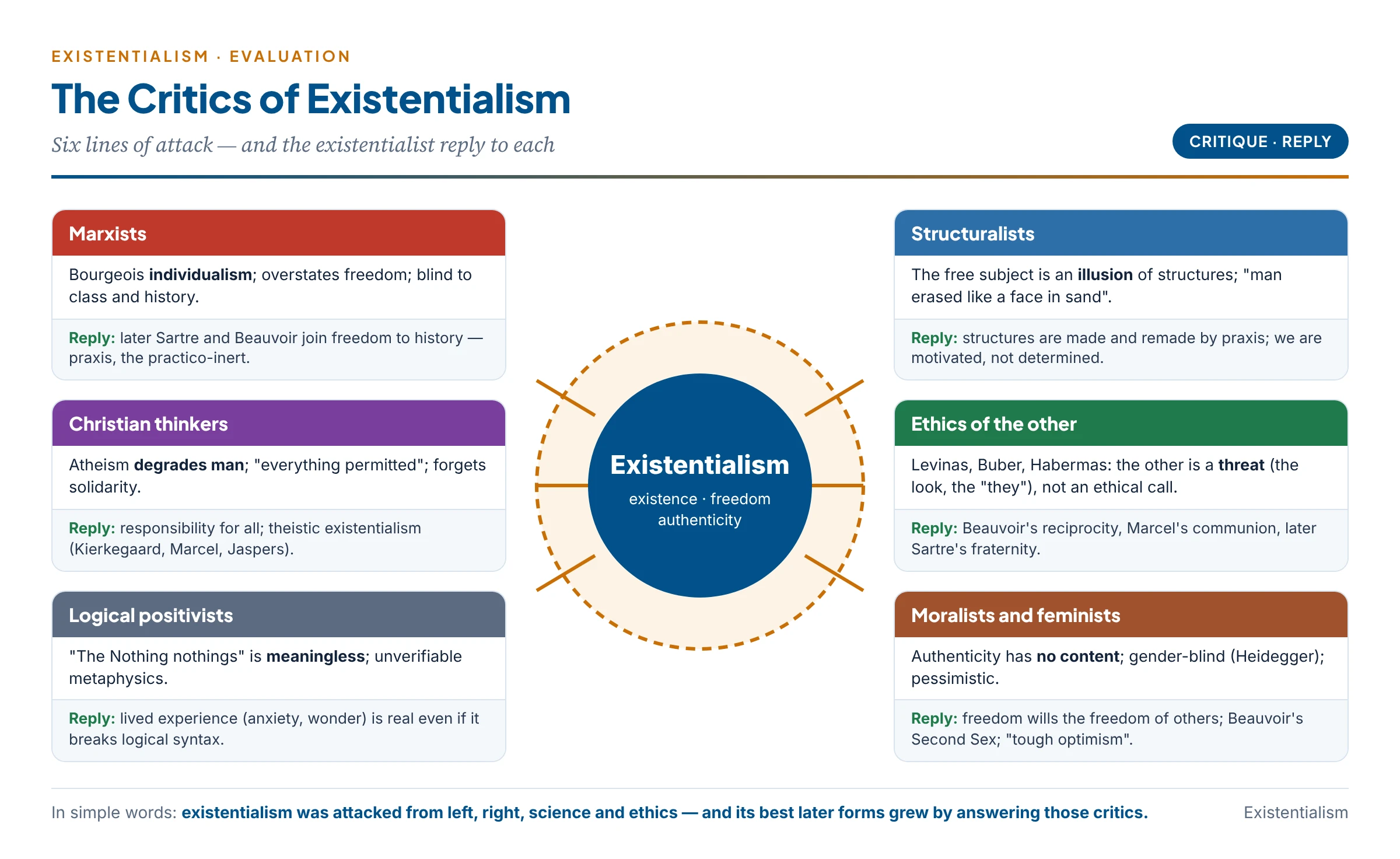
- Marxists: existentialism is bourgeois individualism, blind to class and history.
- Christians: atheistic existentialism degrades man and forgets solidarity.
- Logical positivists: talk of Nothing and Being is meaningless.
- Structuralists: the free subject is an illusion produced by structures.
- Levinas, Buber, Habermas: the other is treated as threat, not as ethical call.
- Moralists: authenticity has no content — even an evil choice can be “authentic”.
Defence — Defenders and strengths
- Puts the concrete, free, responsible individual back at the centre of philosophy.
- Honest about anxiety, death and absurdity; refuses false comfort.
- Diagnoses conformity and self-deception with unmatched precision.
- Later forms (Beauvoir, later Sartre, Marcel) build reciprocity, fraternity and community.
- Shaped psychology, theology, literature, feminism and politics.
- A way of life: philosophy that changes how one lives, not just what one knows.
Cross-Tradition Comparison
Existentialism and Indian Thought
| Existentialist idea | Indian parallel | Similarity | Difference |
|---|---|---|---|
| Existence precedes essence — no fixed human nature | Buddhist anattā / anātmavāda (no permanent self); pratītyasamutpāda | No eternal, fixed essence of the person; the self is a process | Buddhism aims to dissolve the craving self; existentialism to own and shape it |
| — | Advaita and Sāṃkhya: the Ātman / Puruṣa is eternal, unchanging consciousness | — | Here essence precedes existence: the true Self is already perfect; liberation is realising it, not making it |
| Freedom and self-making | Gītā: “Let a man lift himself by himself; let him not lower himself” (uddhared ātmanātmānam); the doctrine of karma as self-made destiny; Vivekananda: we are the makers of our own destiny | We are responsible for what we become | Karma works within a cosmic moral order and rebirth; Sartrean freedom has no such order |
| Atheistic existentialism — man creates values without God | Jainism and early Buddhism (no creator God; liberation by self-effort); Cārvāka (no God, no afterlife) | Human effort, not divine grace, decides the outcome | Jainism and Buddhism keep objective moral laws and liberation; Cārvāka is hedonistic, not authenticity-seeking |
| Theistic existentialism — Kierkegaard’s leap, Marcel’s hope | Bhakti: prapatti (total surrender), Rāmānuja’s devotion; the saint-poets | Personal, passionate relation to God beyond reason | Bhakti is rooted in scripture and tradition, not in paradox and the absurd |
| Existential crisis — anxiety, despair | Arjuna’s viṣāda (despondency) at the start of the Gītā; duḥkha in Buddhism | Crisis as the beginning of wisdom | The Gītā resolves it through knowledge, devotion and duty; Sartre leaves man to invent his own answer |
| Authenticity vs the crowd | Svadharma — one’s own path; the sthitaprajña; the Upaniṣadic seeker | Living one’s own truth, not borrowed opinion | Svadharma is given by one’s nature and station; Sartrean authenticity is self-chosen |
| Subjectivity as truth | K.C. Bhattacharya: “subject as freedom”; anubhava (direct realisation) in Vedānta | Truth as lived and realised, not merely known | Indian subjectivity leads to a universal Self; Kierkegaard’s to a single individual before God |
Indian Connect — Key takeaways
- The Buddhist denial of a permanent self is the closest Indian parallel to “existence precedes essence” — but Buddhism seeks freedom from the self, while existentialism seeks ownership of it.
- Advaita and Sāṃkhya reverse Sartre: the true Self (Ātman, Puruṣa) is an eternal essence, and liberation is realising what we already are.
- The Gītā‘s call to “lift oneself by oneself“, the doctrine of karma and svadharma echo existential responsibility and authenticity, within a cosmic moral order.
- Arjuna’s despondency on the battlefield is a classic existential crisis — anxiety and despair as the doorway to wisdom.
- Kierkegaard’s passionate faith finds a parallel in bhakti and prapatti; Sartre’s atheism in the self-reliance of Jainism and early Buddhism.
Synthesis (Siddhānta)
- The common ground. Kierkegaard, Heidegger and Sartre agree that the human being is not a thing but an existence: free, finite, anxious, and called to become its own self. They agree that conformity (the crowd, the “they”, bad faith) is the great danger, and that anxiety and death reveal the truth of our condition.
- The great divide. For Kierkegaard, the self is completed only before God; for Heidegger, through facing death on the way to Being; for Sartre, through lucid acceptance of a freedom that has no foundation. Their answers to the question “authentic in relation to what?” mark three paths: faith, finitude, freedom.
- Balanced verdict. Existentialism’s lasting gift is its insistence on freedom, responsibility and honesty about the human condition. Its weakness is a tendency to isolate the individual and to leave ethics without content. The best later developments — Beauvoir’s reciprocal freedom, Marcel’s communion, Levinas’s face of the other, the later Sartre’s fraternity — correct this by showing that we become ourselves with and for others.
- Contemporary relevance.
- In an age of algorithms, mass media and consumer conformity, the existentialist warning against the “they” and the “spirit of abstraction” is sharper than ever.
- Debates on gender, identity and social construction still draw on Beauvoir’s “one becomes a woman”.
- Existential psychotherapy helps people face anxiety, meaninglessness and death.
- Questions of collective guilt (Jaspers’ four kinds), colonial responsibility and commitment remain alive in public life.
- Indian synthesis. Indian thought agrees that a crisis of existence (Arjuna’s despondency, the Buddha’s four sights) is the beginning of wisdom, and that we are responsible for what we become. It differs in finding the answer not in groundless freedom but in realising the deeper Self or truth. The two traditions together suggest a mature view: freedom is real and must be owned — and it finds its fullness in relation to others and to what is greater than the self.
“Life can only be understood backwards; but it must be lived forwards.” — Kierkegaard
Previous Year Questions
- 2024What do the existentialist thinkers mean by the slogan “existence precedes essence”? How is human existence related to human freedom according to them? Discuss.
- 2012Elucidate Existentialism and indicate its strong and weak points in your own words.
- 2010How is the empirical ego in Sartre and Heidegger different from the transcendental ego in Husserl?
- 2009“Existence precedes essence”. Comment.
- 2003“Existence precedes essence.” Short notes.