

Existentialism (Kierkegaard, Sartre, Heidegger): Existence and Essence; Choice, Responsibility and Authentic Existence; Being-in-the-world and Temporality.
Official Syllabus: Paper I, Section A, Unit 10
Every human being, says Heidegger, can live in two ways: as “one” among the crowd, doing what “one” does, thinking what “one” thinks — or as oneself, owning one’s life and choices. He calls these inauthenticity (Uneigentlichkeit) and authenticity (Eigentlichkeit). What pulls us out of the crowd is not a sermon but an experience: anxiety, in which the familiar world loses its grip, and the clear facing of our own death. And what makes all this possible is the deepest structure of Dasein — temporality, the way we stretch between past, present and future. This article explains these ideas of Being and Time: care, the “they”, fallenness, anxiety, being-towards-death, conscience, resoluteness, time and history.
In simple words
Think of a student who chose engineering because “everyone takes science”, prepares for a job because “one should be settled by 25″, and posts what “people” are posting. Nothing is wrong in any single act — but the life is not quite his. Then a close friend dies suddenly. For some weeks the questions come: “What am I doing? Is this my life?” That shock, and the honest answer he gives to it, is what Heidegger means by the move from inauthentic to authentic existence.
Context & Problem
From the Structures of Dasein to Their Meaning
- In the first half of Being and Time Heidegger showed that Dasein — the being we ourselves are — is being-in-the-world, and that its Being is care (Sorge): being ahead of itself (future), already in a world (past), alongside things (present).
- Two questions remained:
- Who is Dasein in everyday life? Usually not “I” but the anonymous “they“.
- What gives unity to care? Heidegger’s answer: temporality. Care is, at bottom, time.
- The second half of the published book (Division Two) therefore moves through death, conscience, resoluteness and temporality — showing how Dasein can become a whole and its own.
“Mineness” and the Possibility of Owning Oneself
- Dasein is always mine (Jemeinigkeit). Because its being is its own to be, it can either win itself or lose itself.
- The German word for authentic, eigentlich, comes from eigen — “own“. Authenticity means ownedness: living a life that is one’s own. Inauthenticity is disowned living.
- Heidegger borrowed and transformed ideas from Kierkegaard (the “public”, the “present age”, the single individual before death) — but without Kierkegaard’s God. For Kierkegaard the self finds itself in relation to God; for Heidegger, God’s existence has no philosophical relevance here; the self finds itself through confrontation with death, through conscience and ecstatic temporality.
- Not a moral term — or is it? Heidegger insisted that authenticity and inauthenticity carry no moral significance; they are ontological descriptions of ways to be. Sartre, who borrowed the term “authenticity” from Heidegger, did not believe him — yet Sartre himself said that his “good faith” and “bad faith” were not moral either, which Heidegger would have doubted. Each seems to have been mistaken about his own position: both concepts do carry a moral charge.
Core Doctrine
1. The Three Moments of Care in Detail
(a) Thrownness (Geworfenheit) — the past:
- Dasein finds itself thrown into existence: into a family, a culture, a language, a body, a historical age — in a village or a city, in privilege or poverty — none of which it chose. This given side is its facticity.
- Our social, political, spiritual, material and historical environment limits our possibilities. Thrownness can bring a sense of helplessness; it carries a nothingness (I am not the ground of my own being) that points towards being-towards-death.
- Not fatalism. Thrownness is the starting point, not a prison: what I make of my situation remains open.
- Moods disclose thrownness. We are always “attuned” (Befindlichkeit) in some mood — anxiety, boredom, joy. Moods are not inner colourings of an inner mind; they reveal how we find ourselves in the world as a whole.
(b) Projection, or existence (Entwurf) — the future:
- Dasein is always ahead of itself, “existing-in-advance of himself”, projecting itself onto possibilities. A student is not just “a student”; she is becoming a teacher, and that future shapes how she reads, studies and lives today.
- Projection is not mere daydreaming or planning; it is the way Dasein understands itself — in terms of what it can be. It is open-ended: no possibility exhausts Dasein.
(c) Fallenness (Verfallen) — the present:
- Dasein is mostly absorbed in the world of its concerns and in the “they”. Heidegger calls this falling or fallenness.
- Not moral corruption. Fallenness is the normal, everyday state, not a sin or a failure. (The word does echo the Christian “Fall”, but Heidegger strips it of theology.) We live by “people think“, “one should“, “everyone does“.
- In fallenness Dasein is cut off from its own past and future, living in a scattered present. Fallenness is an essential feature of human existence, not merely the side-effect of bad choices.
- Depersonalisation. In fallenness Dasein takes on an object status: it sees itself and others as functions, judged by averageness and public image.
- Fallenness can be broken: anxiety and the facing of death can awaken Dasein to itself.
In simple words
A bus conductor in a small town: he was born into a family that needed money, left school early, speaks the local dialect — that is his thrownness. He hopes to save enough to send his daughter to college — that is his projection. Day to day he is lost in tickets, change, gossip and the routine of the route — that is his fallenness. All three are present at once, in every moment of his life. That unity is care.
2. Authenticity and Inauthenticity as Modes of Dasein’s Being
- Two possible modes. Because Dasein is always mine, it can exist in two basic ways:
- Inauthentically — lost in the “they”, taking its possibilities from public opinion, fleeing from its own finitude.
- Authentically — owning its existence, choosing itself, facing its death and its freedom.
- There is also an undifferentiated everyday mode, from which both arise.
- “Proximally and for the most part.” Dasein is first and mostly inauthentic. Authenticity is not where we begin; it is a modification of everyday existence that must be achieved — and can be lost again.
- Inauthenticity is not less real. An inauthentic life is not a lower degree of being; it can be busy, cheerful, successful, full of activity. It is simply a life that has not taken hold of itself.
- Authenticity is not escape. The authentic person does not leave the world, the job or society; he lives in the same world, but owns it.
| Inauthentic existence | Authentic existence | |
|---|---|---|
| Who lives? | The “they-self” — anyone and no one | Dasein’s own self |
| Source of choices | Public opinion, “one does” | Dasein’s own possibilities, chosen with clarity |
| Attitude to death | “One dies” — someday, not me, not now | “I will die” — owned, anticipated |
| Mood | Tranquillised, busy, distracted | Anxiety faced; sober, resolute |
| Speech and interest | Idle talk, curiosity, ambiguity | Reticence; listening to conscience |
| Time | Scattered “nows”; forgetting the past; waiting for things | Anticipating the future; retrieving the past; the moment of vision |
| Responsibility | Disburdened onto “them” | Taken up by oneself |
Common confusion
Is inauthenticity a moral failure, hypocrisy or a “lesser” kind of life? No. Heidegger’s terms are ontological, not moral. Inauthenticity is the ordinary, everyday way of being that all of us live in “for the most part“; it is not lying, cheating or hypocrisy, and it does not make anyone a bad person. Equally, authenticity does not mean moral superiority or heroic individualism. It means ownership: living one’s life as one’s own rather than as “one’s”. (Whether the distinction can really stay free of moral overtones is one of the criticisms discussed below.)
3. The “They” (das Man)
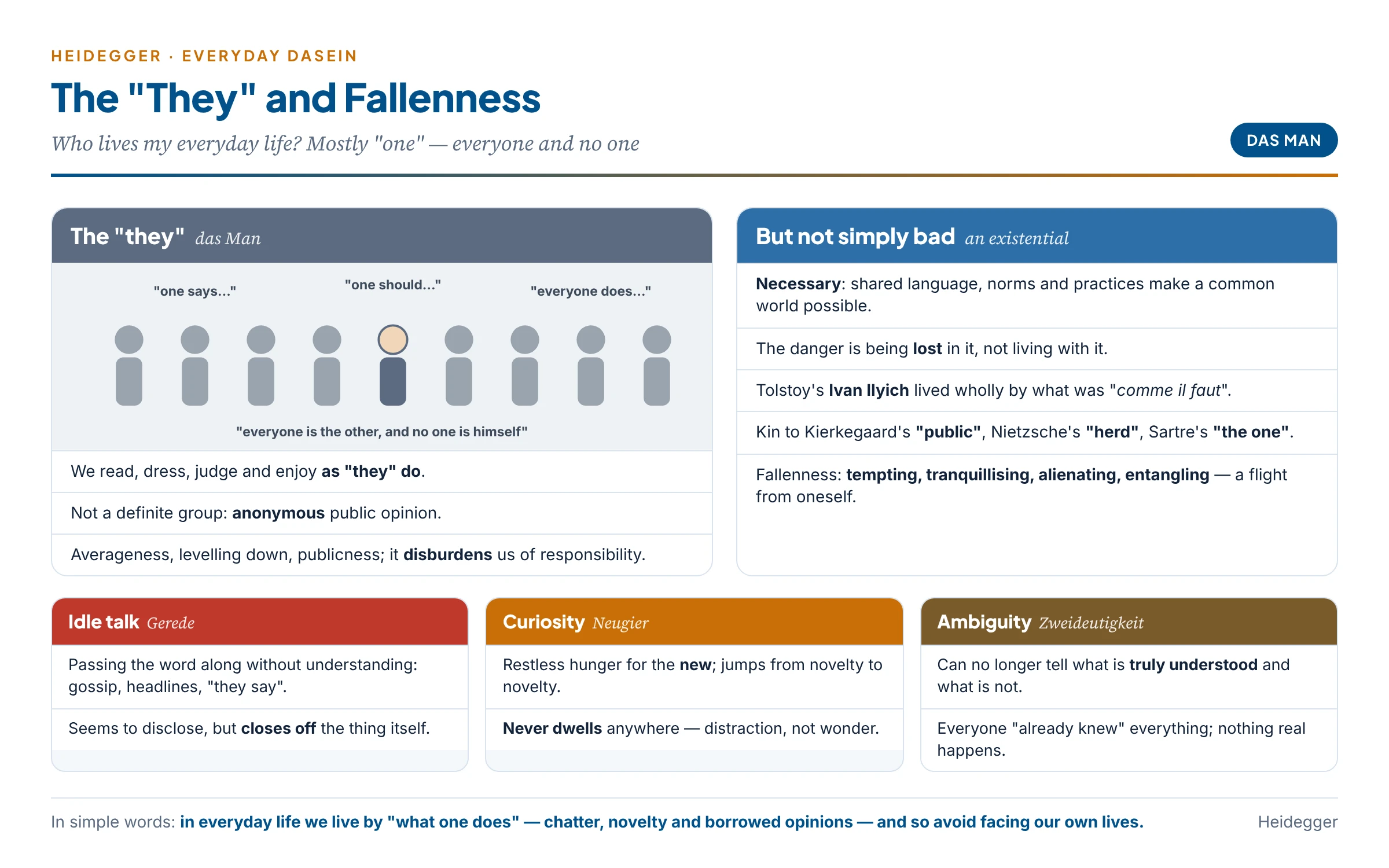
- Who is everyday Dasein? Not “I”, but the anonymous “they” or “one” — das Man, from the German man (“one does”, “one says”).
- Heidegger’s description. We take pleasure as they take pleasure; we read, see and judge literature and art as they see and judge; we dress as people dress; we shrink back from the “great mass” as they shrink back; we find “shocking” what they find shocking.
- Not a specific group. The “they” is not the government, the masses, or any definite set of people. It is everyone and no one: “everyone is the other, and no one is himself“.
- Its features:
- Distantiality — constant concern about how we stand compared with others.
- Averageness — the “they” decides what is normal, what is allowed, what counts as success.
- Levelling down — everything original is flattened; every secret loses its force; every greatness becomes “well-known”.
- Publicness — the “they” controls every way the world and Dasein are interpreted.
- Disburdening — the “they” takes away responsibility: “one” did it, so no one did it.
- Not entirely negative. The “they” is an existential — a basic, necessary structure of Dasein. Without shared norms, a shared language and common practices, there would be no world at all. The danger is not the “they” itself but being lost in it.
- Literary illustration. In Tolstoy’s The Death of Ivan Ilyich, Ivan lives entirely by what is “comme il faut” (proper, as it should be done) — the right career, the right furniture, the right friends. Only when he is dying does he ask whether his life was his own.
- Parallels. Kierkegaard’s “the public” and “the crowd“, Nietzsche’s “herd“, Sartre’s “the one” — all name the same danger of losing oneself in the anonymous many.
4. Fallenness: Idle Talk, Curiosity and Ambiguity
Everyday absorption in the “they” shows itself in three ways:
- Idle talk (Gerede).
- Talk that passes the word along without understanding — gossip, hearsay, the opinions of newspapers, television and the crowds of large cities.
- Things are taken as understood because “they” say so. Idle talk closes off the real thing while seeming to disclose it.
- Curiosity (Neugier).
- Not the philosopher’s wonder, but a restless appetite for the new, seeking novelty only to jump to the next novelty.
- It never dwells; it is distraction, “never-dwelling-anywhere“.
- Ambiguity (Zweideutigkeit).
- It becomes impossible to tell what is genuinely understood and what is not.
- Everyone has “always already” known about everything and talked about it, so nothing real ever happens.
- The movement of falling. Fallenness is tempting (it is easy), tranquillising (everything seems in order), alienating (Dasein is estranged from its own possibilities) and entangling (it gets caught in itself). At bottom it is flight — Dasein fleeing from itself.
In simple words
Think of a day spent scrolling: you read a dozen opinions on a news story you never actually read (idle talk), jump from reel to reel looking for the next new thing (curiosity), and by evening feel you “know all about” a dozen issues you could not explain to anyone (ambiguity). Heidegger wrote in 1927, but he was describing the feed.
5. Moods: Fear and Anxiety
- Fear (Furcht). Fear is always fear of something definite — a dog, an exam result, an illness — something within the world that approaches and threatens.
- Anxiety (Angst). Anxiety has no object. What we are anxious about is “nothing and nowhere” in particular — it is being-in-the-world itself.
- In anxiety the familiar world collapses into insignificance: tools, roles and plans lose their hold. Nothing in the world can help.
- We feel uncanny (unheimlich) — literally “not-at-home“. The comfortable homeliness of everyday life is revealed as a cover.
- Anxiety confronts us with “the nothing” — the groundlessness of our existence.
- What anxiety does.
- It individualises: the “they” can no longer carry me; I am thrown back on myself.
- It reveals my freedom — that I can choose myself, and that my life must justify its own worth.
- It discloses Dasein as being-towards-death: the possibility of not-being belongs to my being.
- Anxiety is not a weakness. For Heidegger it is a “fundamental mood” — painful, yet the door to authenticity. Anxiety is a kind of knowing (it discloses something), while simple fear of death is not.
- Other moods. Heidegger also analyses boredom — in deep boredom, beings as a whole become indifferent, as if nothing has permanent value — and joy. The mood of dread pulls us out of self-forgetfulness.
6. Being-towards-Death (Sein-zum-Tode)
- The problem of wholeness. As long as Dasein exists, something is still outstanding — it is never complete. When it is complete, it no longer exists. How then can Dasein be grasped as a whole? Heidegger’s answer: through its relation to its own end — death.
- Not another’s death. I cannot experience death through the death of others: I can witness it, grieve it, but not live it. Death is not a fact to be observed but a possibility to be existed.
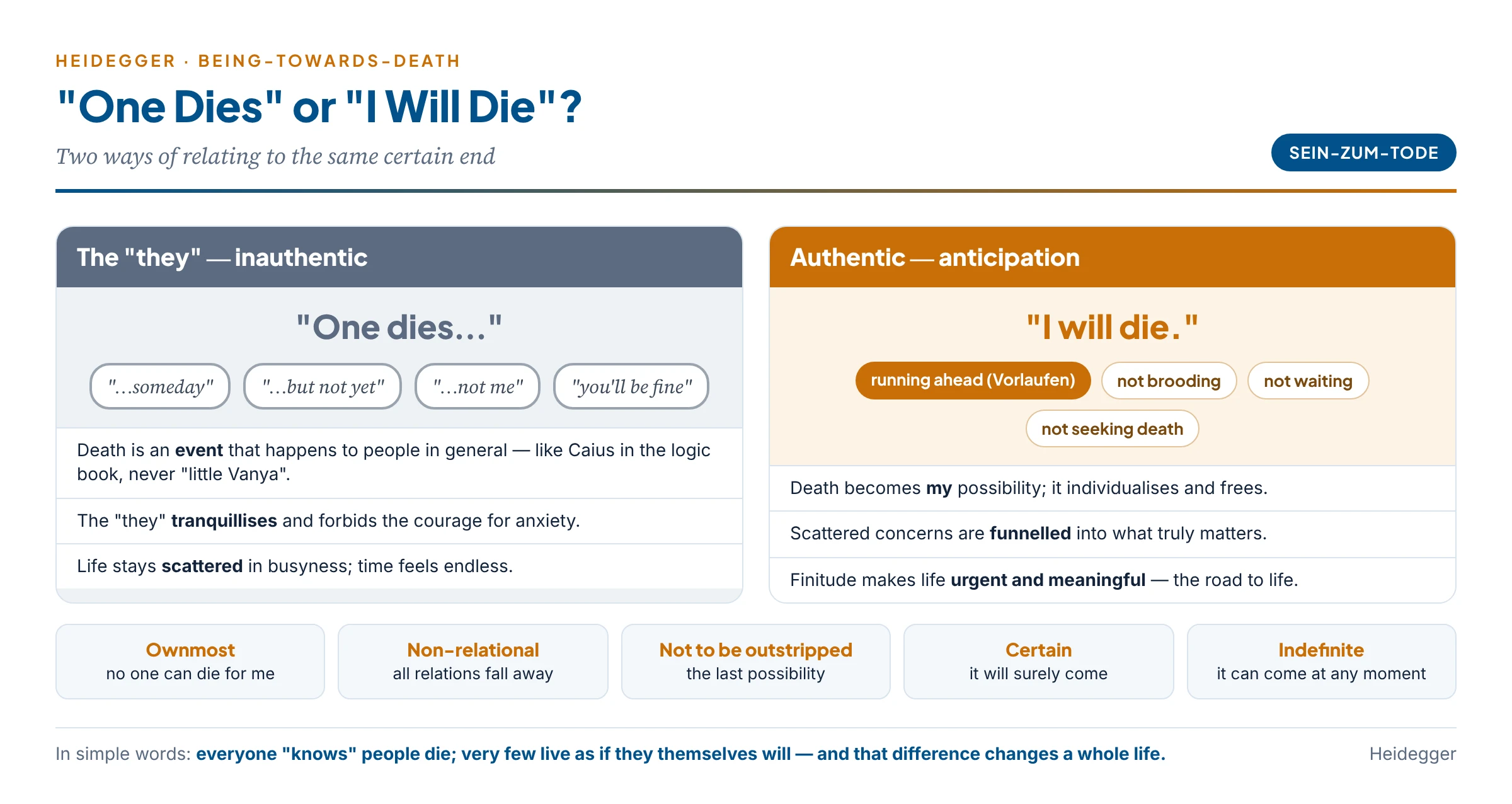
- The marks of death. Death is Dasein’s:
- Ownmost possibility (eigenste) — it concerns my very being; no one can die for me. Someone may sacrifice himself “for” me in a particular situation, but he cannot take my death from me.
- Non-relational (unbezüglich) — in the face of death, all my relations to others and to things fall away; I stand alone.
- Not to be outstripped (unüberholbar) — it is the last possibility, which cannot be surpassed; it is “the possibility of the impossibility of any existence at all”.
- Certain — it will surely come.
- Indefinite — it can come at any moment.
- How the “they” handles death. Everyday talk says “one dies” — as an event that happens to people in general. Death becomes something that “sooner or later” comes, “but not yet“, and “not to me“. The “they” even tranquillises the dying, assuring them they will soon be well. It forbids the “courage for anxiety in the face of death”.
- Ivan Ilyich and Caius. Tolstoy’s Ivan had learnt the syllogism from his logic textbook: “Caius is a man, men are mortal, therefore Caius is mortal.” It had always seemed right — for Caius. But Ivan was not Caius; he was little Vanya, with a mother and father, toys and joys. It could not be that he must die. This is the “they” speaking. Ivan becomes authentic only at the end, when he embraces his own death.
- Being-towards-death as authentic. To exist authentically towards death is not to wait for it or to brood on it, still less to seek it. It is anticipation (Vorlaufen, “running ahead”) — keeping my death present as my possibility, so that it lights up my whole life.
- Death is the key to life. Because I am finite, my choices matter; time is not endless; this day is not to be wasted. Being-towards-death funnels our scattered concerns into what really matters. In Heidegger’s spirit: being-towards-death is the road to life.
- “Spend more time in graveyards.” In a lecture of 1961 Heidegger advised his listeners to spend more time in graveyards — not to be gloomy, but to be woken from the forgetful busyness of everyday life.
- Flight into consolations. Faced with thrownness and death, inauthentic Dasein flees into comforting stories that make death unreal or remove responsibility from itself — for instance, a fatalistic belief that “destiny” decides everything, or a picture of death that makes it someone else’s affair.
Common confusion
Does “being-towards-death” mean a morbid obsession with dying, or a wish to die? No. Being-towards-death is not thinking gloomy thoughts about the event of death, not fear of the deathbed, and certainly not suicide (which would end all possibilities rather than own them). It is a way of living: keeping one’s finitude in view so that life becomes urgent, focused and one’s own. The point is not death but life lived in the light of death.
7. Conscience and Guilt
- The call of conscience. How does Dasein, lost in the “they”, hear that it can be otherwise? Through the call of conscience (Ruf des Gewissens).
- Who calls? Not God, not society, not a moral code, but Dasein itself — in its uncanniness, its not-at-home-ness. The call comes “from me and yet from beyond me“. It is a call by you to you.
- What does it say? Strictly nothing. It gives no information and no rules; it speaks in the mode of silence. It simply summons Dasein out of the “they” to its ownmost potentiality-for-being.
- Where is it heard? In moments that break the routine — visiting a graveyard, reading great literature, a death in one’s near circle.
- Guilt (Schuld). The call reveals Dasein as “guilty” — but in an ontological, not a moral or legal sense.
- Dasein is the basis of a nullity: it did not lay its own foundation (it is thrown), and every choice means not choosing other possibilities.
- We feel this as guilt at lost opportunities, at what we have left undone.
- Moral guilt (for wrongs done to others) is only possible because Dasein is already “guilty” in this deeper sense.
- Responding to the call. To understand the call is “wanting to have a conscience” — being ready to be summoned.
- Ignoring it keeps Dasein inauthentic.
- Listening to it frees us from living to impress others — “people who never really liked us” — and from the attraction of money, power, name and fame.
- Other people cannot save us from the Nothing; only we can take up our own existence.
Common confusion
Is Heidegger’s “guilt” the same as feeling guilty for a wrong action? No. Ordinary guilt is moral — owing something to someone, having broken a rule. Heidegger’s existential guilt is prior to all morality: it means that Dasein is thrown (not its own ground) and finite (it must leave countless possibilities unchosen). We are “guilty” simply by existing as finite choosers. Only because of this structure can there be moral guilt at all.
8. Anticipatory Resoluteness: How Inauthentic Dasein Regains Its Lost Self
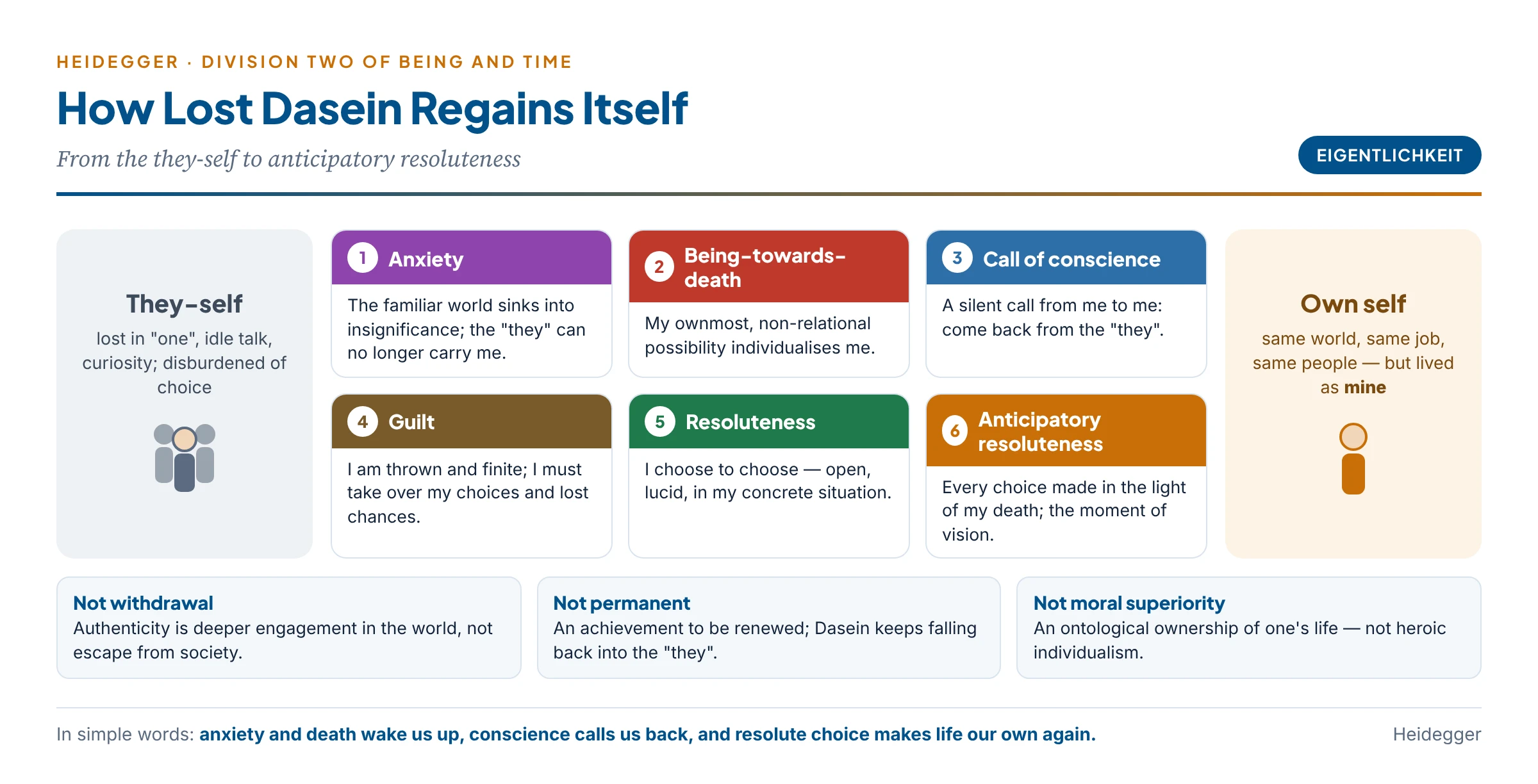
- The path back. Dasein lost in the “they” can regain itself through a sequence of disclosures:
- Anxiety breaks the grip of the “they”; the world loses its familiar meaning.
- Being-towards-death reveals Dasein’s ownmost, non-relational possibility; it individualises.
- The call of conscience summons Dasein from the they-self to its own self.
- Guilt shows that Dasein must take over its thrownness and its choices.
- Resoluteness (Entschlossenheit) — Dasein chooses to choose, decides for its own possibilities in its concrete situation.
- Anticipatory resoluteness (vorlaufende Entschlossenheit) — resoluteness that runs ahead towards death, so that every decision is made in the light of finitude. This is authentic existence.
- Resoluteness is not stubbornness. The German Entschlossenheit also suggests “un-closedness“, openness. Resolute Dasein is open to its situation; it can change course. It is lucid, not rigid.
- The moment of vision (Augenblick). Authentic Dasein grasps the situation in a “glance of the eye” — seeing what is to be done here and now, in the light of its past and its finite future.
- Not withdrawal but deeper engagement. Authenticity does not mean leaving society for a mountain cave. The authentic person is still socially embedded — with a job, family and community — but is individually responsible. He lives the same world, but as his own.
- Never permanent. Authenticity is not a possession; it is an achievement that must be renewed. Dasein constantly falls back into the “they”.
- Echoes in others. Kierkegaard’s knight of faith looks like a tax collector; Sartre’s authentic person accepts the anguish of freedom; Marcel adds that even the believer’s entry into “that good night” is not without risk.
9. Temporality: The Meaning of Care
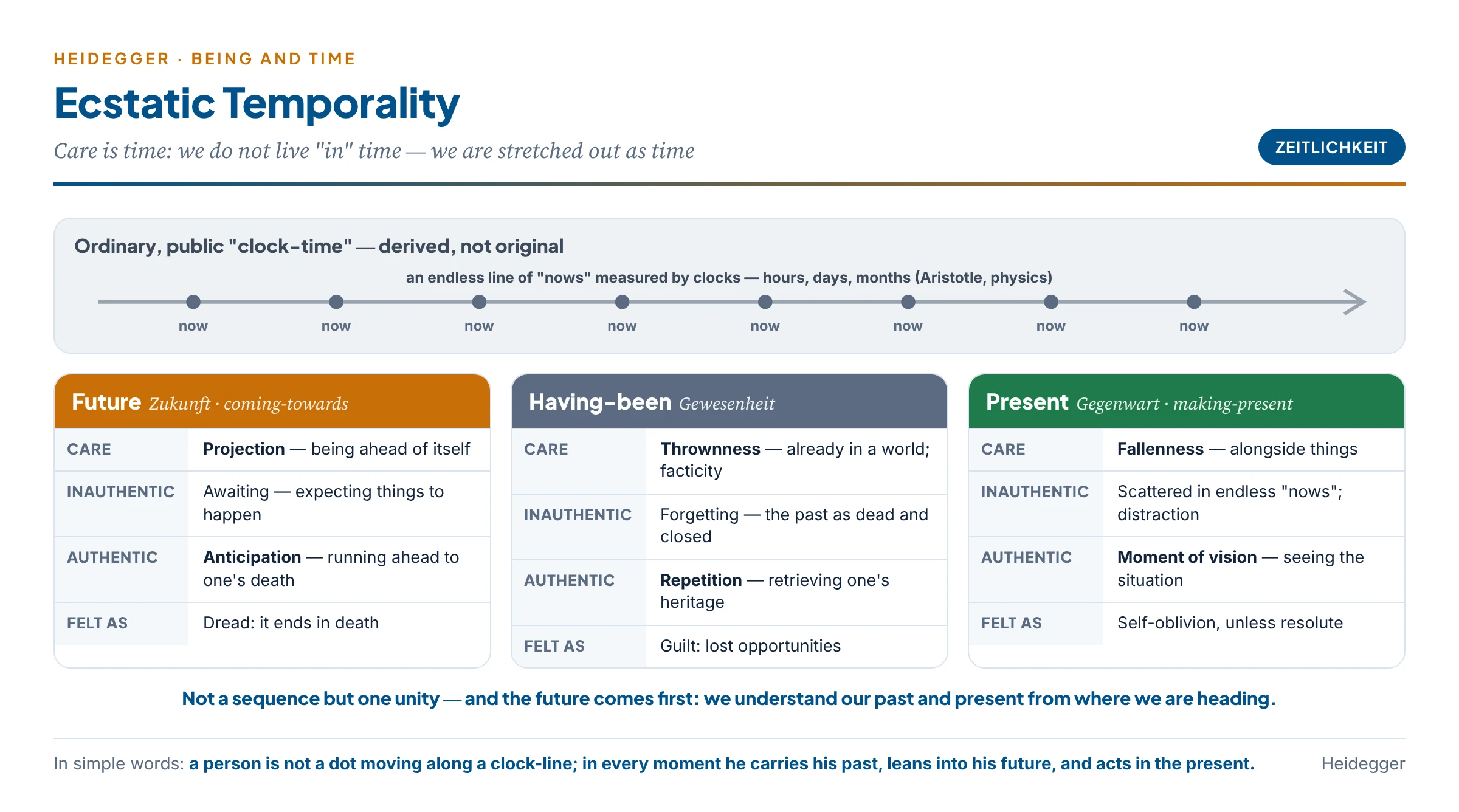
- Dasein is not “in” time like a thing in a container. Ordinary thinking pictures time as an endless line of “nows“, one after another, in which things are placed — the view of Aristotle and of physics. Clocks, hours, days and months measure this public time, which seems infinite.
- Primordial time. Heidegger argues that this “now-time” is derivative. It comes from a more original temporality (Zeitlichkeit) — the way Dasein lives time, in which past, present and future are united in every moment. Public time is derived from private, lived time, not the reverse. Felt time ends; public time does not.
- The three ecstases. Heidegger calls past, present and future the three “ecstases” (from the Greek ekstasis, “standing outside“), because in each Dasein stands out beyond the bare now:
- Future (Zukunft, literally “coming-towards“) — Dasein comes towards itself from its possibilities. This matches projection (being ahead of itself).
- Having-been (Gewesenheit) — Dasein is its past; it carries its thrownness with it. This matches thrownness (already in the world). The past is our facticity.
- Present (Gegenwart, “making present“) — Dasein deals with things at hand. This matches fallenness (alongside entities).
- Not a sequence. The ecstases are not sequential: the past is not “gone”, the future is not “not yet there”. They form a unity — temporality “temporalises” itself as a future that makes present in the process of having-been. Our intentions unite past and future in the “now”.
- The primacy of the future. For Heidegger the future comes first. We understand our past and present in the light of what we are heading towards — and ultimately in the light of our death. The present choice makes the future, and the future gives meaning to the past.
- Temporality is not a property. It is not something Dasein has but the constitutive structure of what Dasein is: “temporality reveals itself as the meaning of authentic care“.
- Authentic and inauthentic time.
| Ecstasis | Inauthentic | Authentic |
|---|---|---|
| Future | Awaiting — expecting things to happen, waiting for the next event | Anticipation — running ahead towards one’s own death and possibilities |
| Past | Forgetting — losing oneself; the past as dead, closed, “over” | Repetition / retrieval — taking up one’s heritage and possibilities again |
| Present | Making-present — scattered in the endless “now”, distraction | Moment of vision (Augenblick) — grasping the situation decisively |
- How a mortal feels time. For a being aware of its mortality, the past is experienced in guilt (lost opportunities), the future is anticipated in dread (it ends in death), and the present is mostly a fallen state of self-oblivion. Some notes call this the “tripartite ontological structure” of Dasein. The authentic self is therefore not a substance but a process born of care, unfolding in time.
- Existence is practical, not first cognitive. Temporality shows that our existence is primarily moral and practical — a matter of what we do with our finite time — not primarily a matter of knowing.
10. Temporality as the Horizon for Understanding Being
- The book’s goal. Being and Time aimed to show that time is the horizon within which Being is understood at all — the “transcendental horizon for the question of Being“.
- What this means. Whenever we understand what it is for something to be, we understand it in terms of time:
- A stone is as something constantly present; a tool is as something available for future use; a person is as someone with a past and a future; a historical event was; a number is “timeless” — but even “timeless” is a time-word.
- The ancient Greeks understood Being as ousia — which also meant “presence” (parousia). Without noticing it, they understood Being in terms of one mode of time: the present.
- “Being is time.” Heidegger’s guiding thesis was that the meaning of Being is to be found in time; Being is not a static presence but an unfolding in time.
- An unfinished project. The planned division “Time and Being“, which was to show this in full, was never published. Heidegger later took up the theme differently in his lecture “Time and Being” (1962).
- Evaluation. The claim is bold and, many think, unproved: it rests on the analysis of Dasein’s time, and it is not clear how the time of human existence can be the horizon for the Being of everything. Yet it changed philosophy’s sense that Being is timeless presence.
11. Historicity (Geschichtlichkeit)
- Dasein is historical because it is temporal. Dasein is not historical because it happens to live “in history”; rather, there is history at all only because Dasein is temporal — stretched between birth and death. In this sense, only the existing human being is historical; nature as such has no history of its own.
- Heritage. Dasein is thrown into a tradition that is handed down to it — values, practices, possibilities.
- Repetition (Wiederholung). Authentic historicity means retrieving possibilities from the past — taking up, for example, a forgotten ideal of one’s tradition and making it one’s own choice. It is not copying the past but answering it.
- Fate and destiny. Individual Dasein’s resolute taking-over of its heritage is its fate (Schicksal); the shared historicity of a community is its destiny (Geschick). Destiny is not blind fate but the collective possibilities of a people.
- Inauthentic historicity. The inauthentic person lives in the present and its fashions, treats the past as a museum of facts, and loses the continuity of his existence.
- Not determinism. History conditions but does not determine; inherited traditions are possibilities to be retrieved or rejected.
12. Is Authenticity an Ethical Ideal?
- Heidegger’s claim. Authenticity is a formal structure, not a moral rule. It says how to choose (lucidly, in the light of death, owning one’s choice), not what to choose.
- Consequence. Authenticity gives no criterion of right and wrong. A resolute person could choose cruelty “authentically”.
- The historical warning. Heidegger’s own political choice in 1933 — when he misread the Nazi movement as an authentic collective “destiny” — is often cited to show the danger of a resoluteness with no ethical content.
- The positive side. Many find in authenticity an ethic of self-ownership, honesty and courage: refusing to hide behind “everyone does it”, taking responsibility, and living with a sense of finitude that makes compassion and seriousness possible.
Critical Evaluation
Objections
- Obscurity. Heidegger’s language — new words, hyphenated compounds, German wordplay — makes his ideas hard to check and easy to mystify. The logical positivists (Carnap) found his talk meaningless.
- No ethics, no criteria. Authenticity tells us to choose resolutely but not what is worth choosing. It can sanctify any decision made with enough intensity — a charge made sharper by Heidegger’s Nazi episode.
- Excessive finitude and pessimism. By building life around death, anxiety and guilt, Heidegger seems to give too dark a picture. Joy, love, play and hope get little room.
- Individualism. Although being-with is basic, the path to authenticity runs through lonely experiences — anxiety, my own death, a silent call. Others appear mostly as “they“, a threat to selfhood. Critics (Buber, Levinas, Habermas) argue that we become ourselves through genuine relations with others.
- Sartre’s objection on death. Sartre argued that my death can never be my possibility: it is “unrealizable“, an absurd fact that comes from outside and robs life of meaning rather than giving it unity. (Epicurus had said: where death is, I am not.)
- Insufficient engagement with science. Heidegger treats the clock-time of physics as merely derivative, without engaging with how science actually understands time.
- Gender blindness. Feminist critics note that Dasein is presented as neutral, ignoring the embodied and gendered character of thrownness and the ethics of care in its ordinary sense.
- Determinism in the later work. The later Heidegger’s picture of history as a destiny of Being (for instance, the age of technology as something “sent”) seems to leave little room for the human freedom that Being and Time stressed.
Replies and Strengths
- The phenomena are real. Whatever one thinks of the vocabulary, the descriptions of idle talk, curiosity, conformity, the flight from death and the call of conscience fit lived experience strikingly well.
- Formal but not empty. Authenticity is formal by design: Heidegger refuses to tell people what to value, because that would be another “they”. It describes the conditions of any responsible choice.
- Not pessimism but sobriety. Facing death is meant to free life from triviality and give it urgency and meaning — a sober joy, not despair.
- Being-with remains basic. The “they” is not entirely negative; authentic Dasein can “leap ahead” for others — freeing them for their own possibilities rather than taking their cares away. Authentic solicitude makes genuine community possible.
- Temporality transformed philosophy. The idea that we are our time — that past, present and future are united in every act — influenced Sartre, Merleau-Ponty, Gadamer, psychology (Binswanger, Medard Boss) and existential therapy.
Critics and Defenders
Criticism — Critics
- No moral content: authenticity gives no criterion; a resolute choice can be evil.
- Too dark: life centred on death, anxiety and guilt; little room for joy and love.
- Too individualistic: others appear mainly as the threatening “they”.
- Sartre: death is “unrealizable”; it cannot give life unity.
- Obscure language; neglect of scientific time; gender-blind.
Defence — Defenders and strengths
- A powerful description of conformity and the flight from death.
- Formal by design: it refuses to impose any “they”-morality.
- Facing finitude gives life urgency, focus and seriousness.
- Authentic solicitude frees others; being-with remains basic.
- Ecstatic temporality reshaped philosophy, psychology and therapy.
Cross-Tradition Comparison
Death, Authenticity and Time in Indian Thought
| Heidegger | Indian parallel | Similarity | Difference |
|---|---|---|---|
| Being-towards-death as the door to authentic life | Naciketā in the Kaṭha Upaniṣad, who faces Yama (Death) and refuses all worldly gifts to learn the secret of death | Facing death awakens the search for what is real | The Upaniṣad seeks the deathless Ātman; Heidegger accepts finitude as final |
| The “they” says “one dies, but not me“ | Yakṣa-praśna (Mahābhārata): asked “what is most wonderful?”, Yudhiṣṭhira answers that every day creatures go to the abode of Death, yet those who remain wish to live forever | Both expose the everyday denial of death | Yudhiṣṭhira’s answer leads to dharma and detachment; Heidegger’s to resolute self-ownership |
| Anxiety breaks the familiar world | The Buddha’s four sights — an old man, a sick man, a corpse, an ascetic — shatter Prince Siddhārtha’s sheltered life | A shock of finitude awakens the search for authentic life | The Buddha seeks liberation from suffering (nirvāṇa); Heidegger seeks ownership of finite existence |
| Authenticity — one’s own possibility vs the “they” | Svadharma: the Gītā says it is better to follow one’s own dharma, even imperfectly, than another’s dharma well done | Live your own path, not a borrowed one | Svadharma is rooted in a cosmic and social order; Heidegger’s authenticity has no given content |
| The call of conscience frees from fame, money, power | Sthitaprajña of the Gītā — the person of steady wisdom, unmoved by praise and blame, gain and loss | Inner independence from the “they” | The sthitaprajña’s calm rests on knowledge of the eternal Self; Heidegger’s resoluteness rests on facing the Nothing |
| Das Man, idle talk, curiosity | Māyā, avidyā; the restless mind (cañcala manas); worldly talk (prapañca) | Everyday life as distraction and forgetting | Indian thought locates the escape in knowledge and yoga; Heidegger in anxiety and resoluteness |
| Temporality: time is lived, finite, ecstatic | Kāla in the Gītā: Kṛṣṇa declares “I am Time, the destroyer of worlds”; Buddhist momentariness (kṣaṇikavāda) | Time as the power that shapes and ends all things | Indian thought often seeks the timeless beyond time; Heidegger finds Being in time |
| Mindfulness of death | Buddhist maraṇasati (recollection of death) as a meditation practice | Remembering death to live wisely now | Maraṇasati aims at non-attachment; Heidegger at resolute engagement |
Indian Connect — Key takeaways
- Naciketā before Yama is the classic Indian image of being-towards-death: facing death is the beginning of true knowledge.
- Yudhiṣṭhira’s answer to the Yakṣa — that humans see others die every day and yet think they will live forever — is a perfect description of Heidegger’s “one dies, but not yet“.
- Heidegger’s authenticity echoes the Gītā’s svadharma (one’s own path) and the sthitaprajña (inner freedom from praise, blame, money and fame).
- The Buddha’s four sights show how a shock of finitude — like Heidegger’s anxiety — can break the hold of a comfortable, borrowed life.
- But where Indian thought seeks the deathless (Ātman, nirvāṇa), Heidegger asks us to accept finitude as the very ground of meaning.
Synthesis (Siddhānta)
- The core insight. Human beings mostly live as “one” — absorbed in the crowd, its chatter and its timetables. This is not a moral fault but the ordinary condition. Yet each of us can own our existence: anxiety, the honest facing of death, and the silent call of conscience can bring us back to ourselves, and resoluteness lets us choose our life in its concrete situation.
- Time as the key. All this rests on temporality. We are not things placed in time; we are time — coming towards ourselves from the future, carrying our past, acting in the present. Authenticity is a way of living time: anticipating, retrieving, seeing the moment.
- Balanced verdict. Heidegger gives an unforgettable diagnosis of conformity and the denial of death, but his remedy remains formal: it tells us how to choose, not what is worth choosing. It needs to be supplemented by an ethics of the other (as Levinas, Buber and Marcel argued) and by a richer place for joy and love.
- Contemporary relevance.
- Digital distraction: idle talk, curiosity and ambiguity describe social media with uncanny accuracy.
- Career conformity: the pressure to follow “what one does” in education and jobs is the “they” at work; Heidegger’s question is “is this my choice?“
- Medicine and dying: palliative care, end-of-life conversations and “death awareness” movements reflect the insight that facing death can make life more meaningful.
- Mental health: existential therapy (Binswanger, Boss, Yalom) draws on Heidegger’s analysis of anxiety and finitude.
- Indian synthesis. From Naciketā to the Buddha, Indian thought too holds that remembering death awakens the search for what is real and one’s own. Heidegger brings this ancient wisdom into a modern, secular idiom: to live authentically is to live as a finite being who has taken its life into its own hands.
“Death is Dasein’s ownmost possibility.” — Heidegger
Previous Year Questions
- 2026Explain Heidegger’s conception of authenticity and inauthenticity as modes of Dasein’s being.
- 2022Provide a critical account of Heidegger’s Being-in-the-world and discuss the problem of ‘authenticity’ in the context of Dasein.
- 2019Is Dasein authentic existence for Heidegger? How does he relate temporality with Dasein? Discuss.
- 2017Discuss Heidegger’s concept of authenticity and explain how an inauthentic Dasein regains the lost self?
- 2014State and evaluate Heidegger’s claim that temporality is the horizon against which the being of any entity is understood.