

Existentialism (Kierkegaard, Sartre, Heidegger): Existence and Essence; Choice, Responsibility and Authentic Existence; Being-in-the-world and Temporality.
Official Syllabus: Paper I, Section A, Unit 10
Existentialism is the philosophy that begins not from the world in general, nor from God, nor from pure reason, but from the concrete human being who must live, choose, suffer and die. Its central claim, made famous by Jean-Paul Sartre, is that for human beings “existence precedes essence”: we are not born with a ready-made nature that fixes what we must be; we first exist, and then make ourselves by our choices. The doctrine answers an old philosophical problem — what is a human being? — by changing the question to how should one live? Its roots lie in Søren Kierkegaard and Friedrich Nietzsche in the nineteenth century; it was given philosophical depth by Martin Heidegger and popular force by Sartre, Simone de Beauvoir and Albert Camus after the Second World War.
In simple words
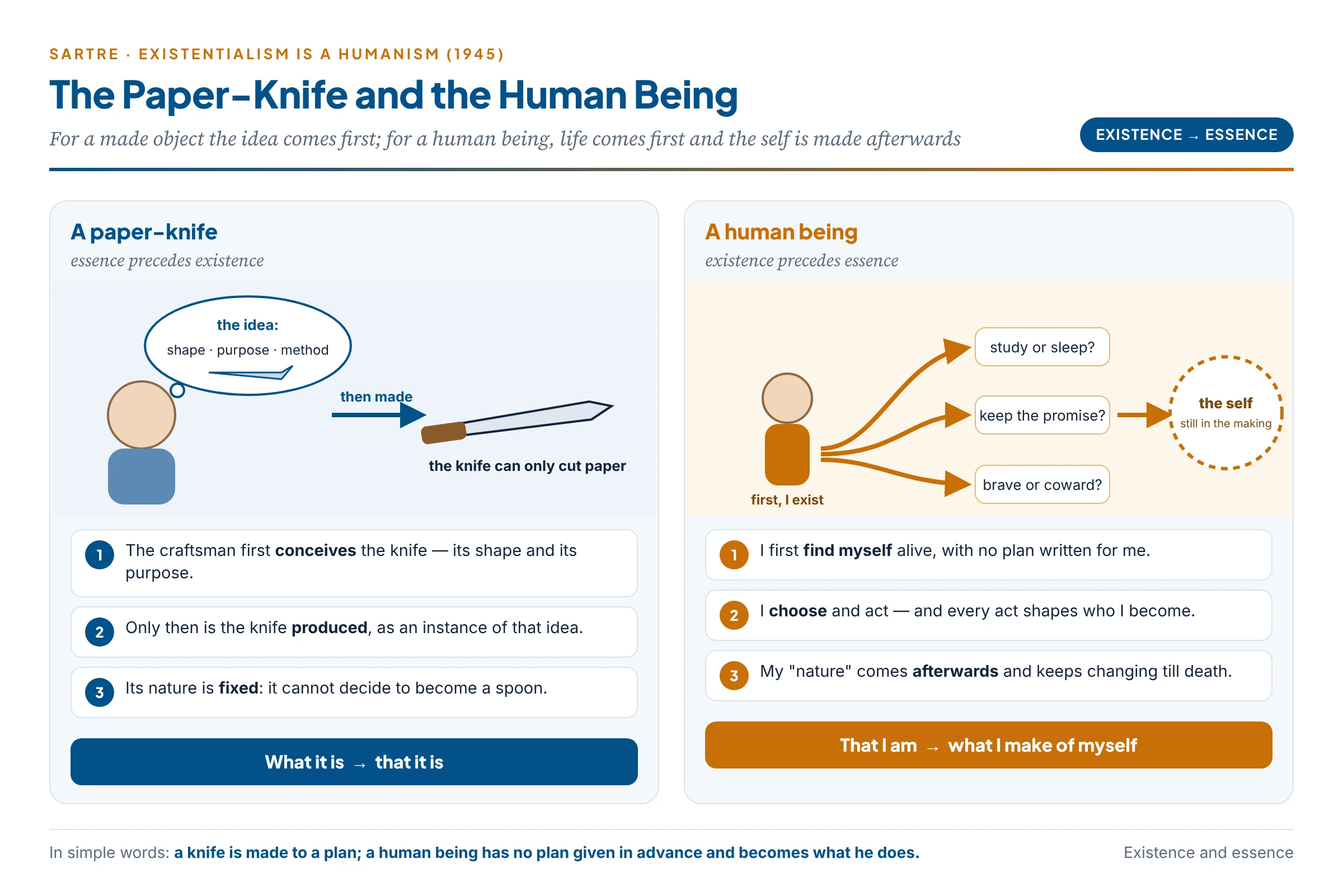
Think of a paper-knife (a letter-opener). Before it was made, its maker already had the idea of it — its shape, its purpose (to cut paper), even the method of making it. For the knife, what it is (its essence) came before the fact that it is (its existence). Now think of yourself. No one wrote out your purpose before you were born. You first find yourself alive, and only then — by studying or not studying, by keeping or breaking promises, by being brave or cowardly — do you become who you are. That is the whole of existentialism in one picture.
Context & Problem
What “Essence” and “Existence” Mean
- Essence (Latin essentia) is what a thing is — the set of features that make it the kind of thing it is. The essence of a triangle is to be a closed figure with three straight sides.
- Existence (Latin existentia) is the fact that a thing is — that it is actually there in the world.
- The two are normally independent. A geometer can describe everything essential about triangles without asking whether any triangle actually exists anywhere. Essence answers “What?“; existence answers “Is it?“
- The traditional order. Western philosophy from Plato onwards held that essence comes first. A thing exists as an instance of an essence that is already defined — in the world of Forms, in the mind of God, or in the order of Nature.
In simple words
A recipe for a cake exists before any cake is baked. Every cake is “an instance of the recipe”. Traditional philosophy pictured human beings like this too — each of us an instance of a recipe called “human nature”. Existentialism says: for human beings, there is no recipe. The cake bakes itself.
The Long Tradition of Essentialism
- Plato. The Form of Man is real and eternal; individual men are passing shadows or copies of it. The universal is real, the individual is less real.
- Aristotle. Every thing has a nature and a purpose (telos): a knife’s essence is to cut; man’s essence is to be a rational animal. Aristotle looked at the world impersonally, as a spectator.
- Christian theology (Augustine, Aquinas). God made man “in His own image”. The idea of man existed in the divine mind before any man existed, just as the idea of a knife exists in the craftsman’s mind. Human purpose and moral law flow from this God-given nature.
- The rationalists. Spinoza‘s single substance and Leibniz‘s pre-established harmony fixed everything in advance; the individual’s path was already written in the nature of things.
- Hegel. The individual is only a moment in the self-unfolding of the Absolute Spirit; “the rational is the real”, and true freedom is the acceptance of necessity.
- Even the atheists kept “human nature”. Sartre pointed out that eighteenth-century free-thinkers such as Diderot, Voltaire and even Kant abolished God but kept the idea of a universal human nature of which each person is an example. In this sense they were still essentialists.
- The consequence. If my essence is fixed before I exist, then my life is pre-determined and my freedom is an illusion. This is what existentialism refuses.
The Crisis that Gave Birth to Existentialism
Existentialism was a protest — against everything that reduces the living individual to something smaller than himself:
- Against Hegel and idealism. If the Absolute swallows the individual, then human freedom is illusory and the individual has no value of his own. Existentialists are consistently anti-Hegelian.
- Against naturalism. If all life, mind and action obey physico-chemical laws and universal causation, there is no room for free action. Sartre answers: man is so free that he is even afraid of his freedom.
- Against scientism and positivism. Positivism said that only what can be measured is real knowledge. But this very rule is not measurable — choosing it is itself a “leap” of value. And it leaves the most important questions (Is cruelty really wrong? How should I live?) not just unanswered but unanswerable.
- Against industrial and technological society. Crowded cities, mass production, mass media and “decisions made by statistics” turn the person into a cog, a tool or a commodity.
- Against mass movements. Nazism, fascism and communism dissolved the individual into the collective. The two world wars shook faith in religion, in science and in the future; life felt like a raft on the open sea, drifting without direction.
- Against “Christendom”. Kierkegaard attacked comfortable, nominal, state-run Christianity in which no one has to become a Christian.
In simple words
Imagine an exam result sheet with lakhs of roll numbers. The system knows your marks, rank and category — but not you: your fears, your hopes, the choice you made last night to study rather than sleep. Existentialism is the philosophy written from behind the roll number.
An Old Question in a New Form
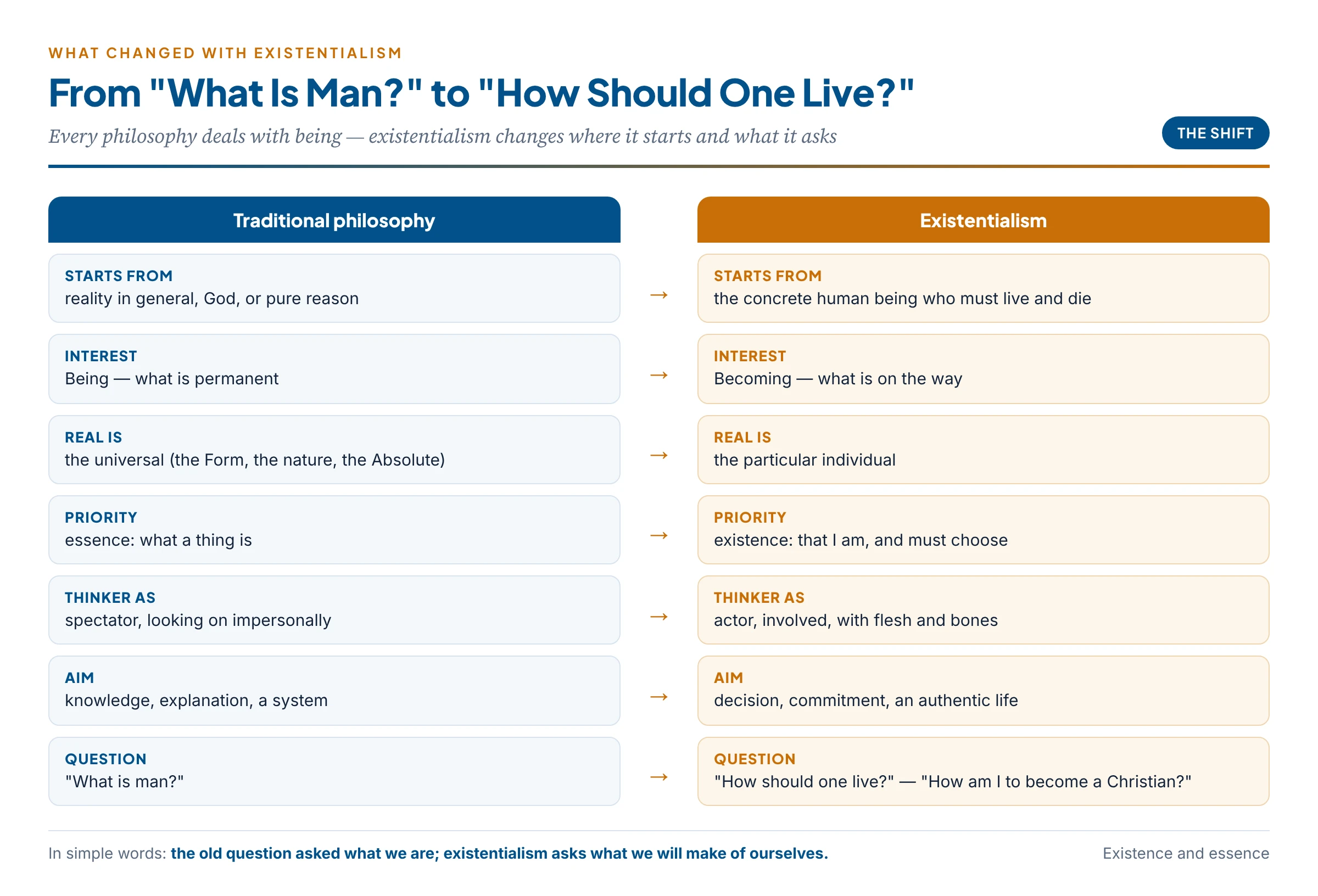
- Every philosophy deals with being. The question “What is it to exist?” is as old as thought. The Upaniṣads asked what in a human being survives death and remains unchanged amid change; the Greeks asked what truly is. In this broad sense every philosophy is “existential”.
- What is new? Modern existentialism shifts attention:
- from Being to Becoming;
- from universals to particulars;
- from essence to existence;
- from knowledge and explanation to action and choice;
- from “What is man?” to “How should one live?”
- Kierkegaard’s formula. The real question for a Christian, he said, is not “what is Christianity?” (a matter of doctrine) but “How am I to become a Christian?” (a matter of life). Atheistic existentialists replace the word “Christian” with “authentic being“.
Core Doctrine
1. What Existentialists Mean by “Existence”
- To “exist” is to “stand out”. The word comes from Latin ex-sistere — “to stand out”. Heidegger and Sartre use it in this root sense: a human being stands out from the crowd, from routine, even from what he already is, towards what he can be.
- Humans exist; things simply are. A stone, a table or a tree merely is. Only the human being exists in the full sense, because only he relates to his own being and must decide what to make of it.
- The act of being, not the fact of being. “Existence” here does not mean the bare fact of being present in space and time. It means the dynamic act of living a life — feeling, choosing, acting, hoping — as an embodied being-in-the-world.
- Existence in Sartre’s special sense. A body that merely breathes does not yet “exist” in this sense. Existence begins when a person realises that he is free to choose and must bear responsibility for it.
- Kierkegaard’s pictures of existing. “To exist is to stand in a very long queue and then not buy a ticket when you reach the window. No — to exist is to be desperately grasping the mane of a horse racing across the plain. No — to exist is like being in the greatest possible hurry while riding a slow old pony.” Existence is urgent, risky and never finished.
- Existence is felt, not merely thought. Existentialism does not take “existence” as a concept but as something each person experiences. The whole person philosophises — “with feeling and emotion, with will and intellect, with flesh and bones“.
- Each thinker’s root experience. Different existentialists start from different experiences of existence: Jaspers from the brittleness of being; Heidegger from being-towards-death; Sartre from existence as nauseating and superfluous; Marcel and Buber from the “I” that is always related to a “Thou“; Levinas from the face of the other person that calls me to responsibility.
2. Actor, not Spectator
- The spectator. Aristotle looked at the world impersonally, like a scientist watching from outside. The traditional epistemological subject stands apart from what it knows.
- The actor. The existentialist thinks as one who is involved — the problems of life are not matters of intellectual curiosity but of vital concern. Kierkegaard philosophised from his own life; with him biography and philosophy are closely joined.
- Problem and mystery (Marcel). A problem lies “in front of me”: I can study it as an impersonal “I” that anyone — even a machine — could replace, and it can be solved. A mystery is a question in which I myself am involved — love, death, faith, evil. It cannot be “solved”, only lived and reflected upon.
In simple words
Fixing a leaking tap is a problem: any plumber can do it and the result is the same. Deciding whether to forgive a friend who betrayed you is a mystery: no one else can decide it for you, and the answer changes who you are. Existentialism is a philosophy of mysteries.
3. “Existence Precedes Essence”: Sartre’s Argument
Sartre stated the principle in his lecture Existentialism Is a Humanism, delivered in Paris on 29 October 1945 (published 1946).
- Step 1 — the manufactured object. A paper-knife is made by a craftsman who already has its concept and purpose in mind. Its essence precedes its existence. Its purpose is fixed; it cannot become anything else.
- Step 2 — the old picture of man. Theism pictured God as a supernatural craftsman: man was made according to an idea in the divine mind, as the knife according to an idea in the craftsman’s mind. Each man realises a concept.
- Step 3 — no God, no blueprint. “Atheistic existentialism, of which I am a representative,” says Sartre, “declares that if God does not exist, there is at least one being whose existence comes before its essence, a being which exists before it can be defined by any conception of it. That being is man, or, as Heidegger has it, the human reality.”
- Step 4 — man defines himself afterwards. “Man first of all exists, encounters himself, surges up in the world — and defines himself afterwards. If man as the existentialist sees him is not definable, it is because to begin with he is nothing. He will not be anything until later, and then he will be what he makes of himself.”
- The first principle. “Man is nothing else but what he makes of himself. That is the first principle of existentialism.”
What follows:
- No pre-written script. Human beings are not born cowardly or brave, selfish or noble. As Sartre puts it, the coward makes himself cowardly, the hero makes himself heroic — and there is always a possibility for the coward to stop being a coward.
- A person is the sum of his acts. “He is what he does.” Identity is not discovered like a buried treasure but created like a story still being written.
- All that is given is that we are, not what we are. A table’s essence is fixed; a human being’s is open.
- Dynamic essence. Human “essence” is not abolished; it comes later and keeps changing — a teacher may become a good teacher or a bad one; a person may become a saint or a sinner.
| Point | Objects (a table, a paper-knife) | Human beings |
|---|---|---|
| Order | Essence precedes existence | Existence precedes essence |
| Essence | Pre-decided, certain, unchangeable | Dynamic, uncertain, made by choices |
| Origin | Begins to exist when the carpenter makes it | “Exists” in the full sense when he realises he is free |
| Choice | Cannot choose | Always choosing |
| Responsibility | None | Total |
Common confusion
Does “existence precedes essence” mean that human beings have no limits and can become anything at all, just by wishing? No. Sartre denies a fixed human nature, but he accepts a universal human condition — the limits every human being faces: to be in the world, to have to work, to live among others, and to die. He also accepts facticity: I cannot choose my parents, my birth, my body or my past. What I can always choose is what I make of these givens. Freedom is never freedom from my situation; it is freedom within it.
4. Three Versions of One Insight
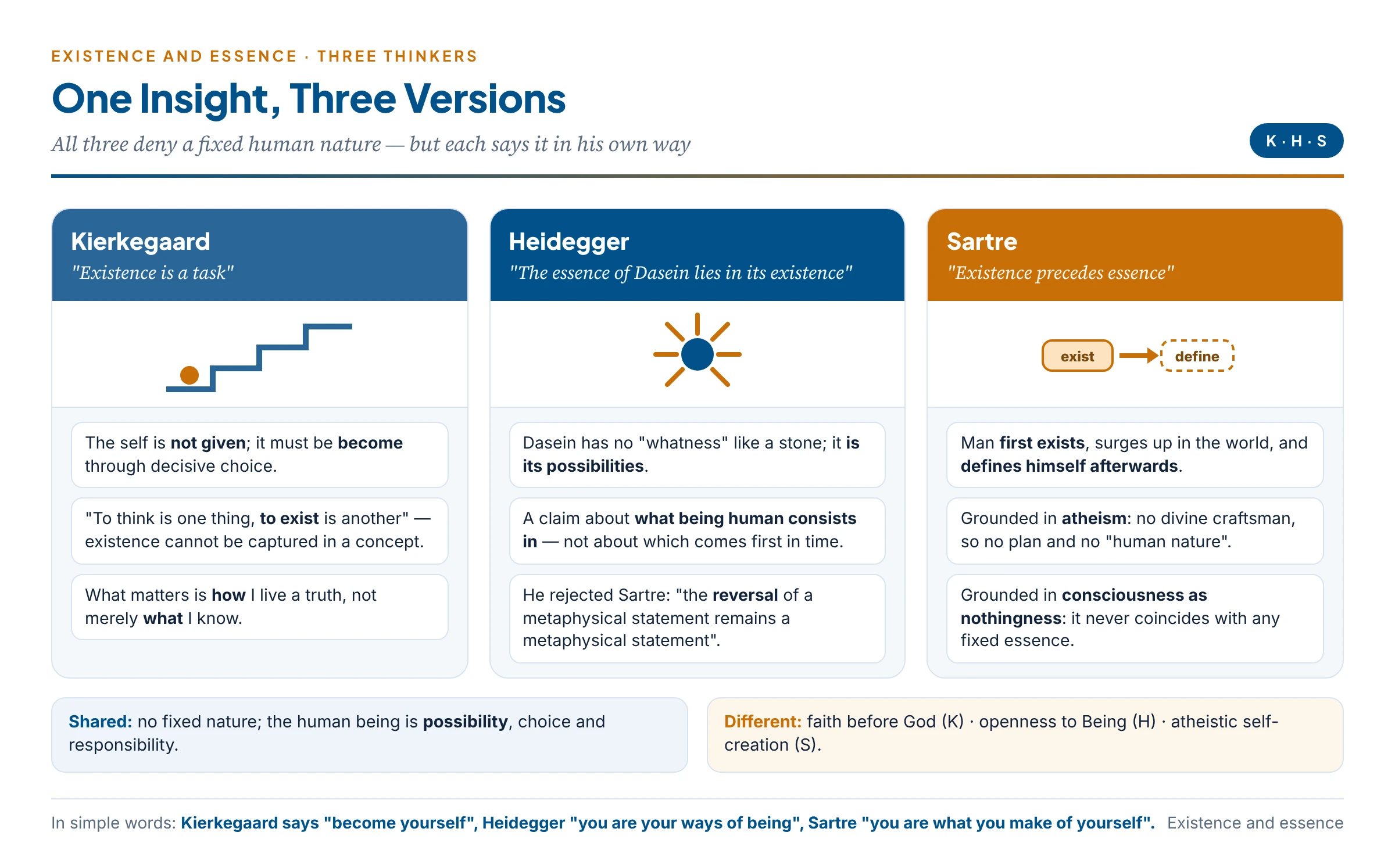
Although the slogan is Sartre’s, the insight is shared, in different forms, by all three thinkers of the syllabus.
Kierkegaard — existence as a task:
- The self must be achieved. The self is not a fixed substance but a task: one must become oneself through decisive choice.
- Existence cannot be captured in thought. Hegel identified thought and reality (“the rational is the real”). Kierkegaard replied: “To think is one thing, to exist is another.” I can say many things about myself — “I am a teacher, I am in love, I prefer tea to coffee” — yet when all is said, one thing remains that cannot be thought: my existence, which I must live.
- “How”, not “what”. What matters is not what I know but how I exist in relation to it — with passion, inwardness and commitment.
Heidegger — “the essence of Dasein lies in its existence”:
- The statement. In Being and Time (1927) Heidegger wrote: “The ‘essence‘ of Dasein lies in its existence.” (Dasein, “being-there”, is his word for the human being.)
- What it means. Human beings have no “whatness” like a stone’s, fixed by properties. What a person is consists in his ways of being — in the possibilities he takes up or neglects. Dasein is always its own possibility; its being is always mine.
- Not a temporal “before”. Heidegger was not saying that existence comes first in time and essence later. He was saying that, for Dasein, essence lies in existence: the old separation of essence and existence does not fit the human being at all.
- His rejection of Sartre. In the Letter on Humanism (1946–47) Heidegger answered Sartre: by simply turning the old order upside down, Sartre “takes existentia and essentia in their metaphysical meaning”, and “the reversal of a metaphysical statement remains a metaphysical statement“. So Sartre’s existentialism, Heidegger insisted, has “nothing in common” with his own sentence.
Sartre — the order of priority reversed:
- Priority of existence. Man exists first and defines himself afterwards.
- Grounded in atheism. No divine artisan, so no plan; and no “human nature” either.
- Grounded in consciousness. Consciousness is a nothingness — never a fixed thing — so it can never coincide with any essence (see the article on Sartre’s ontology).
Others in the family:
- Nietzsche: “Become what you are” — the self is something to be made, like a work of art.
- Beauvoir: “One is not born, but rather becomes, a woman.” There is no eternal feminine essence; what “woman” means is built by society and can be rebuilt.
- Jaspers: Existenz — the properly human way of existing, which cannot be turned into an object of science.
- Marcel: existence is not a brute fact but a gift, received from a Transcendent source.
Common confusion
Is Heidegger’s “the essence of Dasein lies in its existence” the same as Sartre’s “existence precedes essence”? Many notes treat them as identical, and Sartre himself quoted Heidegger in support. But Heidegger rejected Sartre’s reading. Sartre makes a claim about order (existence first, essence later), which keeps the old metaphysical pair intact. Heidegger makes a claim about constitution: for the human being, “what it is” simply is its way of existing — its possibilities and its openness to Being. Both oppose a fixed human nature; they do it in different ways.
5. Human Existence and Human Freedom
Why does having no fixed essence mean being free?
- No essence, no script. If nothing in me fixes in advance what I must do, then every action is chosen. “To be is identical with to be free.”
- Consciousness as a gap. For Sartre, consciousness is a nothingness — a gap between what I am and what I can be — and that gap is freedom itself.
- Condemned to be free. “Man is condemned to be free: condemned, because he did not create himself, yet is nevertheless at liberty, and from the moment that he is thrown into this world he is responsible for everything he does.”
- Even not choosing is a choice. Refusing to decide, or letting others decide, is itself a decision for which I am responsible.
- Choosing for all. In choosing myself, I create an image of man as I believe he ought to be. So “in choosing for myself, I choose for all men“.
- The feelings of freedom. This freedom is felt as anguish (the weight of responsibility), abandonment (no God to give values) and despair (acting without guarantees). These are taken up in the article on Sartre’s ethics of freedom.
- Kierkegaard. Freedom is experienced as anxiety — “the dizziness of freedom” — before the open abyss of possibilities.
- Heidegger. Dasein’s being is possibility; it is free to own its existence (authenticity) or to lose itself in what “they” do (inauthenticity).
- The theists. For Kierkegaard, Jaspers and Marcel, freedom is real but created — it is fulfilled in a free relation to God or to Transcendence.
6. The Issues it Raises for Human Beings
Sartre’s thesis has heavy consequences for the human being:
- Anguish. If I alone create values, every choice weighs on me like the decision of a military commander sending soldiers to death.
- Abandonment. “If God does not exist, everything is permitted” (Dostoevsky’s line, which Sartre called the starting point of existentialism). No one gives me values; I must invent them.
- Despair. I can count only on what depends on my own will; I must act without certainty of success.
- Bad faith. The temptation to escape freedom — “I couldn’t help it; that’s just how I am” — is constant.
- Absurdity and contingency. If there is no reason for my existence, I am “superfluous” (de trop), as Roquentin feels before the root of a chestnut tree in Sartre’s novel Nausea.
- Conflict with others. Under another person’s look I become an object; “Hell is other people“.
- The impossible desire. Human beings long to be both free and solid — a consciousness that is also a fixed thing. This is the ideal of God, and it is impossible: “Man is a useless passion.“
- Yet dignity and hope. The same thesis gives man dignity: no one can define me against my will, and “you can always make something out of what you have been made into“.
7. The Basic Characteristics of Existentialism
- It begins with the human being. Not with reality in general, but with the human being as a subject who exists — an ontological subject (one who is), not merely an epistemological one (one who knows).
- Existence over essence. For most existentialists, the essence of man consists in his existence.
- Becoming over being; particular over universal. The concrete individual, always on the way, is the only real starting point.
- Subjectivity and inwardness. Truth that matters must be lived and appropriated, not just known (Kierkegaard: “truth is subjectivity“).
- Freedom and choice. Human beings are uncompromising free-willists: no universal, natural, social or political law may simply dictate to the individual.
- Responsibility. Freedom brings total responsibility; there are no excuses.
- Anxiety, dread and despair. These moods are not mere psychology but revelations of the human condition — of freedom, finitude and nothingness.
- Finitude and death. Death is the boundary wall of existence, a limit-situation that we cannot choose; before it we feel dread. The presence of the “not” in our being is our ontological guilt, which makes guilty action possible.
- Authenticity versus inauthenticity. The central ideal: to live as one’s own self rather than as “they” live.
- Absurdity and alienation. Existence may appear purposeless; modern man feels homeless, alienated from the world, from society and from himself.
- Against depersonalisation. Existentialism protests against treating persons as “it” rather than “thou” — whether by packing them into a faceless collectivity, or by using them as mere means.
- Against systems. Existentialists distrust system-building; “the aim of philosophy is action, not theory“. Life is movement and creative advance; it has no fixed aim except to be authentic, and authenticity is a present quality of life, not some future goal.
- Philosophy as a way of life. Philosophy is not a game of concepts but care of the self — a way of living, as it was for Socrates.
- Commitment and inner peace. The problems of the modern world are practical, not ideological. Peace will not come from slogans but from free individuals who respect themselves and others — from peace in each heart. Hence the attention to inner conflict.
- Ethics is paramount. Each existentialist invites us to examine the authenticity of our own life and of our society.
Five themes as a “family resemblance”. The existentialists do not share one definition; they share a family resemblance of five criss-crossing themes:
- Existence precedes essence — essence is not destiny.
- Time is of the essence — we are time-bound; lived time (the “already”, the “now”, the “not yet”) differs from clock time.
- Humanism — a person-centred philosophy, not anti-science, but resisting the pull of mass society towards superficiality and conformism.
- Freedom and responsibility — we can always stand back from our lives and reflect; we are always “more” than what we are.
- Ethical considerations are paramount.
8. Lived Time, Lived Space and the Emotions
- Lived time. Clock time is equal for all; lived time is not. Time rushes when we are happy and drags when we are in pain. Camus describes people in a plague-locked city as “hostile to the past, impatient of the present, and cheated of the future“, like prisoners “doing time“.
- Lived space. Space too is personal: my usual route to work, the seat I always take in class, the arrangement of my desk — my “comfort zone“. Two people at a party, one who likes to stand close and one who keeps a distance, push and pull each other around the room.
- Emotions reveal being. Where many philosophers distrusted feelings, existentialists treat them as windows onto existence: anguish reveals freedom; nausea reveals the contingency of existence; shame reveals other people.
- The limits of clarity. Positivist “clarity” is not enough. Even physics shows the limits of an either/or logic: light behaves both as a wave and as a particle; and in the atom the observer is part of the experiment — Sartre drew the lesson that “there is only committed knowledge“.
9. Theistic and Atheistic Existentialism
| Point | Theistic existentialism | Atheistic existentialism |
|---|---|---|
| Thinkers | Kierkegaard, Karl Jaspers, Gabriel Marcel, Martin Buber | Nietzsche, Sartre, Beauvoir, Camus (Heidegger: God “philosophically irrelevant”) |
| God | Met at the deepest level of existence; the highest subjective truth | Absent — “God is dead”; man is alone |
| Freedom | Genuine but created; fulfilled in relation to God / Transcendence | Absolute; nothing determines it but man himself |
| The world | A gift, inviting creative fidelity and thankfulness | A brute fact, absurd and superfluous |
| Hope | Hope in what does not depend on ourselves | No ultimate hope; only limited, human hopes |
| Values | Received and appropriated | Created by human choice |
- The theists’ charge. Atheism degrades man, reducing him to a product of nature without intrinsic worth or ultimate hope.
- The atheists’ charge. Every perfection given to God is taken from man; theology is “anthropology upside down“. With the death of God, Nietzsche demands a heroic atheism that pushes on, like Sisyphus, in an indifferent universe.
- One experience, two readings. Sartre’s hero Roquentin, staring at a chestnut root, feels existence as superfluous and absurd. Marcel accepted the experience as genuine — but asked whether existence is a brute fact to be endured or a gift to be received with gratitude, a “superabundance of being“.
10. The Major Existentialists in Brief
- Søren Kierkegaard (1813–1855). Danish; the “father of existentialism” and of theistic existentialism. Against Hegel’s system he set the single individual, truth as subjectivity, the three stages of life and the leap of faith.
- Friedrich Nietzsche (1844–1900). German; often called the father of atheistic existentialism. “God is dead“: the absolute values of Western culture have collapsed, and humanity faces nihilism. He attacked the “herd” mentality and called free spirits to create values, to make life a work of art, and to love their fate (amor fati). His ideal was the Übermensch (over-man).
- Martin Heidegger (1889–1976). German; turned existentialism into an inquiry into Being itself through the analysis of Dasein — thrownness, care, the “they”, being-towards-death, temporality. He himself rejected the label “existentialist”.
- Karl Jaspers (1883–1969). German psychiatrist-philosopher; the first to call his thought a philosophy of Existenz; theistic; known for limit-situations (suffering, guilt, death) through which we glimpse Transcendence.
- Gabriel Marcel (1889–1973). French Catholic; coined the word “existentialist” (for Sartre); philosopher of hope, fidelity, mystery and the I–Thou relation.
- Jean-Paul Sartre (1905–1980). French; the movement’s best-known voice: existence precedes essence, condemned to be free, bad faith, the look. He declined the Nobel Prize for Literature.
- Simone de Beauvoir (1908–1986). French; carried existentialism into ethics and society. The Second Sex (1949) showed how society makes woman “the Other“; The Ethics of Ambiguity defended freedom that wills the freedom of others.
- Albert Camus (1913–1960). French-Algerian; rejected the label but shares the concerns. The Absurd is the clash between our longing for meaning and the silent, indifferent universe. The answer is neither physical suicide nor “philosophical suicide” (escaping into false hope) but revolt: like Sisyphus, endlessly rolling his rock uphill, we must live lucidly — “one must imagine Sisyphus happy“.
- Maurice Merleau-Ponty (1908–1961). French; the philosopher of the lived body and of ambiguity: “I do not have a body, I am my body.”
- Writers and artists. Dostoevsky, Kafka, Beckett, Ionesco, Giacometti and Picasso expressed existential themes of alienation, absurdity and freedom in literature and art.
In simple words
Camus’s Sisyphus is condemned to push a boulder up a hill, only to watch it roll down again — for ever. Camus says we must imagine him happy: not because the task has a hidden meaning, but because he chooses it with open eyes, and so is greater than the rock. A daily routine you cannot escape becomes yours the moment you stop pretending and take it up freely.
11. Origins and Evolution
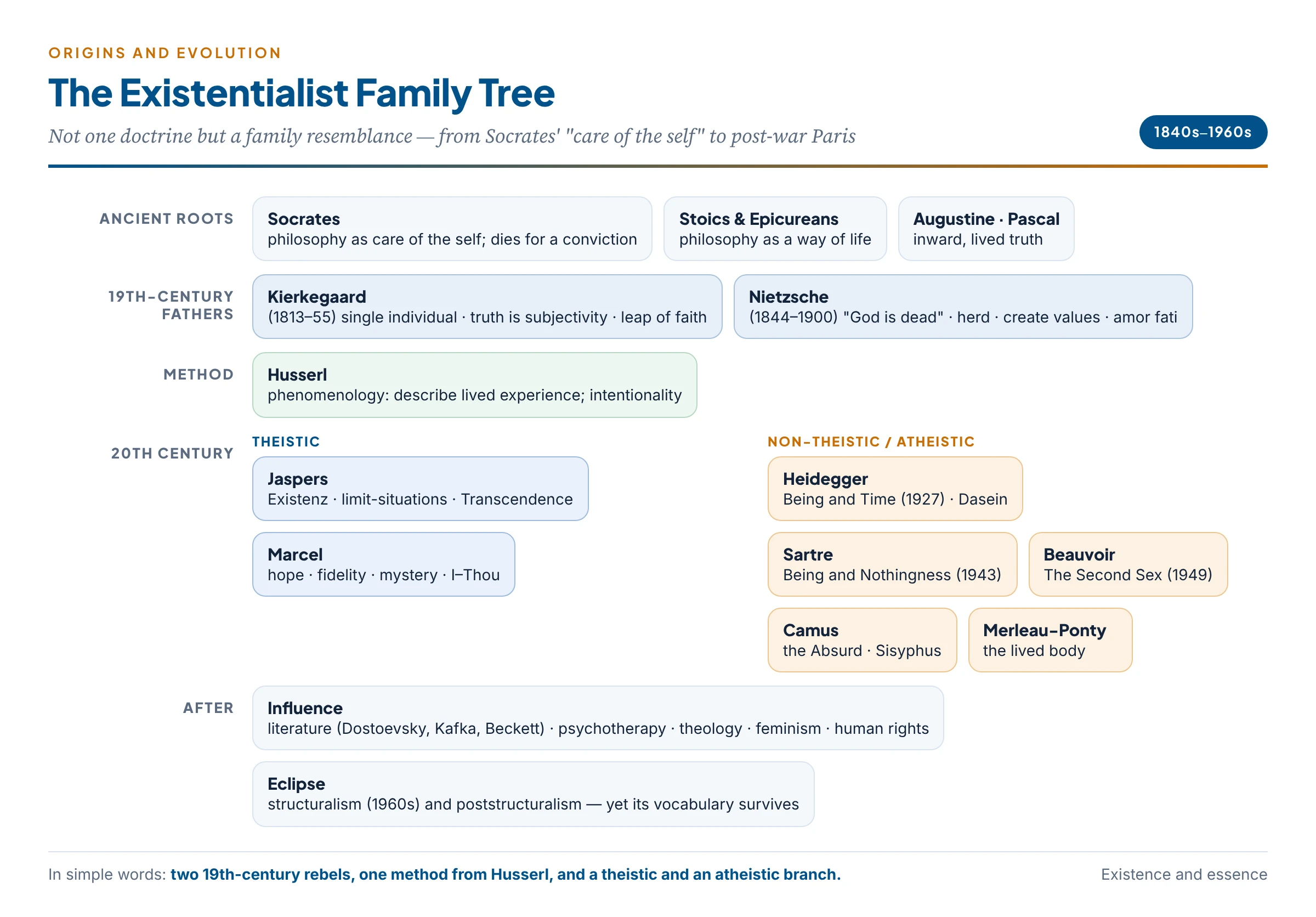
- Ancient roots. Philosophy as “care of the self” begins with Socrates, whose life matched his teaching. Facing death, he drank the hemlock while discussing the possibility of immortality — Kierkegaard saw in this a model of truth as subjectivity: a conviction one is ready to stake one’s life on. The Stoics and Epicureans continued this tradition; later, Augustine‘s Confessions, Pascal‘s Pensées and the German Romantics kept “lived truth” alive.
- Nineteenth-century fathers. Kierkegaard (Denmark) against Hegel’s rationalism; Nietzsche against the morality of the herd.
- Phenomenology. Husserl‘s method of describing lived experience shaped Heidegger, whose Being and Time (1927) gave existentialism its philosophical foundation, and Sartre, whose Being and Nothingness (1943) gave it its ontology.
- Post-war France. After the Liberation of Paris, existentialism became a cultural movement — the cafés of the Left Bank, jazz, the theatre of the absurd. Sartre’s 1945 lecture became its manifesto; the journal Les Temps modernes its voice.
- Influence. Literature, psychology and psychotherapy, theology, feminism, human rights and political thought.
- Eclipse and survival. In the 1960s structuralism and then poststructuralism displaced it. Yet its vocabulary — anguish, bad faith, commitment, authenticity — and its defence of the free, responsible individual remain part of the permanent conversation of philosophy.
Critical Evaluation
Strong Points
- Rescues the individual. It reclaims the existing person from philosophical, theological, political and scientific abstraction.
- Dignity through freedom. By denying a fixed nature, it gives every person the dignity of self-creation and refuses all fatalism.
- Responsibility without excuses. It exposes the many ways we escape responsibility — by blaming nature, fate, God, society or upbringing.
- Honesty about the human condition. It faces death, anxiety, absurdity and guilt instead of hiding them behind comfortable systems.
- Relevance. It speaks directly to an age of mass society, bureaucracy and technology, where people feel like numbers.
- Fertility. It shaped psychotherapy (existential and humanistic psychology), theology (faith as personal commitment), literature, feminism and the defence of human rights.
- Concreteness. It brought philosophy back to life as it is lived and to the emotions as sources of insight.
Weak Points
- Subjectivism and relativism. If values are created by choice, can any choice be criticised? Could one be an “authentic” tyrant?
- Irrationalism. Critics accuse it of exalting passion, leap and decision over reason.
- Pessimism. Its talk of anguish, despair, nausea and death seems gloomy. A Catholic critic, Mlle Mercier, accused Sartre of having “forgotten how an infant smiles“; others called it a “quietism of despair” — a philosophy that leads to inaction.
- Excessive individualism. Marxists and Christians alike charged it with ignoring social solidarity, class and institutions; it looked like “bourgeois individualism“.
- Overstated freedom. It underrates the weight of biology, economics, psychology (the unconscious) and culture. How does “no essence” explain a child prodigy or an inborn talent?
- Vague ethics. It tells us how to choose (sincerely, without excuses) but not what to choose.
- Obscurity. Its language, especially Heidegger’s, is dense and coined; the logical positivists dismissed much of it as meaningless.
- Internal tensions. If there are no given values, how can Sartre say that in choosing for myself I choose for all? And how can bad faith be wrong?
- Not radical enough (Heidegger). Reversing “essence precedes existence” stays inside metaphysics.
- Decentred subject (structuralism). Language, kinship systems and social structures shape us behind our backs; the “free subject” may be an illusion.
Replies and Defences
- Not irrationalism. Existentialists accept logic and science; they only deny that reason alone can settle how one should live.
- Not quietism. “There is no reality except in action.” Despair means acting without guarantees, not ceasing to act.
- A tough optimism. Sartre replied that what people really dislike in existentialism is not its pessimism but “the sternness of its optimism“: it tells a person that his destiny lies within himself.
- Not mere individualism. Sartre: “I cannot make my freedom my aim unless I make that of others equally my aim.” Beauvoir: freedom wills itself only by willing an open future for others; to leave others in oppression is inauthentic. Later existentialism became a “chastened individualism” with a social conscience.
- Facticity acknowledged. Freedom is always situated; existentialism never denied limits, only that limits decide for us.
- Ethics of style and responsibility. Its gift to ethics is an ethics of responsibility and sincerity, not a rule-book — which is also its realism.
Critics and Defenders
Criticism — Critics
- Subjectivism: no criterion to judge between choices.
- Pessimism: anguish, nausea and “useless passion” forget the smile of a child.
- Individualism: blind to class, institutions and solidarity.
- Overstated freedom: ignores biology, the unconscious, poverty and talent.
- Obscurity: coined words and dense prose; “meaningless” to the positivists.
- Heidegger’s objection: a reversed metaphysics is still metaphysics.
Defence — Defenders and strengths
- Responsibility: no excuses — the most honest account of human agency.
- Dignity: no one can define me against my will; I can always remake myself.
- Action: “no reality except in action” — the opposite of quietism.
- Solidarity: my freedom requires the freedom of others (Sartre, Beauvoir).
- Situated freedom: facticity and limits are fully admitted.
- Relevance: a living answer to mass society, technology and the crisis of meaning.
Cross-Tradition Comparison
Essence and Existence in Indian Philosophy
| Point | Existentialism (Sartre) | Advaita Vedānta | Buddhism | Jainism | Karma doctrine (general) |
|---|---|---|---|---|---|
| Is there a fixed essence of the self? | No — self is made by choices | Yes — ātman is pure being-consciousness-bliss, eternal | No — anattā: no permanent self | Yes — jīva has infinite knowledge, bliss and energy, hidden by karma | Self continues, shaped by actions |
| What is “becoming”? | Self-creation through choice | Appearance only; the self never changes | A stream of conditioned moments | Removal of karmic veils | “As one acts, so one becomes” |
| Freedom | Absolute, situated | Freedom = realising the eternal self | Freedom = ending craving | Freedom = purifying the soul | Effort (puruṣakāra) within past karma (daiva) |
| Goal | Authentic self-making | Mokṣa — knowing one is Brahman | Nirvāṇa | Kevala-jñāna | Liberation or a better life |
Indian Connect — Indian Connect: “As one acts, so one becomes”
- The Upaniṣadic insight. The Bṛhadāraṇyaka Upaniṣad says: “yathākārī yathācārī tathā bhavati” — “as one acts, as one behaves, so one becomes.” Like Sartre’s “man is what he does”, it makes action the maker of the self.
- The difference. For the Upaniṣad, this “becoming” concerns the empirical person and his rebirths; beneath it lies an eternal ātman with a fixed nature. Sartre denies any such hidden essence.
- Effort and fate. Indian thought debated puruṣakāra (self-effort) versus daiva (fate, the fruit of past karma). The Yoga Vāsiṣṭha strongly defends self-effort: what we call fate is only our own past effort. This is close to Sartre’s “we are without excuse”, while Indian thought also accepts the weight of the past — much like Sartre’s facticity.
- Buddhism’s no-self. The Buddha’s anattā — no permanent, unchanging self — agrees with existentialism that there is no fixed essence; but Buddhism draws the opposite conclusion: not to build a self through choice, but to let go of self-making craving.
- Birth is not destiny. Beauvoir’s “one is not born a woman” has a strong Indian echo in Ambedkar‘s attack on caste: a person’s worth and role cannot be fixed by birth. Social “essences” imposed at birth are human constructions, and what humans have made, humans can unmake.
Existentialism and Earlier Western Thought
| Thinker | View of human essence | Existentialist response |
|---|---|---|
| Plato | The Form of Man is real; individuals are shadows | The individual is real; universals are abstractions |
| Aristotle | Man is by nature a rational animal with a fixed telos | No fixed telos; purpose is chosen |
| Aquinas | God-given nature and natural law | No divine blueprint (Sartre); or faith as personal leap (Kierkegaard) |
| Descartes | Self = thinking substance | Self is not a substance but an existence and a project |
| Spinoza | Freedom = understanding necessity | Freedom = choice within a situation |
| Hegel | Individual = moment of Absolute Spirit | The single individual is the highest category |
Synthesis (Siddhānta)
- The core thesis. For human beings existence precedes essence: there is no fixed nature written in advance; the self is made through choices. This is the common root of all existentialism, expressed as Kierkegaard’s existence as a task, Heidegger’s essence lying in existence, and Sartre’s priority of existence.
- The link with freedom. Because there is no essence, man is freedom — “condemned to be free” — and therefore wholly responsible, even for not choosing.
- The price. Freedom brings anguish, abandonment, despair, the temptation of bad faith, the sense of absurdity, and conflict with others. Existentialism faces these honestly.
- The balance. Its critics rightly warn against subjectivism, individualism and overstated freedom. Its best answers — situated freedom, freedom that wills the freedom of others, and an ethics of responsibility — show that it is not a doctrine of “anything goes” but a demand for lucid, committed living.
- Contemporary relevance. In an age of algorithms that predict our choices, mass media that shape our opinions and identities assigned by birth, existentialism remains a powerful reminder that a person is more than any label — and that, whatever we have been made into, we can still make something of it.
“Man is nothing else but what he makes of himself.” — Sartre
“The ‘essence’ of Dasein lies in its existence.” — Heidegger
“One must imagine Sisyphus happy.” — Camus
Previous Year Questions
- 2024What do the existentialist thinkers mean by the slogan “existence precedes essence”? How is human existence related to human freedom according to them? Discuss.
- 2015Bring out the relationship between existence and essence in the case of human beings. Explain the issues it gives rise to for human beings according to Sartre.
- 2012Elucidate Existentialism and indicate its strong and weak points in your own words.
- 2009“Existence precedes essence.” Comment.
- 2008Heidegger’s contention that the essence of “Dasein is its existence”.
- 2003“Existence precedes essence.” Short notes.