

The Scientific Turn in the Study of International Politics

For its first half-century the study of international politics was done by historians, lawyers and philosophers. It read treaties, narrated crises, argued about justice and drew lessons from cases. Then, in the 1950s, a group of scholars proposed that this was not a discipline at all but a literature, and that international politics could instead be studied the way physics or economics is studied — by stating hypotheses, measuring, and testing.
- The claim was about method, not about substance. The scientific approach did not begin with a new theory of war or peace; it began with a new account of what would count as knowing something about war or peace.
- Its target was the older way of working, which it labelled traditional, classical or historical-philosophical-legal, and which it accused of producing insight without evidence.
- Its promise was a body of testable, cumulative, generalisable propositions — findings that a later scholar could check, extend or overturn rather than merely admire.
- The behavioural movement arrived in international relations from political science, where it had already reshaped the study of voting, legislatures, parties and public opinion.
- Transferring it to international politics meant finding equivalents: states as units, wars and disputes as events, capabilities and alliances as measurable attributes.
- The scientific turn produced three things in international relations, and they belong together because they share a method rather than a subject.
- Systems theory moved the level of explanation from the state to the configuration of states, and asked what any given configuration requires of its members.
- Game theory modelled strategic interaction as a matrix of choices and pay-offs, and asked what a rational actor facing another rational actor would do.
- Decision-making theory went the other way, opening the state and asking how the officials inside it actually decide.
The Commitments of Positivism
Positivism is the philosophy of science underneath the behavioural movement, and the scientific approach in international relations inherits its commitments whole. Three of these are foundational, and the rest are working rules that follow from them.
- The unity of natural and social scientific method. There is one logic of explanation, and it does not change when the subject changes from planets to parliaments.
- Human affairs display regularities that can be stated as law-like generalisations, even if the laws are probabilistic rather than deterministic.
- Explanation therefore means subsumption under a covering law: this war occurred because wars of this kind occur under these conditions.
- The separation of fact from value, and of subject from object. The observer stands outside what is observed, and describing the world is a different act from evaluating it.
- A value-free social science. The discipline’s proper output is explanation, not prescription; the scholar supplies the causal map and the statesman chooses the destination.
- The working commitments that follow are the visible face of positivism in day-to-day research.
- Observable data: only what can in principle be seen, counted or recorded may enter as evidence — not motives inferred from a statesman’s character.
- Operational definitions: a concept such as “war” must be given a countable definition — the standard being 1,000 battle deaths in a year — before it can be studied.
- Hypothesis testing: propositions must be framed so that some possible observation would refute them, and then confronted with that observation.
- Quantification: where a variable can be measured it should be, because measurement permits comparison across many cases rather than illustration from a favoured few.
The scientific approach did not claim to know more about international politics than the historians did. It claimed to know it in a way that could be checked.
The Second Great Debate as a Methodological Dispute
The confrontation between the traditionalists and the scientists ran through the 1960s and was fought in journals rather than over cases. Its canonical exchange took place in a single volume of one journal: Hedley Bull‘s “International Theory: The Case for a Classical Approach” appeared in World Politics in April 1966, and Morton A. Kaplan‘s reply, “The New Great Debate: Traditionalism vs. Science in International Relations”, appeared in the same journal that October.
Bull’s Case for the Classical Approach
- Bull defined the classical approach by its sources rather than by its conclusions. It is the approach that derives from philosophy, history and law, and that relies on the exercise of judgement.
- His central charge was a dilemma, and it is the most damaging thing ever said about the scientific approach.
- Either the scientists confine themselves to what can be strictly verified, in which case they say almost nothing of substance.
- Or they say something of substance, in which case they have smuggled in the classical method and are being rigorous about the wrong thing.
“If we confine ourselves to strict standards of verification and proof, there is very little of significance that can be said about international relations.” — Hedley Bull
- The specific objections he pressed were sharper than the general complaint.
- The scientific approach is confined to the periphery of the subject — to arms control, deterrence and crisis behaviour — because those are the corners that yield to formal treatment.
- The fetish for measurement produces a bias toward the trivial, because what is easily counted is rarely what matters most.
- Cutting the subject off from history and philosophy is a positive disservice, since the questions of international politics — order, justice, obligation, the ethics of force — cannot be settled without them.
- Bull was not an anti-theorist. His own The Anarchical Society is a work of theory; his objection was to a theory that pretended its assumptions had been proved.
Kaplan’s Reply
- Kaplan’s counter-charge was that traditionalism is unfalsifiable. The classical scholar assembles a large mass of historical detail and applies broad generalisations to it that no evidence could ever contradict.
- Where a proposition cannot in principle be shown false, it is not knowledge but the scholar’s sensibility — and one scholar’s sensibility has no claim over another’s.
- He denied that science excludes judgement. Choosing what to model, what to hold constant and what counts as an interesting question are all acts of judgement — the difference is that the scientist’s judgements are stated and can be inspected.
- The irony is worth stating plainly. Kaplan is the champion of the scientific side against Bull, and the rest of this article is largely an examination of why Kaplan’s own models failed to be scientific in the way he demanded of everyone else.
| Classical / traditional approach | Scientific / behavioural approach | |
|---|---|---|
| Sources of knowledge | Philosophy, history, international law | Logic, mathematics, statistics, the natural-science model |
| Unit of study | The case, understood in its particularity | The class of cases, understood as a population |
| Standard of proof | Informed judgement, plausibility, weight of considerations | Verification, falsifiability, replication |
| Attitude to values | Inseparable from the subject; normative questions are central | Separable and to be excluded from explanation |
| Characteristic output | Interpretation, historical understanding, prudential maxims | Models, correlations, testable hypotheses |
| Characteristic failure | Unfalsifiable generalisation dressed as insight | Rigorous statements about matters of no importance |
| Leading figures | Bull, Wight, Morgenthau, Aron, Carr | Kaplan, Singer, Deutsch, Schelling, Rosenau |
How the Debate Ended
- Nobody won, and the honest description of the outcome is a division of labour. The two approaches stopped arguing and settled into different parts of the discipline.
- Quantitative work took war, alliances, trade, deterrence and crisis behaviour, where events recur and can be coded.
- Interpretive work kept order, legitimacy, diplomacy, ethics and the character of international society, where the questions are not the kind that data settle.
- Post-behaviouralism supplied the internal correction. By the late 1960s the demand from within the scientific camp was for relevance — that a discipline preoccupied with technique had lost sight of Vietnam, poverty, race and nuclear danger.
- The debate’s real legacy is that both sides became more careful. The scientists gave up the claim to a physics of politics; the traditionalists gave up the claim that judgement needs no discipline.
What a System Is
The word “system” was doing serious work in several disciplines before it entered international relations, and much of the criticism of Kaplan turns on whether he took the concept or only the label. A system, in the sense the term carried in the 1950s, is not merely a collection of things; it is a set of parts whose behaviour is intelligible only through their relations to each other.
The Vocabulary of Systems Analysis
- Interdependent parts. A change in one element alters the others, so that the whole cannot be understood by studying the parts separately.
- A boundary. Something distinguishes what is inside the system from what is outside it, and the boundary may be more or less permeable.
- An environment. Whatever lies outside the boundary but acts upon the system — for a political system, the economy, the society, the physical world, other political systems.
- Inputs and outputs. The system receives from its environment and returns something to it; the internal work of converting the one into the other is the system’s characteristic activity.
- Feedback. Outputs alter the environment and the altered environment generates new inputs, so the system is continuously informed about the effects of its own behaviour — negative feedback damping deviation, positive feedback amplifying it.
- Equilibrium. A state in which the forces acting on the system balance, so that it persists without fundamental change; equilibrium is a condition, not a virtue.
- Homeostasis. The system’s capacity to restore a disturbed equilibrium by its own operation, as a body restores its temperature — the property that makes a system self-maintaining rather than merely stable.
- Transformation. When disturbance exceeds the system’s homeostatic capacity, the system does not simply break; it becomes a different system, with different parts, rules or boundaries.
General Systems Theory
- Ludwig von Bertalanffy developed general systems theory as a protest against the fragmentation of the sciences into mutually unintelligible specialisms.
- The danger was equally obvious and was noticed early. Borrowing a vocabulary is not the same as borrowing a theory, and an approach can acquire the words “input”, “feedback” and “equilibrium” without acquiring any of the explanatory work those words do in biology.
David Easton’s Political System
David Easton produced the version of systems analysis that political science actually used, and the systems approach in international relations is built on his. Easton was trying to give political science a subject matter that was neither the state nor government but a process — the authoritative allocation of values for a society — and to show how that process sustains itself over time.
- Inputs enter the political system from its environment in two forms.
- Demands: claims made on the system for action — for a road, a subsidy, a law, a war.
- Supports: the reservoir of compliance, loyalty and legitimacy that allows the system to act at all; without support, demands overwhelm it.
- Conversion is the system’s internal work — the “black box” in which institutions, parties, bureaucracies and courts turn demands into decisions.
- Outputs are authoritative decisions and policies, binding because the system is recognised as entitled to make them.
- Feedback closes the loop. Outputs change conditions in the environment, and the changed environment produces the next round of demands and supports, so that the system is continuously informed about its own performance.
- What international relations borrowed from Easton was the frame. The idea that international politics is a bounded whole, that it has an environment, and that recurrent patterns are properties of the whole rather than of its members.
- What it did not borrow is more important, and it is the core of the case against Kaplan.
- There is no account of inputs — nothing corresponding to demands and supports entering the international system from a society outside it.
- There is no account of conversion — no institutions doing the work of turning inputs into outputs, because at the international level no authoritative allocator exists.
- There is no account of outputs as authoritative decisions, and therefore no genuine feedback loop connecting outputs back to inputs.
- The environment of the international system is never specified: if the system contains all states, what lies outside it?
Why International Relations Reached for the Systems Idea
- The systemic level of analysis promised explanation without biography. If patterns are properties of the configuration, one need not study the internal politics of every state to explain them.
- A warning about a name collision. Immanuel Wallerstein‘s world-systems theory shares a word with the systems approach discussed here and has nothing else in common with it — it is a Marxist theory of a single capitalist world-economy divided into core, semi-periphery and periphery, not a formal model of interstate configurations.
Morton Kaplan and the Grand Theory of International Politics
Morton A. Kaplan‘s System and Process in International Politics, published in 1957, is the most ambitious book the scientific approach produced in international relations, and its ambition is inseparable from its failure. Kaplan was not offering a description of the Cold War. He was offering a general theory of what any international system can look like, what each type requires of its members, and how each turns into another.
The Ambition
- Kaplan wanted a grand theory — a body of propositions as universal as a law of physics, applying to the eighteenth century, the twentieth and any century to come.
- The unit of theory is the system, not the state. What is being explained is the recurrent pattern of behaviour that a configuration of states generates.
- The method is deductive model-building rather than induction from cases. Kaplan specifies a structure, derives the behaviour it requires, and then asks which historical periods approximate it.
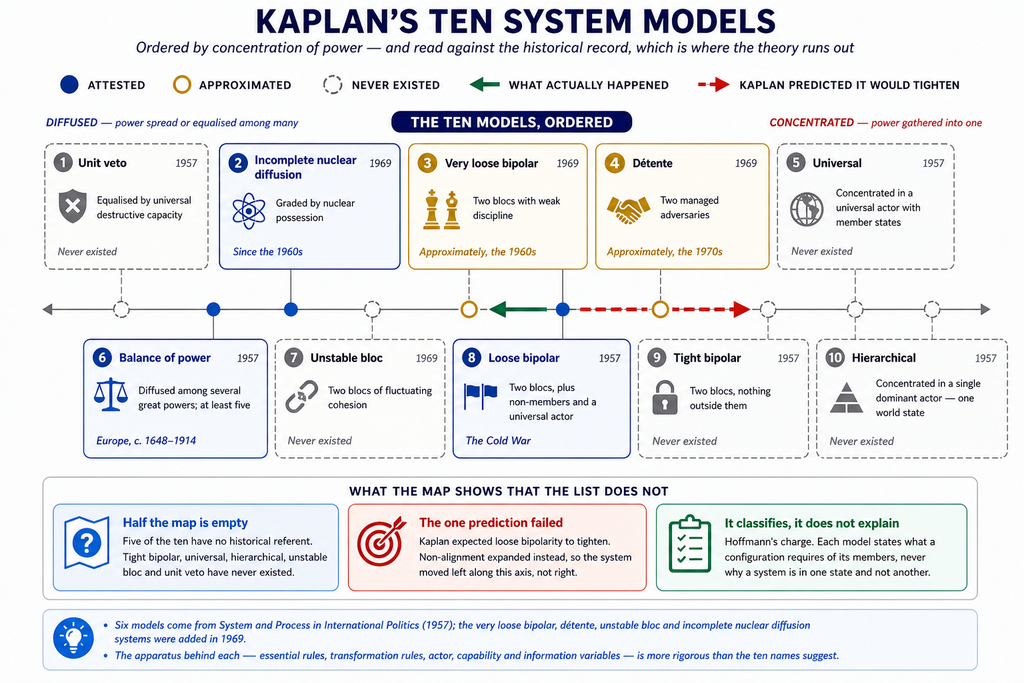
- Ten models in all. Six were set out in the 1957 book — balance of power, loose bipolar, tight bipolar, universal, hierarchical and unit veto — and four more were added in 1969: the very loose bipolar, the détente, the unstable bloc and the incomplete nuclear diffusion systems.
The Anatomy of a Kaplan Model
Each model is specified by five sets of variables, and this apparatus, rather than the six names, is the most rigorous part of the book.
- Essential rules of behaviour. What the actors must do for the system to remain the kind of system it is; these are not moral prescriptions but conditions of persistence.
- Transformation rules. What happens when the essential rules are broken — which system the present one becomes, and under what pressure.
- Actor classificatory variables. The kinds of actor the system contains, and how they are structured internally.
- National actors are states; supranational actors may be blocs or universal organisations; essential actors are those whose removal would change the system.
- Capability variables. The distribution of power among actors, including whether any can destroy the others and whether capabilities are alterable by internal effort or only by alliance.
- Information variables. What actors know about each other’s capabilities and intentions, and how reliably it is transmitted — an unusually modern element in a 1950s model.
The Balance of Power System
This is the model Kaplan specified most fully and the one on which his reputation rests. It describes a system of several independent states, none able to dominate, held in equilibrium by constantly shifting alignments rather than by any authority above them.
- The system requires a minimum number of independent actors, and Kaplan is precise about it.
“The number of essential national actors must be at least five and preferably more.” — Morton A. Kaplan
- The six essential rules are the famous part of Kaplan, and each is a condition of the system’s survival rather than a description of what states always do.
- Act to increase capabilities, but negotiate rather than fight. Expansion is expected; war is the expensive way of achieving it and is preferred only when negotiation fails.
- Fight rather than fail to increase capabilities. An actor that consistently declines opportunities to grow will be outgrown, and the system loses a balancer.
- Stop fighting rather than eliminate an essential national actor. Victory must be limited, because the destruction of a great power permanently removes a weight from the scales.
- Oppose any coalition or single actor tending to assume a position of predominance. This is the balancing rule proper, and it is directed at whoever is strongest, not at whoever is disliked.
- Constrain actors who subscribe to supranational organising principles. A state that acts for an ideology, a church or a universal empire rather than for its own interest cannot be relied on to switch sides, and flexibility is the system’s lifeblood.
- Permit defeated or constrained essential actors to re-enter the system as acceptable role partners. Yesterday’s enemy must be available as tomorrow’s ally, so peace terms must not be humiliating.
- Transformation: if actors ignore the fourth and sixth rules — if coalitions harden and defeated powers are excluded — the system moves toward bipolarity. If essential actors are eliminated, it can move toward hierarchy.
The Loose Bipolar System
- Two blocs dominate, each led by a bloc leader, but the system also contains non-member states and universal actors such as the United Nations.
- Bloc discipline is real but incomplete. Members may defect, non-members may lean one way or the other, and the universal actor can mediate.
- Kaplan attached a longer list of rules to this model than to the balance of power system, reflecting the greater number of distinct roles.
- Blocs act to increase capabilities relative to each other; they fight rather than allow a rival bloc to attain predominance; they subordinate the objectives of the universal actor to their own but do not destroy it.
- Non-member states support the universal actor and act to reduce the danger of war between blocs — the theoretical description of non-alignment.
- Stability depends on the mediating capacity of the non-members and the universal actor, and on both blocs preferring a limited war to a general one.
- Transformation: toward the tight bipolar system if the non-member group is absorbed or ceases to matter; toward the universal system if the universal actor’s authority grows.
- This is the model that most nearly described the Cold War, which is both its strength and, since it was built while the Cold War was running, less of a predictive achievement than it looks.
The Tight Bipolar System
- Every state belongs to one of two blocs; the non-aligned group and the mediating universal actor disappear.
- The system is far less stable than the loose version, because the mediating cushion that absorbed crises has gone and every dispute is directly a bloc dispute.
- Kaplan expected the loose bipolar system to tighten, and it did not: the non-aligned group grew rather than shrank through the 1960s and 1970s. This is the clearest instance of a Kaplan prediction being tested and failing.
The Universal International System
- A universal actor — a world confederation, or a United Nations with real authority — performs judicial, economic and political-integrative functions for the whole system.
- Kaplan treated this as a possible successor to loose bipolarity if the universal actor’s mediating role expanded into an authoritative one; it remains hypothetical.
The Hierarchical International System
- One actor dominates the whole system, which has effectively become a single political unit — a world state rather than a system of states.
- Kaplan distinguished a directive from a non-directive form: authoritarian imposition from above, or a democratic world federation constituted from below.
The Unit Veto System
- Every actor can destroy every other, so that each holds an effective veto over the survival of all.
- The premise is universal nuclear diffusion — a world in which every state possesses a survivable second-strike capability.
- War becomes irrational for everyone simultaneously, and deterrence ceases to be a relationship between two powers and becomes a property of the whole system.
- This is a thought experiment, not a forecast. Kaplan used it to isolate what nuclear weapons do to the logic of a system when the variable is pushed to its limit; the record of non-proliferation has kept it hypothetical.
The Four Later Models
The 1969 additions are refinements rather than new departures, and most of them are attempts to fit the model set to a Cold War that had failed to behave as the original six predicted.
- The very loose bipolar system. Bloc discipline weakens further, bloc members act with substantial autonomy, and the two leaders can no longer deliver their allies.
- The détente system. The two bloc leaders manage their rivalry cooperatively, developing rules of restraint, arms-control understandings and crisis-management channels while remaining adversaries.
- The unstable bloc system. Blocs exist but their internal cohesion fluctuates unpredictably, so that alignment cannot be relied upon and the system oscillates between configurations.
- The incomplete nuclear diffusion system. Nuclear weapons spread to some but not all states — the actual condition of the world since the 1960s — producing a graded hierarchy of nuclear, threshold and non-nuclear actors and complicating deterrence badly.
| Model | Power distribution | Essential actors | Ever existed? |
|---|---|---|---|
| Balance of power | Diffused among several great powers | At least five states | Yes — Europe, roughly 1648–1914 |
| Loose bipolar | Two blocs, plus non-members and a universal actor | Two bloc leaders, blocs, non-members, UN | Yes — the Cold War, approximately |
| Tight bipolar | Two blocs, nothing outside them | Two bloc leaders only | No |
| Universal | Concentrated in a universal actor with member states | A world confederation | No |
| Hierarchical | Concentrated in a single dominant actor | One world state | No |
| Unit veto | Equalised by universal destructive capacity | All states, each with a veto | No |
| Very loose bipolar | Two blocs with weak discipline | Bloc leaders and autonomous members | Approximately — the 1960s |
| Détente | Two managed adversaries | Two superpowers | Approximately — the 1970s |
| Unstable bloc | Two blocs of fluctuating cohesion | Blocs and defectors | No |
| Incomplete nuclear diffusion | Graded by nuclear possession | Nuclear, threshold and non-nuclear states | Yes — since the 1960s |
Which Models Have Actually Existed
- Two of the original six have historical referents; the remaining four are constructions. The balance of power system approximates eighteenth- and nineteenth-century Europe, the period Kaplan drew his rules from, and the loose bipolar system approximates the Cold War.
- The tight bipolar, universal and hierarchical systems have never existed, and the unit veto system is a thought experiment about the limiting case of nuclear diffusion.
- The present international system resembles none of the ten cleanly, which is the substance of the objection that the models have dated.
- It has one preponderant military power, several economic poles, a nuclear order that is diffused but incomplete, deep institutional density, and non-state actors that Kaplan’s actor classification cannot accommodate at all.
- The closest fit is a blend of the very loose bipolar and incomplete nuclear diffusion models, and a taxonomy that must blend its own categories is a weak taxonomy.
The Critical Evaluation of Kaplan
Hoffmann’s Verdict
Stanley Hoffmann delivered the judgement that has stuck to Kaplan ever since, and its shape matters: it is a criticism that concedes the direction while condemning the execution.
Kaplan’s models are a step in the right direction that goes badly wrong in the taking — rigorous about form, and empty about the politics the form was meant to hold.
- The direction is right because international politics does have systemic properties, and a discipline that only narrates episodes will never find them.
- The misstep is the substitution of taxonomy for theory. Hoffmann’s further charge was that the enterprise had become an elaborate arrangement of pieces that does not capture the basic stuff of international politics.
- Alfred Cobban’s older complaint against behavioural political science applies exactly: it can become a device for avoiding politics without achieving science. The same point is pressed against systems language generally — that it may produce the appearance of understanding while evading the substantive political question.
The Substantive Criticisms
- The models classify rather than explain. A taxonomy tells you which box a case belongs in; it does not tell you why the case behaves as it does.
- Kaplan supplies names for configurations and rules attached to names, but no causal mechanism linking structure to outcome.
- The rules are asserted rather than derived. Nothing in the specification of a five-actor system generates the six rules; they are read off eighteenth-century European practice and then presented as requirements.
- Predictive value is close to nil, and where a prediction was made it failed. Kaplan expected loose bipolarity to tighten; non-alignment instead expanded into a movement of most of the world’s states.
- Domestic variables are absent altogether. Regime type, ideology, economic structure, leadership and public opinion do no work in any of the ten models.
- The models are static, and the transformation rules are the weakest part of the apparatus. They state that one system may become another without specifying the threshold, the timescale or the mechanism.
- The vocabulary is abstract to the point of sterility. “Essential national actor” and “role partner” are not gains in precision over “great power” and “ally”; they are the same ideas wearing a laboratory coat.
- The actor classification cannot accommodate the contemporary world. Multinational corporations, transnational networks, armed non-state groups and supranational institutions are not national actors, and Kaplan’s categories have nowhere to put them.
Kaplan Against the Precepts of the Systems Approach
The sharpest criticism is not that Kaplan’s systems theory is wrong about international politics but that it is not a systems theory. Measured against the general systems vocabulary he borrowed and against Easton’s political system, which the international application was built on, the models turn out to have taken the word and left the machinery behind.
- No environment is specified. A system is defined by its boundary and by what lies beyond it; Kaplan’s international system contains all states and therefore has no outside.
- No inputs. There is no counterpart to Easton’s demands and supports — nothing entering the system that the system must process.
- No conversion process. Easton’s system does work: institutions turn demands into authoritative decisions. Kaplan’s models specify structures and rules but no processing machinery.
- No outputs and therefore no feedback. Since nothing is produced, nothing returns to alter the next round of inputs, and the defining loop of systems analysis is missing.
- No functions. General systems theory asks what each part contributes to the maintenance of the whole; Kaplan describes what actors must do without deriving it from any functional requirement.
- Equilibrium is asserted, not analysed. The models say a system persists while the rules are followed, which is close to a tautology, and say little about the homeostatic processes that restore a disturbed balance.
- The system does not act. In Easton, the political system is an agent that allocates; in Kaplan, the “system” is only a name for a pattern among actors, with no capacity of its own.
| Element of systems analysis | Easton’s political system | Kaplan’s international system |
|---|---|---|
| Boundary and environment | Political system bounded off from economy, culture, society | Unspecified; the system has no outside |
| Inputs | Demands and supports from the environment | None identified |
| Conversion | Institutions, parties, bureaucracy, courts | None; only rules of behaviour |
| Outputs | Authoritative allocations of values | None; behaviour is not an allocation |
| Feedback | Outputs reshape environment, generating new inputs | Absent |
| Purpose of the model | Explaining the persistence of a system under stress | Classifying possible configurations |
Kaplan took the vocabulary of systems analysis and left behind the only part of it that did any explanatory work.
What the Approach Genuinely Achieved
Dismissing Kaplan entirely is as lazy as accepting him whole. The models failed as a grand theory, but the exercise changed what the discipline thought a theory of international politics should look like.
- Structural assumptions were made explicit. Before Kaplan, claims about “the balance of power” were made without stating how many actors it needed or what behaviour it required; afterwards, they had to be.
- The rules are a real analytical contribution even where they are not derived. Stating that a balance of power system requires victors to spare the vanquished is a genuine insight, and it explains why the Congress of Vienna succeeded and Versailles did not.
- The systemic level of analysis was established as legitimate. That recurrent patterns may be properties of a configuration rather than of its members is now a commonplace, and it was not one in 1957.
Waltz as the Surviving Systems Theory
Kenneth Waltz is the reason the systems approach survived Kaplan, and the comparison is the most instructive one available. Theory of International Politics, published in 1979, is a systems theory too — its subject is structure and its unit of explanation is the system — but it does with structure what Kaplan could not, which is to explain rather than to sort.
- Waltz reduces structure to three elements and shows that in international politics only one of them varies.
- The ordering principle is anarchy, and it does not change; functional differentiation among units is absent, because states are like units performing like tasks; the distribution of capabilities is the sole variable.
- Kaplan’s ten models multiply categories; Waltz’s one variable generates predictions. That is the whole difference, and it is a difference in the logic of theory-building rather than in subject matter.
- Waltz specifies a mechanism, which Kaplan does not. Structure shapes outcomes through socialisation — states learn from each other’s successes and failures — and through competition, which selects out those that do not conform.
- Waltz is explicit that his theory explains outcomes, not foreign policies. Kaplan’s rules purport to tell actors how to behave, which quietly turns a systemic theory into a theory of the unit and confuses the two levels.
| Kaplan | Waltz | |
|---|---|---|
| What structure is | A named configuration of actors and roles | Ordering principle, differentiation, distribution of capabilities |
| Number of variables | Five sets, across ten models | One that varies: the distribution of capabilities |
| What the theory does | Classifies possible systems | Explains recurrent outcomes |
| Mechanism linking structure to behaviour | None; rules are asserted | Competition and socialisation |
| Testable propositions | Few, and the main one failed | Several, and still contested |
| Status today | A historical stage in the discipline | The reference point that neorealism, neoliberalism and constructivism all argue against |
Functional and Systems Approaches Side by Side
Both approaches treat international politics as a whole rather than a collection of states, and both borrowed their vocabulary from outside the discipline. From the systems side the difference is one of purpose. The systems approach asks what a given configuration of power is and what it requires; the functional approach asks how technical cooperation might gradually change what the configuration is. One is diagnostic and the other prescriptive, and the systems approach has no theory of change to set against spillover.
- The systems approach is agnostic about peace; functionalism is a peace theory. That is precisely Hoffmann’s complaint against Kaplan and precisely functionalism’s vulnerability to the charge of wishful thinking.
- The units differ. Kaplan’s actors are states and blocs; functionalism’s carriers of change are technical agencies, experts and cross-border constituencies that his actor classification cannot see.
Game Theory
Game theory is the second product of the scientific turn. It is a body of formal reasoning, built from mathematics and logic, about what rational behaviour consists of when the outcome of your choice depends on somebody else’s choice. It suits international politics because that is exactly the condition states are in, and it suits realism because it assumes self-interested actors calculating gains.
Origins and the Transfer into Strategic Studies
- John von Neumann and Oskar Morgenstern founded the field with Theory of Games and Economic Behavior, written for economics rather than for politics.
- Thomas Schelling made the transfer into strategy, and The Strategy of Conflict and Arms and Influence are the two books that did it.
- Schelling’s insight was that most international conflict is a mixed-motive situation: adversaries have a common interest in avoiding disaster alongside a conflict of interest over everything else.
- Martin Shubik developed the economics of strategic interaction; William Riker applied coalition theory to politics; Karl Deutsch connected game reasoning to communication and cybernetics.
The Five Elements of a Game
- Strategy. A complete plan of moves specified in advance for every situation the other side may create — not a single move but a rule covering all contingencies.
- Players. There must be an opponent; a game requires at least two decision-makers whose choices interact, and political games cannot be played single-handed.
- Rules. The constraints that define what moves are permitted, in what order, and when the game ends.
- Pay-offs. What the game is worth to each player at the end, expressed as a value attached to each combination of choices.
- Information. What each player knows about the other’s options, pay-offs and past moves, and how signals pass between them.
Classes of Game and Solution Concepts
- Zero-sum games have a fixed total: one player’s gain is exactly the other’s loss, and there is nothing to bargain over.
- Non-zero-sum or variable-sum games allow both sides to gain or both to lose, which is why they carry almost all the interesting applications.
- Two-person games model a bilateral relationship; n-person games admit coalitions, side-payments and free-riding, and are far harder to solve.
- Minimax and maximin are the conservative solution rules for fixed-sum games.
- Maximin means choosing the strategy whose worst outcome is the best of the available worst outcomes — maximising the minimum.
- A saddle point exists where one player’s maximin and the other’s minimax coincide, giving a stable solution neither has reason to abandon.
- A dominant strategy is one that is better than every alternative whatever the opponent does; where one exists, the player needs no beliefs about the opponent at all.
- A Nash equilibrium is a combination of strategies from which no player can gain by unilaterally changing, given what the others are doing.
- Crucially, an equilibrium need not be efficient: both players can be stuck at an outcome both would gladly trade away, which is precisely the prisoner’s dilemma.
The Chicken Game
Two drivers accelerate toward each other on a single road. Each can swerve or hold course. The one who swerves is disgraced as the chicken; the one who holds is acclaimed; if both swerve neither wins but both survive with honour intact; if neither swerves, they collide.
| B swerves | B holds | |
|---|---|---|
| A swerves | Both safe, no glory (2, 2) | A humiliated, B wins (1, 3) |
| A holds | A wins, B humiliated (3, 1) | Collision — worst for both (0, 0) |
- There is no dominant strategy in chicken, which is what makes it dangerous. The best reply to holding is swerving, and the best reply to swerving is holding.
- The rational move against a rational opponent is to swerve, since the collision outcome is catastrophic. But that reasoning is available to both, and each expects the other to reach it.
- Commitment therefore pays, and so does the appearance of irrationality. A driver who visibly tears out the steering wheel and throws it away has made swerving impossible and forced the other to yield.
- This is the logic of brinkmanship: deliberately creating a shared risk of catastrophe that only the other side’s concession can remove.
- Schelling’s phrase for this is the threat that leaves something to chance — since a threat to do something suicidal is not credible, one instead sets in motion a process that may run out of control.
- The Cuban Missile Crisis is the standard application. Two nuclear powers held course, and the Soviet withdrawal of the missiles is read as the rational choice to swerve — accepting a loss of face in exchange for survival.
The Prisoner’s Dilemma
Two suspects are arrested and questioned separately. The prosecutor has enough for a minor charge but not for the serious one. Each is told that if he confesses and the other stays silent he goes nearly free, while the silent one takes the maximum. The structure produces an outcome both would reject if they could speak.
| B stays silent | B confesses | |
|---|---|---|
| A stays silent | 1 year each | A gets 10 years, B gets 3 months |
| A confesses | A gets 3 months, B gets 10 years | 5 years each |
- Confessing is a dominant strategy for both. Whatever the other does, each prisoner is individually better off confessing — so no belief about the other’s character changes the calculation.
- The equilibrium is therefore collectively irrational, and this is the whole point: rational individual choice produces an outcome worse for everyone than an available alternative.
- The applications are the core problems of international politics.
- Arms races. Each state’s dominant strategy is to arm, whatever the other does; both end up more heavily armed, no more secure, and poorer.
- The security dilemma. Defensive measures are indistinguishable from offensive ones, so precaution by one reads as threat to the other and produces the reaction it was meant to guard against.
- Trade protection. Each state gains from protecting its own market while others stay open; universal protection leaves everyone worse off, which is the logic tariff rounds are designed to break.
- Climate free-riding. Emissions cuts are costly and national while the benefit is global and shared, so the dominant strategy is to let others cut — an n-person dilemma, which is harder still.
The prisoner’s dilemma shows that conflict does not need a villain. Two reasonable states with no quarrel of principle can be driven into an arms race by the mere absence of a way to make a promise stick.
Stag Hunt and Deadlock
- Stag hunt models an assurance problem, drawn from Rousseau’s hunters who can take a stag together or a hare alone.
- Both players prefer mutual cooperation to everything else, which is the crucial difference from the prisoner’s dilemma; there is no temptation to exploit a cooperating partner.
- The remedy is therefore information and reassurance, not enforcement — which is what confidence-building measures, hotlines and transparency regimes are designed to supply.
- Deadlock models a genuine conflict of interest, where at least one player prefers mutual defection to mutual cooperation.
- No agreement is available because there is nothing both sides want, and the failure to cooperate is not a tragedy but a preference.
- Mistaking deadlock for a prisoner’s dilemma produces years of wasted negotiation on the assumption that the other side wants a deal.
- Identifying which game is being played is most of the analytical work, and it is the part the formalism cannot do for the analyst.
Iterated Games and the Shadow of the Future
- A one-shot prisoner’s dilemma has no escape; a repeated one does. When the game recurs indefinitely, defection today can be punished tomorrow, and cooperation becomes rational.
- Robert Axelrod demonstrated this experimentally by running computer tournaments in which submitted strategies played each other repeatedly.
- The winner, submitted by Anatol Rapoport, was tit-for-tat — cooperate on the first move, then copy whatever the opponent did last.
- It won by being nice (never defecting first), retaliatory, forgiving and clear, and it performs badly only under noise, where one misread signal starts a spiral.
- The shadow of the future is the mechanism. Cooperation is sustainable when the players expect to meet again often enough that the discounted value of future cooperation exceeds the one-off gain from defecting.
- This is the formal basis of neoliberal institutionalist theory. Institutions promote cooperation by lengthening the shadow of the future, raising the number of iterations, and making defection visible.
The India–Pakistan Nuclear Case
The South Asian nuclear competition is the clearest prisoner’s dilemma in contemporary international politics, and it shows why the structure resists the ordinary remedies of diplomacy.
- India’s structural incentive came from China, not Pakistan. The defeat of 1962 and China’s nuclear test in 1964 created an unanswerable security problem for a state without weapons.
- Pakistan’s incentive came from India, and from an asymmetry it could not otherwise offset. Conventional inferiority made a nuclear equaliser attractive independently of anything India said.
- The joint gain both forgo is large and obvious. Two developing states with severe poverty, spending on arsenals rather than on development, would both be better off under a verified mutual abstention.
- Neither can take the risk, and the reasoning is symmetrical.
- If India abstains and Pakistan does not, India faces a nuclear-armed adversary while disarmed — the maximum loss.
- If Pakistan abstains and India does not, Pakistan faces the same, with a conventional imbalance on top.
- No-first-use pledges do not solve the problem, and the reason is structural rather than a matter of sincerity. A declaratory pledge is not verifiable, cannot be enforced, and can be reversed in the interval between decision and detection.
- India’s own no-first-use doctrine is precisely such a pledge; whatever its intent, it cannot function as the enforceable commitment the dilemma requires.
- What would change the game is verification, not goodwill — which is why arms control historically consists of inspection regimes rather than of promises.
The Limitations of Game Theory
- The rationality assumption is the deepest problem. Actors are assumed to have consistent, transitive, ordered preferences and to compute the best response to them.
- Bounded rationality describes what decision-makers actually do: they satisfice rather than maximise, search a fraction of the options, and stop at the first acceptable one.
- Real pay-offs are extremely hard to specify. The analyst must know how much each outcome is worth to each side before the model can be solved, and that is usually the thing in dispute.
- Assigning cardinal utilities to outcomes like national survival is close to meaningless. Saying that losing a province is worth –4 and losing a war –10 imports a precision that does not exist.
- Reducing a rich political situation to a 2×2 matrix discards most of it. History, alliances, domestic constraints, third parties and the sequence of past interactions are all abstracted away.
- The models are elegant and often unfalsifiable. A prediction that fails can be rescued by re-specifying the pay-offs after the fact, so the framework can accommodate any outcome — which is Bull’s charge in miniature.
- The honest defence is that game theory is a clarifier rather than a predictor. It exposes the structure of an interaction, shows why well-intentioned parties fail to agree, and identifies which remedy fits which structure — and that is a real contribution even if it forecasts nothing.
Decision-Making Theory
Systems theory and game theory both seal the state shut and treat it as a single calculating unit. Decision-making theory does the opposite. It holds that states do not act — officials act, in their name — and that foreign policy is therefore the output of a human process with all the imperfection that implies.
The Founding Framework
- Richard Snyder, H. W. Bruck and Burton Sapin set out the approach in the 1950s, and their opening move is a definition.
- State action is what its official decision-makers do. The state is not an actor with purposes of its own; it is a structure occupied by people whose choices constitute its behaviour.
- The definition of the situation is the central concept. Decision-makers respond not to the world but to the world as they perceive it.
- Objective conditions matter only insofar as they enter someone’s picture of the situation; a capability nobody notices exerts no influence.
- Three clusters of variables organise the framework.
- Spheres of competence — who is authorised to decide what, and how authority is distributed among offices.
- Communication and information — what reaches the decision-maker, through what channels, with what delay and distortion.
- Motivation — the goals and values decision-makers bring, both those attaching to the office and those they carry personally.
- The internal environment enters on the same footing as the external one. Domestic opinion, party pressure, bureaucratic rivalry and electoral timing are inputs to the definition of the situation, not distractions from it.
Allison’s Three Models
Graham Allison‘s Essence of Decision took a single episode — the Cuban Missile Crisis — and showed that three different conceptual lenses generate three different explanations of it, all defensible.
- Model I: the rational actor. Government is treated as a unitary actor with consistent goals choosing the option that maximises value.
- Applied to Cuba, it asks what strategic purpose the deployment served — closing the missile gap, protecting Castro, trading against Berlin or Turkey.
- Model II: organisational process. Government is a constellation of large organisations, each with fixed routines, and its behaviour is the output of those routines rather than a choice.
- Standard operating procedures determine what is possible: options exist only if some organisation already has a programme for them.
- Applied to Cuba, it explains why Soviet missiles were installed to the same visible pattern used at home, and why the American blockade took the shape the Navy’s existing plans allowed.
- Model III: governmental or bureaucratic politics. Decisions are the resultant of bargaining among players with different positions, interests and power.
- Where you stand depends on where you sit — an official’s position is substantially predicted by the office he holds.
- Applied to Cuba, it explains the sequence of options inside the Executive Committee, and why the outcome was a compromise nobody had initially proposed.
- The revised edition, with Philip Zelikow, rebuilt the analysis on Soviet and Cuban archives opened after the Cold War.
- Model II was renamed organisational behaviour and given a less mechanical treatment; Model III was tightened after criticism that it exaggerated bureaucratic autonomy at the expense of presidential authority.
| Model I | Model II | Model III | |
|---|---|---|---|
| Unit of analysis | Governmental action as choice | Governmental action as organisational output | Governmental action as political resultant |
| Actor | The nation, unitary and rational | Loosely allied organisations | Individual players in positions |
| Driving logic | Value maximisation | Standard operating procedures | Bargaining and pulling and hauling |
| Key question | What goal made this the best option? | Which routines produced this output? | Who bargained with whom, and who won? |
| Blind spot | Everything inside the state | Innovation and genuine choice | Structural pressures from outside |
Rosenau’s Pre-Theory of Foreign Policy
James Rosenau argued that foreign policy analysis had accumulated variables without any rule for ranking them, and that until such a rule existed the field had pre-theories rather than theories.
- Five sets of variables exhaust the possible sources of a foreign policy decision.
- Individual — the personality, beliefs, health and experience of the decision-maker, everything that would differ if another person held the post.
- Role — the expectations attaching to the office, which shape behaviour whoever occupies it.
- Governmental — the structure of authority and the institutional arrangements that enable or block particular choices.
- Societal — the non-governmental attributes of the nation: ideology, social structure, degree of national unity.
- Systemic — the external environment, the distribution of power, and the actions of other states.
- The rankings vary by the kind of state, which is Rosenau’s actual contribution, and he sorted states on three dimensions.
- Size (large or small), state of the economy (developed or underdeveloped), and state of the polity (open or closed) generate eight ideal types.
- Systemic variables weigh more heavily for small and weak states, which have less room to act against their environment.
- Individual variables weigh more heavily in closed polities, where fewer people decide and fewer constraints check them.
- Role and governmental variables dominate in large, developed, open polities, where institutions are dense and offices constrain their holders.
Perception, Misperception and the Psychology of Decision
- Robert Jervis made the systematic study of misperception respectable in Perception and Misperception in International Politics.
- Cognitive consistency leads decision-makers to assimilate new information to existing beliefs; the attribution asymmetry leads them to explain their own hostile acts by circumstance and the adversary’s by character.
- Irving Janis identified groupthink — the tendency of cohesive decision groups to suppress dissent in favour of consensus.
- Its symptoms include an illusion of invulnerability, unquestioned belief in the group’s morality, stereotyping of adversaries and self-appointed mindguards who shield the group from discordant information.
- The Bay of Pigs is the founding case, and Kennedy’s deliberate restructuring of deliberation before the missile crisis is the counter-case.
- Poliheuristic theory synthesises the rational and cognitive accounts in two stages: options unacceptable on a noncompensatory political dimension — those that would cost the leader domestic survival — are screened out unweighed, and the survivors are then compared on cost and benefit.
- Prospect theory replaces expected-utility maximisation with the finding that people evaluate outcomes as gains and losses from a reference point rather than as final states.
- Decision-makers are risk-averse in the domain of gains and risk-acceptant in the domain of losses, which predicts that states will gamble to recover something lost far more readily than to acquire something new.
- Charles Hermann defined the crisis situation by three attributes, and the combination is what makes crisis decisions distinctive.
- Threat to high-priority goals, short decision time, and surprise — the event was not anticipated.
Why It Is Called Only a Partial Theory
Decision-making analysis is the most illuminating way to understand a particular decision and the least useful way to understand international politics as a whole. That is not an incidental weakness; it follows from what the approach is.
- It explains cases and generalises badly. An account of the Cuban Missile Crisis at this level of detail teaches little about the next crisis, because the detail is what did the explaining.
- It is descriptive rather than predictive. Knowing that bureaucratic bargaining produces resultants does not tell you which resultant, since that depends on who holds which office at the time.
- The data requirements are prohibitive and never contemporaneous. The approach needs minutes, cables, private deliberations and personal testimony, which arrive decades late, in fragments, and only from open societies.
- It cannot account for non-decisions. Options never placed on the agenda leave no trace in the record, yet the boundaries of the thinkable often matter more than the choice made inside them.
- It cannot explain structural continuity. Indian and Pakistani governments of every ideological complexion, over seven decades and dozens of leaders, have behaved similarly toward each other; a theory of individual decisions has nothing to say about a regularity that survives all its variables.
- It sits awkwardly beside systemic theory rather than integrating with it. The two operate at different levels, and neither specifies how the other’s findings should be incorporated.
- The honest defence is that it is strongest exactly where systemic theory is weakest. Structure explains recurrent patterns and cannot explain particular choices, timing, or the cases where a state acts against its structural interest.
- Neoclassical realism is the formal reconciliation: systemic pressures set the range of possible policies, and unit-level variables — perception, state strength, domestic extraction capacity — determine which one is chosen.
- This concedes the decision-making critique while preserving the systemic frame, and it is now the dominant compromise position.
The Indian Application
- India’s foreign-policy decision-making is unusually concentrated and unusually thin in institutionalised process, which makes it a good test of the approach.
- The Prime Minister’s Office is the effective centre, and the personal authority of the Prime Minister has mattered more than any standing machinery in every major decision.
- The National Security Council, created in 1998, sits alongside a National Security Advisory Board of outside experts, a Strategic Policy Group for inter-agency coordination, and a National Security Council Secretariat.
- The 1998 Pokhran decision is a Model III and Model I hybrid that no systemic theory predicts. The structural incentive had existed since 1964 and the tests happened in 1998, which means something other than structure chose the date.
- The decision circle was extraordinarily small: the Prime Minister, his principal secretary, and the two senior weapons scientists.
- The Defence Minister was outside the loop, as his predecessors had been, and the cabinet was not consulted in advance — an organisational fact that explains the secrecy’s success and would be invisible to a unitary-actor account.
- The 1962 Himalayan reverse is the classic Indian case of decisional rather than structural failure. The forward policy was adopted on a definition of the situation — that China would not respond militarily — that intelligence assessment supported and the field commanders disputed.
- A concentrated circle around the Prime Minister, a Defence Minister with strong views, and the discounting of dissent by area specialists is close to a textbook description of groupthink.
- The contemporary pattern is continuity with concentration. Decisions such as placing the Indus Waters Treaty in abeyance in 2025 were taken rapidly at the apex, which is what a system with a strong centre and a thin deliberative layer produces.
The Balance Sheet of the Scientific Approach
- What survived is substantial and now invisible because it is universal.
- Conceptual precision: the requirement that a term be defined before it is used, and defined the same way twice.
- Quantitative datasets: the Correlates of War project, founded by J. David Singer at Michigan in 1963 and built with the historian Melvin Small, produced the standard definitions and the data on wars, alliances and national capabilities that empirical conflict research still rests on.
- The apparatus of hypothesis testing on which the entire democratic peace literature depends — the finding that democracies rarely fight each other is a behavioural finding, established by counting, and no classical method could have produced it.
- What was promised and not delivered is equally clear.
- The grand theory never arrived. Kaplan’s Newtonian ambition produced a taxonomy, and no successor has come closer.
- Prediction failed. Neither the end of the Cold War, nor the Iraq invasion, nor the Arab uprisings, nor the 2022 invasion of Ukraine was foreseen by any formal model.
- Judgement was not eliminated. Choosing the model, coding the cases and interpreting the coefficient are all acts of judgement, and Bull’s point that these are the substance rather than the preliminaries has held up well.
- The same ambition survives in contemporary form, and so does the same objection.
- Large-N conflict forecasting now runs on machine learning: the Violence Early-Warning System produces monthly forecasts of battle deaths up to three years ahead, combining historical violence, socio-economic indicators, climate, geography and political institutions.
- Its own developers present the results as best estimates rather than certainties, note that many forces can shift a trajectory, and report that the system correctly identifies roughly six or seven of the ten deadliest conflicts in a given year.
- Language-model agents are now being tested in wargames, and a 2024 study of five such models found consistent escalation dynamics, arms-race behaviour and, in rare runs, nuclear use — with the models justifying escalation in the vocabulary of deterrence and first-strike advantage.
- The standing objection has not changed since 1966. These tools forecast what has been coded, and what has been coded is what recurs; the transformations that matter most — 1989, 1991, 2022 — are precisely the ones with no precedent in the training data.
Every generation of the scientific approach has promised that better technique will finally close the gap between explanation and prediction, and every generation has discovered that the gap is where the politics lives.
Previous Year Questions
- Critically examine the functional and system approaches to the study of international relations. (2016)
- “Morton A. Kaplan’s system theory is contrary to the fundamental precepts of systems approach.” Comment. (2014)
- Explain the use of systems approach in international relations and examine the relevance of Kaplan’s system analysis. (2011)
- Analyse and evaluate the role of decision-making theory as a tool of foreign policy analysis. (2006)
- Comment: Game Theory for the study of International Politics and its limitations. (2005)
- Discuss the Systems Approach to the Study of International Relations. (2004)
- “The decision-making is only a partial theory of international politics.” Critically examine the above statement. (1999)
- Examine the explanatory potential of Kaplan’s systems theory in explaining the phenomenon of international politics in the present context. (1998)
- Discuss, with illustrations, the way decision making is influenced by the external and internal environment as perceived by the decision maker. (1994)
