

Marxism entered international relations as an intruder. It was built to explain the inner workings of a national capitalist economy, not the relations of states, and its founder wrote no book on war, diplomacy or the balance of power. What it offers instead is a claim that the discipline’s central question has been posed wrongly from the beginning.
The Framing Problem: Why This Is a School of International Political Economy

- It is imprecise to speak of a “Marxist school of international politics.” Marx treated politics as part of the superstructure — a derivative of the economic base rather than an autonomous domain with laws of its own.
- The accurate term is the Marxist school of international political economy, because the object of analysis is the global organisation of production and exchange, of which inter-state politics is a consequence.
- The naming problem is not pedantry: the reason the label has to change is itself the school’s central claim — that what looks like a system of states is really a system of classes.
- The state-centric question is wrongly posed. Each mainstream approach begins where Marxism refuses to begin.
- Realism asks how states pursue power under anarchy — meaning the absence of a common government above states, not chaos.
- Liberalism asks how states can be brought to cooperate through institutions, trade and shared norms.
- Marxism replies that both treat the state as the given unit and the national interest as a real thing, when the state is an instrument and the “national interest” is the interest of whichever class controls it.
- Power is organised horizontally, not vertically. Mainstream theory reads power as distributed vertically across a world of independent states; Marxism reads it as organised horizontally across an international class structure that cuts through every border.
- Wars, treaties and aid programmes are surface events, occurring inside structures that shape them — and those structures are the structures of global capitalism.
The core commitments every strand shares
- Totality. The social world must be studied as a whole; dividing it into history, economics, sociology and international relations is arbitrary and unhelpful.
- The materialist conception of history. Economic development is the motor of history, and the central dynamic is the tension between the means of production (land, labour, capital) and the relations of production (how they are owned and arranged).
- Together these form the economic base; law, politics and culture form the superstructure and reinforce the pattern of control in the economy.
- Class, not harmony. Where liberals assume an essential harmony of interests, Marxists hold that society is systematically prone to class conflict — under capitalism, between bourgeoisie and proletariat.
- A commitment to change. The approach is not status-quoist: realism explains why the order persists and liberalism how to improve it, while Marxism exists to show that the order is historical and can therefore end.
“The need of a constantly expanding market for its products chases the bourgeoisie over the whole surface of the globe. It must nestle everywhere, settle everywhere, establish connections everywhere.” — Karl Marx and Friedrich Engels, The Communist Manifesto
| Strand | Central question | Key figures |
|---|---|---|
| Classical imperialism | Why does capitalism expand outward, and does expansion cause war? | Hobson, Hilferding, Luxemburg, Lenin, Bukharin |
| Dependency | Why does integration with the world economy make poor countries poorer? | Prebisch, Frank, Amin, Emmanuel, Cardoso |
| World-systems | What is the structure of the single global economy, and where is it going? | Wallerstein |
| Neo-Gramscian | How is consent to an unequal order produced? | Cox, Gill, van der Pijl, Sklair |
| Frankfurt critical theory | Emancipation from what, and towards what community? | Horkheimer, Habermas, Linklater, Booth |
| Neo-colonialism | How does domination survive formal independence? | Nkrumah, Galtung, Schiller |
Marx’s Own Scattered Contribution
Western theorists long maintained that orthodox Marxism contains little of relevance to international relations, and given Marx’s preoccupation with national capitalism the charge is not baseless. But an internationalist perspective is implicit throughout, and four ideas carry directly into the field.
- The expansionist logic of capital. Capital cannot stand still: the search for profit and markets drives the bourgeoisie past every national boundary, dissolving local economies into a single world market.
- Marxists are therefore not against globalisation as such but against capitalist globalisation; proletarian internationalism is itself a globalist project.
- Proletarian internationalism against nationalism. National loyalty binds workers to the class that exploits them, while class loyalty cuts across national divisions.
- The Manifesto‘s claim that workers have no country denies that the nation-state is the natural container of political life — and produced Marxism’s most conspicuous failure when Europe’s socialist parties voted war credits in 1914.
- Base and superstructure applied to the states system. If domestic law and politics are shaped by the mode of production, so are the states system, international law and the balance of power.
- The colonial question and the “double mission” of British rule. Marx’s most sustained writing on a non-European society was his journalism on India, and it is uncomfortable reading.
- He described British rule as performing a double mission — one destructive, annihilating the old Asiatic society, and one regenerating, laying the material foundations of a Western society in Asia.
- He judged the destruction brutal but read railways, the press and unified administration as forces that would eventually make Indian emancipation possible.
- He also argued that colonies were held not only for markets and raw materials but to exclude rival industrial nations — a strategic motive, not a purely commercial one.
- Uneven and combined development, observed by Marx and formalised by Trotsky.
- Uneven development: societies do not pass through the same stages at the same pace, because the world market pulls them in at different points.
- Combined development: a latecomer does not repeat the leader’s path but fuses archaic and advanced forms — foreign-financed heavy industry beside subsistence agriculture, as in Tsarist Russia and much of the post-colonial world.
The Marxist claim is not that economics matters more than politics in world affairs, but that the two were never separate things.
Classical Theories of Imperialism
Imperialism and colonialism are not the same thing
- Imperialism, from imperium, connotes command or domination of one people by a stronger people, with or without settlement.
- It began as an invective — first against Napoleon I, later against Britain — and now names the system of political domination or economic exploitation that expansion establishes.
- Colonialism implies settlement and direct political rule over a territory turned into a colony.
- Settler colonies: the Americas after 1492, the French in Algeria, the Portuguese in Angola and Mozambique, the British in Kenya and Rhodesia, the Dutch and then British in South Africa.
- Administrative colonies: most of European Asia, where the European presence was confined to officials, merchants and managers who went home on retirement — while French colonialism treated colonies as part of the mother country, with formal citizenship.
- Imperialism can operate without a formal colony, which is why decolonisation did not end it — colonialism and neo-colonialism are the two forms imperialism took in the twentieth century.
- In the Marxist tradition imperialism is an economic phenomenon, produced by the pressure to export capital, not by the vanity of monarchs.
J. A. Hobson: underconsumption and the financier minority
Hobson was an English liberal economist, not a Marxist, and is nevertheless the origin of every later theory in this family. Imperialism: A Study asked why Britain was acquiring territory it did not need, at a cost its taxpayers bore and its investors collected.
- The economic taproot of imperialism. Excessive accumulation of capital and saturation of the internal market make it urgent to find outlets for investment abroad.
- The root cause is oversaving, itself caused by the unequal distribution of wealth — the underconsumption thesis, in which the trouble is not too little capital but too little purchasing power at home.
- Late-nineteenth-century imperialism was a new thing, marked by several empires in competition rather than one expanding power, and by the predominance of finance capital over mercantile capital.
- Imperialism serves a minority, not the nation. Empire was bad business for Britain and excellent business for financiers, armaments manufacturers and colonial administrators: costs socialised, returns privatised.
- The reformist conclusion. If the taproot is maldistribution at home, redistribution at home removes the need for empire — raise wages, expand purchasing power, and domestic capital finds domestic outlets.
- Imperialism becomes unnecessary rather than being overthrown, and this is exactly where the Marxists part company with him.
Hilferding on finance capital
- Rudolf Hilferding, in Finance Capital: A Study of the Latest Phase in Capitalist Development, supplied the economic machinery.
- Finance capital is the fusion of bank capital with industrial capital under a small oligarchy — banks stop lending to industry and start owning it.
- Colonialism becomes intelligible as the outcome of a specific phase of industrial growth: finance capital drives the export of capital, which drives conflict between states over annexation.
- He accepted Hobson’s diagnosis of violence and rejected Hobson’s cure: expanding the home market through wage increases would necessarily reduce profits, so capital will not do it.
- He therefore fused the fight against imperialism with the fight for socialism, subordinating national oppression to class analysis — a subordination that would trouble anti-colonial nationalists for fifty years.
Rosa Luxemburg: capitalism needs a non-capitalist outside
- Luxemburg also called imperialism the last stage of capitalism, by a distinctive and more radical mechanism.
- Capitalism cannot realise its surplus value inside a purely capitalist economy; it must continually sell into and absorb a non-capitalist periphery.
- Accumulation therefore rests on unequal exchange between imperialist and colonised societies — an idea dependency theory rediscovered fifty years later.
- Four mechanisms of penetration in The Accumulation of Capital: introducing a commodity economy, separating trade from agriculture, forcibly seizing land and raw materials, and appropriating labour power.
- Militarism as a province of accumulation. Military spending is not merely a cost of empire but itself a means of realising surplus value; she pioneered the study of the link between political domination, military occupation and external debt, and anticipated the military-industrial complex.
Lenin: imperialism as the highest stage of capitalism
Lenin wrote Imperialism, the Highest Stage of Capitalism in 1916, in the middle of a war he had to explain. His question was whether the basis of imperialism can be reformed, or whether its antagonisms must be driven to their conclusion.
- Five defining features mark the stage he called imperialism.
- Monopoly capital: competition concentrates into cartels, trusts and syndicates dominating whole branches of production.
- Finance capital: bank and industrial capital fuse under a financial oligarchy.
- The export of capital, not commodities: the old imperialism sought markets for goods, the new one seeks fields for investment, because the domestic rate of profit has fallen.
- Division of the world among capitalist combines — international trusts partitioning markets between themselves.
- Completed territorial division of the world among the great powers, leaving no unclaimed land.
- War as the mechanism of redivision. Once the map is full, the only way to gain is to take from another power.
- The First World War was therefore an imperialist war on both sides, fought for colonies rather than principle, which is why Lenin refused to support either camp.
- Because economies grow at unequal rates, the distribution of colonies must periodically be realigned with the distribution of power, and there is no peaceful procedure for doing so.
- The labour aristocracy. Colonial superprofits allow the bourgeoisie to buy off an upper stratum of its own working class with higher wages and secure employment.
- This answers why the metropolitan proletariat was not revolutionary, explains the collapse of the Second International in 1914, and shifts the revolutionary centre of gravity from the industrial core to the colonial periphery.
- Imperialism as parasitic, decaying capitalism: the rentier state lives on coupon-clipping, monopoly retards technical progress, and the striving for domination replaces the striving for liberty.
“Imperialism is capitalism at that stage of development at which the dominance of monopolies and finance capital is established; in which the export of capital has acquired pronounced importance; in which the division of the world among the international trusts has begun, in which the division of all territories of the globe among the biggest capitalist powers has been completed.” — V. I. Lenin
| Hobson | Lenin | |
|---|---|---|
| Position | Liberal reformer | Revolutionary Marxist |
| Cause | Underconsumption from maldistributed income | The monopoly stage of capitalist development |
| What is exported | Surplus savings seeking an outlet | Capital, as a structural necessity |
| Who benefits | A financier minority, against the national interest | The capitalist class as a whole, plus a bribed labour aristocracy |
| Is war inevitable? | No — a correctable policy error | Yes — redivision is the only route to gain |
| Remedy | Domestic redistribution; empire becomes unnecessary | Revolution; imperialism cannot be reformed away |
Kautsky’s ultra-imperialism and Lenin’s rejection
- Karl Kautsky proposed that imperialism was a phase, not a destiny. Capitalist powers might discover that war destroys the value they fight over and move to ultra-imperialism — the joint exploitation of the world by an internationally combined finance capital.
- Lenin attacked it as a restatement of Hobson and as masking the true nature of imperialism by holding out a peaceful capitalism.
- His counter was empirical: uneven growth rates guarantee that any cartel of powers is a truce between wars, and politically the theory invited workers to wait for capitalism to civilise itself.
- The debate has aged interestingly. The long peace among advanced capitalist states since 1945 — NATO, the European Union, the Bretton Woods institutions, deeply interpenetrated investment — looks more like Kautsky than like Lenin.
- Lenin’s defenders reply that peace in the core was purchased by displacing violence to the periphery, and that a common hegemon and a common Soviet adversary produced the truce rather than capitalism’s own logic.
- The return of open economic conflict among advanced states — tariff wars, technology export controls, sanctions and weaponised supply chains — is the strongest recent evidence that Lenin’s scepticism was not simply wrong.
Bukharin on the world economy
- Nikolai Bukharin, in Imperialism and World Economy, supplied the framework Lenin used and stated the structural argument more clearly.
- Capitalism develops two contradictory tendencies at once: the internationalisation of economic life, and the nationalisation of capital into state capitalist trusts fusing the national bourgeoisie with the state apparatus.
- World economy is therefore not a collection of national economies but a single system in which state-capitalist trusts compete — the earliest clear statement that the world economy is the unit of analysis.
- On colonialism he differed from Lenin. With Kautsky, he doubted that capitalist production would spread evenly through a colonial economy; it would remain confined to the sectors serving the metropolis.
- This disagreement inside the Third International — does capital develop or distort the colony? — is the exact question dependency theory inherited, and the distortion side won.
Dependency Theory
Dependency theory is what happened when Latin American economists asked why two decades of orthodox development advice had not worked. It grew out of the Marxist debates on colonialism and out of hard evidence on trade statistics, and it dominated thinking about the Third World from the 1960s to the early 1980s.
The Prebisch–Singer thesis and import substitution
- Raúl Prebisch and Hans Singer independently found that the terms of trade for primary commodity exporters decline over the long run against manufactured goods — a sack of coffee buys fewer machine tools each decade.
- The income elasticity of demand for manufactures is high and for primary products low, so demand for manufactures grows faster as world income rises.
- Productivity gains are distributed differently: organised labour and oligopoly in the core capture them as wages and profits, while surplus labour and competitive markets in the periphery pass them on as lower prices.
- The policy conclusion was structuralist rather than revolutionary. Peripheral countries must change what they produce, not produce more of it.
- Import-substituting industrialisation — tariff protection, exchange controls, state investment and directed credit to build manufacturing behind a wall.
- The record is genuinely mixed: real industrial capacity in Brazil, Mexico, Argentina and India, alongside inefficient plants, chronic balance-of-payments crises and rent-seeking, and largely abandoned after the debt crisis of the 1980s.
André Gunder Frank and the development of underdevelopment
- Frank’s central claim reverses the conventional picture: underdevelopment is not an original condition but a produced one.
- “The development of underdevelopment” names this — the two are outcomes of one process, not positions on one ladder.
- The metropolis–satellite chain runs from the world’s financial centres through national capitals and provincial towns to the landless labourer, with surplus extracted upward at every link.
- Two corollaries: the satellite grows fastest when its links to the metropolis weaken, as Latin American industry did during the world wars and the Depression; and the poorest regions today are often those most intensely integrated in the past — the sugar northeast of Brazil, the silver of Potosí.
- Frank’s radicalism lay in denying that a peripheral national bourgeoisie could ever be progressive. It was a comprador class tied structurally to the metropolis, and the only exit was revolutionary rupture.
Amin, Emmanuel and the other founders
- Samir Amin — Accumulation on a World Scale and the strategy of delinking.
- The world system is a single accumulation process in which peripheral economies are shaped by external demand rather than internal need: extraverted growth, against the autocentric growth of the core.
- Delinking is not autarky. It means subordinating external relations to the logic of internal development — pricing, investing and planning by domestic criteria rather than world-market signals.
- Amin was also the sharpest critic of Eurocentrism inside Marxism, arguing that treating the European path as universal was itself an artefact of the system.
- Arghiri Emmanuel — unequal exchange in its strict sense.
- Capital is internationally mobile, so the rate of profit tends to equalise; labour is not, so wages remain vastly unequal.
- Commodities therefore exchange at prices that transfer value from low-wage to high-wage countries even under perfectly free trade with no monopoly anywhere.
- Paul Baran — the earlier claim, in The Political Economy of Growth, that the economic surplus of a backward economy is absorbed by luxury consumption, unproductive intermediaries and repatriated profit rather than invested.
- Walter Rodney — How Europe Underdeveloped Africa, which carried the argument into African historiography and into anti-colonial politics.
Cardoso and Faletto: associated dependent development
- Fernando Henrique Cardoso and Enzo Faletto produced the sophisticated variant, and it is why the school survived its empirical embarrassments.
- Dependency is not a uniform condition with a uniform result but a situation whose consequences turn on internal class alliances, state capacity and the form foreign investment takes.
- Associated dependent development describes growth that is real — factories, cities, rising output — but structurally subordinate, driven by an alliance of multinational capital, the local bourgeoisie and the state.
- What makes it dependent is the shape of the growth, not its absence. Technology and key components are imported, so the dynamic centre lies abroad; growth serves a narrow high-income market, so it coexists with mass poverty; and profits are repatriated.
| Concept | What it asserts |
|---|---|
| Unequal exchange | Trade transfers value from periphery to core even when voluntary and free, removing the liberal defence that trade is mutually beneficial by definition |
| Uneven development | Capitalism develops regions at different speeds and in different directions, permanently — denying that all countries travel one road at different times |
| The development of underdevelopment | Poverty in the periphery is produced by the process that enriches the core, turning a problem of absence into a problem of relationship |
| Core and periphery | A dominant, industrialised, technology-owning centre and a subordinate, commodity-exporting rim — the vocabulary world-systems theory inherits |
Dependency against modernisation theory
The confrontation with political modernisation theory is a real dispute about causation rather than a clash of values. Modernisation theorists held that poverty was a residue of traditional society which contact with the modern world dissolves; dependency theorists held that the contact was the cause.
| Modernisation theory | Dependency theory | |
|---|---|---|
| What underdevelopment is | An original state every society passes through | A produced condition created by incorporation into the world economy |
| Effect of integration | Greater integration alleviates poverty | The closer the integration, the deeper the poverty |
| Engine of change | Diffusion of capital, technology and institutions from the West | Extraction of surplus from periphery to core |
| Multinational corporations | Fill the savings gap and transfer technology | Decapitalise the host and entrench a comprador elite |
| Domestic obstacle | Traditional culture, weak institutions, low savings | The class alliance between local elites and foreign capital |
| Prescription | Open up, attract capital, follow the leader’s path | National autonomous development and delinking |
| Figures | Rostow, Lipset, Almond | Prebisch, Frank, Amin, Cardoso |
The honest problem: East Asia
- Dependency theory held that industrialisation in the periphery was structurally impossible, and it happened. South Korea and Taiwan went from commodity exporters to advanced manufacturers in a generation, with Singapore and later China following other routes to the same result.
- Worse for the theory, they did it through deep integration with the world market, not by delinking — export-led growth aimed at the American consumer.
- China is the largest counter-case in history: the deepest integration of a poor economy into global capitalism ever attempted, accompanied by the largest reduction in absolute poverty ever recorded.
- The replies that carry weight do not deny the facts.
- Cardoso’s variant absorbs the cases as associated dependent development: real growth on terms set elsewhere, with technological dependence persisting at the highest value tiers.
- The Cold War was the enabling condition — land reform, aid, security guarantees and privileged access to the American market, granted for containment and to no other periphery.
- The developmental state literature — Chalmers Johnson, Alice Amsden, Robert Wade — shows these states did not follow liberal prescriptions either: they got prices deliberately wrong, disciplined capital, directed credit and protected infant industries.
- Ha-Joon Chang’s “kicking away the ladder” is the strongest surviving version. Britain and the United States industrialised behind tariffs, subsidies, state banks and lax treatment of others’ intellectual property, then promoted free trade and strict patents as universal wisdom once they had arrived.
- The mechanism of subordination is therefore rule-setting rather than the drain of surplus: WTO disciplines, TRIPS, investment treaties and conditionality foreclose the very instruments the developed world used.
Dependency theory survives less as a prediction about growth than as an argument about who writes the rules under which growth is permitted.
Wallerstein’s World-Systems Theory
- One caution before anything else. Immanuel Wallerstein’s world-systems theory has nothing to do with the systems approach associated with Morton A. Kaplan — the names collide and nothing else does. Kaplan builds abstract models of state interaction and their rules; Wallerstein writes historical sociology about a single global economy.
World-systems theory is a grand historical-sociological theory rather than a theory of international politics in the usual sense. It analyses how capitalism works at the global level, draws on Lenin and the dependency writers, and criticises globalisation and modernisation theory from within Marxism.
The unit of analysis is the system, not the state
- The founding move is to change what is being studied. Social science takes the national society as its container — French society, Indian development, American politics. Wallerstein replaces it with the world-system.
- A world-system is a relatively autonomous social entity with boundaries, structures, member groups, rules of legitimation and coherence, held together by the very forces that conflict within it.
- Once the system is the unit, a state’s wealth or poverty is not a property of the state but a position within a structure — and positions are relational, since there can be no core without a periphery.
- The definition to hold on to: the world-system is a multicultural territorial division of labour in which the production and exchange of the basic goods and raw materials necessary for daily life takes place.
- Multicultural — it contains many cultures, languages and states and requires no cultural unity. Territorial division of labour — different zones perform different functions, unequally rewarded.
Descriptive and prescriptive at once
- The theory does two jobs and admits it: descriptive in setting out the structure of the modern world as one capitalist system, prescriptive in arguing for the transition beyond it.
- Wallerstein put the choice as socialism or barbarism, a phrase inherited from Luxemburg — the present system is terminal, and what replaces it is open and could be worse.
- This is why the theory refuses reform. Inequality is not a defect of the structure but the structure itself, so only a transition to a different system counts as a remedy.
Two kinds of world-system, and the succession of hegemons
- World-empires — up to the seventeenth century. The system was political and centralised.
- A single political centre, of which the Roman Empire is the type, extracts tribute from peripheries and redistributes it outward from the centre; distribution runs through political command, not markets.
- The world-economy — from the seventeenth century. The system became economic and decentralised.
- No single political authority governs it. Distribution runs through markets, and surplus reaches the core through trade and investment rather than tribute.
- This is the decisive innovation: capitalism found a way to extract surplus across enormous distances without paying the cost of ruling the territory, which is why the modern world-economy has lasted four centuries where every world-empire fragmented.
- Multiple competing states are a condition of its survival, not a problem for it — capital moves between jurisdictions and plays them against one another, and no single state can impose rules that would strangle accumulation.
- Hegemonic succession, each holder briefly dominant in production, commerce and finance at once.
- The Dutch in the seventeenth century, Amsterdam as the hub of shipping, trade and credit; Britain in the nineteenth, with industrial supremacy, the City, the gold standard and free trade as an export product; the United States in the twentieth, with mass production, the dollar and Bretton Woods.
| World-empire | World-economy | |
|---|---|---|
| Period | To the seventeenth century | Seventeenth century onward |
| Nature | Political, centralised under one authority | Economic, decentralised across many states |
| Extraction | Tribute, redistributed from the centre | Market exchange and unequal trade |
| Example | Rome and the great land empires | The modern capitalist world-economy |
| Fate | Fragments under the cost of administration | Persists — but, on this account, now in terminal crisis |
The spatial dimension: core, periphery, semi-periphery
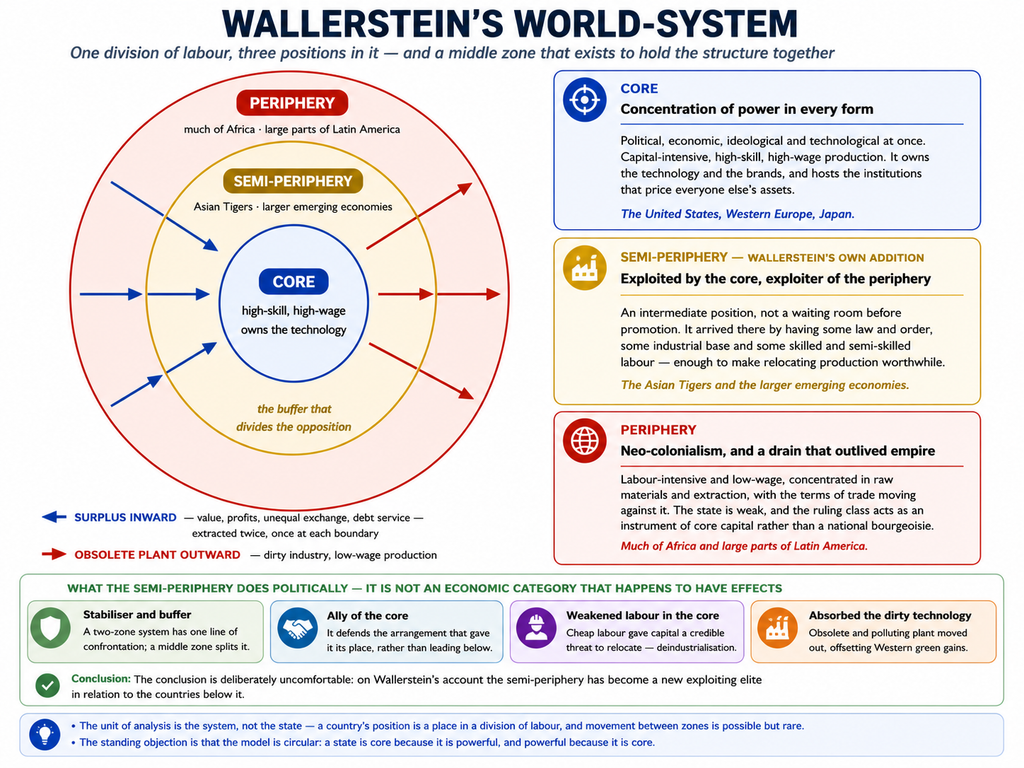
- Core states are defined by the concentration of power in every form — political, economic, ideological and technological.
- They specialise in capital-intensive, high-skill, high-wage production, own the technology and the brands, and host the institutions that price everyone else’s assets — the United States, Western Europe, Japan.
- Peripheral zones remain under neo-colonialism, where the drain of wealth continues after formal independence.
- Production is labour-intensive and low-wage, concentrated in raw materials and extraction, with terms of trade moving against them.
- The state is weak and the local ruling class functions as an instrument of core capital rather than as an independent national bourgeoisie — much of Africa and large parts of Latin America.
- Semi-peripheral states are Wallerstein’s own addition to the dependency vocabulary and the theory’s most original element.
- They are exploited by the core and exploiters of the periphery at the same time — an intermediate position, not a waiting room before promotion.
- They reached this zone because they possessed some law and order, some industrial base and some skilled and semi-skilled labour, which made them worth relocating production to — the Asian Tigers and the larger emerging economies.
What the semi-periphery does politically
The semi-periphery is not an economic category that happens to have political effects. Wallerstein introduced it because a system polarised into two camps would have torn itself apart long ago, and something must hold it together.
- It is the system’s stabiliser and buffer. A structure of only rich and poor produces a single line of confrontation; a middle zone divides the opposition and supplies a visible example of upward movement.
- Semi-peripheral states became allies of the core rather than leaders of the periphery, defending the arrangement that gave them their position.
- It is because of these states that socialist revolution on a global scale has not been possible — the coalition that could have carried it was split exactly where it needed to hold.
- They weakened labour in the core. By supplying cheap labour to core capitalists they gave capital a credible threat to relocate.
- Wages and bargaining power in the core fell, and unemployment and deindustrialisation in the old industrial regions followed — one root of the political backlash now reshaping core politics.
- They absorbed outdated and dirty technology, because weak regulation made it possible to shift obsolete plant and polluting processes out of the core.
- This offset the achievements of Western civil society, and especially of its environmental movements: the emissions and the toxic industries did not disappear, they moved.
- The conclusion is deliberately uncomfortable: the semi-periphery has become a new exploiting elite in relation to the countries below it.
The temporal dimension
- Every system has a lifespan. The present world-economy originated in the long sixteenth and seventeenth centuries and is, on this account, moving towards its end.
- Cyclical rhythms — capitalism moves in cycles of boom and bust rather than in a straight line.
- Long Kondratieff waves of roughly fifty years: expansion driven by a cluster of innovations, then stagnation and restructuring.
- Secular trends are the cumulative one-way movements cycles cannot reverse, and they express capitalism’s contradictions.
- The central one is the conflict between wage suppression and demand: every capitalist wants to cut wages for profit, but wages in aggregate are the purchasing power on which the realisation of profit depends, so cutting them slows the economy.
- Crisis arrives when cyclical downturns can no longer be resolved and secular trends have run to their limits.
- This is also the theory’s most exposed prediction, and the honest observation is that the terminal crisis has been imminent for fifty years.
The cultural dimension: geoculture
- Geoculture is Wallerstein’s term for the shared cultural framework that makes a world-system feel legitimate from inside. Its components are science, supplying authority, and liberalism, supplying the political language; both stabilise capitalism.
- Culture is not neutral scenery. Cultural norms, ideologies and education systems are shaped by the core and legitimise its dominance.
- The spread of consumerism, individualism and liberal democracy is presented as universal progress and functions as a tool of hegemonic control, reinforcing the hierarchy rather than describing it.
- Liberalism as the geoculture of the world-system is his sharpest formulation. After the French Revolution liberalism became the dominant ideology of the system as a whole, and its function was to manage demands for change by conceding them slowly.
- He dated the exhaustion of this geoculture to 1968, read as a world revolution against both the system and the liberal centre claiming to manage it; what follows is a period without a legitimating ideology, which is his explanation for present disorder.
Criticism of world-systems theory
- Monocausal and economically determinist. Everything is explained by the logic of accumulation, and international politics is too complex to reduce to a single factor — nationalism, religion and ethnicity keep behaving as independent causes.
- The circularity problem. A country is core because it is powerful and powerful because it is core; the categories are read off the outcomes they are meant to explain.
- The semi-periphery is especially elastic, having housed Ireland, Brazil, South Africa, South Korea, Poland and India, which makes the scheme hard to falsify.
- No account of the autonomy of the state. States appear as functions of their zone, which cannot explain Japan’s rise, the Soviet construction of an alternative order, or China’s trajectory since 1978.
- Robert Brenner’s critique is the most serious from inside Marxism. Wallerstein explains class relations by exchange — position in the circuit of trade — rather than by production, by the actual relations under which surplus is pumped out of direct producers.
- Brenner called this neo-Smithian Marxism: it makes the market rather than the class structure the motor of history, which inverts Marx, and it cannot explain why the transition to capitalism occurred in England rather than anywhere else that traded.
- Eurocentrism on the post-colonial reading — the framework is built from Western experience and treats the rest of the world as terrain. Frank himself later turned this against Wallerstein in ReOrient, arguing that a single world system long predates 1500 and had Asia at its centre until recently.
- The unfulfilled prophecy. The terminal crisis has been announced since the 1970s, while the system absorbed the collapse of state socialism, incorporated China and survived 2008.
The Neo-Gramscian School
Gramsci’s hegemony, before it was internationalised
- Antonio Gramsci asked why the exploited majority in the developed West did not overthrow a system that caused it so much hardship, and rejected the answer that coercion alone explains it.
- Hegemony is therefore the ability of a dominant class to rule by winning the consent of those it subjugates, as an alternative to coercion.
- Consent is manufactured, not given. Bourgeois moral, political and cultural values are so widely dispersed that subordinate classes accept them as their own, internalising them until they become unquestioned common sense.
- The work is done by the institutions of civil society — media, schools, churches, voluntary associations — not by the coercive apparatus of the state.
Robert Cox and the internationalisation of Gramsci
- Robert Cox, in “Social Forces, States and World Orders: Beyond International Relations Theory” (1981), transposed hegemony to the global level.
- Material structure alone is not enough. To explain American hegemony one must look past economic and military power to the ideological power it exercises.
- The American case, stated precisely: the liberal international economic order is designed to benefit the United States, and the United States has persuaded the international community that it benefits everyone. When all endorse the order, the endorsement itself further entrenches the hegemon.
“Theory is always for someone and for some purpose.” — Robert Cox
- There is no view from nowhere. Every theory is written from a social position and serves interests whether or not the theorist intends it, and Cox concluded that realism and liberalism alike are written from the standpoint of the capitalist class.
Problem-solving theory against critical theory
| Problem-solving theory | Critical theory | |
|---|---|---|
| Takes the order as | Given — the fixed framework within which problems arise | Historical — something that came into being and can pass away |
| Question asked | How do we make the existing arrangement work more smoothly? | How did this order come about, whose interests does it serve, and can it be changed? |
| Treatment of structures | Held constant so that variables can be isolated | The object of enquiry itself |
| Political effect | Inherently conservative — it improves the status quo and thereby stabilises it | Emancipatory — it opens the possibility of an alternative order |
| Typical practitioners | Structural realism, neo-liberal institutionalism, most policy analysis | Cox, the Frankfurt tradition, world-systems and dependency writers |
- Why problem-solving theory is conservative even when its practitioners are not. By fixing the framework in order to study behaviour within it, it makes the framework invisible, and what cannot be seen cannot be contested.
Historical structures and the three-part fit
- Hegemony at the world level is a fit between three categories of force, none of which is prior to the others.
- Material capabilities — productive and destructive potential, technology, resources, wealth.
- Ideas — both the shared meanings that make social practice possible and the collective images of world order that legitimate or contest it.
- Institutions — the means by which a particular order is stabilised and perpetuated, from the Bretton Woods bodies to the norms of trade law.
- Cox also distinguished three levels at which structures operate and interact: social forces generated by the organisation of production, forms of state produced by particular state–society complexes, and world orders.
The Gramscian vocabulary transposed
- Historic bloc — the durable alliance of social forces, held together by a shared ideology, on which a hegemonic order rests. Hegemony is a historic bloc that has become common sense.
- Passive revolution — change imposed from above to forestall change from below, modernising a society while leaving the class structure intact; much post-colonial state-led development reads this way.
- Trasformismo — the absorption of potentially counter-hegemonic leaders and ideas into the existing order, which neutralises opposition by co-opting it. Radical demands re-emerge as technical reforms.
- The internationalisation of the state — the process by which national state apparatuses are reoriented to serve the requirements of the world economy.
- Finance ministries and central banks, which face outward, gain power over labour and welfare ministries, which face inward, converting the state into a transmission belt from global market discipline to domestic society.
Gill, van der Pijl and Sklair
- Stephen Gill — disciplinary neoliberalism, in which market power itself disciplines states and populations through credit ratings, bond markets and investor sentiment.
- New constitutionalism is its legal form: locking market rules beyond democratic reach through central bank independence, balanced-budget rules, investment treaties and investor–state dispute settlement, so that whoever wins an election cannot change the economic constitution.
- Kees van der Pijl — the formation of a transnational ruling class across the Atlantic, traced through elite planning bodies, business councils and interlocking directorates, and the rivalry between money capital and productive capital fractions within it.
- Leslie Sklair — the transnational capitalist class, composed of corporate executives, globalising bureaucrats and politicians, professionals, and consumerist elites in media and retail, held together by the culture-ideology of consumerism.
The Frankfurt School and Critical Theory in International Relations
- The lineage. Critical Theory originated in the Frankfurt School in the first half of the twentieth century, itself beginning from a critique of orthodox Marxism, and it was later shaped strongly by Gramsci.
- Max Horkheimer’s distinction between traditional theory, which mirrors the natural sciences and describes the world as it is, and critical theory, which aims at human emancipation, is the founding move.
- The three postulates of positivism rejected. Critical theorists deny the possibility of objective knowledge, the subject–object distinction, and a value-free social science.
- For them, the social world is a construction of time and place; the international system is a specific construction by the most powerful states; and everything social is therefore changeable and historical.
- Andrew Linklater is the leading exponent within the discipline, and his project is the widening of moral community.
- The core claim is that territorial borders have no intrinsic moral significance — the accident of birthplace cannot justify treating some people’s claims as weightier than others’.
- He argues for a post-Westphalian political community in which citizenship, rights and obligation are unbundled from a single sovereign territory, with authority dispersed across several levels.
- He calls for strengthening transnational civil society and grassroots democracy, so that citizens are empowered enough to press ruling classes towards responsible action — the practical bridge between critique and politics.
- Ken Booth and the Welsh School extend this into security studies.
- Security is emancipation. The referent object should be the individual human being, not the state, and the state is a means to security rather than its end — often, indeed, the principal threat to its own citizens.
- The problem critical theory creates for itself is real and should be faced. If theory is always for someone and for some purpose, there is no neutral ground from which to judge which theory is better.
- The Frankfurt reply is that critical theory is judged by an immanent standard — it holds a society to the emancipatory promises it already makes, rather than to an external yardstick.
- Habermas’s reply is procedural: the test is whether a claim could command agreement in undistorted communication among all affected.
- Neither answer fully escapes the difficulty, and the honest verdict is that critical theory buys its insight into the politics of knowledge at the price of a foundation for its own claims.
If every theory serves someone, the theory that says so is not exempt from its own finding.
Neo-Colonialism
- Kwame Nkrumah, Ghana’s first president, gave the term its currency. He gave it its systematic statement in Neo-Colonialism: The Last Stage of Imperialism, building on the definition adopted by the All-African People’s Conference in 1961 and on Sartre’s earlier use of the word.
“The essence of neo-colonialism is that the State which is subject to it is, in theory, independent and has all the outward trappings of international sovereignty. In reality its economic system and thus its political policy is directed from outside.” — Kwame Nkrumah
- Four further claims complete the thesis.
- Foreign capital is used for exploitation rather than development of the less developed parts of the world.
- It is the worst form of imperialism: for those who practise it, power without responsibility; for those who suffer it, exploitation without redress. The colonial power no longer answers for famine, policing or public order.
- Balkanisation is deliberate. Large colonial territories are broken into small non-viable states incapable of independent development, which must rely on the former imperial power for defence and even internal security.
- Aid is a revolving credit paid by the neo-colonial master, passing through the neo-colonial state and returning to that master as increased profits.
- The mechanisms, set out concretely.
- Aid and conditionality — assistance tied to procurement from the donor, to policy change, or to political alignment.
- Debt — repayment obligations that constrain budgets more tightly than any colonial governor did, with debt service crowding out health and education.
- Terms of trade — the classic squeeze in which rich countries sell manufactures dear and buy commodities cheap, controlling both prices and the shipping, insurance and banking services around the trade.
- Multinational corporations — transfer pricing, repatriated profit, and control of technology and distribution.
- Currency arrangements — the CFA franc, pegged and until recently backed by reserves deposited with the French Treasury, is the clearest institutional case; the 2019 reform to the eco removed the deposit requirement and the French presence on the board while retaining the euro peg.
- Contemporary forms.
- Structural adjustment and IMF conditionality — devaluation, subsidy removal, privatisation and public-sector retrenchment imposed as the price of liquidity, which critics read as policy sovereignty exercised from Washington.
- The “debt-trap diplomacy” argument about the Belt and Road, usually illustrated by Hambantota, whose port was leased to a Chinese firm for 99 years in 2017.
- The honest evidence runs against the strong version. Work by Lee Jones and Shahar Hameiri and by Deborah Brautigam finds a different story.
- Sri Lanka’s distress was driven mainly by sovereign bonds held by Western creditors, not by Chinese lending.
- The port was a domestic political project of the Rajapaksa government rather than a Chinese design, and the lease proceeds went to shore up reserves rather than to cancel Chinese debt.
- The useful conclusion is that asymmetric lending creates real leverage without requiring a deliberate trap.
- Data colonialism — the argument of Nick Couldry and Ulises Mejias that human life is appropriated as raw material for capital much as land and labour once were, with data extracted in the global South and owned in a handful of core jurisdictions.
Cultural Imperialism
- Herbert Schiller gave the thesis its canonical form: the media and communication systems of a dominant society penetrate weaker societies and pull their elites into supporting the values and structures of the dominant centre.
- Johan Galtung’s structural imperialism supplies the model that generalises it.
- The world divides into Centre and Periphery nations, and each nation contains its own centre and periphery.
- The relationship works through a harmony of interest between the centre of the Centre and the centre of the Periphery, a disharmony within the Periphery nation, and a larger disharmony between the two peripheries.
- The structure is reinforced by a feudal interaction pattern: peripheries trade vertically with their Centre and are discouraged from trading horizontally with one another, and their links to the outside world run through the Centre.
- Galtung distinguished five types — economic, political, military, communication and cultural imperialism — and the cultural type transmits the Centre’s teachers, models and news definitions.
- The NWICO debate turned this into a diplomatic conflict. Developing countries argued that the one-way flow of news through four Western agencies made their politics visible to the world only as coups and famines.
- The New World Information and Communication Order was pressed through UNESCO in the 1970s, and the MacBride Report, Many Voices, One World, documented the imbalance and called for a more equitable flow.
- The West read it as a licence for state control of the press; the United States and the United Kingdom withdrew from UNESCO in the mid-1980s, and NWICO effectively collapsed. It is the clearest case of a Marxist-influenced analysis becoming a live inter-state dispute and losing.
- George Ritzer’s McDonaldisation describes the spread of fast-food organisational principles — efficiency, calculability, predictability and control — through education, health care, work and leisure worldwide, with the irrationality of rationality as the cost.
- The counter-arguments are strong and the thesis should not be treated as settled.
- John Tomlinson argues that the concept is incoherent as usually stated: it slides between complaints about capitalism, the West, modernity and media without distinguishing them, and it assumes a passive audience it never studies.
- Jan Nederveen Pieterse proposes hybridisation instead — cultural flows mix rather than replace, and the interesting phenomena are the new forms that result.
- Reception theory shows audiences decode what they receive through local frames, reinterpret it, and often prefer local content when it exists.
- Arjun Appadurai’s five scapes — ethnoscapes, mediascapes, technoscapes, financescapes and ideoscapes — describe global cultural flows as disjunctive, moving at different speeds in different directions, which no single-centre model can capture.
- Non-Western cultural exports are now a major fact: Indian cinema and the platforms carrying it, Nollywood among the world’s largest film industries by output, the global reach of Korean film and popular music, Turkish serials, and Japanese animation.
- The defensible residue is that flows remain asymmetric and that the infrastructure — platforms, recommendation algorithms, advertising markets, payment rails — is more concentrated than the content moving through it.
What Marxism and Realism Share
Placing a materialist theory of class beside a materialist theory of power produces more overlap than either school enjoys admitting, and the overlap is the reason both find liberalism naive.
- Both are materialist. Explanation runs from material forces — the mode of production for one, the distribution of capabilities for the other — not from ideas, norms or good intentions.
- Both are structural. Actors behave as their position in a structure requires, so a benign leader in a hostile structure behaves much like a malign one.
- Both are sceptical of moral rhetoric. Appeals to human rights, free trade or international community are read as ideological cover for interest — Carr’s demolition of the harmony of interests and the Marxist critique of ideology are the same manoeuvre performed on different targets.
- Both see conflict as endemic, arising from the system rather than from misunderstanding, and both therefore reject liberalism’s harmony of interests.
| Realism | Marxism | |
|---|---|---|
| Primary unit | The state | Classes and the world capitalist economy |
| Basic driver | Power and security under anarchy | Accumulation and class exploitation |
| Source of conflict | The security dilemma, scarcity, human nature | The contradictions of capitalism |
| Nature of the structure | Permanent — anarchy cannot be transcended | Historical — capitalism began and will end |
| Purpose of theory | To explain and to advise prudent statecraft | To expose and to emancipate |
| Verdict on the other | Marxism mistakes economics for the whole of politics | Realism naturalises a historically specific order |
The Charge of Economic Reductionism
- The charge: by deriving war, alliance, law and identity from the economic base, the approach explains too much with too little, and is therefore monocausal.
- The Cold War’s ideological intensity, the persistence of nationalism, the force of religion and the Sino-Soviet split — a conflict between two socialist states — resist a purely economic reading.
- The replies are serious and partly successful.
- Engels himself insisted that the economic factor is determining only in the last instance, and that the superstructure reacts back upon the base.
- Gramsci and Cox exist precisely to answer this, making ideas, institutions and consent constitutive of order rather than derivative of it — which is why the neo-Gramscian school is the tradition’s strongest contemporary form.
- The fair verdict is that reductionism is a real tendency of the tradition rather than a defining property of it, and that the strands which corrected it are the ones still generating research.
Relevance After the Cold War and Under Globalisation
The strongest case against the approach is that history has already tested it: the states built in its name collapsed, the immiseration it predicted did not arrive, and the largest surviving communist party presides over the most spectacular capitalist accumulation in history. The strongest case for it is that the structural claims and the distributional predictions have held up far better than the political ones.
What the evidence supports
- Global wealth and income concentration. Oxfam’s January 2026 assessment puts the top 1% at 43.8% of global wealth and the poorest half at 0.52%, with the number of billionaires passing 3,000 for the first time; the World Inequality Report 2026 finds the top 10% earning more than the remaining 90% combined.
- The World Bank’s revised $3.00-a-day line puts 2024 extreme poverty at 847 million people, 10.4% of the world — enormous progress against 1990, and still a tenth of humanity.
- Global value chains and the smile curve. Value in a modern product is captured at the ends — design, branding, intellectual property, finance — and squeezed in the middle, which is assembly.
- Labour arbitrage is the operating principle: production is sited where labour is cheapest and least protected, and the credible threat of relocation disciplines labour everywhere.
- The 2008 crisis restored the credibility of crisis theory. Losses were socialised through public bailouts and gains re-privatised, which is difficult to describe without the vocabulary of class.
- Climate justice. Those who contributed least to cumulative emissions bear the largest damages, and the loss and damage fund established at COP28 had attracted roughly $768 million in pledges against annual needs estimated in the hundreds of billions.
- Vaccine apartheid. The core secured supply first; the India–South Africa TRIPS waiver proposal was resisted for over eighteen months, and the June 2022 decision that emerged was narrow, limited to vaccines, and never extended to therapeutics.
What the evidence undercuts
- The collapse of actually-existing socialism removed the alternative the theory pointed to, and left it stronger at diagnosis than at prescription.
- China’s own capitalist integration is the deepest embarrassment: the largest communist party in the world produced the largest wave of capitalist accumulation, and is now itself a lender and investor.
- The immiseration prediction failed. Absolute poverty fell dramatically over three decades, and living standards in the periphery rose even as relative inequality widened — the theory is far better on the second fact than on the first.
- Class did not become the master identity. Nationalism, religion and ethnicity have repeatedly overridden it, and today’s revolt against globalisation is more often nationalist than socialist.
- The return of overt geopolitics — territorial war in Europe, alliance hardening, technology controls — is a poor fit for a framework that reads states as functions of capital.
The reasonable assessment
- It is the only major approach whose central question is inequality, which is why it is indispensable exactly where realism and liberalism are weakest — on why sovereign equals are so unequal in fact.
- The approach lost its political programme and kept its analytical apparatus. What survives is the insistence that the world economy is one structure, that positions within it are relational, and that distribution is a political outcome.
The Indian Anchor
- The drain of wealth is one of the earliest systematic economic critiques of imperialism anywhere, and it predates Hobson by decades.
- Dadabhai Naoroji, in Poverty and Un-British Rule in India, argued that a large part of India’s annual product was transferred to Britain without any equivalent return — home charges, pensions and salaries paid in England, guaranteed returns on railway capital, and the export surplus that bought nothing.
- R. C. Dutt, in The Economic History of India, supplied the archival documentation, tracing land revenue policy, famine and the collapse of handicrafts across a century.
- The deindustrialisation debate is the contested core of the argument: Indian handicrafts, above all textiles, were destroyed by discriminatory tariffs, lost court patronage and machine competition, pushing artisans back onto the land.
- Critics reply that machine competition would have displaced handicrafts anyway and that regional evidence is uneven; the dispute is open, but the direction of tariff policy is not in doubt.
- R. P. Dutt, in India Today, gave the fullest Marxist account of Indian colonialism, periodising it into mercantile plunder, free-trade exploitation and finance-capital investment, and treating the Congress leadership as an expression of an emerging Indian bourgeoisie.
- M. N. Roy is the single most direct Indian contribution to Marxist international theory.
- At the Second Congress of the Communist International in 1920 he presented supplementary theses challenging Lenin’s on the national and colonial question.
- Lenin’s position was that communists in colonies should support bourgeois-democratic national liberation movements as a stage on the road to socialism.
- Roy’s position was that the colonial bourgeoisie was compromised by its ties to imperial capital and would betray the revolution, so communists should build independent worker and peasant organisations rather than subordinate themselves to nationalist parties.
- He also argued that European capitalism depended on colonial superprofits, so revolution in the colonies was not a sideshow to European revolution but a precondition of it — an inversion of the conventional order of priority.
- Both were adopted, the compromise softening Roy’s. Roy’s later thesis of decolonisation — that imperial powers might grant independence while retaining economic control — anticipates neo-colonialism by thirty years.
- India’s NIEO leadership and third-worldism. India was a principal architect of the New International Economic Order pressed through UNCTAD and the Non-Aligned Movement — commodity price stabilisation, technology transfer, regulation of multinationals, a right to nationalise.
- Prabhat Patnaik and Utsa Patnaik are the leading contemporary Indian Marxist political economists.
- Prabhat Patnaik argues that imperialism persists as a mechanism for imposing income deflation on the periphery to keep tropical commodity prices stable for core consumers.
- Utsa Patnaik’s reconstruction of the drain from trade and fiscal records produced a much-contested estimate of roughly $45 trillion transferred from India between 1765 and 1938 — an estimate rather than a settled fact, but one that returned the thesis to international debate.
- India at the WTO reads cleanly as periphery politics.
- On agriculture, India has defended public stockholding for food security against the argument that administered procurement prices breach subsidy limits; the peace clause agreed at Bali remains a temporary shield, and the permanent solution is still unresolved.
- On special and differential treatment, India resists the demand that large developing economies graduate out of it — a semi-peripheral state defending the terms of its own position, exactly as Wallerstein would predict.
- The wider context is an institution under strain: the WTO’s Appellate Body has been unstaffed since December 2019, leaving the dispute system without a final instance.
The oldest Indian contribution to this tradition is also its most durable: the demonstration that a colony can be poor because of, and not merely during, its integration with a richer economy.
Previous Year Questions
- Explain the central tenets of the World-Systems Theory. (2024)
- “The Gramscian theory of hegemony provides many valuable insights into the nature of global power.” Comment. (2024)
- Discuss the commonalities between the Marxist and Realist approach to the study of International Politics. (2022)
- “Marxist approach to the study of international relations has lost its relevance in the post-cold war era.” Comment. (150 words) (2021)
- Explain the relevance of the Marxist approach in the context of globalization. (2019)
- Examine the World Systems Approach as developed by Immanuel Wallerstein. (2017)
- How does Marxist approach explain contemporary International Relations? (200 words) (2013)
- Do you agree with the notion that Marxist approach to the study of International relations is largely based on economic reductionism? Give reasons. (2008)
- Comment: Marxist approach to international politics. (2002)
- Comment: Neo-Colonialism. (1998)
- Comment: Cultural Imperialism. (1997)
- Comment: Cultural Imperialism. (1993)
- Comment: Neo-colonialism. (1991)
The 2012 question on whether Dependency Theory offers a robust critique of the development process in Africa and Latin America is answered in the companion note on the post-colonial theory of the state.
