

Comparative Politics: nature and major approaches; political economy and political sociology perspectives; limitations of the comparative method.
This article covers the two approaches that gave modern comparative politics its vocabulary — Easton’s systems analysis and the structural-functionalism of Almond, Coleman and Powell — together with their cybernetic and decision-making cousins.
Official Syllabus: Paper II, Section A, Unit 1
The problem the behavioural generation faced was not that it lacked information about the new states of Asia and Africa. It was that it lacked words that would fit both a Westminster parliament and a one-party African state without insulting one of them.
Every available category was borrowed from Western constitutional practice. Cabinet, opposition, federalism, judicial review — used of a post-colonial polity, each of these either described something that did not exist or described something that existed on paper and did nothing in practice. A vocabulary derived from one civilisation’s institutions cannot describe another’s without turning difference into deficiency.
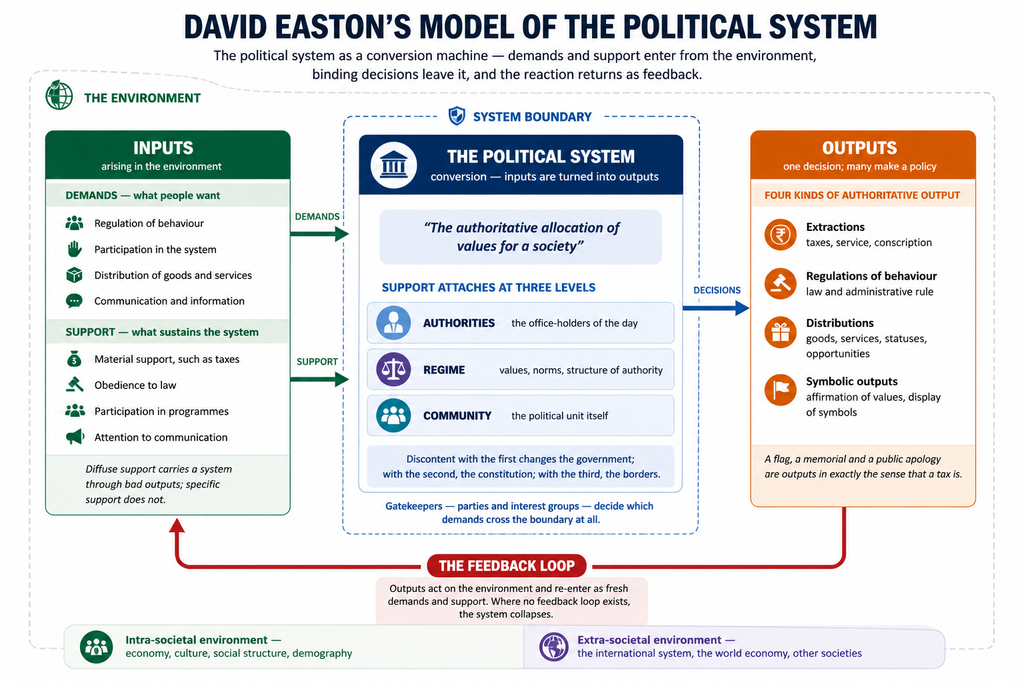
David Easton’s answer was to abandon institutional vocabulary altogether. If the political system is defined by what it does rather than by what it is made of, then any polity anywhere can be described in the same terms — because every polity, however organised, receives demands, converts them into binding decisions, and lives with the consequences. The state, an institutional term, was replaced by the political system, a functional one.
Gabriel Almond then supplied what Easton’s model lacked. Easton’s political system was a black box: demands went in and policies came out, with nothing said about what happened inside. Almond opened the box by borrowing from anthropology the idea that all societies perform the same essential functions through different structures — so that comparison should proceed by function rather than by institution.
Between them these two frameworks did what traditional comparative politics never managed: they made unlike systems genuinely comparable. They also carried a bias that neither author fully saw, and the demolition of that bias is most of the story of what came after.
What This Note Covers
- Why the systems approach was needed — the grand-theory ambition, Parsons’s influence, and the works in which Easton set it out.
- Every concept in Easton’s model — system, political system, authoritative allocation of values, environment, boundary, inputs, gatekeepers, conversion, outputs, feedback, stress and persistence.
- The four types of demand, the four types of support and the four types of output, and how stress is regulated.
- Karl Deutsch’s communications theory and decision-making analysis — the two other models built on the same systems foundation.
- Structural-functionalism — its anthropological ancestry, Almond and Coleman’s four characteristics of every political system, and the seven-function scheme of Almond and Powell.
- Almond’s later three-level model — system, process and policy functions, and the five capabilities.
- Structural differentiation and cultural secularisation as the markers of political development, and Almond’s four-fold classification of systems.
- The full critique, named and attributed — traditionalist, Marxist, feminist, post-colonial, and the internal methodological objections of tautology, teleology and conservative bias.
- The Indian application — Kothari’s Congress system, caste associations as interest articulators, and why Kothari abandoned the framework.
- What survives — where systems and functional thinking still do real work.
Why the Systems Approach Emerged

- The behavioural movement’s ambition was to make political science a science, and a science needs general theory — propositions that hold across all instances of its object, not descriptions of particular instances.
- David Easton set out to build a grand theory: a single model, applicable to the political system of any country whatever, that would be value-free and would allow genuinely equivalent comparison.
- The immediate intellectual source was sociology. Talcott Parsons had developed social system analysis, treating society as a system of interdependent sub-systems each performing a necessary function. Easton adapted the framework to politics.
- Behind Parsons stood general systems theory in biology and, through Norbert Wiener, cybernetics — the study of control and communication in machines and organisms. Behaviouralists imported the concept of the system from the natural sciences precisely because they wanted political science to look like one.
- The works: The Political System (1953) opened with the critique of traditionalism’s failure to build theory; A Framework for Political Analysis and A Systems Analysis of Political Life (both 1965) set out the model in full.
- The purpose is worth stating exactly, because most criticism of Easton misses it: he was not asking how policies are made or who holds power. He was asking how political systems persist — how any system of authority survives the stresses placed on it, and what happens when it cannot.
Easton’s Model, Concept by Concept
The concept of a system
- A system is a set of elements in a state of interaction. The crucial word is interaction: the elements affect one another, and the interaction is patterned rather than haphazard.
- Dahl’s formulation is the most usable: any collection of elements that interact in some way with one another can be considered a system — a galaxy, a football team, a legislature, a political party.
- Elements are treated abstractly rather than concretely. The elements of a political system are not a group of individuals constituting a government; they are abstract interactions.
The political system and the authoritative allocation of values
- Just as a body contains many systems, a society contains many systems. The criterion that distinguishes one from another is the function it performs.
- Easton’s definition is the most-quoted sentence in comparative politics.
“The political system is that system of interactions in any society through which binding or authoritative allocations are made and implemented.” — Easton
- Allocation of values means deciding the distribution of goods, resources, honours, titles, statuses and opportunities — deciding who gets what.
- Authoritative means the decisions are binding, backed by the accepted right to enforce them and by sanction against those who do not comply.
- “For a society” marks the boundary: a corporation or a family allocates values, but not for the society as a whole.
- This definition is what makes universal comparison possible. A Westminster cabinet, a Politburo, a military junta and a village council are all doing the same thing — allocating values authoritatively — and can therefore be compared without either being taken as the standard.
System against state
- Traditionalists use the term state, which denotes institutions. State belongs to the institutionalist approach; political system belongs to the behavioural one.
- The system denotes not only structures but processes and functions, and it includes the whole set of elements within which any particular institution sits.
- The gain was real: the shift let scholars take account of the extra-legal, para-legal and social institutions that turned out to be decisive in non-Western politics and invisible to constitutional analysis.
- The loss was also real, and new institutionalism later collected on it: the state is not merely an arena in which social forces contend but an actor with interests of its own — which is exactly what the systems vocabulary made it impossible to say.
Environment and boundary
- Everything outside the political system that affects it constitutes the environment of that system.
- Intra-societal environment — the economy, the culture, the social structure, the demographic and ecological systems within the same society.
- Extra-societal environment — the international political system, the international economy, other societies’ cultures. This is what makes the model usable for the study of dependent and post-colonial states, whose politics is shaped decisively from outside.
- Every system has a boundary, which marks the limit of the environment. Systems kept outside the boundary do not impact the main system.
- The political system is an open system — it exchanges continuously with its environment — and self-regulating, adapting its own behaviour in response to what it receives.
Inputs: demands and support
- The system receives two kinds of input from its environment.
- Demands are what people want from the system, and Easton classifies them into four:
- Demands for the allocation of goods and services — wages, education, roads, health care, welfare.
- Demands for the regulation of behaviour — public safety, control of markets, rules on conduct.
- Demands for participation in the political system — the franchise, the right to organise, representation.
- Demands for communication and information from the authorities — the display of majesty, statements of policy, information on threats.
- Support is what sustains the system and makes its functioning possible, and it too has four forms:
- Material support — the payment of taxes, contribution of goods and services.
- Obedience to law and to regulations.
- Participatory support — voting, political discussion, other forms of political activity.
- Attention to government communication and deference to public authority.
- Easton distinguished specific support, given in return for satisfactory outputs, from diffuse support — a reservoir of goodwill towards the regime and the political community that does not depend on immediate performance. Diffuse support is what allows a system to survive a period of bad outputs, and its erosion is what makes backsliding possible.
- Support attaches at three levels, and separating them is one of Easton’s genuinely valuable analytical moves: the political community, the regime (its values, norms and structure of authority) and the authorities (the particular occupants of office).
- Discontent with the authorities produces a change of government; discontent with the regime produces constitutional change; discontent with the political community produces secession. The same anger, aimed at three different targets, produces three different politics.
Conversion, and the gatekeepers
- The political system operates like a machine, and every machine works on the principle of input and output. It is a conversion machine, which converts inputs into outputs.
- Conversion is not simple. Of the many demands made on a system, some are lost in transit and never reach the output stage, and the model gives that filtering a name.
- Gatekeepers — pressure groups, interest groups and political parties — stand at the boundary and decide which demands enter the system at all. What never becomes an input has been governed as surely as what does, which is why the concept anticipates the later literature on non-decision-making and agenda control.
Outputs
- Outputs are the authoritative decisions and actions of the system.
- The distinction is simple and worth keeping: a single decision is a decision; a set of related decisions constitutes a policy.
- Outputs come in four kinds, which mirror the four types of demand:
- Extractions — taxes, personal service, conscription, contributions.
- Regulations of behaviour — the whole range of law and administrative rule.
- Allocations or distributions of goods, services, opportunities, honours and statuses.
- Symbolic outputs — the affirmation of values, the display of political symbols, the communication of policy intent. A flag, a memorial, a national holiday and a public apology are outputs of the political system in exactly the sense that a tax is.
Feedback
- Feedback plays the decisive role in the maintenance of the system. Outputs interact with the environment, and information about their effect re-enters the system through the feedback loop, modifying its future behaviour.
- Feedback is essentially a communication process which produces action in response to information about the state of the system or its environment. It tells the political system where its goal is, how far it stands from it, and what its own performance has done to that distance.
- If a feedback loop does not exist, the system will collapse — because it will keep producing outputs that generate no support and will never learn that it is doing so.
- The full cycle: demands and support (input) → the authorities (conversion) → decisions and policies (output) → reaction in the environment (feedback) → new demands and support (input), and so on without end.
Stress and how systems handle it
- Stress arises when inputs overload the conversion capacity of the system — too many demands, or too much insistence on a particular type of demand, so that the channels are overloaded. Easton calls these demand stress and support stress.
- Four regulatory mechanisms are available:
- Structural regulation — parties and pressure groups acting as gatekeepers, admitting only demands the system can process.
- Cultural regulation — norms that make some demands socially unacceptable, so they are never made.
- Communication regulation — expanding the channels so a larger volume can flow through.
- Regulation within conversion — legislative, executive and administrative devices for reducing, delaying, combining or shelving demands.
- If stress reaches a critical level and persists, change in the authorities or even in the regime — through election, or through revolution — becomes inevitable, and failure to control it may bring about the destruction of the system itself.
- This is Easton’s answer to the charge that he cannot explain breakdown, and it is a partial answer: he has a vocabulary for system failure, but he treats persistence as the norm and failure as the exception requiring explanation, rather than the reverse.
The systems model made every polity describable in one vocabulary — and in doing so made stability the definition of health and revolution the definition of failure.
Two Cousins of the Systems Model
Karl Deutsch and communications theory
- Karl Deutsch, in The Nerves of Government, applied cybernetics — the study of control and communication systems in both organisms and machines — to political analysis.
- His formulation is the memorable one: his work was concerned with the nerves of government rather than its bones or muscles — with its channels of communication and decision rather than its structures of power.
- It might be more profitable, he argued, to look at government less as a problem of power and more as a problem of steering — directing the course of activity, which is the function communication performs.
- The political system is therefore a network of communication channels, largely self-regulating, which evolves its own mechanisms for the acquisition, transmission, selection and storage of information.
- The components of analysis are the structures that send and receive messages; the channels, with their load, load capacity, rate of flow, and the lag or gain in responding; storage of information; feedback mechanisms; codes and languages; and message content.
- Communication may be studied within a political system, between a system and its environment, and between two or more systems.
- Distortion is the central analytical problem — the difference between what goes out from the source and what the recipient receives — and correcting distortion is where the approach earns its keep.
- Its use is real but bounded: it illuminates bargaining, conflict resolution, decision-making, propaganda and the dynamics of international relations, and it is almost useless for analysing power structure, ideology, resource allocation, violence and revolution.
Decision-making analysis
- Decision-making analysis treats politics as a process of arriving at decisions, which follows directly from Easton’s treatment of decisions as the system’s output.
- Every actor is a decision-maker: parties decide whom to nominate, voters decide whether and for whom to vote, legislators decide what to support, executives decide what to seek, sign, veto and how to administer.
- The analysis involves identifying the issues on which decisions are made; the structures involved; the actors, including their personalities where relevant; the alternative courses considered; the preferences and utilities that governed the choice; and the external pressures and constraints that shaped it.
- Its comparative payoff is that it can be applied identically to a cabinet, a politburo and a junta, since all of them decide, whatever their constitutional description.
The Structural-Functional Approach
Why Almond went beyond Easton
- The structural-functional approach was developed to address specific deficiencies in the systems approach.
- The systems approach was too general. It did not describe in any detail the structures and processes within the political system — the conversion box stayed black.
- It was criticised as too static, unable to handle systems that were changing rapidly.
- It was modelled on Western political systems and therefore of limited relevance to the study of developing societies — which was precisely the material the new comparative politics existed to explain.
- Structural-functionalism is built on Easton’s foundation, not against it. The systems approach remains its basic conceptual framework.
- The difference is one of focus: Almond and Powell take a micro-view where Easton takes a macro-view, and their aim is a more genuinely universal model, useful for developing countries rather than merely applicable to them.
The anthropological borrowing
- The approach originated in social anthropology, in the work of Bronisław Malinowski and A. R. Radcliffe-Brown, and was developed in sociology by Talcott Parsons, Robert Merton and Marion Levy. Almond and his associates turned it into a tool of political analysis.
- The anthropologists’ finding was the crucial one: all societies perform certain essential functions, but the structures performing those functions vary enormously.
- Applied to politics: every political system must perform the function of security, or of rule-making, but the institutions that perform it may be a parliament, a party congress, a council of elders or a king.
- This solves the comparability problem at a stroke. If comparison proceeds by function rather than by institution, a society without a legislature can still be compared with one that has a legislature — because both make rules, and the question becomes which structure does it, and how well.
Almond and Coleman: four characteristics of every political system
The Politics of the Developing Areas set out the four propositions on which the whole apparatus rests.
- Universality of political structures. All political systems have political structures, however informal or unfamiliar — there is no society without them.
- Universality of political functions. The same functions are performed in all political systems, though with different frequencies and by different kinds of structures.
- Multi-functionality of political structures. No structure performs only one function. A legislature makes rules, but it also articulates interests, aggregates them, socialises members and communicates.
- The mixed character of all systems. All political systems are culturally mixed, resting on a blend of the modern and the traditional. There is no purely modern political system and no purely traditional one — which is a direct rebuke to any theory that treats tradition and modernity as successive stages.
The seven functions
Comparative Politics: A Developmental Approach redefined Easton’s inputs and outputs as functional requisites — tasks every system must perform if it is to remain an ongoing system in working order — and identified the structures best suited to each.
Four input functions
| Input function | What it is | Structures best suited |
|---|---|---|
| Political socialisation and recruitment | Induction into the political culture: the acquisition of attitudes and orientations, and their transmission across generations; and the filling of political roles | Family, school, peer group, religious body, workplace, media, parties |
| Interest articulation | The first step of conversion — converting opinions, attitudes, beliefs and preferences into coherent demands on the system | Interest and pressure groups — institutional, associational, non-associational and anomic |
| Interest aggregation | Collating divergent demands into general policy alternatives and programmes with broad appeal | Political parties, above all |
| Political communication | The transmission of information among all components of the system; the medium through which every other function is performed | Mass media and the organisations controlling them |
- Almond’s image for communication is exact: it is to the political system what the circulation of blood is to the body — not one function among others, but the medium in which all the others take place.
- Interest aggregation operates in three characteristic styles: absolute-value or ideological orientation, traditionalistic, and pragmatic bargaining. The style tells you a great deal about the system: pragmatic bargaining marks a settled competitive polity, absolute-value orientation marks an ideological or polarised one.
- Anomic interest groups — spontaneous, unorganised, often violent eruptions such as riots and demonstrations — are the category that makes the scheme useful outside the West. Where associational groups are weak, articulation takes anomic form, and the frequency of anomic articulation is itself a comparative indicator.
Three output functions
| Output function | What it is | Structures |
|---|---|---|
| Rule making | Broader than legislation, which covers only the formal domain of law | Legislature, but rules are also made by executive and judiciary |
| Rule application | Putting rules into practice; the largest part of output in modern systems | Executive and bureaucracy, but also legislature and judiciary |
| Rule adjudication | Authoritatively determining whether a rule has been transgressed in a given case, and imposing the penalty | Judiciary, but also executive and legislature |
- The deliberate ugliness of the vocabulary is the point. “Rule making” rather than “legislation”, “rule application” rather than “administration”, “rule adjudication” rather than “judiciary” — because the familiar words carry Western institutional baggage and the new ones do not. A council of elders adjudicates; it is not a court.
The later scheme: system, process and policy functions
Almond subsequently reorganised the functions into three levels, and the later version is analytically superior because it separates what the system does to itself from what it does to society.
- System functions — those that maintain or adapt the system: political socialisation, political recruitment and political communication. These determine whether the system reproduces itself.
- Process functions — the conversion chain: interest articulation, interest aggregation, policy-making, policy implementation and adjudication. These relate inputs to outputs.
- Policy or capability functions — how the system acts upon its environment. Almond identifies five capabilities:
- Extractive — drawing material and human resources from the domestic and international environment.
- Regulative — controlling the behaviour of individuals and groups.
- Distributive — allocating goods, services, statuses and opportunities.
- Symbolic — the flow of meaning from the system into its informational environment.
- Responsive — the relation between inputs and outputs, and whether the system’s actions actually answer the demands made on it.
- The capability scheme is the most comparatively useful part of the whole apparatus. It allows a direct statement such as this state has high regulative and low extractive capability, which is a real finding, and it anticipates the entire later literature on state capacity.
Political development: differentiation and secularisation
- Almond and Powell identified two markers of political development.
- Structural differentiation — the process whereby roles become more specialised and more autonomous, and new types of role, structure and sub-system emerge. A developed system has distinct institutions with distinct jobs; an undeveloped one has structures that do several things badly.
- This is why Almond’s developed system has interest groups, parties and mass media as identifiable structures, while in a less developed system the functions of articulation, aggregation and communication are performed by structures that have not taken definite shape.
- Secularisation of culture — the process whereby traditional orientations give way to more dynamic decision-making: gathering information, evaluating it, laying out alternatives, choosing among them, and testing whether the chosen course produced the intended consequences.
- The conclusion follows: a structurally differentiated political system with a secularised political culture will have an increased capability to shape its domestic and international environment.
- On these two axes Almond classified systems as primitive, traditional, transitional and modern — and it is precisely this ladder that carries the ethnocentric charge, since its top rung looks a great deal like a Western liberal democracy.
The Critique
The traditionalist objection
- The systems approach brings unnecessary complications and unnecessary jargon while adding little that could not be said in plainer language.
- Except for a replacement of terms, the theory of the political system had nothing new to offer. Political system for state, rule adjudication for judiciary, interest aggregation for party competition — the traditionalist charge is that this is relabelling presented as discovery.
- It has little analytical importance and is only descriptive. It is a very preliminary conceptual framework, usable at the initial stage of research as a scheme for organising the collection of data and not much more.
- The value-neutrality claim fails on the traditionalist’s own terms: the task of political science is to guide towards a better political order, and a framework that refuses to evaluate abandons that task.
The Marxist objection
- Marxists begin with the origins. Behaviouralism emerged during the Cold War, as an initiative of American political scientists, and a great deal of behavioural research was directed at understanding and explaining social realities in socialist countries.
- The elitist theory of democracy is offered as the exhibit — an empirical finding that oligarchy is an iron law.
- Power rests with elites whether a country is socialist or liberal, the situation being better in the West only because the elite structure there is fractured.
- Marxists therefore read behaviouralism as a weapon aimed at socialist states rather than a neutral science.
- The elitist theory of democracy is offered as the exhibit — an empirical finding that oligarchy is an iron law.
- The systems approach is status-quoist. It gives overwhelming attention to system maintenance and persistence, and correspondingly little to crisis. It does not explain protest, revolution or disruption, and projects a system capable of absorbing every challenge.
- It is not universalist, despite the claim. It is modelled on Western political systems and takes the Western model as the implicit ideal, so that systems not built on that model appear defective or problematic by construction.
- It is not even a correct account of the West. It portrays Western systems as operating smoothly, without disruption or protest, and projects the American system as the ideal type against which nothing better can be conceived.
- Behind these lies the fundamental Marxist objection: a model of politics that never mentions ownership, class or exploitation has abstracted away the thing that determines political outcomes. The systems model can describe an input as a demand for distribution without ever asking why some people must demand what others already have.
The feminist objection
- The systems approach ignores gendered power relations and the role of patriarchy in shaping political systems.
- By focusing on formal structures and assuming neutral functionality, it overlooks how those very structures exclude or disadvantage women.
- It has no category for care work, informal power structures, or gendered access to resources and representation — and since none of these appear as inputs, outputs or functions, the model registers a profoundly unequal system as functioning normally.
- The private sphere sits outside the boundary by definition, which makes the model structurally incapable of seeing the politics feminism exists to expose.
The post-colonial objection
- The approach was built to study the developing world but not from it. Its categories were formulated in American universities, funded by American foundations, at the height of the Cold War competition for the allegiance of newly independent states.
- Differentiation and secularisation as the definition of development smuggle a Western end-state into what is presented as a neutral measurement. A society whose politics is organised through kinship, religious authority or caste association is thereby recorded as undeveloped rather than differently developed.
- Spiro’s charge of ethnocentrism is the standard citation, and it is the objection that eventually did most to discredit the developmental version of the framework.
The internal methodological objections
- Functionalism explains a structure by its consequences, which is a weak and frequently circular form of explanation. A structure exists because it performs a function; we know it performs a function because it exists. Almond never escaped the charge of tautology.
- The associated fault is teleology — the assumption that a system has needs, and that whatever exists must be meeting one. Systems do not have purposes; the people in them do.
- The functional boundaries do not hold. It is genuinely difficult to say where interest articulation ends and interest aggregation begins, since parties articulate and groups aggregate. Meehan criticised Almond’s taxonomy as incomplete and ambiguous; Mackenzie dismissed it as jargon that mystified rather than clarified.
- The pluralist assumption is unwarranted. The scheme assumes that many groups articulate and that parties fairly aggregate. C. Wright Mills and Miliband answered that in advanced capitalist systems policy is set by a power elite, so that articulation and aggregation are performed for some interests and not for others.
- The systems model cannot analyse power, and it cannot handle mass political behaviour such as voting — the two things comparative politics most wanted to explain.
- The conservative bias is structural rather than accidental. By treating persistence as the criterion of health and stress as pathology, the framework encodes stability as a value while claiming to be value-free. A revolution appears in the model as a system failure rather than as a political achievement.
- The summary verdict is the one the field eventually reached about all grand theory: in trying to explain everything, they ended up explaining nothing — which is what drove the discipline from grand theory to middle-range and grounded theory.
- The generous assessment is also fair. Structural-functionalism does not remove the defects of the systems approach, but it is a genuine improvement on it, because it gives a far more detailed view of what happens inside the political system.
The Indian Application
- Rajni Kothari’sPolitics in India is the most important application of structural-functional categories to a non-Western system, and it produced a concept that entered general theory: the Congress system.
- Kothari described a one-party dominant system in which real competition took place inside the dominant party rather than between parties.
- Factions performed the function that an opposition performs elsewhere, and the party contained rather than defeated dissent.
- Parties of opposition functioned as parties of pressure, influencing the ruling party’s internal factions rather than seeking to replace it. This is interest articulation and aggregation performed by a structure the Western model had no name for.
- Kothari described a one-party dominant system in which real competition took place inside the dominant party rather than between parties.
- That Kothari abandoned the framework in his later work is the most instructive fact about it.
- The apparatus let him see the Congress system, then stopped him seeing the political economy of agrarian dominance, the coercive face of the state and the crisis of the 1970s.
- He moved to a state-centred and later a radical humanist analysis, anticipating by a decade the discipline’s own move to bring the state back in.
- Interest articulation in India is the field’s best illustration of Almond’s multi-functionality thesis.
- Caste associations perform interest articulation, and Rudolph and Rudolph’sThe Modernity of Tradition showed how.
- They work by modernising rather than dissolving traditional structures — the caste association is a modern political instrument built from traditional material.
- This is exactly what Almond’s mixed character proposition predicts and what modernisation theory does not.
- Anomic articulation is a permanent feature — rasta roko, bandh, agitation, and the periodic large mobilisations that bypass associational channels entirely. Its frequency is a comparative measure of how far associational channels are blocked.
- Caste associations perform interest articulation, and Rudolph and Rudolph’sThe Modernity of Tradition showed how.
- Rule application is where the Indian system’s characteristic weakness sits. Myrdal’s description of India as a soft state is, in Almond’s vocabulary, a statement about low regulative and extractive capability alongside high symbolic and responsive capability — an unusually precise use of the framework.
- Structural differentiation in India can be traced concretely: the emergence of an autonomous Election Commission, a genuinely independent judiciary asserting basic structure review, specialised regulatory bodies and a differentiated media sector are all instances of Almond’s process, and the contemporary debates over the autonomy of each are debates about de-differentiation.
What Survives
- The vocabulary survives even where the theory does not. Political system, input, output, feedback, interest articulation, interest aggregation, political socialisation, state capacity — every one of these is standard usage, and most people using them have never read Easton or Almond.
- The functional method survives as the answer to the equivalence problem. Any comparison across genuinely different systems still has to ask what is the functional equivalent of X here, and that question is Almond’s.
- The capability scheme survives as the state-capacity literature. Extractive capability is now measured as tax-to-GDP ratio; regulative capability as regulatory quality indices; responsive capability as government-responsiveness measures in the barometer surveys. The concept was renamed, not discarded.
- The feedback concept survives, and has become more important than Easton could have anticipated. Continuous polling, real-time social media reaction and data-driven campaigning have compressed the feedback loop from years to hours.
- The consequence is one Easton’s model states precisely.
- A system with an extremely fast feedback loop optimises for immediate support at the cost of long-horizon policy.
- The gatekeeping structures that once filtered demands — parties, editors, broadcasters — have lost that role to platforms that amplify by intensity rather than filter by processability.
- Easton’s question survives, and has become the field’s central question again. He asked how political systems persist. The literature on democratic backsliding asks how they stop persisting — and answers it in terms he would recognise: erosion of diffuse support for the regime while support for the political community remains intact, which is exactly the combination that permits authoritarian change without civil war.
- The honest final assessment is the one the field reached in the 1970s. These frameworks were not theories, because they generated few propositions that could be shown to be false. They were classificatory schemes — extremely good ones, which made a genuinely global comparative politics possible for the first time, and which could not by themselves explain a single political outcome.
Conclusion
Easton and Almond solved the problem they set out to solve. Before them, comparison across radically unlike systems was not possible without treating one of them as a defective version of the other; after them, it was. The political system, the seven functions and the capability scheme are the reason a comparativist can write about Botswana and Belgium in the same sentence without absurdity.
What they did not solve — and largely did not see — is that a framework built to describe every system equally will describe every system’s stability equally well and every system’s injustice equally badly. The model has a place for a demand and none for a grievance, a place for stress and none for exploitation, a place for system maintenance and none for the question of whether a system deserves maintaining.
Marxists located that silence in class, feminists in patriarchy, post-colonial critics in the Western origin of the categories themselves. Between them they exhausted the framework’s claim to be value-free.
The result is the settlement the discipline still works within: the functional vocabulary is retained because nothing better exists for describing unlike systems in common terms, and the functional theory is abandoned because it explained nothing.
Previous Year Questions
- “Structural-functional approach to political analysis focuses more on status quoism, and less on change.” Elucidate. (2011)
- Comment: Input-output functions of political system. (2006)
