

What “electoral behaviour” means and where the field came from

Electoral behaviour is the study of how people actually vote rather than of how the constitution says they should. It asks a set of deceptively simple questions — who turns out, who they choose, what makes them switch, and what a vote means to the person casting it — and answers them with evidence about individuals rather than with propositions about institutions. In India that shift of attention has produced the single most interesting body of empirical political science the country has generated.
The behavioural revolution
- The field is a direct product of the behavioural revolution in political science, which from the 1930s onward moved the discipline from the study of institutions to the study of observable individual conduct.
- Before it, the study of elections meant the study of electoral law, franchise qualifications and constituency design — the rules of the game, not the players.
- The behaviouralists insisted that political science should be empirical, quantitative and predictive, resting on survey data and aggregate returns rather than on constitutional exegesis.
- The unit of analysis moved decisively from the assembly to the voter, and the characteristic instrument moved from the statute book to the sample survey.
- Psephology — from the Greek psephos, the pebble used as a ballot in Athens — is the name for the specialised sub-field that emerged: the statistical study of elections, voting patterns and turnout.
- Its practitioners work with three kinds of evidence: aggregate constituency results, survey data on individual voters, and increasingly ethnographic observation of what happens in a village on polling day.
- India developed an unusually strong psephological tradition, centred on the Centre for the Study of Developing Societies (CSDS) and its election research programme Lokniti, whose National Election Studies now constitute the longest continuous survey series on any electorate in the developing world.
The four families of voting theory
Almost every explanation of a vote anywhere in the world belongs to one of four families. Each began as a claim to have found the determinant; each is now better read as an account of one layer of a decision that has several.
The sociological model: the Columbia school
- The founding study is Lazarsfeld‘s panel research on the 1940 American presidential election, conducted with Berelson in Erie County, Ohio — the origin of the Columbia school.
- Its central finding was deflating: social characteristics determine political preference.
- Three variables — socio-economic status, religion and place of residence — combined into an index of political predisposition that predicted the vote before the campaign began.
- Most voters had decided before the campaign started; its main effect was reinforcement and activation, not conversion.
- Where social memberships pulled in opposite directions — cross-pressure — the result was delay, indecision and abstention rather than switching.
- Its weakness mirrors its strength. If social location determines the vote, elections should never change anything — a purely sociological model cannot explain swing.
“A person thinks, politically, as he is socially. Social characteristics determine political preference.” — Lazarsfeld, Berelson and Gaudet
The socio-psychological model: the Michigan school
- Campbell, Converse, Miller and Stokes produced The American Voter, relocating the cause of the vote from the voter’s social position to a psychological state inside the voter.
- The core concept is party identification — an enduring affective attachment to a party, acquired early through family socialisation and functioning much like a religious or ethnic identity.
- It is not a running tally of policy agreement but a standing loyalty that survives disagreement with the party’s current position, and it works as a perceptual screen filtering what the partisan notices and believes.
- The funnel of causality is the school’s organising image: causes of a vote run from the distant and stable — social structure, group membership, early socialisation — to the proximate and volatile — the candidate, the issues of the moment, the last week of the campaign.
- Its value is that it makes the four families complementary rather than rival, each describing a different point along the funnel.
- Its Indian difficulty is severe: party identification presupposes stable parties across generations, and much of the Indian party system has not existed long enough for a voter to have inherited an attachment to it.
The rational-choice model: Downs
- Anthony Downs‘s An Economic Theory of Democracy treats the voter as a utility-maximising individual and the party as a vote-maximising firm.
- Spatial proximity voting is the mechanism: parties and voters occupy positions on an ideological continuum, and the voter chooses the party nearest their own.
- The median voter theorem follows — in a two-party contest on one dimension both parties gain by converging on the median voter, which explains why competitive parties sound alike and why the catch-all party spread.
- It also predicts its own limits: with more than two parties, or more than one issue dimension, convergence collapses — precisely India’s situation.
- Downs identified the model’s most damaging internal problem, the paradox of voting.
- The probability that a single vote decides an election is effectively nil, while the costs of voting — time, travel, information, forgone work — are real and certain, so a strictly instrumental voter should abstain.
Retrospective and economic voting
- Morris Fiorina proposed the fourth family: voters are not prospective policy analysts but retrospective judges, asking whether the last few years went well and rewarding or punishing accordingly.
- This makes rational voting cheap — the voter need not understand policy, only observe outcomes personally experienced: prices, jobs, roads, water, a pension that arrived or did not.
- Economic voting is the family’s most tested proposition, with the distinction between pocketbook voting — my own household’s condition — and sociotropic voting — the country’s condition, usually the stronger predictor.
- In India the retrospective model has done more explanatory work than any other in the last two decades, because it accounts for both anti-incumbency and pro-incumbency with a single mechanism: the voter is judging delivery.
| Model | Core claim | Key figures | What it explains well | Where it fails |
|---|---|---|---|---|
| Sociological (Columbia) | The vote follows social location | Lazarsfeld, Berelson | Stability, bloc voting, cross-pressure and abstention | Cannot explain swing |
| Socio-psychological (Michigan) | The vote follows party identification | Campbell, Converse, Miller, Stokes | Long-run loyalty; the funnel of causality | Assumes stable parties |
| Rational choice | The vote follows proximity and utility | Downs | Party convergence, the median voter | The paradox of voting |
| Retrospective | The vote is a verdict on performance | Fiorina | Incumbency effects, delivery-based swing | Voters may blame the wrong level of government |
Arrow’s impossibility theorem and the limits of reading a verdict
- Kenneth Arrow‘s impossibility theorem stands behind any statement about “what the voters said”. It establishes that with three or more alternatives, no rule for aggregating individual preferences into a collective ranking can simultaneously satisfy a set of conditions that all seem reasonable.
- The conditions are unrestricted domain (the rule works for any preferences people hold), Pareto efficiency (if all prefer A to B, so must the ranking), independence of irrelevant alternatives (the ranking of A against B must not depend on how people rank a third option) and non-dictatorship.
- The consequence is direct and uncomfortable: there is no unproblematic “will of the electorate” waiting to be read off a result. What an election produces is the output of one particular aggregation rule, and a different but equally defensible rule could have produced a different winner from identical preferences.
- A plurality rule can elect a candidate opposed by two-thirds of the constituency because the opposition is divided; the same votes counted proportionally would produce a visibly different Lok Sabha, and neither result is the more faithful reading of the people’s will.
- Arrow’s result does not make democracy meaningless. It makes the choice of electoral system a substantive political choice rather than a technical one, and it warns against the confident post-election claim that the country has spoken with one voice.
An election result is not the discovery of a collective preference; it is the product of a rule that had to be chosen before anyone voted.
Why studying Indian electoral behaviour is hard
- Milan Vaishnav‘s observation is the standard starting point: studying electoral behaviour in India is exceptionally difficult because of sheer size and diversity, and the two problems compound each other.
- Scale. The 2024 general election had an electorate of roughly 97.8 crore and about 64.2 crore votes cast. A nationally representative sample must capture variation across 28 states and 8 union territories whose politics are often mutually unintelligible, and samples adequate for a national estimate are far too thin for most state-level estimates — which is why national findings routinely conceal opposite movements in different states.
- Diversity of the relevant categories. Caste, sub-caste, religion, language, region, tenancy and occupation are not standardised across the country, and a caste category that is dominant in one state is marginal in the next.
- The number of parties. With six recognised national parties, dozens of recognised state parties and roughly 2,050 registered unrecognised parties, the dependent variable is itself unstable.
- The classical models were built elsewhere — on electorates that were two-party, highly literate, individually mobilised and stable in partisanship. India is multi-party, unevenly literate, heavily community-mobilised and volatile.
- A methodological caution runs through everything below. Most of what is known about Indian voters comes from post-poll sample surveys, which are estimates with margins of error, subject to recall bias and to respondents’ reluctance to disclose an actual choice. They are the best evidence available and are not the same thing as counted votes.
The Indian puzzle: why do Indians vote?
The most interesting question in Indian electoral behaviour is not whom Indians vote for but that they vote at all, in these numbers, and in this pattern. On every prediction the comparative literature offered, India should have been a low-turnout democracy with participation concentrated among the educated and prosperous. The opposite happened, and explaining it has forced a genuine revision of voting theory.
The three parts of the puzzle
- Turnout is high and, over the long run, rising — in an electorate that classical modernisation theory said was too poor and too unlettered to sustain democracy at all.
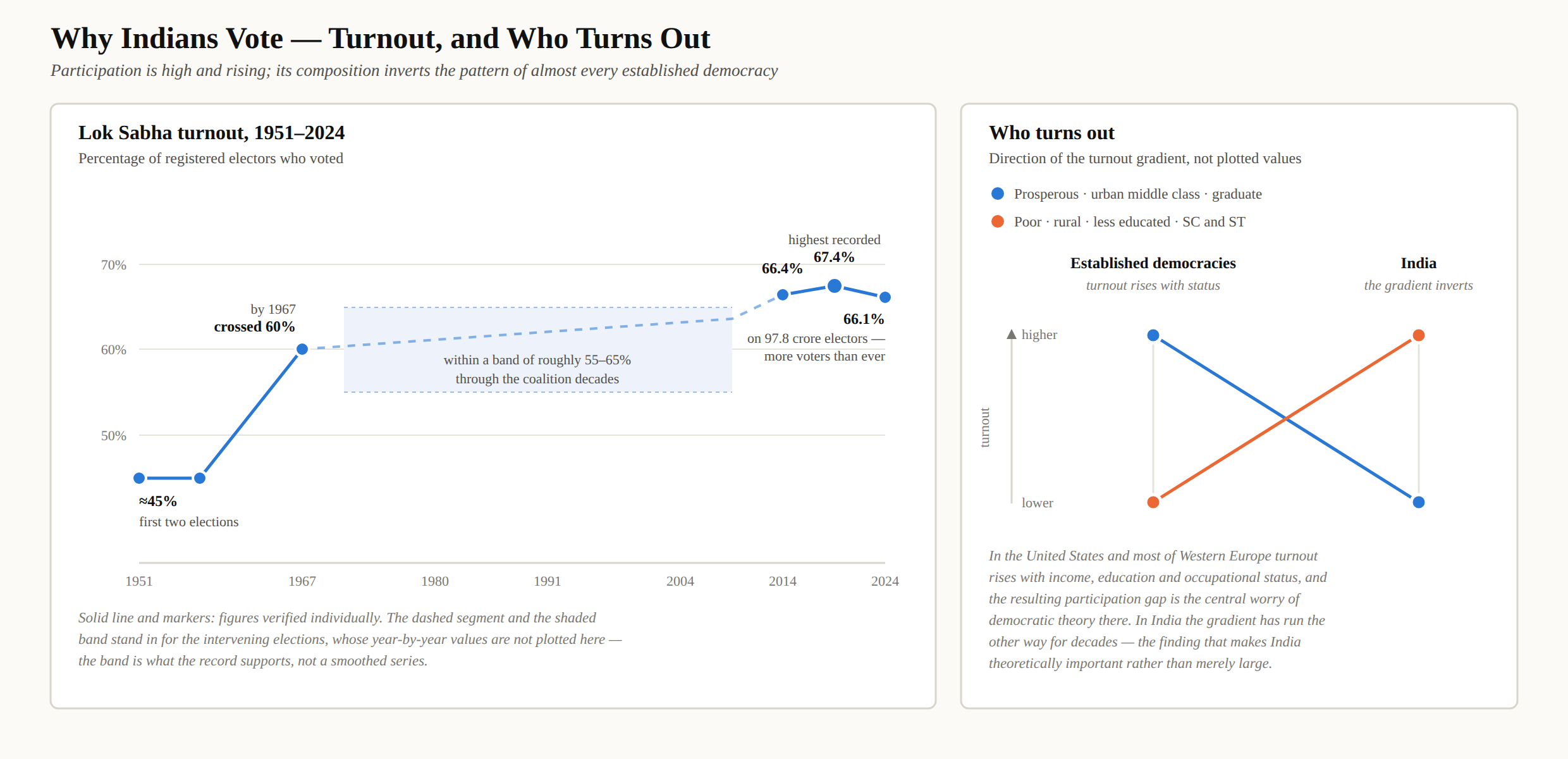
- Participation began at around 45% in the first two general elections, crossed 60% by 1967, moved within a band of roughly 55–65% through the coalition decades, and rose to 66.4% in 2014 and about 67.4% in 2019, the highest recorded.
- 2024 returned 66.1% on an electorate of about 97.8 crore — marginally below 2019 but on a far larger base, so more Indians voted in 2024 than in any election in history.
- The composition of turnout inverts the pattern of almost every established democracy. Participation is higher among the poor, the less educated, Scheduled Castes and Scheduled Tribes and rural voters than among the prosperous and the urban middle class.
- In the United States and most of Western Europe turnout rises with income, education and occupational status, and the resulting participation gap is the central worry of democratic theory there.
- In India the gradient runs the other way and has done so for decades. This is the finding that makes India theoretically important rather than merely large.
- It persists despite weak translation into outcomes. The connection between voting and improved governance, service delivery or development is loose and often invisible. If voting were purely instrumental this should have depressed participation; it has not.
Mukulika Banerjee: what voting means to the voter
Mukulika Banerjee and a team of ethnographers answered the puzzle by doing what psephology could not — living in constituencies through the 2009 general election, across eleven states, and recording what voting meant to the people doing it. The findings are the strongest available correction to instrumental models of the vote.
- Voting is an assertion of citizenship — of rights and duties together, with the inked finger as visible proof of membership in the political community.
- The election is a moment of power inversion: for a short period the ordinary structure of deference reverses and the powerful must come asking.
- Voters described the campaign in the idiom of a festival or carnival, a licensed suspension of the normal order in which the poor are briefly treated as people whose opinion is worth soliciting.
- Banerjee records the word matdan — literally the giving of an opinion — assimilated to the moral vocabulary of ritual gift-giving, which places the act in a register of dignity rather than of transaction.
- The value placed on being able to choose and to reject. Voters distinguished selecting a ruler from retaining the power to remove one, and it was the power of rejection they described as the point.
- Voting out of revenge — settling a score with a representative, an official or a party, which is a rational use of a secret ballot by people with no other instrument of retaliation.
- Voting because a member of one’s own caste or community is contesting, at once a group-loyalty motive and a claim to presence in the institutions of the state.
- Voting because the Election Commission is seen to be doing its job well — the perceived integrity of the process is itself a reason to participate, because a fair count makes the act meaningful.
- Voting because the edifice of Indian democracy is felt to depend on it, a diffuse but widely expressed belief that non-participation would let the whole structure fall.
- Voting as a sacred duty, expressed in explicitly religious language and observed with the seriousness attached to ritual obligation.
- Mukulika Banerjee’s fieldwork on the secret ballot in an Indian village captures what this adds up to: a voter can agree with everyone, disagree with no one, and still register an opinion.
- Banerjee’s larger claim is that voting carries an expressive and dignitarian value that instrumental models cannot capture — the vote is valued not only for what it obtains but for what it says: that the voter counts, and that hierarchy is suspended for a day.
- This dissolves the paradox of voting rather than solving it. The paradox arises only if the vote’s value is entirely instrumental.
- It also explains the participation inversion: expressive returns to voting are highest for those who have least dignity elsewhere, which is exactly the population that turns out most.
The poor as strategic voters
- The finding that most disturbs conventional assumptions is that the poor are more sophisticated and more strategic voters than the rich.
- Dependence on the state is far higher among the poor — rations, pensions, housing, employment guarantee work, scholarships, subsidised fuel, cash transfers — so the stakes attached to who governs are real, immediate and personal.
- That dependence makes them better informed about what a vote is worth, more attentive to which party delivers what, and more willing to bargain, switch and split their votes.
- The educated middle class votes as a national duty and expects nothing in return, being less reliant on state provision and better able to buy privately what the state supplies badly — and it votes at lower rates.
- The comparative point is worth stating plainly: in India the middle class votes expressively and the poor vote instrumentally, the reverse of the assumption built into most Western scholarship.
- Yogendra Yadav‘s account of participation supplies the structural half of the argument. Turnout in India is not principally an individual decision but a socially organised act: people vote as members of communities, mobilised through networks, and the communities most densely organised are not the wealthiest.
- Low middle-class turnout is therefore less apathy than the absence of a mobilising network — the urban prosperous are not asked, ferried, reminded or accompanied.
The other explanations
- Patronage and clientelism.Kanchan Chandra‘s account of India as a patronage democracy — where the state controls jobs, licences, permits, transfers and benefits, and politicians have discretion over their distribution — makes the vote a claim on a stream of future favours rather than a policy preference.
- Where goods move by individual discretion rather than by rule, the voter’s rational strategy is to support the candidate most likely to win and most likely to recognise them, which sustains both ethnic voting and high turnout.
- Social pressure and community turnout. Voting in much of rural India is observable and collective; absence is noticed, and a community’s turnout is treated as a measure of its capacity to bargain. A low-turnout community can be ignored.
- The Commission’s credibility as a cause of turnout. Where voters believe the count is honest the act retains meaning, which makes institutional credibility an input into behaviour rather than merely an administrative virtue.
| Instrumental account of the Indian vote | Expressive and dignitarian account |
|---|---|
| The vote buys benefits, protection and access | The vote asserts citizenship, presence and worth |
| Turnout tracks dependence on the state | Turnout tracks the scarcity of dignity elsewhere |
| Explains why the poor turn out more | Explains why voting survives non-delivery |
| Confronts the paradox of voting | Dissolves the paradox by denying its premise |
| Evidence: patronage and welfare | Evidence: ethnography, the inked finger, matdan |
| Best statement: Chandra | Best statement: Banerjee |
- The two are not alternatives. Most Indian voters plainly hold both motives at once — a vote that is simultaneously a claim on the state and a statement about one’s standing in it — and the turnout record cannot be explained by either alone.
The two democratic upsurges
Yogendra Yadav‘s account of successive democratic upsurges is the organising framework for the long-run history of Indian participation, and it works because it is a claim about who entered the electorate as an effective actor, not merely about how many voted.
The first democratic upsurge
- The first democratic upsurge, from the late 1960s through the 1970s, brought the Other Backward Classes and the intermediate castes into effective political participation.
- Its preconditions were structural: linguistic reorganisation of states, which made state politics the arena where numerically large intermediate castes could dominate; the Green Revolution, which gave landowning peasant castes economic weight; and the abolition of intermediaries, which loosened the upper-caste landlord’s grip on rural authority.
- Politically it was expressed in the 1967 elections, the collapse of Congress governments in nine states, and the Samyukta Vidhayak Dal ministries that followed.
- Its ideological vehicle was Lohiaite socialism, with its demand for proportionate representation of backward castes in every institution, and its organisational vehicle a generation formed by the JP movement.
The second democratic upsurge
- The second democratic upsurge, dated from around 1989, brought in Dalits, Adivasis, the very poor, rural voters and women — the groups the first upsurge had left where it found them.
- Its triggers were the implementation of the Mandal Commission recommendations in 1990, which nationalised backward-class politics, and the parallel Dalit-Bahujan assertion that produced an independent electoral vehicle rather than a dependent vote bank.
- The behavioural evidence is the closing and then reversal of the turnout differential, which is the empirical core of Yadav’s case.
- Through the 1950s and 1960s, turnout among upper-caste, urban, educated and prosperous voters ran above that among Dalits, Adivasis, the poor and rural voters — the ordinary pattern of a stratified democracy.
- By the early 1990s the gap had closed; through the 1990s and 2000s it inverted, so that subaltern turnout came to exceed elite turnout and rural turnout to exceed urban.
- The upsurge changed the quality of participation as well as its quantity — marginalised voters moved from voting under instruction to voting on their own account, from a bloc delivered by a patron to a constituency that must be courted.
The argument about a third upsurge
- A third upsurge is contested rather than settled, and there are two versions of the claim.
- One dates it to the post-1991 liberalisation period and describes a competitive electoral market in which the state shifts from controller to facilitator, government gives way to governance, and voters — especially the young — reward development and delivery rather than identity alone.
- The other, more persuasive on the evidence, locates it in the 2000s and after and attributes it to welfare delivery: the entry of the very poor as a decisive constituency once the state began transferring identifiable benefits to named individuals.
- The sceptical position deserves stating. Turnout among the poorest was already high before the welfare expansion, so welfare may have changed whom the poor vote for rather than whether they vote — which would make the third upsurge a story about preference, not participation.
| First upsurge | Second upsurge | Third upsurge (contested) | |
|---|---|---|---|
| Period | Late 1960s–1970s | From 1989 | 2000s onward |
| Who entered | OBCs and intermediate castes | Dalits, Adivasis, the very poor, rural voters, women | The very poor as a distinct constituency |
| Trigger | State reorganisation, Green Revolution, 1967 | Mandal 1990, Dalit-Bahujan assertion | Welfare delivery and direct transfers |
| Vehicle | Lohiaite socialism, JP movement | BSP, SP, RJD and successors | Parties competing on named schemes |
| Signature | Congress displaced in the states | Turnout differential inverts | Beneficiary voting cuts across caste |
| Status | Established | Established | Disputed |
Participation without representation
- The decisive analytical point is that the upsurges produced participatory deepening without a matching deepening of representation.
- The composition of the electorate has been transformed; the composition of legislatures has not tracked it. Upper castes remain represented well above their population share, Muslims far below theirs, and women’s representation moved only slowly before falling in 2024 for the first time in decades.
- The rising cost of contesting has added a wealth filter on top of the older caste filter, so a widening of participation has come with a narrowing of who can realistically stand.
- The full account of that gap — the caste, religious, gender, occupational and wealth profile of legislators, and the jurisprudence on criminal antecedents — belongs to the companion note on the changing socio-economic profile of legislators.
- What belongs here is the behavioural consequence: Indian voters have been given, and have used, a genuinely equal vote in an arena whose outputs remain markedly unequal.
India democratised participation far faster than it democratised representation, and the distance between the two is where the disappointment with Indian elections lives.
Determinants of the vote
Determinants are best sorted by how long they last. Long-term determinants change slowly and set the range within which a choice will be made; short-term determinants belong to the particular election and decide where within that range the voter lands. Almost every serious dispute in Indian psephology is about the weight of the two columns.
Three stages of the Indian vote
| Stage | Period | How the vote was produced | Signature behaviour |
|---|---|---|---|
| Vote bank | First party system | A patron delivered a bloc; the individual was not the unit | Stable, low-information, elite-mediated voting |
| Identity voting | Mandal and mandir period | Communities voted as self-conscious political actors | High turnout, bloc consolidation, new parties |
| Volatility and delivery | 2000s onward | Blocs fragment; the voter judges performance and transfers | Split-ticket voting, floating voters, pro-incumbency |
Long-term and short-term determinants
| Long-term determinants | Short-term determinants |
|---|---|
| Caste and sub-caste | The candidate and local factors |
| Religion and community | The leader and the national campaign |
| Class and economic condition | The campaign, money and the machine |
| Welfare-beneficiary status | Incumbency and the record of delivery |
| Region, language and locality | The issue environment of the moment |
| Rural or urban location | Media and micro-targeting |
| Gender, age and education | Alliance arithmetic and withdrawals |
Caste
- Caste remains the single most robust long-term determinant of the Indian vote, and it has survived every prediction of its imminent irrelevance — including its own theorists’.
- Rajni Kothari‘s formulation is the correct starting point: the relationship is one of mutual transformation, not of caste simply capturing politics.
- Politics is caste-ridden, in that parties must work with the caste structure they find; but caste is also politicised, forced into new alliances, new organisational forms and a new vocabulary of numbers and shares.
- The most important behavioural change is the shift from the vote bank to the negotiated bloc.
- In the first party system the vote bank was a bloc delivered by a dominant patron to whichever party had secured his support; the individual voter was not the unit of transaction.
- Today the bloc is negotiated with rather than delivered: it has its own leaders, its own party or faction and its own demands, and it can move. The vote bank has become more visible and less reliable at the same time.
- A crucial distinction is between caste as identity — supplying a sense of who “we” are and who represents us — and caste as organised interest, supplying a claim on reservation, land, credit, contracts and office. The second is transferable between parties; the first is stickier.
- The qualification most often missed: no large caste category votes as a bloc, and the internal splits are what parties now compete over.
- Among the OBCs the decisive cleavage is between dominant OBCs — Yadavs, Kurmis, Jats and their state equivalents, who captured the gains of the Mandal period — and the non-dominant and extremely backward castes, who did not and who have proved detachable from the parties of social justice.
- Among Dalits the parallel cleavage is between Jatavs and non-Jatavs in Uttar Pradesh and analogous dominant and non-dominant jatis elsewhere; the non-dominant Dalit vote has moved substantially in two decades.
- The whole architecture of contemporary caste strategy — sub-categorisation of the OBC quota, the demand for a caste census, the careful assembly of coalitions of small castes — is aimed at these fractures rather than at whole categories.
- The depth treatment of caste in Indian politics belongs to the caste note in the preceding unit; what matters here is the movement from delivered blocs to contested fractions.
Religion and community
- Religion works on the vote through two mechanisms that are frequently conflated, and the distinction is the analytical point.
- Religious identity as a determinant — a standing correlation between community and party preference, produced by history, local competition, perceived security and the availability of representation.
- Communal polarisation as a campaign strategy — deliberately raising religious salience during a campaign so that voters set aside caste, class and local grievance.
- The behavioural pattern of the last three decades is consolidation and counter-consolidation. Majority consolidation seeks to override caste fragmentation within the Hindu electorate; minority counter-consolidation responds with tactical concentration behind whoever is best placed to win, which is strategic behaviour rather than positive preference.
- 2024 provides the sharpest illustration: survey estimates put Muslim consolidation behind the principal opposition formation at about 65%, the highest recorded — a bloc produced by the arithmetic of defeating a party rather than by enthusiasm for one.
- Two qualifications keep this honest. Minority consolidation converts into seats only where the minority is concentrated and the opposition united; and the majority vote does not consolidate uniformly, fracturing along caste and state lines, as it did in Uttar Pradesh in 2024.
- The wider treatment of religion in Indian politics belongs to the religion note in the preceding unit; this note carries only its voting-behaviour face.
Class and economic condition
- The long-standing finding, repeatedly confirmed, is that India has no sharp class cleavage in voting — there is no Indian equivalent of a working-class party facing a party of property.
- Every major party draws support across the income distribution, and the parties that explicitly claimed to represent class are now confined to a few states, winning 8 seats in 2024 against a best-ever 59 in 2004.
- Banerjee, Gethin and Piketty‘s long-run study of the changing structure of party electorates supplies the strongest evidence and the sharpest formulation.
- Their finding is a shift from class-based to identity-based cleavages: the education and income gradients that predicted party support in the 1960s and 1970s had largely disappeared by 2014, while caste gradients remained sharp and the religious gradient widened from near zero to some thirty points.
- They conclude that political conflict in India is increasingly organised around identity rather than material distribution — and, tellingly, that changes in which party governs have produced no corresponding change in social spending.
- Their summary formulation is that caste and religion-based schisms remain sharp while the economic cleavages have mostly disappeared.
- 2024 adds a qualification rather than a refutation: no sharp class cleavage, but the Congress made modest gains among the poorest voters on an explicitly pro-poor campaign while the incumbent’s share among the poor stagnated. Small class effects exist; they are dwarfed by identity effects.
- The productive way to state the whole finding: class in India is not absent from voting, it is refracted through caste. Caste categories are also, approximately, economic categories, so a caste-based vote carries a great deal of class content without ever appearing as class voting.
The welfare beneficiary as a political category
- The newest and most consequential literature argues that the useful economic category in Indian elections is no longer income or occupation but beneficiary status — whether the voter has personally received an identifiable, named benefit from the state.
- The empirical claim is strong: receipt of a named benefit predicts the vote better than income does, and it does so across caste and religious lines, which is exactly what a purely identity-based model does not expect.
- Yamini Aiyar‘s account of the labharthi describes the shift in the relationship it produces.
- Welfare framed as rights and entitlements created a citizen with a claim; welfare framed as benefit conferred creates a recipient with an obligation of gratitude.
- Scheme design reinforces this. Direct, visible, individually attributable transfers — cash, cylinders, houses, toilets, grain — are electorally far more productive than diffuse public goods such as a functioning school, because the voter can name the giver.
- The result is a personalised politics of welfare in which delivery is attributed to a leader rather than to a state or a programme, detaching the benefit from institutional accountability for it.
- The behavioural consequences are substantial: a new cross-cutting bloc that parties address directly, across the caste coalitions built in the Mandal period; women as a distinct target constituency, because transfers to women are cheaper and produce a verifiable recipient in nearly every household; and competition pushed toward a bidding contest in transfers.
The most important new category in Indian electoral behaviour is not a caste or a class but the beneficiary, and no party has yet found a way to compete without bidding for it.
Gender
- The most striking change in four decades is the closing and then crossing of the gender turnout gap, and it is one of the few trends visible in official data rather than survey estimates.
- In the first general elections women’s turnout ran ten to twenty points below men’s; the gap narrowed from the 1970s, closed in the 2000s, and women’s turnout came to exceed men’s nationally in 2019 and again in 2024.
- In 2024 female turnout edged ahead of male turnout nationally, with women close to half of all registered electors and the sex ratio of the electorate continuing to improve.
- State-level gaps are far larger than the national one and are politically decisive. In the Bihar assembly election of 2025 women’s turnout ran about nine points ahead of men’s, the widest lead in years, in a state where women have outvoted men in every assembly election since 2010.
- The essential distinction is between women voting more and women voting differently, and the evidence points in opposite directions on the two.
- On turnout the change is dramatic, sustained and independently verifiable.
- On preference there is no large national gender gap; survey estimates for 2024 found only negligible differences in party choice between men and women at the all-India level.
- At the state level, gender preference gaps are real and appear precisely where women-targeted schemes have been deployed — Bihar, after a long sequence of women-directed interventions from cycles and local-government reservation to prohibition and cash transfers; West Bengal and Maharashtra, where large monthly transfers to women preceded measurable swings; and Odisha, where women’s self-help group networks were built into the governing party’s machine over two decades.
- Two cautions belong with this. Household pressure on women’s votes has not disappeared, so higher turnout is not automatically autonomous choice; and rising female turnout has coincided with falling female representation — 74 women MPs (13.6%) in 2024, down from 78 (14.4%).
Age and generation
- India has the youngest large electorate in the world, but the evidence for a distinct youth vote is weaker than the rhetoric around it.
- Young voters’ preferences track those of their household and community far more closely than those of their age cohort; the family remains the primary agent of political socialisation.
- Where an age effect appears it is modest — survey estimates for 2024 found roughly a one-to-two point dip in under-35 support for the leading party, not a generational break.
- The more useful concept is the political generation — a cohort marked by the events it came of age with. Voters formed by the Emergency, by Mandal and mandir, by the 1991 reforms and by the post-2014 period carry different default assumptions about what politics is for, and these persist as the cohort ages.
- The genuine age effect is aspiration: the young are disproportionately concerned with jobs, education and mobility, which makes them the constituency most responsive to a development pitch and the most volatile if it is not met.
Region, locality and the state as the unit of competition
- The most useful correction to how national elections are discussed: Indian general elections are better understood as an aggregation of state verdicts than as a single national contest.
- Party competition differs by state — a two-party contest in one, a bipolar alliance in another, a multi-cornered fight in a third — so identical national vote shares can produce entirely different seat outcomes.
- The effective choice set differs by state; in several large states the principal contest does not involve one or both national parties at all. State-specific issues, leaders and alliances frequently override the national campaign.
- 2024 demonstrated the point precisely. Losses for the leading party were concentrated in a few states — sharply so in Uttar Pradesh, Maharashtra, West Bengal, Rajasthan and Haryana — while it gained ground in Odisha, Telangana, Kerala and the North-East. The national aggregate concealed movements running in opposite directions.
Urban and rural
- Rural turnout has exceeded urban turnout in every recent general election, reversing the pattern found in almost every other democracy.
- The explanations are the greater density of mobilisation networks in villages, the visibility of the act and the social cost of abstaining, higher dependence on state provision, and the fact that migrant urban workers are frequently registered where they no longer live.
- On preference the urban–rural difference is genuine but smaller, and it has recently reversed direction. Urban India has been the stronger base for the incumbent national party through the last decade; in 2024 the NDA retained urban dominance but lost ground in rural and semi-urban India, where distress over prices, wages and farm incomes was the operative issue.
Education
- Education is the determinant whose Indian pattern most sharply contradicts the comparative literature. In Western democracies it strongly and positively predicts turnout; in India the relationship is weak and has at times been negative, with the least educated voting at rates equal to or above graduates.
- What education does affect is the form of participation: better-educated voters follow campaigns through the media rather than through community mobilisation, which changes how they are persuaded rather than whether they vote.
Short-term determinants
The candidate and the leader
- The candidate matters most where party attachment is weak and the local network is strong, and survey evidence consistently finds a minority — decisive in close seats — naming the candidate rather than the party as the reason for their choice.
- Four attributes carry weight: caste and community fit with the constituency; local presence and accessibility between elections; the perceived capacity to get things done, which favours the moneyed and connected; and incumbent performance where the sitting member is re-nominated.
- The candidate effect is strongest in assembly elections and weakest in a presidentialised general election — itself a finding about the two arenas.
- National campaigns have been progressively presidentialised: framed as a choice between individuals for Prime Minister rather than between parties or programmes, despite a parliamentary constitution in which no voter anywhere votes for a Prime Minister.
- The pattern has precedents in the Indira Gandhi campaigns of 1971 and 1980 and the sympathy wave of 1984, but it has been the settled form of national competition since 2014.
- Survey series now routinely find a substantial share of voters citing the leader as the primary reason for their choice, and a considerable number saying they would have voted differently had the leader been different.
- The countervailing fact matters as much as the trend: state leaders remain decisive in assembly elections, and a party that dominates a state in a general election can lose it months later to a stronger state-level opponent.
- The consequences of leader-centred voting run deeper than campaign style. It weakens the party as an organisation, since the leader’s appeal substitutes for cadre and local reputation; it concentrates both credit and blame, which cuts both ways; and it flattens local accountability, because a candidate carried by a wave owes little to the constituency that elected them.
The campaign, money and the machine
- The campaign matters more in India than the classical literature expected, because a large share of the electorate decides late and much of it is reached only during campaigns.
- Money has become the central resource of Indian campaigning. The 2024 general election was credibly estimated by election-monitoring researchers at around ₹1.35 lakh crore across all participants — plausibly the most expensive election ever held anywhere.
- Money buys visibility — advertising, transport, rallies, media presence — and it buys organisation, which is the more consequential purchase.
- It also finances direct inducement, whose scale is real but unmeasurable; what is measurable is that seizures of cash, liquor, drugs and freebies during election periods now run into thousands of crores.
- The behavioural effect is a filter on the choice set: voters choose among candidates who could afford to contest, so money constrains the vote before a ballot is cast.
- The organisational machine — the booth-level worker, the voter slip, the transport, the list of one’s own supporters — is decisive where margins are thin. It is the least glamorous and most reliable determinant of Indian election outcomes.
The issue environment
- Issues shift votes when they are personally experienced, clearly attributable and salient at the moment of voting — prices, unemployment, farm incomes, water, electricity.
- Corruption is the standing exception. Indian survey evidence has repeatedly found it a weak direct predictor of the vote: voters register disapproval and then vote on other grounds, unless corruption becomes the organising theme of a campaign, as in 1989 and in the anti-corruption mobilisation preceding 2014.
Media, social media and micro-targeting
- The media environment has changed more in the last decade than any other determinant, and it has changed the mechanism by which voters are reached.
- The older model was the two-step flow, with newspapers and television carrying a broadly common national conversation into which parties had to insert themselves.
- The current model is direct, personalised and fragmented: smartphones, WhatsApp groups, short video and party-run message networks deliver different content to different voters with no common reference point.
- Micro-targeting is now standard. Parties assemble booth-level databases combining electoral rolls, scheme-beneficiary lists, caste data and canvassing returns, and address distinct messages to distinct segments with a precision no rally could achieve.
- The consequences are serious and not symmetrical.
- Misinformation travels through closed groups where it cannot be publicly contested, reaching voters through socially trusted intermediaries, which makes it far more persuasive than broadcast propaganda.
The electoral machinery from the voter’s side
The design of the electoral system, the counting technology, the drawing of constituencies and the financing of campaigns are treated in full in the companion note on the Election Commission of India and electoral reform — the Model Code of Conduct, EVMs and VVPAT, electoral bonds, delimitation, state funding, simultaneous elections, NOTA and the Special Intensive Revision all belong there. What belongs here is narrower: what the machinery does to the behaviour of the person casting the vote.
What first-past-the-post does to the meaning of a vote
- India elects by first-past-the-post in single-member constituencies — the candidate with the most votes wins, whether or not that is a majority — and this shapes behaviour before any campaign begins.
- The system is systematically disproportionate, converting vote shares into seat shares with a large bonus for the leading party.
- In 1984 the Congress won about 49% of the vote and roughly three-quarters of the seats; in 2024 the BJP won 36.6–36.9% of the vote and 240 of 543 seats.
- Evenly spread support wins nothing: the BSP polled over 4% of the national vote in 2014 and won no seats at all, while parties with a fraction of that vote concentrated in one state won a dozen. Geographic concentration, not aggregate support, converts votes into power.
- The behavioural consequences are direct.
- Strategic voting becomes rational — a voter who prefers a third-placed party has an incentive to back the stronger contender, which is the mechanism behind minority counter-consolidation.
- Wasted votes are the norm: in a multi-cornered contest a majority of votes cast routinely elect nobody, which is the standing argument for proportional representation and the reason it keeps returning.
Voter trust in the machine
- Confidence in the count is a determinant of participation: the incentive to vote depends on believing votes are recorded and counted as cast.
- The EVM has real behavioural benefits its critics skip past — it ended the booth capturing and ballot-box stuffing that disfigured elections in several states, made invalid votes negligible where illiterate voters had previously spoiled ballots in large numbers, and shortened counting from days to hours.
- What has changed is not the machine but trust in it, and trust is measurable. A large pre-election survey in 2024 found only 28% expressing great trust in the Election Commission, down from more than half in 2019, with 17% considering ruling-party manipulation of EVMs highly likely and a further 28% somewhat likely.
- Both directions of the consequence matter.
- Distrust has not depressed turnout — 2024 was a very high-participation election — which suggests Indians vote for reasons that survive doubt about the count.
- It does corrode acceptance of results, the more dangerous effect. An election’s real output is not only a government but a losing side that concedes, and that depends on belief in the process.
- Distrust is now partisan and asymmetric, which converts a technical question into a permanent political grievance.
What the delimitation freeze does to the weight of a vote
- Seat allocation between states has been frozen on 1971 population since the 42nd Amendment, extended by the 84th Amendment to the first census after 2026, so the value of a vote varies enormously with where the voter lives.
- The distortion is large and growing — roughly two million people per Lok Sabha seat in Uttar Pradesh against about 1.6 million in Kerala at the last delimitation, widening as differential population growth compounds.
- A vote in a slow-growing southern state therefore carries measurably more weight in choosing the Lok Sabha than a vote in a fast-growing northern one.
- The freeze protects states that succeeded at population stabilisation from being penalised for it — but it does so by holding one person, one vote, one value in permanent suspension.
- The politics of unfreezing are live: the 131st Amendment Bill of 2026 was negatived in the Lok Sabha, short of a two-thirds majority, on a north–south dispute over reapportionment. The substance belongs to the companion note; what belongs here is that the weight of an Indian vote is currently unequal by design.
What money does to what voters are offered
- Campaign finance shapes behaviour by shaping the menu, well before polling day.
- Parties dependent on large donors have structural reasons to compete on identity and delivery rather than redistribution, which narrows the range of programmes on offer.
- The striking down of the Electoral Bonds Scheme in 2024 restored a measure of the voter’s right to know who funds parties, grounded in Article 19(1)(a) precisely because informed voting requires it. The regulatory story belongs to the companion notes; the behavioural point is that a voter who cannot know who paid for a campaign cannot fully evaluate the promise it makes.
Patterns and trends
Anti-incumbency and its qualification
- Through the 1980s and 1990s anti-incumbency was close to automatic, and it was the first thing any analyst said about any Indian election.
- Governments were voted out at both levels with striking regularity, and studies of the period found that association with the ruling party actually reduced a sitting member’s chances of re-election.
- The explanation was structural rather than moral: governments promised far more than the administrative and fiscal capacity of the state could deliver, so the gap between promise and delivery produced disappointment on a predictable cycle.
- Since roughly 2004 the pattern has weakened, and there is substantial evidence of pro-incumbency where delivery is visible.
- State governments in Gujarat, Odisha, Bihar, Delhi, West Bengal, Madhya Pradesh, Assam and Haryana have won second, third and fourth consecutive terms, which the older pattern would have made improbable.
- The mechanism is retrospective voting in Fiorina’s sense: delivery a voter can personally identify — a road, a house, a pension, a transfer, a cylinder — is attributable and therefore rewardable in a way that generalised claims of good government never were. Direct benefit transfer sharpened this by removing intermediaries.
- The conclusion is that Indian voters are performance-sensitive rather than reflexively hostile. The high turnover of the 1980s and 1990s was not habitual ingratitude but a reasonable response to consistent non-delivery.
- Two qualifications keep this from becoming a celebration. Rewarding visible transfers over invisible public goods biases governments toward the electorally legible; and incumbency advantage is far weaker where a government presides over inflation, unemployment or agrarian distress, as several 2024 state results showed.
Volatility and dealignment
- India shows high electoral volatility by comparative standards: large swings in vote share between consecutive elections, frequent changes of governing party, and a large stock of voters who do not vote the same way twice.
- The underlying condition is weak and weakening party identification. Where the Michigan school found stable inherited attachments, Indian survey evidence finds a large body of voters with no durable party attachment at all — and the parties are too young, too prone to split and too frequently realigned to sustain inherited loyalty.
- Dealignment — the loosening of the tie between social groups and parties without a stable new alignment forming — describes India better than realignment. Caste and community blocs that once moved as units now split between competing parties, and the fragments are recruited separately.
- The consequences for party strategy are large. Parties invest less in membership and cadre and more in campaign machinery, leader projection and targeted delivery; alliances become more instrumental; and no party can treat any bloc as safe, which is a genuine if uncomfortable form of accountability.
Split-ticket voting and the two arenas
- Split-ticket voting — the same voter choosing different parties for the Lok Sabha and the assembly, sometimes weeks apart — is among the strongest demonstrations of Indian voter sophistication.
- Odisha in 2019 is the clearest case: simultaneous polls in which the BJP ran several points stronger in the parliamentary contest than in the assembly contest held on the same days, while the Biju Janata Dal won the state comfortably.
- What it demonstrates is that voters distinguish the two arenas and the questions each asks — who should govern the country, and who should govern the state — and attribute credit and blame to the right level.
- The enabling condition is institutional: the delinking of the national and state election cycles after 1971, and the further scattering of cycles by premature dissolutions, gave voters two separate occasions to answer two different questions. This is precisely what the argument for simultaneous elections would compress, and it is the behavioural cost that argument has to answer.
Welfare, delivery and the “freebies” debate
- Welfare delivery has become the principal currency of electoral competition, displacing both ideological argument and, in many states, identity appeals as the organising theme of a campaign.
- The revdi debate — the charge that parties distribute revdi, sweets, in the form of unaffordable giveaways — is the standard criticism, made from the political executive, the central bank and the bench.
- The Supreme Court has heard petitions against pre-election promises of free goods since 2022, and judges have remarked from the bench that free rations and cash risk “creating a class of parasites”.
- Its own precedent cuts the other way: in S. Subramaniam Balaji (2013) the Court held that manifesto promises are matters of legislative policy, largely beyond judicial scrutiny — which is why the litigation has produced observations rather than orders.
- The counter-argument is serious and more persuasive on the behavioural evidence.
- A poor electorate voting on transfers is behaving rationally, not being bribed. For a household near subsistence a monthly transfer is larger and more certain than any promise of long-run growth.
- The term is applied asymmetrically — transfers to the poor are freebies, while tax concessions, loan write-offs and subsidised inputs to the better-off are policy.
- An unelected body deciding which promises a party may make would displace the voter’s own judgment, which is what elections exist to register.
- The distinction worth holding is not between welfare and freebies but between transfers and public goods. Transfers are individually attributable, immediately felt and electorally productive; public goods — schools, clinics, water systems, courts — are collectively consumed, slow and electorally almost invisible. The incentive structure pushes governments toward transfers even where public goods would do more for the same money, and that is the strongest version of the freebies critique.
From identity to “identity plus”
- Yogendra Yadav‘s formulation is that Indian voters have moved from identity politics to “identity plus” politics — they want recognition and delivery, and no longer accept the first as a substitute for the second.
- Identity sets the range of acceptable choices; performance decides which within that range gets the vote. Parties offering identity alone have lost ground to parties offering identity with a visible delivery record, and purely developmental appeals with no identity anchor have generally failed.
- The counter-claim, that identity has trumped development, has real support: the intensification of religious cleavage in the long-run data, the electoral productivity of polarisation, and the fact that campaigns still turn on symbolic questions when material ones are unfavourable.
- The reconciliation is that the two are not competing offers but a compound one. The successful Indian formula of the last decade combined majoritarian cultural assertion with named, attributable welfare delivery, and it is the combination rather than either half that has won. The party’s side of this argument belongs to the companion note on the ideological and social bases of Indian parties.
The 2024 verdict as a case study
The 2024 general election shows how these determinants interact. The social breakdown below rests on post-poll survey estimates, not counted votes, and should be read as such.
- The headline arithmetic. The BJP won 240 seats on 36.6–36.9% of the vote, 32 short of a majority, and the NDA 293 against the INDIA bloc’s 234 — the first time since 2014 that the leading party needed allies to govern.
- Caste moved, and unevenly. The NDA’s Dalit vote share fell about five points; OBC support held nationally but swung away sharply in Haryana and Uttar Pradesh; and BJP support among Adivasis rose to just under half, from about a quarter in 2009 — a long-run gain running against the national trend.
- Religion consolidated on one side only. Muslim consolidation behind the opposition reached about 65%, the highest recorded, while the majority vote fragmented along caste and state lines in exactly the states where the NDA lost most.
- Class effects were small but real. No sharp cleavage, but the Congress gained modestly among the poorest on a pro-poor campaign while the incumbent’s share among the poor stagnated.
- Gender produced turnout but not preference. Women’s turnout again exceeded men’s, and there was no major national gender voting gap.
- Age and location. A modest dip in young-voter support for the BJP, and an NDA that retained urban dominance while losing rural and semi-urban ground — the signature of economic distress rather than identity realignment.
- Taken together, 2024 is the clearest recent evidence for the retrospective, performance-sensitive voter: identity held the coalition together while material dissatisfaction in specific states moved enough seats to remove a majority without removing a government.
Assessment of the Indian voter
The case for the Indian voter
- Prannoy Roy, Ashok Lahiri and David Butler, in A Compendium of Indian Elections, conclude from the long data series that Indian voting behaviour is in many respects more mature than that of Western electorates — more discriminating between levels of government, more willing to punish non-performance, less captive to inherited loyalty.
- M.P. Singh‘s judgement is stronger: the credit for the survival of Indian democracy belongs to the common sense of the ordinary voter, and no election verdict can be shown to have been wrong, because people have always voted for the best option actually available to them.
- The supporting evidence does not depend on either author.
- Turnout is high, rising and inverted in favour of the poor — participation is not a middle-class monopoly as it is in much of the West.
- Split-ticket voting shows that voters distinguish arenas and attribute responsibility correctly.
- Every national government has been changed peacefully by vote, including one that had suspended the constitutional order; the 1977 verdict remains the strongest single piece of evidence for the voter’s judgment.
The case against
- The counter-case is real and should not be softened.
- Ascriptive voting persists. Caste and community remain the strongest predictors of the vote, so a great deal of choosing is done by inheritance rather than evaluation — and an electorate that votes its birth cannot easily hold governments to a programme.
- Money and muscle carry a premium. 93% of MPs in the 18th Lok Sabha are crorepatis and 251 of 543 have declared criminal cases, a share that has risen at every election since 2004. Voters demonstrably elect such candidates in preference to others.
- The information environment is thin. Most voters decide on campaign material, community networks and personally experienced outcomes, with little independent information about what a government has done — and closed messaging networks have made this worse rather than better.
- Participation has not produced proportionate accountability. Voters turn out in enormous numbers and still receive poor schools, poor clinics, unreliable water and slow courts.
- The two cases do not resolve into each other. The honest position holds both: the Indian voter is discriminating within a badly constrained choice set — sophisticated in using a vote, but choosing among candidates already filtered by money, community and party control, and judging on outcomes already selected for visibility.
What electoral behaviour tells us about Indian democracy
- The central finding of the whole field is a mismatch. Participation has deepened far faster than representation or accountability, and the distance between them is the defining fact about Indian elections.
- Participation is the success: an equal, universal, heavily used franchise, exercised most enthusiastically by those with least, in an electorate no other democracy has ever had to manage.
- Representation has lagged — legislatures that remain disproportionately male, upper-caste, Hindu and wealthy, in a country whose electorate is none of those things.
- Accountability has lagged furthest — elections that reliably change governments but only unevenly change what governments do.
- This makes Indian democracy neither the triumph nor the failure that partisans of each account describe. It is a democracy in which the act of voting has been completely democratised and the consequences of voting have not been. The behaviour of the Indian voter is not the problem in that sentence; it is the part that has worked.
The most remarkable thing about the Indian voter is that participation has survived four decades of evidence that it does not reliably change very much.
Previous Year Questions
The questions on the electoral machinery and its reform — proportional representation, the code of conduct, electronic voting machines, state funding, delimitation and the wider reform agenda — are answered in the companion note on the Election Commission of India; those listed below test electoral behaviour proper.
- The decision to conduct Population Census-2027 has reopened the debate on delimitation in India. Discuss its various aspects. (2025)
- Electoral behaviour of voters is governed more by the social and economic factors than the political factors. Explain. (2022)
- State subvention/funding may be an effective instrument in strengthening electoral democracy in India. Comment. (2017)
- Discuss the nature of reforms of the electoral process in India and explain the further scope for reforms. (2014)
- Examine the changing pattern of electoral behaviour in India. (2011)
- Comment: Upsurge in political participation among the marginalised communities in the Indian General Elections during the last two decades. (2010)
- Comment: Implications of the use of Electronic Voting Machines (EVMs) on electoral politics. (2009)
- Comment: Revision in the Election Code of Conduct. (2008)
- Comment: Proportional representation. (1996)
