

Does ideology matter in Indian party politics?

The honest place to begin is with a genuine disagreement. One body of scholarship holds that Indian parties are ideologically empty vessels — machines for capturing office that borrow whatever vocabulary the season demands. Another holds that Indian politics is at this moment more ideologically polarised than at any time since Partition, and that observers miss it because they are looking for a left–right economic axis that India never had. Both readings rest on real evidence.
The case that ideology does not matter
- Zoya Hasan‘s indictment is the sharpest statement of the sceptical position, and it has six parts.
- No concern for ideology — what has grown instead is the catch-all party, which dilutes doctrine to reach every social segment at once.
- Parties are office-oriented rather than policy-oriented; the programme serves the campaign rather than the campaign the programme.
- A disconnect between parties and people — parties reach voters at election time and vanish between elections.
- A dense connection with corporate groups, which she notes runs through the communist and socialist parties too.
- Odd nomenclature that tells the voter nothing about doctrine — names announcing a region and a lineage rather than a programme.
- Most damning, none of them has a grand design — a picture of the society they intend to build.
- Kirchheimer’s catch-all thesis, written about post-war Western Europe where mass ideological parties shed their doctrinal skin to chase the median voter, transfers to India with unsettling ease: doctrine de-emphasised, appeal widened to all social groups, the individual member downgraded and the leadership strengthened against the activist. Every large Indian party now fits that description organisationally, whatever its stated creed.
- Economic policy stopped being contested after 1991, which is the strongest single piece of evidence for the sceptics.
- Liberalisation was begun by a Congress government, deepened by an NDA government, continued through ten years of UPA and accelerated after 2014. No major party campaigns on reversing it.
- So the biggest ideological cleavage of twentieth-century politics — who owns the means of production, and how far the state should direct the economy — was simply removed from party competition.
- Alliance behaviour looks nakedly opportunistic. A party of Hindu nationalism has governed with Dravidian, Kashmiri and Akali partners; parties of social justice have allied with their own caste antagonists; the left sustained a Congress government it had spent forty years denouncing.
- Manifestos converge on welfare. Cash transfers to women, free foodgrain, subsidised cylinders, farm income support and health insurance appear in near-identical form across parties calling themselves socialist, nationalist, Dravidian and centrist alike.
The case that ideology does matter
- The divergence on secularism, nationhood and citizenship is sharp and widening, and it is genuinely ideological rather than tactical.
- Parties differ fundamentally on who the nation belongs to — whether Indian nationhood is defined by a shared territory and constitution or by a cultural and civilisational core.
- That difference has produced contested legislation and executive action on citizenship, personal law, religious conversion and minority institutions, on which the parties do not converge and cannot be brought to converge.
- A recognisable social-justice bloc persists. The demand for a caste census, for extending reservation, for sub-categorisation within the backward classes and for proportional representation of communities is made by an identifiable set of parties and hedged by another — an ideological division with a fifty-year lineage.
- Alliance behaviour is far more constrained than the cynical reading suggests. The Congress and the BJP have never allied; the left has never allied with the BJP; the DMK and AIADMK have never allied with each other. The pattern of who will not combine is stable, and stable exclusions are what ideology produces.
- The absence of a left–right economic axis is not the absence of ideology. In most Western democracies the founding cleavage was class and the ownership of property. In India, mass mobilisation was organised first against colonial rule and then around caste hierarchy and religious community — so the deepest division is about the nation and who belongs to it, not about the distribution of the surplus. On that axis, competition is intense, and economic convergence is exactly what leaves it carrying the whole weight of political conflict.
| The sceptical reading | The ideological reading |
|---|---|
| Parties are catch-all, office-seeking machines | Parties differ irreconcilably on nationhood and citizenship |
| Economic convergence after 1991 proves there is nothing to argue about | Economic convergence displaced conflict onto identity, it did not end it |
| Opportunistic alliances show doctrine is disposable | The stable pattern of who will never ally shows doctrine binds |
| Manifesto overlap on welfare | Overlap on delivery coexists with total divergence on secularism |
| Verdict: ideology as decoration | Verdict: ideology relocated, not abolished |
The Indian party system is not post-ideological; it is ideological on a different axis, and the axis is the nation rather than the economy.
The ideological inheritance from the national movement
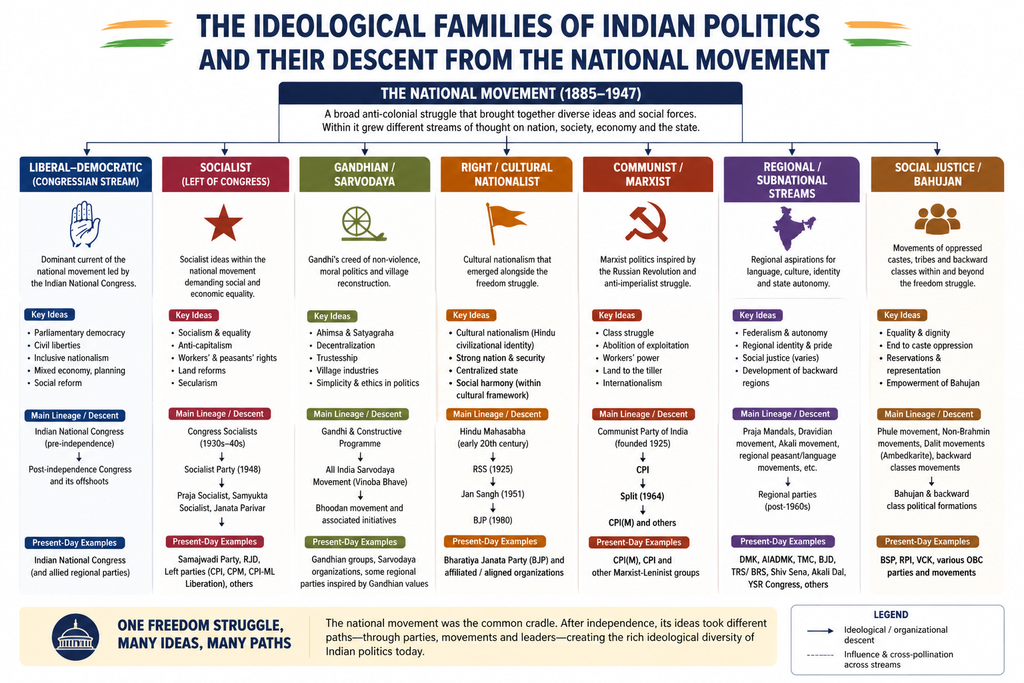
Indian parties did not choose their ideological menu from a catalogue. They inherited it from a national movement that had contained almost every available position inside a single organisation, and from the settlement the movement’s winners imposed after 1947.
The Congress as an umbrella, not a party
- The Congress before independence was a movement carrying several incompatible ideologies at once, and its capacity to hold them together is the reason it dominated afterwards.
- Conservatives and industrial interests who wanted a strong state and protected markets but no social upheaval.
- The Congress Socialist Party current, pressing for land redistribution, nationalisation and a workers’ and peasants’ programme from inside the organisation.
- Gandhians, for whom the village, decentralisation, trusteeship and moral self-restraint were the point, and the industrial state itself the problem.
- A communal-conservative fringe, and a liberal-constitutionalist current predating the mass phase altogether.
- Because all of these had a home inside the Congress, opposition after 1947 had to be built from positions the Congress had failed to accommodate — which is why the earliest challengers were the communists on one flank and the Hindu nationalists on the other.
The Nehruvian consensus as the reference point
- The post-independence settlement rested on four commitments, and each generated its own opposition.
| Pillar of the consensus | What it meant | Who attacked it, and on what ground |
|---|---|---|
| Secularism | State neutrality between faiths; protection of minority rights and institutions | Hindu nationalists, as minority appeasement and a denial of the majority’s cultural claim |
| Planning and a public sector | State-directed industrialisation, a commanding-heights public sector, licensing | Swatantra from the right, as statism; the communists, as too timid to touch property |
| Non-alignment | Autonomy from both blocs | The right, as strategic naivety; the left, as insufficiently anti-imperialist |
| Scientific temper | Rational, modernising public culture written into the Constitution as a duty | Gandhians and traditionalists, as an alien import that devalued indigenous ways of knowing |
- The consensus was not merely a set of policies but a definition of what Indian politics was for — nation-building through a modernising, redistributive, religiously neutral state. Every later ideological family is best understood as an argument with one of those four words.
Political reform versus social reform: the argument that never closed
- The deepest fault line in Indian politics is older than any party. It is the nineteenth-century question of sequence — must Indians first win political power and then reform their society, or is a society organised on graded inequality incapable of using political power well?
- Tilak took the first position: political reform must precede and not follow social reform.
- The argument had three supports. Social reform divides, and a divided people cannot confront an empire; reform imposed by a foreign government is illegitimate whatever its content, because it is not self-rule; and once swaraj is won a self-governing people will reform itself by consent rather than by statute.
- Behind it lay a revivalist instinct: the reformers’ agenda looked to him like a surrender of the civilisation’s self-respect at the moment it needed confidence to fight. His Ganapati and Shivaji festivals were designed to build political mass out of existing religious and historical sentiment rather than against it.
- Agarkar took the opposite view: there is no point demanding democracy in the state while denying it in the household.
- His paradox was uncomfortable but serious — a colonial administration, insulated from Indian public opinion, was more likely to legislate against social cruelty than an indigenous ruler dependent on the sanction of orthodoxy.
- Ranade stood in the same camp with a more integrative formulation: political and social reform were two aspects of one process, and a people low in the scale of social justice could not exercise political rights well. The Indian National Social Conference, meeting alongside the Congress, was its institutional expression — and it lost.
- Ambedkar rejected the framing itself, which is the more radical intervention.
- His point was not that social reform should come first in a queue, but that political freedom without social democracy is not freedom at all — a constitutional superstructure on a caste foundation will not hold.
- He observed that the political-reform party had defeated and absorbed the social-reform party, and that the Social Conference failed partly because it confined itself to the reform of the high-caste Hindu family — widow remarriage, child marriage, the age of consent — and never attacked caste itself.
“Political tyranny is nothing compared to social tyranny, and a reformer who defies society is a much more courageous man than a politician who defies the government.” — B.R. Ambedkar
- Ambedkar quoted the political reformers’ own words to show how completely they had shut the question down.
“I for one have no patience with those who say we shall not be fit for political reform until we reform our social system. I fail to see any connection between the two.” — W.C. Bonnerji
- Phule had made the argument a generation earlier and from further outside: for the shudras and atishudras, swaraj under an unreformed social order simply changed the nationality of the master. Independence without the destruction of Brahminical authority was, in his reading, a project of the oppressor classes in patriotic clothing.
- The argument was never settled — it was postponed by independence and inherited by the party system. The Constitution attempted a synthesis: political democracy immediately, social democracy as a directive obligation. The synthesis was procedural rather than ideological, and the disagreement resurfaced the moment the Congress umbrella collapsed.
| Position | Core claim | Where it resurfaces in the party system |
|---|---|---|
| Tilak — political first | Unity against the outsider precedes internal reform; reform must be self-generated | Parties of national assertion: the nation is the primary category, internal divisions are secondary or divisive |
| Agarkar and Ranade — social first, or together | Democracy in the state is empty without democracy in the household | The liberal-reformist strand, now thinly represented as an organised force |
| Phule and Ambedkar — the framing is false | Political power without social democracy reproduces the old hierarchy under a new flag | Parties of social justice: caste enumeration, reservation, proportional representation of communities |
- The contemporary party system reproduces this quarrel almost exactly. Parties of national assertion treat caste mobilisation as a fragmenting force that weakens a nation which must present a united front; parties of social justice treat national unity talk as the historic device by which the upper castes have deferred the redistribution of power. Each accuses the other of exactly what Tilak and Phule accused each other of.
Tradition is not always incompatible with modernity
The second inherited assumption that Indian politics broke was the modernisation theorists’ expectation that democracy would dissolve traditional identity. It did the opposite, and why it did is the frame for the whole question of party social bases.
- Modernisation theory in its mid-century form predicted a linear transition — from ascriptive to achievement-based status, from particularism to universalism, from religious to secular authority. Applied to India, it forecast that industrialisation, urbanisation, literacy and the secret ballot would erode caste and community into class and citizenship.
- What happened instead was that traditional institutions became the vehicles of modern political participation. This is the argument of Lloyd and Susanne Rudolph in The Modernity of Tradition.
- Caste associations — formed to press claims for status, education, employment and reservation — took a traditional identity and gave it a modern organisational form: written constitutions, membership rolls, subscriptions, journals, conferences, office-bearers, petitions and electoral endorsements.
- In doing so they performed the textbook functions of a modern voluntary association: interest articulation, political education, leadership recruitment and the transmission of demands to the state. Caste supplied the boundary; the organisation and purpose were new.
- The larger claim is that tradition and modernity are not sequential stages but interpenetrating conditions — India did not modernise by abandoning tradition but by adapting it, and the adaptation was often more effective than an imported form would have been.
- The dominant caste is the parallel case: a landholding community with numerical strength and ritual standing converting its rural authority into electoral currency — a thoroughly modern use of a thoroughly traditional resource.
- Rajni Kothari made the same argument from the other direction.
“It is not politics that gets caste-ridden; it is caste that gets politicised.” — Rajni Kothari
- His point was that caste and politics transformed each other. Politics found in caste a ready-made structure of organisation and loyalty; caste found in politics a route to power that ritual status could not provide.
- A secularising effect ran alongside: to win, a caste had to combine with others, which meant bargaining, alliance, programme and the abandonment of purely ritual claims. Caste entering politics made caste more political and less sacral.
- The corollary is uncomfortable for both sides of the usual debate: caste politics is neither a pre-modern residue nor a betrayal of democracy — it is what democratisation looked like in a society organised on caste.
- A dissenting line insists this overstates popular attachment to identity. Dipankar Gupta argues that ethnicity in India is not a popular passion but an elite preference, mobilised from above rather than welling up from below. S.D. Muni adds that identity markers here are fluid rather than fixed, and that the political class selects which to activate: a population united by language today can be divided by caste or religion tomorrow.
- If identity is elite-selected rather than primordial, then a party’s social base is something it constructs, not something it discovers — and can therefore be constructed differently, which is what the BJP’s transformation of its own base demonstrates.
| Position | Expectation about tradition | Verdict on Indian experience |
|---|---|---|
| Modernisation theory | Traditional identity dissolves under industrialisation and democracy | Falsified — caste organisation grew with democracy |
| Rudolph and Rudolph | Tradition is adapted into modern forms, not displaced | Caste associations as modern voluntary associations |
| Kothari | Politics and caste transform each other | Caste politicised; politics organised through caste |
| Gupta and Muni | Identity is elite-selected and fluid, not primordial | Party social bases are constructed, and can be reconstructed |
A party’s social base in India is not a natural constituency waiting to be claimed; it is an artefact of decades of organisational work, and it can be taken apart as deliberately as it was assembled.
The rise of the right
From two seats in 1984 to a party of government within a decade and of dominance within three, the trajectory of the Indian right is the largest single fact in the ideological history of the party system. It should be stated as data before it is explained.
The electoral arc
| General election | BJP seats | BJP vote share |
|---|---|---|
| 1984 | 2 | ~7.7% |
| 1989 | 85 | 11.4% |
| 1991 | 120 | 20.1% |
| 1996 | 161 (single largest) | 20.3% |
| 1998 | 182 | 25.6% |
| 1999 | 182 | 23.8% |
| 2004 | 138 | 22.2% |
| 2009 | 116 (the low point) | 18.8% |
| 2014 | 282 (first single-party majority since 1984) | 31.3% |
| 2019 | 303 | 37.4% |
| 2024 | 240 (32 short of a majority) | ~36.6% |
- Three features of that series matter more than the headline numbers.
- The 1989–91 jump is where the party became nationally relevant, coinciding with the Ram Janmabhoomi mobilisation and the counter-mobilisation against Mandal.
- The 2004–09 trough shows the rise was never inevitable: two consecutive defeats, and a vote share below its 1991 level.
- 2024 broke the majority but not the dominance — the vote share fell less than a point while the seat count fell by 63, which is what first-past-the-post does to a party that loses narrowly in many seats at once.
Lineage and doctrine
- The Bharatiya Jana Sangh was founded in 1951 by Syama Prasad Mookerjee, who had resigned from Nehru’s cabinet over the Nehru–Liaquat Pact and the treatment of minorities in East Bengal.
- Its founding premise was that democracy requires a strong opposition and that the Nehruvian consensus faced none, so an alternative had to be built outside the Congress rather than inside it.
- Deendayal Upadhyaya supplied the doctrine; the cadre came from the RSS — the source of both the party’s durability and of the recurring dispute about where the party ends and the organisation begins.
- The Janata Party episode (1977–79) and the dual-membership dispute produced the BJP. The Jana Sangh merged into the Janata Party in 1977; former socialists then demanded that members give up either their Janata Party or their RSS membership, arguing that a party of government could not carry a parallel loyalty. The Jana Sangh element refused, left, and constituted itself as the Bharatiya Janata Party on 6 April 1980. That founding quarrel is still the quarrel about the party.
- Its declared commitments were three, and deliberately moderate.
- Cultural nationalism — the nation defined by a shared civilisational inheritance rather than by religion narrowly.
- Gandhian socialism — decentralised, small-scale, self-reliant economics, offered as an indigenous alternative to both state socialism and Western capitalism.
- Positive secularism — equal protection for all religions rather than equal distance from them, and explicitly not the Hindu Mahasabha’s position of a state identified with one faith. The formula was justice for all, appeasement of none.
- The 1984 rout forced a strategic reversal. Two seats after a moderate, quasi-socialist repositioning was read inside the party as proof that moderation had no constituency; the return to an explicitly Hindutva register followed, with the Ram Janmabhoomi campaign, the rath yatra of 1990 and the mobilisation cycle that carried the party to 161 seats within twelve years.
Integral Humanism
- Integral Humanism, formulated by Deendayal Upadhyaya, is the BJP’s official philosophy and is regularly reduced to a slogan. Its structure is worth setting out.
- It begins by rejecting both capitalism and communism as Western and materialist. Capitalism, in his reading, addresses the needs of the body; communism the body and the mind; neither accounts for the intellect or the soul, and a doctrine built on an incomplete account of the human being produces an incomplete society.
- Against both it proposes the integrated development of body, mind, intellect and soul — the person treated as a whole rather than as a producer, a consumer or a class position.
- Chiti is the innate nature or essential soul of a nation, its animating principle, which political and economic arrangements must express rather than override.
- Dharma is placed above the state: the state is one institution among several, subordinate to the moral order, and society has an autonomy the state may not absorb. This grounds the doctrine’s suspicion of both the welfare state and the socialist state.
- Antyodaya — the rise of the last, a policy measured by its effect on the person at the very bottom — is its distributive principle, and is Gandhian in derivation.
- Its three organising principles are the primacy of the whole over the part, the supremacy of dharma, and the autonomy of society.
- Upadhyaya’s answer to the charge of nativism was the Japan example: a country could adopt modern science without adopting the Western way of life. The argument is not against modernisation but against the assumption that modernisation must be Westernisation — the Rudolphs’ analytical claim, made programmatically.
- Assessment. It is a genuinely distinct third position rather than a rhetorical cover, but the ambiguity its critics press is real: chiti and dharma are not defined in a way that answers who decides what a nation’s essential nature is, and in practice that has been settled by a religious majority rather than by a philosophical procedure. Its economic content has also been quietly abandoned — the party’s programme since 1991 has been market-liberalising, which is neither swadeshi nor Gandhian.
Explaining the rise: a real scholarly debate
- Thomas Blom Hansen, in The Saffron Wave, gives the most theoretically ambitious account: the rise is neither purely religious nor strictly political, but a response to India’s democratic transformation.
- As lower castes and OBCs mobilised and began to claim office, reservation and public visibility, the amorphous middle class became anxious — its status no longer secured by the old hierarchy, it needed a language in which to reassert itself.
- Hindu nationalism supplied that language, offering a national identity above caste in which the middle class could recover its position as the nation’s natural representative.
- His more counter-intuitive finding is that lower-caste and lower-class Hindus were themselves drawn to it — the majoritarian appeal was constructed not out of theology but out of nationalism, cultural pride, order, development and leadership, a bundle available to anyone willing to identify with the majority.
- Christophe Jaffrelot supplies the mechanism, and it operates over the long run.
- Stigmatisation and emulation of the threatening Other: the movement identifies a minority as both a threat and a model, stigmatises it, then borrows the organisational features it envies — conversion answered with reconversion, a scripture with a canon, a community organisation with a cadre organisation.
- Ethno-religious mobilisation cycles: advance in waves of agitation, each producing a crisis, a backlash, then moderation and coalition-building before the next wave.
- The Congress’s reduction from umbrella to minority party: having lost the upper castes, the OBCs and then much of the Dalit vote, what remained was a coalition of minorities — which made it plausible to describe its secularism as appeasement and generated a majority sense of insecurity that is sociologically odd but politically potent.
- His later work adds subaltern Hindutva and the conservative revolution: a movement that mobilises the lower orders in large numbers while leaving the social hierarchy intact, offering Dalits and OBCs symbolic recognition and welfare delivery and the dignity of belonging to the majority, but not the redistribution of land, capital or elite positions a social-justice programme would demand.
- James Manor offers the simplest structural explanation, which should not be dismissed for being simple: with the Congress in decline the alternatives were left or right, and the left disqualified itself — it lacked imagination, having no new reading of Indian conditions, and it lacked leadership of national appeal. The right won partly by default.
- Milan Vaishnav reads it as a real change in electoral behaviour rather than a manipulation of it: politics organised for decades around secularism and minority protection has given way to a rejection of both minoritarianism and the Congress version of secularism, and an assertion of majoritarianism combined with a demand for good governance and development. His framing treats the voter as author of the shift rather than its victim.
| Scholar | Driving mechanism | What it explains best | What it under-explains |
|---|---|---|---|
| Hansen | Middle-class anxiety at democratic upsurge from below | Why the appeal crossed class lines | The long organisational build-up |
| Jaffrelot | Stigmatisation and emulation; mobilisation cycles; Congress’s collapse into a minority party | The century-long ideological continuity | The 2014 discontinuity in scale |
| Manor | Absence of a credible left alternative | Why the vacuum was filled from the right | Why this right, in this form |
| Vaishnav | A real shift in voter preference toward majoritarianism plus delivery | Post-2014 voting data | The role of organisation and money |
- Alongside the interpretive accounts sit the structural causes, which no single scholar owns and which any adequate account must combine.
- The decline of the Congress — the vacated centre had to be occupied by somebody.
- The demise of the left, which removed the only ideologically organised national competitor.
- Organisational depth built over decades — a cadre structure reaching to the village, sustained by an affiliated network in education, welfare, labour, tribal areas and student politics, and unmatched by any rival.
- The nationalist register, which converts questions of security, borders and foreign policy into questions of loyalty.
- Globalisation, through four channels: diaspora support and funding; a worldwide turn to ethnic and religious politics as the liberal order weakened; the fear of Islamic fundamentalism; and an economic policy congruent with liberalisation at the moment liberalisation was creating a large, aspirational middle class with no attachment to the Nehruvian settlement.
- Leadership — a centralised, personalised campaign around a single figure, with a resource and media advantage no competitor can match.
How the social base was built and widened
- The Jana Sangh’s base was narrow, northern, urban and upper-caste — Brahmins and Banias, traders, small businessmen and Hindi-belt professionals, with negligible presence among peasants, Dalits, Adivasis or in the south. A party of that composition has a ceiling of roughly a tenth of the vote, which is what it kept hitting.
- The base was widened by a deliberate strategy usually called social engineering, and its logic is precise.
- Mandal-era politics empowered the dominant backward castes — Yadavs in the Hindi heartland and their equivalents elsewhere — who captured the parties of social justice and the benefits flowing through them.
- That left the non-dominant and extremely backward castes, numerically large, internally fragmented and resentful of the dominant OBCs above them, without a vehicle. The BJP built one, offering tickets, ministries, symbolic recognition and a place in the Hindu majority.
- The identical operation was performed among Dalits: the BSP’s core was Jatav, so the BJP mobilised non-Jatav Dalit communities against that dominance.
- The result is a coalition assembled less against the upper castes than against the dominant intermediate castes — which is why it can hold Brahmins and the most marginal backward castes at once.
- Welfare delivery converted mobilisation into a durable base. The labharthi — the enumerated beneficiary of a housing grant, a gas connection, a toilet, free foodgrain, a bank account or a cash transfer — became a political category in its own right.
- Its power lies in individuation: the benefit reaches a named person rather than a caste or a locality, is credited directly to a leader, and is therefore not mediated by the caste broker on whom older parties depended.
- This is the material counterpart of subaltern Hindutva — tangible delivery to the poor without redistribution of assets or of elite position, which is what makes a coalition of the very rich and the very poor sustainable.
- Where the base is thin now.
- Among Muslims, comprehensively — and the 18th Lok Sabha contains no Muslim, Christian or Sikh MP from the NDA, a structural fact about the coalition rather than an accident of one election.
- In the south, where the Dravidian and Kerala party systems rest on cleavages the Hindutva frame does not address, and where the 2026 Tamil Nadu upheaval reorganised competition without the BJP becoming its principal beneficiary.
- The eastern half of that claim needs retiring. The party has formed a third consecutive government in Assam, and in West Bengal in 2026 it won 208 seats to the Trinamool Congress’s 80, ending fifteen years of TMC rule. The south, not the east, is now the real limit.
The BJP did not win the backward castes by becoming a backward-caste party; it won them by organising the communities that the dominant backward castes had left behind.
The marginalisation of the left
The mirror image of the rise of the right is the disappearance of the left, and it poses a genuine puzzle. India has mass poverty, an enormous agricultural workforce, extreme inequality of land and capital, and a competitive electoral democracy — the textbook conditions for a strong electoral left. Instead the left holds a handful of seats, and Indian youth are drawn to the right.
The trajectory
- In the first decades the left was the principal opposition to the Congress, and its vote share was roughly double that of the Jana Sangh. It governed Kerala from 1957 — the first communist government anywhere to take office through a free election — and was a serious presence in Bengal, Andhra, Bihar and Tripura.
- West Bengal, 1977–2011: the Left Front governed for thirty-four consecutive years, the longest continuously elected communist government in the world, built on Operation Barga, the recording of sharecroppers’ rights, and on a panchayat system that gave the party a rural machine.
- The peak was 59 seats in 2004 — CPI(M) 43, CPI 10, RSP 3 and the Forward Bloc 3 — and with them the ability to set the terms of a national government from outside it.
- The collapse: Bengal was lost in 2011 and has not been recovered; Tripura fell in 2018; the Lok Sabha tally fell to 5 seats and 2.33% in 2019, the worst performance in the party’s history.
- 2024 halted the slide without reversing it: 8 seats and about 2.5% — CPI(M) four, CPI two, CPI(ML) Liberation two.
- 2026 removed the last redoubt. The LDF lost Kerala to the Congress-led UDF, with CPI(M) reduced to 26 seats and CPI to 8 in a house where Congress alone won 63. In West Bengal the same year the CPI(M) won a single seat. For the first time in roughly half a century, the left governs no Indian state.
- The one genuine counter-trend is CPI(ML) Liberation, which has grown modestly in Bihar on the strength of landless-labourer and Dalit organisation — the only left formation currently expanding, and notably the one closest to the movement model rather than the electoral one.
Why the left failed
- The debts of the freedom struggle. The shifting position during the national movement — including the wartime line that put the party on the opposite side from the Quit India agitation — cost a trust it never recovered. A party that appeared absent at the founding moment could not claim the nationalist inheritance, and in India that inheritance is the licence to govern.
- Imported doctrine. Neither then nor since has the Indian left produced a serious theorisation of Indian conditions. It analysed a society organised by caste using categories built for one organised by class, so it could neither explain caste nor mobilise through it, and its Eurocentric frame kept it from engaging Indian religious traditions except as false consciousness.
- Democratic centralism. The principle that decisions taken at the top bind all levels absolutely was designed for a clandestine revolutionary party and is corrosive inside an electoral one. It suppressed dissent, prevented the debate that might have produced a new line, and generated a high-command culture of the left’s own — the defect it denounced in the Congress.
- Leadership without roots. Left leaders have overwhelmingly been recruited from universities rather than built from a grassroots base, which gave the parties intellectual seriousness and cost them the organic connection that carries a party through defeat.
- The agenda was hijacked twice. The Congress’s own socialism — planning, nationalisation, land ceilings, bank nationalisation, garibi hatao — offered redistribution without revolution, from inside the state. Much later, AAP offered a more attractive version of the new left: anti-corruption, service delivery, urban and youthful, unencumbered by doctrine.
- No solidarity among the left parties. The movement split in 1964 into CPI and CPI(M) over the Congress relationship and the Soviet–China divide, and again in 1969 with the Naxalite breakaway. Successive fragments have spent as much energy on each other as on their opponents.
- Confinement to electoral politics. The left’s real métier is the politics of social movements and radical democracy — organising the unorganised, contesting outside legislatures, building counter-power. Having become an electoral machine in two states, it vacated that terrain, which was occupied by non-party movements, rights-based campaigns and eventually AAP.
- Caste and religious politics in practice. For all its class rhetoric, the left in office practised caste and community arithmetic like everyone else — losing the ideological distinctiveness that was its only asset without winning the arithmetic.
- Globalisation eroded the appeal of the ideology just as liberalisation expanded aspiration, and created a footloose workforce — contractual, mobile, dispersed across the informal sector — that is extremely hard to unionise. The left’s organisational model presupposes a stable factory workforce to which a shrinking share of Indian workers belongs.
- A foreign policy that reads as anachronistic — anti-globalisation, anti-Americanism and a pro-China tilt maintained through the border crises — revives the oldest charge against the movement. Its inheritance of non-alignment from a Congress that abandoned it is emblematic: the left became custodian of somebody else’s discarded doctrine.
- West Bengal destroyed it from within. At Singur and Nandigram the Left Front used state force against peasants and sharecroppers, its own constituency, to acquire land for corporate industrial projects. No episode did more damage: it collapsed the moral claim on which thirty-four years of rule had rested, and did so precisely on the question of whose side the party was on.
- Taken together, the decline is a long structural story rather than an electoral accident. The most careful account of it, Praful Bidwai‘s, argues exactly this: the crisis was decades in the making, visible well before the Bengal defeat, and rooted in the movement’s failure to indigenise itself.
The corrective view
- The obituary is easy to overwrite, and three qualifications matter.
- Disproportionate influence in the UPA years. With around sixty MPs and no ministries, the left set the policy agenda of a national government from outside it — the rights-based legislation of that period, from the employment guarantee and the right to information to the forest rights and right to education laws, bears its imprint, and economic direction was visibly constrained until it withdrew support in 2008.
- Kerala as a functioning counter-example. Whatever the 2026 result, the state’s outcomes in literacy, life expectancy, infant mortality, land reform, public health and decentralised planning are the product of sustained left and left-influenced governance, and show the programme can work where it is implemented.
- Ideas outlast organisations. Land rights, minimum wages, public health, universal food security and labour protection have been absorbed into the mainstream consensus. The left lost the parties and won part of the argument.
- What a revival would require is not better electoral tactics but a return to origins: back to social movements, radical democracy and organising the exploited — building power outside legislatures before contesting inside them, and producing at last a reading of Indian society that begins from caste rather than apologising for it.
The Indian left was defeated less by the right than by its own refusal to translate itself into Indian.
The other ideological families
The Congress: from doctrine to defence
- Nehruvian socialism gave the party a programme with a name: the socialistic pattern of society adopted at Avadi in 1955, planning, a commanding-heights public sector, land reform, and a secular, minority-protecting state. It was not Marxist, and that was the point — redistribution through parliamentary means and a mixed economy.
- Indira Gandhi’s populist left turn after the 1969 split converted a governing doctrine into a mobilising one.
- Bank nationalisation, the abolition of privy purses, and garibi hatao allowed the party to appeal directly to the poor over the heads of the state-level dominant castes who had previously delivered the vote.
- The cost was organisational: the party stopped being a federation of state units and became a plebiscitary machine dependent on a single leader, which worked spectacularly in 1971 and hollowed out the structure permanently.
- The 1991 turn was executed by a Congress government and is the party’s central ideological problem to this day. Having abandoned the economic programme that distinguished it from the right, and having conceded ground on secularism repeatedly under pressure, it lost the ability to say what it is for in a sentence.
- The current predicament is that its remaining coalition — minorities, Dalits, Adivasis and the poor — is held together by little more than opposition to the BJP.
- Recent attempts at a programmatic core have been redistributive and enumerative rather than economic in the old sense: a caste census, the demand to breach the 50 per cent reservation ceiling, a guaranteed-income proposal, cash transfers to women.
- The difficulty is structural: a caste-census-led social-justice platform competes directly with the regional parties that are its own allies, while offering the upper castes and the aspirational middle class nothing.
- Survey evidence for 2024 shows modest gains among the poorest, recovery among Dalits and dominant OBCs, and a continued hold on the Muslim vote — a coalition of the excluded rather than a majority coalition.
The socialist tradition
- The socialists are the most consequential ideological family relative to their electoral record: they never governed at the Centre in their own name, and they wrote the agenda that has dominated north Indian politics for thirty-five years.
- Ram Manohar Lohia is the pivotal figure, and three of his ideas outlived him.
- Saptakranti, the seven revolutions — simultaneous struggles against inequality between man and woman; against inequality of caste and colour; against colonial and imperial domination; against economic inequality and private capital; against unjust encroachment on private life; against weapons, and for satyagraha; and for individual freedom against unjust social and state authority. Its significance is that caste and gender sit alongside class as primary axes of exploitation rather than being derived from it — exactly what the communists refused to do.
- Non-Congressism — the doctrine that all non-Congress forces, however distant ideologically, should combine, because a single party’s permanent monopoly of power was itself the primary democratic problem. It produced the Samyukta Vidhayak Dal governments after 1967 and remains the organising logic of every opposition alliance since.
- Backward-class reservation — his insistence that the backward classes must hold a guaranteed share of positions in the state, with special opportunity for backwards, Dalits, Adivasis, women and poor Muslims. This is the ideological seedbed of Mandal: the 27 per cent OBC reservation implemented in 1990 was the belated enactment of a socialist demand, not a Congress or a communist one.
- Jayaprakash Narayan carried the tradition elsewhere: from the Congress Socialist Party to Sarvodaya and then to total revolution (sampoorna kranti) in 1974 — simultaneous social, economic, political, cultural, educational, ideological and spiritual transformation, pursued through mass movement rather than party.
- The organisational lineage runs from the Congress Socialist Party through the Praja Socialist and Samyukta Socialist parties into the Janata Party of 1977, the Janata Dal, and thence the Janata parivar — Samajwadi Party, Rashtriya Janata Dal, Janata Dal (United) and their offshoots.
- What survived and what did not. The caste-and-class argument survived and became the electoral basis of backward-class politics in Uttar Pradesh and Bihar. The economic content, the anti-capitalism, the decentralisation and the internal democracy did not: the successor parties are personalised, family-controlled and economically indistinguishable from their rivals. Lohia’s descendants kept his sociology and discarded his socialism.
Dalit-Bahujan politics
- Ambedkar’s organisational sequence was a search for the right vehicle, and each shift was a strategic judgement.
- The Independent Labour Party (1936) was a class-and-caste formation contesting on labour and tenancy as well as untouchability — an attempt to fuse the two axes.
- The Scheduled Castes Federation (1942) abandoned that fusion for explicit Dalit political identity once the ILP’s limits became clear.
- The Republican Party of India, conceived shortly before his death in 1956, was intended as a broad party of the oppressed on constitutional-republican principles; it fragmented rapidly and became a case study in what happens to a movement without an organisation.
- Kanshi Ram rebuilt from outside electoral politics, in a deliberate sequence.
- BAMCEF (1978) organised educated, employed SC, ST, OBC and minority government servants — not the poorest, but the section with the resources, security and capacity to fund and staff a movement.
- DS-4 was the agitational front; the Bahujan Samaj Party (1984) the electoral one.
- His central claim was arithmetical and it reframed the field: the Bahujan — SC, ST, OBC and minorities — are around 85 per cent of the population but are divided into thousands of castes, and the achievement of the upper castes was to rule as a minority by keeping that majority fragmented. Hence the slogan that power is the master key.
- The Bahujan-to-Sarvajan shift of 2007 delivered the BSP its only outright Uttar Pradesh majority — 206 seats — by adding Brahmins to the Dalit core. The tactical gain was immediate and the ideological cost permanent: a party defined by opposition to caste hierarchy had allied with its apex, blunting the moral claim and giving non-Jatav Dalits no reason to stay.
- The collapse is now near-total. The party’s Uttar Pradesh vote fell from about 31 per cent in 2007 to roughly 13 per cent in 2022 and about 9 per cent in 2024, and it holds no Lok Sabha seats. Explanations converge on no second-rung leadership, no organisational investment, ideological erosion after Sarvajan, and nothing to offer an aspirational Dalit middle class whose demands are education, employment and mobility rather than recognition alone.
- Unit 9’s Dalit politics note carries the movement’s social and intellectual history; what belongs here is the party-political consequence — Dalit votes are now dispersed across the BJP, the Congress, the regional parties and newer assertive formations rather than consolidated behind a single Bahujan vehicle.
Dravidian and regionalist ideologies
- The Dravidian tradition has the most fully developed non-national ideology in Indian party politics, and is the clearest case of a party family whose social base and doctrine were built together.
- Periyar E.V. Ramasamy’s Self-Respect Movement attacked Brahminical authority, ritual, priesthood and the religious sanction of hierarchy directly, in a register of rationalism and atheism no other Indian mass movement has sustained.
- Its anti-Brahminism was not merely cultural but a claim on positions in the state, in education and in the professions, producing the oldest and deepest reservation regime in India — communal representation from the 1920s, and a reservation level well above the national ceiling.
- Tamil linguistic nationalism supplied a mass base beyond caste, and the anti-Hindi agitations of 1937–40 and 1965 converted a cultural movement into a governing party.
- The secessionist demand for Dravida Nadu was abandoned in the 1960s and the movement thereafter worked wholly within the Union — the standard illustration of how a democratic system absorbs and moderates a radical regional ideology.
- Its record is distinctive: reservation, temple-entry and priesthood reform, a mid-day meal programme that became a national model, high female literacy and strong public provisioning — a development record built out of an anti-caste ideology rather than a class one.
- 2026 disturbed the vehicle without displacing the ideology. The DMK–AIADMK duopoly that had governed Tamil Nadu without interruption since 1967 ended, with the Tamilaga Vettri Kazhagam becoming the single largest party at its first attempt — a new claimant to Dravidian social justice rather than a repudiation of it.
- Telugu sub-nationalism was articulated as Telugu self-respect — the charge that the state’s dignity had been slighted by a distant national leadership — fusing linguistic pride with a welfare and subsidy programme.
- Marathi sub-nationalism developed the sons-of-the-soil argument, that local people hold a prior right to employment and urban space, directed successively at south Indian migrants, north Indian migrants and Muslims — the clearest Indian case of a nativist ideology.
- Akali politics rests on the claim that the Sikhs constitute a qaum, a religious-political community entitled to its own institutional expression, which is why the party has always been fused with the management of Sikh shrines.
- The Anandpur Sahib Resolution of 1973 is its programmatic text: Punjabi-speaking areas including Chandigarh transferred to Punjab, river waters and hydel power restored to the state, and the Centre’s jurisdiction confined to defence, foreign affairs, currency, communications and railways, with residuary powers to the states.
- Its central assertion — that the Union is a federation of states, not a unitary state with provinces — has since been made by many parties without the religious framing. Read as maximalist federalism it is among the most durable demands in Indian politics; read at the time as a secessionist charter, it precipitated the Punjab crisis.
- Article 2 of this set treats regional parties as organisations. What matters here is that regionalist ideologies are not thin: they carry distinct theories of community, nation and justice, and in the Dravidian case a more coherent social programme than most national parties possess.
AAP as an ideological phenomenon
- AAP is best understood as a movement-party thrown up by globalisation rather than a conventional ideological formation. Its parallels lie elsewhere: Tehreek-e-Insaf in Pakistan, Syriza in Greece, the Workers’ Party in Brazil and the wave of anti-establishment urban movements of the same decade. The enabling conditions were common to all: globalisation widened inequality, raised expectations of good governance, and produced an urban, educated, connected constituency whose demands existing parties could not process.
- Formed in 2012 out of the anti-corruption movement, it described itself as anti-politics and anti-ideology and against power politics as such — itself an ideological position, and a familiar one: the claim that the problems of governance are technical and moral rather than distributive.
- Its stated purpose was that it entered politics not for power but for change, needing power only because outside pressure had failed to move the system.
- Its organisational promises were the sharpest critique of the Indian party system made from inside it: rejection of high-command culture, a bottom-up approach, intra-party democracy, a bar on two members of the same family contesting or sitting on the executive, and a right of recall over executive members.
- The gap between promise and practice is the whole of the case against it. The internal democratic machinery was dismantled early through the expulsion of founding dissenters; the party became as leader-centred as any it criticised; the anti-corruption plank was undercut by prosecutions of its own leadership; and the programme settled into a subsidy-and-services model — electricity, water, schools, clinics — that is a delivery record rather than an ideology.
- Its actual content is best described as post-ideological centrism with elastic positioning: it can move right on nationalism and left on public services within a single campaign, a strength in a city-state and a weakness everywhere else.
- The trajectory since is instructive. It won national party recognition in 2023 on the strength of Delhi and Punjab, then lost Delhi in 2025, retaining 22 of 70 seats while the Congress won none. A party built on an anti-incumbency critique of governance found it could be judged by the same standard.
The AIMIM and Muslim political mobilisation
- The AIMIM is the only significant party seeking votes explicitly as a Muslim political vehicle, and its argument is serious: that the secular parties have taken Muslim votes as a bloc while delivering neither representation, security nor development, and that a community of roughly a seventh of the population should negotiate for itself.
- The counter-argument is equally serious and empirical rather than moral: in a first-past-the-post system with a dispersed minority, an explicitly Muslim party splits the anti-BJP vote without winning seats, and so works objectively in the interest of the party it opposes.
- Why no durable national Muslim party has emerged has five compounding reasons.
- Demographic dispersion. Muslims form a majority in only a handful of constituencies, so a community party cannot convert votes into seats under FPTP. The community’s power lies in being decisive in many seats rather than dominant in a few.
- The Partition inheritance. Separate electorates and the Muslim League’s role made confessional political organisation politically radioactive after 1947, for the community’s own leadership as much as anyone else’s.
- Internal heterogeneity. Sect, language, region, class, and the status distinction between Ashraf and Pasmanda groups all cut across a common political identity — and Pasmanda mobilisation has recently been courted from the other side of the communal divide.
- The strategic-voting habit. Muslim voters behave as tactical voters, consolidating behind whoever can win locally. In 2024 this reached about 65 per cent behind the principal opposition formation, the highest recorded.
- Elite absorption. Secular parties offered tickets, ministries and patronage to Muslim leaders, supplying representation without autonomy and removing the incentive to build a separate organisation.
- The representational outcome is stark. The 18th Lok Sabha has 24 Muslim MPs, about 4.4 per cent — the lowest share in six decades and roughly a third of the community’s population share. Consolidated voting has not produced proportionate representation, which is exactly the fact on which the AIMIM’s argument rests.
The social bases: which groups vote for whom
These are survey findings, not census facts. They come from post-poll sample evidence for the 2024 Lok Sabha election, carry sampling error, and rest on coalition arithmetic that changes between elections. Use them for direction and magnitude of change, never as exact measurements.
| Social group | NDA 2019 → 2024 | Opposition 2019 → 2024 | The party-political reading |
|---|---|---|---|
| Upper castes | Held above 50% | 18% → 21% | The founding base, still the most loyal, marginal erosion only |
| Dominant OBCs | 52% → 48% | 24% → 35% | The largest single swing; where the reservation argument bit hardest |
| Lower and extremely backward OBCs | Broadly held | 18% → 25% | Social engineering held nationally even as it failed in Haryana and Uttar Pradesh |
| Dalits | 41% → 36% | Congress ~19–20%, allies 5% → 13% | A five-point NDA loss; near-parity restored |
| Adivasis | 45% → 51% | 37% → 31% | The standout gain: from about a quarter in 2009 to just under half |
| Muslims | Marginal | ~65% behind the principal opposition | The highest consolidation ever recorded |
- What the table shows about party strategy, which is the concern here rather than voter psychology.
- The Dalit swing was not a return to a Dalit party — the BSP won nothing. It was a movement to the Congress and its allies, driven substantially by the campaign claim that a large mandate would be used to alter the Constitution and with it reservation. A base built on symbolic inclusion proved vulnerable to a threat against a material guarantee.
- The OBC picture is two pictures. Nationally the NDA held; in Haryana and Uttar Pradesh it swung sharply away on local grievances over agitational politics, recruitment and the standing of particular communities. This is the strongest evidence that caste coalitions are assembled state by state and can fail state by state while the national aggregate looks stable.
- The Adivasi rise is the most under-noticed structural change of the last fifteen years, built through sustained welfare and organisational presence in tribal districts and consolidated by the elevation of an Adivasi woman to the Presidency in 2022 — recognition politics working as intended.
- Muslim consolidation is defensive, not an endorsement. It is tactical voting for whoever can win locally, and it coincides with the lowest Muslim representation in six decades — the sharpest available illustration of the difference between voting power and representational power.
- Class does not cut cleanly. There is no sharp class cleavage in Indian voting; the Congress gained modestly among the poorest while the NDA retains substantial support at every income level. Party competition here is not organised on class, which is the empirical counterpart of the ideological point made at the outset.
- There is no large national gender gap in party preference, though women’s turnout now exceeds men’s and several parties have built women-directed transfer programmes on the assumption that a gap can be created.
- The urban–rural pattern reversed in 2024. The NDA held its urban and metropolitan dominance while losing ground in rural and semi-urban India, reversing its 2019 rural expansion — and this is why the seat count fell while the vote share barely moved.
- Two cautions. An alliance’s share depends on who is in it, so a rise can be arithmetic rather than persuasion. And a party’s social base and its representational profile diverge: upper-caste representation in the Hindi belt has recovered toward pre-Mandal levels even as parties broadened their voter coalitions downward, so widening bases has not widened the political class. Article 6 treats voting behaviour proper; Article 7 the legislator profile.
Identity politics versus development politics
- The claim that identity politics has trumped development politics rests on real observations, and should be put at its strongest before it is qualified.
- Candidate selection is overwhelmingly caste-calculated, and parties circulate caste arithmetic to their own workers as routine.
- The most successful mobilisations of the last four decades — Mandal, mandir, the Dalit assertion of the 1990s, the linguistic movements — were identity mobilisations, not programmatic ones.
- Governments with poor delivery records are re-elected on identity appeals; governments with good records are defeated when the arithmetic turns against them.
- Development itself gets ethnically inflected — which region gets the investment, which community the recruitment, whose village the road. A development claim in India frequently is an identity claim in another vocabulary.
- The counter-arguments are strong enough that the claim cannot stand as stated.
- Yogendra Yadav‘s formulation is the most useful: voters have moved from identity politics to “identity plus” politics, wanting identity and delivery together, and punishing recognition without performance. Identity has not been displaced; it has ceased to be sufficient.
- The bijli-sadak-paani elections of the 2000s are the empirical counter-case: state governments were returned or thrown out on electricity, roads and water in Bihar, Madhya Pradesh, Chhattisgarh, Gujarat and Odisha. The voter supposed to be captive to caste turned out to be retrospective.
- The welfare-delivery literature goes further: the individuated labharthi is a category that cuts across caste, and there is substantial evidence that receipt of a tangible benefit shifts votes independently of community.
- Poor voters are the more strategic voters, not the less. They turn out at higher rates than the prosperous, depend more on state provision and evaluate it more carefully — the opposite of what the captive-vote picture assumes.
- The resolution is that the dichotomy is false, and that is a finding rather than an evasion.
- Identity determines which parties a voter will consider; performance determines which of them is rewarded. The two operate at different stages of one decision.
- The most successful formula in contemporary India is precisely the combination — a majoritarian identity appeal, a welfare-delivery record and a leadership claim, offered together. Neither element alone has proved sufficient.
- What has genuinely declined is neither identity nor development but the third term: programmatic competition over the structure of the economy. That absence is what leaves identity and delivery to divide the field between them.
Previous Year Questions
- Illustrate with examples how political parties in India have played a crucial role in drawing the historically disadvantaged groups into the mainstream political system. (2025)
- “Identity politics has trumped development politics in India.” Comment. (2015)
- Comment in 150 words: Marginalization of the left ideology in India. (2014)
- “Political reform must precede and not follow social reforms”. (Tilak). Elucidate. (2007)
- “Political reforms must precede and not follow social reforms.” (Tilak). Discuss. (1994)
- ‘Tradition is not always incompatible with Modernity’. Comment on the statement with reference to the modernisation trends in Indian policy. (1992)
