

India is often described as having a multi-party system, but the phrase conceals more than it reveals. The country carries roughly two thousand registered parties, of which six are legally “national” and fewer than fifty are legally recognised in any state. Meanwhile the parties that actually govern most Indians in their daily lives — the ones that run schools, police stations and land records — are overwhelmingly parties that exist in one state only.
The two distinct legal statuses: registration and recognition

Registration and recognition are separate things, and confusing them is the single most common error on this topic. One is a declaratory formality open to almost anyone; the other is an earned status with real privileges attached.
Registration under Section 29A of the Representation of the People Act 1951
- Section 29A of the RPA 1951 requires any association of Indian citizens calling itself a political party to apply to the Election Commission of India for registration within thirty days of its formation.
- The substantive requirement is thin. The party’s memorandum or rules must contain a specific provision that it bears true faith and allegiance to the Constitution, to the principles of socialism, secularism and democracy, and to the sovereignty, unity and integrity of India.
- The Commission’s role at this stage is largely verificatory rather than evaluative — it checks the constitution, the office-bearers, the address and the fee, not the party’s prospects.
- Registration brings tax exemption under Section 13A of the Income Tax Act and the right to contest under a common name, which is precisely why so many entities register and then never contest.
- A registered party that is not recognised is called a Registered Unrecognised Political Party (RUPP), and these are the overwhelming majority.
- They get a free symbol from the Commission’s common pool at each election, allotted afresh and shared with anyone else who asks — not a reserved symbol of their own.
- Around 690 RUPPs put up candidates in the 2024 Lok Sabha election, alongside six national parties and the recognised state parties.
Registration says only that a party exists on paper; recognition says that voters have actually turned up for it.
Recognition under the Election Symbols (Reservation and Allotment) Order 1968
- Recognition is governed not by statute but by the Election Symbols (Reservation and Allotment) Order 1968, an order the Commission issued under Article 324 of the Constitution read with the Conduct of Elections Rules.
- It is therefore subordinate, Commission-made law, which matters: the thresholds can be altered by the Commission itself, and have been, most recently in 2011 and 2016.
- Recognition turns entirely on demonstrated electoral performance, measured in votes and seats, and it is granted state by state before it is ever granted nationally.
Thresholds for recognition as a State party (Paragraph 6A)
| Route | Condition to be satisfied in that State |
|---|---|
| Votes plus Assembly seats | 6% of valid votes at the last Assembly election and at least 2 members in the Assembly |
| Votes plus Lok Sabha seats | 6% of valid votes in the State at the last Lok Sabha election and at least 1 member in the Lok Sabha |
| Assembly seats alone | 3% of the total Assembly seats, or 3 seats, whichever is more |
| Lok Sabha seats alone | one Lok Sabha member for every 25 seats allotted to that State |
| Votes alone (added 2011) | 8% of valid votes in the State at the last Assembly or Lok Sabha election, with no seat requirement |
- The fifth route matters more than it looks. It was inserted so that a party with broad but thinly spread support — strong everywhere, first past the post nowhere — is not permanently locked out of a reserved symbol.
Thresholds for recognition as a National party (Paragraph 6B)
| Route | Condition |
|---|---|
| Votes across States | 6% of valid votes in four or more States at a Lok Sabha or Assembly election, plus at least 4 Lok Sabha members |
| Seats across States | 2% of Lok Sabha seats — currently 11 seats — won from not less than three different States |
| Aggregation of State recognitions | Recognised as a State party in at least four States |
- National status is thus a federal aggregation, not a separate national test. The third route in particular makes “national” mean nothing more than “a state party four times over”.
- The seats route requires geographical spread precisely to prevent a party concentrated in one very large state from qualifying on arithmetic alone.
Continued recognition and the periodic review (Paragraph 6C)
- Recognition is not permanent. Paragraph 6C makes continuation depend on satisfying the conditions again at subsequent general elections, and the Commission conducts a periodic review.
- The 2016 amendment softened this considerably. Before it, a party losing the thresholds at the very next general election lost recognition. After it, the review is conducted after two successive general elections, so a party gets one bad election as a grace period.
- The practical effect is a ten-year cushion rather than a five-year one, which is why several parties held national status for a cycle after their vote had already collapsed.
What recognition actually buys
- A reserved symbol — the single most valuable privilege. The symbol is exclusive to the party across the whole country for a national party and across the state for a state party, and cannot be allotted to anyone else.
- In a country where a substantial share of voters identify parties by symbol rather than by name, an exclusive symbol is a standing asset in every constituency and a genuine barrier to entry for newcomers.
- Free broadcast time on Doordarshan and All India Radio during general elections, allotted by a formula that combines an equal base share with a share proportionate to past performance.
- Forty star campaigners instead of twenty. Under Section 77 of the RPA, travel expenditure of designated star campaigners is not counted against the individual candidate’s expenditure ceiling — a large and underrated financial advantage.
- Two sets of the electoral rolls free of cost at the time of revision, and one free copy of the relevant roll for each of the party’s candidates at a general election.
- A single proposer suffices for a candidate’s nomination paper, against ten for others — a small provision that in practice screens out unserious entrants.
- Consultative standing. Recognised parties are the bodies the Commission convenes when it consults on the Model Code of Conduct, poll scheduling and procedural change, and national parties may be allotted land or a building for a party headquarters in the capital.
Recognition is a statement about performance, not about geography — which is why a party governing a state of ten crore people can fail the test that a party with a handful of seats passes.
The current map of parties
- Six recognised national parties as of 2026: the Bharatiya Janata Party, the Indian National Congress, the Bahujan Samaj Party, the Communist Party of India (Marxist), the Aam Aadmi Party and the National People’s Party.
- The April 2023 revision was the most consequential in decades. By an order of 10 April 2023, the Commission:
- granted national status to the AAP, which had by then been recognised as a state party in Delhi, Punjab, Goa and — after polling roughly 13% in the 2022 Gujarat Assembly election — Gujarat;
- withdrew national status from the Trinamool Congress, the Nationalist Congress Party and the Communist Party of India, all of which had fallen below the thresholds.
- The withdrawal from the TMC is the sharpest illustration of what the category does and does not measure. A party that had governed West Bengal continuously since 2011 and was the third-largest party in the Lok Sabha was, in law, no longer national.
- The National People’s Party, recognised in June 2019, was the first party from the North-East to attain national status. Founded in 2013 by P.A. Sangma, it reached the threshold by holding state recognition in four states — Meghalaya, Manipur, Nagaland and Arunachal Pradesh — rather than by any national vote share.
- It is the clearest case of the four-states aggregation route producing a “national” party with no presence in the Hindi belt, the south or the west.
Registered unrecognised parties and the delisting drive
- RUPPs are the submerged mass of the Indian party system. Their number rose to roughly 2,800 by the early 2020s, and a large proportion had never contested a single election.
- The suspicion is straightforward: Section 13A tax exemption without any obligation to contest creates a standing incentive to register a shell, and the Commission has repeatedly flagged the money-laundering risk.
- The Commission ran a systematic delisting drive through 2025.
- 334 RUPPs were delisted in August 2025 and a further 474 in September 2025 — 808 in two rounds — bringing the total from roughly 2,854 to about 2,046.
- The principal ground was failure to contest any election for six years, coupled with non-existent or unverifiable registered offices.
- Action was initiated against a further 359 parties, with the Commission stressing that delisting follows a show-cause notice and a hearing by the Chief Electoral Officer of the state.
- The drive matters analytically, not just administratively. It is the first serious attempt to make the register describe the party system rather than clutter it.
The category is legal, not sociological
- The “national” label is a term of art and should never be read as a claim about ideological reach or governing weight.
- The BSP holds national status while holding zero Lok Sabha seats after 2024 and a single seat in the Uttar Pradesh Assembly.
- The NPP holds it while being, in every substantive sense, a Meghalaya party with a foothold in neighbouring hill states.
- The DMK, the TMC, the Samajwadi Party, the Telugu Desam Party and the Janata Dal (United) are all state parties in law, and between them supply chief ministers, Union ministers and the parliamentary arithmetic of the Union government.
- Conversely, some national parties are functionally regional. The CPI(M) is a Kerala party with residual presence elsewhere; the AAP is a Delhi-and-Punjab party. Their national status describes a past or a technicality, not a footprint.
- The six national parties polled over 63% of valid votes in the 2024 Lok Sabha election. That figure is real, but it is dominated by two of the six; the remaining four together account for a small fraction of it.
Symbol disputes: who is the party?
When a party splits, the law must answer a question that political science cannot: which fragment is the party? The stakes are the name, the reserved symbol and the accumulated recognition — assets that ordinarily take decades to build.
Paragraph 15 of the Symbols Order
- Paragraph 15 empowers the Commission, where it is satisfied that rival sections or groups of a recognised political party each claim to be that party, to decide which of them is that recognised political party, and provides that its decision binds all such rival sections.
- Three features of the power deserve notice.
- It is exercisable only in respect of recognised parties; a split in an RUPP raises no symbol question because there is no reserved symbol to fight over.
- The Commission may, pending a decision, freeze the symbol and allot both factions interim names and free symbols — the course taken with the Shiv Sena in October 2022.
- Under Paragraph 18, the Commission may issue directions to remove difficulties, and it has used this to offer a losing faction a one-time option to register afresh under a new name.
Sadiq Ali v. Election Commission of India (1971)
- The case arose from the Congress split of 1969, when the party divided into the organisation faction and the Indira Gandhi faction, both claiming the party name and its two bullocks with yoke symbol, which the Commission froze while it decided. The Commission recognised the requisitionist faction as the Indian National Congress, and the Supreme Court upheld it.
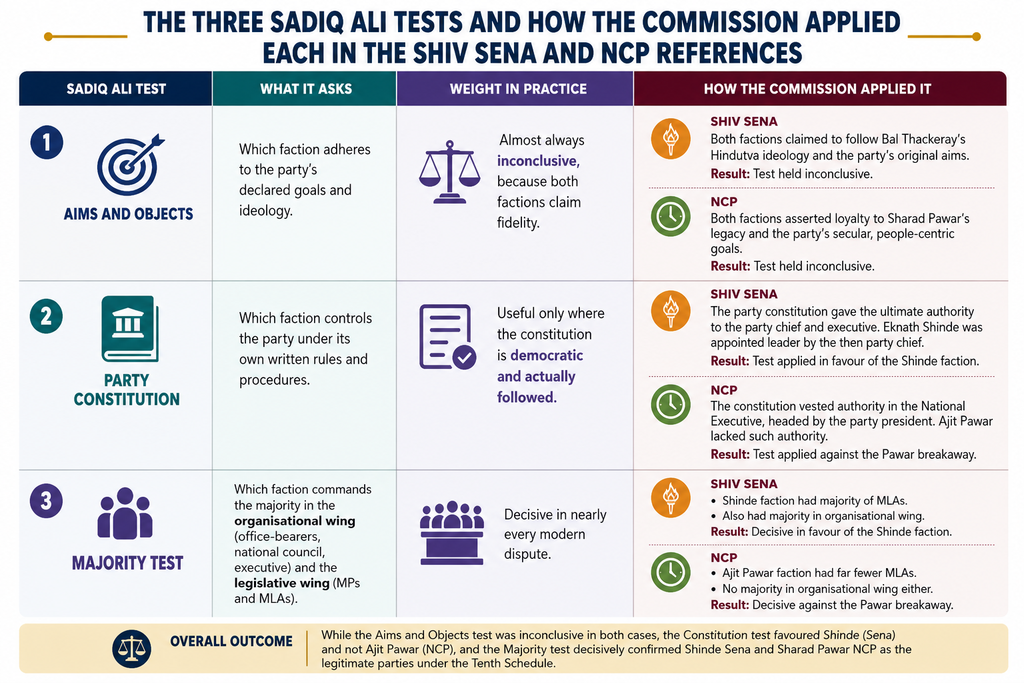
- The Court approved a three-fold enquiry, and the tests it endorsed remain the operative law more than half a century later.
| Test | What it asks | Weight in practice |
|---|---|---|
| Aims and objects | Which faction adheres to the party’s declared goals and ideology | Almost always inconclusive, because both factions claim fidelity |
| Party constitution | Which faction controls the party under its own written rules and procedures | Useful only where the constitution is democratic and actually followed |
| Majority test | Which faction commands the majority in the organisational wing (office-bearers, national council, executive) and the legislative wing (MPs and MLAs) | Decisive in nearly every modern dispute |
- The Court’s own emphasis was on the organisational wing as much as the legislative one — the majority test was conceived as a test of the party as a body, not of its legislators alone.
The contemporary applications
- The Commission’s reasoning in the recent disputes turns on one proposition: reliance on the test of the party constitution would itself be undemocratic where that constitution is neither democratic nor observed.
- Shiv Sena, February 2023. After the split of June 2022, the Commission by an order of 17 February 2023 recognised the Eknath Shinde faction as the Shiv Sena and allotted it the bow and arrow.
- It found the aims and objects test inconclusive and declined to rely on the party constitution, holding that the 2018 amendments to the Shiv Sena constitution had never been submitted to it and had made the organisation undemocratic — the Commission adding that those amendments had made the party “akin to a fiefdom”.
- It then applied the majority test in the legislative wing, counting the votes polled by the MLAs supporting each side in 2019: roughly 76% for the Shinde group against about 23% for the Uddhav Thackeray group.
- The Thackeray faction was allotted the name Shiv Sena (Uddhav Balasaheb Thackeray) and the flaming torch.
- Nationalist Congress Party, February 2024. After the July 2023 split, the Commission recognised the Ajit Pawar faction as the NCP and gave it the clock.
- Again the aims-and-objects test was held inapplicable and the party-constitution route unhelpful; again the legislative-wing majority carried the decision, the Commission observing that the Sharad Pawar side had not produced reliable evidence of an organisational majority.
- The Sharad Pawar faction was permitted under Paragraph 18 to register as the Nationalist Congress Party (Sharadchandra Pawar).
- The 2024 general election tested both determinations at the ballot box and did not confirm them. The Uddhav faction won 9 Lok Sabha seats to the Shinde faction’s 7, and the Sharad Pawar faction won 8 to Ajit Pawar’s 1 — the factions that lost the symbol outpolled the factions that kept it.
The critique
- The numerical test in the legislature wing rewards defection, and this is now the standard criticism. A group that engineers a split acquires the very majority the Commission will treat as proof that it is the party.
- It sits uneasily with the Tenth Schedule. The anti-defection law was designed to penalise legislators who leave a party; the symbol jurisprudence hands the party to the legislators who left. The two bodies of law point in opposite directions, and the coalition consequences belong to the study of coalition politics.
- It privileges a wing that is small, visible and purchasable over an organisation that is large, diffuse and hard to count — and it does so because counting MLAs is administratively easy and auditing a membership register is not.
- It converts internal party authoritarianism into a legal liability. Where a party’s constitution is a formality, as most are, the Commission cannot use it and must fall back on head-counting. Weak intra-party democracy thus produces a rule that further weakens it.
- The remedy usually proposed is that the Commission should be required to attempt a genuine determination of organisational majority — verified membership rolls, minuted meetings of the general body — before falling back on the legislative count, and that a statutory basis should replace an order made under a general power.
The six national parties as organisations
The recognised national parties have almost nothing in common as organisations. One is the most elaborately structured mass party in the democratic world; one is a century-old movement organisation that has not held a full organisational election in living memory; two are cadre parties whose cadre has largely gone; one is a decade-old urban formation; one is a hill-state party.
| Party | Founded | Organisational form | Where it governs or is competitive (2026) |
|---|---|---|---|
| BJP | 1980, successor to the Bharatiya Jana Sangh (1951) | Cadre-based mass party with a parallel ideological parent, booth-level structure, permanent full-time functionaries | Union government; a majority of states directly or through allies |
| INC | 1885 | Movement-descended catch-all party, federal in form, centralised in practice, weak below the district | Kerala, Telangana, Karnataka, Himachal; part of the Tamil Nadu government |
| BSP | 1984, by Kanshi Ram | Leader-centred cadre party built on the earlier BAMCEF and DS-4 networks | No state; residual vote in Uttar Pradesh |
| CPI(M) | 1964, on the split in the CPI | Democratic centralist cadre party with a Polit Bureau, Central Committee and mass fronts | Kerala (in opposition since 2026); marginal in West Bengal and Tripura |
| AAP | 2012, out of the anti-corruption agitation | Volunteer-founded party with a National Council and Political Affairs Committee; in practice leader-dominated | Punjab; opposition in Delhi |
| NPP | 2013, by P.A. Sangma | Regional cadre-and-notable party, coalition-oriented | Meghalaya; junior partner elsewhere in the North-East |
The BJP’s organisational machine
The BJP is the current benchmark against which every other Indian party’s organisation is measured, and the gap is not close. Its distinguishing feature is not its ideology, which belongs to a different discussion, but its capacity to sustain a permanent organisation between elections.
- Booth-level organisation is the foundation. The party’s basic unit is the polling-booth committee, and its stated ambition has long been a functioning committee at each of the roughly one million polling booths in the country.
- Below the booth committee sits the panna pramukh — literally the “page in-charge” — a worker assigned responsibility for the thirty or so voters listed on a single page of the electoral roll.
- The design converts an abstract mobilisation problem into a set of very small, checkable tasks: verify the voter exists, ensure a voter slip, ensure turnout. It is the closest thing in Indian politics to an industrialised canvass.
- Membership drives on a scale no other party attempts. The drive launched on 2 September 2024 targeted 10 crore members, was conducted through OTP-verified enrolment and a party application, and was declared complete within roughly two months.
- The party claims on this basis to be the world’s largest political party, a title it says it took from the Communist Party of China in 2015.
- The claim needs qualification. Missed-call and app-based enrolment is close to costless for the enroller, reports of bogus and duplicate registrations accompanied the drive, and “active membership” requires a further step — a small subscription and the recruitment of fifty others. Membership on this model measures reach, not commitment.
- A cadre relationship with a parent organisation. The party draws full-time organisers — sangathan mantris or organising secretaries — from its ideological parent, and these functionaries hold organisational rather than electoral office.
- This gives the party a supply of workers who do not want tickets, which is precisely the resource that ticket-seeking parties lack, and it insulates the organisation from the electoral cycle.
- The wider ideological ecosystem and its affiliated fronts are treated in the study of the ideological bases of Indian parties.
- A resource advantage that is now structural. Of the roughly ₹7,960 crore declared by all six national parties in 2024-25, the BJP accounted for about ₹6,769 crore. Party finance belongs to the study of the party system as a whole.
- Professionalised campaign management. Constituency-level micro-targeting, a permanent social-media and messaging apparatus, dedicated IT cells, and beneficiary databases built from Union welfare schemes have converted campaigning from a seasonal exercise into a continuous one.
- The labharthi or beneficiary outreach, in which welfare recipients are identified, contacted and canvassed as a category, is an organisational innovation rather than a policy one.
- The centralisation problem. The same machine that makes the party formidable nationally has weakened its state leaderships, since state satraps are rotated and subordinated to keep the central leadership pre-eminent.
- Jaffrelot and Verniers have noted the resulting disjuncture: the party has repeatedly polled far better in national elections than in the state elections that followed within months, because the resource and the leader are both national.
The Congress’s organisational hollowing
- The Congress’s problem is the mirror image of the BJP’s: it retains a presence everywhere and an organisation almost nowhere. Its constitution provides for elections at every level from the block upward; those elections have been notional for decades.
- Internal organisational elections have not been conducted in any full sense since 1972, and the membership register on which any such election would rest has repeatedly been found unreliable.
- The Udaipur Chintan Shivir of May 2022 produced the Udaipur Declaration, the most detailed self-diagnosis the party has published in a generation.
- Its commitments included one family, one ticket (with an exception for a second member who had put in five years of organisational work), 50% of organisational posts for those under fifty, a five-year cap on holding any one office, a mandatory cooling-off period, and new departments for public insight and election management.
- Implementation has been partial at best, and the family-ticket rule in particular has been honoured in the breach.
- The presidential election of October 2022 was the first contested election for the party presidency since 2000.
- Mallikarjun Kharge defeated Shashi Tharoor by 7,897 votes to 1,072 on a turnout of roughly 96% of delegates.
- It was a real contest with a real ballot, and it was also a contest in which the establishment candidate was widely understood to be the leadership’s choice; it demonstrated the form of internal democracy more convincingly than the substance.
- The Bharat Jodo Yatra was an attempt at organisational revival through mobilisation rather than through structure — Kanyakumari to Srinagar across roughly 4,000 kilometres between September 2022 and January 2023, followed by the Bharat Jodo Nyay Yatra from Manipur to Mumbai in early 2024.
- The yatras restored visibility and preceded a near-doubling of the party’s Lok Sabha tally in 2024, from 52 seats to 99. They did not build a cadre, and the distinction between a mobilisation and an organisation is exactly the party’s difficulty.
- The Sangathan Srijan Abhiyan, announced in 2025, is the current attempt to address the structural problem directly, by empowering district presidents as the pivot of the organisation, deploying observers to vet appointments, and creating a dedicated department to monitor district, block and booth committees.
- Its premise is a correct one — that the Congress’s failure is concentrated at the district level, where the BJP’s strength is — and its outcome is not yet assessable.
| Dimension | BJP | INC |
|---|---|---|
| Basic unit | Booth committee and panna pramukh, maintained between elections | District committee, frequently dormant |
| Full-time workers | Organising secretaries seconded from the parent organisation | Almost none who are not aspirants for tickets |
| Internal elections | Conducted, though consensual and centrally managed | Not held in substance since 1972; one contested presidential poll in 2022 |
| Membership | Claimed at 10 crore after the 2024 drive, app-verified | Register unreliable; enrolment drives repeatedly restarted |
| Candidate selection | Centralised, but on data-backed winnability assessment | Centralised, on factional recommendation |
| Resources | Dominant share of declared party income | A fraction of the BJP’s, though far above other parties |
| Revival strategy | Continuous expansion into new states and social groups | Yatras and declarations, now the district-level Sangathan Srijan Abhiyan |
The BSP: national status without a vote
- The BSP is the strongest case of recognition outliving relevance. Founded in 1984 by Kanshi Ram on the BAMCEF employees’ network of 1978 and the DS-4 of 1981, it was the only party in independent India built from the ground up as a Dalit political vehicle, with a full-time bahujan cadre and four terms for Mayawati as Chief Minister of Uttar Pradesh.
- The collapse has been rapid and near-total. From 21 Lok Sabha seats in 2009, the party fell to zero in 2014, recovered to 10 in 2019 on an alliance with the Samajwadi Party, and returned to zero in 2024; its Uttar Pradesh vote share fell from roughly a fifth to about 9%, and it won a single Assembly seat in 2022.
- The organisational diagnosis is consistent across observers: no second-rung leadership, no succession plan other than a family one, a cadre structure allowed to decay into a ticket-distribution machine, and no ideological renewal to match the change in Dalit aspiration.
- The party nonetheless retains national status, protected by the two-election review — the clearest single demonstration that the legal category lags the political reality.
The CPI(M): a cadre party with a shrinking map
- The CPI(M) has the most disciplined organisation of any Indian party and the smallest electorate of any national one. Its structure — branch, local committee, district committee, state committee, Central Committee, Polit Bureau — operates on democratic centralism, with binding decisions and a full-time whole-timer cadre.
- The territorial base has contracted to one state. Thirty-four years of continuous government in West Bengal ended in 2011; Tripura was lost in 2018; Kerala remains the only state where the party is a governing force, and the 2026 Kerala election returned the Congress-led UDF, ending the LDF’s second term.
- In the 2026 West Bengal election the party won a single seat; the Left’s national tally in 2024 was 8 Lok Sabha seats on about 2.5% of the vote, against a best-ever 59 seats in 2004.
- The organisational paradox is worth stating plainly: the party that has the most cadre has the fewest voters, while the party that has the most voters built its cadre most recently. The ideological reasons for the Left’s decline belong to a separate discussion.
The AAP: internal democracy claimed and abandoned
- The AAP was founded in November 2012 out of the anti-corruption agitation, and its founding claim was organisational as much as programmatic: it would be the party that did politics differently.
- Its stated commitments included an internal Lokpal, a National Council as the sovereign body, no two members of one family holding office or contesting, and a right of members to recall executive members.
- The distance between the claim and the practice opened early. The removal of Prashant Bhushan and Yogendra Yadav from the National Executive in March 2015, and the subsequent restructuring of the internal Lokpal, established that the party’s decision-making would be as leader-centred as any other’s.
- Its electoral trajectory is the fastest rise and one of the fastest reversals in recent Indian politics. Delhi in 2013 (28 seats), 2015 (67 of 70) and 2020 (62); Punjab in 2022 (92 of 117); state recognition in Goa and, decisively, roughly 13% in Gujarat in 2022, which took it to the four-state threshold and national status in April 2023.
- The Delhi defeat of February 2025 ended a twelve-year hold on the capital: BJP 48, AAP 22, Congress 0, with the BJP returning to power in Delhi after twenty-seven years and several senior AAP leaders, including the party’s founder-leader, losing their own seats.
- Punjab is now the party’s only government, which makes the AAP a national party with a single-state base — the same position the BSP and the CPI(M) occupy, reached from the opposite direction.
The NPP and the North-Eastern route
- The NPP shows that national status can be reached entirely outside the national arena — by holding state recognition in four North-Eastern states at once, not by any all-India vote. It leads the Meghalaya Democratic Alliance government under Conrad Sangma and is a coalition partner elsewhere in the region.
- It is aligned with the North-East Democratic Alliance at the Centre while contesting against the BJP in some state elections. This posture — ally at the Centre, rival in the state — is characteristic of the region and is one reason its party systems resist the national categories entirely.
Regional parties: what they are and why the definition is hard
- A regional party is conventionally defined as one that operates within a single state or a sub-region of one, and derives its appeal from a distinctive regional attribute — language, ethnicity, religion, sub-regional grievance, caste, or the personal following of a leader rooted there.
- The legal category and the sociological category do not coincide, and the mismatch is analytically important.
- The Commission’s “state party” label is a performance threshold, not a description of a party’s character. A national party that clears the state threshold is not thereby a regional party, and a regional party that fails it is not thereby something else.
- Some state parties are ideologically national. The Samajwadi Party and the RJD contest on questions of caste, reservation and secularism that are entirely national in scope; they are regional in reach, not in agenda.
- Some national parties are effectively regional. The BSP, the CPI(M), the AAP and the NPP each operate meaningfully in one or two states.
- The category is also unstable over time. The TMC was a Congress splinter that became a state party and then a national one and then a state one again; the AAP travelled in the opposite direction. Any typology has to be read as a snapshot.
- Scholarship has moved away from treating these parties as symptoms. Sudha Pai makes the essential corrective: regional parties are rooted in regional social ground and are a phenomenon in their own right, not a by-product of “regionalism” understood as a pathology, and they arise out of linguistic reorganisation, the decline of the Congress system and uneven development.
- The rise of regional parties is an eternal theme of Indian politics rather than a phase — the number of such parties being large in India simply because the variety they draw on is large.
- Sumantra Bose, in Transforming India, argues that the emergence of regional parties has deepened India’s democracy rather than fragmented it.
A typology of regional parties
| Type | Basis of mobilisation | Examples |
|---|---|---|
| Linguistic and cultural nationalism | Defence of a language, a cultural identity or a “sons of the soil” claim | DMK, AIADMK (Tamil); Shiv Sena and its factions (Marathi bhumiputra); Asom Gana Parishad (Assamese); Maharashtra Navnirman Sena; TVK |
| Caste and community mobilisation | Assertion of a specific caste bloc or coalition of subordinated castes | Samajwadi Party (Yadav-Muslim); RJD; BSP historically (Dalit-bahujan); Apna Dal (Kurmi); RLD (Jat) |
| Religion-linked regional parties | A religious community’s political vehicle within a defined territory | Shiromani Akali Dal (Sikh, founded 1920 — the oldest surviving regional party); Indian Union Muslim League; AIMIM; AIUDF |
| Statehood and sub-regional assertion | Demand for a separate state, or the politics of a state newly created | Jharkhand Mukti Morcha; TRS/BRS (Telangana); Gorkha Janmukti Morcha; Mizo National Front |
| Splinters from national parties | Personality or factional break from Congress or another national party | Trinamool Congress (1998); NCP (1999); YSR Congress (2011); Biju Janata Dal (1997, from the Janata Dal); Jana Sena |
| Personality vehicles | A leader’s personal following, often cinematic, institutionalised into a party | TDP (N.T. Rama Rao, 1982); AIADMK (M.G. Ramachandran, 1972); TVK (Vijay, 2024); Jan Suraaj |
- The types overlap heavily and most real parties sit in two or three cells at once. The AIADMK is a personality vehicle and a Dravidian cultural party; the BRS is a statehood party and the vehicle of one family; the Shiv Sena is a nativist party that has been, at different times, a religion-linked one.
- The typology is nonetheless useful because it predicts durability. Parties built on a linguistic or caste-social base have generally outlived their founders; pure personality vehicles have generally not, which is why the DMK persists and several film-star parties have not.
Why regional parties rose
The rise of regional parties is not a single event with a single cause; it is the convergence of an institutional opening, a social transformation and a political collapse.
Institutional causes
- The delinking of Lok Sabha and Assembly elections after 1971 is the most underrated cause. Until then the two sets of elections were largely simultaneous, and the national wave carried state contests with it.
- Once the cycles separated, state elections acquired their own agenda, their own issues and their own campaign, and a party with nothing to say about foreign policy or the national economy could still win an Assembly.
- It gave regional parties a full electoral arena of their own — and gave voters the practical possibility of splitting their ticket between levels.
- The federal structure itself advantages the state-level party. The subjects that touch daily life most directly — land, police, public order, agriculture, water, health, school education, local government — sit with the states.
- State leaders are physically and socially closer to the ground, and a party that concentrates on one state can build a denser network there than a national party spreading itself across twenty-eight.
- The linguistic reorganisation of states from 1956 created the arena in which regional parties became possible. Each reorganised state gave a dominant landholding caste a state-sized political stage on which it was the largest group, and dominant castes proceeded to build parties to occupy it.
- The Reddys and Kammas in Andhra, the Marathas in Maharashtra, the Jats in western Uttar Pradesh and Haryana, the Vokkaligas and Lingayats in Karnataka: the pattern repeats because the incentive was identical everywhere.
- First-past-the-post rewards geographic concentration. A party with 25% of the vote spread nationally wins nothing; a party with 25% of the vote in one state wins seats. The electoral system is structurally friendly to the regional party and structurally hostile to the small national one.
Social and economic causes
- The Green Revolution produced an assertive intermediate-caste peasantry. Rising agricultural surplus in Punjab, Haryana, western Uttar Pradesh and parts of the south converted economic strength into political demand, and the parties that carried that demand were regional ones.
- The deepening of social cleavages through continuous ethnic mobilisation. Each round of mobilisation on caste, language or community sharpens the identity mobilised and creates an organised constituency that outlasts the campaign.
- The growing politicisation of religion, which produced both religion-linked regional parties and counter-mobilisations that were themselves organised regionally.
- Rising consciousness of rights and of democracy itself, which made previously quiescent groups willing to contest for power rather than to accept patronage.
- Uneven regional development and the perception of central neglect. Backwardness experienced as a regional condition rather than a class condition produces a regional political demand — the argument that runs from the Telangana movement of the 1960s through Vidarbha, Bundelkhand and the North-East to the southern states’ current complaint about fiscal transfers and delimitation.
Political causes
- The Emergency and its aftermath fragmented the Congress and legitimised its opponents. The suspension of democracy discredited the centralising model, the 1977 verdict proved the Congress could be beaten, and the parties that beat it in the states stayed.
- The collapse of the Congress system was the permissive condition for everything else. As the party that had internalised India’s social diversity ceased to be able to contain it, the factions it had contained walked out and became parties.
- Congress centralisation under Indira Gandhi actively manufactured regional opponents. Replacing elected state units with appointed loyalists removed the internal route to state power, so ambitious state leaders had to build their own vehicles — which is how the TDP, the TMC, the NCP and the YSRCP were each, in their own decade, created.
The regional party is not a fragment of the national party system. In most of India it is the party system, and the national arena is where its bargaining is conducted.
Phases of regional party growth
| Phase | Character | Markers |
|---|---|---|
| Before 1967 | Isolated exceptions in a Congress-dominated field | Akali Dal (1920) in Punjab; DMK breaking through in Tamil Nadu from 1957; the communist ministry in Kerala in 1957; the distinct politics of Jammu and Kashmir |
| 1967–77 | The first real opening | Congress loses nine states; Samyukta Vidhayak Dal coalitions; defection as the currency of state politics; DMK forms government in 1967 |
| 1977–89 | Post-Emergency surge and consolidation | TDP founded 1982 and wins in nine months; AGP after the Assam Accord of 1985; regional parties become the natural party of government in several states |
| 1989–2014 | Indispensability | No party wins a Lok Sabha majority across seven elections; every Union government rests on state parties; the National Front, United Front, NDA and UPA are all built on them |
| Since 2014 | Divergence, not uniform decline | Some squeezed hard, others not squeezed at all |
- The pre-1967 exceptions are instructive because they were not accidents. Each rested on something the Congress could not absorb: a religious community with its own institutions in Punjab, a non-Brahmin cultural movement in Tamil Nadu, an organised communist peasantry in Kerala, and a constitutionally distinct arrangement in Jammu and Kashmir.
- 1967 is the hinge. The SVD governments were unstable and mostly short-lived, but they broke the assumption that only the Congress could govern a state, and they created the political class from which regional parties were subsequently built.
- The 1989–2014 phase gave regional parties structural leverage rather than merely seats. A party with fifteen Lok Sabha members could set the terms on which a Union government was formed, and did.
- The period since 2014 has not been uniform, and the common claim that regional parties are in general retreat does not survive the evidence.
| Regional party | Position before 2023 | Position by 2026 |
|---|---|---|
| BJD | Governing Odisha for 24 years | Lost the state and all 21 Lok Sabha seats in 2024 |
| YSRCP | Governing Andhra with 151 of 175 seats | Reduced to 11 Assembly seats in 2024 |
| BRS | Governing Telangana | Lost office in 2023; no Lok Sabha seat in 2024 |
| Shiv Sena / NCP | Single parties | Split and legally divided; the factions holding the symbols govern in Maharashtra |
| SAD | Principal Punjab pole for decades | 3 Assembly seats in 2022, leadership crisis, marginal in 2024 |
| TMC | Governing West Bengal since 2011 | Held 29 Lok Sabha seats in 2024; lost West Bengal in 2026 |
| DMK | Governing Tamil Nadu | Won 22 of 39 Lok Sabha seats in 2024; lost office in 2026 to a party founded in 2024 |
| JMM | Governing Jharkhand | Retained Jharkhand in 2024 |
| TDP / JD(U) | Regional allies | Pivotal to the Union government formed in June 2024 |
- The squeeze has been sharpest in the Hindi belt and in bipolar states where the BJP could position itself as the sole alternative, and weakest where the regional party is itself the pole of a settled state system.
- What defeated the BJD, YSRCP and BRS was in each case an anti-incumbency of long tenure rather than a national wave — each had governed for a decade or more, and each was replaced in its own state arena.
What regional parties have done to Indian democracy
Whether regional parties have strengthened Indian democracy and the federal system is best answered as “substantially yes on representation and federalism, substantially no on internal democracy and stability“, and the two halves have to be argued separately.
The case that they have strengthened democracy
- They made democracy more representative in the most literal sense: they brought into the system groups the national parties had never recruited from. The chief ministers, ministers and legislators produced by the Dravidian parties, the SP, the RJD, the BSP and the JMM came from social locations that the Congress of the 1950s treated as vote banks rather than as leadership pools.
- They strengthened the federal axis and the bargaining power of the states. A Union government dependent on state parties cannot treat state governments as administrative subordinates, and the practice of Centre-state relations changed accordingly after 1989.
- The sharpest fall in the use of Article 356 came after 1989, when the parties that stood to lose most from its abuse held the balance of power in Delhi. The judicial constraint imposed in S.R. Bommai (1994) and the political constraint imposed by coalition arithmetic operated together, and it is difficult to separate them.
- They forced the Centre to negotiate rather than to instruct. The Inter-State Council, the National Development Council and later the GST Council became real bargaining forums because the parties sitting in them had leverage at the Centre.
- They gave the states a voice in matters formally reserved to the Union, including foreign policy: Tamil Nadu’s parties on Sri Lanka and the Katchatheevu question, West Bengal on the Teesta agreement with Bangladesh, and the North-Eastern parties on border and citizenship questions.
- They widened political recruitment and lowered the entry cost of politics. A cultivator, a schoolteacher or a film technician could reach a chief ministership through a regional party in a way that was structurally improbable through a national one.
- They deepened electoral competition. Genuine two-pole competition arrived in most states through regional parties, and alternation — the routine defeat of incumbents — is the single most reliable indicator of a functioning democracy.
- They gave political expression to grievances that might otherwise have taken extra-constitutional form. The absorption of the Assam movement into the AGP after 1985, of the Mizo insurgency into the MNF, and of the Telangana agitation into the TRS are all cases of movements converted into parties and thereby into the constitutional order.
The case that they have weakened it
- Regional interest is systematically placed above national concern, because a party accountable to one state’s electorate has no incentive to internalise costs borne elsewhere — visible in river-water disputes, in resistance to national tax and policing reforms, and in the delimitation dispute.
- They produced instability at the Centre for a quarter-century. The governments of 1989–91 and 1996–98 fell because allies withdrew, and the cost of buying stability was paid in policy and in portfolios.
- The price of support has often been extracted in coin the public interest cannot afford — ministries chosen for their rent-generating capacity, protection from investigation, and the tailoring of national policy to one state’s demand.
- Personalisation and dynasty afflict them more severely than the national parties. Most regional parties are the property of a family or a founder; succession is hereditary; and the party frequently does not survive the leader’s political eclipse.
- The DMK, SP, RJD, TDP, JMM, Shiv Sena, NCP, SAD, YSRCP, BRS and INLD have all passed or attempted to pass leadership within a family. Internal democracy is close to absent, and organisational elections where they exist are ratifications.
- Criminalisation and money power are more acute where the party is smaller and the leader is the party, because there is no organisational check on candidate selection. The pattern in the legislator data belongs to the study of the socio-economic profile of legislators.
- Parochialism and nativism. The “sons of the soil” logic that mobilises a linguistic community also licenses hostility to internal migrants, which several such parties have practised.
- The shrinkage of an all-India agenda. When competition is organised state by state, questions that are genuinely national — macroeconomic direction, defence, climate, institutional design — drop out of electoral contestation altogether.
- A federal paradox worth stating. Regional parties strengthen federalism as a bargaining structure while frequently weakening it as a normative order, since a party that demands autonomy for its own state rarely defends it for another.
| Dimension | Strengthening effect | Weakening effect |
|---|---|---|
| Representation | Brought excluded castes and communities into leadership | Capture of the gains by dominant subordinate castes |
| Federalism | Real bargaining power for states; collapse in Article 356 misuse | Federal bargaining reduced to transactional demands |
| Competition | Genuine alternation in almost every state | Competition emptied of national policy content |
| Party organisation | Denser local networks than national parties manage | Dynasty, personalisation, no internal democracy |
| Governance | Responsiveness to local demand | Instability at the Centre; the price of support |
Regional parties and historically disadvantaged groups
- This is the strongest single argument in the regional parties’ favour, and it is a matter of record rather than of interpretation.
- The Dravidian parties institutionalised non-Brahmin mobilisation. Descended from the Justice Party and the Self-Respect Movement, the DMK and AIADMK converted an anti-Brahmin social movement into governing power, and Tamil Nadu’s reservation regime, midday meals and social-welfare architecture followed from it.
- The SP and the RJD carried OBC assertion into state power in the Hindi belt after Mandal, and permanently altered who could expect to hold office in Uttar Pradesh and Bihar.
- The BSP achieved something no other party has: a Dalit-led party winning a majority in India’s largest state in its own right, with a Dalit woman as Chief Minister four times, and the symbolic assertion — statues, parks, renamed districts — that accompanied it.
- The JMM built Adivasi politics into a governing force and delivered the state of Jharkhand itself, alongside the MNF, the NPP and other tribal-based parties in the North-East.
- The counter-argument must be stated with equal force. The gains were captured disproportionately by the dominant backward castes — the Yadavs, Kurmis and Gujjars who, on Jaffrelot and Verniers’s finding, have supplied more than 60% of all OBC MPs from the Hindi belt since the early 1960s.
- This is precisely what OBC sub-categorisation is about. The Rohini Commission, constituted in 2017 and reporting on 31 July 2023, found that roughly 97% of central OBC reservation benefits had gone to about 25% of OBC castes, and that some 983 OBC communities had zero representation in the jobs and seats concerned. The report has not been made public or acted upon.
- The same critique applies within Dalit politics, where Jatav consolidation behind the BSP left non-Jatav Dalits available for mobilisation by others.
- The social bases of these parties are treated in the study of ideological and social bases, and the representation data in the study of the legislator profile. The point here is organisational: regional parties were the institutional vehicle through which the mobilisation happened.
Third fronts and non-Congress non-BJP formations
A “third front” is a coalition of mainly regional parties assembled to offer an alternative to both the Congress and the BJP. It is a fluid category whose composition changes at every attempt, and it is usually pre-poll but has sometimes been assembled after results are known. What follows is what these fronts were as party formations; how they governed belongs to the study of coalition politics.
| Formation | Composition | Outcome |
|---|---|---|
| National Front, 1989–91 | Led by the Janata Dal, with DMK, TDP, AGP and Congress (S); JMM joined in 1991 | Formed the Union government on outside support from both the BJP and the Left — support withdrawn from both ends |
| United Front, 1996–98 | A thirteen-party front: Janata Dal, SP, DMK, TDP, AGP, the Left and others | Two Prime Ministers, H.D. Deve Gowda then I.K. Gujral, on outside support from the Congress, withdrawn twice |
| Third Front, 2009 | Assembled by the CPI(M) with BSP, AIADMK, BJD, TDP, Forward Bloc and others | Held 109 seats going in and won 82 — the clearest demonstration of the format’s electoral weakness |
| Mahagathbandhan, 2019 | State-level opposition alliances, with the Congress inside some and outside others | Did not affect the national outcome |
| I.N.D.I.A. bloc, 2024 | Congress with SP, TMC, DMK, RJD, the Left, Shiv Sena (UBT), NCP (SP), JMM and others | Won 234 seats; denied the leading party a single-party majority |
- The I.N.D.I.A. bloc is a different animal and should not be filed with the others. Every earlier front defined itself against the Congress as well as the BJP; in 2024 the Congress was inside the coalition, as its largest component — which makes it a bipolar opposition alliance rather than a third pole.
- Why third fronts have repeatedly failed — and the reasons are consistent across four decades:
- Too many prime-ministerial claimants. Every constituent leads a state and believes it entitles them to lead the country; the arithmetic of a front gives no one an obvious claim.
- Opportunism in formation. Parties join on the calculation of the moment and leave on the next one, so the front has no stable membership to build on.
- Parochialism. Each constituent’s mandate is a state mandate, and its first obligation is to that state, which makes coherent national positioning impossible.
- The absence of a national agenda. There is no programme that a Tamil nativist party, an Assamese regionalist party, a Yadav-Muslim party and a communist party can jointly own.
- They are negative coalitions. They are defined by what they oppose, and once the common adversary recedes there is nothing holding them together — the Janata experience of 1977–79 being the archetype.
- They are nonetheless not insignificant, and dismissing them is a mistake.
- Their aggregate vote share is large: state parties and non-aligned parties together account for a very substantial share of every general election’s vote, and in 2024 the recognised state parties alone were the difference between a majority government and a coalition one.
- They are dominant in several large states, so they hold the arena rather than merely contesting it.
- They carry the political representation of OBCs, Muslims and Dalits more consistently than either national pole, which gives them a durable social constituency independent of any particular front.
India’s many party systems
India does not have one party system; it has as many as it has states, and the national picture is an aggregation of them rather than a description of any of them. This is the central insight of the state-politics literature, and it is the reason national vote shares mislead.
- Yadav and Palshikar’s first proposition is that states have emerged as the effective arena of political choice.
- They put the behavioural consequence sharply: where voters in the 1970s and 1980s cast Assembly votes as if choosing a Prime Minister, they now cast parliamentary votes as if choosing a Chief Minister. Split-ticket voting between the two levels is the routine expression of this.
| Type of state system | Character | Cases |
|---|---|---|
| Bipolar, two-party | Two poles alternating, with third forces squeezed out | Tamil Nadu (DMK–AIADMK from 1967 to 2026); Andhra Pradesh (TDP–Congress, then TDP–YSRCP); Odisha until 2024 |
| Bipolar, two-coalition | Two stable fronts alternating, each with a permanent core | Kerala (LDF–UDF alternating at every election from 1980 until the LDF’s re-election in 2021) |
| Multipolar | Three or more parties with real seat-winning capacity | Uttar Pradesh (BJP, SP, BSP, Congress); Bihar (BJP, JD(U), RJD, Congress, Left) |
| Single-dominant | One party with no effective challenger for long stretches | West Bengal under the Left Front and then the TMC; Odisha under the BJD; Gujarat since 1995 |
| Fragmented and coalition-bound | Many small parties, government by post-poll assembly | Most of the North-East; Jammu and Kashmir |
- A state system can change type, and the direction is not one-way. West Bengal moved from single-dominant Left to single-dominant TMC and, in 2026, to something else again; Uttar Pradesh moved from multipolar to effectively bipolar as the BSP collapsed.
- The 2026 Tamil Nadu result is the most significant single event for this analysis in decades. Tamilaga Vettri Kazhagam, founded by the actor Vijay in February 2024, won 108 of 234 seats in its first election — short of the 118 needed — against the DMK’s 59 and the AIADMK’s 47, and formed a government in coalition with the Congress and with outside support from the CPI, CPI(M), VCK and IUML. Vijay was sworn in as Chief Minister on 10 May 2026.
- This ended the DMK–AIADMK duopoly that had governed Tamil Nadu without interruption since 1967 — the longest-running two-party system in India.
- It should be read carefully and not over-theorised. One result establishes that a bipolar state system can be broken by a new entrant with a mobilised following; it does not establish that Tamil Nadu now has a different party system, or that the pattern travels. The failure of Jan Suraaj in Bihar in 2025, which won no seats in its debut and dissolved its organisational units, is the immediate counter-example.
- What it does confirm is the older finding it sits inside: the Tamil arena remains a Dravidian-cultural arena, and the party that broke the duopoly did so from within that tradition, not against it.
- The consequence for the national question is direct. Any claim that India has entered a “fourth party system” of single-party dominance has to reckon with state systems in which the dominant national party is not one of the two poles — and with 2026, in which a state’s poles changed without the national party becoming one of them.
Regional parties and coalitions at the Centre
- The pattern is now settled: national governments are assembled out of state parties, and the price is paid in portfolios, in policy and in fiscal transfers. The TDP and the JD(U) were the pivotal allies of the government formed on 9 June 2024, when the leading party fell 32 short of a majority on its own.
- The mechanics of coalition formation, coalition dharma, the common minimum programme and the federal consequences of coalition government belong to the study of coalition politics, and are treated there.
Assessment
The Indian party system is best described as a national arena superimposed on twenty-eight state arenas that do not resemble each other, and the legal apparatus of recognition tracks that reality only imperfectly. The regional party is the characteristic institution of Indian democracy after 1967 — simultaneously its most effective instrument of inclusion and its least internally democratic organisation.
- The verdict that the record supports is a divided one.
- Regional parties have strengthened Indian federalism decisively, converting a constitutionally centralised design into a politically negotiated one.
- They have strengthened representation substantially but unevenly, drawing in groups the national parties never recruited from while allowing dominant sections within those groups to capture most of the gains.
- And they have weakened the quality of party organisation almost everywhere they have succeeded, since the leader-founder model that makes them electorally agile is the same model that leaves them without a succession or an internal check.
Previous Year Questions
- How far is it correct that the regional parties have strengthened Indian democracy and federal system? Substantiate your answer with suitable examples. (2022)
- Explain the increasing role of regional political parties in the national politics. (2018)
- Account for the rise of regional political parties and assess their role in contemporary India. (2015)
