

“Write short note: Participant observation.” (1990)
- Participant observation is the method in which a researcher joins and lives within the social setting under study, recording its life from the inside rather than reconstructing it from respondents’ after-the-fact answers.
- Bronislaw Malinowski’s fieldwork among the Trobriand Islanders is the method’s founding instance, establishing prolonged immersion as a disciplined research technique rather than incidental travel-writing.
- Its classic stated aim, in Malinowski’s own formulation, was to grasp how the people studied actually experienced their world from within.
- This note describes the method evenhandedly — its defining roles, a classic example of how access is actually secured, and its genuine strengths alongside its genuine costs — without arguing for or against any particular claim about its effectiveness.
Definition and Founding Instance
- Participant observation involves the researcher taking part in a group’s ordinary activities over an extended period while simultaneously recording what is observed, often supplemented by informal conversation, interviews, or documents gathered along the way.
- Malinowski’s insistence on long-term residence among the people studied, learning their language and participating in their daily and ceremonial life, set the disciplinary standard that later ethnographic fieldwork — in sociology as much as anthropology — continued to follow.
- “To grasp the native’s point of view, his relation to life, to realise his vision of his world.” — Bronislaw Malinowski
- This formulation names the method’s core ambition precisely: not merely to record behaviour from outside, but to reconstruct the meaning that behaviour holds for those living it — a goal no purely external, structured instrument can reach.
The Four Classic Roles
- Fieldwork of this kind is conventionally organised around four possible positions the researcher can occupy relative to the group, a typology commonly attributed to the sociologist Raymond Gold.
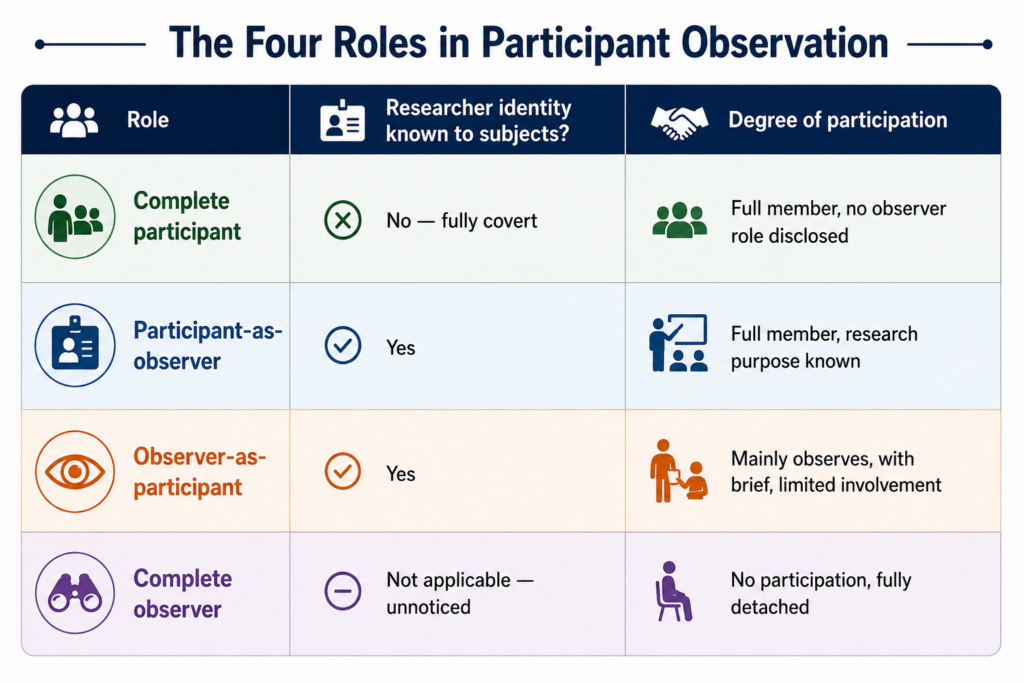
- The four roles form a continuum from full immersion to full detachment, and the same study can shift between them as access, trust, and the research question evolve over time.
Gatekeeper-Mediated Access: The Street Corner Society Example
- Entry into a closed social setting is rarely open-ended — it is typically secured through a gatekeeper, an insider who vouches for the researcher and opens (or restricts) access to the wider group.
- William Foote Whyte’s study of an Italian-American slum neighbourhood, conducted with the help of a local insider who introduced him around and shaped which parts of the community he could credibly approach, illustrates how a gatekeeper’s own position and relationships inevitably colour what the researcher is able to see.
- This is a structural feature of the method rather than a flaw specific to any one study: whoever grants access also, inevitably, frames the researcher’s starting view of the setting.
Strengths
- Ecological validity: behaviour is recorded in its natural setting, not in an artificial interview or laboratory context that may itself alter how people act.
- Access to the tacit and unspoken: body language, informal norms, and taken-for-granted routines that respondents would never think to mention in an interview become visible to a researcher actually present in the setting.
- Discovering the unanticipated: sustained presence in a setting regularly surfaces patterns the researcher did not originally set out to study, generating new hypotheses rather than only testing pre-existing ones.
Weaknesses
- Time-intensive: meaningful immersion typically requires months or years, far longer than a structured survey or a single interview.
- Low reliability and replicability: because the “instrument” collecting the data is the researcher’s own perception, judgement, and relationships, a second researcher entering the same setting cannot be guaranteed to observe or record the same things.
- Single-setting generalisation problem: findings from one community, gang, or workplace cannot straightforwardly be assumed to hold for other settings of the same general type.
- Observer effect: the presence of a researcher can itself change how people behave, independent of anything the researcher does deliberately.
- The risk of “going native”: prolonged immersion can erode the analytic distance a researcher needs, blurring the line between participating in the setting and objectively studying it.
- Participant observation remains distinctive among sociological methods for its unmatched closeness to lived social meaning, at the direct cost of the standardisation and replicability more structured techniques offer.
- The four-role typology remains a useful map for locating exactly where any given study sits on the participation-to-detachment continuum, rather than a rigid classification each study must fit neatly into.
- Gatekeeper dependence, illustrated sharply by the Street Corner Society case, is a reminder that access itself is never neutral, whatever role the researcher ultimately settles into.
- Its core logic has extended into contemporary digital settings, where researchers embedding themselves in online communities and forums face the same questions of disclosed versus undisclosed identity and of how much participation is enough to count as genuine immersion — showing the method’s underlying questions have outlasted the physical fieldwork settings that first defined it.