

Two real routes lead to the SDM’s chair — the UPSC Civil Services Examination and a State PCS exam — and they differ sharply on age limits, attempts, and how fast you actually get posted. Here’s exactly what each one demands, state by state.
There are two real paths to becoming an SDM.
Route 1 — UPSC Civil Services Examination: clear Prelims, Mains and the Interview, secure an IAS allocation, complete roughly two years of training at LBSNAA, and receive a first SDM posting within your first 1-3 years of service. Age limit: 21-32 (General/EWS), up to 35 (OBC), up to 37 (SC/ST); 6 attempts for General/EWS.
Route 2 — State PCS exam: clear your state’s Deputy Collector/SDM-track exam (UPPSC, BPSC, MPPSC, RPSC and others), which usually allows a higher age limit (commonly up to 40, and up to 44 in some states) and unlimited attempts within that limit, with a shorter, state-run training period and a faster first posting. Most working SDMs in India today reached the post through the State PCS route, not UPSC.
Quick Answer
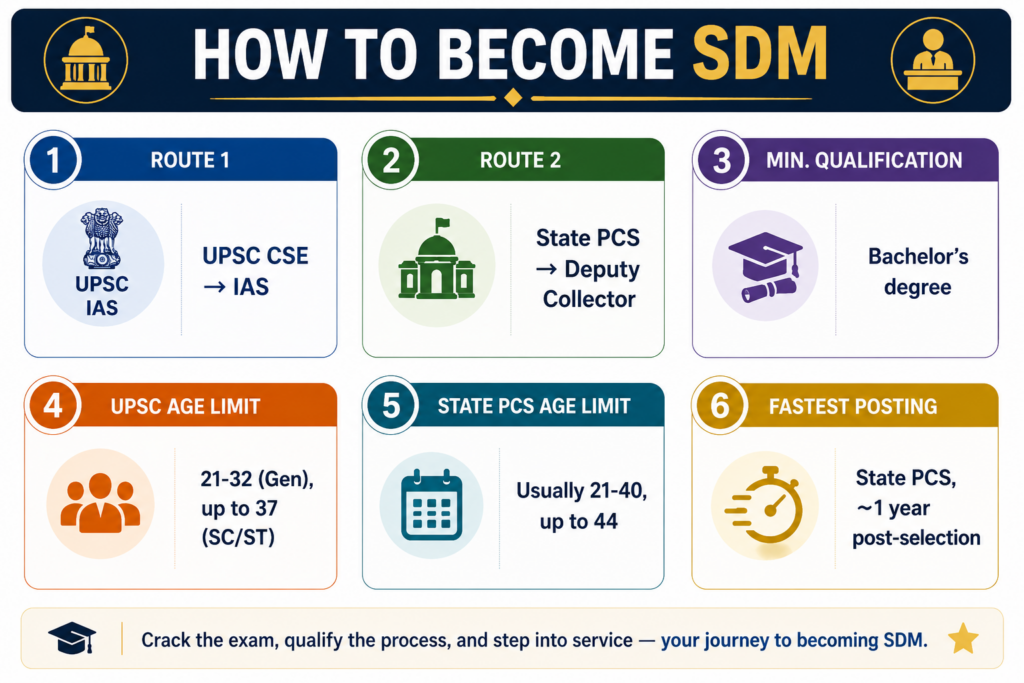
The Two Real Routes to SDM
Every “how to become SDM” answer has to start by separating two genuinely different careers, because most existing guides blur them into one generic checklist.
| Parameter | Route 1: UPSC CSE (IAS) | Route 2: State PCS (Deputy Collector) |
|---|---|---|
| Conducting body | Union Public Service Commission | State Public Service Commission (UPPSC, BPSC, MPPSC, RPSC, etc.) |
| Geographic scope | All-India cadre allocation | Fixed to home state, with rare inter-state deputation |
| General category age limit | 21-32 years | Usually 21-40 (varies 37-44 by state) |
| Attempts (General) | 6 | Usually unlimited within the age limit |
| Residential training | ~2 years at LBSNAA, Mussoorie | Shorter, state academy-run training |
| Time to first SDM posting | Year 1-3 of service, after training | Often within the first year of selection |
| Career ceiling | Can reach Cabinet Secretary | Typically caps at Additional/Principal Secretary; a small quota promotes into IAS |
Route 1: UPSC Civil Services Examination — Eligibility
| Category | Minimum Age | Maximum Age | Attempts |
|---|---|---|---|
| General / EWS | 21 | 32 | 6 |
| OBC | 21 | 35 | 9 |
| SC / ST | 21 | 37 | Unlimited (till age limit) |
| Eligible PwBD | 21 | 42 | Unlimited (till age limit), or 9 for General PwBD |
Age is calculated as on 1 August of the examination year. Additional relaxation applies for ex-servicemen and defence personnel disabled in operations.
Educational qualification: a bachelor’s degree from a university recognised under Indian law, or an equivalent qualification; final-year students may apply, but must produce proof of having passed before the Personality Test stage.
Nationality: for the IAS and IPS specifically, a candidate must be a citizen of India (candidates who are citizens of Nepal, Bhutan, Tibetan refugees who arrived before 1962, or persons of Indian origin who have migrated from certain other countries are eligible only for other, non-IAS/IPS services, subject to a certificate of eligibility).
📌 India Focus — What Actually Counts as an “Attempt”
An attempt is counted the moment you appear in even one paper of the Preliminary Examination — not when you clear it, and not when you merely submit an application without sitting for the paper. Submitting a form and then skipping Prelims entirely does not cost you an attempt.
UPSC CSE Exam Pattern
| Stage | Structure | Nature |
|---|---|---|
| Preliminary Examination | Paper I (General Studies, 200 marks) + Paper II (CSAT, 200 marks) | Objective (MCQ); CSAT is qualifying (33% minimum); only Paper I marks count toward the Prelims cut-off |
| Main Examination | 9 papers — 2 qualifying language papers, Essay, GS Paper I-IV, and 2 papers of one optional subject | Descriptive/written; 1,750 marks count toward the final merit |
| Personality Test (Interview) | Single round before a UPSC Board | 275 marks; tests personality, judgment and suitability for public service, not just knowledge |
Final merit is drawn from Mains (1,750 marks) plus the Interview (275 marks) — a total of 2,025 marks. Prelims is only a qualifying filter for Mains and does not add to the final score.
IAS Route Timeline: Exam to the SDM’s Chair
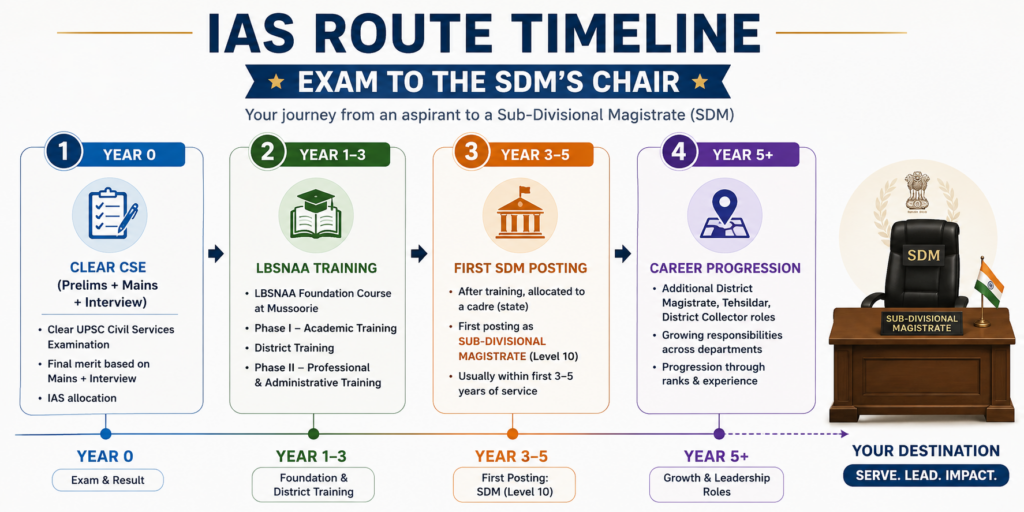
Most UPSC aspirants spend 3-6 years in serious preparation before clearing the exam. After selection, training at LBSNAA (Foundation Course, Phase I, a district-level attachment, and Phase II) runs roughly two years, after which the SDM posting is typically the first independent field charge, usually within year 1-3 of service.
Route 2: State PCS Eligibility — State-wise Comparison
This is the route that actually fills most SDM chairs in India, and it is also where age limits vary the most — often by a decade or more between states.
| State & Exam | Age Range (General) | Attempts | Notable Requirement |
|---|---|---|---|
| Uttar Pradesh — UPPSC (PCS) | 21-40 | No fixed cap, within age limit | — |
| Bihar — BPSC | 21-37 (M) / 21-40 (F) | No fixed cap, within age limit | Separate male/female upper limits |
| Madhya Pradesh — MPPSC | 21-40 | No fixed cap, within age limit | 2026 cycle introduced negative marking in Prelims |
| Rajasthan — RPSC (RAS) | 21-40 | No fixed cap, within age limit | — |
| Maharashtra — MPSC | 21-38 (approx.) | No fixed cap, within age limit | Marathi language proficiency required |
| Tamil Nadu — TNPSC (Group 1) | 21-32/37 (varies by post) | No fixed cap, within age limit | Hard domicile requirement; SC/ST relaxation extends notably higher |
| Punjab — PPSC | 21-37 (approx.) | No fixed cap, within age limit | Punjabi (Matric-level) proficiency required at the eligibility stage |
| Andhra Pradesh — APPSC | 18/21-42 | No fixed cap, within age limit | — |
| Telangana — TGPSC | 18/21-44 | No fixed cap, within age limit | Among the highest general-category ceilings nationally |
| Haryana — HPSC | 21-42 | No fixed cap, within age limit | — |
| Chhattisgarh — CGPSC | 21-40 (domicile); 21-30 (non-domicile) | No fixed cap, within age limit | Non-domicile candidates face a much lower cap |
These figures track each state’s most recent notification cycle as of mid-2026. Age cut-off reference dates also differ by state (commonly 1 January, but 1 July for UPPSC and TNPSC, and 1 August for BPSC) — always verify against the specific year’s official notification before applying, since state rules change from cycle to cycle.
State PCS Exam Pattern
Nearly every State PCS exam mirrors the UPSC three-stage structure — Preliminary (objective GS + a qualifying or scored aptitude paper, format varies by state), Main Examination (descriptive papers, typically fewer than UPSC’s nine), and an Interview/Personality Test — but with a syllabus weighted toward that state’s own history, geography, economy and current affairs, and, in several states, a compulsory regional-language paper at the eligibility or qualifying stage (Marathi for MPSC, Bengali for WBCS, Tamil for TNPSC, Gujarati for GPSC, Punjabi for PPSC, Telugu/Urdu options for the Andhra and Telangana commissions).
State PCS Route Timeline
Because there is no LBSNAA-equivalent residential training block, the gap between clearing the exam and taking charge as SDM/Deputy Collector is considerably shorter than the IAS route — commonly within the first year after the final result, following a state-run foundational training programme at that state’s own administrative training institute.
Physical & Medical Standards
For the SDM/administrative track specifically (via IAS or the Deputy Collector stream of a State PCS exam), there is no common physical fitness test — only a standard medical examination for general fitness, vision and hearing. Fixed physical standards (minimum height, chest measurement, and specific vision requirements) apply to the police-service track recruited through the same combined UPSC or State PCS notification — IPS via UPSC, and DSP via most State PCS exams — not to the SDM/administrative track. This distinction is worth double-checking carefully on a combined notification, since a single advertisement often lists both tracks together.
Step-by-Step: From Zero to SDM
- Complete a bachelor’s degree in any discipline from a recognised university (or reach your final year, if applying to UPSC CSE).
- Choose your route — UPSC CSE for an all-India IAS career, or your home state’s PCS exam for a faster, state-based Deputy Collector/SDM posting. (See the decision framework below.)
- Register — complete UPSC’s Universal Registration to obtain a URN, or your State PSC’s equivalent one-time registration, well before the application window closes.
- Clear the Preliminary Examination — an objective-format screening stage; only Mains-stage marks (plus Interview) count toward final merit.
- Clear the Main Examination — descriptive papers covering General Studies, Essay (UPSC), an optional subject (UPSC) or state-specific papers, and a qualifying language paper where applicable.
- Clear the Personality Test/Interview — the final stage before the merit list and service/cadre allocation.
- Complete training — LBSNAA for the IAS route (~2 years); a shorter state academy programme for the State PCS route.
- Receive your first SDM posting — typically year 1-3 of service via IAS, or within the first year via most State PCS routes.
Which Route Should You Target?
Neither route is objectively “better” — they optimise for different things.
- Choose UPSC CSE if you want an all-India career with the highest ceiling (Collector, Secretary, eventually Cabinet Secretary), you’re within the 21-32 window (or the relevant relaxed limit), and you can commit to a multi-year, high-intensity preparation cycle with only 6 attempts (General/EWS) to work with.
- Choose State PCS if you want to stay rooted in your home state, you’re past UPSC’s age ceiling but still within your state’s (often a decade higher), you want a meaningfully faster route to an SDM posting, or you’ve exhausted your UPSC attempts and want to keep going without an attempt cap.
- A common, credible middle path: prepare for both simultaneously in the early years — the GS syllabus overlaps heavily — and let your UPSC CSE result (or lack of one, by your last attempt) determine whether you pivot fully to your state’s PCS track.
Common Mistakes to Avoid
- Miscalculating age against the wrong reference date — UPSC uses 1 August; many states use 1 January, 1 July, or their own notified date. Check the specific year’s notification, not last year’s.
- Treating “attempt” loosely — for UPSC, appearing in even one Prelims paper counts as a used attempt, regardless of your Mains or Interview outcome.
- Assuming UPSC’s age/attempt rules apply to State PCS, or vice versa — the two systems are independent; a candidate who has exhausted UPSC’s 6 attempts may still have a full decade of eligibility left on their home state’s PCS exam.
- Confusing the administrative and police tracks on a combined notification — physical standards apply to the DSP/police stream, not the SDM/Deputy Collector stream.
- Ignoring domicile and language requirements — several states (Tamil Nadu, Maharashtra, West Bengal, Punjab, and others) either restrict eligibility to domiciled candidates or require proficiency in the regional language at the application stage itself.