

“Define the term ‘meander’ and describe the basic characteristics of entrenched meander and ingrown meander.” (2014)
- A meander is a pronounced, sinuous, loop-like bend in a river’s course, developed characteristically on low-gradient floodplains and delta plains where a river’s tendency to erode on one bank and deposit on the other causes its channel to migrate laterally into an increasingly curved, S-shaped or looping planform rather than flowing in a straight line.
- Where a river’s base level subsequently falls — through tectonic uplift, regional crustal warping, or a fall in sea level — the river’s renewed vertical erosive energy can cause it to cut these meander loops directly downward into bedrock, producing a specialised landform category termed incised (or entrenched, in the broad sense) meanders, of which entrenched meanders proper and ingrown meanders are the two principal, mechanically distinct types.
- The thesis argued here: the defining difference between entrenched and ingrown meanders is governed by a single controlling variable — the relative rate of vertical incision versus lateral migration during downcutting — and this single variable produces two geometrically and genetically distinct landforms whose cross-sectional shape alone allows a geomorphologist to infer the tempo of the uplift or base-level fall event that produced them.
Defining the Meander: Formation Mechanism
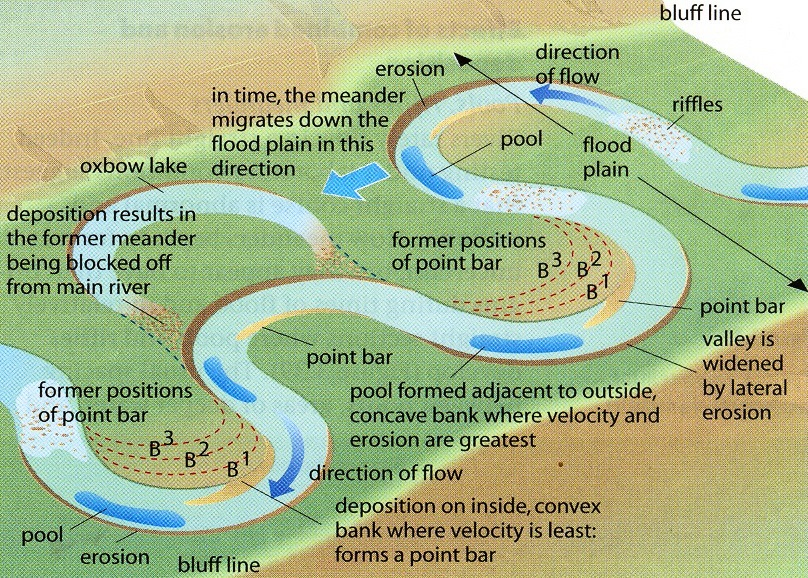
- Meanders develop where active erosion on the concave (outer) bank — producing a steep, undercut cut bank — operates simultaneously with active deposition on the convex (inner) bank — producing a gently sloping slip-off slope or point bar — a self-reinforcing asymmetry that steadily accentuates any initial bend in the channel.
- The process becomes progressively more pronounced in a river’s lower course, where reduced gradient and abundant fine sediment favour both the lateral erosion and point-bar deposition that drive meander growth, eventually producing deep, tightly curved loops.
- Where continued lateral erosion causes a meander loop to narrow at its neck until the river cuts directly across it during a flood, the abandoned loop is left behind as an isolated, crescent-shaped water body termed an oxbow lake — itself the natural end-stage of unchecked lateral meander growth on a stable floodplain.
Incised Meanders: The Shared Origin of Entrenched and Ingrown Types
- Both entrenched and ingrown meanders belong to the broader category of incised (entrenched, in the general sense) meanders: meander loops that originally developed on a gentle, low-relief surface and were subsequently cut down into underlying bedrock as a consequence of river rejuvenation — renewed vertical erosive capacity following a fall in base level, whether from tectonic uplift of the land or a drop in sea level.
- Because the meander loop’s planform was established before incision began, the loop’s looping, sinuous shape is preserved as the river cuts downward — meaning an incised meander is, in effect, a fossil record of an earlier, gentler landscape’s drainage pattern now imprinted into hard rock at depth, often producing spectacular gorges and canyons.
- The specific cross-sectional character the incised meander ultimately takes — symmetrical or asymmetrical — depends entirely on how the incision proceeded relative to any lateral migration during downcutting, which is precisely the variable separating entrenched from ingrown meanders.
Entrenched Meanders: Rapid, Symmetrical Downcutting
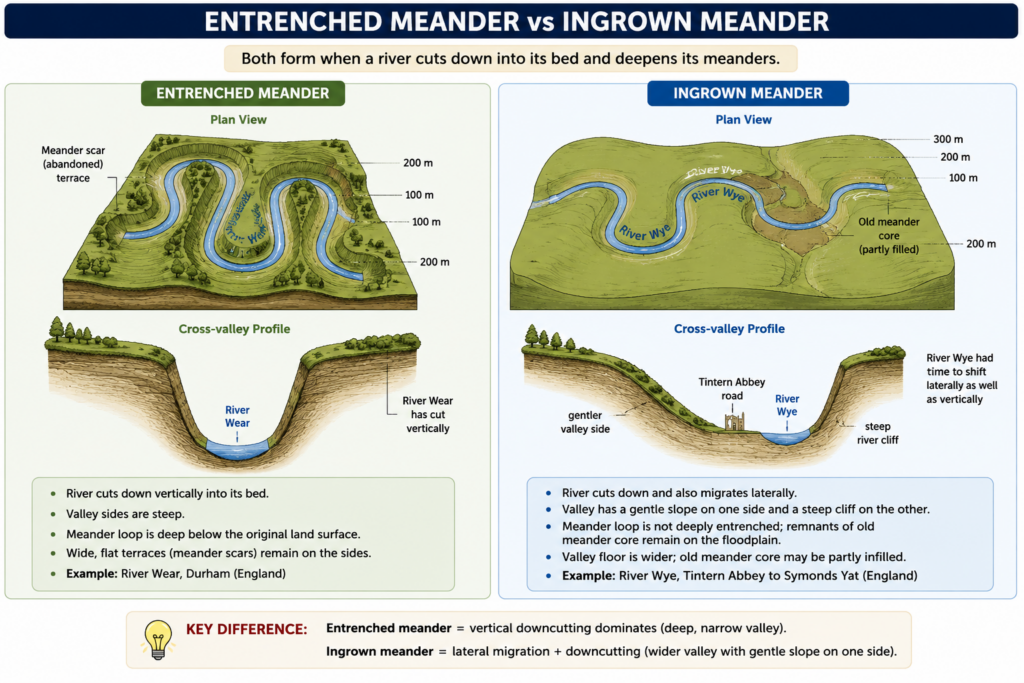
- Entrenched meanders form where vertical downcutting proceeds rapidly relative to lateral erosion, typically because the meandering river is superimposed onto resistant bedrock during comparatively swift tectonic uplift, leaving the river little opportunity for lateral erosion to modify the loop’s shape as it cuts downward.
- The defining characteristic of an entrenched meander is its symmetrical, steep-sided cross-section: because downcutting so heavily outpaces sideways migration, both valley walls (inner and outer bank) are cut at similarly steep angles, producing a valley that looks essentially the same in profile on either side of the river.
- Entrenched meanders are frequently found where valley sides consist of particularly resistant rock, since resistant bedrock further discourages the kind of lateral undercutting that would otherwise soften and asymmetrise the profile, reinforcing the deep, narrow, gorge-like character these features characteristically display.
Ingrown Meanders: Slower Downcutting With Continued Lateral Migration
- Ingrown meanders form under a less rapid rate of uplift or base-level fall, giving the river continued opportunity to erode laterally even while it is also cutting vertically — the incising river therefore keeps migrating sideways in essentially the same manner an unincised meandering river would, even as the whole system is being progressively lowered.
- The defining characteristic of an ingrown meander is its asymmetrical cross-section: the outer (concave) bank remains a steep, actively undercut cliff exactly as in an ordinary surface meander, while the inner (convex) bank develops a much gentler, widened slip-off slope, since lateral migration continues to add material to that side even as incision proceeds.
- Because lateral migration remains active throughout incision, ingrown meanders often preserve a wider valley floor than entrenched meanders of comparable depth, and the meander loop’s shape may be visibly modified (widened, flattened) relative to its original planform, unlike the essentially “frozen” loop geometry an entrenched meander preserves.
- “Entrenched meanders possess a symmetrical cross section… while ingrown meanders are asymmetrical and form when the river downcuts at a less rapid pace, giving the river opportunity to erode laterally as well as vertically” — the single distinguishing criterion around which this entire answer is organised.
Reading Landscape History From the Two Types
- Because entrenched meanders indicate rapid, largely vertical-only incision, their presence is generally taken as evidence of a swift pulse of tectonic uplift or rapid base-level fall, with too little time elapsed for lateral processes to keep pace.
- Because ingrown meanders indicate slower incision with sustained lateral activity, their presence instead suggests a more gradual, prolonged uplift or base-level change, allowing the river’s ordinary lateral migratory behaviour to continue operating throughout the incision episode.
- This makes the entrenched-versus-ingrown distinction directly useful as a diagnostic tool in denudation chronology: geomorphologists reading a landscape’s tectonic history can use the cross-sectional symmetry of its incised meanders as physical evidence for whether the uplift event that produced them was comparatively abrupt or comparatively gradual, without needing independent dating evidence.
- A meander is fundamentally a self-reinforcing product of differential erosion and deposition on opposite banks of a low-gradient channel, and where such a channel is subsequently rejuvenated, its preserved loop geometry becomes incised directly into bedrock as either an entrenched or an ingrown meander.
- The entrenched-versus-ingrown distinction reduces to a single controlling variable — the pace of vertical incision relative to lateral migration — yet this one variable produces two geometrically distinct, readily field-identifiable landforms (symmetrical gorge-like entrenched meanders versus asymmetrical, slip-off-slope-bearing ingrown meanders).
- Because their cross-sectional form directly encodes the tempo of the tectonic or base-level event that produced them, incised meanders remain a genuinely useful field diagnostic for reconstructing a region’s uplift history well beyond their intrinsic value as spectacular landscape features in their own right.