

“Write short note: Impact of Pleistocene Ice age on the crust of the Earth.” (2013)
- The Pleistocene Ice Age, during which continental ice sheets reached their maximum extent roughly 18,000 years ago and covered nearly one-third of the Earth’s land surface (compared to about one-tenth today), imposed a genuinely massive physical load on the crust wherever thick ice accumulated, chiefly across North America, northern Europe, and parts of Asia.
- The crustal response to this loading and its subsequent removal is best explained through the principle of isostasy — the state of gravitational-buoyancy balance in which the crust effectively “floats” on the denser material beneath it, first substantively developed as a concept by geologists studying exactly this kind of large-scale mass redistribution.
- The thesis argued here: the Pleistocene Ice Age’s crustal impact operated through two closely linked but analytically distinct mechanisms — glacio-isostatic depression and rebound (the vertical crustal response to ice loading and unloading) and glacio-eustatic sea-level change (the global sea-level response to water being locked into and released from ice sheets) — and the crust in formerly glaciated regions is, remarkably, still actively adjusting to this ice-age loading event today.
Glacio-Isostatic Depression: The Crust Sinks Under Ice Load
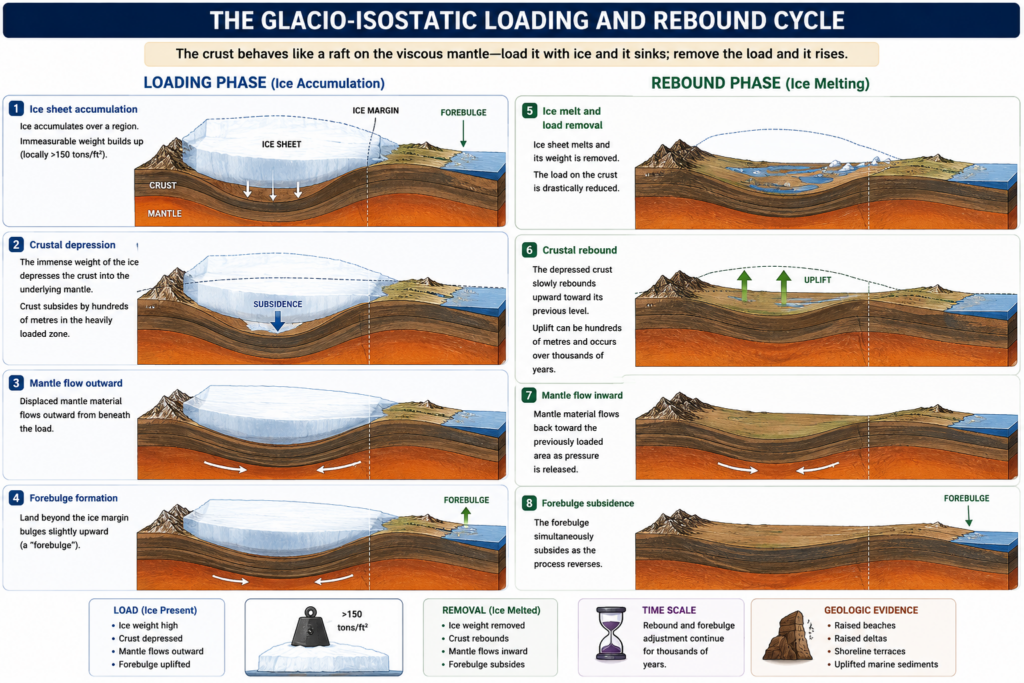
- Where ice sheets grew thick enough, the sheer weight of accumulated ice — estimated to have exceeded 150 tons per square foot over large parts of North America, Europe, and Asia — pressed the crust downward into the underlying, plastically deformable mantle by as much as 400 metres in the most heavily loaded regions.
- This depression was not confined to directly ice-covered areas alone: the displacement of mantle material outward from beneath the ice load caused land at the ice sheet’s margins to bulge slightly upward, a feature termed the forebulge, which itself later subsided once the main depression began to rebound.
- Once melting removed the ice load (beginning roughly 18,000 years ago and continuing through the early Holocene), the depressed crust began — and in many regions continues — to slowly rise back toward its pre-glacial position through post-glacial (glacio-isostatic) rebound, a process governed by the mantle’s high viscosity and therefore proceeding over many thousands of years rather than instantaneously.
Present-Day Evidence: Scandinavia’s Raised Beaches
- Scandinavia offers the clearest and most frequently cited demonstration of ongoing glacio-isostatic rebound: the raised beaches of Finland record an uplift of approximately 250 metres over the last 8,000 years, direct physical evidence that the crust beneath this heavily ice-loaded region is still actively adjusting to the removal of Pleistocene ice.
- “The concept of isostasy is extremely useful to explain ‘glacial adjustment’ taking place in Scandinavian countries after the Pleistocene great ice age” — a direct statement of the causal link between the isostatic concept and the observable Scandinavian evidence.
- This rebound process is genuinely ongoing rather than historical: because the mantle’s viscosity is so high, geophysical estimates suggest it may take another 10,000 years for regions like Scandinavia and Hudson Bay to complete their rebound and fully reclaim the mantle material still stored beneath their surrounding forebulge zones — meaning the Pleistocene Ice Age’s crustal impact remains a live, measurable process today, not merely a completed episode from the geological past.
- Hudson Bay, in central Canada, sat beneath one of the thickest parts of the former Laurentide Ice Sheet and today shows measured present-day uplift rates among the highest in the world, providing a second major real-world confirmation of the same rebound mechanism documented in Scandinavia.
Glacio-Eustasy: Global Sea-Level Change as a Secondary Crustal Effect
- Alongside the direct isostatic loading effect, the Pleistocene glaciations produced a second, globally distributed crustal-relevant effect through glacio-eustasy: as enormous volumes of ocean water were locked up as continental ice, global sea level fell dramatically during glacial maxima and rose again during interglacial melting phases.
- This eustatic sea-level oscillation altered the effective base level for rivers worldwide, driving repeated cycles of valley incision (during sea-level fall) and subsequent alluviation or drowning (during sea-level rise) — a mechanism directly responsible for many of the rejuvenation-linked landforms (incised meanders, river terraces, drowned coastlines) found across regions that were never themselves ice-covered at all.
- Crucially, glacio-isostatic and glacio-eustatic effects interact rather than operate independently: through processes geophysicists term ocean siphoning and continental levering, the redistribution of mass following ice melting affects relative sea level differently in different regions, meaning the net crustal and coastal impact of the Pleistocene Ice Age varies significantly by location even far from the former ice margins themselves.
Broader Structural and Landscape Consequences
- Beyond vertical crustal adjustment, the sheer mass redistribution associated with Pleistocene glaciation and deglaciation has been linked by some researchers to changes in regional stress patterns within the crust, with post-glacial rebound implicated in triggering minor seismic activity in some formerly heavily glaciated regions as the crust readjusts along pre-existing fault lines.
- The glacially depressed and subsequently rebounded regions also inherited a legacy of distinctive erosional and depositional landforms — fjords, drumlin fields, and moraine systems — whose present elevation and drainage relationships continue to reflect the ongoing isostatic adjustment rather than a fixed, completed geological state.
- Taken together, these effects mean the Pleistocene Ice Age’s crustal impact should be understood as a still-unfolding process: the ice load itself vanished thousands of years ago, but the crust’s isostatic response to its removal remains one of the clearest, most directly measurable examples of genuinely ongoing geomorphological change operating on human-observable, if slow, timescales.
- The Pleistocene Ice Age’s impact on the Earth’s crust operated through the combined mechanisms of direct isostatic loading and unloading (depression and rebound) and indirect glacio-eustatic sea-level change, both traceable through concrete, measurable present-day evidence such as Scandinavia’s raised beaches.
- The continuing, multi-millennial timescale of post-glacial rebound demonstrates that even a climatic event long concluded in the geological record can leave a crustal signature still actively evolving today, underscoring that geomorphological “equilibrium” is frequently a matter of gradual, ongoing readjustment rather than a fixed, completed state.
- This principle carries direct relevance for regions like Scandinavia and Hudson Bay, where infrastructure planning, harbour design, and coastal management must account for measurable ongoing land uplift — a genuinely rare case where a geomorphological process operating over millennia nonetheless requires active, present-day engineering consideration.