

“Explain with examples as to how channel dynamics has been responsible for the development of alluvial fans and cones.” (2015)
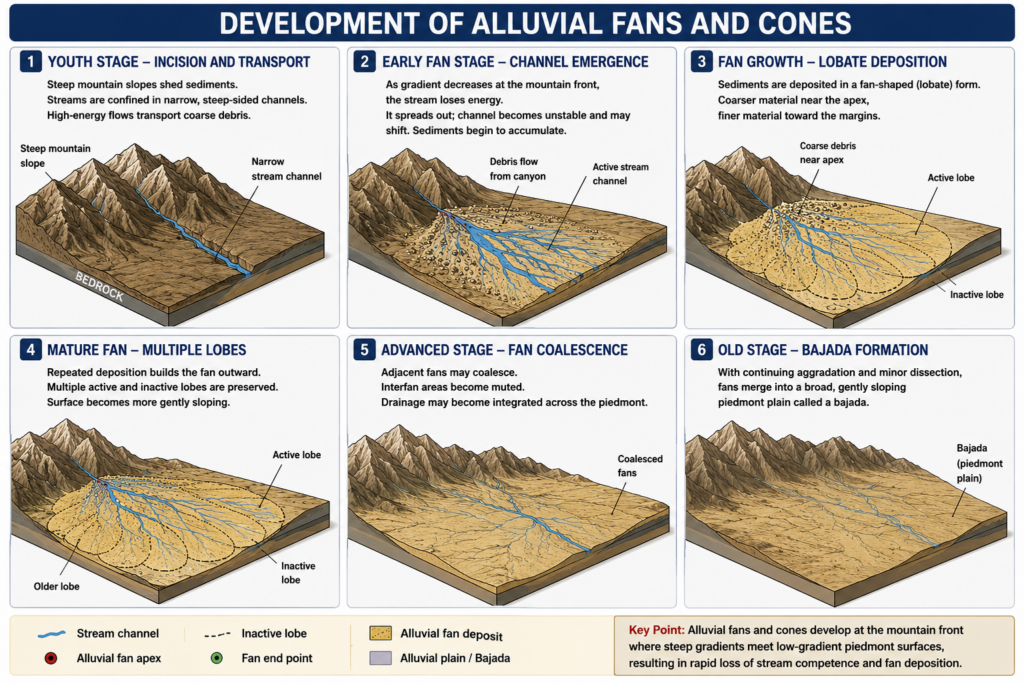
- An alluvial fan (and its steeper, coarser-grained variant, the alluvial cone) is a cone- or fan-shaped depositional landform built where a stream, heavily laden with sediment, emerges from a confined mountain valley onto a lower-gradient plain — a landform whose entire architecture is the direct, continuously evolving product of channel behaviour rather than a single, one-time depositional event.
- The central mechanism this answer develops is the abrupt loss of a channel’s transporting capacity at the mountain front, following the general relationship (associated with Gilbert’s early process-mechanistic work on stream grade) that a channel’s ability to carry sediment falls sharply as gradient and confinement decrease — but it is specifically the dynamic, unstable, repeatedly shifting character of the channel thereafter, not simply “deposition,” that builds the fan’s characteristic radiating, cone-like form.
- The thesis argued here: alluvial fans and cones are best understood as channel-dynamics-built landforms in the fullest sense — every stage of their construction, from initial deposition at the mountain front through the fan’s radial spreading to its final cross-sectional profile, is the cumulative record of a channel that braids, aggrades, and repeatedly avulses across the fan surface, rather than the product of one stream cutting one stable course.
The Trigger: Abrupt Loss of Transporting Capacity at the Mountain Front
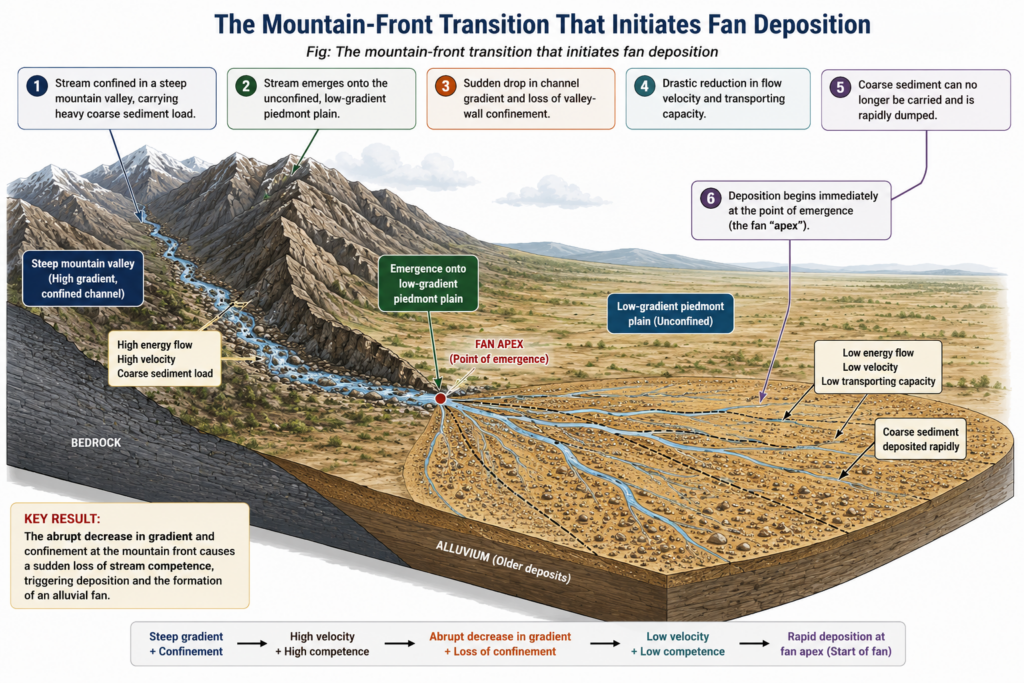
- A mountain stream carries an especially coarse, heavy sediment load because steep channel gradients within the confined valley generate high flow velocity and correspondingly high transporting capacity, allowing the stream to move large boulders and cobbles that a lower-gradient channel could never carry.
- The instant this stream crosses the mountain front and spreads out onto an unconfined piedmont plain, both its gradient and its confinement drop sharply — the same water volume is no longer channelled between steep valley walls but is free to spread laterally, and the reduced gradient directly lowers flow velocity — producing a correspondingly sharp fall in transporting capacity.
- Because the coarsest material becomes too heavy to carry the moment this capacity threshold is crossed, deposition begins immediately at the point of emergence (the fan’s apex), with progressively finer material carried slightly further before it too is deposited — this size-sorting from coarse-near-apex to fine-near-toe is a direct, continuously renewed record of the channel’s changing carrying capacity as it spreads outward.
Braiding and Aggradation: How Channel Instability Builds the Fan’s Radial Form
- Once past the apex, the channel does not maintain a single stable course; instead, the sudden sediment overload forces it into a braided pattern — multiple shifting, interweaving channels separated by temporary mid-channel bars — since no single channel thread can carry the entire sediment load the stream is attempting to deposit.
- This braided channel network continuously aggrades (raises) its own bed through repeated deposition, and as the bed rises, the channel becomes progressively less efficient at containing even normal flows — a self-reinforcing instability that is the direct mechanical precursor to the channel’s eventual, larger-scale relocation.
- Bank erosion and lateral bar growth within the braided network force individual channel threads to shift position continuously, while both ongoing bed aggradation and mid-channel bar formation periodically force the main flow into an entirely new path, causing the stream to episodically abandon one channel course in favour of another.
- “Channels are usually braided from the apex, and bank erosion and lateral bar formation can force the channel to shift, while both bed aggradation and mid-channel bar formation can force water into new paths” — a description that captures precisely why a fan is never built by one channel, but by a whole population of channels that occupy the surface in sequence.
Avulsion: The Mechanism That Gives the Fan Its Radial, Fan-Shaped Geometry
- The single most important channel-dynamic process shaping the fan’s overall radial, fan-like plan-view geometry is repeated avulsion — the periodic, often abrupt abandonment of an aggraded channel in favour of a new course, radiating outward from the same fixed apex point in a slightly different direction each time.
- Because each avulsion event starts from the same apex but sends the active channel down a different radial direction across the fan surface, the cumulative effect of many such avulsions over time is to build up sediment across the entire arc of the fan rather than along a single fixed line — this repeated, apex-pivoted redirection of the active channel is what produces the fan’s characteristic smooth, symmetric, cone-like form when viewed in plan or cross-section.
- Fan surface climate strongly conditions the resulting cone’s steepness and shape: fans built under humid conditions tend to be low, gently sloping cones (since more continuous fluvial reworking smooths the surface and finer material is more readily transported further from the apex), whereas fans built under arid and semi-arid conditions tend to be steeper, higher cones (since flashier, less continuous flow deposits coarser material closer to the apex with less subsequent reworking), giving rise to the classic sharp-fronted desert alluvial cone as distinct from the gentler humid-region fan.
- Where numerous individual fans along a single mountain front grow large enough to merge laterally, their coalescence produces a continuous, apron-like depositional feature termed a bajada — itself simply the aggregate geomorphic signature of many separate channels’ avulsion histories operating side by side along the same range front.
Examples: Channel Dynamics in Action
- The Kosi River fan on the Himalayan foreland in northern Bihar is among the world’s most-studied active megafans, and its recorded history is essentially a history of channel avulsion: the Kosi has shifted its course by roughly 120 kilometres westward across its fan over the historical period through repeated avulsion events, most dramatically in the catastrophic 2008 eastward avulsion that abandoned an aggraded channel for a new course with severe flood consequences — a real-time, well-documented illustration of exactly the aggradation-then-avulsion mechanism described above.
- Death Valley, California, presents a classic arid-zone example: dozens of steep, sharply defined alluvial fans spill from the surrounding fault-bounded mountain ranges directly onto the valley floor, their high, sharp-fronted cone profiles a direct product of flashy, episodic desert channel flow depositing coarse material close to each fan’s apex with minimal subsequent smoothing.
- Along the Himalayan foothills of Uttarakhand, streams descending from the mountains onto the Indo-Gangetic Plain build a near-continuous belt of coalescing fans, whose active channel courses continue to braid and periodically avulse today — a present-day, ongoing demonstration that fan-building through channel dynamics is not merely a completed historical process but an active one, with direct and continuing implications for flood-hazard management in these densely settled foothill zones.
- Alluvial fans and cones are, from apex to toe, a continuously updated record of channel behaviour: the abrupt loss of transporting capacity at the mountain front initiates deposition, braiding and progressive bed aggradation destabilise the channel, and repeated avulsion around the fixed apex point is what actually builds the landform’s distinctive radial, cone-shaped geometry rather than any single depositional event.
- The clear climatic conditioning of fan form — steep cones under arid, flashy channel regimes versus gentle cones under humid, more continuous ones — further confirms that it is channel behaviour, not simply sediment supply, that is doing the shaping work, since the same volume of sediment produces measurably different landforms depending on how the channel delivering it actually behaves.
- The continuing activity of major fans such as the Kosi’s, still avulsing within recorded historical memory and causing serious flood disasters when they do, means channel-dynamics-driven fan-building remains directly relevant to disaster management and settlement planning today, not merely a completed process to be read retrospectively off an inactive landform.