

“Discuss the contribution of the American school of subaerial Denudation in geomorphology.” (2015)
- The American school of subaerial denudation refers to the sequence of nineteenth-century American geologists — John Wesley Powell, Grove Karl Gilbert, Clarence Dutton, and, culminating the tradition, William Morris Davis — whose field studies of the American West established that vast landscapes could be reduced to low-relief plains by ordinary, ongoing surface processes (rivers, weathering, mass movement) acting over long time spans, without invoking marine erosion or catastrophic events.
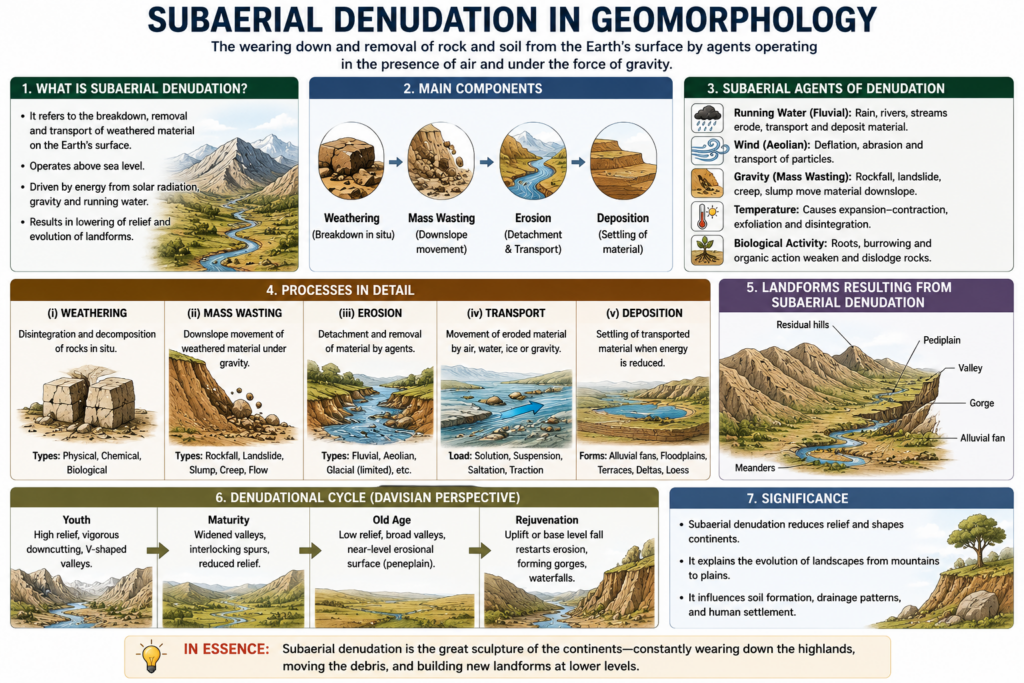
- Their shared, foundational departure from earlier catastrophist thinking was the argument that subaerial denudation — erosion occurring on exposed land surfaces by rain, rivers, and weathering — was itself sufficient to explain the reduction of continents to plains, an idea Powell first emphatically asserted and which the rest of the school subsequently elaborated, quantified, and systematised.
- The thesis argued here: the American school’s collective contribution should be read as a cumulative, four-stage synthesis — Powell established the base-level concept and the very possibility of denudational plains, Gilbert supplied the dynamic, equilibrium-based mechanics of how landforms actually adjust to process, Dutton extended the same denudational logic to isostatic crustal response, and Davis finally assembled all three into the single, unifying geographical cycle that became geomorphology’s dominant explanatory framework for the next half-century.
John Wesley Powell: Base Level and the Foundational Insight
- Powell, through his pioneering exploration and survey of the Colorado River and the Grand Canyon region in the 1870s, first articulated the possibility that prolonged subaerial denudation alone — without any marine incursion — could reduce an uplifted landmass toward a plain, a genuinely original insight at a time when many geologists still leaned on marine planation to explain large-scale erosional surfaces.
- His concept of the base level of erosion — the theoretical lower limit (ultimately sea level, though a river may have a local or temporary base level at a lake or resistant rock barrier) below which a river cannot erode its valley — became the single most durable conceptual tool the entire school subsequently built upon, since it supplied the necessary lower boundary condition for any theory of landscape reduction by rivers.
- Powell’s direct field observation of the Colorado Plateau’s deeply incised canyons, cut through structurally near-horizontal strata, gave the school its first clear physical demonstration that rivers alone, given sufficient time, could accomplish extraordinary vertical erosion — a demonstration that subsequently anchored Dutton’s and Davis’s more theoretical elaborations.
Grove Karl Gilbert: Dynamic Equilibrium and the Mechanics of Process
- Gilbert’s landmark study of the Henry Mountains of Utah — where he first systematically documented laccoliths (dome-shaped igneous intrusions) — went beyond structural description to develop a genuinely mechanistic understanding of how landform shape reflects the balance between erosive force and material resistance.
- Gilbert’s most enduring conceptual contribution was the principle later termed dynamic equilibrium: he argued that a landform’s shape is continuously adjusted so that it is just capable of transmitting the load (water and sediment) supplied to it — a river’s gradient, for instance, adjusts itself so that the channel’s transporting capacity exactly balances its sediment load, a self-regulating, grade-seeking behaviour rather than the one-directional, stage-bound evolution Davis would later formalise.
- “Gilbert (1877) treated landscape as the product of a complete or incomplete cycle of erosion” — an early framing that shows Gilbert had already grasped the cyclical possibility Davis would later elaborate, even while Gilbert’s own emphasis remained on the continuous, self-adjusting mechanics of process rather than a strictly staged sequence.
- Gilbert additionally recognised soil creep as a significant, continuously operating agent responsible for the characteristic rounding of hilltops — a specific, empirically grounded mechanism illustrating his broader methodological commitment to explaining landforms through identifiable, measurable physical processes rather than through descriptive stage-classification alone.
- This process-mechanistic, equilibrium-based strand of Gilbert’s thinking would later be revived and extended by twentieth-century geomorphologists such as A.N. Strahler and J.T. Hack, whose own dynamic equilibrium models explicitly positioned themselves as a return to Gilbert’s original insight against the historicist, stage-bound Davisian tradition that had come to dominate in between.
Clarence Dutton: Isostasy and the Colorado Plateau’s “Great Denudation”
- Dutton, studying the Colorado Plateau’s High Plateaus, is remembered above all for coining the term isostasy in 1889, describing the state of gravitational-buoyancy balance between the Earth’s crust and the denser material beneath it — directly relevant to denudation because the removal of a great thickness of rock by erosion causes measurable, compensating crustal uplift.
- Dutton’s detailed analysis of the Colorado Plateau’s erosional history, which he characterised as recording a period of extraordinary landscape reduction he termed the “Great Denudation,” provided the school’s clearest single regional case study of subaerial processes operating over a sufficiently long timespan to strip away enormous volumes of rock.
- Dutton’s repeated demonstration of how the base-level concept applied concretely across the Colorado Plateau’s varied terrain — connecting Powell’s abstract principle to observable regional landscape history — is widely credited with directly inspiring Davis’s subsequent, more general formalisation of peneplanation as a universal end-stage of landscape denudation.
William Morris Davis: Synthesis into the Geographical Cycle
- Davis drew together Powell’s base-level concept, Dutton’s regional denudational case studies, and the broader orogenic-cycle ideas of contemporaries such as Dana and Le Conte, synthesising them into the single, unifying geographical cycle (cycle of erosion, 1899) — landscape evolution as a directional sequence of youth, maturity, and old age, culminating in a low-relief peneplain graded to base level.
- Where Gilbert had emphasised continuous, self-adjusting process mechanics, Davis instead framed landform development as historical and staged, analysable through his famous trio of structure, process, and stage — a framing that, while criticised by Gilbert’s intellectual successors for underplaying dynamic equilibrium, gave the school’s cumulative insights their most widely taught, examinable, and internationally influential form.
- Davis’s model achieved a genuinely global reach that Powell’s, Gilbert’s, and Dutton’s more regionally grounded contributions had not: it was subsequently extended by Davis himself and others to arid landscapes (1905), glacial landscapes (1900), coastal landscapes (Johnson, 1919), karst landscapes (Cvijić, 1918), and periglacial landscapes (Peltier, 1950) — a direct testament to how thoroughly the American school’s originally regional, American-West-based insights came to structure geomorphology as a discipline worldwide.
- The American school of subaerial denudation is best understood not as the work of a single figure but as a genuinely cumulative intellectual tradition: Powell’s base-level concept supplied the boundary condition, Gilbert’s dynamic equilibrium supplied the process mechanics, Dutton’s isostasy and regional case studies supplied the crustal-response dimension and empirical grounding, and Davis’s geographical cycle supplied the synthesising framework that carried all of it into international currency.
- Its lasting significance lies precisely in this layered character: even where later geomorphologists (Penck, Strahler, Hack, Chorley) explicitly rejected Davis’s historicist staging in favour of something closer to Gilbert’s original equilibrium-based thinking, they were still working within the conceptual vocabulary — base level, subaerial denudation, grade — the American school had first established.
- The school’s foundational premise — that ordinary, patient surface processes acting over sufficient geological time, not catastrophic or marine events, are what ultimately reduce continents toward low relief — remains, more than a century later, the working assumption underlying virtually all mainstream fluvial and denudational geomorphology.