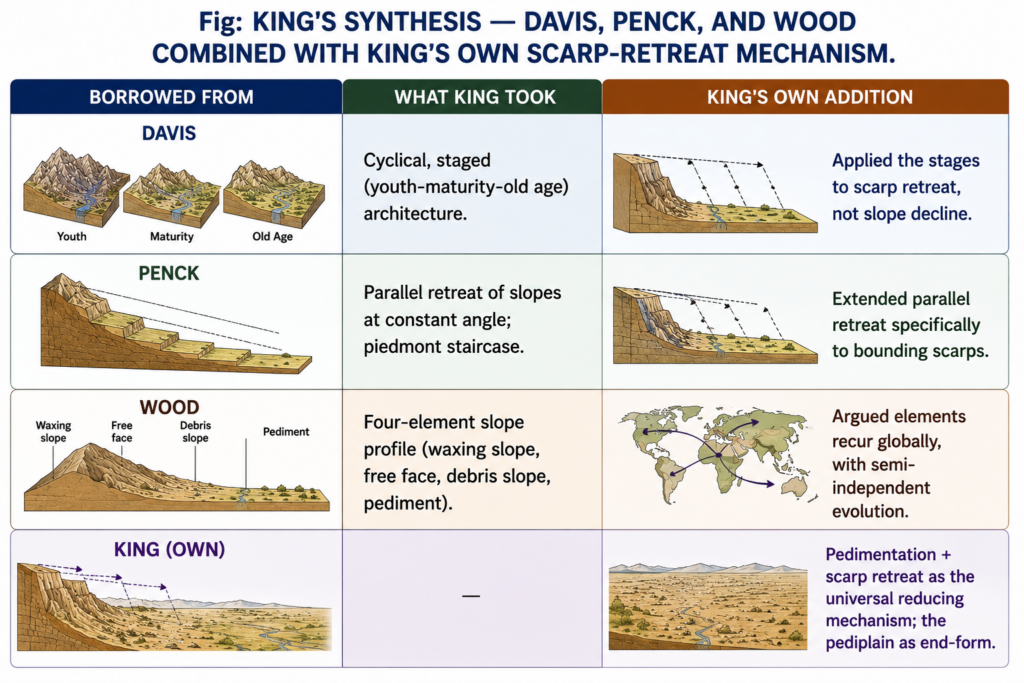
“”In explaining the concept of ‘Pediplanation’, King combined the ideas of Davis, Penck and Wood with his own.” Elaborate.” (2016)
- Lester Charles King (1953, 1957, 1967) proposed the cycle of pediplanation based on his study of the semi-arid and savanna landscapes of Southern Africa, arguing that parallel scarp retreat producing coalescing pediments — not the Davisian process of slope decline producing a peneplain — is the dominant, near-universal mode of landscape reduction.
- King explicitly rejected Davis’s humid-temperate model as the “normal” template for landscape evolution, yet his own synthesis was not built from nothing: it deliberately absorbed and reworked specific, identifiable elements from W.M. Davis’s cyclical framework, Walther Penck’s dynamic slope-process analysis, and Alan Wood’s (1942) four-element slope model, fusing them with his own field observations into a single coherent theory.
- The thesis argued here: King’s pediplanation is best understood not as a wholly original theory but as a genuine act of synthesis — he retained Davis’s cyclical, stage-based architecture, adopted Penck’s emphasis on parallel slope retreat over slope decline, borrowed Wood’s four-part slope-element vocabulary wholesale, and added his own decisive contribution of scarp retreat as the landscape’s primary reducing mechanism, producing a theory more comprehensive than any of its individual sources.
What King Took From Davis: The Cyclical, Stage-Based Architecture
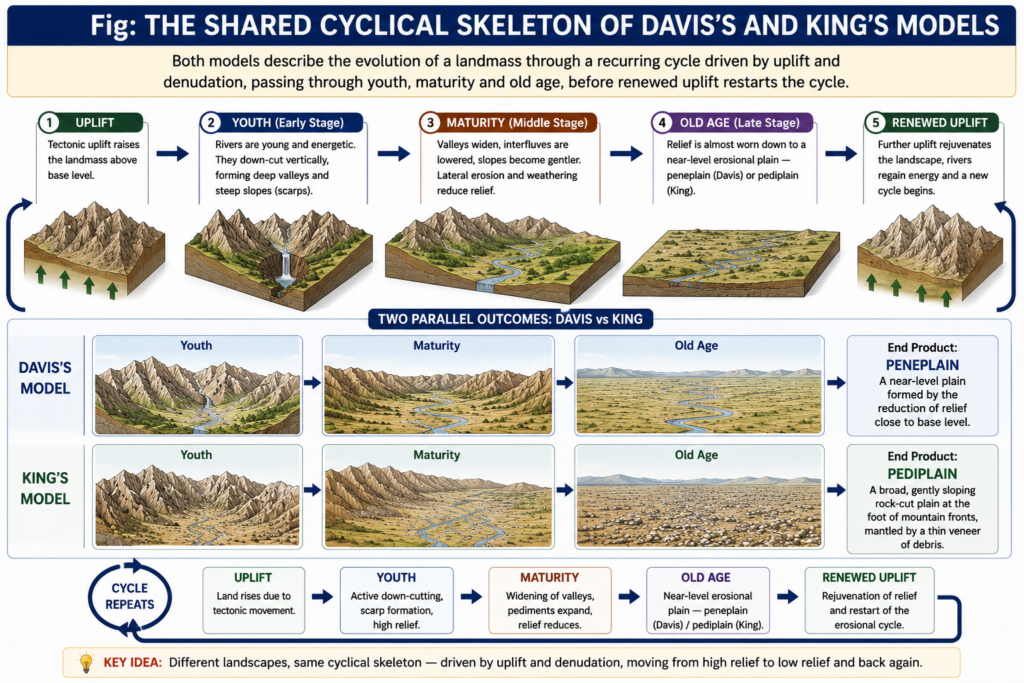
- King retained the single most structurally important feature of Davis’s geographical cycle: the idea that landscape evolution is a directional, staged process beginning with tectonic uplift and passing through recognisable youth, maturity, and old-age phases before culminating in a low-relief erosional end-form.
- Just as Davis’s cycle could, in principle, be interrupted and restarted by renewed uplift (rejuvenation), King’s cycle of pediplanation likewise envisaged repeated episodes of uplift punctuating long periods of stability, producing a landscape of multiple pediplain remnants at different elevations — a staircase of erosion surfaces recording successive cycles, directly analogous to Davis’s concept of multi-cyclic landscapes.
- King’s very use of the “cycle” terminology, and his structuring of pediplanation into youth, maturity, and old age stages exactly mirroring Davis’s own vocabulary, signals how deliberately he preserved the Davisian scaffolding even while rejecting its process content — the argument was over how landscapes are reduced, not over whether landscapes evolve through a staged sequence at all.
What King Took From Penck: Parallel Retreat Over Slope Decline
- Walther Penck had already broken from Davis by arguing that slopes do not necessarily decline in angle through time (as Davis assumed); instead, Penck proposed that under many conditions slopes retreat parallel to themselves, maintaining a roughly constant angle while the slope as a whole migrates backward — a process Penck’s own model culminated in with the low-angle, concave end-form he termed the Endrumpf.
- King adopted this parallel-retreat mechanism as the operative process behind his own scarp evolution: in King’s model, the steep scarps bounding upland blocks retreat backward through weathering and erosion without any reduction in their steepness, exactly the parallel-retreat behaviour Penck had described rather than the progressive flattening Davis’s slope-decline model would predict.
- “There is no reduction in their steepness when they are wasted back by weathering or rain wash” — King’s own characterisation of scarp retreat, which is functionally Penck’s parallel-retreat principle applied specifically to the bounding escarpments of African upland blocks.
- King’s pediplains are also directly comparable to Penck’s concept of the piedmontreppen (piedmont staircase) — a series of stepped erosional surfaces at the foot of a retreating highland — since both models envisage new, lower erosion surfaces being progressively cut and extended at the base of a retreating scarp, leaving a staircase-like landscape rather than Davis’s smoothly declining single surface.
What King Took From Wood: The Four-Element Slope Model
- King explicitly adopted Alan Wood’s (1942) analysis of hillslope form wholesale, accepting Wood’s identification of four recurring elements making up a fully developed slope profile: the waxing slope (the convex crest), the free face (the exposed bare-rock scarp), the debris or talus slope (the constant-angle scree accumulation at the scarp’s base), and the pediment (the concave basal ramp).
- King’s own contribution here was less to invent new slope elements than to argue for their semi-independent evolution — each element could develop somewhat separately from the others while still interacting with them — and to insist these same four elements recur on hillslopes across virtually every climatic environment on Earth, not merely in Wood’s original observational setting.
- Where a slope lacks strong bedrock or sufficient relief, King recognised (following the logic of Wood’s model) that the free face and debris slope tend to disappear first, leaving a decadent convexo-concave hillslope — showing that King treated Wood’s four elements not as a rigid checklist but as a flexible framework whose components could be suppressed under weaker structural conditions, a refinement King added on top of Wood’s original scheme.
King’s Own Original Contribution: Scarp Retreat and Pedimentation as the Universal Mechanism
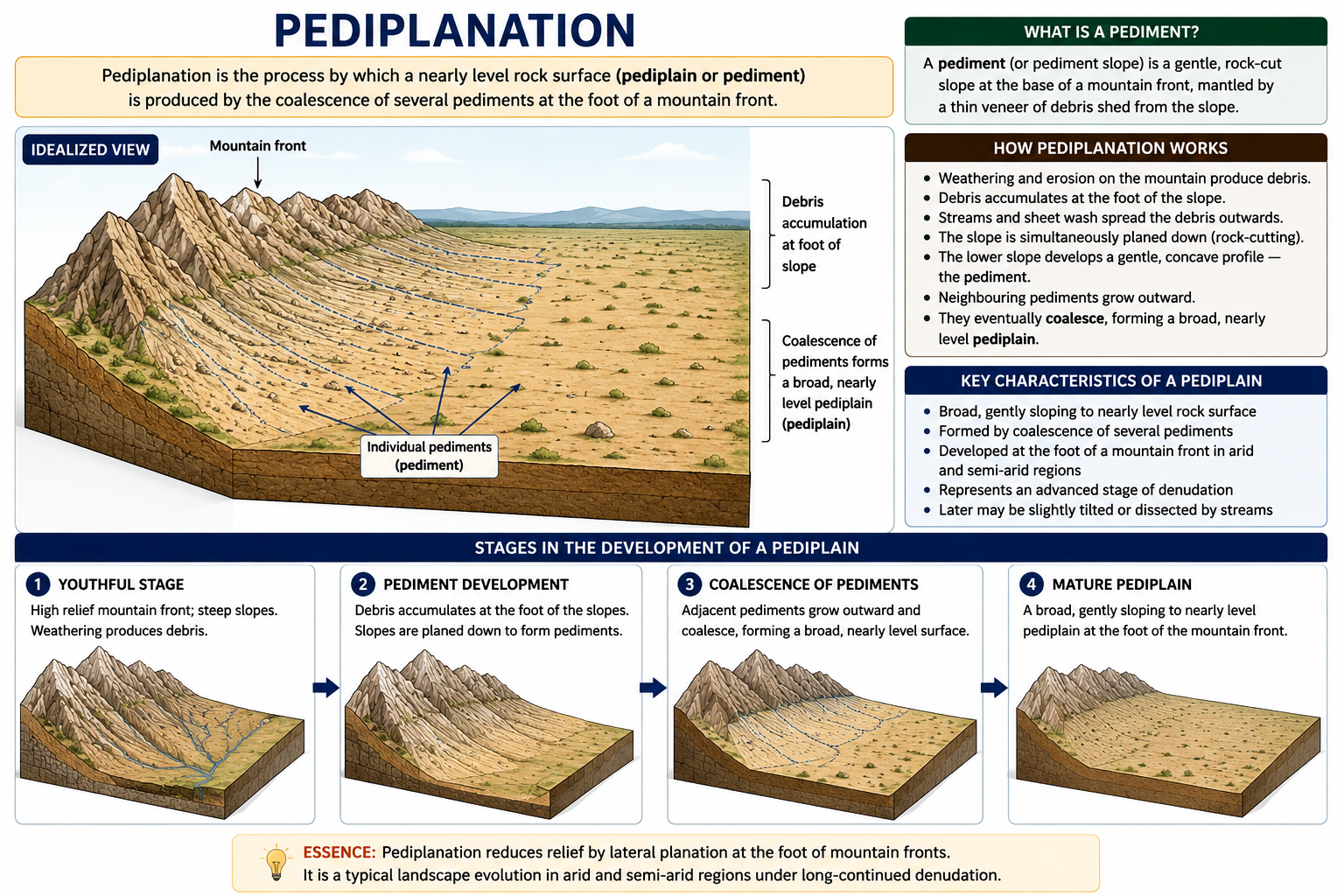
- King’s genuinely original contribution was to combine these borrowed elements into a specific, mechanistic two-process explanation for pediplain formation: pedimentation (the progressive extension of gently concave pediments at the foot of retreating uplands) operating in tandem with scarp retreat (the parallel backward wasting of the steep bounding free face).
- Crucially, King argued this combined mechanism was not a special case limited to Africa’s semi-arid environment but was instead the dominant mode of landscape reduction under most climatic conditions worldwide — a direct and deliberate challenge to Davis’s assumption that humid-temperate “normal” conditions and slope decline represented the general case.
- The end-form of King’s cycle — the pediplain, a “multi-concave” surface formed by the lateral coalescence of numerous individual pediments as upland remnants (inselbergs) are progressively consumed by scarp retreat — is genuinely King’s own synthesis product: geometrically and genetically distinct from both Davis’s smoothly convex-concave peneplain and Penck’s Endrumpf, even though it borrows structural DNA from both.
- Later evaluation has been mixed: King’s model has been criticised for being derived almost entirely from the African landscape and for assuming a uniformity of process across climates and tectonic settings that may not hold everywhere, alongside being seen as more descriptive than quantitative in its treatment of process rates — yet the pediplain concept remains a standard and widely applied framework for describing erosional surfaces in semi-arid and savanna terrain globally.
- King’s cycle of pediplanation is best read as a genuine act of theoretical synthesis rather than either a simple restatement of Davis or a wholly independent invention: the cyclical, staged architecture came from Davis, the parallel-retreat mechanism and piedmont-staircase end-form came from Penck, and the fourfold slope-element vocabulary came from Wood.
- What King added on top of this borrowed scaffolding — the specific combination of pedimentation and scarp retreat as a near-universal reducing mechanism, and the pediplain as its distinctive multi-concave end-form — is what elevates the theory beyond a mere compilation into a genuinely original contribution to geomorphology.
- This layered, synthetic character is precisely why King’s theory remains instructive to study alongside Davis’s and Penck’s models rather than in isolation: it shows how successive geomorphologists built on, rather than simply discarded, their predecessors’ frameworks even while fundamentally disagreeing about which climatic setting should be treated as the geomorphic “norm.”