

“Write a note on pseudovolcanic features.” (2017)
- Pseudovolcanic features are landforms that visually resemble true volcanic landforms — cones, craters, and vents — but originate from processes that involve no actual magma rising from a deep-seated magma chamber, distinguishing them sharply from genuine volcanic edifices built by primary igneous activity.
- The defining test separating a pseudovolcanic feature from a true volcanic one is the absence of a feeder conduit connecting the surface feature to a magma source at depth — the surface expression (a mound, a crater, a cone) may look convincingly volcanic, but the material and mechanism producing it are fundamentally non-magmatic or only secondarily related to magma.
- The thesis argued here: pseudovolcanic features are best classified by the specific non-magmatic mechanism that produces their volcano-like form — gas- and fluid-driven extrusion of sediment (mud volcanoes), steam-explosion cratering at the surface of already-erupted lava (rootless cones), and impact- or evaporite-related processes (meteorite craters, salt plugs) — each mimicking a different aspect of true volcanism while remaining genetically distinct from it.
Mud Volcanoes: Gas- and Fluid-Driven Sediment Extrusion
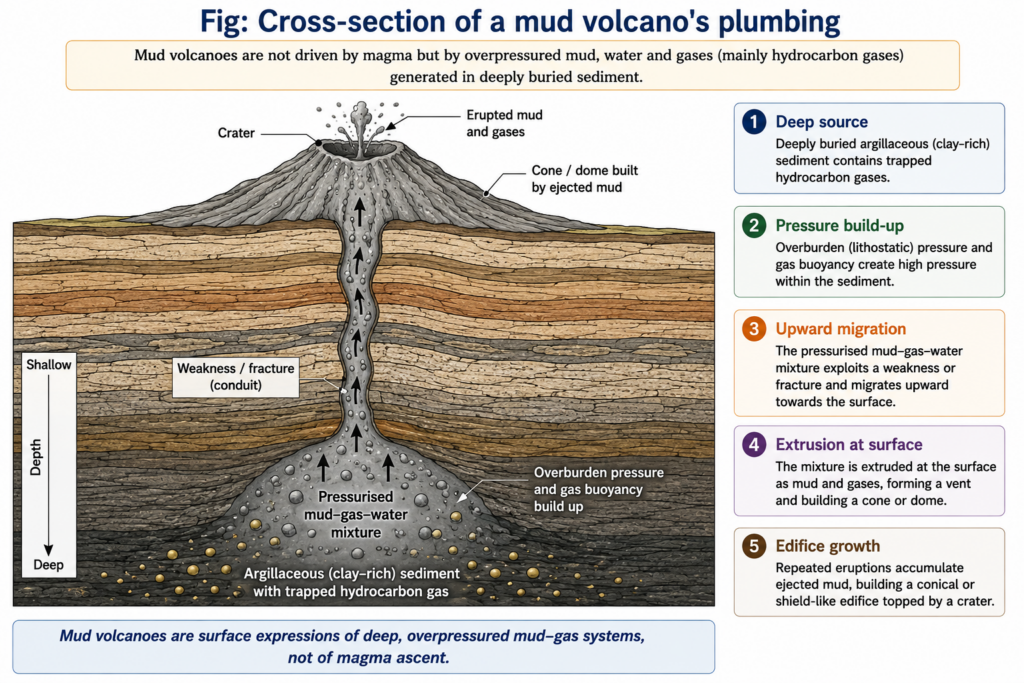
- A mud volcano forms where argillaceous (fine-grained, clay-rich) material, mixed with water and often hydrocarbon gas, is squeezed upward and expelled at the surface under pressure generated by the weight of overlying sediment strata and by buoyant gas trapped within the source layer — a mechanism entirely sedimentary and gas-driven rather than magmatic.
- The resulting edifices are classified by form into several types — conical, shield-like, domed, and irregular — and are typically accompanied by a family of related smaller features: gryphons (small, steep-sided mud cones with narrow vents), mud cones, mud flows, and salses (shallow pools or pits of bubbling liquid mud, generally lacking a raised cone).
- Mud volcanoes are strongly associated with hydrocarbon-bearing sedimentary basins, since the gas driving their eruptions is frequently thermogenic or biogenic methane migrating up from petroleum source rocks — making mud volcano fields a recognised surface indicator that geologists use in petroleum exploration to infer subsurface hydrocarbon presence.
- Azerbaijan, sitting atop the highly gas-charged sediments of the South Caspian Basin, hosts the world’s largest concentration of mud volcanoes — several hundred individual edifices — some of which have been documented producing dramatic, flame-accompanied gas-ignition eruptions when escaping methane ignites at the surface, a spectacle that only reinforces their superficial resemblance to true volcanic activity despite the entirely different underlying mechanism.
- Within the Indian context, small mud volcanoes occur along parts of Myanmar and the Andaman Islands’ forearc region, associated with the same kind of gas-charged, tectonically active sedimentary setting seen in the major world mud-volcano provinces.
Rootless Cones (Pseudocraters): Steam-Explosion Features on Lava Surfaces
- A rootless cone, also called a pseudocrater, is a landform that closely resembles a small volcanic crater but critically lacks any magma conduit connecting it downward to a magma chamber — hence “rootless.”
- Rootless cones form when actively flowing hot lava crosses a wet surface — a swamp, lake margin, or waterlogged ground — and the trapped water beneath the advancing lava is instantly superheated and flashes to steam; the resulting steam explosions blast upward through the still-molten lava surface, ejecting tephra (fragmented lava and country material) that accumulates into small crater-rimmed cones.
- The eruptive mechanism driving a rootless cone is explicitly analogous to a phreatic eruption — both are steam-driven explosions caused by water flashing to vapour on contact with a heat source — the key difference being that a true phreatic eruption is powered by magmatic or geothermal heat at depth, whereas a rootless cone’s heat source is a surface lava flow that has already erupted from elsewhere.
- “Rootless cones are formed by steam explosions as flowing hot lava crosses over a wet surface… in a manner similar to a phreatic eruption, with tephra building up crater-like forms” — a description that captures precisely why these features are pseudovolcanic: the explosive mechanism is genuinely volcanic in character, but the material erupted is already-surfaced lava, not fresh magma from depth.
- Classic rootless-cone fields occur in Iceland, where basaltic lava flows have repeatedly advanced across wetlands and shallow lakes, and comparable pseudocrater-like features have been tentatively identified on the surface of Mars, interpreted from orbital imagery as evidence of past lava-water interactions on that planet.
Other Pseudovolcanic Forms: Meteorite Craters and Salt Plugs
- Meteorite impact craters are included among pseudovolcanic features because their circular, often centrally-uplifted crater morphology can superficially resemble a volcanic caldera or explosion crater, despite originating from an entirely extraterrestrial, non-igneous mechanism — the sudden kinetic-energy release of a hypervelocity impact rather than any internal earth process at all.
- Salt plugs (salt domes/diapirs), formed where a buried, low-density evaporite (salt) layer rises buoyantly through overlying denser sedimentary strata and breaches the surface, can produce a domed or conical surface expression reminiscent of a volcanic dome, even though the driving process is purely density-driven diapiric intrusion of sedimentary rock salt, with no volcanic or magmatic component whatsoever.
- Both these categories illustrate the same underlying principle running through every pseudovolcanic feature: a genuinely volcano-like surface form can arise from processes as different as extraterrestrial impact, evaporite buoyancy, gas-charged sediment extrusion, and lava-water steam explosions — meaning form alone, without an understanding of the underlying mechanism, is an unreliable guide to a feature’s true genetic classification.
- Pseudovolcanic features collectively demonstrate that a volcano-like surface expression — a cone, a dome, a crater — is not, on its own, sufficient evidence of magmatic activity, since gas-charged sediment, lava-water steam explosions, extraterrestrial impacts, and buoyant salt intrusion can each independently produce forms that superficially mimic true volcanism.
- Distinguishing pseudovolcanic from true volcanic features carries real practical stakes: mud volcano distribution is a genuine exploration indicator for subsurface hydrocarbons, while correctly identifying a crater as impact-related rather than volcanic (or vice versa) has direct implications for regional hazard assessment and geological mapping.
- As remote-sensing and planetary geology extend the search for pseudovolcanic analogues beyond Earth — the tentative identification of rootless-cone-like features on Mars being a case in point — the careful mechanism-based classification this note has outlined remains the essential first step before any surface feature, on Earth or elsewhere, can be correctly attributed to volcanic or non-volcanic origin.