

“”Landscape is a function of structure, process and stage.” Critique the statement.” (2018)
- The statement is W.M. Davis’s foundational dictum (1899), the organising principle behind his geographical cycle (cycle of erosion): every landform can be understood as the product of three interacting variables — structure (the underlying rock type, hardness, porosity, folding, and faulting), process (the weathering, fluvial, glacial, aeolian, and mass-wasting agents actively working on that structure), and stage (the elapsed time during which those processes have operated).
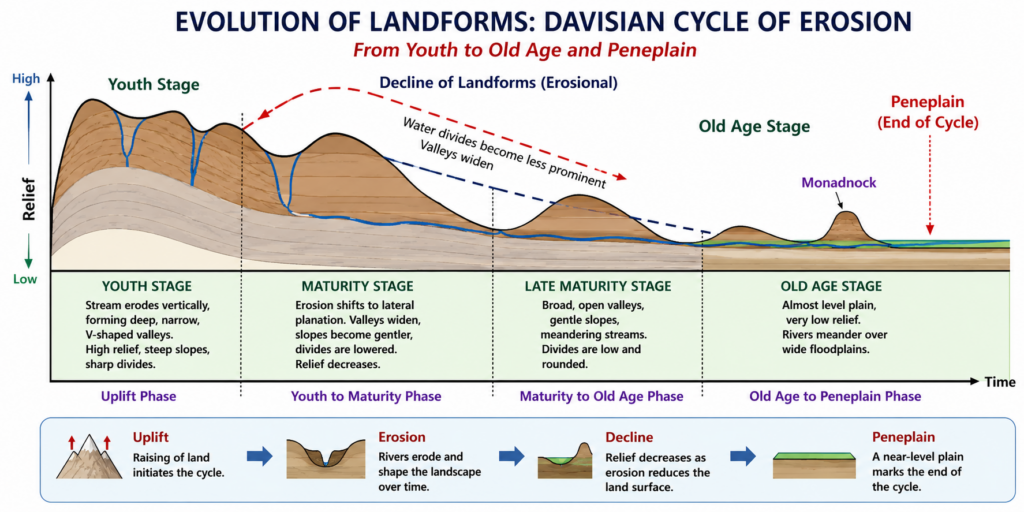
- Davis intended this trio not as three independent factors but as a genuinely interactive system — structure sets the raw material, process supplies the sculpting agents, and stage measures how far that sculpting has progressed — with landscape evolution following an orderly, directional sequence from youth through maturity to old age, terminating in a low-relief peneplain.
- The thesis argued here: the structure-process-stage formula was a genuine conceptual breakthrough for organising landform description, but it has been subjected to sustained and largely justified criticism — from Walther Penck’s rejection of “stage” as an independent variable, through L.C. King’s climatic objection, to A.N. Strahler’s dynamic-equilibrium alternative — such that the formula today survives mainly as a useful descriptive shorthand rather than as an accurate causal model of how landscapes actually evolve.
The Strength of Davis’s Formulation: Structure, Process, and Time Together
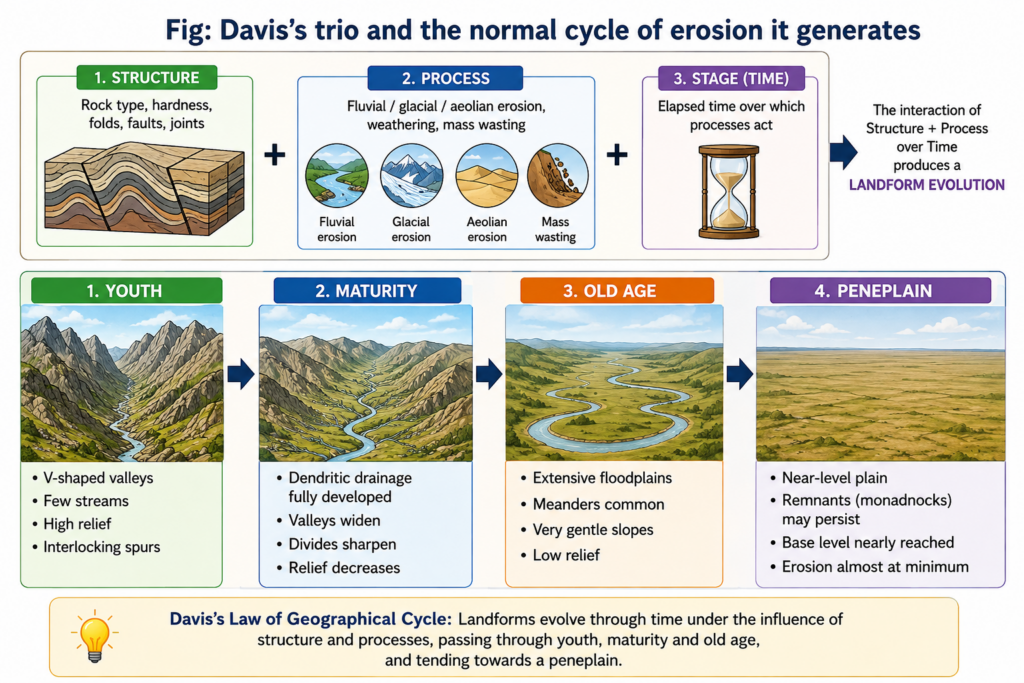
- Davis’s genuine innovation was treating landform evolution as a directional, time-dependent sequence analogous to the life-cycle of an organism — a landmass, once uplifted, passes through youth, maturity, and old age exactly as Davis himself put it: “a period of time during which an uplifted landmass undergoes its transformation by the process of land-sculpture, ending into a low, featureless plain — a peneplain.”
- Crucially, Davis treated the stages as relative rather than fixed in absolute duration — the same stage takes far longer to traverse in a landscape of highly resistant rock than in one of weak, easily eroded rock, meaning “stage” in Davis’s own formulation was never meant as a rigid clock but as a relative measure of how far denudation had progressed relative to structure and process.
- The trio’s descriptive power is real: it gives geomorphologists a common, shared vocabulary — a V-shaped, gorge-dominated valley is instantly recognisable as “youthful,” a broad, meandering floodplain as “old age” — regardless of the specific region being described, which is precisely why the terminology has remained in use across generations of geomorphology long after the underlying cyclic theory itself fell out of favour.
Penck’s Critique: Rejecting “Stage” as an Independent Variable
- Walther Penck, Davis’s most influential early critic, objected specifically to the over-emphasis on time in Davis’s model, arguing that Davis’s cycle envisaged a “time-dependent series” of landforms when what actually mattered was a “time-independent series” governed by the changing relationship between uplift and denudation.
- Penck’s central reformulation held that “geomorphic forms are expressions of the phase and rate of upliftment in relation to the rate of degradation” — meaning slope form is a direct function of the ratio between tectonic uplift and denudational removal operating simultaneously, not of elapsed time since a single, completed uplift episode.
- “Davis has also offered an explanation to this objection: if crustal stability for the desired period is not possible, the cycle of erosion is interrupted and a fresh cycle of erosion may start.”
- This defence, however, concedes exactly what Penck was attacking — if the cycle is routinely interrupted before completion, then “stage” cannot function as the clean, sequential variable Davis’s model requires, since the landscape a geomorphologist actually observes is rarely a pure representative of any single textbook stage.
- Penck’s deeper structural objection was to Davis’s assumption that upliftment and erosion do not occur simultaneously — Davis explicitly assumed a short, rapid pulse of uplift followed by a long period of erosion during crustal stability, an assumption Penck (and subsequent tectonic evidence) showed to be geologically unrealistic, since uplift in most active mountain belts is itself a slow, continuous process contemporaneous with ongoing denudation rather than a discrete event preceding it.
King’s Critique: The Climatic Objection to “Normal” Process
- L.C. King challenged the “process” leg of Davis’s trio from a different angle, arguing that Davis’s choice of humid-temperate fluvial denudation as the geomorphically “normal” case was itself an unjustified generalisation from Davis’s own regional experience rather than a genuinely universal process.
- King instead proposed that arid and semi-arid conditions, driving landscape evolution through parallel scarp retreat rather than Davisian slope decline, should be treated as at least equally “normal,” producing a pediplain rather than a peneplain as the cyclic end-form.
- This climatic critique exposed a deeper flaw in treating “process” as a single, generalisable variable: because different climatic regimes drive fundamentally different dominant processes (fluvial, glacial, arid/aeolian, periglacial, karst), a single universal sequence of youth-maturity-old age cannot hold across all climatic settings — a point later formalised into the entire sub-discipline of climatic geomorphology (associated with Peltier, Büdel, and Tricart and Cailleux), which treats climate as effectively a fourth, independent control alongside Davis’s original three.
Strahler’s Critique: Dynamic Equilibrium as an Alternative Framework
- A.N. Strahler, along with J.T. Hack and R.J. Chorley, rejected Davis’s entire premise of a directional, “historical evolution” of landforms progressing through fixed stages, proposing instead the dynamic equilibrium model — in which slope form reflects a continuous, statistically stable balance between the resisting strength of structure and the eroding force of process, adjusting essentially instantaneously to changes in either, rather than passing through a long sequence of time-dependent stages.
- Under dynamic equilibrium, a slope’s form at any moment is explained by present-day process-form relationships, not by its position along a Davisian developmental trajectory — a fundamentally different epistemology that treats “stage” as largely irrelevant to explaining observed form, since equilibrium slopes can persist stably, or restore themselves rapidly after disturbance, without ever needing to “age” through Davis’s sequence at all.
- The dynamic-equilibrium critique also directly targets the tectonic-stability assumption underlying Davis’s stage variable: because plate tectonics demonstrates that crustal stability of the duration Davis’s full cycle requires is geologically implausible almost anywhere on Earth, an equilibrium framework that requires no such prolonged stability is, on tectonic grounds alone, a more realistic description of how most real landscapes actually behave.
An Overall Assessment: What Survives of the Trio
- Structure remains the least controversial of the three variables — virtually every subsequent model of landform development, cyclic or otherwise, retains rock type, resistance, and structural control as a genuine first-order influence on landform, since no credible alternative denies that harder rock resists erosion longer than softer rock.
- Process survives too, but only once decoupled from Davis’s implicit assumption of a single “normal” (humid-temperate fluvial) case — modern geomorphology treats process as climate-dependent and regionally variable rather than universal, which is effectively King’s and climatic geomorphology’s correction rather than an outright rejection of “process” as a variable.
- Stage, by contrast, has fared worst of the three — both Penck’s uplift-denudation-ratio critique and Strahler’s dynamic-equilibrium critique converge on rejecting elapsed time as a valid independent explanatory variable, arguing instead that the same landform can arise from very different histories, and different landforms can arise from similar elapsed time, once structure and process are allowed to vary freely.
- Even so, the Davisian vocabulary of youth, maturity, and old age has proven remarkably durable as a descriptive shorthand, even among geomorphologists who reject the underlying cyclic theory entirely — a testament to how effectively Davis’s trio organised observation, even where it failed as a strict causal explanation of process.
- Davis’s structure-process-stage formula succeeded brilliantly as an organising and descriptive device but has not survived intact as a causal theory, precisely because “stage” — the variable that gave the model its distinctive cyclic, evolutionary character — has proven the least defensible once uplift-denudation simultaneity (Penck), climatic variability in process (King), and dynamic equilibrium (Strahler) are taken seriously.
- What remains valid is a weaker, more defensible claim: landscape is a function of structure and process, continuously interacting, with “stage” retained only in the loose sense of how far denudation has progressed relative to structural resistance — not as Davis’s original time-dependent developmental sequence.
- The controversy itself has been productive: the sustained critique of Davis’s trio is precisely what drove geomorphology’s twentieth-century shift from historical, descriptive landform classification toward the quantitative, process-based, and climatically differentiated discipline it is today.