

“Compare and contrast different types of plate boundaries.” (2019)
- Plate tectonics, formally advanced by W.J. Morgan (1962) and named by J. Tuzo Wilson, holds that the lithosphere is broken into rigid plates whose margins are the sites of nearly all significant geological activity — and it is specifically the type of relative motion at a given margin that determines everything else about it: what landforms it builds, how deep and frequent its earthquakes are, whether it hosts volcanism, and how fast it typically moves.
- Three fundamental boundary types are recognised by their relative motion — divergent (constructive) boundaries where plates move apart, convergent (destructive) boundaries where plates collide, and transform (conservative) boundaries where plates slide past one another — and each of the first two further subdivides depending on whether oceanic or continental lithosphere is involved on each side.
- The thesis argued here: comparing and contrasting plate boundaries is best organised not as a simple three-way list but as a comparison along five consistent parameters — relative motion, crust type involved, dominant landform produced, seismicity pattern, and volcanic activity — because it is precisely these parameters that reveal both what unites all plate boundaries (they are all zones of intense geological activity) and what sharply distinguishes one type from another.
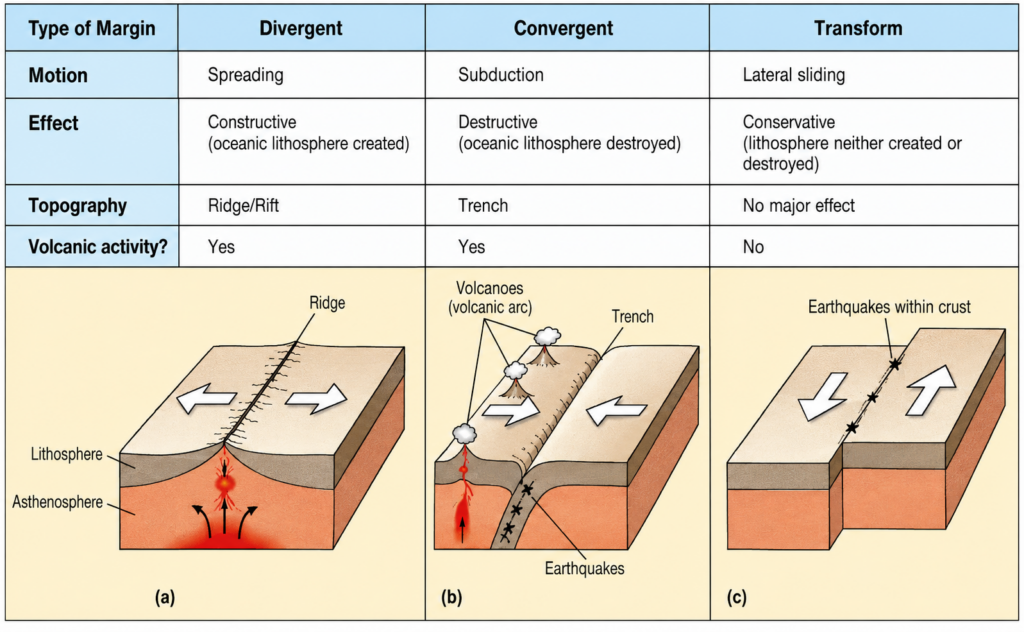
Divergent (Constructive) Boundaries
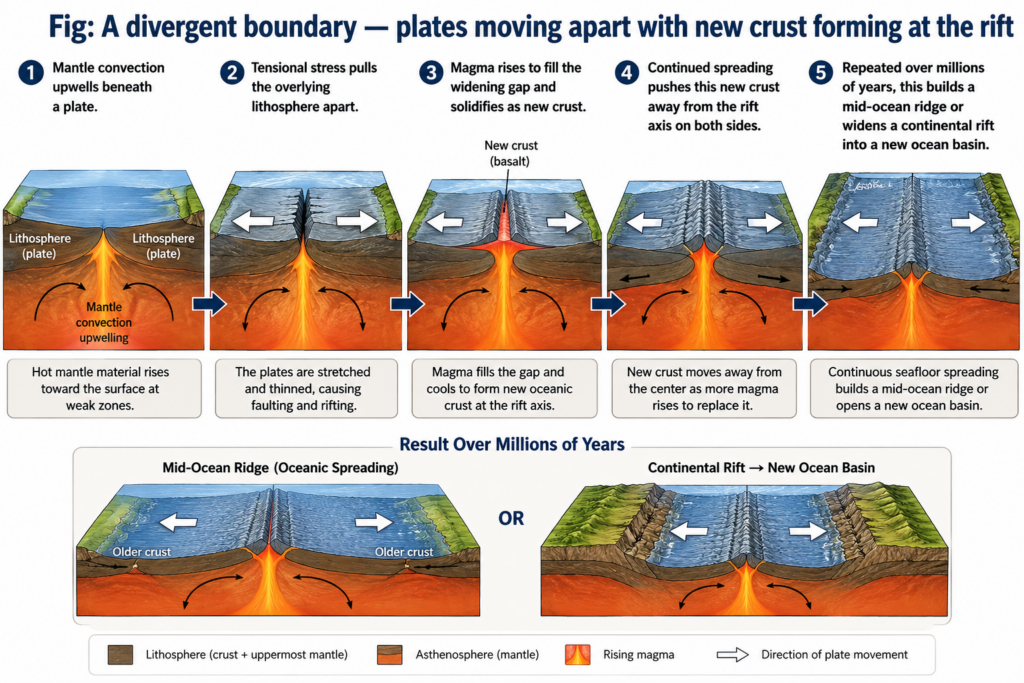
- At a divergent boundary, plates move apart, and new lithosphere is continuously created as magma wells up to fill the gap — this is why such boundaries are termed constructive.
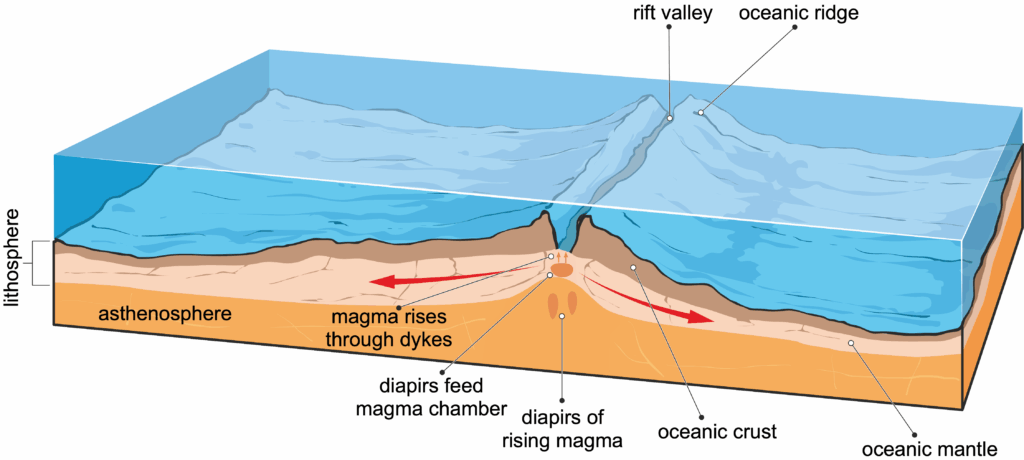
- Oceanic divergence produces mid-ocean ridges — the longest mountain chain system on Earth — with associated fissure volcanism, shallow-focus earthquakes, and the symmetrical magnetic striping first explained by the Vine-Matthews-Morley hypothesis; the Mid-Atlantic Ridge is the classic example.
- Continental divergence instead produces a continental rift valley — bounded by normal faults on either side of a down-dropped graben — before the rift widens enough to admit the sea and eventually evolve into a new ocean basin; the East African Rift Valley, extending from Ethiopia south through Mozambique, illustrates this earlier stage, while the Red Sea shows the same process already advanced far enough to have formed a young “proto-ocean.”
- Seismicity at divergent boundaries is characteristically shallow-focus and moderate in magnitude, since the crust here is being pulled apart under tension rather than violently compressed or forced downward.
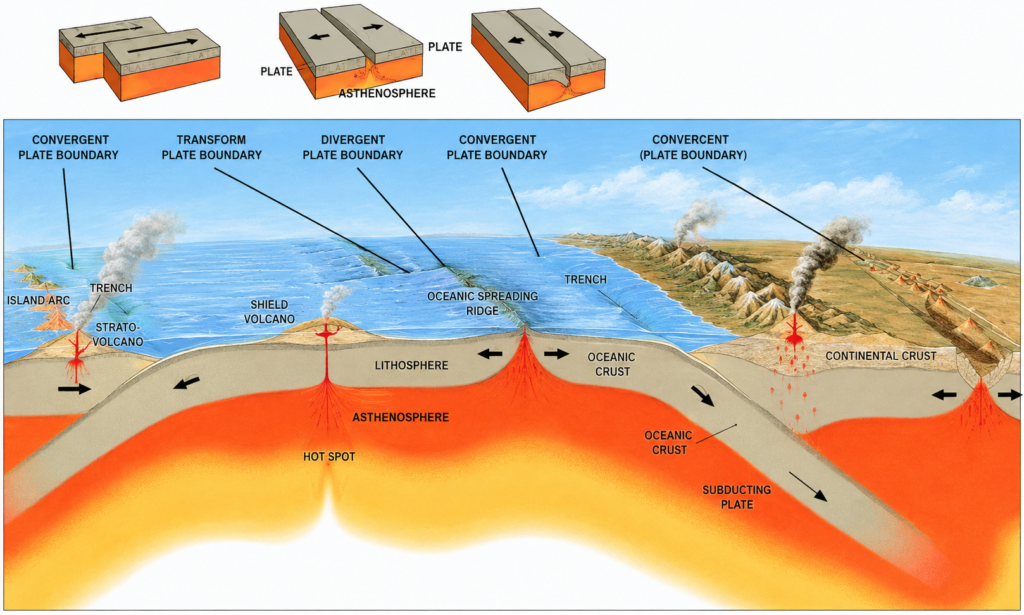
Convergent (Destructive) Boundaries
- At a convergent boundary, plates move toward one another, and crust is generally consumed (destroyed) rather than created — though the specific outcome depends entirely on which combination of oceanic and continental lithosphere is involved.
Oceanic-Continental Convergence
- Because oceanic lithosphere (dense, basaltic) is denser than continental lithosphere (lighter, granitic), the oceanic plate always subducts beneath the continental plate, sinking into the asthenosphere and pulling the rest of the plate after it through “slab pull” — probably the dominant force driving most plate motion overall.
- This produces a characteristic landform sequence: a deep oceanic trench marking the subduction line, a chain of continental volcanic mountains fed by magma generated from the melting subducted slab, and progressively deeper-focus earthquakes moving inland from the trench as the subducting slab descends further beneath the continent.
- The Andes, formed by subduction of the Nazca Plate beneath the South American Plate, is the textbook example of this boundary type.
Oceanic-Oceanic Convergence
- Where two oceanic plates converge, the older, denser (and therefore colder and heavier) plate subducts beneath the other, producing an oceanic trench and, on the overriding plate, a curved chain of volcanic islands known as an island arc rather than a continental mountain range.
- Japan, the Philippines, and the Mariana Islands/Trench system all illustrate this boundary type, each associated with both shallow and deep-focus earthquakes and explosive andesitic-to-rhyolitic volcanism.
Continental-Continental Convergence
- Because continental lithosphere on both sides is too buoyant for either plate to subduct fully, collision instead produces intense crustal shortening, thickening, and folding, thrusting up the highest and most extensive mountain systems on Earth without the trench or the extensive volcanism seen at the other two convergent subtypes.
- The ongoing collision of the Indian and Eurasian plates, still actively raising the Himalaya, is the clearest and most consequential example — the associated seismicity is intense but overwhelmingly shallow-to-intermediate focus, since no continuous subducting slab descends deep into the mantle the way it does at oceanic-continental or oceanic-oceanic margins.
- “Slab pull is probably the main cause of most plate movement” — a principle that also explains why continental-continental convergence eventually slows and largely stalls once subduction genuinely ceases, since the driving force from a sinking oceanic slab is no longer available.
Transform (Conservative) Boundaries
- At a transform boundary, plates slide horizontally past one another along a roughly vertical fault plane, with crust neither created nor destroyed — hence “conservative.”
- Because motion here is lateral shearing rather than vertical subduction or crustal thickening, transform boundaries produce no significant volcanism and generate earthquakes that are typically shallow-focus but can still be of very high magnitude, since stress can accumulate over long, locked fault segments before releasing suddenly.
- The San Andreas Fault in California, marking the boundary between the Pacific and North American plates, is the standard example; oceanic transform faults also commonly occur as short offset segments linking successive sections of a mid-ocean ridge, a geometry J. Tuzo Wilson first explained as a natural consequence of sea floor spreading on a curved planetary surface.
A Structured Comparison Across All Boundary Types
| Parameter | Divergent | Convergent | Transform |
|---|---|---|---|
| Relative motion | Plates move apart | Plates move together | Plates slide past each other |
| Crust created/destroyed | Created | Destroyed (subducted) | Neither |
| Dominant landform | Mid-ocean ridge / rift valley | Trench + mountains/island arc | Linear fault zone |
| Seismicity | Shallow, moderate | Shallow to very deep (subduction zone) | Shallow, can be very high magnitude |
| Volcanism | Fissure/basaltic | Explosive andesitic-rhyolitic (except continent-continent) | Generally absent |
| World example | Mid-Atlantic Ridge; East African Rift | Andes; Japan; Himalaya | San Andreas Fault |
- What unites all three boundary types is that each is a zone of concentrated geological activity — Wilson’s and Morgan’s core insight was precisely that virtually all of the earth’s earthquakes, volcanism, and major landform-building are confined to these narrow plate-margin zones rather than distributed evenly across plate interiors.
- What distinguishes them is the direction of relative motion and its direct mechanical consequence: divergence builds new crust and produces extensional landforms, convergence destroys or thickens crust and produces compressional or subduction-related landforms (with three genuinely different outcomes depending on the crust types involved), and transform motion does neither, producing purely lateral shear.
- The three convergent subtypes themselves form a useful internal comparison: as the density contrast between the converging plates decreases from oceanic-oceanic, to oceanic-continental, to continental-continental, subduction becomes progressively less complete, volcanism progressively weaker, and simple crustal thickening progressively more dominant — a gradient visible directly in comparing the volcanic Andes and Japan against the largely non-volcanic Himalaya.
- Every plate boundary type shares the same underlying cause — differential mantle convection driving relative plate motion — but the specific direction and combination of that motion at a given margin is what produces the entire diversity of landforms, earthquake patterns, and volcanic activity observed along the world’s plate margins.
- Comparing convergent boundaries’ three subtypes in particular shows that “convergent” is not a single uniform category but a spectrum running from vigorously volcanic oceanic subduction to largely non-volcanic continental collision, governed entirely by the relative density and buoyancy of the two plates involved.
- Because divergent, convergent, and transform boundaries between them account for essentially the entire global distribution of major earthquakes and active volcanoes, this comparison is not merely a classificatory exercise but the direct explanatory basis for why hazard risk, from the Himalaya to California, is concentrated exactly where it is.