

“Describe phreatic eruptions and their consequences.” (2019)
- A phreatic eruption (from the Greek phrear, “well” or “spring”) is a steam-driven volcanic explosion caused when groundwater, crater-lake water, or ice/snowmelt comes into contact with hot magma, hot rock, or volcanic gases and is flash-heated into steam faster than it can escape — the resulting pressure build-up ruptures the overlying rock explosively, without any fresh magma itself reaching the surface.
- This distinguishes phreatic eruptions sharply from magmatic eruptions (which eject new lava and juvenile pyroclastic material, of the Hawaiian, Strombolian, Vulcanian, and Plinian types classified by eruption style) and from phreatomagmatic eruptions (where fresh magma physically mixes with external water, producing a genuinely hybrid explosive event) — a phreatic eruption ejects only pre-existing, already-solidified country rock, fragmented and blasted apart by superheated steam.
- The thesis argued here: phreatic eruptions are geomorphologically and hazard-wise distinctive precisely because they are driven by water rather than magma — this makes them capable of striking with almost no warning even at volcanoes showing no sign of an imminent magmatic eruption, turning what looks like a dormant or merely “restless” volcano into a sudden, lethal hazard.
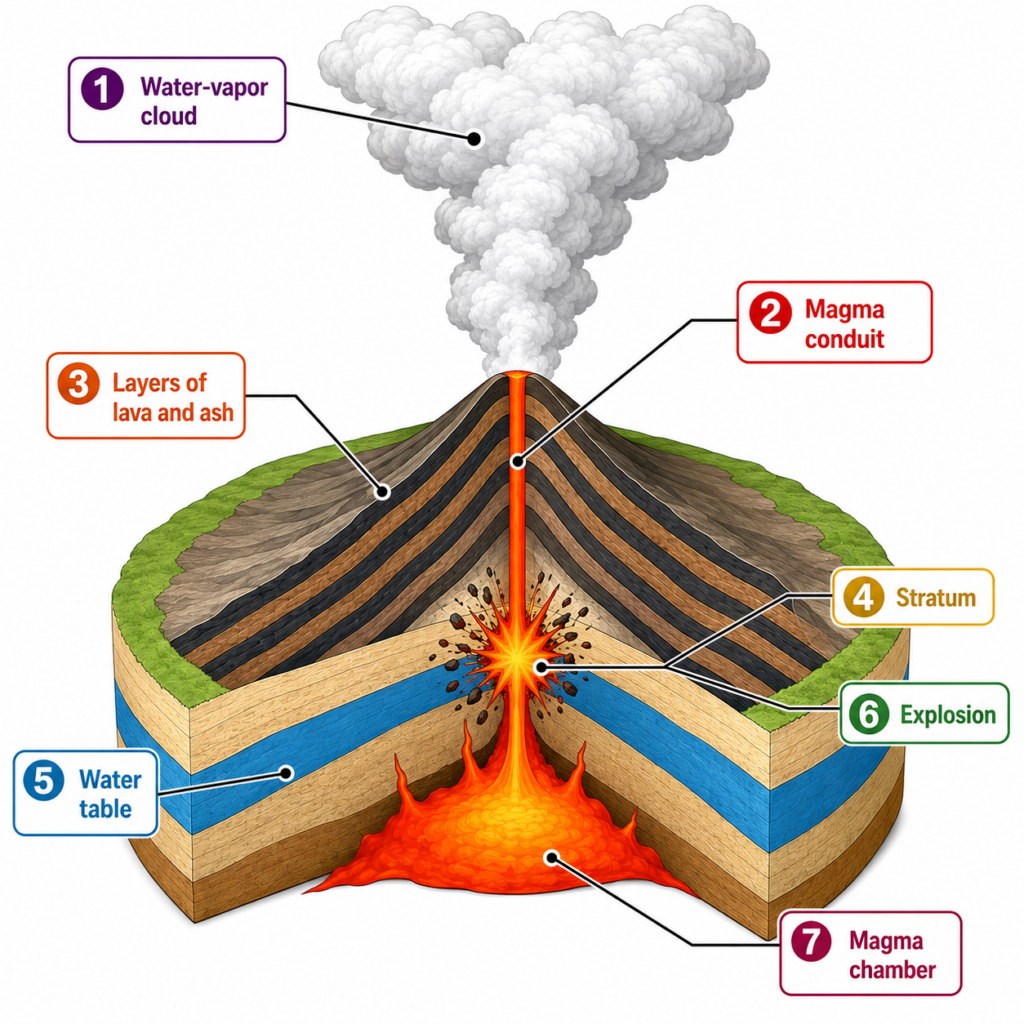
The Mechanism: Water Meeting Heat Beneath the Surface
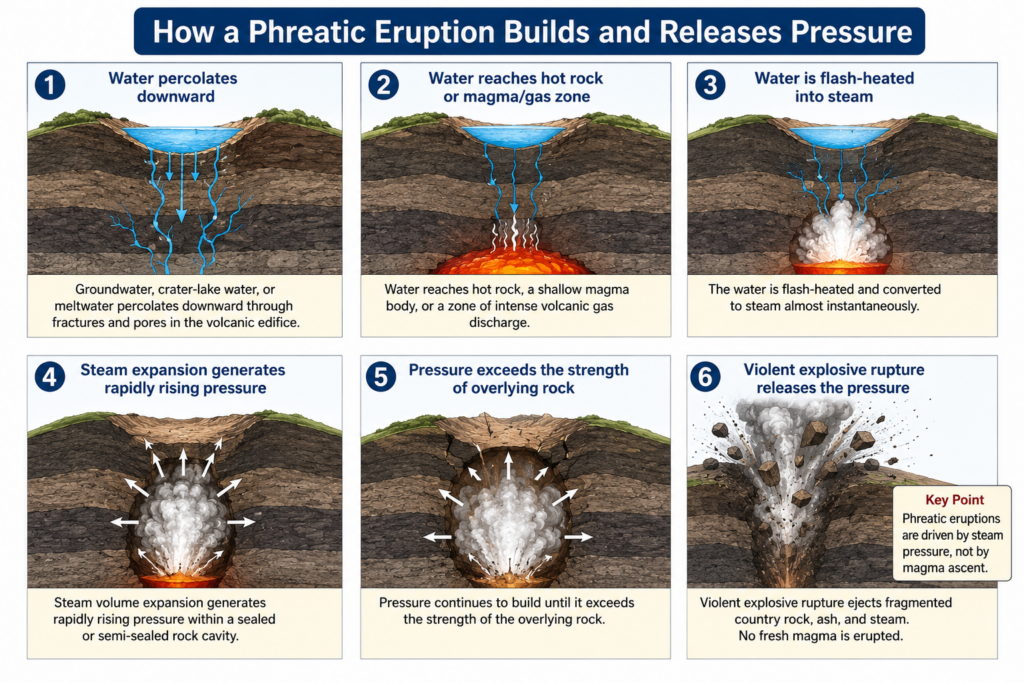
- The critical precondition is a sealed or partially sealed hydrothermal system: a hot rock body or shallow magmatic heat source overlain by rock through which percolating water cannot easily escape as steam, allowing pressure to accumulate to explosive levels before any release occurs.
- Because the explosion is powered by trapped steam rather than the arrival of new magma, phreatic eruptions can occur with very little or no precursory seismicity — the classic magmatic warning signs (a rising swarm of volcano-tectonic earthquakes tracking magma ascent, measurable ground deformation from an inflating magma chamber) are frequently minimal or entirely absent, since no large body of magma is actually moving toward the surface.
- The explosion itself is essentially a hydrothermal blast: it fragments and ejects whatever solid rock caps the pressurised zone, producing an eruption column of ash, steam, and rock debris that, while it can look visually similar to a magmatic eruption from a distance, contains no fresh volcanic glass or juvenile pyroclastic material when its deposits are examined.
Settings Where Phreatic Eruptions Occur
- Crater lakes: volcanoes with a standing lake occupying their summit crater are especially prone to phreatic activity, since the lake supplies a large, continuously replenished reservoir of water sitting directly above the volcano’s shallow heat source — Taal Volcano in the Philippines, whose crater lake has repeatedly generated phreatic and phreatomagmatic explosions, is a textbook example of this setting.
- Hydrothermal/geothermal fields: geothermally active volcanic islands with extensive fumarole and hot-spring activity, where groundwater percolates through a shallow, superheated hydrothermal system, are similarly prone — Whakaari (White Island), New Zealand’s most active volcano, sits on exactly this kind of persistently active hydrothermal system.
- Snow- and ice-capped stratovolcanoes: where meltwater from summit snow or glacier ice percolates down into a heated vent, the same mechanism operates even without a permanent crater lake — Mount Ontake in Japan, whose fatal 2014 eruption struck a mountain with no permanent summit lake, illustrates this variant.
Notable Examples and What They Reveal About the Hazard
- Whakaari/White Island, New Zealand (December 2019): a sudden phreatic eruption struck while a tour group was present on the crater floor, killing 22 people and injuring many more — the eruption occurred with essentially no meaningful advance warning distinguishable from the volcano’s ordinary background unrest, making it the starkest recent illustration of how little precursory signal a purely steam-driven eruption can give.
- Mount Ontake, Japan (September 2014): a phreatic eruption during the peak autumn hiking season killed 63 people, making it Japan’s deadliest volcanic disaster in the post-war period — hikers on the summit had no meaningful opportunity to evacuate once the eruption began, since the event escalated from onset to full explosion within seconds.
- Taal Volcano, Philippines (January 2020): an eruption that began with intense phreatic and phreatomagmatic activity forced the evacuation of hundreds of thousands of people from the densely populated area surrounding Taal Lake, illustrating how a crater-lake volcano’s phreatic phase can also serve as the opening act of a larger eruptive sequence.
- “A volcano need not show any sign of an imminent magmatic eruption to be lethally dangerous” — the central lesson repeatedly drawn from these events by volcanic hazard scientists.
- This has directly reshaped volcanic monitoring practice: agencies overseeing hydrothermally active volcanoes now treat gas-emission rates, crater-lake temperature and chemistry, and subtle ground-deformation changes as being at least as important as traditional seismic monitoring, precisely because phreatic events can occur without the seismic build-up magmatic eruptions typically show.
Consequences of Phreatic Eruptions
- Minimal-warning ballistic hazard: the most severe human consequence is the sudden ejection of rock fragments (ballistics) at velocities capable of causing fatal injury within seconds of eruption onset, striking anyone in or near the crater — including tourists, hikers, or workers who had no reason to expect an eruption was imminent.
- Ashfall and respiratory/visibility hazard: fine ash ejected in the explosion can disperse over a wider area than the immediate ballistic-strike zone, disrupting aviation, contaminating water supplies, and causing respiratory distress in nearby populations.
- Toxic gas release: the explosion frequently vents accumulated volcanic gases (hydrogen sulphide, sulphur dioxide, carbon dioxide) that had been trapped within the hydrothermal system, posing an additional, less visible hazard to anyone in the vicinity.
- Lahars (volcanic mudflows): where a phreatic eruption disturbs a crater lake, melts summit snow/ice, or destabilises loose ash and debris on steep volcanic slopes, the resulting rapid mobilisation of water-saturated debris can generate destructive lahars travelling well beyond the volcano’s immediate flanks.
- Precursor to larger eruptions: a phreatic explosion can — though does not always — mark the opening phase of a developing magmatic eruption, as fracturing of the cap rock opens new pathways that magma subsequently exploits; this dual character (a hazard in its own right, and a possible early-warning sign of worse to come) is precisely what makes phreatic activity so difficult to manage from a hazard-monitoring standpoint.
- Monitoring and evacuation-planning challenges: because phreatic eruptions can occur with little seismic precursor, volcanic hazard agencies worldwide have had to develop supplementary monitoring protocols — including tighter access restrictions around crater floors and crater lakes at known hydrothermally active volcanoes — specifically in response to fatal phreatic events like Whakaari and Ontake.
- Phreatic eruptions occupy a distinctive place among volcanic hazards precisely because they are driven by water rather than magma, meaning the usual precursory signals that give warning of magmatic eruptions can be weak, ambiguous, or absent entirely.
- The recurring pattern across Whakaari, Ontake, and Taal — sudden onset, minimal warning, and a toll concentrated among people physically present at the crater at the moment of eruption — has made phreatic activity a central case study in why volcanic risk cannot be assessed by seismicity alone.
- As crater-lake and hydrothermally active volcanoes worldwide remain popular tourist and pilgrimage sites, the continuing challenge for volcanology is developing monitoring techniques (gas geochemistry, crater-lake thermal surveys, subtle deformation tracking) sensitive enough to give at least some warning of an event whose defining characteristic is how little warning it otherwise gives.