- Welfare geography and humanistic geography both grew in the late 1960s and 1970s from dissatisfaction with positivist spatial science, which had treated people as points on an isotropic plain.
- They answered that dissatisfaction in opposite directions.
- Welfare geography turned outward, to the distribution of resources and social justice between places.
- Humanistic geography turned inward, to human experience, meaning and the sense of place.
- Both are part of the critical revolution, and both made geography people-centred and value-conscious again.
The Two Approaches in Brief

Welfare Geography
- Welfare geography is the study of spatial inequality and territorial justice. In David M. Smith’s words, it studies “who gets what, where, and how”.
- Origins: it was the liberal, reformist wing of the 1970s relevance movement, set against the urban crisis, poverty and racial discrimination in the United States.
- It sits alongside, but is milder than, radical geography.
- Key works:
- Smith’s The Geography of Social Well-Being in the United States (1973) and Human Geography: A Welfare Approach (1977);
- Paul Knox’s Social Well-being: A Spatial Perspective (1975);
- David Harvey’s Social Justice and the City (1973), which set out territorial social justice.
- Method: social indicators, mapping of levels of living, and evaluation of policy on efficiency and equity. Its later work turned to the processes behind inequality.
- Core concepts:
- territorial social justice, meaning resources allocated by need, contribution to the common good and merit;
- levels of need: physical, cultural and higher;
- public goods and bads: services and burdens such as pollution;
- Pareto efficiency weighed against equity.
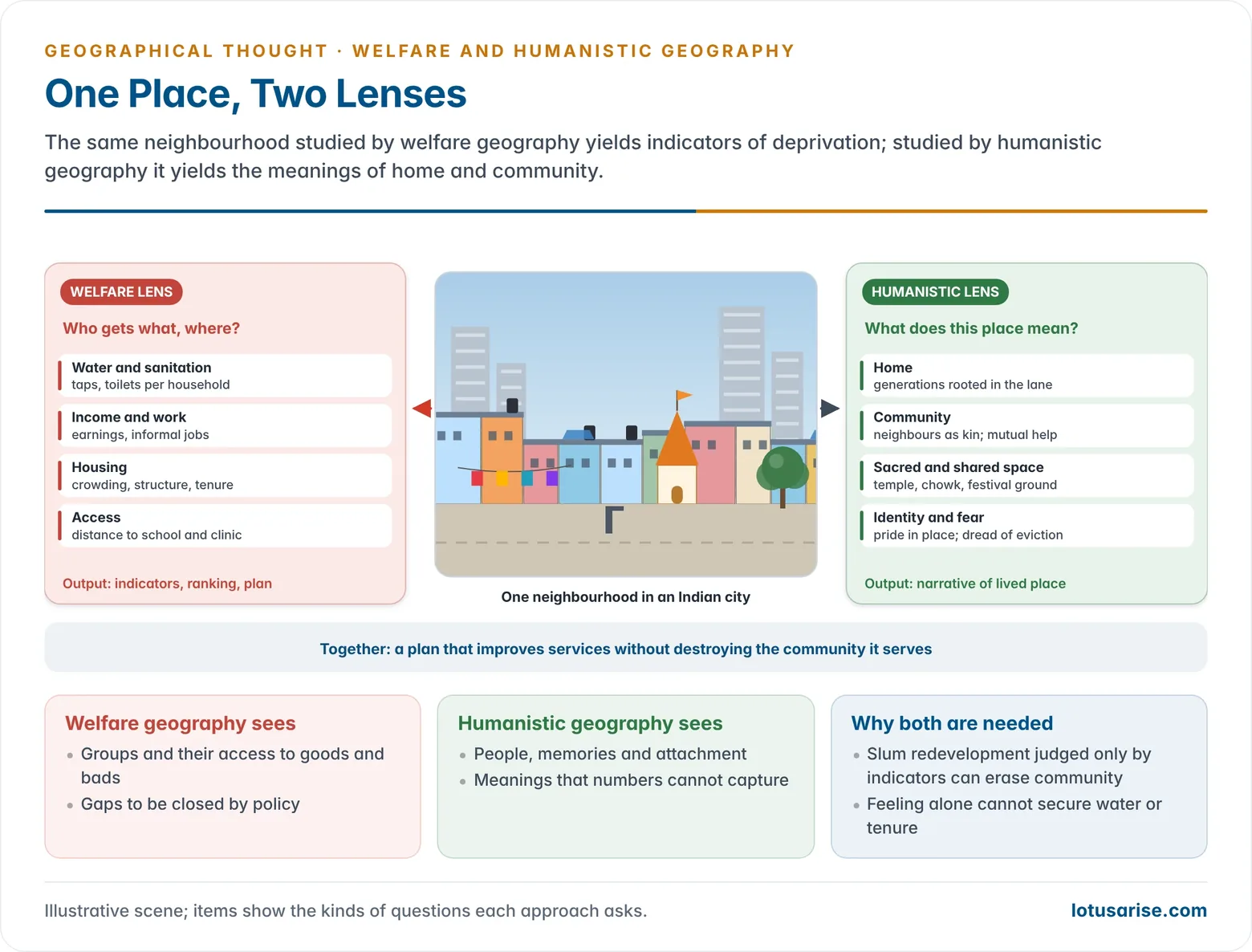
- Indian lens: maps of multidimensional poverty, the ranking of Aspirational Districts and the gap between planned colonies and slums are welfare-geography questions.
Humanistic Geography
- Humanistic geography gives a central place to human awareness, agency and creativity. It seeks to understand the world as people experience it.
- Origins: a reaction against the “dehumanising” effect of scientific method, which had reduced people to rational economic actors or stimulus–response machines.
- It aimed to study the social organisation of space rather than the spatial organisation of society.
- Philosophies: phenomenology, existentialism, idealism and, in practice, pragmatism.
- Key works:
- Yi-Fu Tuan’s Topophilia (1974) and Space and Place (1977);
- Edward Relph’s Place and Placelessness (1976);
- Anne Buttimer’s work on the lifeworld;
- David Ley and Marwyn Samuels’ Humanistic Geography: Prospects and Problems (1978).
- Method: interpretation (verstehen), participant observation, interviews, and the reading of landscapes and literature as texts.
- Core concepts:
- topophilia: the affective bond between people and place;
- placelessness: the loss of distinctive places to standardised landscapes;
- the lifeworld of taken-for-granted daily experience;
- John Kirtland Wright’s earlier idea of geosophy, the study of geographical knowledge in all its forms.
- Indian lens: the sacred geography of Varanasi and of pilgrimage circuits, and the loss of home felt by communities displaced by large dams, are humanistic questions.
Points of Difference
| Basis | Welfare geography | Humanistic geography |
|---|---|---|
| Core question | Who gets what, where, and how? | What do places mean to people? |
| Philosophy | Welfare economics, liberal justice; later Marxism | Phenomenology, existentialism, idealism |
| View of people | Members of groups with needs | Unique, conscious, creative individuals |
| Focus | Distribution of goods and bads | Experience, values, sense of place |
| Scale | Regions, cities, groups | Individuals, homes, localities |
| Method | Social indicators, mapping, policy evaluation | Interpretation, ethnography, texts |
| Data | Mainly quantitative | Mainly qualitative |
| Aim | Reduce inequality; guide planning | Deepen understanding; self-awareness |
| Policy role | Strong, through the state | Indirect; wary of top-down planning |
| Key thinkers | D. M. Smith, Knox, Harvey, Coates | Tuan, Relph, Buttimer, Ley, Samuels |
- Society versus self: welfare geography sees people as members of groups defined by income, class, race or caste. Humanistic geography sees each person as unique and as responsible for creating their own world.
- Structure versus meaning: welfare geography explains patterns by the systems that allocate resources. Humanistic geography explains action by the intentions and meanings behind it.
- Measurement versus understanding: welfare geography counts and ranks. Humanistic research has no explicit test of progress, because its aim is understanding, not prediction.
- Context of origin: welfare geography grew from a social and political crisis and a demand for policy. Humanistic geography grew from a philosophical critique of how science treats human beings.
- Prescription versus description: welfare geography ends in prescription: who should get what, where. Humanistic geography usually stops at describing and interpreting experience.
Points of Convergence
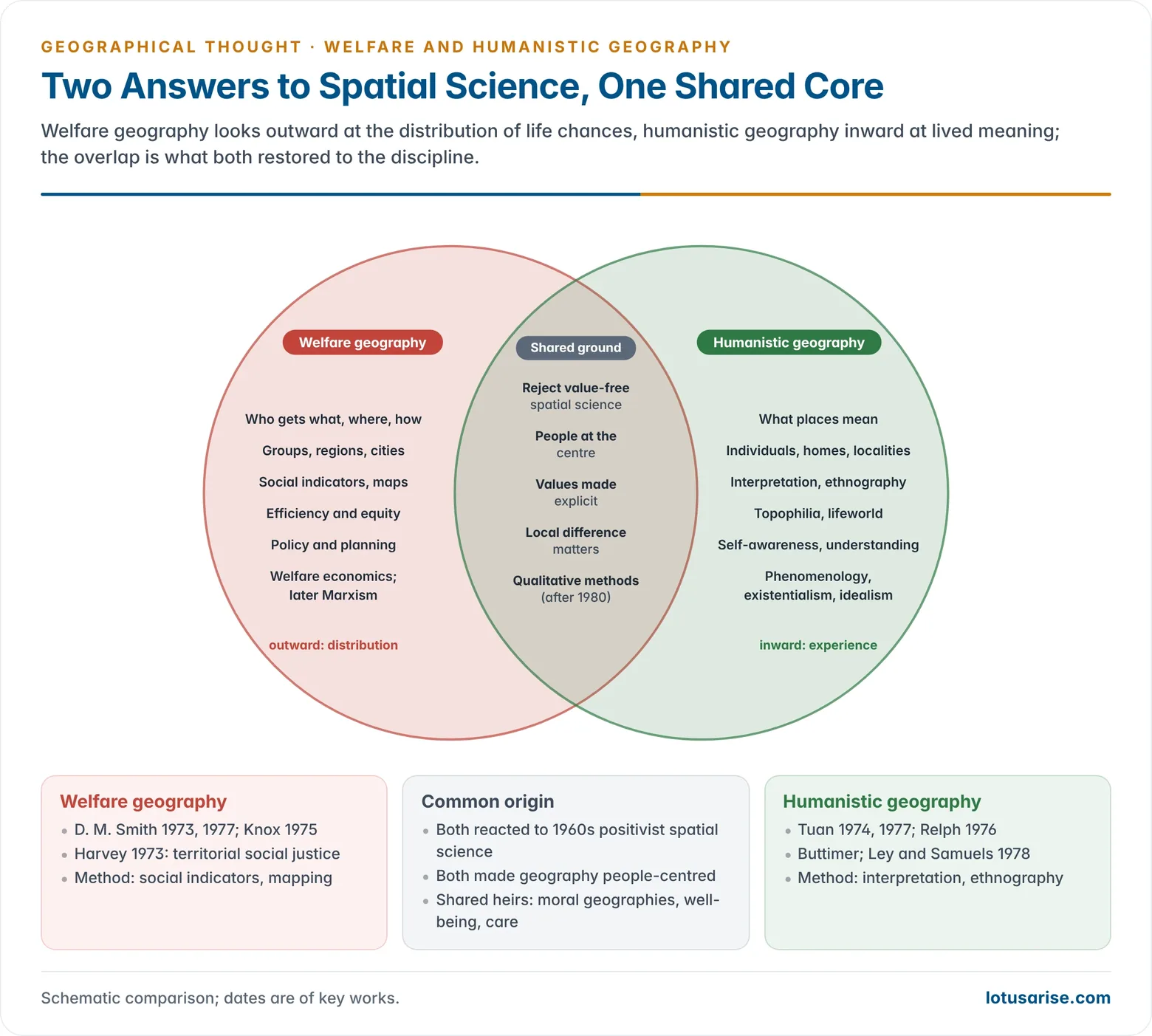
- Common enemy: both reject the claim of positivist spatial science to be value-free, and both restore people to the centre of geography.
- Values made explicit: both accept that research rests on values. Welfare geography emphasises justice; humanistic geography removes the fact–value dichotomy.
- “People geography”: Smith, a welfare geographer, called for a geography “about real people and for the people”. This phrase is often used to sum up the humanistic aim as well.
- Place matters: both insist that local difference is real. A welfare map shows unequal places; a humanistic study shows what that inequality feels like to live in.
- Methods have converged: after the 1980s, welfare and social-justice research adopted qualitative methods, such as interviews, participation and the voices of marginalised “others”. Humanistic work, for its part, engaged with power and inequality.
- Shared descendants: moral geographies, the geography of care, well-being studies, the human development approach and feminist geography all join material distribution to lived experience.
Critical Assessment
- Welfare geography:
- Its strength is its policy relevance, as in India’s area-based programmes and the income-distance criterion of the Finance Commission.
- Its weaknesses are a top-down view, the difficulty of measuring “welfare”, and its reliance on the state.
- Humanistic geography:
- Its strength is a richer view of human agency, culture and place.
- Its weaknesses are subjectivity, weak generalisation, little concern for structures of power, and a tendency to make experience into a “fetish” detached from material life.
- Complementary, not rival: a full account of a place needs both the distribution of life chances and the meaning of living there.
- For example, a slum-redevelopment plan judged only by welfare indicators may destroy the community bonds and identity that humanistic study reveals.
Previous Year Questions
2003Present a critical analysis of human and welfare approaches in Human Geography.