Education and Educational Institutions: Nalanda, Vikramshila, and Vallabhi

- With the rise of Buddhism in India, many new centres of learning emerged that had not existed before.
- Buddhist monks could choose between a life of meditation in the forests, or a life of teaching, preaching, and propagating the Dharma.
- As a result of the activities of these teaching monks, seats of learning arose — these monastic centres of learning (Pirivenas) gradually developed, and some evolved into full-fledged universities.
- Buddhist India thus came to have several major universities of wide fame: Nalanda, Vikramasila, Odantapuri, Somapura, Jagaddala, and Vallabhi.
(1) Nalanda University
(2) Vallabhi
- Vallabhi University achieved as much fame as Nalanda. The Maitraka kings, who ruled western India, built a monastery at Vallabhi, their capital.
- While Nalanda was the centre for Mahayana Buddhism, Vallabhi achieved renown as the centre for Hinayana Buddhism.
- The Maitraka kings spent lavishly to maintain the university, giving every encouragement and assistance to Buddhist studies there.
- By the 7th century, Vallabhi was as prosperous and famous as Nalanda.
- Hiuen Tsang visited Vallabhi and recorded his impressions in his “Ta-Tang-Si-Yu-Ki”:
- “The population of Vallabhi is very large. The country is rich and prosperous. There are over a hundred millionaire families there. Imported luxury goods are seen in this city. There are about 100 monasteries with about 6,000 Buddhist monks. Most of them belong to the Sammitiya Sect. There are also many Hindu temples and a large Hindu population in this part of the country. The Buddha had visited this land during his ministry. There are stupas erected by King Ashoka to mark the spots hallowed by the Buddha’s visit.”
- Vallabhi had about 100 shrines and roughly 6,000 resident monks studying there.
- They did not believe Abhidharma to be the teaching of the Buddha, and instead subscribed to the Antarabhava doctrine.
I-Tsing’s Record
- I-Tsing records the presence of foreign students at Vallabhi, arriving from many lands both near and far — confirming that, like Nalanda, Vallabhi was internationally recognised.
- There was a large library, maintained through a fund established by the king, confirmed by an inscription put up by King Guhasena.
- Sammitiya doctrines were given precedence at the university. The curriculum included Comparative Religion, the Six Systems of Hindu Philosophy, various schools of Buddhism, as well as Politics, Law, Agriculture, and Economics.
- I-Tsing records that Vallabhi’s graduates displayed their skills before royalty, nobles, and other eminent figures.
- The elders Gunamati and Sthiramati, both alumni of Nalanda, taught at Vallabhi for a time and are said to have been its founders.
- As its founders came from Nalanda, Vallabhi followed the Nalanda pattern in most of its activities.
- Vallabhi flourished from 475 to 1200 CE, before meeting the same fate as other universities at the hands of the Muslim invaders.
(3) Vikramshila University
- Vikramasila University (village Antichak, Bhagalpur district, Bihar) was one of the two most important centres of Buddhist learning in India during the Pala empire (the Pala Empire is discussed elsewhere), alongside Nalanda University, on the banks of the Ganges.
- It was established by King Dharmapala (783–820), in response to a perceived decline in the quality of scholarship at Nalanda.
- It prospered for about four centuries before being destroyed by Bakhtiyar Khilji during his campaign against the Sena dynasty, along with the other major centres of Buddhism in India, around 1200.
- Vikramasila is known to us chiefly through Tibetan sources, especially the writings of Taranatha, the Tibetan monk-historian of the 16th–17th centuries.
- Several monasteries grew during the Pala period. According to Tibetan sources, five great Mahaviharas stood out:
- Vikramashila, the premier university of the era.
- Nalanda, past its prime but still illustrious.
- Somapura.
- Odantapura (Uddandapura), established by King Gopala of the Pala dynasty.
- Jagaddala.
- These five monasteries formed a network — “all of them were under state supervision,” and there existed “a system of co-ordination among them,” the different seats of Buddhist learning in eastern India under the Palas being regarded together as an interlinked group of institutions; it was common for great scholars to move freely between them.
- Subjects such as philosophy, grammar, metaphysics, and Indian logic were taught at Vikramasila, though its most important branch of learning was Tantrism.
- Vikramasila served as a centre for Vajrayana Buddhism and employed Tantric preceptors — the first being Buddhajnanapada, followed by Dipankarabhadra and Jayabhadra.
- The first two were active during Dharmapala’s reign, the third in the early-to-mid 9th century. Jayabhadra was the first prominent commentator on the Cakrasamvara tantra in Vajrayana Buddhism.
- Vikramasila served as a centre for Vajrayana Buddhism and employed Tantric preceptors — the first being Buddhajnanapada, followed by Dipankarabhadra and Jayabhadra.
Organisation
- Vikramasila appears to have had a more clearly delineated hierarchy than other mahaviharas, structured as follows:
- Abbot (Adhyaksa)
- Six gate protectors or gate scholars (Dvarapala or Dvarapandita) — one each for the Eastern, Western, First Central, Second Central, Northern, and Southern Gates.
- Great Scholars (Mahapandita)
- Scholars (Pandit) — roughly 108 in number.
- Professors or Teachers (Upadhyaya or Acharya) — roughly 160 in number, including panditas.
- Resident monks (bhikshu) — roughly 1,000 in number.
Stupa in Vikramasila
- The main stupa stood at the centre of the monastery.
- The Vikramshila stupa, built for worship, is a brick structure laid in mud mortar, standing at the centre of the square monastery complex.
- The walls of both terraces are decorated with mouldings and terracotta plaques, testifying to the high excellence of terracotta art flourishing in the region during the Pala period (8th–12th centuries).
- The plaques depict numerous Buddhist deities, including Buddha, Avalokiteshvara (a bodhisattva embodying the compassion of all Buddhas), Manjusri (a bodhisattva associated with transcendent wisdom), Maitreya (a future Buddha), Jambala, Marichi, and Tara, along with scenes related to Buddhism, and some social and hunting scenes.
- A few Nath deities also appear — Adinath/Vishnu, Paddabati/Parvati, Ardhanarisvara (Nath), and Hanuman (Nath).
- Many human figures are depicted as well — ascetics, yogis (Nath), preachers, drummers, warriors, archers, and snake charmers — alongside animal figures such as monkeys, elephants, horses, deer, boar, panthers, lions, wolves, and birds.
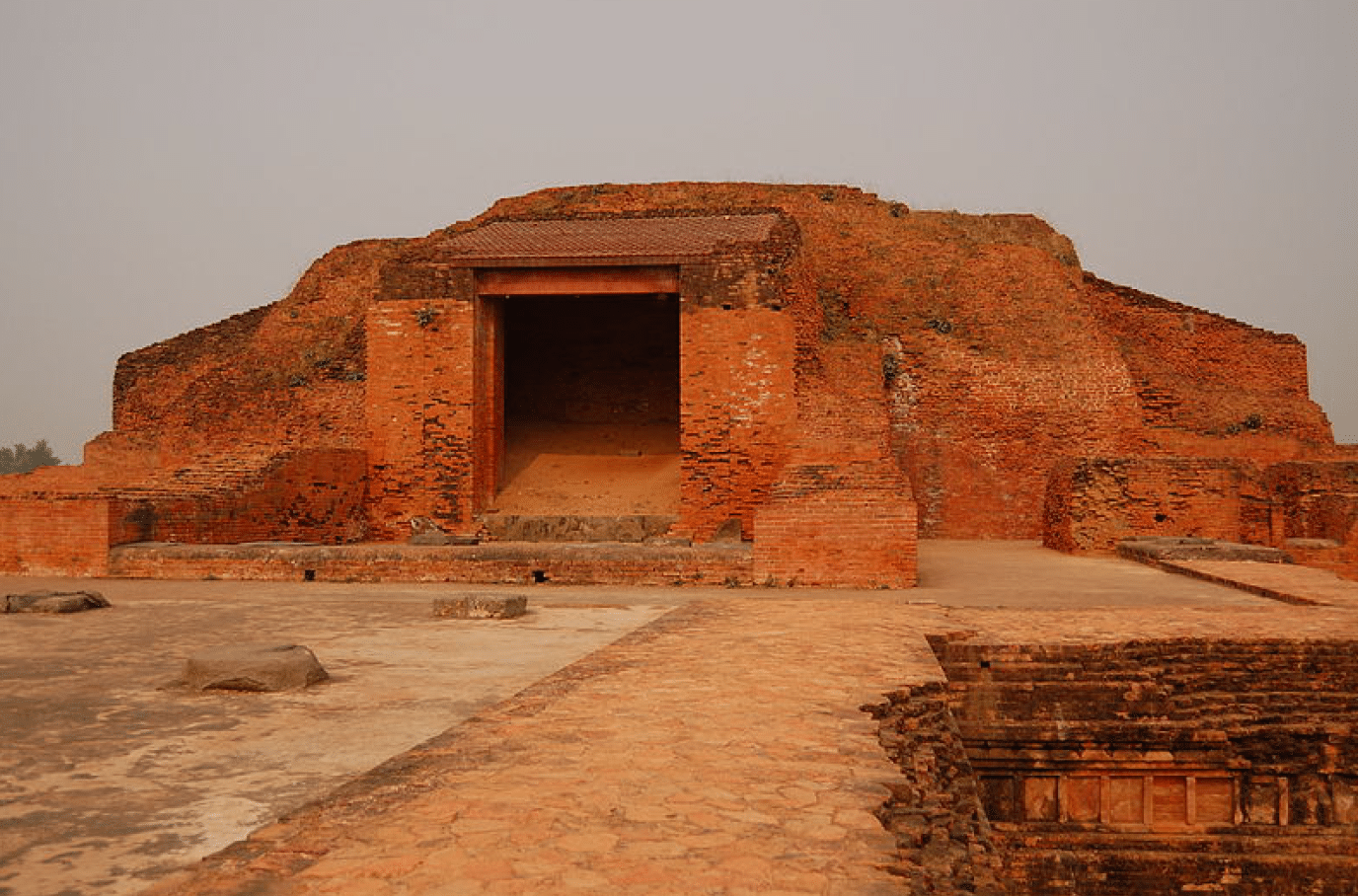
The Main stupa at the centre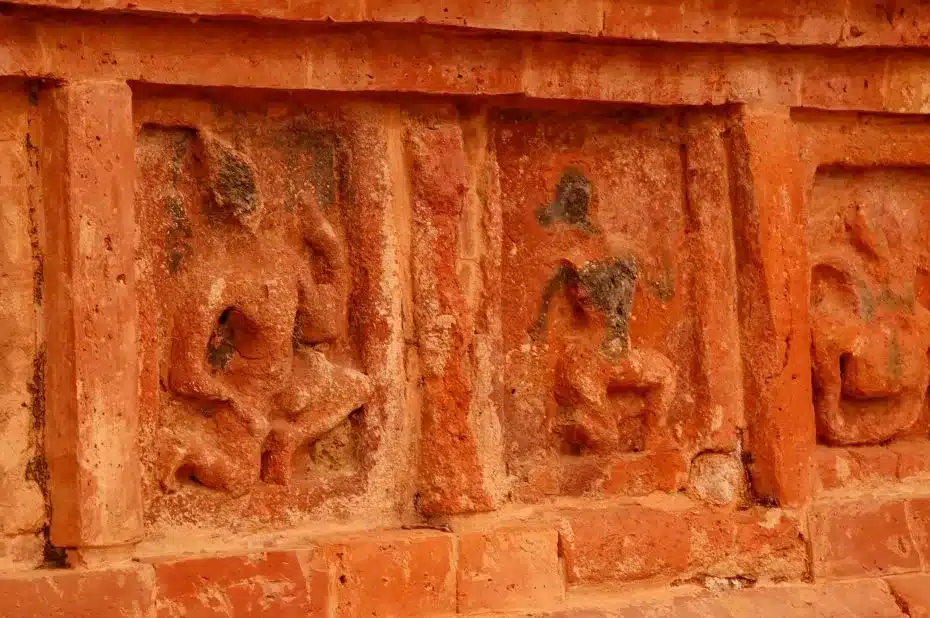
The wall carvings of various deities
(4) Odantapuri
- Odantapuri was considered the second oldest of India’s universities, situated in Magadha, about 6 miles from Nalanda (near Biharsharif).
- Acharya Sri Ganga, later associated with Vikramasila, had been a student here before subsequently joining Vikramasila.
- King Gopala (660–705) was the patron who helped found this university.
- According to Tibetan records, there were about 12,000 students at Odantapuri, though our knowledge of this seat of learning otherwise remains obscure.
- Like the others, Odantapuri perished at the hands of the Muslim invaders.
- It is said that the invaders mistook the universities, with their high walls, for fortresses, and believed the Buddhist monks to be “shaven-headed Brahmins” who were idolaters.
(5) Somapura Mahavihara
- Somapura was situated in present-day Bangladesh. King Devapala (810–850 CE) is said to have erected the Dharmapala-Vihara at Somapura.
- The ruins of these buildings cover an area of about 1 square mile.
- There was a large gate, with the buildings surrounded by a high wall.
- There were about 177 cells for monks, in addition to shrines and image houses; a common refectory and kitchen are among the ruins, along with the remains of three-storeyed buildings.
- This university flourished for about 750 years, before being abandoned following the Muslim invasion.
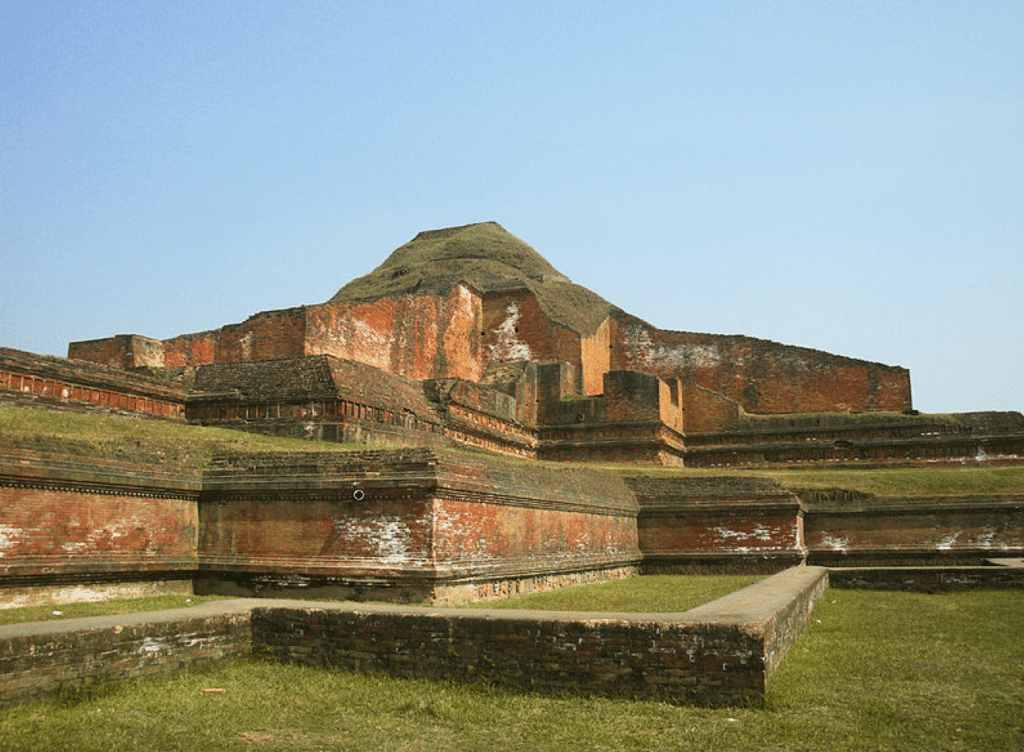
(6) Jagaddala
- King Ramapala (1077–1129) is said to be the founder of Jagaddala University — the largest construction undertaken by the Pala kings.
- It served as a centre for the study and dissemination of Tantric Buddhism, following the methods, practices, and traditions of Nalanda.
- According to Tibetan works, many books were translated into Tibetan at Jagaddala.
- The Buddhist teacher Sakya Sri Bhadra studied at Jagaddala; his pupil Danaseela is said to have translated ten books into Tibetan.
- Sakya Sri Bhadra was responsible for the propagation of Tantric Buddhism in Tibet, and lived at Jagaddala for seven years.
- In 1027, Muslim invaders sacked and destroyed Jagaddala.