Colonisation and Decolonisation of South-East Asia

South-East Asia’s colonial history is remarkable for its sheer diversity — a single region colonised in turn, or simultaneously, by the Portuguese, Spanish, Dutch, British and French, with a lone holdout, Siam (Thailand), surviving as an independent buffer state between rival empires. With rejuvenated nationalist movements waiting in the wings, the Europeans returned after the Second World War to a region utterly transformed by Japanese occupation, and found themselves negotiating, fighting, and eventually withdrawing from territories stretching from the spice islands of Indonesia to the trading ports of Hong Kong and Macau. This article surveys the colonisation and decolonisation of ten South-East and East Asian territories in turn.
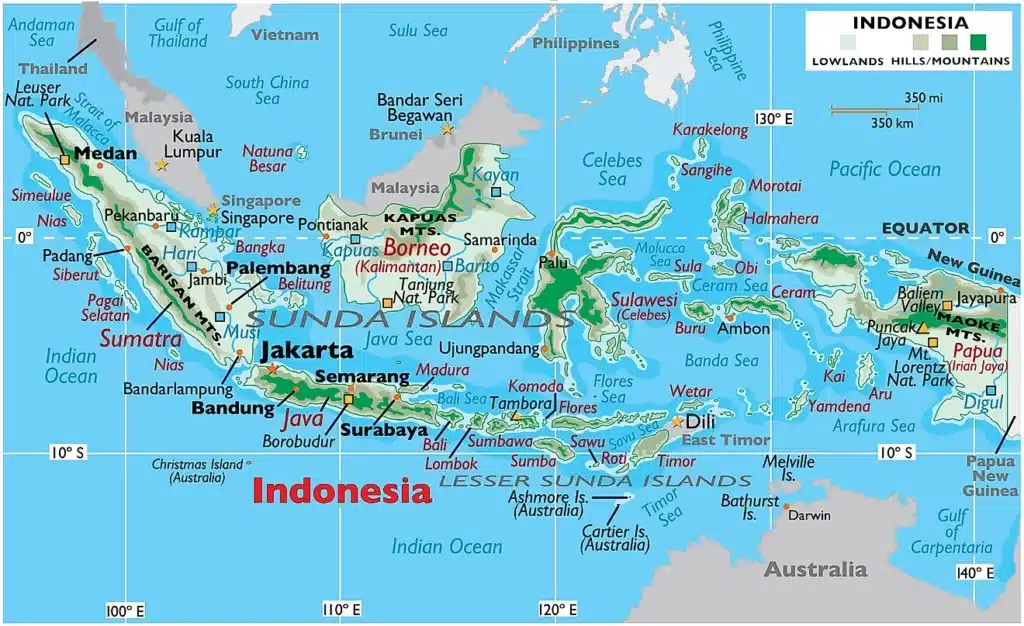
1. Indonesia
- Beginning in the sixteenth century, successive waves of Europeans — the Portuguese, Spanish, Dutch and British — sought to dominate the spice trade at its sources in India and the “Spice Islands” (Maluku) of Indonesia.
- This meant finding a sea route to Asia that could bypass the Muslim merchants who, through their Venetian outlet in the Mediterranean, monopolised spice imports into Europe. Spices were highly coveted not only to preserve and make palatable poorly preserved meat, but also as medicines and magic potions.
- The arrival of Europeans in South-East Asia is often regarded as the watershed moment in the region’s history.
The Portuguese in Indonesia
- The nutmeg plant is native to Indonesia’s Banda Islands. Once among the world’s most valuable commodities, it drew the first European colonial power — Portugal — to Indonesia.
- Newfound Portuguese expertise in navigation, shipbuilding and weaponry enabled daring expeditions of exploration and expansion. Starting with exploratory voyages sent from newly conquered Malacca in 1512, the Portuguese became the first Europeans to arrive in Indonesia, seeking to dominate the sources of valuable spices and extend the Catholic Church’s missionary reach.
- Turning east to Maluku, they established trading posts, forts and missions through both military conquest and alliances with local rulers.
- Ultimately, the Portuguese presence in Indonesia was reduced to Solor, Flores and Timor, following defeat at the hands of the indigenous Ternateans and the Dutch in Maluku, and a broader failure to maintain control over regional trade.
- Compared to their original ambition of dominating Asian trade, Portuguese influence on Indonesian culture proved relatively small. Its most significant legacies were the disruption and disorganisation of existing trade networks — largely a consequence of the conquest of Malacca — and the first significant plantings of Christianity in Indonesia.
The Dutch East India Company (VOC)
- In 1602, the Dutch parliament awarded the VOC (Dutch East India Company) a monopoly on trade and colonial activity in the region, at a time before the Company controlled any territory in Java.
- In 1619, the VOC conquered the West Javan city of Jayakarta, where it founded the city of Batavia (present-day Jakarta).
- The Dutch followed the Portuguese in ambition, daring and brutality, but brought superior organisation, weapons, ships and financial backing.
- Although they never gained complete control of the Indonesian spice trade, they achieved far greater success than the Portuguese before them — exploiting the factional rivalries among Java’s small kingdoms to establish a permanent foothold, from which grew a land-based colonial empire that became one of the richest colonial possessions on earth.
The French and British Interlude
- After the fall of the Netherlands to the French Empire and the dissolution of the Dutch East India Company in 1800, the European colonial administration of the East Indies underwent significant change — the Company’s assets were nationalised as the Dutch colony known as the Dutch East Indies, even as Europe itself was devastated by the Napoleonic Wars.
- In 1806, Napoleon Bonaparte oversaw the dissolution of the Batavian Republic, replacing it with the Kingdom of Holland — a French puppet state ruled by Napoleon’s brother, Louis Bonaparte.
- Since 1685, the British had consolidated their rule at Bencoolen on the western coast of Sumatra, and had also established themselves in the Malacca Strait, on the island of Singapore, and at Penang.
- As the British coveted the Dutch colonies in the region, the French-controlled East Indies braced for an anticipated British invasion. In 1806, the King of the Netherlands sent his general, Daendels, to serve as Governor-General of the East Indies, based in Java, with orders to strengthen Javanese defences against the expected attack. Daendels oversaw construction of the Great Post Road across northern Java — a thousand-kilometre route intended to ease logistics across the island, during which thousands of Javanese forced labourers died.
- In 1811, Java fell to a British East India Company force under Minto, then Governor-General of India, who appointed Sir Thomas Stamford Raffles as Lieutenant-Governor of Java.
- Raffles carried forward the administrative centralisation Daendels had begun, and launched military expeditions to subjugate local princes under British rule. During his administration, numerous ancient monuments in Java were rediscovered — most notably the Buddhist temple of Borobudur in Central Java. An enthusiast of the island’s history, Raffles wrote The History of Java.
- In 1815, following the end of the Napoleonic Wars, Java was returned to Dutch control under the terms of the Anglo-Dutch Treaty of 1814.
Dutch State Rule
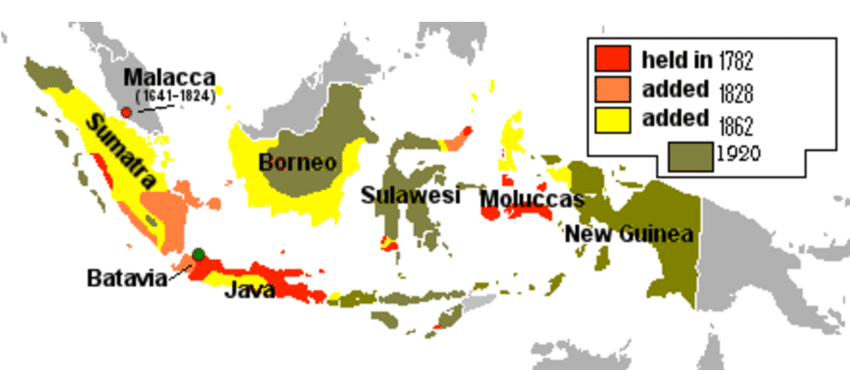
- After the VOC was dissolved in 1800 following bankruptcy, and following a brief period of British rule under Raffles, the Dutch state formally took over the VOC’s possessions in 1816.
- A Javanese uprising was crushed in the Java War of 1825–1830.
- After 1830, a system of forced cultivation and indentured labour — the Cultivation System — was introduced on Java, tying peasants to their land and forcing them to work in government-owned plantations for 60 days a year. The system brought the Dutch enormous wealth and was only abolished during the more liberal period after 1870.
- In 1901, the Dutch adopted what they called the Ethical Policy, involving somewhat increased investment in indigenous education alongside modest political reforms.
- The Dutch colonialists formed a privileged upper social class of soldiers, administrators, managers, teachers and pioneers, living alongside the “natives” but at the top of a rigid social and racial caste system.
- The Dutch East Indies recognised two legal classes of citizens — European and indigenous — with a third class, “Foreign Easterners,” added in 1920.
- Upgrading port and road infrastructure was a high Dutch priority, aimed at modernising the economy, channelling wages into local areas, facilitating commerce, and speeding up military movements.
- For most of the colonial period, Dutch control over its Indonesian territories remained tenuous — it was only in the early twentieth century, three centuries after the first Dutch trading post, that the full extent of the colonial territory was established and direct colonial rule fully exerted.
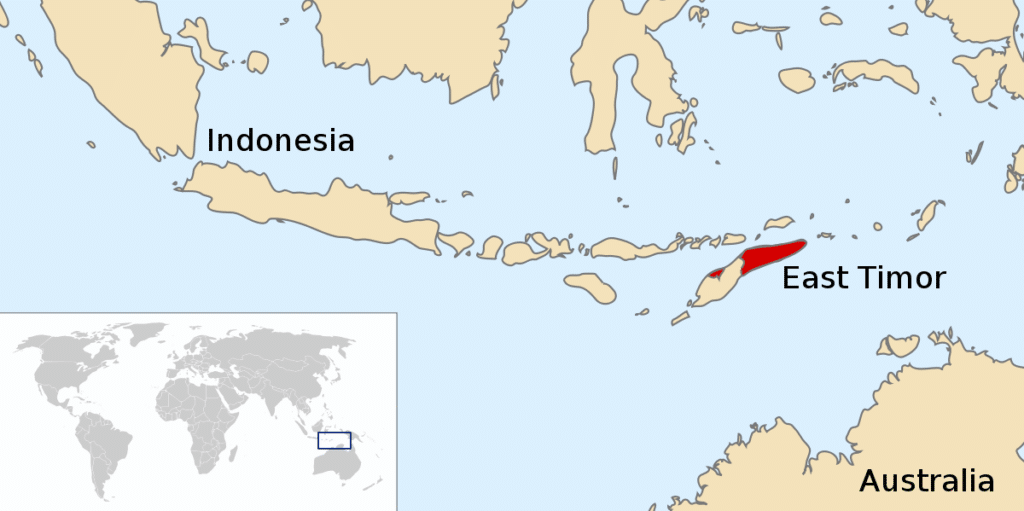
- Portuguese Timor, now East Timor, remained under Portuguese rule until 1975, when it was invaded by Indonesia. The Indonesian government declared the territory an Indonesian province, but relinquished it in 1999 following a UN-sponsored act of self-determination — East Timor became the first new sovereign state of the twenty-first century on 20 May 2002.
The Indonesian National Awakening
- In October 1908, the first nationalist movement, Budi Utomo, was formed. On 10 September 1912, the first nationalist mass movement, Sarekat Islam, followed.
- The Dutch responded, after the First World War, with repressive measures. Nationalist leadership was drawn from a small group of young professionals and students, some of whom had been educated in the Netherlands.
- In the post-World War I era, Indonesian communists associated with the Third International began to gain ground within the nationalist movement.
- Repression led to many arrests, including that of Indonesia’s first president, Sukarno (1901–70), imprisoned for political activities on 29 December 1929. Also arrested were Mohammad Hatta, Indonesia’s first Vice-President, and Sutan Sjahrir, who later became its first Prime Minister.
- In 1914, the exiled Dutch socialist Henk Sneevliet founded the Indies Social Democratic Association — initially a small forum of Dutch socialists, it would evolve into the Communist Party of Indonesia (PKI) in 1924.
- Strong Dutch repression in the post-World War I era, rather than suppressing the PKI, actually fuelled its growth.
- Between 1926 and 1927, a PKI-led revolt against Dutch colonialism, built on urban worker strikes, was put down by the Dutch.
- Sukarno was released from prison in December 1931, but was re-arrested on 1 August 1933.
The Japanese Occupation
- The Japanese invasion and subsequent occupation during the Second World War ended Dutch rule and reinvigorated the previously suppressed Indonesian independence movement.
- In May 1940, early in the war, the Netherlands was occupied by Nazi Germany, and the Dutch East Indies declared a state of siege.
- Negotiations with Japan aimed at securing aviation fuel supplies collapsed in June 1941, and Japan began its conquest of South-East Asia that December — the same month in which factions from Sumatra sought Japanese help for a revolt against the Dutch wartime government. The last Dutch forces were defeated by Japan in March 1942.
- In July 1942, Sukarno accepted Japan’s offer to rally public support for its war effort.
- Many Indonesians in areas important to the war effort nonetheless experienced torture, sexual slavery, arbitrary arrest and execution, and other war crimes. Thousands taken away as war labourers suffered or died from ill-treatment and starvation, with people of Dutch and mixed Dutch-Indonesian descent particularly targeted.
- In March 1945, Japan organised an Indonesian committee on independence, BPUPKI.
- At its first meeting, Muhammad Yamin suggested the new nation should claim British Borneo, British Malaya, Portuguese Timor, and all pre-war territories of the Dutch East Indies. The committee drafted the 1945 Constitution, which remains in force today, though much amended since.
- Japan intended to announce Indonesian independence on 24 August. After Japan’s surrender, however, Sukarno unilaterally proclaimed independence on 17 August instead. A later UN report stated that four million people died in Indonesia as a result of the Japanese occupation.
The Indonesian National Revolution
- Under pressure from radical, politicised pemuda (“youth”) groups, Sukarno and Hatta proclaimed Indonesian independence on 17 August 1945, two days after the Japanese Emperor’s surrender.
- The following day, the Central Indonesian National Committee (KNIP) declared Sukarno President and Hatta Vice President. Indonesia’s wartime military (PETA), youths and others rallied in support of the new Republic.
- The Netherlands, initially backed by Britain, tried to re-establish its rule, triggering a bitter armed and diplomatic struggle. Indonesian nationalist groups attacked returning Allied troops, and more Europeans died in Indonesia after the war than during it.
- After returning to Java, Dutch forces quickly re-occupied the colonial capital, Batavia (now Jakarta), making Yogyakarta in central Java the capital of the nationalist forces instead. Negotiations produced two major truce agreements, but disputes over implementation, and repeated mutual provocation, led each time to renewed conflict.
- Within four years, the Dutch had recaptured almost the whole of Indonesia, but guerrilla resistance, led on Java by commander Nasution, persisted.
- On 27 December 1949, after four years of sporadic warfare and fierce UN criticism of the Dutch, the Netherlands officially recognised Indonesian sovereignty under the federal structure of the United States of Indonesia (RUSI).
- On 17 August 1950 — exactly five years after the original proclamation of independence — the last of the federal states were dissolved, and Sukarno proclaimed a single, unitary Republic of Indonesia.
2. The Philippines
Spanish Colonisation
- In 1521, Portuguese explorer Ferdinand Magellan arrived in the Philippines and claimed the islands for Spain.
- Colonisation proper began when Spanish explorer Miguel Legazpi arrived from Mexico in 1565 and formed the first Hispanic settlements at Cebu. After relocating to Panay island and consolidating a coalition of native allies and Spanish soldiers, the Spaniards marched on Islamic Manila.
- Under Spanish rule, Manila became the capital of the Spanish East Indies (1571), where the Spanish put down the Tondo Conspiracy (a 1587–1588 plot against colonial rule) and defeated the Chinese warlord and pirate Limahong.
- Spanish rule contributed significantly to bringing political unity to the fragmented island states.
- From 1565 to 1821, the Philippines was governed as a territory of the Viceroyalty of New Spain, and was thereafter administered directly from Madrid following the Mexican War of Independence.
- Trade introduced foods such as corn, tomatoes, potatoes, chili peppers and pineapples from the Americas. Roman Catholic missionaries converted most lowland inhabitants to Christianity, founding schools, a university and hospitals.
- While a Spanish decree introduced free public schooling as early as 1863, real efforts at mass public education mainly bore fruit during the later American period.
- Spanish rule fought off various indigenous revolts and several external colonial challenges from Chinese pirates, the Dutch and the Portuguese.
- In an extension of the Seven Years’ War, British forces occupied Manila from 1762 to 1764; Spanish rule was restored following the 1763 Treaty of Paris, signed by Great Britain, France and Spain (with Portuguese agreement) after Britain’s victory over France and Spain in that war.
- In the nineteenth century, Philippine ports opened to world trade, triggering social change. Many Spaniards born in the Philippines (criollos) and those of mixed ancestry (mestizos) grew wealthy, while an influx of Latin American settlers opened up government posts traditionally reserved for Spaniards born in the Iberian Peninsula (peninsulares).
- The ideals of revolution began spreading through the islands. Criollo dissatisfaction produced the 1872 Cavite Mutiny — a precursor to the Philippine Revolution, in which around 200 soldiers and labourers rose up hoping to spark a national uprising, though the mutiny itself proved unsuccessful. (Criollo was a social class in Spain’s colonial caste system, comprising locally born people of confirmed Spanish ancestry, ranked below the peninsulares.)
- Revolutionary sentiment was further stoked in 1872, after three priests collectively known as Gomburza were accused of sedition by colonial authorities and executed.
- This inspired a propaganda movement in Spain, organised by Pilar, Rizal and Ponce, lobbying for political reform in the Philippines. Rizal was eventually executed on 30 December 1896 on charges of rebellion. As reform efforts met continued resistance, Andrés Bonifacio established the secret society Katipunan in 1892, seeking independence from Spain through armed revolt.
- Bonifacio and the Katipunan launched the Philippine Revolution in 1896. A faction of the Katipunan, the Magdalo of Cavite province, eventually challenged Bonifacio’s leadership, and Emilio Aguinaldo took over the movement.
- In 1898, the Spanish-American War began in Cuba and reached the Philippines. Aguinaldo declared Philippine independence from Spain, and the First Philippine Republic was established at Barasoain Church the following year.
The American Period
- The islands were ceded by Spain to the United States following the latter’s victory in the Spanish-American War, with the US paying Spain a compensation of 20 million dollars under the terms of the 1898 Treaty of Paris.
- As it became increasingly clear that the United States would not recognise the nascent First Philippine Republic, the Philippine-American War broke out. The First Republic was defeated, and the archipelago was placed under an Insular Government.
- The Americans then suppressed the sub-states into which the First Republic had fractured — chiefly the Sultanate of Sulu, as well as the insurgent Tagalog Republic, the Cantonal Republic of Negros in the Visayas, and the Republic of Zamboanga in Mindanao.
- This era saw a renaissance in Philippine culture, marked by the expansion of Philippine cinema and literature — Daniel Burnham even designed an architectural plan intended to transform Manila into a modern city.
- In 1935, the Philippines was granted Commonwealth status, with Manuel Quezon as president. Quezon designated a national language and introduced women’s suffrage and land reform.
- Plans for full independence over the following decade were interrupted by the Second World War, when Japan invaded and established the Second Philippine Republic under collaborator José P. Laurel.
- Numerous atrocities and war crimes occurred during this period, including the Bataan Death March and the Manila massacre, culminating in the Battle of Manila (fought between combined American and Filipino forces and the Japanese from 3 February to 3 March 1945).
- In 1944, Quezon died in exile in the United States and was succeeded by Sergio Osmeña. Allied troops defeated the Japanese in 1945.
- On 24 October 1945, the Philippines became one of the founding members of the United Nations, and on 4 July 1946, it was formally recognised by the United States as independent.
3. Burma
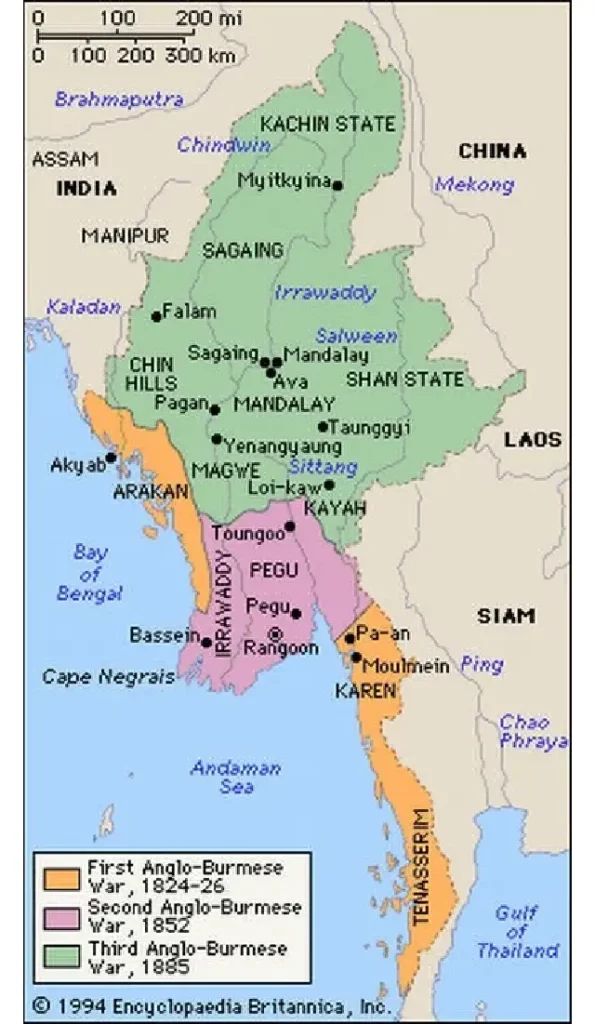
- Burma was colonised by Britain following three Anglo-Burmese Wars (1824–1885).
- Burma’s own territorial expansion had consequences along its frontiers — as those frontiers moved ever closer to the British East India Company, and later British India, problems arose over refugees and military operations spilling across ill-defined borders.
- First Anglo-Burmese War (1824–1826). This ended in a British East India Company victory, and under the Treaty of Yandabo, Burma lost previously conquered territory in Assam, Manipur and Arakan.
- The British also took possession of Tenasserim, intending to use it as a bargaining chip in future negotiations with Burma or Siam. As the century progressed, the East India Company increasingly coveted Burma’s resources and territory during an era of aggressive territorial expansion.
- Second Anglo-Burmese War. In 1852, Commodore Lambert was dispatched to Burma by Lord Dalhousie over minor disputes related to the earlier treaty.
- The Burmese immediately made concessions, including removing a governor the British had held responsible for the friction — but Lambert nonetheless provoked a naval confrontation under highly questionable circumstances, starting the Second Anglo-Burmese War in 1852, which ended in British annexation of Pegu province, renamed Lower Burma. The war triggered a palace revolution in Burma, with King Pagan Min (1846–1852) replaced by his half-brother, Mindon Min (1853–1878).
- Third Anglo-Burmese War.King Mindon tried to modernise the Burmese state and economy to resist British encroachment, establishing and fortifying a new capital at Mandalay.
- This proved insufficient. The British claimed Mindon’s son Thibaw Min (r. 1878–1885) was a tyrant intending to side with the French, had lost control of the country, and was reneging on a treaty signed by his father. Britain declared war again in 1885, conquering the rest of the country in the Third Anglo-Burmese War, resulting in the total annexation of Burma.
- With the fall of Mandalay, all of Burma came under British rule, formally annexed on 1 January 1886.
- Throughout the colonial era, many Indians arrived as soldiers, civil servants, construction workers and traders, dominating — alongside the Anglo-Burmese community — commercial and civil life in Burma. Rangoon became the capital of British Burma and an important port linking Calcutta and Singapore.
- Burmese resentment ran strong, occasionally venting in violent riots that paralysed Rangoon (Yangon) well into the 1930s — some of this discontent stemmed from disrespect for Burmese culture and tradition, such as the British refusal to remove their shoes when entering pagodas.
- Buddhist monks became vanguards of the independence movement. The activist monk U Wisara died in prison after a 166-day hunger strike, protesting a rule that forbade him from wearing his Buddhist robes while imprisoned.
- On 1 April 1937, Burma became a separately administered British colony, with Ba Maw as its first Premier.
- Ba Maw was an outspoken advocate of Burmese self-rule and opposed Britain’s — and, by extension, Burma’s — participation in the Second World War. He resigned from the Legislative Assembly and was arrested for sedition. In 1940, before Japan formally entered the war, Aung San formed the Burma Independence Army in Japan.
- Burma was devastated as a major battleground of the Second World War. By March 1942, within months of entering the war, Japanese troops had advanced on Rangoon, and the British administration collapsed.
- A Burmese Executive Administration, headed by Ba Maw, was established by the Japanese in August 1942.
- Wingate’s British Chindits — a British-Indian “Special Force” — were organised into long-range penetration groups trained to operate deep behind Japanese lines; a similar American unit, Merrill’s Marauders, followed them into the Burmese jungle in 1943.
- Beginning in late 1944, Allied troops launched a series of offensives that ended Japanese rule by July 1945. The fighting was intense, and much of Burma was laid waste — the Japanese lost some 150,000 men in Burma overall.
- Although many Burmese initially fought for Japan as part of the Burma Independence Army, many others, mostly from ethnic minorities, served in the British Burma Army.
- The Burma National Army and the Arakan National Army fought alongside the Japanese from 1942 to 1944, before switching allegiance to the Allies in 1945.
- Following the war, Aung San negotiated the Panglong Agreement with ethnic leaders, guaranteeing the independence of Burma as a unified state.
- The agreement, reached at Panglong, Southern Shan State, between the Burmese government under Aung San and the Shan, Kachin and Chin peoples on 12 February 1947, accepted in principle “full autonomy in internal administration for the Frontier Areas,” envisioning a future Kachin State. It preserved existing financial arrangements between the Shan states and the Burmese federal government, and envisioned similar arrangements for the Kachin and Chin Hills. The day is still celebrated in Myanmar as Union Day every 12 February.
- In 1947, Aung San became Deputy Chairman of the Executive Council of Burma, a transitional government — but in July 1947, political rivals assassinated Aung San and several cabinet members.
- On 4 January 1948, the nation became an independent republic, the Union of Burma, with Sao Shwe Thaik as its first President and U Nu as its first Prime Minister.
- Unlike most other former British colonies, Burma chose not to become a member of the Commonwealth.
4. French Indochina
- French Indochina — officially the Indochinese Federation since 1947 — was a federation of colonies within the French colonial empire in South-East Asia.
- A federation of the three Vietnamese regions — Tonkin (North), Annam (Central) and Cochinchina (South) — together with Cambodia, was formed in 1887. Laos was added in 1893, and Kouang-Tchéou-Wan (Guangzhouwan) in 1900.
- The capital moved from Saigon (Cochinchina) to Hanoi (Tonkin) in 1902, then to Da Lat (Annam) between 1939 and 1945, before returning to Hanoi.
- After the Fall of France in the Second World War, the colony was administered by Vichy France under Japanese supervision, until a brief period of full Japanese control between March and August 1945.
- Beginning in May 1941, the Viet Minh, a communist army led by Ho Chi Minh, began a revolt against French rule that grew into the First Indochina War.
- In Saigon, the anti-communist State of Vietnam, led by former Emperor Bảo Đại, was granted independence in 1949. Following the Geneva Accords of 1954, the Viet Minh became the government of North Vietnam, while the Bảo Đại government continued to rule the South.
Vietnam: Early French Contact and Colonisation
- France-Vietnam relations date as early as the seventeenth century, with the mission of the Jesuit missionary Alexandre de Rhodes. European involvement remained confined largely to trade through the eighteenth century.
- France became heavily involved in Vietnam during the nineteenth century, often citing the protection of the Paris Foreign Missions Society as justification. The ruling Nguyễn Dynasty, for its part, increasingly viewed Catholic missionaries as a political threat.
- In 1862, France obtained concessions from the Emperor, securing three treaty ports in Annam and Tonkin, and all of Cochinchina — the latter formally declared French territory in 1864.
- In 1863, the Cambodian king Norodom requested the establishment of a French protectorate over his country. In 1867, Siam renounced suzerainty over Cambodia and formally recognised the 1863 protectorate, in exchange for control of Battambang and Siem Reap provinces, which officially became part of Thailand (these provinces were later ceded back to Cambodia under a 1906 border treaty between France and Siam).
Establishment of French Indochina
- Vietnamese independence was gradually eroded by France — aided by large Catholic militias — through a series of military conquests between 1859 and 1885.
- In 1862, the southern third of the country became the French colony of Cochinchina; by 1884, the entire country had come under French rule, formally integrated into the union of French Indochina in 1887.
- France secured control over northern Vietnam following its victory in the Sino-French War (1884–85).
- French Indochina was formally formed in October 1887 from Annam, Tonkin, Cochinchina (together comprising modern Vietnam) and the Kingdom of Cambodia; Laos was added after the Franco-Siamese War of 1893. The federation lasted until 1954.
- Across its four protectorates, France formally left local rulers in place — the Emperors of Vietnam, the Kings of Cambodia, and the Kings of Luang Prabang — but gathered all real power into its own hands, reducing local rulers to figureheads.
- The French administration imposed significant political and cultural change: a Western-style modern education system was developed, and Roman Catholicism propagated widely. Most French settlers concentrated in Cochinchina.
- The royalist Cần Vương movement rebelled against French rule and was defeated in the 1890s, after a decade of resistance; guerrillas of this movement murdered around a third of Vietnam’s Christian population during this period.
- Developing a plantation economy geared to exporting tobacco, indigo, tea and coffee, the French largely ignored growing calls for Vietnamese self-government and civil rights.
- A nationalist political movement soon emerged, with leaders such as Phan Bội Châu, Phan Chu Trinh, Emperor Hàm Nghi and Ho Chi Minh fighting or calling for independence. The 1930 Yên Bái mutiny of the Vietnamese Nationalist Party (Vietnamese Kuomintang) was, however, suppressed with relative ease.
- France retained full control of its colonies until the Second World War, when the Pacific war led to the Japanese invasion of French Indochina in 1941.
- Japan was subsequently permitted to station troops in Vietnam while allowing the pro-Vichy French colonial administration to continue nominal rule. Japan exploited Vietnam’s natural resources to support its military campaigns, culminating in a full-scale takeover of the country in March 1945 and the Vietnamese Famine of 1945, which caused up to two million deaths.
1946–54: The First Indochina War
- In 1941, the Viet Minh — a communist and nationalist liberation movement — emerged under the Marxist-Leninist, French-educated Ho Chi Minh, seeking Vietnamese independence from France and an end to Japanese occupation.
- Following Japan’s military defeat and the fall of its puppet Empire of Vietnam in August 1945, the Viet Minh occupied Hanoi and proclaimed a provisional government, asserting national independence on 2 September.
- After the war, France petitioned for the nullification of the 1938 Franco-Siamese Treaty and attempted to reassert itself in the region, coming into conflict with the Viet Minh.
- In 1945, the Provisional Government of the French Republic dispatched the French Far East Expeditionary Corps to restore colonial rule, and the Viet Minh began a guerrilla campaign against France in late 1946. The resulting First Indochina War lasted until July 1954.
- The defeat of French and Vietnamese loyalist forces at the 1954 Battle of Dien Bien Phu allowed Ho Chi Minh to negotiate a ceasefire from a position of strength at the subsequent Geneva Conference.
- Colonial administration ended, and French Indochina was dissolved under the Geneva Accords of 1954, which separated loyalist and communist forces at the 17th parallel north, along the Vietnamese Demilitarized Zone. Two states emerged from the partition — Ho Chi Minh’s Democratic Republic of Vietnam in the north and Emperor Bảo Đại’s State of Vietnam in the south. A 300-day period of free movement followed, during which nearly a million northerners, mainly Catholics, moved south, fearing communist persecution.
The Geneva Accords of 1954
- On 27 April 1954, the Geneva Conference produced the Geneva Agreements between North Vietnam and France.
- Its provisions supported the territorial integrity and sovereignty of Indochina, granted independence from France, declared a cessation of hostilities and foreign involvement in internal Indochinese affairs, delineated northern and southern zones for opposing troop withdrawal, and mandated eventual unification through internationally supervised free elections, to be held in July 1956.
- It was at this conference that France formally relinquished all claims to territory in the Indochinese peninsula.
- The United States and South Vietnam rejected the Geneva Accords and never signed them. South Vietnamese leader Diệm rejected nationwide elections outright, arguing free elections were impossible in the communist North and that his government was not bound by the agreement.
- France did withdraw, ceding the north to the Communists, while the Bảo Đại regime, with American support, retained control of the South.
- The events of 1954 marked the beginning of serious United States involvement in Vietnam and the ensuing Vietnam War. Laos and Cambodia also became independent in 1954, but were both drawn into the wider Vietnam War.
- As the war progressed, Cambodia adopted an official policy of Cold War neutrality, though it was widely regarded as sympathetic to the communist cause — Sihanouk allowed Vietnamese communists to use Cambodia as a sanctuary and supply route for arms reaching their forces in South Vietnam.
- Laos. In 1955, the US Department of Defense created a special Programs Evaluation Office to replace French support for the Royal Lao Army against the communist Pathet Lao, as part of America’s containment policy.
- In 1960, amid a series of rebellions in the Kingdom of Laos, fighting broke out between the Royal Lao Army and the North Vietnam- and Soviet-backed Pathet Lao guerrillas. A Provisional Government of National Unity, formed in 1962, proved unsuccessful, and the situation steadily deteriorated into large-scale civil war. The North Vietnamese invasion, and post-Vietnam War occupation of Laos by the Moscow-backed Vietnam People’s Army, continued through the 1960s, 1970s and 1980s.
1954–1975: The Vietnam War
- The partition of Vietnam was never intended to be permanent under the Geneva Accords, which stipulated reunification following elections in 1956.
- In 1955, however, the State of Vietnam’s Prime Minister, Ngô Đình Diệm, toppled Bảo Đại in a fraudulent referendum organised by his brother Ngô Đình Nhu, proclaiming himself president of the Republic of Vietnam.
- The pro-Hanoi Viet Cong began a guerrilla campaign in the late 1950s to overthrow Diệm’s government.
- In the North, the communist government launched a land reform programme, executing many in campaigns against wealthy farmers and landowners amid broader political purges. In 1960 and 1962, the Soviet Union and North Vietnam signed treaties providing for further Soviet military support. In the South, Diệm crushed political and religious opposition, imprisoning or executing tens of thousands.
- In 1963, Buddhist discontent with Diệm’s regime erupted into mass demonstrations, met with a violent government crackdown — collapsing Diệm’s relationship with the United States and culminating in the 1963 coup, in which Diệm and Nhu were assassinated.
- The Diệm era was followed by more than a dozen successive military governments, before General Nguyễn Văn Thiệu took control in mid-1965. Amid this political instability, the communists steadily gained ground.
- To support South Vietnam against the communist insurgency, the United States began increasing its military advisers, using the 1964 Tonkin Gulf incident as a pretext for deeper intervention.
- US forces became involved in ground combat in 1965, eventually numbering more than 500,000 at their peak, alongside a sustained aerial bombing campaign. Meanwhile, China and the Soviet Union provided North Vietnam with significant material aid and 15,000 combat advisers. Supplies for the Viet Cong moved along the Ho Chi Minh Trail, passing through Laos.
- Communist forces attacked South Vietnamese targets during the 1968 Tet Offensive. Although it failed militarily, the offensive shocked the American establishment and turned US public opinion decisively against the war.
- Facing rising casualties, growing domestic opposition, and mounting international condemnation, the US began withdrawing from ground combat roles in the early 1970s — a process that also involved an unsuccessful effort to strengthen and stabilise South Vietnam.
- Following the Paris Peace Accords of 27 January 1973, all American combat troops were withdrawn by 29 March 1973.
- In December 1974, North Vietnam captured Phước Long province and launched a full-scale offensive, culminating in the Fall of Saigon (later renamed Ho Chi Minh City) on 30 April 1975.
- On 2 July 1976, North and South Vietnam were merged to form the Socialist Republic of Vietnam. The war left Vietnam devastated, with a total death toll estimated between 800,000 and 3.1 million.
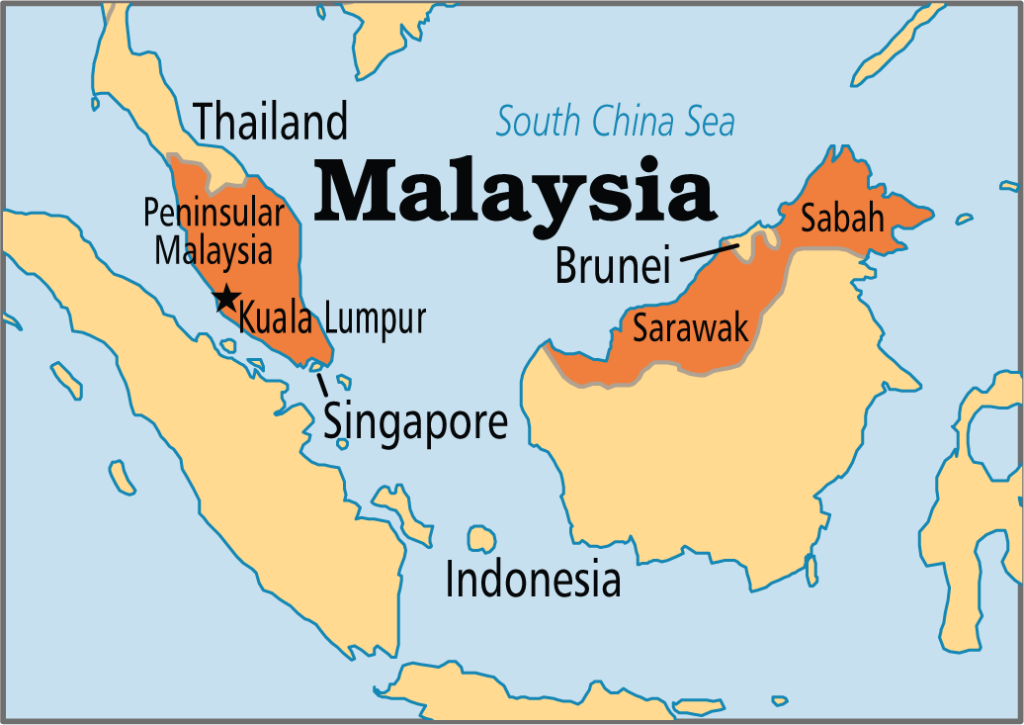
5. Malaysia
- Malacca was conquered by Portugal in 1511, before being taken by the Dutch in 1641.
- In 1786, the British Empire established a presence in Malaya when the Sultan of Kedah leased Penang to the British East India Company. The British obtained Singapore in 1819, and took control of Malacca in 1824 following the Anglo-Dutch Treaty.
- By 1826, the British directly controlled Penang, Malacca, Singapore and Labuan, consolidated as the crown colony of the Straits Settlements.
- By the twentieth century, Pahang, Selangor, Perak and Negeri Sembilan — the Federated Malay States — had British Residents appointed to advise their rulers, who were bound by treaty to defer to them.
- The remaining five peninsular states, the Unfederated Malay States, while not under direct British rule, also accepted British advisers around the turn of the twentieth century.
- Development on the Peninsula and in Borneo proceeded largely separately until the nineteenth century. Under British rule, the immigration of Chinese and Indian labourers was actively encouraged.
- The area now known as Sabah came under British control as North Borneo, once both the Sultan of Brunei and the Sultan of Sulu transferred their territorial rights between 1877 and 1878.
- In 1842, Sarawak was ceded by the Sultan of Brunei to James Brooke, whose successors ruled as the “White Rajahs” until 1946, when it became a Crown colony.
- During the Second World War, the Japanese army invaded and occupied Malaya, North Borneo, Sarawak and Singapore for more than three years, sharply raising ethnic tensions and fuelling nationalism.
- Popular support for independence grew further once Malaya was reconquered by Allied forces.
- Post-war British plans to unite Malaya’s administration under a single crown colony, the Malayan Union, met strong Malay opposition, centred on fears that it would weaken the Malay rulers and extend citizenship too readily to the ethnic Chinese.
- The Malayan Union, established in 1946 to cover all British possessions on the Malay Peninsula except Singapore, was quickly dissolved and replaced by the Federation of Malaya, restoring the autonomy of the Malay rulers under continued British protection.
- During this period, largely Chinese rebels under the Malayan Communist Party launched guerrilla operations aimed at forcing the British out of Malaya. The Malayan Emergency lasted from 1948 to 1960, involving a long anti-insurgency campaign by Commonwealth troops.
- Countering the threat of communism was a major theme running through the Cold War-era process of decolonisation. Having suppressed the communist insurrection during the Emergency (1948–60), Britain granted independence to Malaya in 1957, and later to Singapore, Sabah and Sarawak in 1963, within the framework of the Federation of Malaysia.
- A plan was put in place to federate Malaya with the crown colonies of North Borneo (joining as Sabah), Sarawak and Singapore. The proposed federation date of 31 August 1963 was delayed until 16 September 1963, owing to opposition from Indonesia’s Sukarno and the Sarawak United Peoples’ Party.
- Singapore became part of Malaysia on 16 September 1963, with Malaysia formed from the merger of the Federation of Malaya with North Borneo, Sarawak and Singapore — ending a 144-year period of British rule in Singapore dating back to Sir Stamford Raffles’s founding of modern Singapore in 1819.
- The union, however, proved unstable, undermined by distrust and ideological differences between the leaders of the State of Singapore and the Federal Government of Malaysia, producing frequent disagreements over economics, finance and politics.
- The federation also brought heightened regional tensions, including a conflict with Indonesia, Singapore’s eventual exit in 1965, and ongoing racial strife.
6. Ceylon (Sri Lanka)
The Portuguese Era
- The first Europeans to visit Sri Lanka in the modern era were the Portuguese — Francisco de Almeida arrived in 1505, finding the island divided into seven warring kingdoms unable to fend off intruders.
- The Portuguese founded a fort at the port city of Colombo in 1517, gradually extending control over the coastal areas.
- In 1592, the Sinhalese moved their capital inland to Kandy, a location more secure against invasion; intermittent warfare continued through the sixteenth century.
- Many lowland Sri Lankans were forced to convert to Christianity, while coastal Moors faced religious persecution and were driven to retreat into the Central highlands.
- The Buddhist majority disliked Portuguese occupation and its influences, welcoming any power that might rescue them and defeat the Portuguese. In 1602, when the Dutch captain Joris van Spilbergen landed, the King of Kandy duly appealed to him for help.
The Dutch Era
- It was in 1638 that the Dutch attacked in earnest, ending with an agreement disrespected by both parties — not until 1656 did Colombo finally fall.
- By 1660, the Dutch controlled the whole island except the Kingdom of Kandy. The Protestant Dutch persecuted the remaining Portuguese Catholic settlers but left the Buddhists, Hindus and Muslims alone — though they taxed the population far more heavily than the Portuguese had. A mixed Dutch-Sri Lankan people known as the Burghers are the enduring legacy of Dutch rule.
- In 1659, British sea captain Robert Knox landed by chance in Sri Lanka and was captured by the King of Kandy. He escaped 19 years later and wrote an account of his captivity — helping bring the island to British attention.
The British Era
- During the Napoleonic Wars, Great Britain, fearing French control of the Netherlands might deliver Sri Lanka to France, occupied the island’s coastal areas (which they called Ceylon) with little difficulty in 1796.
- In 1802, under the Treaty of Amiens, the Dutch-held part of the island was ceded to Britain and became a crown colony.
- In 1803, the British invaded the Kingdom of Kandy in the First Kandyan War, but were bloodily repulsed. In 1815, Kandy was occupied in the Second Kandyan War, finally ending Sri Lankan independence.
- Following the bloody suppression of the Uva Rebellion — the Great Rebellion of 1817–1818, or Third Kandyan War, sparked by Kandyan discontent with distant British administration — the Kandyan peasantry was stripped of its lands under the Wastelands Ordinance.
- The British found Sri Lanka’s uplands well-suited to coffee, tea and rubber cultivation, and by the mid-nineteenth century, Ceylon tea had become a staple of the British market, generating great wealth for a small class of white tea planters.
- To work the estates, planters imported large numbers of Tamil workers as indentured labourers from South India, who soon made up 10 per cent of the island’s population — working under slave-like conditions and housed in “line rooms” scarcely different from cattle sheds.
- The British colonialists favoured the semi-European Burghers, certain high-caste Sinhalese, and the Tamils concentrated mainly in the north — exacerbating divisions that have persisted ever since.
- Nevertheless, the British also introduced democratic elements to Sri Lanka for the first time in its history. The Burghers received a degree of self-government as early as 1833.
- Constitutional development began only in 1909, with a partly elected assembly; elected members did not outnumber official appointees until 1920. Universal suffrage was introduced in 1931, over the objections of the Sinhalese, Tamil and Burgher elite, who opposed extending the vote to the common people.
The Independence Movement
- The Ceylon National Congress (CNC) was founded to agitate for greater autonomy, but soon split along ethnic and caste lines — the refusal of the Ceylon Tamils to accept minority status was among the main causes of this fracture.
- The CNC did not, in fact, seek independence or “Swaraj.” What might be called the independence movement instead split into two streams: the “constitutionalists,” seeking independence through gradual modification of Ceylon’s status, and more radical groups tied to the Colombo Youth League, Goonasinghe’s Labour movement, and the Jaffna Youth Congress.
- These radical groups were the first to raise the cry of Swaraj, or outright independence, following the Indian example, after Jawaharlal Nehru, Sarojini Naidu and other Indian leaders visited Ceylon in 1926.
- Constitutionalist efforts led to the Donoughmore Commission reforms (1931) and, later, the Soulbury Commission recommendations.
- The Marxist Lanka Sama Samaja Party (LSSP), which grew out of the Youth Leagues in 1935, made the demand for outright independence a cornerstone of its policy, aided by figures like Colvin R. de Silva, Leslie Goonewardena and Don Alwin Rajapaksa. It also demanded replacing English as the official language with Sinhala and Tamil.
- Though the Marxist groups were a tiny minority, their movement was viewed with grave suspicion by the British administration — their heroic but largely ineffective attempts to rouse public revolt against the Raj risked bloodshed and might have delayed independence, and left a very negative impression on Colonial Office policymakers.
- The Soulbury Commission proved the most important outcome of the constitutional-reform agitation of the 1930s.
- By then, Tamil leadership had fallen into the hands of G. G. Ponnambalam, who rejected the “Ceylonese identity” and declared himself a “proud Dravidian,” attempting to establish an independent Tamil identity. Ponnambalam attacked the Sinhalese and their historical chronicle, the Mahavamsa — a stance that led to the first Sinhala-Tamil riot in 1939.
- Ponnambalam opposed universal franchise, supported the caste system, and argued that protecting Tamil rights required the Tamils (15 per cent of the population in 1931) holding an equal number of parliamentary seats to the Sinhalese (about 72 per cent of the population) — the “50-50,” or “balanced representation,” policy that became the hallmark of Tamil politics of the era. He also accused the British of colonising “traditional Tamil areas” and favouring Buddhists through the Buddhist Temporalities Act.
- The Soulbury Commission rejected Ponnambalam’s submissions outright, noting their unacceptably communal character.
- Meanwhile, Senanayake, Baron Jayatilleke, Oliver Gunatilleke and others lobbied the Soulbury Commission informally, without confronting it officially — these unofficial submissions would later form the basis of the draft constitution of 1944.
- The close collaboration between D. S. Senanayake’s government and the wartime British administration won the support of Lord Louis Mountbatten, whose dispatches and telegram to the Colonial Office backing Ceylonese independence helped the Senanayake government secure it.
The Second World War
- During the Second World War, Sri Lanka served as a front-line British base against Japan; opposition to the war within Sri Lanka was orchestrated by Marxist organisations.
- The Japanese Navy bombed Colombo, prompting the flight of Indian merchants, who had dominated the Colombo commercial sector — removing a significant political problem for the Senanayake government. Marxist leaders also fled, to India.
- The Senanayake government used the war to strengthen its rapport with the ruling British elite. Ceylon became crucial to the British war effort, with Lord Louis Mountbatten using Colombo as his headquarters for the Eastern Theatre.
- The Sinhalese continued agitating for independence and sovereignty, using wartime opportunities to build a special relationship with Britain. Sri Lankans in Singapore and Malaysia formed the “Lanka Regiment” of the Indian National Army.
- The constitutionalists, led by D. S. Senanayake, ultimately succeeded in winning independence. The Soulbury constitution was, in essence, what Senanayake’s board of ministers had already drafted in 1944 — the promise of Dominion status, and independence itself, had already been extended by the Colonial Office.
Post-War Independence
- Sinhalese leader Don Stephen Senanayake left the CNC over the question of independence, disagreeing with its revised aim of merely “achieving freedom.” He subsequently formed the United National Party (UNP) in 1946, when a new constitution was agreed.
- At the 1947 elections, the UNP won a minority of parliamentary seats, but formed a coalition with the Sinhala Maha Sabha of Solomon Bandaranaike and the Tamil Congress of G. G. Ponnambalam — a remarkable political balancing act on Senanayake’s part.
- The vacuum in Tamil nationalist politics created by Ponnambalam’s shift towards moderation opened the field for the Tamil Arasu Kachchi, a Tamil sovereigntist party.
- The Soulbury constitution ushered in Dominion status, with independence proclaimed on 4 February 1948. D. S. Senanayake became the first Prime Minister of Ceylon.
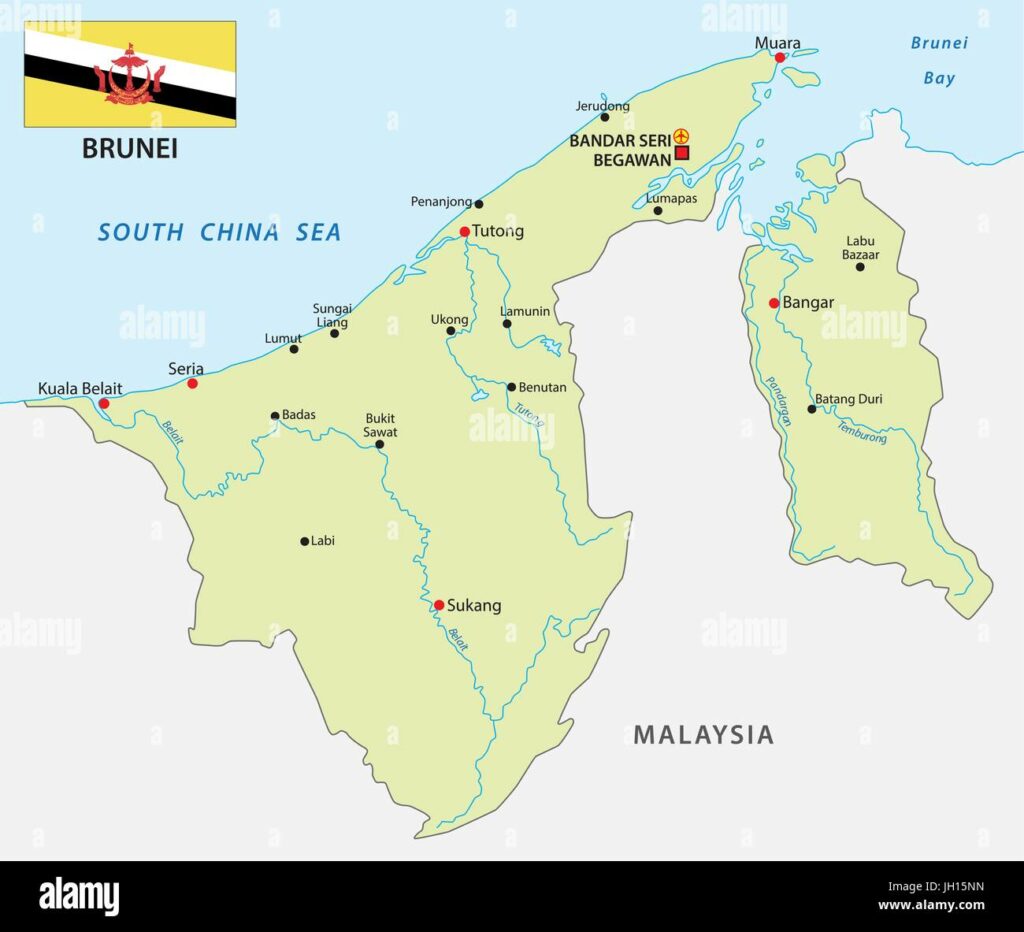
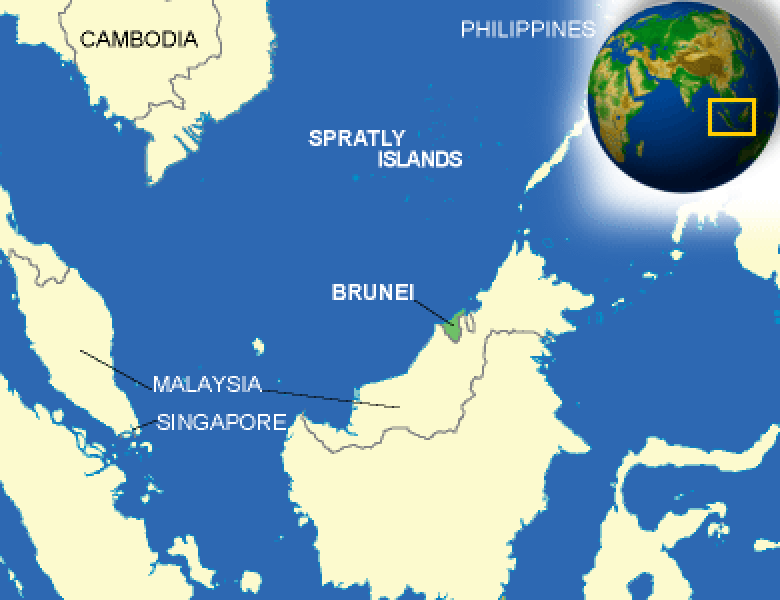
7. Brunei
- The Spanish were the first Europeans to reach Brunei, in the sixteenth century.
- The British intervened in Brunei’s affairs on several occasions, attacking in July 1846 amid an internal dispute over the rightful Sultan.
- British Residents were introduced under the Supplementary Protectorate Agreement of 1906, advising the sultan on all matters of administration; over time, the resident assumed more executive control than the sultan himself. The residential system ended in 1959. Petroleum was discovered in 1929, after several earlier fruitless attempts.
- During the Second World War, Japan invaded Brunei on 16 December 1941, eight days after Pearl Harbor.
- During the occupation, Japanese was taught in schools, government officers were required to learn the language, and the local currency was replaced.
- After the war, a new government was formed under the British Military Administration (BMA), consisting mainly of Australian officers and servicemen.
- Before 1941, the Governor of the Straits Settlements, based in Singapore, had been responsible for the duties of British High Commissioner for Brunei, Sarawak and North Borneo (now Sabah). The first dedicated British High Commissioner for Brunei was the Governor of Sarawak, Sir Charles Arden-Clarke.
- In 1959, a new constitution declared Brunei a self-governing state, while foreign affairs, security and defence remained the responsibility of the United Kingdom.
- A small rebellion against the monarchy erupted in 1962, suppressed with UK help — known as the Brunei Revolt, it contributed to the failure to form a North Borneo Federation, and partly influenced Brunei’s decision to opt out of the Malaysian Federation.
- Brunei gained its independence from the United Kingdom on 1 January 1984.
8. Hong Kong
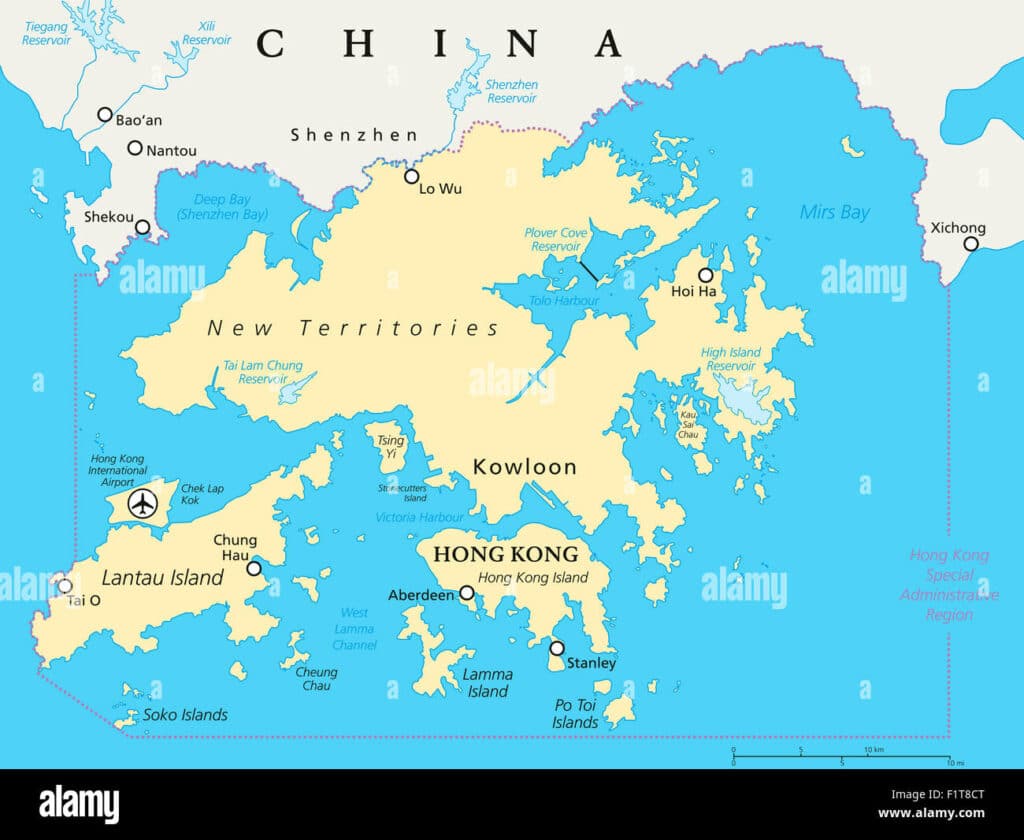
- In 1839, the refusal of Qing-dynasty authorities to permit opium imports triggered the First Opium War between Britain and China. China’s defeat led to the occupation of Hong Kong Island by British forces on 20 January 1841, initially ceded under the Convention of Chuenpee — an agreement never ratified, owing to a dispute between senior officials of both countries.
- On 29 August 1842, Hong Kong Island was formally ceded in perpetuity to the United Kingdom under the Treaty of Nanking. The British officially established a Crown colony and founded the City of Victoria the following year.
- Addition of Kowloon (1860). Further conflict over the opium trade escalated into the Second Opium War. The Anglo-French victory expanded the Crown Colony to include the Kowloon Peninsula (south of Boundary Street) and Stonecutter’s Island, both ceded to Britain in perpetuity under the Convention of Beijing.
- The free port of Victoria City. Establishing a free port turned Hong Kong into a major entrepôt, attracting new immigrants from both China and Europe — though society remained racially segregated and polarised under British colonial policy.
- Despite the rise of a British-educated Chinese upper class by the late nineteenth century, race laws still prevented ethnic Chinese residents from acquiring houses in reserved areas. Most of Hong Kong’s Chinese population had no political representation in the colonial government, though a small number of Chinese elites, relied upon by British governors, served as communicators and mediators between the government and the local population.
- The New Territories: a 99-year lease. In 1898, Britain obtained a 99-year lease over additional territory from China, under the Convention for the Extension of Hong Kong Territory.
Post-Second World War Growth
- Hong Kong’s population recovered quickly after the war, as a wave of skilled migrants fled China’s Civil War (1945–49) for refuge in Hong Kong. When the Communists took control of mainland China in 1949, even more skilled migrants — fearing persecution — crossed the open border into Hong Kong.
- Many newcomers, especially those from major port cities such as Shanghai and Canton, established corporations and small- to medium-sized businesses, shifting their base of operations to British Hong Kong.
- By the early 1990s, Hong Kong had established itself as a global financial centre alongside London and New York, a regional logistics and freight hub, one of the Four Asian Tigers, and the world’s exemplar of laissez-faire market policy. Its skyline along Victoria Harbour earned the city its nickname, the “Pearl of the East” of the British Crown.
Transfer of Sovereignty
- Hong Kong’s territory was acquired through three separate treaties — the Treaty of Nanking (1842), the Treaty of Beijing (1860), and the Convention for the Extension of Hong Kong Territory (1898) — granting the UK control of Hong Kong Island, Kowloon (south of Boundary Street) and the New Territories (north of Boundary Street and south of the Shenzhen River, plus outlying islands), respectively.
- While Hong Kong Island and Kowloon had been ceded in perpetuity, control of the New Territories rested on a 99-year lease. On 1 July 1997, sovereignty over Hong Kong transferred from the United Kingdom to the People’s Republic of China, formally ending 156 years of British colonial governance — and, as the last Crown Colony of the United Kingdom, symbolically marking the end of the British Empire itself.
- In March 1979, Hong Kong Governor Murray MacLehose paid his first official visit to the PRC, raising the question of Hong Kong’s sovereignty directly with Deng Xiaoping.
- Amid the PRC’s growing openness and mainland economic reforms, British Prime Minister Margaret Thatcher sought Chinese agreement to a continued British presence in the territory.
- The PRC took the opposite position — it wished for the New Territories, leased until 1997, to fall under its jurisdiction, and refused to recognise the “unfair and unequal treaties” under which Hong Kong Island and Kowloon had been ceded in perpetuity.
- Sino-British Joint Declaration (1985). In this declaration, the PRC government stated it had decided to resume sovereignty over Hong Kong — including Hong Kong Island, Kowloon and the New Territories — with effect from 1 July 1997, while the UK declared it would restore Hong Kong to the PRC on the same date.
- The declaration also set out China’s basic policies for the territory. Under the “One Country, Two Systems” principle agreed between the two governments, the PRC’s socialist system would not apply in the new Hong Kong Special Administrative Region (HKSAR), and Hong Kong’s existing capitalist system and way of life would remain unchanged for 50 years. These basic policies were subsequently enshrined in the Hong Kong Basic Law, and Hong Kong became China’s first Special Administrative Region.
9. Macau
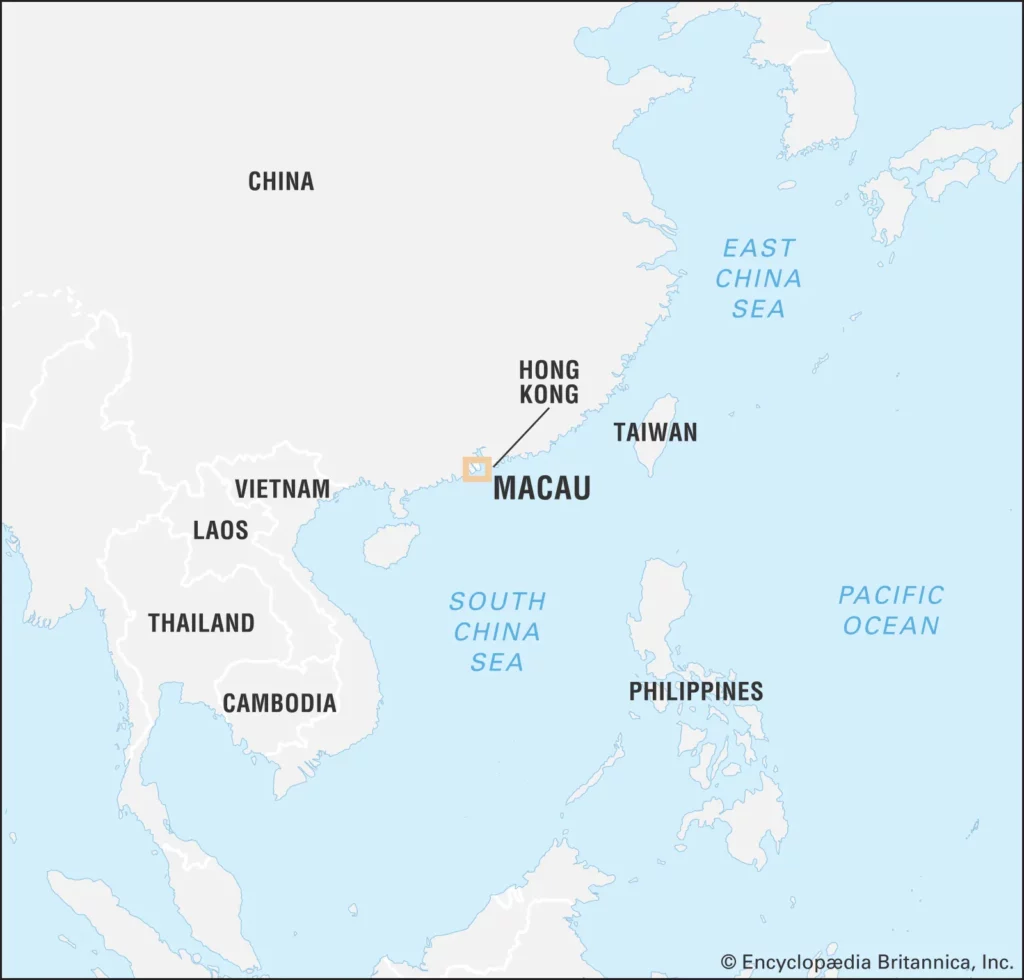
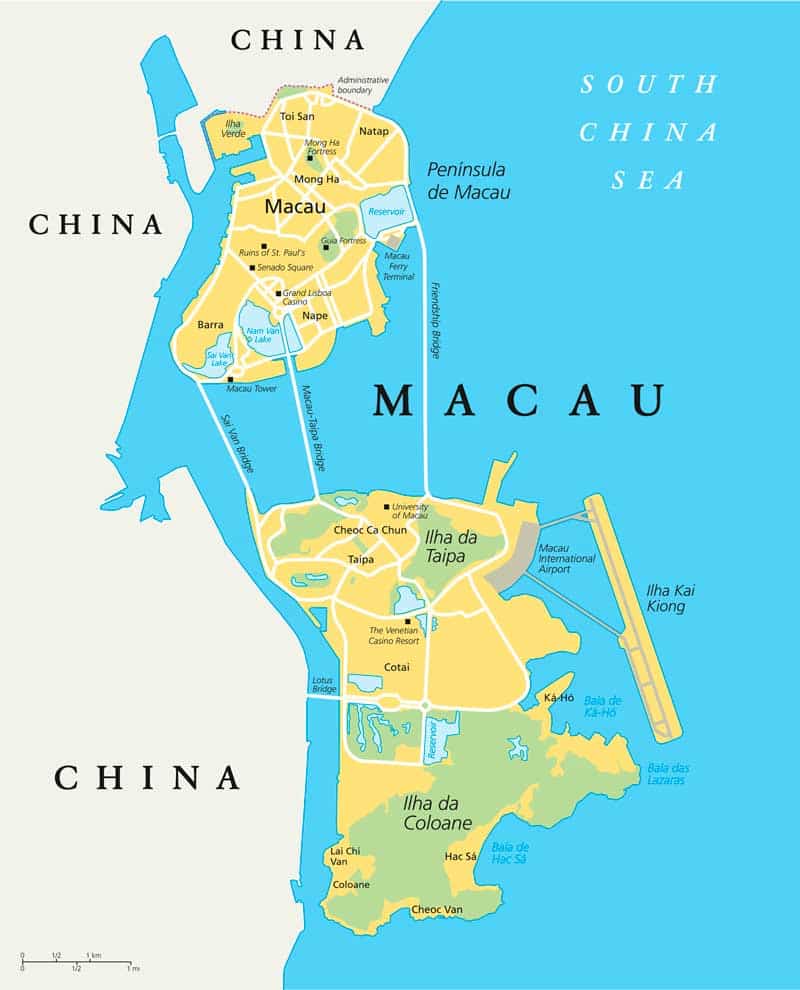
- Macau did not develop as a major settlement until the Portuguese arrived in the sixteenth century. In 1513, Jorge Álvares became the first Portuguese to land in China.
- In 1535, Portuguese traders obtained rights to anchor ships in Macau’s harbours and trade there, though not to stay onshore. Around 1552–1553, they obtained temporary permission to erect storage sheds onshore to dry goods drenched by seawater. In 1557, the Portuguese established a permanent settlement in Macau, paying an annual rent — a tribute continued until 1863.
- By 1564, Portugal commanded Western trade with India, Japan and China, though its pride was wounded by the indifference with which China treated it. In 1631, the Chinese restricted Portuguese commerce in China to the port of Macau alone.
- As more Portuguese settled in Macau to trade, they demanded self-administration — not achieved until the 1840s.
- In 1576, Pope Gregory XIII established the Roman Catholic Diocese of Macau. In 1583, the Portuguese in Macau were permitted to form a Senate to handle social and economic affairs, under strict Chinese supervision — though this involved no transfer of sovereignty.
- Macau prospered as a port but was repeatedly targeted by failed Dutch attempts at conquest during the seventeenth century.
- On 24 June 1622, the Dutch attacked in the Battle of Macau; the Portuguese repulsed them, and the Dutch never tried again. The majority of the defenders were, notably, African slaves, alongside only a handful of Portuguese soldiers and priests.
- Following the Opium War (1839–42), Portugal occupied Taipa and Coloane in 1851 and 1864, respectively.
- On 1 December 1887, the Qing and Portuguese governments signed the Sino-Portuguese Treaty of Amity and Commerce, under which China ceded the right of “perpetual occupation and government of Macau by Portugal.” In return, the Macau government would cooperate against the smuggling of Indian opium via Hong Kong, and China would benefit from increased customs revenue.
- Portugal was also obliged “never to alienate Macau without previous agreement with China,” blocking any Portuguese negotiation with France (over a possible exchange of Macau and Portuguese Guinea for the French Congo) or with other powers — thereby also securing British commercial interests. Macau officially became a territory under Portuguese administration.
- On 1 December 1887, the Qing and Portuguese governments signed the Sino-Portuguese Treaty of Amity and Commerce, under which China ceded the right of “perpetual occupation and government of Macau by Portugal.” In return, the Macau government would cooperate against the smuggling of Indian opium via Hong Kong, and China would benefit from increased customs revenue.
- In 1928, after the Qing dynasty’s overthrow in the Xinhai Revolution, the Kuomintang (KMT) government notified Portugal it was abrogating the earlier Treaty of Amity and Commerce; the two sides signed a new Sino-Portuguese Friendship and Trade Treaty, altering only tariff and business provisions while leaving Macau’s sovereignty and Portuguese administration unchanged.
- During the Second World War, unlike Portuguese Timor (occupied by Japan in 1942 alongside Dutch Timor), Japan respected Portuguese neutrality in Macau — up to a point.
- Macau enjoyed a brief period of economic prosperity as the only neutral port in South China after Japan occupied Guangzhou (Canton) and Hong Kong. By August 1943, however, Japan was demanding the installation of Japanese “advisers,” under threat of military occupation — the result being a virtual Japanese protectorate over Macau.
- Between the end of the Pacific War and the founding of the People’s Republic of China, Macau served as a safe haven for refugees from China’s civil war.
- After the PRC’s establishment in 1949, Beijing declared the Sino-Portuguese Treaty of Amity and Commerce invalid, an “unequal treaty” imposed by foreigners — though it was not yet ready to formally settle the question, choosing instead to maintain “the status quo” until a more suitable time.
- Influenced by the Cultural Revolution in mainland China and by broader dissatisfaction with Portuguese rule, riots broke out in Macau in 1966 — the most serious, the so-called 12-3 Incident, left 6 people dead and more than 200 injured.
- Shortly after the overthrow of Portugal’s dictatorship in 1974, Lisbon’s new government determined it would relinquish all its overseas possessions.
- In 1976, Lisbon redefined Macau as a “Chinese territory under Portuguese administration,” granting it substantial administrative, financial and economic autonomy. China and Portugal began negotiations on Macau’s future in June 1986, signing a Sino-Portuguese Joint Declaration the following year, designating Macau a Special Administrative Region (SAR) of China.
- The Chinese government formally assumed sovereignty over Macau on 20 December 1999. Its economy has since continued to prosper, driven by sustained tourism growth from mainland China and the construction of new casinos.
10. Thailand (Siam)
Why Was Thailand Never Colonised?
- Thailand succeeded in remaining independent partly because it served as a buffer state between French Indochina and the British Empire, and partly through the reforms and modernisation carried out by Rama IV and Rama V.
- Western influence began to be felt in Siam during Rama II’s reign. Siam undertook wide-ranging reforms — railways and telegraph lines united previously remote, semi-autonomous provinces; the currency was tied to the gold standard; and a modern system of taxation replaced the arbitrary exactions and forced labour of the past.
- In 1785, the British occupied Penang, and in 1819 founded Singapore, becoming the dominant Western economic and political influence in Siam.
- To negotiate with Britain, Siam signed the Burney Treaty, agreeing to a uniform taxation system, reduced taxes on foreign trade, and the abolition of certain royal monopolies — expanding trade, and making the kingdom wealthier and its army better equipped.
- In 1859, the French occupied Saigon and began extending influence over Vietnam and Cambodia. Rama IV, recognising French interest lay chiefly in territorial expansion, offered Britain the economic concessions it sought, hoping to secure British support in turn.
- Through the nineteenth century, Siam was the largest and strongest power in the region, its sphere of influence nearly double what it is today.
- European expansion accelerated from around the mid-century, with Britain consolidating its hold over India and moving into present-day Myanmar — a country of many ethnic states, named by the British after the first ethnic group they encountered and conquered, the Burmese.
- The French advanced from the east, having solidified control over what is now Vietnam before moving westward — leaving Siam caught between the two great powers.
- The two powers approached Siam with different strategies: England favoured the concept of “buffer states,” neutral territory maintained to keep rival powers from direct contact, while France was far less concerned with this approach.
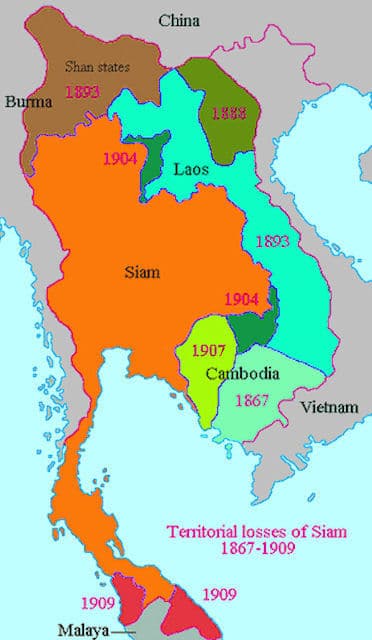
- France conquered Saigon in 1859, then turned its attention to territories owing allegiance to Siam — present-day Cambodia, Laos and the Malay Peninsula.
- In 1867, France sailed up the Mekong to Phnom Penh, whose king protested to Siam’s ruler, Rama IV, who in turn protested to Paris, to no avail. Rama IV then turned to the British for support, who refused — even though Britain was, at the time, Siam’s strongest ally.
- By 1890, France was determined to take over all of Siam, beginning with the lands east of the Mekong and west of Vietnam, aiming eventually to seize the Lao-speaking areas of the North-East (today’s Isaan) and progressively weaken Siam.
- In 1893, France pushed into the jungles of present-day Laos; the Siamese, recognising France’s intent, attacked first. France counter-attacked and demanded Siam cede all territory east of the Mekong.
- Rama V, having succeeded his father, again appealed to Britain for help and was again refused — Britain, in fact, welcomed France’s territorial gains in Siam under a new concept known as the “Doctrine of Compensatory Advantage“: France would be allowed to take eastern Siam in exchange for Britain’s free hand in the remaining Burmese territories.
- With France in Laos and Cambodia, and Britain in Burma, the British had achieved a regional balance they were content with, using Siam as a buffer state. Britain accordingly urged Rama V to give in to French demands, but the King initially refused — a difficult position to hold against a far mightier force.
- France, to force the issue, sent gunboats to Paknam, at the mouth of the Chao Phraya River near Bangkok. Britain warned the King that continued refusal risked “the complete extinction of the Siamese national existence.”
- Faced with Britain’s refusal to support him, Rama V eventually conceded, ceding further territory to France.
- The stage was now set for France to consider absorbing all of Siam. In 1896, British and French foreign ministers met in Paris, with France seeking the Korat Plateau (today’s Isaan).
- In formal talks, France proposed dividing Siam along the Chao Phraya River, with France taking everything to the east, and Britain everything to the west, including the peninsular lands down to modern Malaysia — linking British Burma to the Straits Settlements. Under this plan, all of Isaan and Pattaya would have gone to France, and Phuket to Britain.
- Britain rejected this, preferring to preserve the buffer state, prompting a second French proposal similar to the first, but leaving the Chao Phraya River Valley independent.
- Excluded from these meetings, Siam’s ambassador to Europe conducted back-channel lobbying with Britain directly, arguing the entire country should serve as a buffer zone — a position Britain ultimately accepted. Lord Curzon, then Viceroy of India, wrote of the French: “we particularly desire to avoid them as neighbours.”
- In 1896, Britain and France signed a treaty pledging to support Siam’s independence against any third party — a hedge against Russian and German interest in the kingdom.
- This marked a major diplomatic triumph for Siam, which managed to preserve its independence despite French designs on the country. Though Siam ceded some territory it had previously controlled, it retained its freedom, the bulk of its land, and virtually all territory inhabited by Thai-speakers — the lands it gave up being mostly Khmer, Malay or Lao.
- Naturally, the two signatories could not entirely restrain themselves. In 1907, France annexed further territory for Cambodia (specifically Battambang and Siem Reap), and two years later, Britain claimed additional land for Malaysia, fixing the modern Thailand-Malaysia border.
- Siam thus joined a select group of historical buffer states:
- Thailand — buffer between French Indochina and the British Empire.
- Nepal — buffer between the Qing Empire and British India.
- Mongolia — buffer between the Soviet Union and China.