

Emergence of Two Power Blocs: The World After World War II

The emergence of two power blocs after 1945 and the onset of the Cold War form a core theme of World History in the UPSC History Optional syllabus, explaining how the wartime alliance between the USSR, the USA, and Britain collapsed into decades of ideological rivalry. This article traces the breakdown of Allied harmony, the formation of the Western and Eastern blocs, the key conferences and doctrines that shaped the early Cold War, and the long-running historiographical debate over who was responsible for it.
Background: The Breakdown of Wartime Harmony
- Towards the end of the war, the harmony that had existed between the USSR, the USA, and the British Empire began to wear thin, and all the old suspicions came to the fore again.
- Relations between Soviet Russia and the West became so difficult that, although no actual fighting took place directly between the two opposing camps, the decade after 1945 saw the first phase of what became known as the Cold War. This continued, despite several ‘thaws’, until the collapse of communism in eastern Europe in 1989–91.
- Instead of allowing their mutual hostility to express itself in open fighting, the rival powers attacked each other with propaganda, economic measures, and a general policy of non-cooperation.
- Both superpowers, the USA and the USSR, gathered allies around them.
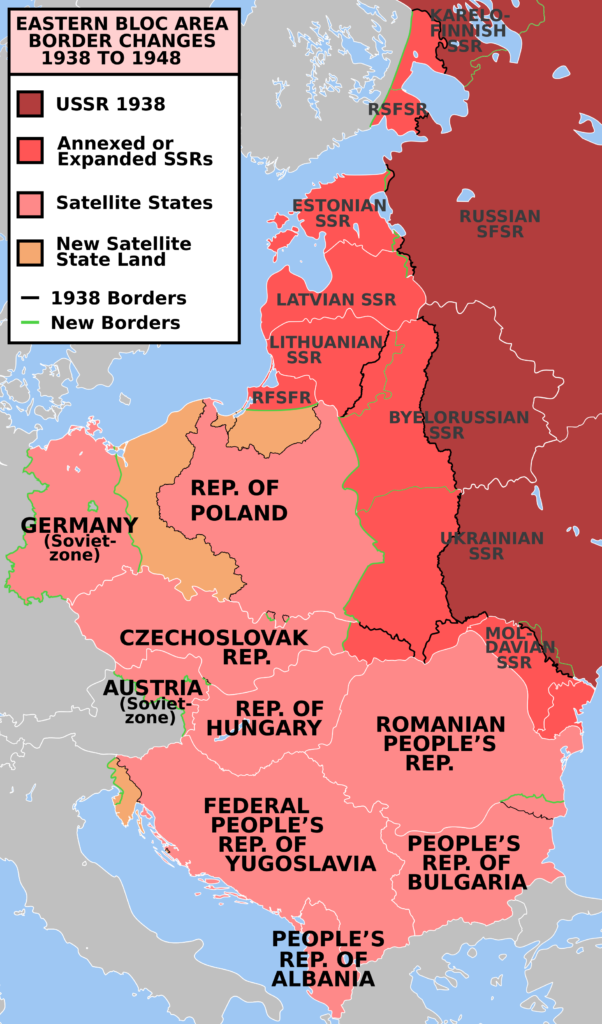
- Between 1945 and 1948, the USSR drew into its orbit most of the states of eastern Europe, as communist governments came to power in Poland, Hungary, Romania, Bulgaria, Yugoslavia, Albania, Czechoslovakia, and East Germany (1949).
- A communist government was also established in North Korea (1948), and the Communist bloc seemed further strengthened in 1949 when Mao Zedong was at last victorious in the long-drawn-out Chinese civil war.
- On the other side, the USA hastened the recovery of Japan and fostered her as an ally, and worked closely with Britain and 14 other European countries, as well as with Turkey, providing them with vast economic aid to build up an anti-communist bloc.
- Whatever one bloc suggested or did was viewed by the other as having ulterior and aggressive motives.
- There was a long wrangle, for example, over where the frontier between Poland and Germany should lie, and no permanent settlement could be agreed on for Germany and Austria.
- After the death of Stalin (1953), the new Russian leaders began speaking of ‘peaceful coexistence’ in the mid-1950s, mainly to give the USSR a much-needed break from its economic and military burdens; the icy atmosphere between the two blocs began to thaw, and in 1955 it was agreed to remove all occupying troops from Austria.
- However, relations did not improve sufficiently to allow agreement on Germany, and tensions mounted again over Vietnam and the Cuban Missile Crisis (1962).
- The Cold War moved into a new phase in the later 1960s as both sides took initiatives to reduce tensions, a period known as detente, which brought a marked improvement in international relations, including the signing of the Strategic Arms Limitation Treaty (SALT) in 1972.
- Detente did not end superpower rivalry, however, and the Soviet invasion of Afghanistan in 1979 heightened international tensions once more. The Cold War finally came to an end in 1989–91 with the collapse of the Soviet Union.
Introduction to the Cold War
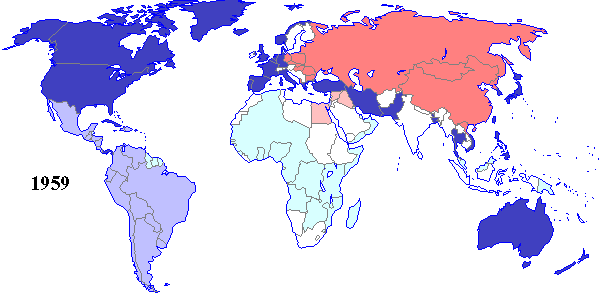
- The Cold War was a state of political and military tension after World War II between powers in the Western Bloc (the United States, its NATO allies, and others) and powers in the Eastern Bloc (the Soviet Union and its allies in the Warsaw Pact).
- Historians have not fully agreed on the exact dates, but 1947–1991 is the commonly used range.
- It was termed “cold” because there was no large-scale fighting directly between the two sides, although there were major regional wars in Korea, Vietnam, and Afghanistan that the two sides supported.
- The Cold War split the temporary wartime alliance against Nazi Germany, leaving the USSR and the US as two superpowers with profound economic and political differences — the former a single-party Marxist-Leninist state, the latter a capitalist state with generally free elections.
- The two superpowers never engaged directly in full-scale armed combat, but each armed heavily in preparation for a possible all-out nuclear world war.
- Each side possessed a nuclear deterrent capable of deterring an attack by the other, on the basis that such an attack would lead to the total destruction of the attacker — the doctrine of mutually assured destruction (MAD).
- Aside from the development of nuclear arsenals and the deployment of conventional military forces, the struggle for dominance was expressed through proxy wars around the globe, psychological warfare, propaganda, espionage, and technological competitions such as the Space Race.
Origins of the Term
- The first use of the term to describe the specific post-war geopolitical confrontation between the USSR and the United States came in a speech by Bernard Baruch, an influential advisor to Democratic presidents.
- Newspaper columnist Walter Lippmann gave the term wide currency through his book The Cold War; when asked in 1947 about its source, Lippmann traced it to a French term from the 1930s.
- A self-proclaimed neutral bloc arose in the form of the Non-Aligned Movement, founded by Egypt, India, Indonesia, and Yugoslavia, which rejected association with either the US-led West or the Soviet-led East.
Events Which Evolved into the Cold War
The Russian Revolution and Early Soviet Isolation
- As a result of the 1917 Bolshevik takeover, Soviet Russia found itself isolated in international diplomacy.
- Leader Vladimir Lenin stated that the Soviet Union was surrounded by a “hostile capitalist encirclement,” and viewed diplomacy as a weapon to keep Soviet enemies divided, beginning with the establishment of the Soviet Comintern, which called for revolutionary upheavals abroad.
- Subsequent leader Joseph Stalin, who viewed his USSR as a “socialist island,” stated that it must ensure “the present capitalist encirclement is replaced by a socialist encirclement.”
- As early as 1925, Stalin described international politics as a bipolar world in which the Soviet Union would attract countries gravitating toward socialism while capitalist countries would attract states gravitating toward capitalism, with the world then in a period of “temporary stabilization of capitalism” preceding its eventual collapse.
- Bipolarity is a distribution of power in which two states hold the majority of economic, military, and cultural influence internationally or regionally.
- Spheres of influence would often develop as a result: in the Cold War, most Western and capitalist states fell under US influence, while most Communist states fell under Soviet influence, after which the two powers would typically maneuver for the support of unclaimed areas.
Mistrust Before the Second World War
- Various events before the Second World War demonstrated mutual distrust and suspicion between the Western powers and the Soviet Union, apart from the general philosophical challenge that communism posed to capitalism.
- There was Western support for the anti-Bolshevik White movement in the Russian Civil War.
- In 1926, Soviet funding of a British general workers’ strike caused Britain to break relations with the Soviet Union.
- Other factors that deepened mutual distrust included:
- Stalin’s 1927 declaration that peaceful coexistence with capitalist countries was receding into the past;
- conspiratorial allegations during the 1928 Shakhty show trial of a planned British- and French-led coup d’état — in this trial, 53 engineers and technical specialists were accused of sabotage and treason for acts allegedly carried out since 1920, though all the evidence had in fact been fabricated by the secret police;
- American refusal to recognize the Soviet Union until 1933; and
- the Stalinist Moscow Trials of the Great Purge, which involved allegations of British, French, Japanese, and Nazi German espionage.
Suspicion During the Second World War
- The Soviet Union initially signed a non-aggression pact with Germany, but after the German Army invaded the Soviet Union in June 1941 and the Japanese bombed Pearl Harbor in December 1941, the Soviet Union and the Allied powers formed an alliance of convenience — Britain signing a formal alliance and the United States an informal agreement.
- In wartime, the United States supplied both Britain and the Soviets through its Lend-Lease Program; proposed in late 1940 and passed in March 1941, the Lend-Lease Act was the principal means of providing US military and other aid to foreign nations during World War II.
- Despite this cooperation, Stalin remained highly suspicious, believing the British and Americans had conspired to ensure the Soviets bore the brunt of the fighting against Nazi Germany.
- He suspected the Western Allies had deliberately delayed opening a second anti-German front in order to step in at the last moment and shape the peace settlement.
- These Soviet perceptions of the West left a strong undercurrent of tension and hostility between the Allied powers throughout the war.
Differences of Principle
- The basic cause of conflict lay in the differences of principle between the communist states and the capitalist or liberal-democratic states.
- The communist system of organizing state and society was based on the ideas of Karl Marx, who believed a country’s wealth should be collectively owned and shared by everybody, its economy centrally planned, and the interests and well-being of the working classes safeguarded by state social policies.
- The capitalist system, by contrast, operates on the basis of private ownership of a country’s wealth, driven by private enterprise in pursuit of profit and the preservation of the power of private wealth.
- Ever since the world’s first communist government was set up in Russia in 1917, the governments of most capitalist states viewed it with mistrust and feared communism spreading to their own countries, since this would mean the end of private ownership of wealth and the loss of political power by the wealthy classes.
- When civil war broke out in Russia in 1918, several capitalist states — the USA, Britain, France, and Japan — sent troops to Russia to help the anti-communist forces.
- The communists won the war, but Joseph Stalin, who became Russian leader in 1929, was convinced there would be another attempt by the capitalist powers to destroy communism in Russia — a belief the German invasion of Russia in 1941 appeared to confirm.
- The need for self-preservation against Germany and Japan caused the USSR, the USA, and Britain to set aside their differences and work together, but as soon as Germany’s defeat became only a matter of time, both sides — and especially Stalin — began planning for the postwar period.
Stalin’s Foreign Policies and Growing Tensions
- Stalin’s aim was to take advantage of the military situation to strengthen Russian influence in Europe.
- As the Nazi armies collapsed, he tried to occupy as much German territory as possible, and to acquire as much land as he could get away with from countries such as Finland, Poland, and Romania.
- He was highly successful in this, but the West grew alarmed at what it took to be Soviet aggression, believing Stalin was committed to spreading communism over as much of the globe as possible.
US and British Hostility Toward the Soviet Government
- During the war, the USA under President Roosevelt sent war materials of all kinds to Russia under the ‘Lend-Lease’ system, and Roosevelt himself was inclined to trust Stalin.
- After Roosevelt died in April 1945, his successor Harry S. Truman proved more suspicious and toughened his attitude towards the communists.
- Some historians believe Truman’s main motive for dropping the atomic bombs on Japan was not simply to defeat Japan — which was ready to surrender anyway — but to show Stalin what might happen to Russia if he dared go too far.
- Stalin, for his part, suspected the USA and Britain were still keen to destroy communism.
- He felt their delay in launching the invasion of France — the Second Front, which did not take place until June 1944 — was deliberately calculated to keep most of the pressure on the Russians and exhaust them.
- Nor did the Western Allies tell Stalin about the existence of the atomic bomb until shortly before its use on Japan, and they rejected his request that Russia share in the occupation of Japan.
- Above all, the West possessed the atomic bomb, and the USSR did not.
Who Was to Blame? The Historiographical Debate
- During the 1950s, most Western historians blamed Stalin.
- This orthodox view, associated with figures such as George Kennan, argued that Stalin’s motives were sinister and that he intended to spread communism as widely as possible through Europe and Asia, thereby destroying capitalism.
- Kennan advised a policy of ‘containment’ of the USSR by political, economic, and diplomatic means; the formation of NATO and American entry into the Korean War (1950) were seen as the West’s self-defence against communist aggression.
- On the other hand, Soviet historians — and, during the 1960s and early 1970s, some American historians — argued that the Cold War ought not to be blamed on Stalin and the Russians.
- Their theory was that Russia had suffered enormous losses during the war, and it was therefore only to be expected that Stalin would try to ensure neighbouring states were friendly, given Russia’s weakness in 1945.
- They believed Stalin’s motives were purely defensive and that there was no real threat to the West from the USSR; some Americans argued the USA should have been more understanding and should not have challenged the idea of a Soviet ‘sphere of influence’ in eastern Europe, and that the actions of American politicians, especially Truman, had provoked Russian hostility unnecessarily.
- This came to be known among historians as the revisionist view, which held that the Cold War was mainly caused by the USA’s determination to make the most of its atomic monopoly and industrial strength in its drive for world hegemony.
- This new view gained ground because, during the late 1960s, many people in the USA became critical of American foreign policy, especially American involvement in the Vietnam War, prompting some historians to reconsider the American attitude towards communism in general and to take a more sympathetic view of the difficulties Stalin had faced at the end of the war.
- A third view — known as the post-revisionist interpretation — was later put forward by some American historians and became popular in the 1980s.
- Benefiting from access to new documents and archives not previously available, these historians concluded the situation at the end of the war was far more complicated than earlier scholars had realized, leading them to take a middle view in which both sides bore some blame for the Cold War.
- They believed American economic policies such as Marshall Aid were deliberately designed to increase US political influence in Europe; at the same time, they held that although Stalin had no long-term plan to spread communism, he was an opportunist who took advantage of any weakness in the West to expand Soviet influence.
- The crude Soviet methods used to force communist governments on the states of eastern Europe, in this view, were bound to lend credibility to claims that Stalin’s aims were expansionist.
- With their entrenched positions and deep mutual suspicion, the USA and the USSR created an atmosphere in which every international act could be interpreted in two ways: what one side claimed as necessary for self-defence, the other took as evidence of aggressive intent.
- Open war was nonetheless avoided, since the Americans were reluctant to use the atomic bomb again unless attacked directly, while the Russians dared not risk provoking such an attack.
The Situation at the End of World War II (1945–47)
- The Allies disagreed about how the European map should look and how borders would be drawn following the war, each side holding dissimilar ideas regarding the establishment and maintenance of post-war security.
- The Western Allies desired a security system in which democratic governments were established as widely as possible, allowing countries to resolve differences peacefully through international organizations.
- Given Russia’s historical experience of frequent invasions, and the immense death toll — estimated at 27 million — and destruction the Soviet Union sustained during World War II, the USSR instead sought security by dominating the internal affairs of the countries bordering it.
- During the war, Stalin had created special training centers for Communists from different countries so they could set up secret police forces loyal to Moscow as soon as the Red Army took control.
- Soviet agents took control of the media, especially radio, and quickly harassed and then banned all independent civic institutions, from youth groups to schools, churches, and rival political parties.
- Stalin also sought continued peace with Britain and the United States, hoping to focus on internal reconstruction and economic growth.
- The Western Allies were themselves divided in their vision of the new post-war world.
- Roosevelt’s goals — military victory in both Europe and Asia, the achievement of global American economic supremacy over the British Empire, and the creation of a world peace organization — were more global than Churchill’s, which centred mainly on securing control over the Mediterranean, ensuring the survival of the British Empire, and the independence of Central and Eastern European countries as a buffer between the Soviets and the United Kingdom.
- In the American view, Stalin seemed a potential ally in accomplishing these goals, whereas in the British approach he appeared as the greatest threat to their agenda; with the Soviets already occupying most of Central and Eastern Europe, Stalin held the advantage, and the two Western leaders vied for his favour.
- These differences between Roosevelt and Churchill led to several separate deals with the Soviets: in October 1944, Churchill travelled to Moscow and agreed to divide the Balkans into respective spheres of influence, while at Yalta, Roosevelt signed a separate deal with Stalin regarding Asia and refused to support Churchill on the issues of Poland and reparations.
- Allied negotiations on the post-war balance of power took place at the Yalta Conference in February 1945, though even this conference failed to reach a firm consensus on the framework for a post-war settlement in Europe.
Development of the Cold War, 1945–1953
Yalta Conference (4–11 February 1945)
- The Yalta Conference was a major World War II conference of the three chief Allied leaders — US President Franklin D. Roosevelt, British Prime Minister Winston Churchill, and Soviet Premier Joseph Stalin — who met at Yalta in Crimea to plan the final defeat and occupation of Nazi Germany.
- At the time, the conference seemed a success, with agreement reached on several points:
- a new organization, the United Nations, was to be set up to replace the failed League of Nations, its charter already drafted, with the conferees working out a compromise formula for voting in the Security Council;
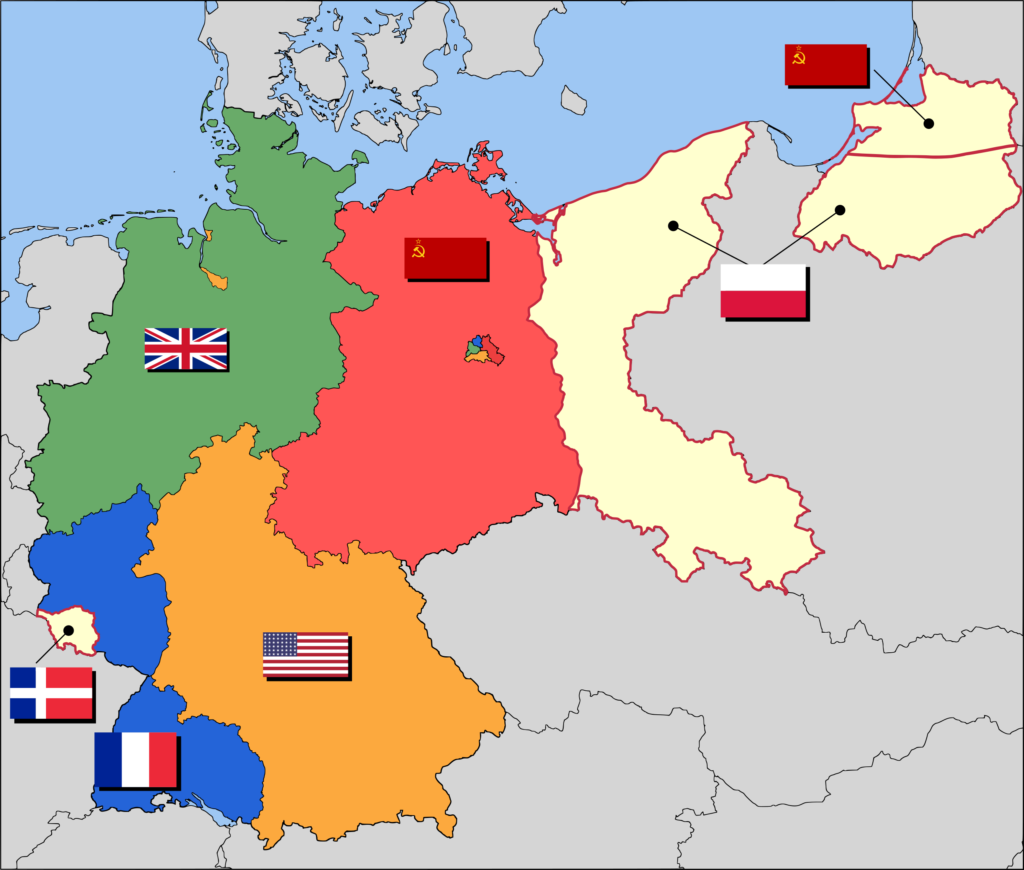
- Germany was to be divided into zones — Russian, American, and British, with a French zone added later — while Berlin, located in the middle of the Russian zone, would also be split into corresponding zones; similar arrangements were to be made for Austria;
- German military industry would be abolished or confiscated, and major war criminals tried before an international court, which subsequently sat at Nuremberg;
- the determination of reparations was assigned to a commission;
- free elections would be allowed in the states of eastern Europe; and
- Stalin promised to join the war against Japan on condition that Russia received the whole of Sakhalin Island and some territory in Manchuria.
- However, there were ominous signs of trouble over Poland.
- As the Russian armies swept through Poland driving the Germans back, they had set up a communist government in Lublin, even though a Polish government-in-exile already existed in London.
- It was agreed at Yalta that some non-communist members of the London-based government should be allowed to join the Lublin government, while in return Russia would keep a strip of eastern Poland it had annexed in 1939.
- Roosevelt and Churchill were unhappy about Stalin’s demand that Poland be given all German territory east of the rivers Oder and Neisse, and no agreement was reached on this point.
- At the time, the conference seemed a success, with agreement reached on several points:
- After the Yalta agreements were made public in 1946, they were harshly criticized in the United States, since Stalin failed to keep his promise that free elections would be held in Poland, Czechoslovakia, Hungary, Romania, and Bulgaria — instead, communist governments were established in all these countries, non-communist parties were suppressed, and genuinely democratic elections never held.
- At the time of the conference, both Roosevelt and Churchill had trusted Stalin and believed he would keep his word, never suspecting he intended for all the popular front governments of Europe to be taken over by communists.
- They were further inclined to accept the Yalta agreements because they mistakenly assumed Soviet assistance would be sorely needed to defeat the Japanese in the Pacific and Manchuria; and since the Soviet Union was already the military occupier of eastern Europe at the war’s end, there was in any case little the Western democracies could do to enforce Stalin’s promises.
- American delegation member James F. Byrnes, soon to be Secretary of State (1945–47), summed this up aptly: “It was not a question of what we would let the Russians do, but what we could get the Russians to do.”
- In April 1945, President Roosevelt died and was succeeded by Harry S. Truman, who distrusted Stalin and turned for advice to an elite group of foreign policy intellectuals; both Truman and Churchill opposed, among other things, the Soviets’ decision to prop up the Lublin government.
- Following the Allies’ victory in May 1945, the Soviets effectively occupied Central and Eastern Europe while strong US and Western Allied forces remained in Western Europe. In occupied Germany, the Soviet Union, United States, Britain, and France established zones of occupation and a loose framework for parcelled four-power control.
- The 1945 Allied conference in San Francisco established the multi-national United Nations for the maintenance of world peace, but the enforcement capacity of its Security Council was effectively paralysed by individual members’ power of veto, converting the UN into an essentially inactive forum.
The Potsdam Conference (July 1945)
- The atmosphere at Potsdam was distinctly cooler than at Yalta. The leaders at the start of the conference were Stalin, Truman (replacing Roosevelt), and Churchill, though Churchill was replaced partway through by Clement Attlee, the new British Labour Prime Minister, following Labour’s election victory.
- The war with Germany was over, but no agreement was reached about her long-term future; the big question was whether, or when, the four occupation zones would be allowed to reunite into a single country.
- Germany was to be disarmed, the Nazi party disbanded, and its leaders tried as war criminals.
- It was agreed that Germany should pay reparations for war damage, with most going to the USSR, which would be permitted to take non-food goods from its own zone and from the other zones as well, provided the Russians sent food supplies to the western zones of Germany in return.
- It was over Poland that the main disagreement occurred: Truman and Churchill were angered that Germany east of the Oder-Neisse Line had been occupied by Russian troops and was being run by the pro-communist Polish government, which had expelled some five million Germans from the area — an arrangement that had not been agreed at Yalta.
- Truman did not inform Stalin about the exact nature of the atomic bomb, though Churchill was told about it.
- A few days after the conference closed, the two atomic bombs were dropped on Japan, and the war ended quickly on 10 August without the need for Russian help, though the Russians had declared war on Japan on 8 August and invaded Manchuria; they annexed south Sakhalin as agreed at Yalta, but were allowed no part in the occupation of Japan.
The Nuclear and Hydrogen Bomb
- The first nuclear weapon was created by the United States during the Second World War; Soviet scientists were aware of the potential of nuclear weapons and had also been conducting their own research in the field.
- The Soviet Union was not officially informed of the Manhattan Project — the US government research project (1942–45) that produced the first atomic bombs — until Stalin was briefed at the Potsdam Conference on 24 July 1945 by President Truman, eight days after the first successful test of a nuclear weapon.
- Despite their wartime military alliance, the United States and Britain had not trusted the Soviets enough to share knowledge of the Manhattan Project, partly to keep it safe from German spies and partly from concern that the Soviet Union, as an ally, would request and expect technical details of the new weapon.
- When Truman informed Stalin of the weapon, he was surprised at how calmly Stalin reacted, and assumed Stalin had not understood what he had been told.
- In fact, Stalin had long been aware of the programme: a ring of spies operating within the Manhattan Project had kept him well informed of American progress, providing the Soviets with detailed designs of both the implosion bomb and the hydrogen bomb.
- The first Soviet atomic bomb was detonated on 29 August 1949, after which both governments spent massive sums to increase the quality and quantity of their nuclear arsenals.
- Both nations quickly began developing a hydrogen bomb: the United States detonated the first hydrogen bomb on 1 November 1952, and the Soviets surprised the world by exploding a thermonuclear device in August 1953.
Differences Between Yalta and Potsdam
- There were huge differences between Yalta and Potsdam — the underlying issues were largely the same, but the goodwill needed to overcome them was gone, since the Allies no longer needed to stick together once the common enemy was defeated.
- Leaders present: Yalta was attended by Churchill, Roosevelt, and Stalin; Potsdam by Attlee, Truman, and Stalin.
- Germany’s zones: Yalta agreed Germany would be split into four zones; at Potsdam, arguments broke out over the details of the boundaries between them.
- Reparations: Yalta simply agreed that Germany would pay reparations; at Potsdam, disagreements emerged over the amount Russia wanted to take. It was agreed Russia could take whatever it wanted from the Soviet zone, plus 10 per cent of the industrial equipment of the western zones, though Britain and the US considered this too much.
- Poland’s government: Yalta called for a government of ‘national unity’ in Poland comprising both communists and non-communists; at Potsdam, Truman was angry because Stalin had arrested Poland’s non-communist leaders.
- Free elections: Yalta’s promise of free elections in eastern Europe was formalised as the Declaration of Liberated Europe; at Potsdam, America and Britain were alarmed that communists were instead coming to power across Eastern Europe.
- Japan: Yalta secured Russia’s promise to help against Japan once Germany was defeated; at Potsdam, Truman instead dropped the atomic bomb so Japan would surrender before Russian troops could enter the country — America had possessed the bomb since July 1945 but had not told Stalin of its intended use, and Stalin was furious once he realised he had been misled.
Beginnings of the Eastern Bloc
- During the opening stages of World War II, the Soviet Union laid the foundation for the Eastern Bloc by directly annexing several countries as Soviet Socialist Republics, territories initially ceded to it by Nazi Germany under the Molotov-Ribbentrop Pact (1939) — named after the Soviet and German foreign ministers.
- These included eastern Poland, Latvia, Estonia, Lithuania, part of eastern Finland, and eastern Romania.
- In the months following Potsdam, the Russians systematically interfered in the countries of eastern Europe to set up pro-communist governments, a pattern seen in Poland, Hungary, Bulgaria, Albania, and Romania.
- In some cases their opponents were imprisoned or murdered; in Hungary, for example, the Russians allowed free elections, but although the communists won less than 20 per cent of the votes, they ensured a majority of the cabinet was communist regardless.
- The Central and Eastern European territories liberated from the Nazis and occupied by Soviet forces during the war were converted into satellite states, including:
- East Germany;
- the People’s Republic of Poland;
- the People’s Republic of Bulgaria;
- the People’s Republic of Hungary;
- the Czechoslovak Socialist Republic;
- the People’s Republic of Romania; and
- the People’s Republic of Albania.
- The Soviet-style regimes that arose across the Bloc not only reproduced Soviet command economies, but also adopted the brutal methods employed by Stalin and the Soviet secret police to suppress opposition.
- In Asia, the Red Army had overrun Manchuria in the last month of the war, and went on to occupy the large swathe of Korean territory north of the 38th parallel.
- British Prime Minister Winston Churchill was concerned that, given the enormous size of Soviet forces deployed in Europe at the war’s end, and the perception that Stalin was unreliable, a genuine Soviet threat to Western Europe existed.
- The Eastern Bloc was the name used by NATO-affiliated countries for the former communist states of Central and Eastern Europe — broadly, the Soviet Union and the countries of the Warsaw Pact.
The ‘Long Telegram’ and the ‘Iron Curtain’ Speech
George Kennan’s ‘Long Telegram’
- In February 1946, George Kennan, the American chargé d’affaires in Moscow, sent an 8,000-word telegram to the US Department of State detailing his views on the Soviet Union and recommending US policy toward the communist state.
- The telegram helped articulate the US government’s increasingly hard line against the Soviets and became the basis for US strategy toward the Soviet Union for the duration of the Cold War, providing one of the most influential underpinnings for America’s policy of containment.
- Stalin, for his part, frightened the West further with a widely reported speech in February 1946, in which he declared that communism and capitalism could never live peacefully together, and that future wars were inevitable until the final victory of communism was achieved.
- Russian historians, however, have claimed that this speech was reported in the West in a misleading and biased way, particularly by George Kennan himself.
Churchill’s ‘Iron Curtain’ Speech
- Churchill responded to these developments in his famous ‘Iron Curtain’ speech at Fulton, Missouri, in March 1946, repeating a phrase he had used earlier: “From Stettin in the Baltic to Trieste in the Adriatic, an iron curtain has descended across the continent.”
- Claiming the Russians were bent on “indefinite expansion of their power and doctrines,” he called for a Western alliance that would stand firm against the communist threat.
- The Iron Curtain came to symbolize the ideological conflict and physical boundary dividing Europe into two separate areas from the end of World War II in 1945 until the end of the Cold War in 1991, representing Soviet efforts to block itself and its satellite states from open contact with the West and other non-Soviet-controlled areas.
- The speech drew a sharp response from Stalin, who revealed his own fears about Germany and the need to strengthen Soviet security; the rift between East and West widened steadily, and Stalin was able to denounce Churchill as a ‘warmonger’.
- Not everybody in the West agreed with Churchill, however — over a hundred British Labour MPs signed a motion criticizing the Conservative leader for his stance.
The Novikov Telegram
- In September 1946, the Soviet side produced its own response in the form of the Novikov telegram, sent by the Soviet ambassador to the US, which portrayed the United States as being in the grip of monopoly capitalists building up military capability “to prepare the conditions for winning world supremacy in a new war.”
The Morgenthau Plan and Byrnes’s Response
- On 6 September 1946, James F. Byrnes delivered a speech in Germany repudiating the Morgenthau Plan and warning the Soviets that the US intended to maintain a military presence in Europe indefinitely.
- The Morgenthau Plan, first proposed by US Secretary of the Treasury Henry Morgenthau, had advocated that the Allied occupation of Germany include measures to eliminate Germany’s ability to wage war by dismantling its armament industry and destroying other key industries basic to military strength.
Russia Tightens Its Grip on Eastern Europe
- By the end of 1947, every state in the region except Czechoslovakia had a fully communist government.
- Elections were rigged, non-communist members of coalition governments were expelled, many were arrested and executed, and eventually all other political parties were dissolved — all of this under the watchful eyes of secret police and Russian troops.
- Stalin also treated the Russian zone of Germany as though it were Russian territory, permitting only the Communist Party and draining the zone of vital resources.
- Only Yugoslavia did not fit this pattern: here, the communist government of Marshal Tito had been legally elected in 1945.
- Tito had won largely because of his immense prestige as leader of the anti-German resistance — it was his own forces, not the Russians, who had liberated Yugoslavia from German occupation — and he resented Stalin’s attempts to interfere in Yugoslav affairs.
- The West was profoundly irritated by Russia’s treatment of eastern Europe, which disregarded Stalin’s promise of free elections made at Yalta, though it ought not to have been entirely surprised: even Churchill had agreed with Stalin in 1944 that much of eastern Europe should fall within a Russian sphere of influence.
- Stalin could argue that friendly governments in neighbouring states were necessary for Soviet self-defence, that these states had never had genuinely democratic governments in any case, and that communism would bring much-needed progress to backward countries.
- It was ultimately Stalin’s methods of gaining control — rather than the fact of Soviet influence itself — that most upset the West, and these methods gave rise to the next major developments of the Cold War.




