

Educational Development during the Sultanate Period

The Sultanate period witnessed the coexistence of two distinct, largely parallel educational traditions in India — an Islamic education system, patronised by the Delhi Sultans and their successor kingdoms, and a Non-Islamic education system, rooted in older Hindu, Buddhist, and Jain traditions of learning. Rather than displacing indigenous knowledge systems, the establishment of the Sultanate added a new, richly endowed network of maktabs, madrasas, and khanqahs alongside the continuing institutions of pathshalas, tols, temple colleges, and viharas — with both traditions flourishing under substantial royal patronage across Delhi, the Deccan, Bengal, Gujarat, and Vijayanagara. Yet, for all this institutional vibrancy, the period’s educational achievements remained constrained by significant social limitations — most notably the near-total absence of formal provision for women’s education, and the restriction of access largely to the upper classes and castes. This article examines the subjects, institutions, and royal patrons of both the Islamic and Non-Islamic educational systems during the Sultanate period, before assessing the period’s overall limitations.
Islamic Education System
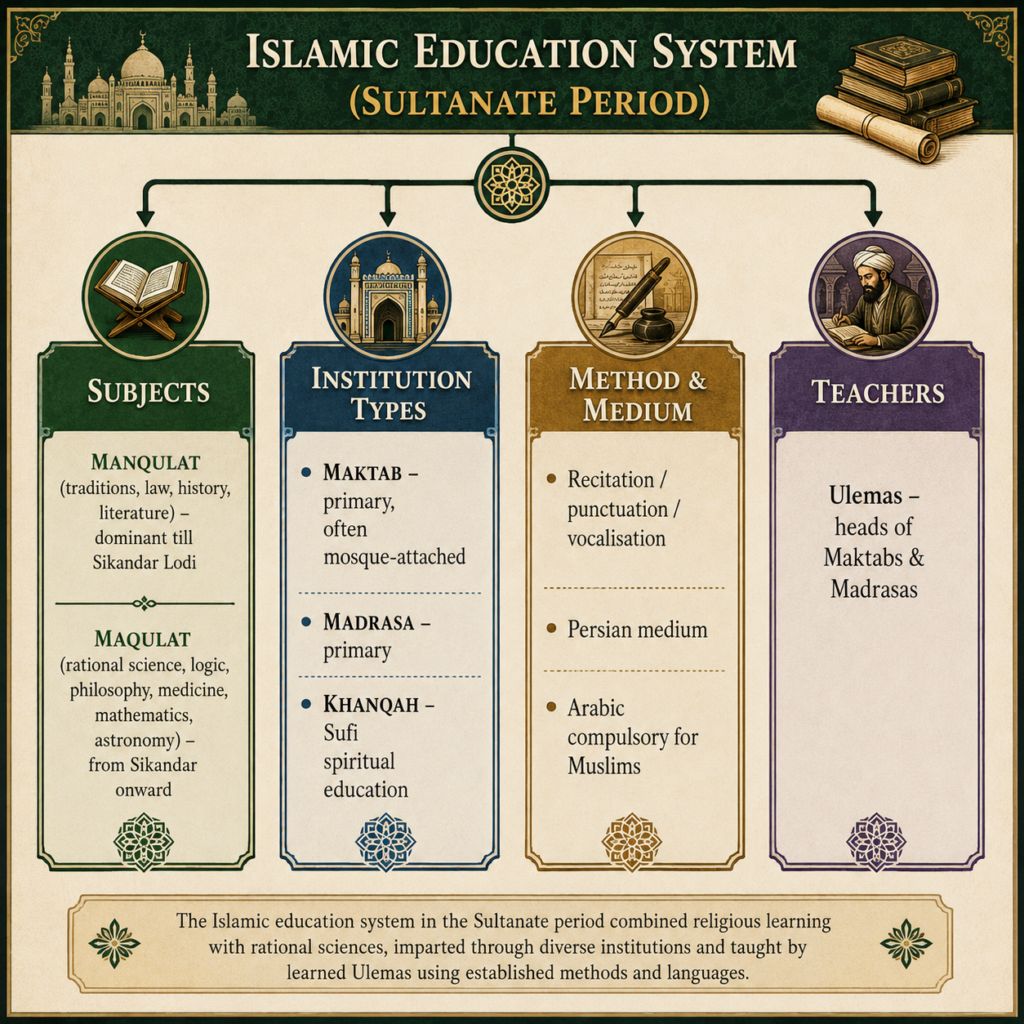
Subjects
- The Islamic education system was traditional in spirit and theological in content.
- Subjects included the Quran, Shariat, Arabic grammar, Persian grammar, and various secular subjects, such as mathematics, astronomy, and medicine.
- Traditional subjects (manqulat) dominated education from Iltutmish to Sikandar (Lodi); scientific and secular subjects (maqulat) gained prominence from Sikandar onward.
- In the madrasas and maktabs of this period, no distinction was made between religious and secular education.
- Manqulat comprised: traditions, law, history, and literature.
- Maqulat comprised: rational science, logic, philosophy, medicine, mathematics, and astronomy.
Types of Institutions
- Institutions were of several types:
- Established and maintained by rulers and nobles.
- Started by individuals, with state assistance.
- Those attached to mosques and tombs.
- Started by individual scholars.
- Those attached to a khanqah (Sufi hospice).
Method and Medium
- The method of instruction relied on recitation, punctuation, and vocalisation of texts.
- The main medium of instruction was Persian; the study of Arabic was compulsory for Muslims.
Institutions
- Maktabs:
- Institutions for primary education, often attached to mosques.
- Madrasa:
- Institutions for primary education.
- Khanqahs:
- Sufi centres that also imparted Islamic spiritual education.
Important Centres
- Important centres of Islamic education included Delhi, Lahore, Agra, Jaunpur, Lucknow, Gulbarga, Bidar, Burhanpur, etc.
Providers (Teachers)
- Mainly the Ulemas served as teachers, and also as heads of Maktabs and Madrasas.
Royal Patronage
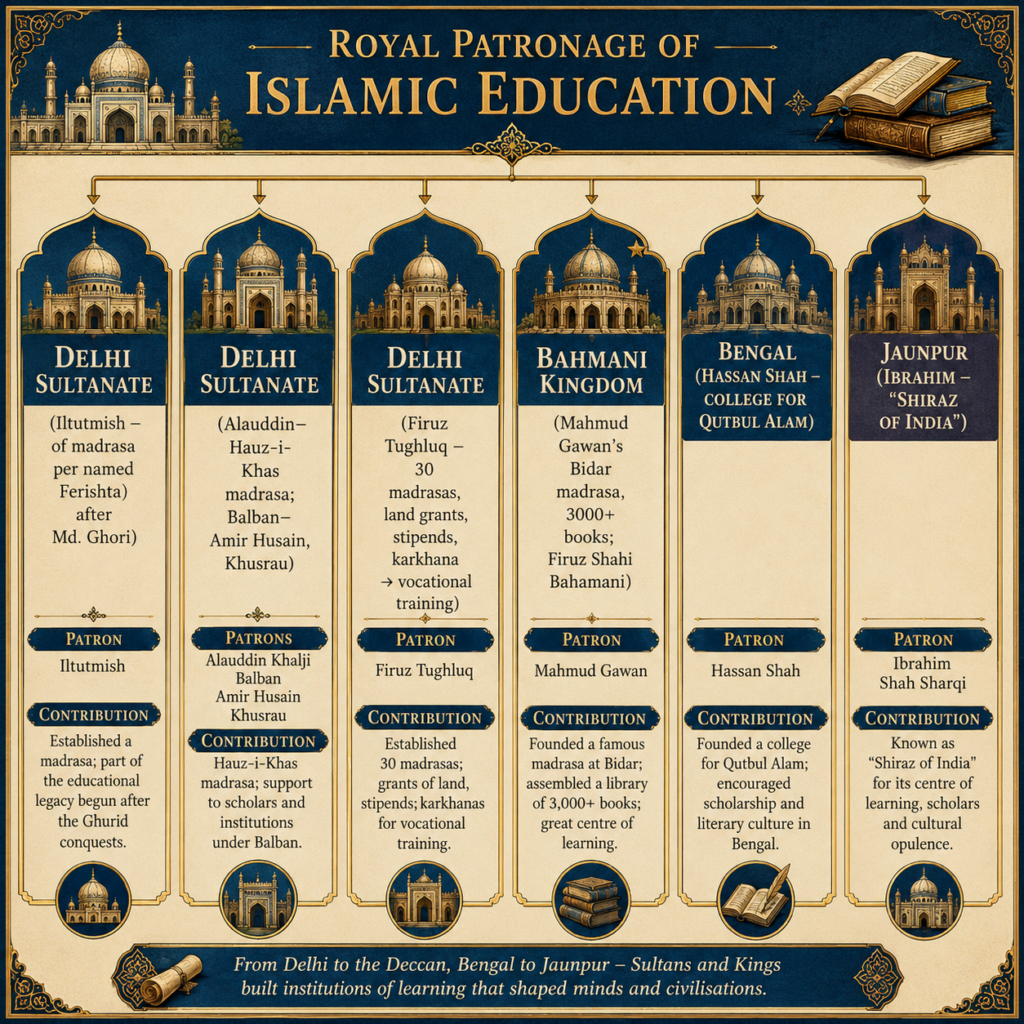
- The Muizzi, Nasiri, Firuzi, and Madrasa-i-Ferozeshahi madrasas in Delhi were among the famous madrasas built by the Delhi Sultans.
- Iltutmish:
- Set up a madrasa at Delhi, named it after Muhammad Ghori.
- Balban:
- Gave patronage to men of learning, such as Amir Husain and Amir Khusrau.
- Also encouraged jurists, physicians, astronomers, and mathematicians.
- Alauddin Khalji:
- Founded a madrasa attached to Hauz-i-Khas, and continued to patronise men of learning.
- Muhammad Bin Tughlaq:
- Established a madrasa in Delhi in 1346, attaching a mosque to it.
- Feroz Shah Tughlaq:
- A great lover of learning and patron of scholars.
- Said to have endowed 30 madrasas in different parts of his kingdom.
- Made liberal land grants for the upkeep of educational institutions, encouraged men of learning, and gave stipends to poor students to enable them to pursue their studies.
- He even converted karkhanas (workshops) into institutions of vocational training, where captives of war were taught different arts and crafts.
- The Bahmanis:
- Sultan Muhammad Shah opened educational centres, and patronised scholars.
- Mahmud Gawan (Prime Minister of the Bahmani Kingdom):
- Built a madrasa at Bidar, which became a famous centre of learning.
- The madrasa also had a large library, containing more than three thousand books.
- Firuz Shah Bahmani:
- Gave support to Islamic educational institutions.
- Patronised a large number of learned people and scholars.
- Qutb Shah of Golconda:
- Established institutions of primary and higher education.
- Bengal:
- Sultan Hassan Shah set up a college in memory of the famous saint Qutbul Alam.
- Jaunpur:
- Ibrahim played an important role in spreading science and learning among Muslims, earning the title “Shiraz of India” from Ferishta.
- Jaunpur retained its reputation as an educational centre for a long time.
Non-Islamic Education System
Subjects
- Subjects included the Vedas, Upanishads, Puranas, Sanskrit grammar, and the six systems of philosophy, etc.
- Science subjects, such as astronomy, astrology, and mathematics.
- Buddhist religious texts, and tantric Buddhist texts.
- Jaina religious texts, and Jaina logic.
Medium
- Sanskrit.
- Hindi.
- Regional languages — Prakrit in the Gujarat region, mainly for Jaina learning; Pali was used only very minimally.
Institutions
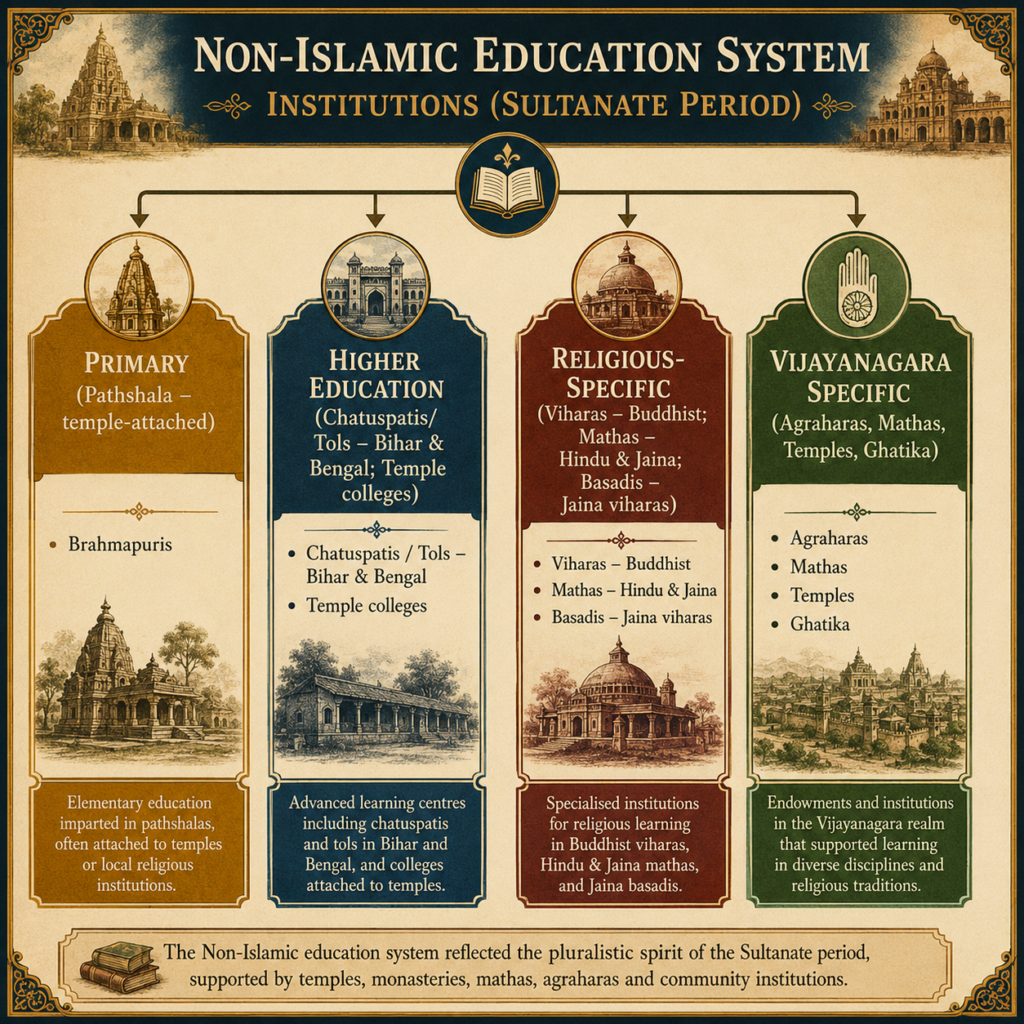
- Pathshala:
- Often attached to temples, for primary education.
- Chatuspatis or Tols:
- Higher education centres in Bihar and Bengal.
- Temple:
- Temple colleges within the temple complex.
- Viharas of the Buddhists.
- Mathas:
- Hindu and Jaina, many located within temples.
- Basadis:
- Jaina viharas.
- Institutions of higher learning in Vijayanagara: Agraharas, mathas, temples, brahmapuris, and ghatika.
Important Centres
- Places related to Tantrik Buddhism: Vikramshila, Odantpuri, Jagdalpur.
- Anhilpatan:
- Capital of the Chaulukyas of Gujarat.
- Home to the Jaina scholar Hemchandra Suri.
- Dhar:
- Capital of the Paramaras of Malwa.
- The famous Paramara king Bhoja held the title of “Kaviraj”, and established the Bhojshala at Dhar.
- Other places: Banaras, Mathura, Ayodhya, Kanchipuram, Madurai, Nadia (West Bengal), etc.
Providers (Teachers)
- Brahmins for Hindu education.
- Monks and scholars for Buddhist and Jaina education.
Royal Patronage
- Patronage was provided by dynasties such as the Palas, Paramaras, and the Solanki/Chaulukyas of Gujarat.
- Krishnadeva Raya:
- Promoted Telugu learning and literature.
- Himself wrote the famous Telugu work Amuktamalyada.
- His court included great literary figures known as the Ashtadiggajas — including Allasani Peddana, Tenali Ramakrishna, Dhurjati, and Nandi Thimmana, etc.
Limitations of Sultanate-Period Education
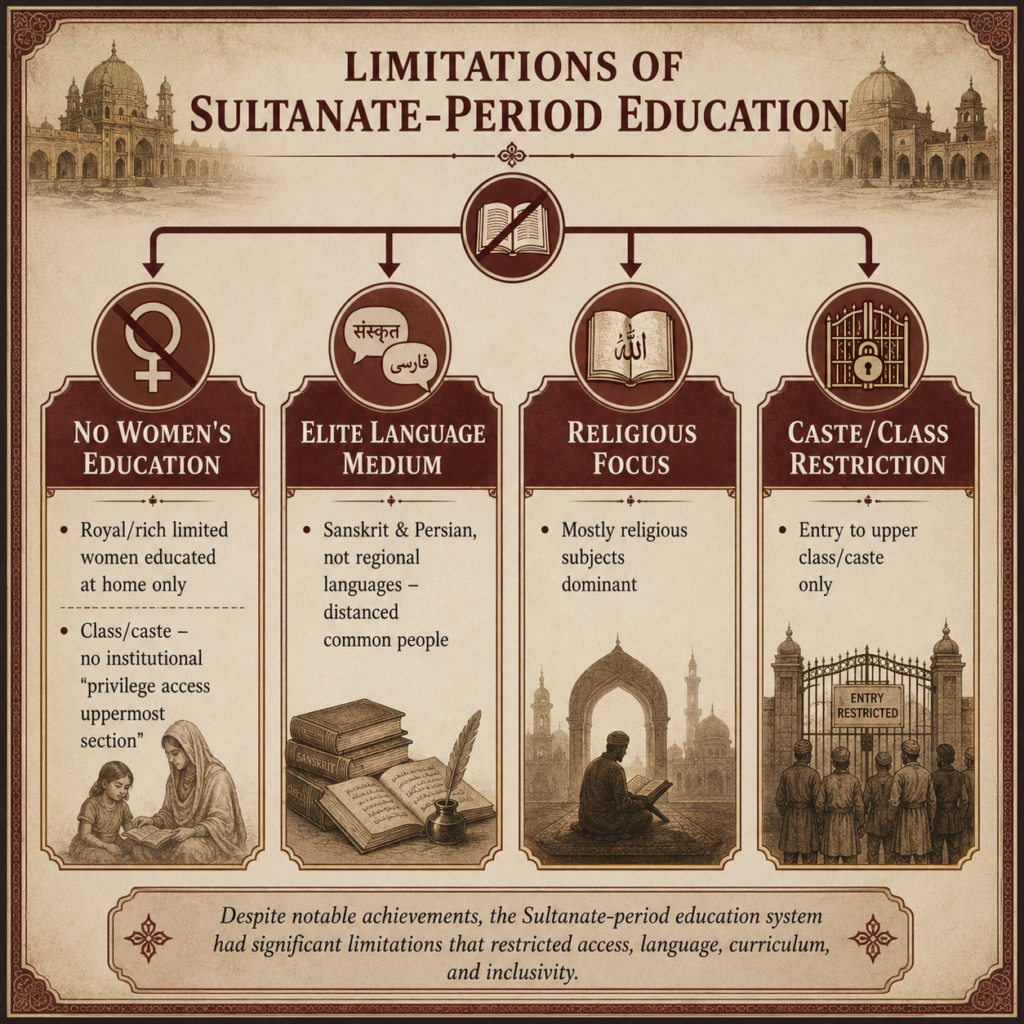
Though there was marked development in education and educational institutions during the Sultanate period, certain limitations persisted:
- There was no provision for women’s education. Royal and rich women received education at home only.
- The medium of instruction was mostly Sanskrit and Persian — i.e., there was less prevalence of regional languages — which distanced the common people from education.
- Education was mostly limited to religious subjects.
- Entry to educational institutions was opened only to the upper class and caste. Thus, education became the privilege of only the uppermost section of society.
Conclusion
The Sultanate period, spanning roughly the 13th to the early 16th century, witnessed a genuinely remarkable expansion of educational institutions across India — the Islamic system, anchored in maktabs, madrasas, and khanqahs and richly patronised by rulers from Iltutmish to Feroz Shah Tughluq and the Bahmani and Jaunpur courts, developed alongside a continuing and equally vibrant Non-Islamic system, rooted in pathshalas, tols, temple colleges, viharas, and mathas, sustained by dynasties such as the Palas, Paramaras, Chaulukyas, and the rulers of Vijayanagara. This dual educational landscape reflected the broader pluralism of Sultanate-period society, even as both systems shared certain structural limitations — a heavy reliance on classical rather than regional languages, a predominant focus on religious and traditional subjects, near-total exclusion of women from formal institutional education, and access restricted largely to the upper classes and castes. These limitations meant that, for all its institutional richness, education during the Sultanate period remained the privilege of a narrow elite, rather than a genuinely widespread social good — a pattern that would only begin to shift in subsequent centuries.




